



Exams Prep Master
LCD (Liquid Crystal Display) and LED (Light Emitting Diode) are two of the most extensively utilized display technologies today. Gallium arsenide and gallium phosphide are used in the LED, which emits visible light when heated. A tiny coating of liquid filament is present between the glass electrodes in the LCD, on the other hand. Let’s have a closer look at the topic along with a few important questions.
The distinctions between LCD and LED are vital to grasp because they are closely related, and it is easy to confuse one with the other. The acronym LCD stands for liquid crystal display, while LED stands for light-emitting diodes. LCDs and lights differ in that LCDs typically employ fluorescent lights whereas lights use light-emitting diodes.
The construction of LCD and LED screens is nearly identical, as is the technology that powers them. The different types of televisions feature two layers of polarized glass, through which the liquid crystals are blocked as well as passed the light. As a result, one of the most significant distinctions and similarities between LCD and LED is this. Numeric and alphanumeric characters are displayed using the LED. When the facility is used across the electrodes, light energy in the form of photons begins to be emitted. Within the type of matrix and segments, the LCDs the text or graphics.
| Table of Content |
Keyterms: LCD, LED, PN Junction, Television, Computer Monitor, Heat, Light, Electric Current, Gallium arsenide, Gallium phosphide, Visible light
What is LED?
[Click Here for Sample Questions]
When an electric current runs in the forward direction through a PN junction diode, it creates light. Doping the p-type and n-type materials are used to create the LED. Recombination of P-type and N-type material charges occurs when power is delivered across the LED. Heat and light are produced when charges recombine.
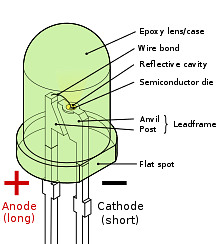
Early LEDs could only produce red light; today's LEDs can produce a variety of hues, including green, red, and blue (RGB) light. LEDs can now produce white light as well, thanks to recent advancements in LED technology. The single LED represents the decimal points, whereas the several LEDs represent the one segment. LEDs are a sort of LCD that has grown in popularity as technology has advanced. Backlight technology substitutes the fluorescent bulb, resulting in a crisper image than an LCD. When compared to LCD, LED has a broader viewing angle. In comparison to LED, LCDs have greater black levels and contrast. In comparison to LCD, LED provides greater color accuracy.
They're common in smartphones, televisions, computer monitors, and instrument panels, and they use a liquid crystal display panel to control where the light appears on your screen.
Based on their backlighting mechanisms, LEDs are classified into three groups:
- Edge-LEDs
- Dynamic RGB LEDs
- Full-array LEDs

Also Read:
What is LCD?
[Click Here for Sample Questions]
LCD (Liquid Crystal Display) is a type of display that displays text and images as a dot matrix or segments. The filaments get activated and emit visible light when the current travels between the electrodes.
A liquid crystal display (LCD) is a smooth board with an electrical visual display that works through light with liquid crystal quality. LCDs are ultra-thin displays that are used in tablet phones and level board displays. Handheld TVs, PDAs, and small computer game devices can all benefit from smaller LCDs.

The liquid crystal utilized in the display has the properties of both a solid and a liquid, making it ideal for use in displays. When no potential is applied across the liquid, it becomes transparent; nevertheless, when the crystal is activated, it scatters light in all directions and appears bright. The LCD is more energy-efficient and even features a seven-segment display. However, it is a slow device that takes longer to switch. Because dc shortens their lives, they're often used with AC at a frequency of less than 500 Hz.
Laptops, digital clocks, digital cameras, and watches all employ this technology.
LCD televisions are divided into three categories.
- Flat-screen LCDs
- Front projection LCDs
- Rear projection LCDs

Differences between LCD and LED
[Click Here for Sample Questions]
LCD stands for "liquid crystal display," and both LED and LCD televisions are liquid crystal displays in technological terms. Both television models use the same basic technology, which consists of two layers of polarized glass through which the liquid crystals block and pass light. LED televisions are, in reality, a subset of LCD televisions.
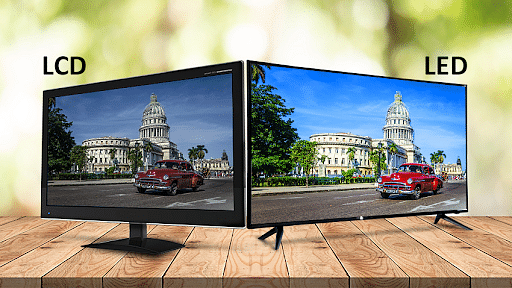
- The backlight of the LCD panel is provided by a cold cathode fluorescent lamp, whilst the light displayed by the LED is displayed by PN-junction diodes. The term "backlight" refers to the process of turning screens on and off to improve visibility.
- Black with contrast Because liquid crystals cannot stop 100% of the backlight from cold cathode lighting, the level of the LED screen is better than that of LCD panels. As a result, when a black screen is displayed on a monitor, it is not entirely black. However, as LED panels have no backlight, they flawlessly display the dark screen.
- LEDs have far higher resolution than LCDs. The number of pixels on a screen's display is known as its resolution.
- Because of the plasma, the LED consumes more energy than the LCD. Plasma filaments are utilized in LCDs, and they require less energy to activate.
- Because LEDs use a PN-junction diode, which only shows light in one direction, and LCDs display light in all directions, the display area of an LED is smaller than that of an LCD.
- LED TVs vary from standard LCD TVs in that LEDs employ light-emitting diodes rather than fluorescent lights. On an LED TV, the positioning of the lights might also alter. An LCD TV's fluorescent lights are always behind it.
- In comparison to LCD, LED has a higher price tag. LEDs employ gallium arsenide, which generates light when heated, whereas LCDs use electrified liquid crystals to produce light.
- The color accuracy of direct and edge LED displays, as well as LCDs, is nearly identical, but the color accuracy of RGB LED displays is significantly superior. Based on the way the diodes are organized in the monitor, there are three main types of LED monitors available. Direct LEDs, Edge LEDs, and RGB LEDs are the three types of LEDs that are available. White diodes are utilized to illuminate the LCD panel in both Edge and Direct LED display displays, resulting in increased image quality.
- In comparison to LCD, LEDs have a faster switching time. The active and deactivated times of their display are referred to as switching times. The LCD's lifespan is shortened by direct current, while it is unaffected by LEDs.
- Compared to LCDs, LED displays are more contemporary, iconic, and energy efficient. Using liquid crystals to rotate polarized light, the pixels in an LCD are turned on and off electronically.
- The LCD emits mercury, which is harmful to the environment, but the LED emits no mercury.
The lighting technology: cold-cathode fluorescent lighting vs. light diodes is the main difference between these two technologies. The resolution of larger screens is usually higher. The number of picture pixels up by the number of pixels down is referred to as the resolution. Pixels are the tiniest of dots that make up an image. A richer, more colorful, and clearer image is achieved by increasing the number of pixels. LEDs and LCDs are both popular technologies. However, because LED has more advantages than LCD, it is the most often used display technology.
Working Principle of LCD Monitor
[Click Here for Sample Questions]
Three major components are required to display anything on the screen:
- Light: It is a source of illumination that allows you to see the objects.
- Colour: To see the things in distinct hues instead of all being white on the screen.
- A method of adjusting the screen's brightness and colour.
LCD contains these three components. To produce a viewable image, LCDs rely on liquid crystals as their primary component.

Principle
It is a sort of flat panel display technology that generates images using diodes, tiny cells, and ionized air.
The principle of LCD is to block light.
It also works with light's modulating property, where light modulation is a method of delivering and receiving signals using light.
Working
When light passes through a plane, it is non-polarized by nature. It disperses in various directions and phases.
Placing the polarization filter (horizontally or vertically) and shining the same light through it.
The filter would polarize the light in one phase, resulting in pure polarized light that you can see on your computer and television screens.
After passing through the liquid crystal element in LCD panels, light generated from the backlight passes through a vertical polarization filter, which twists the light wave. After that, the vertically polarized light becomes horizontally polarized. The horizontal polarization filter allows this horizontally polarized light to pass through, allowing light to pass through. As a result, we can see the light. We apply voltage to the LCD in such a way that the light's crystal mechanism is gone and the light obtains a straight pattern. As a result, vertically polarized light will only come out vertically, but horizontally polarized light will be blocked, and no light will be visible in this situation. This is how an LCD works, based on the principle of light blocking.
Things to Remember
- The acronym LCD stands for liquid crystal display, while LED stands for light-emitting diodes.
- Doping the p-type and n-type materials are used to create the LED.
- Recombination of P-type and N-type material charges occurs when power is delivered across the LED.
- LCD (Liquid Crystal Display) is a type of display that displays text and images as a dot matrix or segments.
- Light, colour, are the components on which LCDs rely. To produce a viewable image, liquid crystals as their primary component.
- The principle of LCD is to block light.
- When light passes through a plane, it is non-polarized by nature. It disperses in various directions and phases.
Also Read:
Sample Questions
Ques. What is the liquid that is present in the LCD screen? (2 marks)
Ans: LCDs (liquid crystal displays) are a type of display that uses liquid crystals that are actuated by an electric current. The liquid crystal, a substance made up of complex molecules, lies at the heart of this technology (crystallized solids). Liquid crystals, like water, are solid at low temperatures and melt when they are heated.
Ques. Which is superior, an LCD or an LED display? (2 marks)
Ans: Because LED TVs have a lower power dissipation, they are more energy-efficient. They can operate at a higher level of energy efficiency. Because these TVs use a color wheel or unique RGB (red, green, blue) colored lights to produce more realistic and sharper colors, they deliver a clearer and better picture than standard LCD TVs.
Ques. Does the color of an LED or LCD panel affect its power consumption? How? (2 marks)
Ans: Color has no discernible impact on the power consumption of LCD/LED-Backlit LCDs. This is because the backlight is responsible for most of the power usage, as it remains on regardless of the color displayed. Because the pixels simply serve as color filters and do not emit light, they use relatively little electricity.
Ques. LED versus LCD: which is healthier for your eyes? (2 marks)
Ans: They are fundamentally the same. There's no difference. Look for low blue light features if you wish to safeguard your eyes. For this functionality, some models have a TUV accreditation.
LCD monitors and LED monitors are the same things. In LCDs, they simply employ LED lights instead of fluorescent lights.
Ques. Is it true that AMOLED displays create more eye strain than LCDs? (3 marks)
Ans: You’ll be OK with a larger screen (AMOLED TV) and a well-lit environment. But, based on my experience, if you're using an AMOLED smartphone that demands you to be close to the screen the majority of the time in full brightness, the answer is probably yes. You're staring at a screen with a highly uneven light source, which forces your eyes to constantly adjust. In contrast to backlit LED, which produces light uniformly across the entire screen, AMOLED emits light only when it projects any color except black. Even when the display is black, the LED produces light. If you use an AMOLED screen in places with poor ambiance lighting or if you keep it close to your eyes all the time, it can be stressful on your eyes. Our eyes prefer a modest and uniform source of illumination because the seemingly undetectable lighting contrast is stressful to them.
Ques. What exactly is SMT? What exactly is SMD? (2 marks)
Ans: SMT stands for surface assembly technology (SURFACE MOUNTED Technique), which is the most widely used technology and procedure in the electronics assembly business. SMD stands for surface mount device. (DEVICE SURFACE MOUNTED).
Ques. What is the difference between white balance and white balance adjustment? (2 marks)
Ans: The white balance we're talking about is the white balance, which is the balancing of the brightness ratios of the three RGB colors; white balance adjustment is the adjustment of the brightness ratios of the three RGB colors as well as the white coordinates.
Ques. What is the difference between an asynchronous and an asynchronous system? (2 marks)
Ans: The terms synchronous and asynchronous refer to the computer. The LED display control system that shows the content displayed on the display and the computer display is referred to as the synchronization system. The computer-edited display data is stored in advance in an asynchronous system. After the computer is shut off, the normal display of the LED display will not be influenced by the display control system. Asynchronous control systems are one system of control systems.
Ques. What is your point of view? What is the point of view? What is the best perspective? (2 marks)
Ans: When the brightness of the viewing direction lowers to 1/2 of the brightness of the LED display's normal, this is referred to as the viewing angle. The angle is formed by the normal direction and the two observation directions of the same plane. The viewing angle is the angle between the direction of the visual content on the display and the normal to the display screen, which is divided into horizontal and vertical viewing angles. The optimal viewing angle is the angle between the clearest direction of the image and the normal, where you can only see the content on the display, and it is not flat.
Ques. What is the difference between dual primary color, pseudocolor, and full-color displays? (2 marks)
Ans: LEDs of various colors can be utilized to create a variety of display screens. Red, green, or yellow, and green make up the two primary hues. The pseudo-color is made up of three hues: red, yellow, green, and blue. The whole color is red. There are three different colors: pure green, pure blue, and pure red.
For Latest Updates on Upcoming Board Exams, Click Here: https://t.me/class_10_12_board_updates
Do Check Out:



Comments