



Exams Prep Master
Einstein Field Equations are used to draw relationships between the geometry of spacetime and the distribution of matter inside it, with reference to the general theory of relativity. Einstein used two heuristic and physically insightful approaches to find these field equations. The initial step was to obtain the field equations in vacuum in a geometrical manner. The field equations in the presence of matter were obtained from the field equations in vacuum in the second stage. The derivation of Einstein's Field Equations, as well as the meanings of the cosmological constant and stress-energy tensor, will be discussed in this article.
| Table of Content |
Key takeaways: Einstein’s field equations, theory of relativity, Einstein Tensor, stress-energy tensor, the cosmological constant, Matter, Stress, Energy, gravitation
NCERT Solutions of: Class 12 Physics Chapter 5 Magnetism and Matter
What is Einstein's Field Equation?
[Click Here for Sample Questions]
The Einstein Field Equation (EFE) is also referred to as Einstein’s equation. Almost ten nonlinear partial differential equations of Einstein's field are there that are extracted from Albert Einstein’s General Theory of Relativity. These equations were first published by Albert Einstein as a tensor equation in the year 1915. Einstein's Field Equation describes the basic interaction of gravitation.

Also Read:
| Related Links | ||
|---|---|---|
| Paramagnetism | Magnetic Susceptibility | Ferromagnetism |
| Rare Earth Magnets | Magnetic Levitation Project | Bar Magnet as an Equivalent Solenoid |
Einstein’s Field Equations Derivation
[Click Here for Previous Year Questions]
The Einstein Field Equations can be condensed into a single tensor equation as follows:
| Gμν + gμνΛ = \(\frac{8\pi G}{c^4}\) Tμν |
Where,
- Gμν is the Einstein tensor which is given as Rμν – ½ Rgμν
- Rμν is the Ricci curvature tensor
- R is the scalar curvature
- gμν is the metric tensor
- Λ is a cosmological constant
- G is Newton’s gravitational constant
- c is the speed of light
- Tμν is the stress-energy tensor
The tensor equation contains 10 equations that define gravity as the outcome of mass and energy curving spacetime.
Einstein's goal was to explain why the radius of curvature is equal to the gravitational force. The stress-energy tensor is the cause of gravity.
Because the stress–energy tensor has an order of two, its components can be written as a four-by-four matrix as follows:
T αβ = 0 0 0 0 P 0 0 0 0 P 0 0 0 0 P → 0 0 0 0 0 0 0 0 0 0 0 0 0 0 0
We can deduce from the aforementioned matrices that P equals zero. This is because the mass density, according to Newton's theory of gravity, is the source of gravity.
The following is a representation of the motion equation:
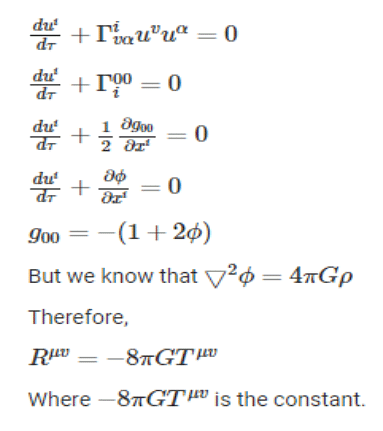
Read more: Difference Between Electromagnet and Permanent Magnet
What is Einstein Tensor?
[Click Here for Sample Questions]
It's also known as the trace-reversed Ricci tensor in differential geometry. It represents a pseudo-Riemannian manifold's curvature. It is also present in the Einstein field equations for gravitation, where it is utilized to describe spacetime curvature in a way that is consistent with energy and momentum conservation.
G represents the Einstein tensor, which is a tensor of rank 2. Over pseudo-Riemannian manifolds, it is defined. It is defined by the equation in index-free notation:
| G = R – \(\frac{1}{2}\) gR |
Where,
R represents Ricci tensor,
g represents metric tensor,
R represents the scalar curvature.
Cosmological Constant
[Click Here for Previous Year Questions]
In cosmology, the cosmological constant, often known as Einstein's cosmological constant, is a word. The Greek capital letter lambda (Λ) is used to represent it. It's said to be a mysterious sort of substance or energy that works in opposition to gravity. Most physicists regard it to be the same as dark energy. In the Einstein field equations, the cosmological constant is written as:
| Rμν – 1/2R gμν + Λgμν = \(\frac{8\pi G}{c^4}\) Tμν |
Where the Ricci tensor/scalar R and the metric tensor g describe spacetime structure, the stress-energy tensor T describes the energy and momentum density and flux of matter in that point in spacetime, and the universal constants of gravitation G and the speed of light c are conversion factors that arise when using traditional units of measurement.
Stress – Energy Tensor
[Click Here for Sample Questions]
The stress-energy-momentum tensor, or the energy-momentum tensor, is also known as the stress-energy-momentum tensor. It's a tensor physical quantity that describes the density and flux of energy and momentum in spacetime, thereby generalizing Newtonian physics' stress tensor. In the Einstein field equations of general relativity, these, in turn, operate as sources of the gravitational field.
The stress-energy tensor in Einstein's general relativity is symmetric, and may thus be expressed as:
| Tαβ = Tβα |
Also Read:
| Related Links | ||
|---|---|---|
| Magnetism and Matter | Magnetism and Gauss’s Law | The Bar Magnet |
| Magnetic Properties of Materials | The Earth’s Magnetism | Magnetisation and Magnetic Intensity |
Previous Year Questions
- A coil in the shape of an equilateral triangle of side 0.02 m is suspended from its vertex such that it is hanging in a vertical plane between the pole pieces of permanent magnet producing a uniform field of 5×10⁻²T.5×10−2T. If a current of 0.1 A is passed through the coil, what is the couple acting? [CBSE CLASS XII]
- The variation of the intensity of magnetisation (I) with respect to the magnetising field (H) in a diamagnetic substance is described by the graph [VITEEE 2002]
- A metal ring is held horizontally and bar magnet is dropped through the ring with its length along the axis of the ring. The acceleration of the falling magnet is..[NEET]
- A bar magnet is equivalent to ............[KCET 2004]
- If a bar magnet of magnetic moment M is kept in a uniform magnetic field B, its time period of oscillation is T. In the same magnetic field, the time period of another magnet of same dimension and same mass but of moment M/4 is...[WBJEE 2016]
- Magnetic permeability is maximum for:..[BCECE 2003]
- Each atom of an iron bar (5cm×1cm×1cm)(5cm×1cm×1cm) has a magnetic moment 1.8×10⁻²³Am21.8×10−23Am2. Knowing that the density of iron is 7.78×10³kgm−37.78×10³kgm−3, atomic weight is 5656 and Avogadro's number is 6.02×10236.02×1023 the magnetic moment of bar in the state of magnetic saturation will be….[BHU UET]
- Figure shows a straight wire length ll carrying current ii. The magnitude of magnetic field produced by the current at point PP is.[VITEEE 2010]
- A coil in the shape of an equilateral triangle of side l is suspended between the pole pieces of a permanent magnet such that →BB→ is in plane of the coil. If due to a current i in the triangle a torque ττ acts on it, the side l of the triangle is...[NEET 2005]
- A rectangular coil of length 0.12 m and width 0.1 m having 50 turns of wire is suspended vertically in a uniform magnetic field of strength 0.2 Weber/m2m2. The coil carries a current of 2 A. If the plane of the coil is inclined at an angle of 30∘∘ with the direction of the field, the torque required to keep the coil in stable equilibrium will be...[NEET 2015]
- Coercivity and retentivity of soft iron is:…
- A 25cm25cm long solenoid has radius 2cm2cm and 500500 total number of turns. It carries a current of 15A15A. If it is equivalent to a magnet of the same size and magnetization |¯M||M¯| (magnetic moment/volume), then |¯M||M¯| is :...[JEE Main 2015]
- A magnet of total magnetic moment 10−2^iA−m210−2i^A−m2 is placed in a time varying magnetic field, B^i(costωt)Bi^(costωt) where B=1B=1Tesla and ω=0.125rad/sω=0.125rad/s. The work done for reversing the direction of the magnetic moment at t=1t=1 second, is :[JEE Main 2019]
- A magnetic compass needle oscillates 3030 times per minute at a place where the dip is 45∘45∘, and 4040 times per minute where the dip is 30∘30∘. If B1B1 and B2B2 are respectively the total magnetic field due to the earth at the two places, then the ratio B1/B2B1/B2 is best given by :[JEE Main 2019]
- A magnetic dipole in a constant magnetic field has :...[JEE Main 2017]
- A magnetic needle of magnetic moment 6.7×10⁻²Am26.7×10−2Am2 and moment of inertia 7.5×10⁻⁶kgm27.5×10−6kgm2 is performing simple harmonic oscillations in a magnetic field of 0.01T0.01T. Time taken for 1010 complete oscillations is :...[JEE Main 2017]
- A paramagnetic substance in the form of a cube with sides 1cm1cm has a magnetic dipole moment of 20×10−6J/T20×10−6J/T when a magnetic intensity of 60×103A/m60×103A/m is applied. Its magnetic susceptibility is :[JEE Main 2019]
- Hysteresis loops for two magnetic materials AA and BB are given below : These materials are used to make magnets for electric generators, transformer core and electromagnet core. Then it is proper to use :[JEE Main 2016]
- At some location on earth the horizontal component of earth's magnetic field is 18×10−618×10−6 T. At this location, magnetic needle of length 0.12m0.12m and pole strength 1.8Am1.8Am is suspended from its mid-point using a thread, it makes 45∘45∘ angle with horizontal in equilibrium. To keep this needle horizontal, the vertical force that should be applied at one of its ends is :[JEE Main 2019]
- A short bar magnet is placed in the magnetic meridian of the earth with north pole pointing north. Neutral points are found at a distance of 30cm30cm from the magnet on the East - West line, drawn through the middle point of the magnet. The magnetic moment of the magnet in Am2Am2 is close to : (Given μ04π=10−7μ04π=10−7 in SI units and BHBH = Horizontal component of earth's magnetic field = 3.6×10−53.6×10−5 Tesla.) [JEE Main 2015]
Things to Remember
- The EFE is a tensor equation that connects a set of four symmetric tensors. There are ten independent components in each tensor.
- The four Bianchi identities reduce the number of independent equations from ten to six, giving the metric four gauge-fixing degrees of freedom, or the freedom to pick a coordinate system.
- Unlike in general relativity, the stress-energy tensor in some alternative theories, such as the Einstein-Cartan theory, may not be fully symmetric. This is because a nonzero spin tensor correlates to a nonzero torsion tensor geometrically.
- Einstein first proposed the cosmological constant in 1917 as a repulsive force required to maintain the Universe's static equilibrium. It is the leading candidate for dark energy, the explanation for the acceleration of the universe's expansion, in current cosmology.
- The Einstein tensor is a nonlinear function of the metric tensor in its explicit form; however it is linear within the second partial derivatives of the metric. The Einstein tensor is a symmetric order-2 tensor with ten independent components in a four-dimensional space. As a result, the Einstein field equations for the metric tensor are a set of ten quasilinear second-order partial differential equations.
Also Read: Permanent Magnets and Electromagnets
Sample Questions
Ques. What is a Field Equation? (2 marks)
Ans. A partial differential equation is a field equation in theoretical physics and applied mathematics. It determines the physical field's dynamics, focusing on the field's spatial distribution and time evolution. Einstein's field equation, meanwhile, deals with space and time at a specific place.
Ques. What is the equation of general relativity and what is its main idea? (2 marks)
Ans. Gravitational time dilation is another name for the general theory of relativity. It is one of the most important phenomena in physics theory, according to which time slows down in the gravitational field when gravity is present. E = mc2 is the fundamental equation of general relativity.
Einstein released his general theory of relativity in 1915. Time and space are both components of spacetime, according to general relativity. Momentum, gravity, energy, and matter all contribute to the curvature of spacetime. The relationships between all of these forces are represented by Einstein's equations.
Ques. Who solved Einstein’s field equations? (2 marks)
Ans. Karl Schwarzschild, a German physicist, discovered a perfect solution to the equations that describe what we now know as a black hole in 1916, nearly immediately after Albert Einstein published his theory of general relativity (the word would not be coined for another five decades).
Ques. Why are Einstein’s field equations non-linear? (2 marks)
Ans. The Einstein field equations are nonlinear because masses have an effect on the geometry of the space in which they exist. And this is the core discovery of mass curves: they determine the geometry of spacetime, which in turn determines how masses travel.
Ques. What are Einstein’s field equations used for? (2 marks)
Ans. When even a single point mass in put down in spacetime, the fabric of spacetime is curved everywhere as a result. The Einstein field equations allow us to relate spacetime curvature to matter and energy, in principle, for any distribution that is chosen.
Ques. Why did Einstein add Lambda to his field equation? (2 marks)
Ans. As a mathematical fix to the theory of general relativity, Einstein proposed the cosmological constant, which is generally symbolized by the Greek letter "lambda" (Λ). Because Einstein believed the universe was static, he coined this new phrase to halt its expansion.
For Latest Updates on Upcoming Board Exams, Click Here: https://t.me/class_10_12_board_updates
Do Check Out:



Comments