



Education Content Expert
Entamoeba Histolytica are infectious pathogens that cause several intestinal and extraintestinal diseases in humans. They are pathogenic species of amoeba that may cause serious health illness.
- Entamoeba Histolytica were first discovered by Lambl. S. Chaudin in 1859.
- They fall under the phylum Protozoa, the class Sarcodina and the order Lobosa.
- They are often found in the quadrinucleate cysts of the large intestine.
- They may become fatal suddenly and can cause serious ailments.
- They are the main cause behind critical ailments like Amoebiasis and Amoebic Dysentery.
- In severe cases, these parasites can even reach the organs like brain, liver, lungs, etc. and may cause chronic diseases.
Entamoeba Histolytica Life Cycle begins and ends inside one single host which is an individual human being. It includes three major stages namely Cyst, Excystation, and Trophozoite.
| Table of Content |
Key Terms: Entamoeba Histolytica, Parasite, Trophozoites, Encystment, Excystation, Chronic diseases, Amoebiasis, Liver, Human gut, Food, Water, Cyst
What is Entamoeba Histolytica?
[Click Here for Sample Questions]
Entamoeba Histolytica is a single-celled parasite that can cause infections in the human gut and liver. It is primarily found in areas with poor sanitation and is transmitted through contaminated food or water.
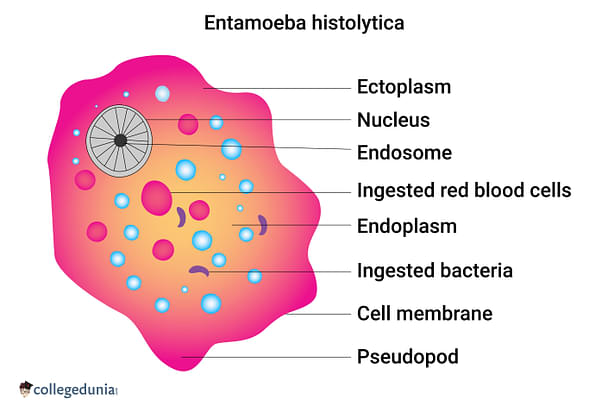
Entamoeba Cell
- Symptoms of infection can include diarrhea, abdominal pain, and blood in the stool.
- In severe cases, the parasite can invade the liver and cause liver abscesses.
- Treatment typically involves the use of antiparasitic drugs such as metronidazole or tinidazole.
- Preventative measures include improved sanitation and hygiene, as well as careful food preparation and water purification in areas where the parasite is common.
- It is important to note that not all individuals infected with Entamoeba histolytica will develop symptoms, and some may be asymptomatic carriers of the parasite.
Read More:
| Relevant Concepts | ||
|---|---|---|
| Termite Life Cycle | Dragonfly Life Cycle | Plasmodium Life Cycle |
| Lice Life Cycle | Tick Life Cycle | Flea Life Cycle |
| Bed Bug Life Cycle | Cockroach Life Cycle | Grasshopper Life Cycle |
Entamoeba Histolytica Life Forms
[Click Here for Sample Questions]
Entamoeba Histolytica has two different life forms, the Cyst, and the Trophozoite.
Trophozoites or Magna
The adult tropic forms of Entamoeba are also known as the trophozoites, these are present in the colon of the large intestine in human beings. They differ in the parasitic mode of life.
- Trophozoite form is a form that causes disease in the host.
- It is the feeding and reproducing stage.
- They can also encyst and form cysts, which are then passed in the feces and can infect new hosts.
- Trophozoite form is responsible for the pathology and symptoms of infection.
- Trophozoites multiply through binary fission in the host cell of the intestinal wall.
Precystic or Minuta
It is a smaller, spherical, and non-pathogenic form of Entamoeba. They are formed during the binary fission process where some of the daughter cells grow on to become normal adults while some do not grow, these cells formed are smaller and are found generally in lumen of intestine.
- Cyst form is the infective stage of the parasite.
- It is hardy and able to survive outside the host for extended periods of time.
- It is also resistant to chlorine and other common disinfectants.
- The cyst stage is ingested and then encyst in the small intestine, releasing trophozoites which then attach to the intestinal wall and begin to multiply.
- It is responsible for the parasite's ability to survive in the environment and to be spread person-to-person.
- The diagnosis of infection is usually made by identifying cysts in the feces, but trophozoites may also be seen in cases of invasive disease.
Entamoeba Histolytica Life Cycle
[Click Here for Sample Questions]
Entamoeba Histolytica is a monogenetic parasite i.e. its life cycle evolves in a single host or say in a particular human being. Entamoeba Histolytica Life Cycle involves three stages, which are as follows:
Encystment
Entamoeba Histolytica remains present in the lumen of the human intestine. They get encysted by ingestion in the mature cell, but before encystment, they coil up to defecate the food vacuole in order to collect a considerable amount of food in the form of glycogen and chromatoid and they form thin cysts around the body which is circular, colorless and transparent in nature.
- The cysts differ in size and contain cytoplasm in it, at this stage it also develops a nucleus which further divides into two, to form a tetra nucleus.
- At this stage of the formation of the cysts, the parasitic amoeba is infectious and can build upon the walls of the intestine causing infection in it.
- It may also get contaminated with the blood and reach organs like the brain and lungs infecting them.
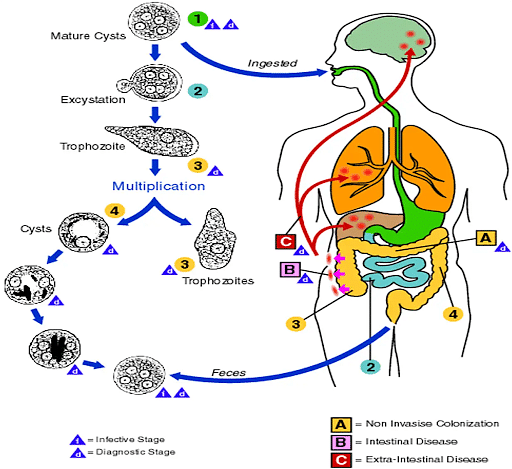
Entamoeba Histolytica Life Cycle
Transfer to New Host
- The cyst remains protected outside the human intestine because of the outer layer of the wall.
- It can survive for as long as seven days or more in an outside environment after excretion through human feces.
- They are transmitted to new hosts by the means of consumption of contaminated food or water.
Excystment
- In the process of Excystation or Excystment, Cysts transform into trophozoites in the small intestine and migrate to the large intestine.
- They keep on multiplying themselves through binary fission.
- These trophozoites can infect the walls of the intestine and can also be transmitted to the brain or other organs through infected blood cells.
Diseases Caused By Entamoeba Histolytica
[Click Here for Sample Questions]
Entamoeba Histolytica parasites can cause serious chronic ailments in the human body. They may infect the human intestine and can also cause damage to human brain, lungs etc. If transmitted to infected blood cells, some chronic diseases caused by E. Histolytica are-
- Amoebiasis: It is a parasitic infection caused by Entamoeba Histolytica, it is mainly caused by eating or drinking contaminated water, and its symptoms include stomach cramps, diarrhea, etc.
- Liver Abscess: It is caused by an infection in the liver leading to the formation of a mass filled with pus inside the liver.
- Perianal Ulceration: This causes sores that develop inside the rectum. They are caused by inflammatory bowel diseases, constipation, etc. which are again caused by Entamoeba Histolytica.
Check More:
| Related Topics | ||
|---|---|---|
| Difference Between Pathogens and Parasites | Parasitism | Parasitic Symbiosis |
| Human Health and Diseases | Vector-Borne Diseases | Unicellular Organisms |
Things to Remember
- Entamoeba Histolytica is an infectious parasite present in the human intestine.
- It is widely known for causing intestinal and extraintestinal infections in human beings.
- It is found in two different life forms namely ‘Magna or Trophozoite Form’ or ‘Minuta or Precystic Form’.
- Entamoeba Histolytica can be transferred to several hosts by the means of untreated or contaminated water or food.
- They can survive for more than 2 weeks outside the human intestine.
- Entamoeba Histolytica Life Cycle involves three stages namely ‘Encystment’, ‘Transmission to Another Host’, and ‘Excystment’.
- The infection through Entamoeba Histolytica can be avoided by the consumption of clean water and uncontaminated food.
Sample Questions
Ques. Can Entamoeba Histolytica Cysts survive in the outside environment? (1 Mark)
Ans. Yes, Entamoeba Histolytica Cysts can survive in the harsh outer environment of the human intestine for more than seven days. It is possible because of the outer layer developed around it during the process of Encystation.
Ques. What is the infective stage of Entamoeba Histolytica? (1 Mark)
Ans. The formation of cysts during encystation is the stage where the parasite is infectious. It can infect the walls of the intestine and can also infect the blood leading to infection in organs like the liver, lungs, and brain.
Ques. Explain the Life Cycle of Entamoeba Histolytica. (5 Marks)
Ans. The Life Cycle of Entamoeba Histolytica is explained as follows:
- Entamoeba Histolytica Life Cycle begins with the ingestion of infective cysts, which are found in contaminated food or water.
- Once inside the host, the cysts encyst in the small intestine, releasing trophozoites.
- The trophozoites then attach to the intestinal wall and begin to multiply.
- The trophozoites can also encyst and form cysts, which are then passed in the feces and can infect new hosts.
- The trophozoites can also migrate to other organs, such as the liver, where they can cause invasive disease and form abscesses.
- The life cycle of Entamoeba Histolytica is completed when the cysts are excreted in the feces and infect new hosts.
- The entire life cycle of Entamoeba Histolytica takes place within the human host, and the parasite does not have an intermediate host
- The cyst form is responsible for the parasite's ability to survive in the environment and to be spread person-to-person.
- The trophozoite form is responsible for the pathology and symptoms of infection.
Ques. How do Entamoeba Histolytica Cysts replicate? (1 Mark)
Ans. Entamoeba Histolytica Cysts replicate through existing, this is when the diffusion takes place, the cysts release the trophozoites and are transferred from the small to the large intestine.
Ques. What does Entamoeba histolytica feed on? (1 Mark)
Ans. Entamoeba histolytica survives by feeding on the various cells found in the human colon.
Ques. What does Entamoeba Histolytica feed on? (3 Marks)
Ans. Entamoeba histolytica is a parasitic protozoan that feeds on human cells and tissues.
- Trophozoites: The trophozoites, which are the actively growing and dividing forms of the parasite, feed on a variety of host cells, such as epithelial cells, blood cells, and immune cells. They attach to the host cells and form a feeding cup or a peduncle, which allows them to ingest the host cell's contents.
- Cysts: The cysts, which are the dormant and infective forms of the parasite, do not feed on host cells. Instead, they survive by using the host's nutrients and water.
- Liver Abscess: Trophozoites migrate to the liver from liver abscesses, which are filled with necrotic tissue, inflammatory cells, and trophozoites.
The ability of Entamoeba histolytica to feed on host cells and tissues is a major factor in the pathology of the infection, and it is responsible for the symptoms and complications of the disease.
Ques. Is Entamoeba Histolytica common? (1 Mark)
Ans. Yes, Entamoeba Histolytica is quite common throughout the world. Entamoeba histolytica parasites infect 50 million human beings across the globe and is known to kill over 55,000 people every year.
Ques. What are the various steps in the life cycle of Entamoeba Histolytica? (5 Marks)
Ans. Entamoeba Histolytica Life Cycle has the following stages:
- Cysts: The life cycle begins with the ingestion of infective cysts, which are found in contaminated food or water.
- Excystation: Once inside the host, the cysts encyst in the small intestine, releasing trophozoites.
- Attachment and Multiplication: The trophozoites then attach to the intestinal wall and begin to multiply.
- Encystation: Some of the trophozoites can encyst and form cysts.
- Fecal-oral Transmission: The cysts are then passed in the feces and can infect new hosts through the fecal-oral route.
- Invasion: Some of the trophozoites can migrate to other organs, such as the liver, where they can cause invasive disease and form abscesses.
- Completion of Life Cycle: The life cycle of Entamoeba histolytica is completed when the cysts are excreted in the feces and infect new hosts.
Ques. How are Entamoeba Histolytica spreaded? (5 Marks)
Ans. Entamoeba histolytica is primarily spread through contaminated food or water. The following are the ways in which the parasite can be spread:
- Fecal-oral Route: The most common mode of transmission is through the fecal-oral route, where an individual ingests infective cysts present in fecally contaminated food or water.
- Person-to-Person: The parasite can also spread from person to person through poor hygiene and sanitation. This can occur when an infected person does not properly wash their hands after using the toilet and then handles food, which is then consumed by another person.
- Sexual Transmission: The parasite can also be spread through sexual contact, especially in men who have sex with men.
- Travel: Traveling to areas with poor sanitation and high rates of Entamoeba histolytica infection increases the risk of infection.
- Daycare Centers and Schools: Entamoeba histolytica can be spread in daycare centers and schools where hygiene practices are poor.
- Animal-to-human Transmission: In rare cases, the parasite can be spread from animals to humans.
Ques. How to prevent Entamoeba Histolytica? (5 Marks)
Ans. Entamoeba Histolytica is primarily found in areas with poor sanitation and is transmitted through contaminated food or water. Therefore, preventing infection with the parasite involves measures to improve sanitation and hygiene, as well as careful food preparation and water purification. The following steps can be taken to prevent infection with Entamoeba histolytica:
- Maintaining Good Personal Hygiene: This includes frequent handwashing, especially after using the toilet or before preparing food.
- Drinking Clean and Safe Water: Use only purified or treated water for drinking, cooking and brushing teeth. Avoid drinking water from untreated sources.
- Proper Food Handling and Preparation: Cook food properly and avoid consuming raw or undercooked meat. Also, practice good food hygiene and avoid cross-contamination of food.
- Proper Sanitation: Dispose of human and animal feces properly, and maintain cleanliness in areas where people live and work.
- Travel Precautions: Take extra precautions when traveling to areas with poor sanitation and high rates of Entamoeba histolytica infection.
- Avoiding Risky Behaviors: Avoiding risky behaviors such as unprotected sex or sharing needles can also lower the risk of contracting the parasite.
For Latest Updates on Upcoming Board Exams, Click Here:https://t.me/class_10_12_board_updates
Check-Out:



Comments