



Content Curator
Temperature refers to the hotness or coldness of a body. In specific terms, it is the way of determining the kinetic energy of particles within an object. Faster the movement of particles; more the temperature and vice versa. Temperature is important in all fields of Science right from Physics to Geology and also it is crucial in most aspects of our daily life.
| Table of Content |
Key Terms: Temperature, Temperature Inversion, Altitude, Thermal conductivity, Temperature Scales, Temperature Measurement
What is Temperature?
[Click Here for Sample Questions]
Temperature is the measurement of the kinetic energy of particles in a substance. When the temperature increases, the particle's motion also increases. The temperature is measured with a thermometer or a calorimeter. Temperature determines the internal energy within the system present.
Also Read:
| Related Articles | ||
|---|---|---|
| Heat Engine | Cyclic Process | Reversible & Irreversible Process |
Temperature Measurement
[Click Here for Previous Years Questions]
To measure kinetic energy indirect methods are used in the molecules of a substance. When Heat is added to the substance, the molecules move rapidly. The increased motion causes a little increase in the volume and space taken up by most materials. Devices like thermometers use the expansion of a substance to give an indirect measure of temperature.

Temperature calculated from thermometer
- Thermometers are the most common instruments which are used to measure temperature. They are a thin glass tube filled with a small amount of mercury in them.
- Liquid thermometer is the simplest of thermometers.
- Thermometers measure the temperature due to thermal expansion.
- The increase in volume of substance because of the increase in its temperature is known as Thermal expansion.
- A small change in the temperature causes changes in the volume of the mercury.
- When the mercury gets hotter, it increases in size by an amount that’s directly related to the temperature. Therefore, if the temperature is increased by 20 degrees, the mercury expands and moves up the temperature scale twice as much.
Read More: Isobaric Process
Temperature Scales
[Click Here for Sample Questions]
Thermometer uses scales to well define the scales of measurement to measure the temperature. The three most common temperature scales are-
- Celsius
- Fahrenheit
- Kelvin

Temperatures Scales
1. Celsius Scale
On A Celsius scale the freezing point of water is 0℃ and the boiling point is 100℃. The temperature difference of one degree celsius scale is greater than the temperature difference of one fahrenheit.
- The celsius scale is also called centigrade scale.
- The symbol we use to represent celsius is ℃.
- Normal body temperature is 37℃.
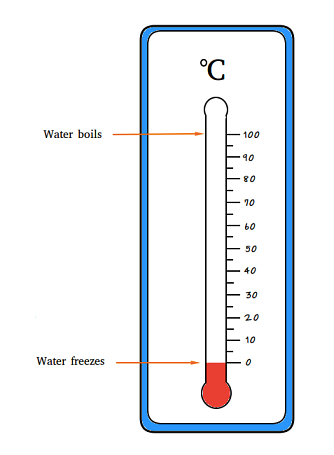
Celsius Scale
2. Fahrenheit Scale
On a Fahrenheit's scale the freezing point of water is 32℉ and the boiling point is 212℉. One degree on the celsius scale is 1.8 times bigger than one degree on Fahrenheit scale 180/100=9/5.

Fahrenheit Scale
3. Kelvin Scale
The kelvin scale is a commonly used scale in science. The absolute temperature scale is defined to have 0 k at lowest temperature. It is called absolute zero.
- The freezing point of water in kelvin scale is 273.15 K and the boiling point is 373.15 k.
- The Kelvin scale is an absolute scale.
- Kelvin Scales possess a true zero with no negative temperatures.

Kelvin Scale
Also Read:
| Related Articles | ||
|---|---|---|
| Thermodynamics | Carnot Energy | Kelvin Planck Statement |
| First Law of Thermodynamics | Bomb Calorimeter | Difference Between Kinetics and Kinematics |
What are the effects of Temperature?
[Click Here for Previous Years Questions]
An increase or decrease in temperature causes various changes in the physical and chemical processes of life. Some of those are given below-
- It affects the solubility, density, vapor pressure, physical properties of various materials along with the electrical conductivity
- The rate of a chemical reaction is also affected by the temperature.
- The thermal radiations from the surface of objects are also affected by temperature.
Things to Remember
- Temperature refers to the hotness or coldness of a body.
- Temperature is the measurement of the kinetic energy of particles in a substance.
- Devices like thermometers use the expansion of a substance to give an indirect measure of temperature.
- Thermometer uses scales to well define the scales of measurement to measure the temperature.
- On A Celsius scale the freezing point of water is 0℃ and the boiling point is 100℃.
- On a Fahrenheit's scale the freezing point of water is 32℉ and the boiling point is 212℉.
- The absolute temperature scale is defined to have 0 k at lowest temperature. It is called absolute zero
Sample Questions
Ques. Find the temperature that the thermometer shows. (2 marks)

(A) 46°F
(B) 45°F
(C) 47°F
(D) 7°F
Ans. A. 46℉.
Explanation- In the given figure, the temperature is marked till 46°F. So, the temperature shown in the thermometer is 46°F.
Ques. Do substances expand or contract as they get hotter? (3 marks)
Ans. Substances expand as they get hotter. When heat is added to a body, the molecules and atoms of the body vibrate faster. The space between atoms Increases when the atoms vibrate faster.
- The motion and spacing of the particles determine the state of matter of the substance.
- The result of these increased molecular motion is that the object expands and takes up more space than before.
Ques. What is temperature? (2 marks)
Ans. Temperature is the measure of hotness or coldness in terms of any of several
Scales like kelvin, Fahrenheit and Celsius. Temperature indicates the direction in which heat energy will flow which is from a hotter body (at higher temperature) to a colder body (at a lower temperature).
Ques. Why does temperature decrease with higher altitude? (2 marks)
Ans. Temperature decreases at higher altitudes because there is less air exerting pressure than at sea level. In the Gay-Lussac’s law,the pressure and temperature at a constant volume are directly proportional, so when there is a decrease in pressure the temperature will consequently decreases.
Ques. When do temperature inversions occur? (3 marks)
Ans. Under normal conditions, the temperature usually decreases with an increase in altitude in the troposphere at a rate of 1 degree for every 165 meters.it is called normal lapse rate, But in some cases, the situation is reversed and the temperature increases with height rather than decreasing. This condition is called temperature inversion.
- The environmental lapse rate varies from place to place and from time to time, particularly in the lowest few hundred meters of the troposphere.
- The average rate of temperature change is about 6.5°C for 1000 meters i.e (3.6°F 1000 feet).
- This is called the average vertical temperature gradient or lapse rate within the troposphere.

Temperature Inversion
Ques. Why is the air temperature lower at night? (2 marks)
Ans. During the night there is no direct sunlight, so there is more solar energy being lost than absorbed, causing air temperature during the night to be relatively cooler than during the day.
Ques. What is the relationship between Celsius temperature and Fahrenheit? (4 marks)
Ans. The relation between Celsius and Fahrenheit is direct. The Celsius is directly proportional to Fahrenheit. Which implies that –
- When the temperature on the Celsius scale increases, it’s Fahrenheit equivalent temperature will also be high.
- When the temperature on the Celsius scale decreases, it’s Fahrenheit equivalent temperature will also be low.
Both scales have their own thermometer for measurements. The Fahrenheit scale is proposed by taking 32 °F as a freezing point of water and 212 °F as a boiling point of water. Whereas in the Celsius scale 0 °C is the freezing point of water and 100 °C is the boiling point of water.

Ques. What is the Temperature Sensor? (3 marks)
Ans. A temperature sensor is a thermocouple or a Resistance Temperature Detector which collects data about temperature from a source and converts it into an understandable form for an observer. Temperature sensors are used in many applications like food processing units and medical devices.
Common type of temperature sensor is a thermometer. It measures the temperature of solids, liquids, and gaseous. It is also a common type of temperature sensor mostly used for non-scientific purposes because it is not so accurate. The following are a few temperature sensors besides the thermometer.
- Thermocouples
- Resistor temperature detectors
- Thermistors
- Infrared sensors
- Semiconductors
Ques. The room temperature is generally defined to be 25ºC. What is the room temperature in ºF? What is the room temperature in K? (2 marks)
Ans. To convert from Celsius to Kelvin we use the equation-
TK = TC + 273.15
Now, Substituting the values in the equation-
TK = T25C + 273.15 = 298K
Do Check Out:



Comments