



Education Journalist | Study Abroad Lead
Mirror Formula derivation results in an equation that relates the object and image distance with the focal length. It is also referred to as the mirror equation. The equation is applicable to both plane mirror and spherical mirrors. A plane mirror is a type of flat surface that produces a straight image where the front and back of a real object are reversed. A spherical mirror, also known as a sphere mirror, is a mirror with the shape of a piece cut from a spherical surface or material. The concave and convex mirrors are the two forms of spherical mirrors. The derivation of the mirror formula is one of the most frequently asked questions in both board and competitive examinations. In this article, we will discuss the derivation and sample questions of the mirror formula. The mirror formula can be represented as:
\({1 \over f }= {1 \over v} + {1 \over u}\)
| Table of Content |
Key Terms: Mirror Formula, Plane Mirror, Spherical Mirror, Convex Mirror, Concave Mirror, Image Formation
What is the Mirror Formula?
[Click Here for Sample Questions]
The mirror formula gives the relationship between the distance of the object 'u,' the distance of the image 'v,' and the focal length of the mirror 'f'. Both planar and spherical mirrors (convex and concave mirrors) use the mirror formula.
The formula is as given below:
\( {1 \over v} + {1 \over u} = {1 \over f }\)

Mirror Formula
The video below explains this:
Mirror Formula Detailed Video Explanation:
Read More:
Sign Convention for Mirror Formula Derivation
[Click Here for Previous Year Questions]
The derivation of mirror formula makes use of the following sign convention –
- The object distance is usually taken negatively if the object is placed on the left side of the major axis from the mirror.
- It is considered positive if it is positioned on the right side. The sign of focal length depends on the type of mirror we're using; for concave mirrors, it's always negative, whereas, for convex mirrors, it's always positive.
- It is worth repeating that to reach the correct result, we must strictly obey the sign conventions. Positive heights are above the major axis, whereas negative heights are below.

Mirror Formula Sign Convention
Assumptions of Mirror Formula
[Click Here for Sample Questions]
To derive the mirror formula, the following assumptions are made.
- The distances are computed from the pole of the mirror; according to the convention, the negative sign denotes the distance measured in the direction opposite the incident ray, while the positive sign denotes the distance measured in the direction of the incident ray.
- Positive distances are above the axis, whereas negative distances are below it.
Derivation of Mirror Formula
[Click Here for Previous Year Questions]
In the ray diagram, the object AB is placed on the principal axis of the concave mirror beyond its center of curvature (C) forming an image A′B′ between the center of curvature (C) and principal focus (F) of the concave mirror. Here, we have taken a concave mirror that forms a real image..
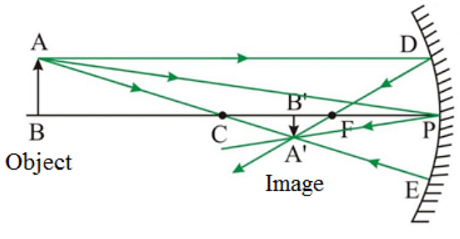
Ray Diagram
As shown in the ray diagram, ΔABC and ΔA′B′C are similar triangles.
∴ \({AB \over A'B'} = {CB \over CB'}\)
Similarly, ΔABP and ΔA′B′P are also similar triangles
\({AB \over A'B'} = {PB \over PB'}\)
Thus, combining both the relations we get,
\({AB \over A'B'} = {CB \over CB'}= {PB \over PB'}\)
∴ \({CB \over CB'} = {PB \over PB'}\)
Measuring all the distances from the pole (P) we get,
CB = PB – PC
CB′ = PC – PB’
Putting the values of CB and CB’ in the above equation, we get,
\({PB - PC \over PC - PB'} = {PB \over PB'}\)
Using cartesian sign convention, we get,
PB= – u
PC= –R
PB′= –v
Here, u is the object distance, v is the image distance, and R is the radius of curvature.
Now, substituting the values of PB, PB′, and PC in the above equation, we get,
\({-u-(-R) \over -R-(-v)} = {-u\over -v}\)
∴ \({-u+R \over -R+v} = {u\over v}\)
Now, by simplifying the equation, we get,
v(–u+R) = u(–R+v) – vu + vR
= –uR + uv
or
uR + vR = 2uv
Now, dividing both the sides by uvR, we get,
\({1 \over v} + {1 \over u} = {2\over R}\)
But we know that, f= R/2
\({1 \over f }= {1 \over v} + {1 \over u}\)
which is the required mirror equation.
This equation is true even in the case that a virtual image is formed by the concave mirror.
Thus, the mirror equation for a spherical mirror is \({1 \over f }= {1 \over v} + {1 \over u}\)
For convex lens, mirror formula is \({1 \over f }= {1 \over v} - {1 \over u}\)
Applications of Mirror Formula
[Click Here for Sample Questions]
The Mirror Equation can be used in the following ways:
- When the object distance and the focal length of the mirror are known, the mirror equation can be used to determine the image distance.
- When we know the image distance and the focal length of the mirror, we can use the equation to get the object distance.
- By knowing the distance of the object and the distance of the image it generates, the mirror equation allows us to calculate the focal length of the mirror.
- When the other is known, we can use the mirror equation in conjunction with the magnification equation to derive the value of either the image height or the object height.
Read More:
Things to Remember
- The branch of physics that deals with light, its behavior patterns, and qualities is known as Optics.
- Light is a type of electromagnetic radiation that allows the human eye to see or make objects visible. It can also be described as radiation that can be seen with the naked eye.
- The ability of a lens to converge or diverge light rays is determined by its focal length.
- If we know the object position and the focal length of the mirror, we may use mirror formulas and equations to determine where the image will be produced.
- The Mirror Equation is a mathematical formula that connects the object distance, image distance, and mirror focal length.
- The mirror formula is 1/f = 1/v + 1/u
Previous Year Questions
- Which of the following is true for rays coming from infinity? [DUET 2006]
- A point source of light S, placed at a distance L in front of the centre of a plane mirror of width…? [DUET 2000]
- A girl of height 150cm with her eye level at 140cm stands in front of plane mirror…? [KCET 2019]
- A given ray of light suffers minimum deviation in an equilateral prism P. Additional prisms…? [NEET 2001]
- A biconvex lens has a radius of curvature of magnitude 20cm. Which one of the following options…? [NEET 2011]
- A converging beam of rays is incident on a diverging lens. Having passed through the lens…? [NEET 2011]
- A lens having focal length f and aperture of diameter d forms an image of intensity…? [NEET 2010]
- A person can see clearly objects only when they lie between 50cm and 400cm from his eyes…? [NEET 2016]
- A plano convex lens fits exactly into a plano concave lens. Their plane surfaces are parallel…? [NEET 2013]
- A ray is incident at an angle of incidence i on one surface of a small angle prism…? [NEET 2020]
- A ray of light travelling in a transparent medium of refractive index μ, falls on a surface…? [NEET 2010]
- A rod of length 10cm lies along the principal axis of a concave mirror of focal length…? [NEET 2012]
- A thin prism having refracting angle 10∘ is made of glass of refractive index 1.42. This prism…? [NEET 2017]
- A thin prism of angle 15∘ made of glass of refractive index (μ1=1.5) is combined with another prism…? [NEET 2011]
- An air bubble in a glass slab with refractive index 1.5 (near normal incidence) is…? [NEET 2015]
- An astronomical refracting telescope will have large angular magnification and high angular…? [NEET 2018]
- An astronomical telescope has objective and eyepiece of focal lengths 40cm and 4cm respectively…? [NEET 2016]
- An equiconvex lens has power P it is cut into two symmetrical halves by a plane containing…? [NEET 2019]
- An object is placed at a distance of 40cm from a concave mirror of focal length…? [NEET 2018]
- Assume that light of wavelength 600nm is coming from a star. The limit of resolution…? [NEET 2020]
Sample Questions
Ques 1. Define the term "optics." What are the different kinds of optics phenomena? (2 marks)
Ans. The study of light's wave characteristics is known as optics. There are three types of optics phenomena that can be classified as follows:
- Interference
- Polarization
- Diffraction
Ques 2. Calculate the image's position if the bus is eight meters away from a convex mirror. The Convex Mirror has a 5-meter radius of curvature. (3 marks)
Ans. Given Information:
The curvature radius (R) is +5.00 m.
Distance between objects (u) = -5.00 m
We need to figure out what image distance(v) equals.
We know that f = R/2 = 8/2 = 4 m
The mirror's formula is 1/u + 1/v = 1/f.
We get the following equation after rearranging the above equation.
1/v = 1/f - 1/u= 2
Substituting the data in the equation above
9/20 = 1/v = 1/f - 1/u = 14 - 1/(-5)
2.22 metres (V = 20/9)
As a result, the picture is created 2.22 meters away from the mirror.
Ques 3. The radius of curvature of a convex mirror used for rearview on the bus is 4 meters. Find the position of the picture if a car is 2 meters away from the mirror. (3 marks)
Ans. Given that,
The object distance is u = –2m
The radius of curvature of the convex mirror is R = 4m
So, the focal length of the convex mirror is f = R/2 = 4/2 = 2m
The image distance is given by the relation,
1/v = 1/f – 1/u = 1/2–1/-2
∴ 1/v = 1/2+1/2 = 2/2 = 1/1
∴ v=1m
Hence, the image of the car is formed behind the mirror at a distance of 1m.
Ques 4. A 60cm object is held in front of a concave mirror with a 30cm focal length. Determine the location of the image that has been formed. (3 marks)
Ans. As a result,
u = –60cm is the object's distance.
The concave mirror has a focal length of f = –30cm.
1/v = 1/f – 1/u = (1/–30) – (1/–60)
∴v = – 60cm
As a result, the picture is generated 60cm in front of the concave mirror.
Ques 5. When an object is placed in front of a concave mirror with a focal length of 12 cm, the image is generated at a location 10 km away from the mirror. What is the image's magnification? (3 marks)
Ans. Given: f =12 cm and v = u+10
1/21= (1/u)+ (1/u+10)
u= 20 cm
v = 20+10 =30 cm
We have magnification, m = v/u= 30/20 = 1.5
Ques 6. Mention the Wavefront's Categories. (2 marks)
Ans. According to the source of light, wavefronts might be one of three types:
- Wavefront spherical
- Wavefront on a plane
- Wavefront with a circular shape
Ques 7. How can you tell if a mirror is convex or concave only by looking at the virtual picture it creates? (2 marks)
Ans. A virtual and enlarged image is always formed by a concave mirror, whereas a virtual and diminished image is always formed by a convex mirror. Thus, if the virtual image generated by the mirror is increased, the mirror is concave; otherwise, if the image formed is shrunk, the mirror is convex.
Ques 8. What images does a concave mirror produce? (1 mark)
Ans. Real and virtual pictures are created by a concave mirror. It can create larger, equal-sized, or reduced real images, but only enlarged virtual images.
Ques 9. What are some of the applications of the mirror formula? (5 marks)
Ans. The Mirror Equation can be used in the following ways:
- When the object distance and the focal length of the mirror are known, the mirror equation can be used to determine the image distance.
- When we know the image distance and the focal length of the mirror, we can use the equation to get the object distance.
- By knowing the distance of the object and the distance of the image it generates, the mirror equation allows us to calculate the focal length of the mirror.
- When the other is known, we can use the mirror equation in conjunction with the magnification equation to derive the value of either the image height or the object height.
For Latest Updates on Upcoming Board Exams, Click Here:https://t.me/class_10_12_board_updates
Do Check Out:



Comments