



Education Journalist | Study Abroad Lead
A diode is a cylindrical electronic apparatus that possesses two terminals electronic and conducts current mostly in one direction. The unidirectional flow of current is because it has low resistance in one direction, and higher resistance in the other. Semiconductor diodes are made up of semiconductor materials such as metals silicon and germanium. In some semiconductor diodes, the electric current is carried by the excited photons. Such devices are termed optometric devices, and one such device is photodiodes.
| Table of Content |
Key Terms: Semiconductor, diodes, current, p-n junction diode, Photon, Electric current, Photodiode, Metal, silicon, germanium, Zener diode, Electrons, Anode, Cathode
What are Semiconductor Diodes?
[Click Here for Sample Questions]
Semiconductors diodes are made up of semiconductor materials such as metals silicon and germanium.
In a diode, there are two ends, a cathode, negatively charged, and anode, having a positive charge.
The cathode possesses a large number of electrons and is placed beside the anode. The junction between the cathode and the anode in a semiconductor diode possesses a depletion region, which does not contain any electrons or holes.
When there are positive voltages at the anode, the depletion area shrinks dramatically, and current flows through the semiconductor diode.
Examples: p-n junction diode, Zener diode
Also Read:
| Related Articles | ||
|---|---|---|
| Difference between LCD and LED | Types of LED | Rectifier |
| Optical Instruments | Bridge Rectifier | Application of Junction Diode |
What are Optometric Devices?
[Click Here for Sample Questions]
In some semiconductor diodes, the electric current is carried by the excited photons. Such devices are termed optometric devices, and one such device is photodiodes. Other optometric devices are:
- Photodiodes, which are used to detect optical signals (photodetectors).
- Electrical energy is converted into light energy by light-emitting diodes.
- Photovoltaic devices convert optical radiation into electricity (commonly used in solar cells).
What are Photodiodes?
[Click Here for Sample Questions]
One of the commonly employed optometric devices is photodiodes. They are used to detect optical signals and are employed in photodetectors.
Photodiodes are a modified version of the p-n junction.
It comprises three main parts, a-p side, a-n side, and a window to enable the light to fall on the diode.
Photodiodes absorb these photos of energy and produce electrical currents. Photodiodes are also called photodetectors, photosensitizers, etc. and they work on the reverse bias.

Working
[Click Here for Sample Questions]
- Light is composed of packets of energy called photons hν.
- When light (having photons) with energy (hν) is greater in amount as compared to the energy gap (eg) of the semiconductor, then new electron-hole pairs are generated due to the absorption of photons by the photodiode.
- This results in the generation of e-h pairs in or near the depletion region of the diode. Due to the electrical field of the junction, electrons and holes are separated.
- The applied electrical field pushes the electrons towards the n-side and holes towards the p-side. Electrons are collected on the n-side and holes are collected on the p-side and result in the development of an emf, thus a current flow.
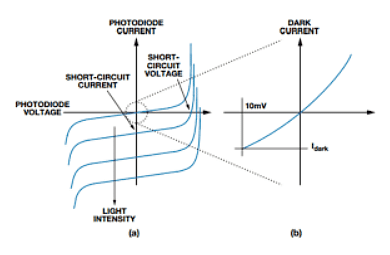
- The amount of the photocurrent depends on the intensity of incident light (photocurrent is proportional to incident light intensity) and is measured using reverse bias. As a result, a photodiode may be used to detect optical signals as a photodetector.
Applications
[Click Here for Sample Questions]
Photodiodes are commonly employed in several appliances such as:
- Photodetectors
- Smoke detectors
- Blood gas monitors
- solar cell panels.
- logic circuits.
- detection circuits.
- character recognition circuits.
- lighting regulation and optical communication.
Things to Remember
- Semiconductor diodes are made up of semiconductor materials such as metals silicon and germanium.
- In a diode, there are two ends, a cathode, negatively charged, and anode, having a positive charge.
- The cathode possesses a large number of electrons and is placed beside the anode. The junction between the cathode and the anode in a semiconductor diode possesses a depletion region, which does not contain any electrons or holes.
- In some semiconductor diodes, the electric current is carried by the excited photons. Such devices are termed optometric devices, and one such device is photodiodes.
- One of the commonly employed optometric devices is photodiodes. They are used to detect optical signals and are employed in photodetectors.
- Photodiodes are a modified version of the p-n junction.
- Photodiodes are commonly employed in several appliances such as:
- Photodetectors
- Smoke detectors, etc.
- Optometric devices are:
- Photodiodes, which are used to detect optical signals (photodetectors).
- Light-emitting diodes, which convert electrical energy into light energy.
- Photovoltaic devices convert optical radiation into electricity (commonly used in solar cells).
Also Read:
Sample Questions
Ques: How does photodiode detect light? (2 Marks)
Ans: Photodiodes are used to determine the nature of both visible and invisible light. The light rays fall on the surface of the p-n junction as packets of photons, these photons when absorbed by the surface, excite the electrons and result in the generation of electrical current, thus, they convert light energy to current energy. The amount of current flowing through the circuit indicates the intensity of the light rays.
Ques: Why are photodiodes based on reverse bias determination? (2 Marks)
Ans: When the photons are incident, the fractional charge in reverse current is larger than the fractional charge in forwarding current. When a reverse bias is developed, current only flows through the photodiode with incident light creating a photocurrent. This creates a large area for the photons to absorb.
Ques: How does the presence of dark current affect the sensitivity of photodiodes? (2 Marks)
Ans: The sensitivity of photodiodes is decreased due to the presence of dark current. The presence of dark current hinders the conversion of the light energy into electronic energy, as a result, the determination of the light energy becomes difficult, thus affecting its sensitivity.
Ques: Briefly describe the functioning of photodiodes? (2 Marks)
Ans: Photodiodes function by absorbing the protons or charged particles and then generating a flow of current in an external circuit proportional to the incident power, the light is absorbed exponentially with distance and is proportional to the absorption coefficient.
Ques: What is Dark current in photodiodes? (2 Marks)
Ans: In absence of incident light, the photons are absent that would excite the electrons present in the p-n junction, thus there is almost negligible reverse current. This reverse current in the photodiode is known as, Dark current. This also if present in large amounts hinders the generation of the electric current when light rays are subjected to the p-n junction.
For Latest Updates on Upcoming Board Exams, Click Here: https://t.me/class_10_12_board_updates
Do Check Out:



Comments