



Education Content Expert
Potassium Hydroxide is an inorganic chemical compound with the chemical formula KOH.
- Potassium Hydroxide is also known as Caustic Potash, lye, and Potash lye.
- It is an inorganic compound that appears as a powder, flakes, or pellets.
- It is an alkali metal hydroxide which is a very powerful base.
- Potassium Hydroxide appears as a clear solution in its aqueous state.
- It is an odorless, white or slightly yellow, flakey or lumpy solid.
Key Terms: Potassium Hydroxide, Caustic Potash, KOH, Ethanol, Electrolysis, Saponification, Electrolysis
What is Potassium Hydroxide?
[Click Here for Sample Questions]
Potassium Hydroxide is an odorless, white, or slightly yellow chemical compound that is commonly found in form of powder, flakes, or pellets.
- The chemical formula of Potassium Hydroxide is KOH.
- KOH is soluble in water, ethanol, methanol, and glycerin.
- It has minimal solubility in ethers.
- It is a highly corrosive yet not combustible substance.
- It is extensively utilized for the production of chemicals, cleaning agents, and petroleum refineries.
- It is used in the manufacturing of soap, as an electrolyte in alkaline batteries, and in electroplating, lithography, and paint and varnish removers.
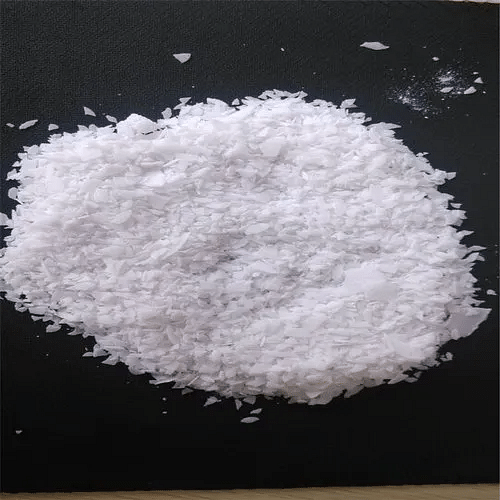
Potassium Hydroxide
Potassium Hydroxide Structure
[Click Here for Sample Questions]
Potassium Hydroxide has the chemical formula KOH.
- One hydrogen atom and one oxygen atom with a charge of -1 make up the compound hydrogen oxide (OH-).
- Potassium (K+), an alkali metal, has a positive charge. The equation is balanced as a result, and the charges are dispersed equally.
- K+ and OH- ions are separated from one another between 2.69 and 3.15.
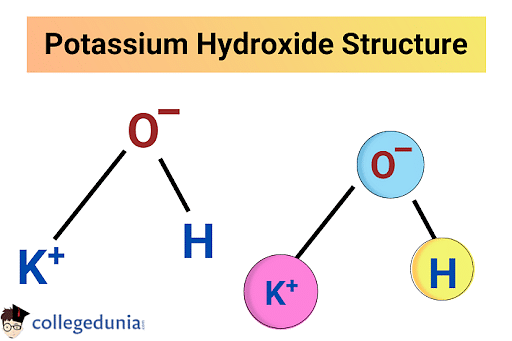
Potassium Hydroxide structure
- KOH has a strong affinity for water, therefore even though it can exist as a crystalline solid similar to sodium chloride, it typically forms crystalline hydrates instead.
- One, two, or four molecules of water are linked to one molecule of potassium hydroxide, respectively, to form the most common hydrates of caustic potash, known as mono, di, and tetra.
Read More:
Properties of Potassium Hydroxide
[Click Here for Sample Questions]
The important properties of Potassium Hydroxide are as follows:
| Properties of Potassium Hydroxide | |
|---|---|
| Chemical Name | Potassium Hydroxide |
| Chemical Formula | KOH |
| Molecular Weight/Molar Mass | 56.11 g/mol |
| Density | 2.12 g/cm³ |
| Boiling Point | 1,327 °C |
| Melting Point | 360 °C |
Preparation of Potassium Hydroxide
[Click Here for Sample Questions]
Potassium Hydroxide is prepared through the electrolysis of a potassium chloride solution on a large scale. The procedure is also known as the ChlorAlkali Process. Here is the reaction:
| 2KCl + 2H2O \( \rightarrow\) 2KOH + Cl2 + H2 |
KCl Electrolysis for Potassium Hydroxide Production
KOH is currently produced via KCl electrolysis, but traditionally it was produced by a salt metathesis process between calcium hydroxide and potassium carbonate. In a salt metathesis reaction, the respective components or constituents of the two reactant compounds swap places to generate two new compounds as result.
The following reaction occurs when potassium hydroxide is prepared.
| Ca(OH)2 + K2CO3 \( \rightarrow\) CaCO3 + 2KOH |
Chemical Reactions of Potassium Hydroxide
[Click Here for Sample Questions]
Potassium Hydroxide undergoes several important chemical reactions as follows:
Ester Saponification
- Ester is heated with a predetermined quantity of potassium hydroxide in an organic solvent in a sealed tube to create saponification.
- To be analytically useful, this response must be quantified and take an adequate period of time.
- Using a strong base is one condition that encourages a fast and accurate response.
| KOH + RCOOR’ \( \rightarrow\) RCOOK + R’OH |
Reaction with CO2 to Produce Bicarbonate
When Carbon Dioxide interacts with KOH, bicarbonate is formed. The pH is altered when hydroxide ions like lime, sodium hydroxide, or potassium hydroxide are added because these ions react with carbon dioxide to produce bicarbonate alkalinity.
| KOH + CO2 \( \rightarrow\) KHCO3 |
Reaction with Zinc
- KOH, also known as potassium hydroxide, is a robust inorganic alkaline chemical.
- Considering that it is a fireproof, hydrophilic substance, it is extremely corrosive to metal and tissue.
- The moisture in the air is easily absorbed by it, so it creates a caustic solution that corrodes zinc and aluminum.
| KOH + Zn \( \rightarrow\) K2ZnO2 + H2 |
Uses of Potassium Hydroxide
[Click Here for Sample Questions]
Here are some important uses of Potassium Hydroxide:
- Potassium Hydroxide Solution is used as an electrolyte in some alkaline batteries because it is more conductive than NaOH.
- It is also utilized in the saponification process, which is used to make soap.
- In order to create soapy salts, it serves as a base for fatty acids, oils, and esters.
- The soaps that contain potassium salts are classified as soft soaps because they are more soluble than the other types.
- In the food sector, Potassium Hydroxide acts as a pH-regulating agent.
- It works as a stabilizer and thickening agent for food.
- It is utilized in a specified amount to make the food products safe for consumption.
- Potassium Hydroxide is used in household cleaning such as in drain cleaners.
- It is used for manufacturing electronic chips of semiconductor wafers as a good etching agent.
- For manicure treatments, cuticle removers are made using Potassium Hydroxide.
- For medical uses, Potassium hydroxide is used to prepare clinical specimens of fungal infections in hair, skin, nails, etc.
- Cotton is mercerized with potassium hydroxide.
- It is used in the manufacturing of fertilizers as well.
Health Hazards of Potassium Hydroxide
[Click Here for Sample Questions]
The health hazards associated with Potassium Hydroxide are similar to the ones of other strong alkalies, such as sodium hydroxide. On contacting Potassium Hydroxide and its solution, the following body parts can be irritated:
- Skin
- Mucous Membranes
- Eyes
It can produce heat to start combustion when it comes into touch with water or moisture. Body tissues are also corroded by potassium hydroxide.
Check More:
Things to Remember
- Potassium Hydroxide is a water-soluble, and odorless chemical compound with the formula KOH.
- It is commonly known as Caustic Potash, lye, and Potash lye.
- Potassium Hydroxide is a strong base that is sold in different forms including pellets, flakes, and powders.
- It appears white to slightly yellow in color.
- Potassium Hydroxide is highly corrosive but is non-combustible.
- It is prepared by the electrolysis of a potassium chloride solution.
- It is used in households as a drain cleaner agent and even in petroleum refineries.
- Potassium Hydroxide is used in food items as a thickening agent and stabilizer.
Sample Questions
Ques. What is Potassium Hydroxide? (3 Marks)
Ans. Potassium Hydroxide is an inorganic chemical compound with the chemical formula KOH.
- Potassium Hydroxide is also referred to as lye or Caustic Potash.
- It is available in a range of shapes, including pellets, flakes, and powders.
- It is odorless and appears as a white or slightly yellow, flakey or lumpy solid.
- It has numerous uses in the manufacturing, mining, and chemical industries.
Ques. What are the uses of Potassium Hydroxide? (3 Marks)
Ans. The uses of Potassium Hydroxide are listed as follows:
- Potassium Hydroxide is used as a pH control agent in the food industry.
- It is used in the thickening of food in the food industry.
- It is used in the fabrication of chips for semiconductors.
- Potassium Hydroxide is also used in mercerizing cotton.
- Liquid fertilizers are manufactured using Potassium Hydroxide.
Ques. What is the chemical formula of Potassium Hydroxide? (1 Mark)
Ans. The chemical formula for Potassium Hydroxide is KOH.
Ques. What is the pH of Potassium Hydroxide? (2 Marks)
Ans. Potassium Hydroxide (KOH) is a very strong base in Chemistry. It totally separates into its ions when placed in an aqueous solution. Despite the high pH of KOH, or potassium hydroxide (normal solutions typically range from 10 to 13), the precise value relies on the amount of this potent base in the water.
Ques. Is it safe to consume Potassium Hydroxide? (3 Marks)
Ans. Potassium Hydroxide is used in specific amounts in food to ensure that it is safe to eat. It acts as a stabilizing and thickening agent. Potassium Hydroxide is considered a safe ingredient by FDA to use in food items.
However, too much exposure to Potassium Hydroxide can lead to extreme irritation in the eyes, mucous membranes, and skin. It also produces heat to initiate combustion when it comes into touch with water or moisture.
Ques. List the important properties of Potassium Hydroxide. (3 Marks)
Ans. The important properties of Potassium Hydroxide are as follows:
- Molecular Weight of Potassium Hydroxide: 56.11 g/mol
- Density of Potassium Hydroxide: 2.12 g/cm3
- Boiling Point of Potassium Hydroxide: 1,327 °C
- Melting Point of Potassium Hydroxide: 360 °C
Ques. What are the other names of Potassium Hydroxide? (1 Mark)
Ans. Caustic Potash, lye, and potash lye are other names for potassium hydroxide.
Ques. Why should one be careful when dealing with Potassium Hydroxide? (3 Marks)
Ans. One should be careful when dealing with Potassium Hydroxide as
- Potassium Hydroxide can affect a person when inhaled and by passing through the skin.
- It is a highly corrosive chemical and its contact can severely irritate and burn the skin and eyes leading to eye damage.
- It can irritate the lungs and continuous exposure may cause a build-up of fluid in the lungs (pulmonary edema), which is a medical emergency.
- Generally, it can cause headaches, dizziness, nausea, and vomiting.
Ques. In which household product, Potassium hydroxide is found? (1 Mark)
Ans. Potassium Hydroxide is found in household products like Drain cleaners.
Ques. State the health hazards associated with Potassium Hydroxide. (3 Marks)
Ans. If a person is exposed to Potassium Hydroxide in extreme amounts, it can cause the following problems:
- Eye Pain
- Tearing
- Redness
- Swelling
Larger exposures can also cause serious burns with potential subsequent blindness. Chronic and repeated contact with dilute solutions of potassium hydroxide dust has a tissue-destroying effect.
For Latest Updates on Upcoming Board Exams, Click Here: https://t.me/class_10_12_board_updates
Check-Out:



Comments