



Education Journalist | Study Abroad Lead
Propionic acid is a carboxylic acid where ethane is attached to a carboxyl group to form saturated fatty acid. It is identified as a liquid with a pungent odor similar to a body odor. It finds extensive use in industrial and household means as an antifungal and flavoring agent. It is produced industrially from ethanol or ethylene and carbon monoxide. Besides, it is also produced naturally on our body, on the skin or in the gastrointestinal tract.
| Table of Content |
Key Terms: Propionic acid, carboxylic acid, saturated fatty acids, Antifungal agent, Flavoring agent, Carbon Monoxide, Skin
Propionic Acid
[Click Here for Sample Questions]
Propionic acid is a carboxylic acid. The Chemical formula of Propionic acid is CH3CH2COOH or C3H6O2. Due to the presence of single bonds, it comes under the category of saturated fatty acids. In natural fats, propanoic acid is in the form of esters of glycerol.
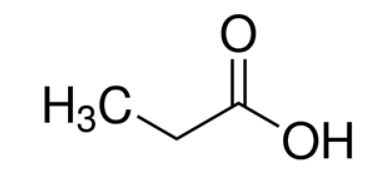
Propionic Acid
Also Read:
Preparation of Propionic Acid
[Click Here for Sample Questions]
The industrial or commercial preparation of propionic acid involves two methods:
- Hydrocarboxylation of ethylene with nickel carbonyl as the catalyst. Hydrocarboxylation is a chemical reaction in which carbon monoxide and water/alcohol are added to the alkene to produce esters.
- Aerobic oxidation of propionaldehyde or propanal with salts of manganese or cobalt is used as catalysts. The reaction takes place in temperatures between 40oC to 50oC.

- Biological methods of manufacturing propionic acid involve fermentation of sugar and fermentation of mash made out of cornmeal. The bacteria that results in fermentation is known as Propionibacterium.

Structure of Propionic Acid
[Click Here for Sample Questions]
The structure of Propionic acid is monoclinic which has a carboxyl group (COOH) attached to an ethane molecule.
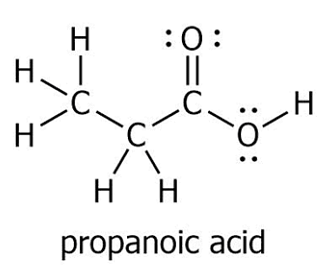
Structure of Propionic Acid
Chemical Properties of Propionic Acid
[Click Here for Sample Questions]
Chemical formula: CH3CH2COOH of C3H6O2.
Molecular weight: 74.08 g mol-1
Chemical Name: Propionic acid, Ethane Carboxylic acid
Solubility: Miscible in Ether, Ethanol and Trichloromethane (CHCl3). Propionic acid is fairly soluble in water.
Refractive Index: 1.38
Physical Properties of Propionic Acid
[Click Here for Sample Questions]
Odor: In liquid form the compound emits a strong pungent and corrosive smell.
Appearance: Propionic acid appears as a clear and colorless oily liquid.
Melting Point: 141.15oC
Boiling Point: -20.5oC
Density: 0.98 g/cm
Vapour Pressure: 0.32 kPa (20oC)
0.47 kPa (25oC)
9.62 kPa (100oC)
Combustibility: If exposed to fire, heat or oxidizing agents, propionic acid turns flammable.
Important Chemical Reactions of Propionic Acid
[Click Here for Sample Questions]
Some of the important chemical reactions of propionic acids are as follows.
Reaction with metals and alkalis
On reacting with metal hydroxides, propanoic acid forms salts whereas on reacting with weak bases, along with water carbon dioxide is released.
CH3CH2COOH + NaOH → CH3CH2Na + H2O
CH3CH2COOH + NaHCO3 → CH3CH2Na + H2O + CO2
Reaction with Ammonia
The reaction of propionic acid with ammonia (NH3) gives ammonium salts. The ammonium salt if further heated at high temperatures gives amides.
CH3CH2COOH + NH3 ⇔ CH3CH2COONH4 (Ammonium Propanoate)
CH3CH2COONH4 CH3CH2CONH2 (Propanamide)
Reaction with PCl5, PCl3 and SOCl2
CH3CH2COOH + PCl5 → CH3CH2COCl + POCl3 + HCl
3CH3CH2COOH + PCl3 → 3CH3CH2COCl + H3PO3
CH3CH2COOH + SOCl2 → CH3CH2COCl + SO2 + HCl
Uses of Propionic Acid
[Click Here for Sample Questions]
- Propanoic acid suppresses the growth of fungus. Hence, it is used to kill molds as preservatives in foods.
- Salts of propanoic acid known as propionates are added as flavoring agents to enhance the taste.

Uses of Propionic Acid
- Used in the industrial manufacturing of polymers, modified fibers (cellulose acetate propionate), herbicides, rubber, pharmaceuticals.
Hazards of Propionic Acid
[Click Here for Sample Questions]
- Being a highly corrosive compound, wear a mask and glove before handling.
- Keep the compound away from heat/flames/sparks. Avoid smoking near the compound.
- If propionic acid falls on the skin, remove spoiled clothes and wash the affected area with water.
- If fumes of propionic acid are inhaled, move to an open space and inhale fresh air. Artificial oxygen must be provided if breathing gets difficult. Seek medical assistance if necessary.
Things to Remember
- Propionic acid is a carboxylic acid where ethane is attached to a carboxyl group to form saturated fatty acid.
- Due to the presence of single bonds, it comes under the category of saturated fatty acids.
- Propionic acid is prepared industrially by hydrocarboxylation method and by Aerobic oxidation of propionaldehyde.
- Propionic acid is fairly soluble in water.
- Propanoic acid suppresses the growth of fungus. Hence, it is used to kill molds as preservatives in foods.
Also Read:
Sample Questions
Ques 1. What is the chemical formula of Ethane Carboxylic acid? Write the IUPAC and common name? (2 Marks)
Ans. The chemical formula of Ethanecarboxylic acid is CH3CH2COOH. The IUPAC name is propanoic acid and the common name is propionic acid.
Ques 2. Discuss the reduction reaction of propionic acid. (2 Marks)
Ans. Propionic acid undergoes reduction under the presence of lithium aluminum hydride or diborane. It leads to the formation of propanol.
CH3CH2COOH
 CH3CH2 -CH2OH (Propanol)
 Ques 3. Name some of the other names of Propionic acid. (2 Marks)
Ans. Some commonly used names of Propionic acid are Ethyl Formic acid, Metacentric acid, Methylacetic acid, Carboxyethane and Ethane Carboxylic acid.
Ques 4. What is the conjugate base of propionic acid? (1 Mark)
Ans. The propanoate or propionate ion, C2H5COO- is the conjugate base of propionic acid.
Ques 5. Give names and chemical formulas of some esters of Propionic acid. (2 Marks)
Ans.
- Pentyl propionate (C2H5(CO)OC5H11)
- Fluticasone propionate (C25H31F3O5S)
- Methyl propionate (C2H5(CO)OCH3)
- Ethyl propionate (C2H5(CO)OC2H5)
- Propyl propionate (C2H5(CO)OC3H7)
Ques 6. Give names and chemical formulas of some salts of Propionic acid. (2 Marks)
Ans.
- Sodium propionate NaC2H5CO2
- Calcium propionate Ca(C2H5CO2)2
- Aluminium PropionateC9H15AlO6
- Zirconium propionate Zr(C2H5CO2)4
- Potassium propionate KC2H5CO2
Ques 7. Steps to be taken if Propionic acid comes in contact with skin. State the precautions to prevent burns. (2 Marks)
Ans. Propionic acid if come in contact with skin can cause a severe burn. Immediately remove any piece of cloth from the affected area and thoroughly wash with water for 15 to 20 minutes. If the burning sensation still persists, go to a doctor. To prevent such unfortunate events, wear proper gloves before working with propionic acid.
Ques 8. Draw the atomic structure of Propionic acid. (2 Marks)
Ans.

Atomic structure of Propionic acid.
Ques 9. Discuss Hell-Volhard-Zelinsky reaction. (2 Marks)
Ans. The halogenation of Carboxylic acid is known as the Hell-Volhard-Zelinsky reaction. In this reaction, α-hydrogen undergoes halogenation at the α-position of carboxylic acid when treated with bromine or chlorine. The reaction occurs in the presence of a minimal quantity of red phosphorus to form α-halo carboxylic acid.
Halogenation of Propionic acid gives out 2-bromopropanoic acid when a mixture of bromine and phosphorus tribromide is used as the catalyst.
For Latest Updates on Upcoming Board Exams, Click Here: https://t.me/class_10_12_board_updates
Check-Out:



Comments