



Education Journalist | Study Abroad Lead
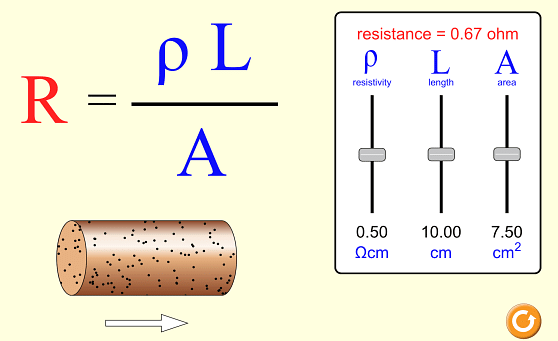
Relation between resistance and length is proportional. When the length of the conductor increases, the resistance also increases. Just with a few mathematical expressions, the relation between resistance and length can be determined. Experimental results serve as proof for the theoretically obtained mathematical relation between resistance and length.
Read More: Difference Between Resistance and Resistivity
| Table of Content |
Key Terms: Power, Resistance, Watts, Joules, Conductors, Electricity, Length, Ohms, Current, Meter
Resistance
[Click Here for Sample Questions]
Resistance is defined as the opposition experienced by the flow of a current. Resistance is denoted by the symbol R. The SI unit of resistance is Ohms.

Resistance
The video below explains this:
Resistance Formula Detailed Video Explanation:
Length
[Click Here for Previous Year Questions]
Length is defined as the physical distance between two points lying anywhere in a three-dimensional space. Length is denoted by the symbol L. The SI unit of length meters.

Length measurement
Mathematical Expression Of Resistance And Length
The relationship between resistance and length can be given by the mathematical formula,
ρ = RA/L
Where,
ρ → Resistivity/ proportionality constant/ specific resistance
R → Resistance of the conductor
A → Area of cross-section of the conductor
L → Length of the conductor
The SI unit of resistivity is ohms-meters (ohm-m).
For a conductor with a constant cross-sectional area, the above mathematical expression can be written as,
ρ = R/L
Check out:
Relation Between Resistance And Length
[Click Here for Sample Questions]
The mathematical expression ∝ = RL can be rearranged in terms of resistance and length. In terms of resistance, the above expression can be given as,
R = ∝ L
Where,
∝ → Proportionality constant.
Removing the proportionality constant, the expression can be expressed as,
R ∝ L
This means that the resistance of a conductor is directly proportional to the length of that conductor.
Thus, when the length of a conductor is increased, its resistance increases. And when the length of the conductor is decreased, its resistance decreases.
Proof of Relation Between Resistance And Length
[Click Here for Previous Year Questions]
Assume that there are two conductors of length L and cross-sectional area A respectively.
When the potential difference is applied across one of these conductors, a current flows through it. Ohm’s law will give the exact equation of this relationship.
R = VI …(1)
Where,
- R → Resistance
- V → Voltage applied across the conductor
- I → Current flowing through the conductor
If two conductors are joined from end to end, the total length of the conductor becomes 2L and the cross-sectional area remains the same i.e. A.
Resistance and Length
Thus, the current flowing through the conductor of length 2L on the application of voltage V is I/2.
Applying ohm's law,
R' = VI/2
R' = 2VI…(2)
Comparing equations (1) and (2),
R' = 2R
When the length of the conductor is doubled, the resistance also doubles. This proves that resistance is directly proportional to length.
Discover about the Chapter video:
Current Electricity Detailed Video Explanation:
Also Check Out:
Things to Remember
- Resistance is defined as the opposition experienced by the flow of a current. It is denoted by the symbol R.
- The formula for resistance is R = ρL/A
- Length is defined as the physical distance between two points lying anywhere in the three-dimensional space. It is denoted by the symbol L.
- The formula for length is L = RA/ρ
- Resistance is directly proportional to length i.e. with an increase in length, resistance increases and with a decrease in length, resistance decreases.
Also Read:
Sample Questions
Ques. Calculate the value of resistance of a 2-meter-long wire with a cross-sectional area of 1.7 × 10⁻⁵ m2 and resistivity 1.86 × 10⁻⁷ Ohm-m. [3 marks]
Ans. It is given that:
Length of the wire (L) = 2 m
Area of cross-section (A) = 1.7 × 10⁻⁵ m2
The resistivity of the material (ρ) = 1.86 ×10⁻⁷ Ohm-m
It is known that:
R = ρL/A
Substituting given values in the above equation
R = 1.86 ×10⁻⁷ Ohm-m x2 m1.7 × 105 m2
= 2.188 × 10⁻² ohms
∴ The resistance of the wire is 2.188 × 10⁻² Ohms.
Ques. What Determines the Resistance of a Wire? [3 marks]
Ans. The resistance of wire changes with a few variables. The factors that affect the resistance of a wire are :
- Cross-sectional area
- Resistivity
- Length of the wire
- The temperature of the wire
Ques. How can you Derive the SI Unit of Resistivity? [3 marks]
Ans. It is known that the formula of resistivity is:
ρ = RA/L
The unit of the resistance is Ohms, length is meters, and the area of cross-section is m2.
Substituting these units in the above equation
ρ = Ohm x m2m= Ohm-m
∴ The unit of resistivity is Ohm-m.
Ques. Define Resistance. What is the SI unit of resistance? Give the formula to calculate resistance. [1 marks]
Ans. Resistance is defined as the opposition experienced by the flow of a current. Resistance is denoted by the symbol R. The SI unit of resistance is Ohms.
The formula for resistance is R = ρL/A
Ques. A secondary cell after long use has an emf of 1.9 V and a large internal resistance of 380 ?. What maximum current can be drawn from the cell? [3 marks]
Ans. It is given that:
Emf of a secondary cell (V) = 1.9 V
Resistance of the secondary cell (R) = 380
It is known that
R = VI
Where I is the maximum current drawn through the battery.
Rearranging the above formula for I
I = VR= 1.9 V380
= 5 x 10⁻³ Ampere
∴ The maximum current that can be drawn from the storage battery of the car is 5 x 10⁻³ Ampere.
Ques. A negligibly small current is passed through a wire of length 15 m and a uniform cross-sectional area of 6.0 × 10⁻⁷ m2. Its resistance is 5.0 ?. What is the resistivity of the material? [3 marks]
Ans. It is given that:
Length of a wire (L) = 15 m
Area of cross-section (A) = 6.0 × 10⁻⁷ m2
Resistance (R) = 5.0
It is known that
ρ = RA/L
Where ? is the resistivity of the material
Substituting given values in this formula
ρ = 5.0 x 6.0 × 10-7 m2/15 m
= 2.0 × 10⁻⁷ Ohm-m
∴ The resistivity of the material is 2.0 × 10⁻⁷ Ohm-m.
Ques. The storage battery of a car has an emf of 12 V. The internal resistance of the storage battery of the car is 0.4 ?. What amount of current can be drawn from the storage battery of the car? [3 marks]
Ans. It is given that:
Emf of a storage battery (V) = 12 V
Resistance of the storage battery(R) = 0.4
It is known that
R = VI
Where I is the maximum current drawn through the battery.
Rearranging the above formula for I
I = VR= 12 V0.4
= 30 Ampere
∴ The maximum current that can be drawn from the storage battery of the car is 30 Ampere.
Ques. Can you calculate the length of a wire if you know the voltage applied across it and the total current flowing through it? [3 marks]
Ans. The relationship between voltage and current is given by the equation
R = V/I
By using this equation you can calculate the resistance of that wire. It is well known that the resistance of a conducting wire is directly proportional to its length.
Thus, the relation between resistance and length is given by
ρ = R/L
If one knows the resistivity of the material of the wire then one can easily calculate the length of a wire if the applied voltage and current flowing are known.
Ques. Write a relation between current and drift velocity of electrons in a conductor. Use this relation to explain how the resistance of a conductor changes with the rise in temperature? [CBSE 2013] [3 marks]
Ans. Relation between current and drift velocity of electrons in a conductor is given by
l = Anevd
where
l = current,
A = area of conductor,
n = number density of electrons and
vd = drift velocity.
With the increase in temperature of a metallic conductor, resistance increases and hence, drift velocity decreases.
Ques. What are the factors that can decrease the resistance through an electrical cord? (3 Marks)
Ans. The equation for resistance is given by R=ρL/A.
From this equation, we can see the best way to decrease resistance is by increasing the cross-sectional area, A, of the cord. Increasing the length, L, of the cord or the resistivity, ρ, will increase the resistance.
Ques. What is the resistance of a 100m length of round copper wire with a radius of 0.3mm?
ρcopper=1.68⋅10−8Ωm (3 Marks)
Ans. Resistance and resistivity are related as follows:
R=ρL/A
A=π(0.0003m)2
A≈2.83⋅10−7
R≈1.68⋅10−8Ωm(100m)/2.83⋅10−7m2
R≈5.94Ω
Ques. Two students are performing a lab using lengths of wire as resistors. The two students have wires made of the exact same material, but Student B has a wire that has twice the radius of Student A's wire. If Student B wants his wire to have the same resistance as Student A's wire, how should Student B's wire length compare to Student A's wire? (3 Marks)
Ans. Resistance is proportional to the length and inversely proportional to the cross-sectional area. The area depends on the square of the radius: A=πr2, so Student B's wire has 22=4 times the cross-sectional area of Student A's wire.
In order to compensate for the increased area, Student B must make his wire 14 the length of Student A's wire. This can be shown mathematically using the equation for resistance: R=ρL/A
Ques. You have a very long wire connected to an electric station. Even though you are supplying 120V from the source, by the time it reaches the station, there is a loss of voltage. The wire is 100 meters long. If 100V reaches the power station, what is the resistivity of the wire? Assume a current of 2A. (5 Marks)
Ans. The voltage drop from the source to the station (the "load") indicates that there is internal resistance in the wire. According to the voltage law, the total amount of voltage drop is equal to the total amount of voltage supplied. Since 100V was supplied, and 100V drops at the station, that means that 20V drops along the wire.
Vsource=Vwire+Vstation
Vwire=Vsource−Vstation
Vwire=120V−100V=20V
Now that the voltage drop across the wire is known, Ohm's law will give the resistance of the wire:
V=IR→R=V/I=20V/2A=10Ω
R=10Ω
The resistivity of the wire is equal to the resistance per unit length, therefore, in order to find resistivity you divide the total resistance by the length:
ρ=R/L=10Ω/100m=0.10Ω/m
Ques. Find the resistivity of a cylindrical wire with a resistance of 100Ω, length of 2m, and cross-sectional area of 4mm2. (3 Marks)
Ans. There exist a formula that directly relates resistance and resistivity. The formula is R=ρLA.
R is resistance, ρ is resistivity, L is length, and A is the cross-sectional area. Solving for ρ, we get ρ=RA/L. Plugging in our givens, we get
ρ=(100Ω) 4mm2(1m/1000mm)2/2m
=.0002Ω⋅m
=0.2mΩ⋅m.
Previous Year Questions
- The current in the given circuit is….[NEET 1999]
- The internal resistance of a cell of e.m.f. 2 V….[NEET 1999]
- In a meter bridge, the balancing length from the left end….[NEET 1999]
- The resistance of a discharge tube is…...[NEET 1999]
- A potentiometer wire of length 1 m and resistance 10Ω is connected in series with a cell...[KCET 1999]
- A micro-ammeter gives full scale deflection at…
- Two ideal batteries of emf V1 and V2 and three resistances...
- Which of the following Material has lowest resistivity… [UPSEE 2016]
- Specific resistance of a conductor material increases with… [COMEDK UGET 2009]
- Two resistances A and B have colour codes orange, blue, white and brown… [COMEDK UGET 2015]
- In the circuit shown the equivalent resistance between A and B is
- Two batteries of emf 4V and 8V with internal resistance
- A material B has twice the specific resistance of
- The length of a conductor is halved. Its conductivity will be
- The masses of three copper wires are in the ratio
- To increase the range of an ammeter, we need to connect a suitable
- Two electric bulbs, one of 200V, 40W and other of
- What is the resistance between A and B in the figure
- The ammeter A reads 2 A and the voltmeter V reads 20 V
- All the resistors are equal in value each being 2 ohm
For Latest Updates on Upcoming Board Exams, Click Here: https://t.me/class_10_12_board_updates
Check-Out:



Comments