



Education Journalist | Study Abroad Lead
Rosenmund reduction reaction is a hydrogenation mechanism that reduces an acyl chloride to an aldehyde preferentially. The reaction is named after Karl Wilhelm Rosenmund, who found the reactions in 1918. In this reaction, hydrogenolysis is used to transform acid chlorides into aldehydes. The Rosenmund catalyst is a mixture of palladium and barium sulfate. With the presence of poison, the performance of the more reactive acyl chlorides is further lowered. To avoid excessive hydrogenation, a toxin such as Thioquinanthrene or thiourea is utilized. If deactivation does not occur, additional degradation of aldehydes may take place, culminating in the creation of secondary alcohol.
| Table of Content |
Key Terms: Rosenmund Reduction Reaction, Hydrogenation, Thioquinanthrene, Barium Sulfate, Aldehydes, Ketones, Alcohol, Palladium, Barium Sulfate, Secondary Alcohol
What is Rosenmund Reduction?
[Click Here for Sample Questions]
Rosenmund reduction is an organic chemical process in which hydrogen gas is transmitted through palladium (Pd) on barium sulfate to transform an acid chloride to an aldehyde (BaSO4). Palladium levels are reduced by barium sulfate because of its reduced covering area. As a result, the lowering potential of palladium is reduced, preventing the acid from being over-reduced.

Rosenmund Reduction Reaction
The Rosenmund catalyst is the name of the catalyst used in the reaction. To inhibit further hydrogenation of some reactive acyl chlorides, the catalyst is combined with a toxin such as thioquinanthrene or thiourea. Additional reductions will occur if the catalyst is not removed, leading to the formation of secondary alcohol. The residual acid chloride reacts with the alcohol to produce an ester.
Also Read:
| Related Articles | ||
|---|---|---|
| Aldehydes, Ketones and Carboxylic Acids | Clemmensen Reduction Reaction | Methyl Ethyl Ketone |
| Electropositivity | Aromaticity | Acetylation |
| Cycloalkanes | Cannizzaro Reaction | Benzyl Alcohol |
Rosenmund Catalyst
[Click Here for Sample Questions]
Rosenmund catalyst is made of palladium and barium sulfate. Palladium drives the removal efficiency, however, barium sulfate decreases palladium activity because barium sulfate has a limited surface area and thus, it prevents excessive reductions. In this process, over-lowering should be prevented for the intended result, which is an aldehyde.
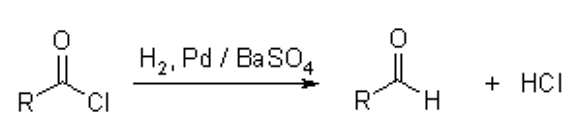
Rosenmund Reduction Reaction
If there is an overproduction, the aldehyde is converted to alcohol which then reacts with the residual acyl chloride to produce an ester. The catalyst is combined with poisons to inhibit further hydrogenation. The Rosenmund catalyst is made by reducing a palladium (II) chloride solution with barium sulfate.
Mechanism of Rosenmund Reduction Reaction
[Click Here for Sample Questions]
The Rosenmund reaction is a process of hydrogenation. This reaction is done in the presence of hydrogen, acyl chloride and barium sulfate. The mechanism for the reaction is as follows:
Step I: When hydrogen gas is transported over acyl chloride in the existence of the Rosenmund catalyst, an aldehyde and hydrochloric acid are formed.
Step II: Over barium sulfate, the resultant aldehyde performs additional reactions with palladium. This results in the creation of alcohol, which then produces an alkane.
Step III: Once the appropriate result is achieved, the Rosenmund catalyst is poisoned to prevent further reduction. This technique can be carried out using a number of poisons.

Mechanism of Rosenmund Reduction Reaction
Uses and Limitation of Rosenmund Reduction Reaction
[Click Here for Sample Questions]
Rosenmund reaction can be used for following purposes:
- The Rosenmund reduction procedure is used to make aldehydes.
- It is employed to manufacture saturated fatty aldehydes.
- It is utilized to make alkyl and aryl aldehydes.
Limitation of Rosenmund Reduction Reaction
This reductive procedure can produce a variety of aldehydes, however, formaldehyde cannot be produced because formyl chloride is fragile at room temperature.
Chemical Diagram of Rosenmund Reduction Reaction
[Click Here for Sample Questions]
An example of Rosenmund reduction reaction is given below:

Chemical Diagram of Rosenmund Reduction Reaction
Things to Remember
- Rosenmund reduction reaction uses hydrogenation mechanism to convert acyl chloride into an aldehyde.
- The catalyst used in the reaction consists of palladium and barium sulfate.
- The catalyst is used along with a poison to prevent further hydrogenation and formation of a secondary alcohol.
- Formaldehyde cannot be produced by this reaction because formyl chloride is unstable at room temperature.
- If hydrogenation is not controlled, the resulting alcohol can react with residual acid chloride to produce an ester.
Also Read:
Sample Questions
Ques. How is acetophenone prepared? (2 marks) [CPMT 2003]
Ans. Acetophenone can only be prepared from Friedel-crafts reaction. The process of Friedel-crafts reaction is done in the presence of acetyl chloride with benzene and anhydrous aluminium chloride. With the respective level of combination of above mentioned chemical substances, acetophenone can be prepared.

Ques. What is Rosenmund's reaction? (2 marks) [JIPMER 1997]
Ans. Rosenmund Reduction is an organic chemical reaction in which hydrogen gas is transferred from an acid chloride and is converted to an aldehyde via palladium (Pd) on barium sulphate (BaSO4). Because of its smaller covering area, barium sulphate lowers palladium levels. As a result, palladium's lowering potential is lowered, which prevents the acid from being over-reduced.
Ques. What is the purpose of adding BaSO4 in Rosenmund’s reaction? (5 marks)
Ans. The Rosenmund reaction is a hydrogenation reaction in which molecular hydrogen combines with an acyl chloride in the existence of palladium on barium sulfate catalyst. Palladium on barium sulfate catalyzes the Rosenmund reaction.
Due to its limited surface area, barium sulfate lowers the activity of palladium, lowering its degradation efficiency and preventing the acid from being over-reduced. To completely disable the palladium catalyst, a toxin might be introduced. The catalyst for this reaction is Pd/BaSO4, which does not participate in the chemical change. Due to hydrogen gas's strong reactivity, it quickly begins a replacement in the acyl chloride, resulting in HCl and the necessary aldehyde.
Ques. Write the structural formula of 1-phenyl pentan- 1- one. (2 marks) (All India 2009)
Ans. The molecular formula of 1 - phenyl pentan - 1 - one is C11H14O.
The element system of 1 - phenyl pentan - 1 - one consist of C - H - O (Chloride, Hydrogen, Oxygen)
The structural formula of 1 - phenyl pentan - 1 - one is shown below:

Ques. Ethanal is water-soluble. Why? (2 marks) (India-wide, 2013)
Ans. H-bonding can be found between the two chemical components of polar molecules of carbonyl group and hydrogen oxide molecules. Ethane is soluble because of the presence of hydrophobic nature in the polar part. This hydrophobic nature will be overcome by the polar part only that allows them to dissolve easily.
Ques. In Rosenmund reduction, which reagent is used? (2 marks)
Ans. Hydrogen gas and a tweaked palladium catalyst are used in the Rosenmund reduction. Acid chlorides are also converted to aldehydes by lithium tri(tert-butoxy) aluminium hydride. This hydride reagent alone would not decrease the aldehyde as LiAIH4 would. Diisobutylaluminum hydride is used to convert esters to aldehydes (DIBAL).
Ques. What is meant by the following terms? (5 marks)
(i) Cyanohydrin
(ii) Acetal
(iii) Semicarbazone
(iv) Aldol
(v) Oxime
Ans. (i) Cyanohydrin: The compounds containing hydroxyl and cyano groups on the same carbon atom are called cyanohydrins.
(ii). Acetal: The compounds in which the terminal carbon contains two alkoxy groups are called acetals.
(iii) Semicarbazones: These are derivatives of aldehydes and ketones. They are produced by the action of semicarbazide.
(iv) Aldols: They are P-hydroxy aldehydes or ketones and are produced by the condensation of two molecules of the same or one molecule each of two different aldehydes or ketones in presence of a dilute aqueous base.
(vi) Oximes: When aldehydes or ketones react with hydroxylamine in a weakly acidic medium, oximes are produced.
For Latest Updates on Upcoming Board Exams, Click Here: https://t.me/class_10_12_board_updates
Check-Out:



Comments