



Content Writer-SME
The word 'science' itself is an acronym whose full form is "systematic and thorough study and exploration of the causes and consequences of nature". Thus, science in everyday life is not limited to just cooking or boiling water. It is way more than that. Large industrial setups that manufacture a range of commodities using various chemical processes are also a part of our daily lives.
The omnipresence and uses of science in everyday life can be seen in everything from the usage of fertilisers in farming to the skin cream that we apply in skin-care routine. Meanwhile, chemical engineers have designed procedures for scaling chemical reactions for commercial uses with basic & advanced rules and principles of chemistry.
The chemistry of atoms and molecules is used to make fertilisers, superconducting ceramics, petroleum products, solvents, polymers, soaps, and detergents, among other things. In this article we will learn in detail about real life applications and science in everyday life.
Related Links
Importance of Science in Everyday Lives
[Click Here for Previous Year Questions]
Science is an essential part of our daily life. The need of new technologies and devices have given more attention to science and scientific research. Thus, we can't deny the importance of science and its applications in our daily lives. Everyone should have a basic understanding of science since it makes life easier and expands our minds in many ways.
Due to the fact that science in everyday life is entirely based on concepts and experiments, it does not change through time; the fundamentals never change. You can see how science is used in almost every part of our lives. Every new technology was founded on scientific principles.
Science and technology are mutually beneficial. Thus, science in everyday life investigates natural occurrences based on facts and develops new technology to make our lives easier.
Science in Everyday Life
Science is a term used to describe the study of the environment. Following are some of the major areas that will highlight the importance of chemistry in daily life more clearly:
- Chemistry is the discipline of science that deals with the study of matter, change in states, and factors that influence these changes.
- It is concerned with the interactions of matter's fundamental constituents.
- Humans, as a rational being, have been unusual in exploring environmental issues, which has led to many discoveries in different parts of the world.
- Animals, chemicals, the force, the earth, plants, and other subjects are researched in different branches of science.
- We get up from bed and apply paste and brush, which is possible only through the applications of science.
- Our daily routine revolves around the application of science, like use of science in cooking, eating food, ironing clothes etc.
Baking requires an elementary understanding of science, and baking equipment such as ovens and microwaves are scientific endowments.
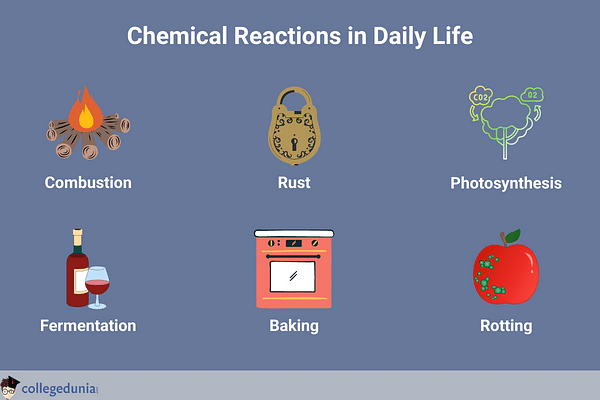
Chemical reactions are the terms used to describe chemical processes. Thus, it can not be denied that we are surrounded by chemical reactions in some way or another. Some of them are created naturally, while others are chemically generated in a commercial setting.
Read More:
| Read more about chemicals used in everyday life | ||
|---|---|---|
| Chemical Tranquilizers | Analgesics | Micelle |
| Antidepressant Drugs | Acetylsalicylic acid | Antacids |
Examples of Science in Daily Lives
[Click Here for Sample Questions]
The following are some examples of how science is used in everyday life:
- To get from one point to another, we utilise automobiles, bicycles, or bicycles, all of which are scientific inventions.
- We use soap, which is also provided by science.
- For cooking, we use LPG gas and stoves, among other things; all of this is provided by science.
- Even the house we live in is a scientific achievement.
- Even the iron that we use to iron our clothes is a scientific development, as are the clothes we wear.
Uses of Science in Different Fields
[Click Here for Previous Year Questions]
Our contact with science begins immediately after we wake up and continues even while we sleep. The concept of science is inherent in everything. Various theories and inventions have been observed in this field based on daily applications. Advancements in various technologies based on necessity revolves around arguments and evidence that are validated by science in everyday life. Following are some examples of applications of science in various fields:
Science in Agriculture
Science has made a significant contribution in the area of agriculture. With the invention of new technologies, sowing seeds in fields have now become more easier. Science has created the tractor, thresher, drip irrigation system, sprinkler irrigation system, and so forth. Chemical science also provides all fertilisers.
- The Green Revolution is responsible for the true success of scientific farming and the use of diverse agricultural technology.
- New farming irrigation systems, such as drip irrigation, and newly created seeds, all contributed to crop improvement.
Science in Medicine
The medical field is completely based on the applications of science in everyday life, from inserting needles to administering medicines to patients. Medicinal chemistry is responsible for all of the medications. With the help of science, equipment and machines like stretchers, ECG machines, MRI machines and even injections used to treat diseases came into existence.
Science in Machines
Human beings are getting more dependent on various tools and machines in their everyday lives be it for cooking, washing clothes, solving complex calculations, etc. Moreover, science has created bicycles, scooters, vehicles, planes, and other innovations. Science in everyday life has provided us with machines that allow us to carry items more easily and quickly.
Science in Transportation
Transportation science and technology advances are crucial in providing communities with a higher quality of life while reducing stress on our current infrastructure. All vehicles and automobiles are scientific inventions. Science has shrunk the planet into a manageable size. In just a few hours, you can travel from Kashmir to Kanyakumari.
Science in Communication
The world has shrunk dramatically with the applications of science in everyday life. In a fraction of a second, you can talk to anyone, anywhere. Telephones, cell phones, and other scientific inventions are all examples of science in everyday lives. All of these communication media are also available at a very minimal cost. As a result, everything is within reach of the average person with the help of science.
Talking on a mobile phone has become quite simple and inexpensive thanks to scientific advancements. Science and technology advancements have had a significant impact on how we connect. Over time, communication methods have progressed from simple text messages and voice conversations to more effective video calls and chat channels with extra communication features.
Science in Construction
All of our structures are built on the foundation of science in everyday life. The construction of structures is done using science-based technology. Science has given us machines like motor graders, bulldozers, and backhoe loaders that are employed in construction.
- Construction is frequently connected with huge constructions such as houses, trains, and power plants in engineering terms.
- Construction is the process of putting together different elements to make a structure for a specific site, using a thorough design and plan.
Read More:
| Read more about chemicals used in everyday life | ||
|---|---|---|
| Antibiotics classification | Antiseptics and disinfectants | Aspirin uses |
| Iodine | Spirochete | Drug Interaction |
Things To Remember
- The use of chemicals for the treatment of humans is known as chemotherapy. Generally used for cancer patients.
- Proteins that perform the role of biological catalysts in the body are called enzymes.
- Some drugs do not bind to the enzyme’s active site. These bind to a different site of enzyme which is called the allosteric site.
- Drugs that bind to the receptor site and inhibit its natural function are called antagonists.
Sample Questions
Ques 1. Why do we need to classify drugs in different ways? (2 Marks)
Ans. The importance of drug classifications cannot be overstated. They help in the prevention of serious side effects and drug interactions. They aid in the breakdown and utilisation of the drug by your body. Many treatment decisions are aided by them. This classification is based on how medications interact with macromolecules. Carbohydrates, lipids, proteins, nucleic acids, and other biomolecules can all be targets for drugs. Drugs with similar structures react similarly to biomolecules of this type. This is chemists' preferred way of classification.
Ques 2. Explain the term, target molecules or drug targets as used in medicinal chemistry. (2 Marks)
Ans. Target molecules or therapeutic targets are important molecules (such as carbohydrates, proteins, and nucleic acids) that are engaged in certain metabolic pathways that contribute to certain disorders in medicinal chemistry. When drug molecules bind to the active sites, they inhibit the target molecules.
Ques 3. Why should not medicines be taken without consulting doctors? (2 Marks)
Ans. A medication can bind to multiple receptor sites at the same time. As a result, a drug may be harmful to certain receptor sites. As a result, drugs in such situations may be poisonous. Taking the medicine without first getting a correct diagnosis could hide signs of an underlying illness that is worsening. It's possible that the dose is incorrect for your body size or weight. To avoid side effects, you may need to take other medications alongside it.
Ques 4. Define the term chemotherapy. (2 Marks)
Ans. Chemotherapy is a medicinal treatment that uses strong chemicals to kill your body's fast-growing cells. Chemotherapy is most commonly used to treat cancer because cancer cells grow and proliferate significantly faster than the rest of the body's cells. Chemotherapy medications come in a variety of forms.
Ques 5. While antacids and antiallergic drugs interfere with the function of histamines, why do these not interfere with the function of each other? (2 Marks)
Ans. Specific medications have an effect on specific receptors. Anti-allergic medicines and antacids target separate receptors. This is why antacids and anti-allergic medicines do not interact with one another's functions but do interfere with histamines' functions.
Ques 6. What is meant by the term ‘broad-spectrum antibiotics? (2 Marks)
Ans. A broad-spectrum antibiotic is one that works against both Gram-positive and Gram-negative bacteria, as well as any antibiotic that works against a large range of disease-causing microorganisms. Azithromycin, amoxicillin, tetracycline, and quinolones are examples of broad-spectrum antibiotics. Glycopeptides and bacitracin are the most popular narrow-spectrum antibiotics used to treat Gram-positive infections, while polymyxins are used to treat Gram-negative bacterial infections.
Ques 7. How do antiseptics differ from disinfectants? (2 Marks)
Ans. Antiseptics, on the other hand, are used on live tissues like wounds, cuts, ulcers, and infected skin surfaces, whereas disinfectants are used on inanimate items like floors, drainage systems, equipment, and so on. Disinfectants are toxic to live organisms. An example of a strong antiseptic is iodine.
Ques 8. What is the tincture of iodine? (2 Marks)
Ans. A tincture of iodine is a weak or dilute solution of elemental iodine in water and alcohol with sodium iodide or potassium iodide. The solution is largely made up of ethanol. Iodine tincture is another name for iodine tincture. It's for minor cuts, scrapes, and wounds.
Ques 9. Why is the use of aspartame limited to cold foods and drinks? (2 Marks)
Ans. Because aspartame is unstable at cooking temperatures, it is only used in cold foods and soft drinks. In comparison to other sweeteners, aspartame is inappropriate for baking and cooking at high temperatures because it breaks down and loses sweetness when heated. It does not heat well, so it cannot be used as a baking or cooking substitute. It's frequently used to sweeten hot drinks like tea and coffee. The Food Standards Agency (FSA) recommends 40 milligrams of aspartame per kilogram of body weight per day as an Acceptable Daily Intake (ADI).
Ques 10. Define Drugs. (2 Marks)
Ans. Drugs are chemicals of low molecular masses which interact with macromolecular targets and produce a biological response.
Ques 11. What are antagonists and agonists? (2 Marks)
Ans. Drugs that bind to the receptor site & inhibit its natural action are called antagonists whereas the drugs that mimic the natural messenger by switching on the receptor are agonists.
Ques 12. Metal hydroxides are used as antacids instead of metal hydrogen carbonates. Why? (2 Marks)
Ans. The stomach produces more acid if there are excessive hydrogen carbonates. Therefore metal hydroxides are better antacids as they are insoluble & do not increase pH above neutrality.
Ques 13. What are antihistamines? Give two examples. (2 Marks)
Ans. Antihistamines prevent the interaction of histamine with the receptors present in the stomach wall e.g. Ranitidine, Soldane etc.
Ques 14. Give two examples of barbiturates. (2 Marks)
Ans. Veronal, Amytal, Nebutal, Liminal & Seconal are some of examples of barbiturates.
Ques 15. What are analgesics? (2 Marks)
Ans. Analgesics are used as painkillers that do not distort any functions of the nervous system.
Ques 16. What are tranquillizers? (2 Marks)
Ans. Tranquillizers are drugs used to treat anxiety and stress. It soothes the nervous system thus releasing stress and tension.
Ques 17. What are antiseptics and disinfectants? (2 Marks)
Ans. Antiseptics and disinfectants are alcohol-based chemicals that kill disease-causing germs, bacterias and viruses and keeps the place clean.
Ques 18. Give two examples of drugs used as antiseptics and disinfectants. (2 Marks)
Ans. Some examples of antiseptics and disinfectants are:
- 0.2% solution of phenol is an antiseptic while its one % solution disinfectant.
- Dettol
Ques 19. Give examples of antifertility drugs. (2 Marks)
Ans. Some Antifertility drugs are as follows.
- Norethindrone
- Novestcof (ethrynylestrediol)
Ques 20. Give some examples of artificial sweeteners. (2 Marks)
Ans. Examples of artificial sweeteners are Aspartame, Saccharin, Alitame, Sucrolse etc.
Ques 21. Which artificial sweetener is preferred for diabetes and why? (2 Marks)
Ans. Saccharin is preferred for diabetic persons as it is excreted from body in urine unchanged. It is entirely inert and harmless when taken.
Ques 22. Name some food preservatives. (2 Marks)
Ans. Some food preservatives are:
- Salt
- Benzoates
- Sorbates
- Nitrites
- Sulphites
- Vitamin E
Ques 23. Why soaps do not work in hard water? (2 Marks)
Ans. Calcium and magnesium ions in hard water form insoluble calcium or magnesium soaps when soap is dissolved in hard water. They separate as scum in water and are useless as cleaning agents. Therefore soaps do not work in hard water.
Ques 24. What are the primary components of soaps? (2 Marks)
Ans. The major components of soaps are:
- Fat or oil
- Alkali
- Distilled water
Ques 25. What are the various basis of classification of drugs? (2 Marks)
Ans. Drugs are classified on the basis of
- Pharmacological effect
- Drug action
- Chemical structure
- Molecular targets
Join Our Telegram Channel for Live Updates on Board Exams: https://t.me/class_10_12_board_updates
Do Check Out:



Comments