



Education Journalist | Study Abroad Lead
Trichloroethylene is a clear, colourless, non-flammable mobile liquid with the chemical formula C2HCl3. It possesses a chloroform-like sweet smell and is used as an industrial solvent and as a degreasing agent in the manufacture of metal parts. Upon combustion, it produces irritants and toxic gases. Though it is manufactured by man and is not found in the atmosphere naturally, it may be released into the atmosphere by evaporation from adhesive glues, paints and other chemicals during their manufacture. It was first prepared in 1864.
| Table of Content |
Key Terms: Trichloroethylene, Trichloroethene, Chloroform, Adhesives, Acetylene, Ethylene, Combustion Reaction, Anesthesia
Structure of Trichloroethylene
[Click Here for Sample Questions]
The molecular formula of Trichloroethylene is C2HCl3 and its IUPAC name is Trichloroethene. This compound is man-made and can not occur naturally in the environment. The structure of Trichloroethylene is as follows:

Structure of Trichloroethylene
The video below explains this:
Trichloroethylene Detailed Video Explanation:
Also Read:
Production of Trichloroethylene
[Click Here for Previous Year Questions]
Trichloroethylene can be produced using the following methods:
-
Using Acetylene
Trichloroethylene can be produced by a two-step process using acetylene. Acetylene is treated with chlorine using ferric chloride catalyst at 90 degrees Celsius to produce 1,1,2,2-tetrachloroethane which is then dehydrochlorinated to give trichloroethylene.
HC≡CH + 2Cl2 → Cl2CHCHCl2
2Cl2CHCHCl2 + Ca(OH)2→ 2ClCH=CCl2 + CaCl2 + 2H2O
-
Using Ethylene
Ethylene is chlorinated over a ferric chloride catalyst to produce 1,2-dichloroethane which when heated to 400 degrees Celsius with more chlorine, gets converted to trichloroethylene.
CH2=CH2 + Cl2 → ClCH2CH2Cl
ClCH2CH2Cl + 2Cl2 → ClCH=CCl2 + 3HCl
Properties of Trichloroethylene
[Click Here for Sample Questions]
The physical and chemical properties of Trichloroethylene are as follows:
Physical Properties of Trichloroethylene
The properties of trichloroethylene are as follows:
- Appearance: Volatile and Colourless Liquid
- Molecular Weight/ Molar Mass: 131.4 g/mol
- Density: 1.46 g/cm3
- Melting Point: -73 °C
- Boiling Point: 87.2 °C
- Viscosity: 0.53 mPa.s at 25 °C
- Surface Tension: 28.7 dyn/cm
- Odour: Chloroform-like odour
- Solubility: Insoluble in water, however, soluble in most organic solvents.
Chemical Properties of Trichloroethylene
Trichloroethylene undergoes a combustion reaction, leading to the formation of carbon dioxide, water and chlorine.
4C2HCl3 + 9O2 = 8CO2 + 2H20 + 6Cl2
Uses of Trichloroethylene
[Click Here for Previous Year Questions]
The major uses of Trichloroethylene are as follows:
- When it was first majorly produced, its use was to extract vegetable oils from plant materials such as soy, coconut and palm. It is also used for coffee decaffeination and preparing flavouring extracts from hops and spices.
- It is used for removing water in the production of 100% ethanol.
- This substance is also been used as a dry-cleaning solvent.
- It is used as a degreaser for machinery parts and equipment and it is used to take out grease from fabricated pieces of metal and some textiles as a solvent.
- It is used in anesthesia for its analgesic properties.
- It is used in the manufacture of a range of fluorocarbon refrigerants. It was also used in industrial refrigerant applications due to its high heat transfer capabilities and low-temperature specification.
- It is an essential ingredient in adhesives, spot removers, typewriter correction fluids, and paint removers.
- It is used as a supplementary agent during nitrous oxide and oxygen anesthesia.
- It is used as a solvent in the production of synthetic fibres, plastics etc.
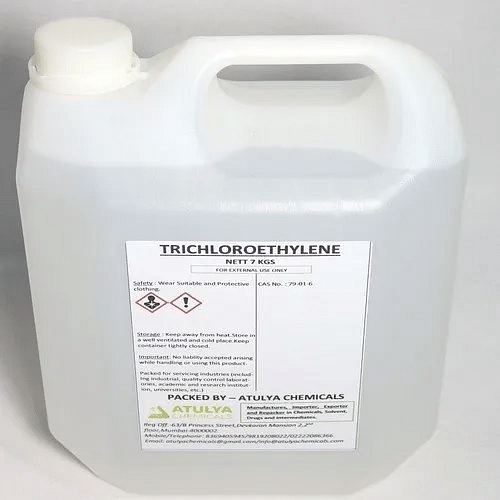
Liquid Trichloroethylene
Human Exposure and Health Hazards
[Click Here for Sample Questions]
Humans can be exposed to it through breathing or through consumption by eating or drinking, and contact with soil contaminated with it. The symptoms of acute non-medical exposure to Trichloroethylene are the same as those of alcohol intoxication, beginning with headache, dizziness and confusion and later on progressing with increasing exposure to unconsciousness.
Respiratory and circulatory depression can result in death. Beyond the effects on the central nervous system, workplace exposure to trichloroethylene has been associated with toxic effects on the liver and kidney. Skin contact with it for a prolonged duration can also cause skin rashes. It is considered to be a likely human carcinogen. It is also a reproductive toxin and can cause birth defects.
Trichloroethylene in Water and Soil
[Click Here for Previous Year Questions]
Exposure to trichloroethylene is mainly through contaminated water and though it dissolves only a little in water, it can remain in groundwater for quite a long time. It is found as vapour in the air when it evaporates from surface water while it shows lesser evaporation from the soil as it sticks to particles and stays there for long.
Things to Remember
- The IUPAC name of trichloroethylene is trichloroethene and its chemical formula is C2HCl3. It is a man-made compound that does not occur naturally.
- It is a clear, colourless mobile liquid with a chloroform-like odour, and it is soluble in organic solvents.
- One of its important chemical properties is that it undergoes a combustion reaction leading to the formation of carbon dioxide, water and chlorine. The reaction is as follows: 4C2HCl3 + 9O2 = 8CO2 + 2H20 + 6Cl2
- Trichloroethylene can be produced using acetylene and ethylene.
- Humans get exposed to trichloroethylene through breathing, drinking, eating, or contact with skin. Health hazards of trichloroethylene include headache, dizziness, toxic effects on the liver and kidney, and skin rashes.
Read More:
Previous Year Questions
- Phosgene is a common name for… (NEET 1988)
- The alkyl halide is converted into an alcohol by… (NEET 1997)
- When chlorine is passed through propene at… (NEET 1993)
- Industrial preparation of chloroform employs acetone… (NEET 1993)
- Which of the following is not chiral… (NEET 2006)
- Which one of the following is an allylic halide…
- Which of the following is responsible for the depletion of the…
- Benzene reacts with n-propyl chloride in the presence of… (NEET 1993)
- The number of enantiomers of the compound… (BITSAT 2013)
- The correct statement(s) about the compound… (JEE Advanced 2008)
Sample Questions
Ques. Give the IUPAC name and structure of trichloroethylene. What is its characteristic odour like? (3 Marks)
Ans. The IUPAC name of trichloroethylene is trichloroethene.
Here is the structure of Trichloroethylene:

It possesses a chloroform-like sweet smell.
Ques. What is the combustion reaction of trichloroethylene? What happens to trichloroethylene when it enters the environment? (3 Marks)
Ans. Most of the trichloroethylene released into the environment comes from its use to remove grease from metals. It can also enter the air and water when it is disposed of at waste sites. Trichloroethylene evaporates easily however, it can stay in the soil and in groundwater for a long time. Also, it breaks down in the air in presence of sunlight. Trichloroethylene present in surface waters or on soil surfaces evaporates into the air. It is highly mobile in soil and susceptible to leaching into the groundwater.
Trichloroethylene undergoes a combustion reaction which is given as follows:
4C2HCl3 + 9O2 = 8CO2 + 2H20 + 6Cl2
Ques. What are the potential risks of trichloroethylene to people? (3 Marks)
Ans. Trichloroethylene is a reproductive toxin and can cause birth defects. Its effects on the nervous system are similar to those of alcohol intoxication, beginning with headache, dizziness and confusion and progressing with increasing exposure to unconsciousness.
Workplace exposure to trichloroethylene has been associated with toxic effects on the liver and kidneys. Prolonged contact with skin can also cause skin rashes.
Ques. What are some uses of trichloroethylene? (3 Marks)
Ans. Some of the uses of trichloroethylene are listed below:
- Trichloroethylene is used for removing water in the production of 100% ethanol.
- It is used in the manufacturing of a range of fluorocarbon refrigerants. It also acts as a dry-cleaning solvent.
- It is an integral component or ingredient in adhesives, typewriter correction fluids, spot removers, and paint removers.
Ques. How are people exposed to Trichloroethylene? (3 Marks)
Ans. People can be exposed to Trichloroethylene in the following ways:
- Through breathing air in the home that is contaminated with Trichloroethylene vapours.
- Drinking, swimming, or bathing in water that has been contaminated with Trichloroethylene.
- Through contact with soil contaminated with Trichloroethylene.
Ques. (a) Trichloroethylene is highly soluble in water. Is the statement true/false? (b) Which catalyst is used in the reaction of acetylene and chlorine-producing tetrachloroethane? (3 Marks)
Ans. (a) The statement is false. Trichloroethylene is not highly soluble but slightly soluble in water. It is miscible with ethers and alcohols.
(b) Ferric chloride is used as a catalyst in the reaction of acetylene and chlorine to give tetrachloroethane whereas barium chloride is used as a catalyst in the reaction to produce trichloroethylene from tetrachloroethane.
Ques. List the industrial uses of Trichloroethylene. (3 Marks)
Ans. The industrial uses of Trichloroethylene are as follows:
- Trichloroethylene is used as a solvent for organic solvents.
- Trichloroethylene is used as anesthesia administered with nitrous oxide. This substance is very effective even when used in low concentration and thus considered a better anesthetic than chloroform and ether.
- It is also used to extract vegetable oil from plant materials.
- Trichloroethylene is used in the food industry for coffee decaffeination and is used for the preparation of flavouring extract from spices.
For Latest Updates on Upcoming Board Exams, Click Here: https://t.me/class_10_12_board_updates
Check-Out:



Comments