



Content Writer
Universal motor is a category of motor which is capable of functioning on both AC (Alternating Current) and DC (Direct Current). It uses an electromagnet to create the required magnetic field. Universal Motor is a type of motor in which coils are connected in series with rotor windings.
- Universal Motor is a device which is capable of converting electrical energy into mechanical energy.
- The connection of the coil in series helps in the generation of high torque.
- Michael Faraday and Henry Joseph were the first to invent the electric motor.
- The motor utilizes the magnetic fields produced by the rotor and the stator to create a rotary motion.
- Universal motors can even operate on all voltages, thus making it universally adaptive.
- These motors are extremely lightweight and compact in design.
Read More: Current density
| Table of Content |
Key Terms: Universal Motor, Electric Motor, Torque, Armature Reaction, Electromagnetic Field, Alternating Current, Direct Current, Eddy current, Speed, Voltages
What is Universal Motor?
[Click Here for Sample Questions]
Universal Motor is a special type of motor that is created with the aim to operate with almost the same features as AC as well as DC power. This unique feature of being able to operate at all types of voltages makes it ‘Universal’.
- Universal Motor can generate a speed of up to 3500 rpm.
- These types of motors are used in portable tools and different types of equipment.
- The structure of the universal motor is similar to the DC motor except for certain changes to let it operate on AC devices.
- It is divided into two categories, namely compensated type and uncompensated type.
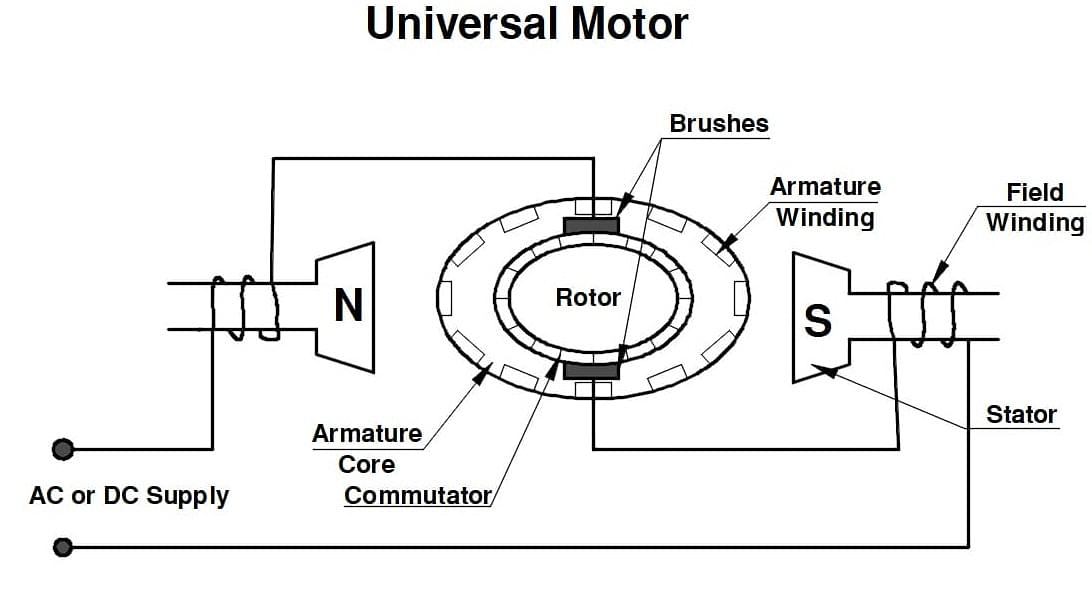
Universal Motor
Read More:
| Related Concepts | ||
|---|---|---|
| Moment of force | Center of Mass | Angular momentum |
| Angular displacement | Torque Formula | Rotational Kinetic Energy |
Features of Universal Motor
[Click Here for Sample Questions]
Some features of a Universal Motor are as follows:
- Universal Motor has a high changeable speed.
- The transmitting torque created by the motor is high.
- Universal Motor is a type of commutation motor.
- These motors are light in weight and hence, finds its application in portable devices.
- Universal motor is less expensive.
- It is a single-phase series motor.
- The motor runs at a very high speed when running on DC supply.
- It runs at a lower speed when using an AC supply due to voltage drop in reactance.
Construction of Universal Motor
[Click Here for Sample Questions]
Design of a universal motor is similar to that of a common brushed DC motor. A universal motor consists of an electromagnetic type of magnet where commutator and brushes are placed on skewed slots. Its main parts are the rotor and the stator.
The main parts of Universal Motor are shown in the figure below are:
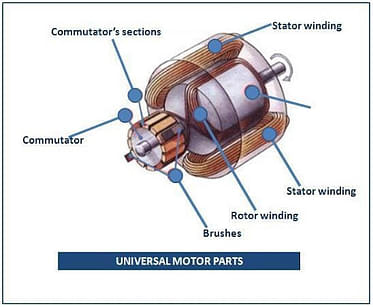
Universal Motor
Stator
It is the stationary part of the motor which contains the following components:
- Laminated case
- Field coils
- Wiring from source
- Brushes
Rotor
It is the rotating part and is also called the armature. It consists of the following-
- Shaft
- Commutator
- Rotor windings
Commutator
The Commutator periodically reverses the direction of current in the rotor and external circuit. This makes sure that the current flowing through the rotor winding is always in the same direction.
Frame
The frame of a universal motor is made up of steel or rolled iron shells. It is responsible for maintaining the laminations of the magnetic field and motor body.
Field Winding
Field Winding is an important component of the Universal Motor. It is responsible for generating the required magnetic field flux within the rotor armature.
Read More: DC Generator
Working Principle of Universal Motor
[Click Here for Sample Questions]
When a universal motor is supplied with a DC supply, it works like a DC Series Motor with brushes. The current passes from the field coil on the stator to the Commutator through the brushes to reach the armature coils or the rotor winding.
- Electric current passes through each segment of the Commutator in the same direction to produce an electromagnetic flux.
- The current-carrying armature conductor experiences a mechanical force or torque due to the magnetic field around it.
- This causes the rotor to spin and works with high efficiency in this arrangement.
When a Universal Motor is subjected to an AC supply, the current will flow in different directions in opposite coils. This is the reason for using a series connection, which causes the polarity change and magnetic flux in winding to reverse at the same time.
- The unidirectional magnetic field and torque action causes the rotor to rotate in the same manner.
- The efficiency of the motor is much lower with AC supply.
- A DC series motor connected to an AC source will not function properly.
- The reason is heavy losses due to eddy currents and a fluctuating magnetic field.
- To avoid this, the stator windings and armature are laminated.
- To change the direction of the rotation of the motor, the connection of windings of either the stator or the rotor needs to be reversed.

Working of a Universal Motor
Read More: Cells In Series and Parallel
Characteristics of Universal Motor
[Click Here for Sample Questions]
The characteristic of universal motor are as follows:
- Universal Motor produces a unique whirring sound when operational.
- The stator and rotor windings are connected in series to create a voltage difference between them.
- The rotor pursues the magnetic field of the stator.
- Universal Motor works with high efficiency in DC supply, but the efficiency decreases when using an AC supply
- The speed of a universal motor is low at full load and very high at no load, i.e. speed is inversely proportional to load.
- The motor is fitted with permanent loads or gear trains to avoid running at no load.
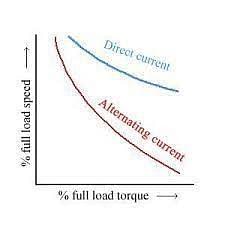
Characteristics of Universal Motor
Read More: Types of Motors
Types of Universal Motors
[Click Here for Sample Questions]
There are two types of Universal Motors:
Non-Compensated Motor
Non Compensated motor has concentrated poles and is used for appliances that require low power. High resistance brushes are used in the construction of the motor to improve commutation.
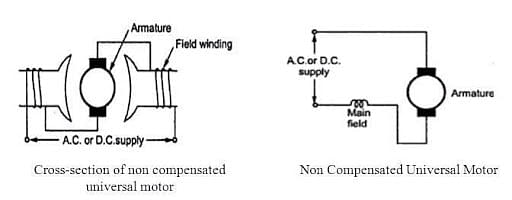
Non Compensated Universal Motor
Compensated Motor
Compensated Motors are type of motor which has a distributed field winding. There is an extra winding in addition to the major field winding called the compensating winding. The extra winding reduces the high voltage reactance in the armature of the motor due to the alternating flux when it is supplied with AC. It is used in appliances that run on high power.

Compensated Universal Motor
Advantages of Universal Motor
[Click Here for Sample Questions]
The main advantages of a Universal Motor that make it suitable for use in household electrical appliances are as follows:
- Simple design, easy construction
- Cheap and inexpensive
- Lightweight
- Very high speed
- Miniature size which makes it compact
- It is ideal for small appliances that require high power.
- Universal Motor are capable of generating a high number of revolutions.
- They run at extremely high speed when connected to single phase A.C. supply.
- It is not used in machines that require continuous use, as the commutator brushes wear out easily.
Read More: Difference Between Motor and Generator
Applications of Universal Motor
[Click Here for Sample Questions]
Universal Motor are most commonly used in electrical appliances where high speed is required. Some of the applications of Universal Motor are as follows:
- Universal Motors ares used in mixer grinders, vaccum cleaner and washing machine.
- They are used inside the motor of fans and air conditioners
- These motors are used in hair dryers, sewing machine and drilling machine.
Read More:
Things to Remember
- Universal motors run at a very high speed at no load, which is quite dangerous.
- It is a series wound double exciting motor
- It has a high starting torque and a variable speed.
- Compensating winding is applied to decrease reactance voltage in the armature when the motor runs on an A.C. supply.
- A Universal Motor produces more power than any other A.C. motor because of its high speed.
Read More: Fleming’s Left Hand Rule
Sample Questions
Ques. How does a universal motor operate on AC and DC supply? (4 Marks)
Ans. When a universal motor is supplied with D.C. supply, it works like a D.C. Series Motor with brushes. The current passes from the field coils on the stator to the Commutator through the brushes to reach the armature coils or the rotor winding.
- Electric current passes through each segment of the Commutator in the same direction to produce an electromagnetic flux.
- The current carrying armature conductor experiences a mechanical force or torque due to the magnetic field around it. This causes the rotor to spin.
- When Universal Motor is subjected to an A.C. supply, the current will flow in different directions in opposite coils.
- This is the reason for using a series connection, which causes the polarity change and magnetic flux in winding to reverse at the same time.
- The unidirectional magnetic field and torque action causes the rotor to rotate in the same manner despite alternating current.
Ques. How can we reverse the direction of rotation in a Universal motor? (1 Mark)
Ans. To change the direction of the rotation of the motor, the connection of windings of either the stator or the rotor need to be reversed.
Ques. What is an armature reaction? (2 Marks)
Ans. In a universal motor, there are two kinds of magnetic flux namely Main Field Flux and Armature Flux. The action of Armature flux on the main field flux is termed as Armature reaction. Armature reaction changes the distribution of the magnetic field and distorts the main flux to make it weak which leads to decrease in the generated voltage.
Ques. Why is compensating winding provided in an A.C. series Universal Motor? (3 Marks)
Ans. In AC series Universal Motor, Compensating winding is provided to reduce sparking of brushes and reduce the effect of armature reaction. Armature reaction changes the distribution of the magnetic field and distorts the main flux to make it weak which leads to decrease in the generated voltage. The compensating winding neutralizes the cross magnetic effect produced by the armature reaction. Also, the pole pieces are laminated to prevent losses due to eddy currents.
Ques. How can you tell if a motor is Universal? (2 Marks)
Ans. On inspecting the rotor and stator core construction, if we find a commutator and brushes then it indicates that the motor can run on either a DC or AC supply and so it is a Universal Motor. The absence of a commutator will denote that it is an AC Motor.
Ques. Why are Universal Motors suitable for use in household electrical appliances? (4 Marks)
Ans. The main features of a Universal Motor that make it suitable for use in household electrical appliances are as follows:
- Simple design, easy construction
- Cheap and lightweight
- Very high speed
- Miniature size which makes it compact and suitable for portable high power tools
- Although Universal Motors are very noisy, they are capable of generating a high number of revolutions and run at extremely high speed when connected to single phase A.C. supply.
- It is not used in machines that require continuous use, as the commutator brushes wear out easily.
Ques. What is the difference between the AC motor and DC motor? (4 marks)
Ans. The difference between the AC Motor and DC Motor are as follows:
| AC Motor | DC Motor |
|---|---|
| AC Motor is a device that converts alternating current into mechanical energy. | DC Motor is a device that converts direct current into mechanical energy. |
| In these types of motors amateur is stationary and magnetic field rotates. | In thes types of motors amateur is rotating and magnetic field is stationary. |
| These motors are slow with respect to load change. | These motors are quick with respect to load change. |
| It require less maintenance as brushes and commutators are absent. | It require more maintenance as brushes and commutators are present. |
Ques. Explain the speed of the universal motor? (2 marks)
Ans. The speed of the universal motor is similar to DC devices. The motor runs at a very low speed when full load is applied to the circuit. The result is the opposite in the case of no lad. It means the speed of the universal motor is very high when no load is applied to the motor. To increase the speed, the motor and gear trains are used. Gear trains help in increasing the load efficiency in the case of universal motors.
Ques. What are the disadvantages of using a Universal Motor? (3 marks)
Ans. The disadvantages of using a universal motor are as follows:
- The life cycle of the universal motor is short.
- Universal motors work best in places where air quality is better.
- There are chances of sparking between commutator and electromagnetic interference.
- The motor gets heated up quickly and requires a large fan to circulate air.
Ques. Explain (A) Electric Coil (B) Slip in Motor (C) Commutator(3 marks)
Ans. (A) Electric Coil: An Electric Coil is a type of conductor where a required amount of electric current is passed in to create a required magnetic field. The direction of the magnetic field can be determined with the help of the right-hand grip rule.
(B) Slip in Motor: Slip in an induction motor is defined as the relative speed between the synchronous speed of the rotating field and the rotor speed. It is also a type of speed that is generated when torque is generated in a motor.
(C) Commutator: A Commutator is defined as a type of electrical switch that is used in electrical generators and motors. It can easily reverse the direction of current between the rotor and the electrical circuit.
Ques. What are the advantages of using universal motors? (3 marks)
Ans.
The advantages of using universal motors are as follows:- Universal Motors are cheap and inexpensive, which are available easily.
- The motor is light in weight and quite compact in design.
- The universal motor will run best for devices which require high power.
- It runs at a very high speed.
Ques. What is the efficiency of the universal motor?
Ans. Efficiency is defined as the amount of work or energy saved during a particular process. In mathematical terms, it is the amount of work done by a machine with respect to the total amount of energy consumed. In the case of universal motors of small size, efficiency is calculated to be around 30 per cent. Similarly, in the case of universal motors of large size, efficiency is calculated to be around 70 – 75 percentage.
Ques. How many types of universal motors are there? (2 marks)
Ans. Universal Motors are of two types, namely compensated type and non compensated type. Non compensated type of motor is a type that uses high brushes to improve the commutation power of the machine. Compensated type of universal motor is defined as the type of motor that is used to reduce the high voltage reactance in the armature of the motor.
Ques. In how many electrical appliances can an individual uses Universal Motor? (1 mark)
Ans. Universal motor can be used in various electrical appliances which are as follows:
- Mixer Grinders
- Vacuum Cleaner
- Fans and Air conditioners
- Hair dryers
- Drills
- Pumps
- Washing Machine
- Sewing Machine
Ques. How can the speed of the universal motor can be controlled? (2 marks)
Ans.The speed of the universal motor can be controlled in the following ways:
- Universal Motor speed can be controlled by using a gear train that will reduce the actual load speed.
- The speed can be controlled by using a centrifugal mechanism.
- Another method to control the speed of a universal motor includes using the resistance method.
For Latest Updates on Upcoming Board Exams, Click Here: https://t.me/class_10_12_board_updates
Check-Out:



Comments