



Exams Prep Master
Generators are gadgets that are used as an alternative to the current supply. They are also used to meet power demands in industries like road construction, mining, offshore drilling, outdoor filming, event management, etc. Generators produce electric energy as current and voltage by using the principle of electromagnetic induction to generate electricity. Here, we will learn about the basic types of generators, generators based on their purpose, fuel used, and discuss some important questions.
| Table of Content |
Key Terms: Generators, AC Generator, DC Generator, Solar Generator, Energy, Fuels, Power, electric energy, voltage, electromagnetic induction
What is a Generator?
[Click Here for Sample Questions]
A generator is basically a device that turns mechanical energy into electrical energy (which can be from coal, oil, natural gas, wind, water, nuclear processes, or other sources). The generator continues to rotate when we apply torque to it. It is because of mechanical energy, rotational mechanics occur. We gain electricity because of this motion. It is based on the concept of energy conservation. The generator, according to the law of conservation of energy, does not produce energy; rather, it converts one kind of energy into another.
Generator
Working Principle of a Generator
[Click Here for Previous Year Questions]
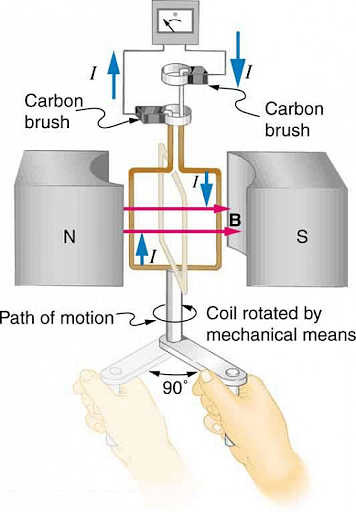
Electromagnetic induction is the basis for electric generators. A conductor coil (a copper coil wound tightly onto a metal core) is rapidly rotated between the poles of a horseshoe-type magnet. An armature comprises a conductor coil and a core. The armature is rotated by connecting it to a shaft of a mechanical energy source, such as a motor. The mechanical energy required can be supplied by engines that run on fossil fuels, such as diesel, gasoline, natural gas, and so on, or by renewable energy sources that are not permanently installed, making them easy to start.
Also Read:
| Related Articles | ||
|---|---|---|
| Difference between AC and DC Generator | AC Voltage Applied to a Capacitor | AC Voltage Applied to a Resistor |
Uses of a Generator
[Click Here for Sample Questions]
Uses of a generator are as follows:
- Generators are beneficial in places where there are frequent power outages, such as residences, shops, and workplaces. They serve as a backup to guarantee that the appliances are not left without electricity.
- Electric generators serve as the principal source of power in remote places where electricity from the mainline is unavailable.
- Electric generators can power machinery or tools on project sites where electricity is not available from the grid.
Types of Generators
[Click Here for Previous Year Questions]
- AC Generators
- DC Generators
AC Generators
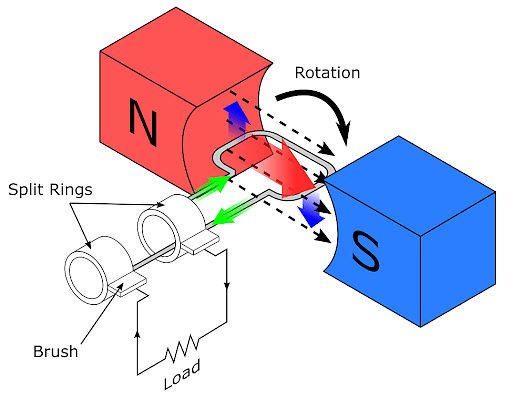
It is also called Alternator. It is a method of generating electrical power in a variety of locations. Since everyone nowadays uses air conditioning. Its operation is based on the electromagnetic induction law. There are two types of AC generators: induction and synchronous.
AC Generators
Advantages of an AC Generator
- Cost-effective.
- In the office, it's ideal for compact and electrical gadgets because it requires less maintenance.
Read Also: Difference Between AC and DC Motor
DC Generator
A DC generator turns mechanical energy into direct current electricity. Separately excited and self-excited DC generators are the two main types.
- Independently excited: Its field coils are powered by an external DC source.
- Self-excited: Its field coils are powered by the generator's current.
There are three different types of self-excited DC generators. – (a) Wound in series Shunt-wound (b) b) A compound wound is a wound that has multiple layers.

DC Generator
Advantages of a DC Generator
- The design is straightforward.
- Large motors are driven.
- The voltage is steady.
Also Read:
| Related Topics | ||
|---|---|---|
| Faraday’s Law of Induction | Unit of Magnetic Flux | Faraday Constant |
| Inductance Formula | Magnetic Induction Formula | Faraday's Law of Electromagnetic Induction |
Types of Generators based on their Purposes
[Click Here for Sample Questions]
They are classified based on their purposes. The uses of these generators are intimately interwoven.
- Portable generators
- Inverter generators
- Standby generators
- Industrial generators
- Induction generators
Portable Generators
Portable generators are extremely handy and are used in a wide range of situations. It is lightweight, safe to operate, dependable, and soundproof, and can be placed outdoors. They are available in a variety of power combinations to meet a variety of applications. When grid electricity fails because of natural catastrophes or calamities, portable generators come in helpful.

Portable Generators
During planned or unplanned power outages, they provide power. They're better suited to home use and smaller business establishments like retail stores and shops, as well as building sites.
Read Also: Electric Flux
Inverter Generators
Installing an inverter generator is the best option if you want low-energy output and a small, silent functioning gadget. Instead of running at full throttle all the time, an inverter generator electronically adjusts the engine's movement to meet electricity demand. The nicest aspect of using such a device is that you won't have to worry about running out of petrol.

Inverter Generators
Standby Generators
Standby generators are designed to automatically turn on when the grid goes down. Residential flats, hotels, restaurants, hospitals, and business facilities with grid power can benefit from these.
Industrial Generators
Generators are used differently in industrial settings than they are in-home or small commercial settings. Industrial or large commercial generators must be more durable and resistant in order to work in hostile environments. They must also be able to deliver a wide range of power supply characteristics, ranging from 20 to 2500 kW, 120 to 48 volts, and single-phase to three-phase. These generators are usually more specialized than regular generators. Industrial equipment comes in a variety of shapes and sizes.
Also Read:Electromagnetism
Induction Generators
Externally excited generators and self-excited generators are the two forms of these devices. Regenerative braking applications in hoists, cranes, elevators and electric trains are all made possible by externally excited generators. Self-excited generators are used in wind turbines, which transform wind as a non-traditional source of energy into electricity.

Induction Generators
Types of Generators based on the Fuel Used
[Click Here for Previous Year Questions]
These are some of the most frequent and popular types of generators, each with its own set of features, attributes, applications, benefits, and drawbacks.
- Gasoline Generators
- Diesel Fuel Generators
- Propane Gas or Vapour Generators
- Biodiesel Generators
- Emulsified Diesel Generators
- Natural Gas Generators
- Hydrogen Generator
- Solar Generators
Also Read: Lenz’s Law
Gasoline Generators
It's among the finest generators because it runs on gasoline and is cheap. They are small in size and are excellent for power models.

Gasoline Generators
Pros
- They are highly cost-effective.
- They are incredibly portable, allowing you to move them around as needed.
Cons
- They emit a lot of pollution.
- They produce a lot of unwanted noise and irritating sounds.
- In cooler conditions, they do not start well or efficiently.
Diesel Fuel Generators
Diesel generators, also known as diesel gen-sets, run on diesel fuel, which is one of the least combustibles of all the fuel sources. Among all generator fuel kinds, it provides the highest energy per gallon. It is a good choice for residential standby generators or commercial generators because it is reliable and easily available. When used for large operations over a long length of time, diesel generators function best. It should only be used in the open air. When properly stored and without extra stabilizers, it can last up to a year.

Diesel Fuel Generators
Pros
- They are extremely long-lasting and durable.
- They are really simple to start, even in freezing weather.
Cons
- They emit harmful fumes that endanger the environment.
- They are not well adapted to wet regions.
- Diesel fuel has a 24-month shelf life and is expensive to store in enormous volumes.
Also Check: Electromagnetic Induction
Propane Gas or Vapour Generators
Propane is a type of liquefied petroleum gas and is the fuel that people often choose to power generators. A propane generator is referred to as a mechanical generator that is used for the purpose of electricity generation. Here, electricity is created by converting motorized power from the combustion of propane into electrical energy.
Pros
- Low-emissions
- Compared to diesel and gasoline generators, they have a longer shelf life.
- Cleanly combust
- It's simple to store in any amount.
- In the event of a power outage, it is readily available.
- Cost-effective and long-lasting
- In chilly conditions, it starts quickly.
- The operation that is quiet
Cons
- Because propane is highly flammable, even explosive, it is stored under pressure.
Biodiesel Generators
Biodiesel is produced by combining diesel with biological sources such as vegetable oil or animal fat. This is a one-of-a-kind generator that can run on gasoline or diesel and has a natural gas connection. This product should not be used inside.
Using biodiesel-fuelled generators helps to avoid harmful blackouts of increased pollution and emissions. These generators can almost remove the byproducts that cause smog, ozone, and sulfur emissions. When these generators are used in residential areas near schools, hospitals, harmful carbon monoxide is significantly reduced.

Biodiesel Generators
Emulsified Diesel Generators
Emulsified diesel is a mixture of diesel fuel and water that has been combined with a mixer.
Pros
Emits fewer pollutants and uses fewer fossil fuels than regular diesel.
Cons
It, too, has a two-year shelf life, and keeping the right water-to-diesel ratio is difficult, especially in fast-paced work conditions.
Also Check: Class 12 Physics Chapter 6 Electromagnetic Induction
Natural Gas Generators
This is one of the most efficient and extensively utilized power and electricity generation methods. Fuels for home standby generators are the most cost-effective and easily available. Per gallon, it is less energy efficient than diesel, gasoline, and propane. Refueling is not required because the gas is delivered through natural gas pipelines. It is the most convenient solution for home and business generators because it does not require storage. Indoors, it should never be used. Power interruptions normally have no effect on supply.
Pros
- They are silent and do not create any disruption.
- They burn cleanly and produce minimal waste.
Cons
- They do not have the same longevity as diesel generators.
- Because of their connection to existing gas lines, they have substantial installation expenses.
Hydrogen Generator
A hydrogen generator is a machine that uses electrolysis to create hydrogen from water.
Hydrogen is used in these generators because it is extremely abundant (particularly from water sources). It is non-toxic, clean, inexpensive, and produces more energy per pound than any other fuel.
Solar Generators
These generators are fascinating because they utilize the sun's radiant energy to generate electricity. Solar generators primarily function by capturing energy from the sun through the use of solar panels. The battery charged with sunlight is then used to generate power. The time it takes for solar generators to full charge is the most critical factor to understand. These generators require nearly eight hours of direct sunlight to charge fully.
Pros
- They are quiet and make no annoying noises.
- They are ideal for applications with modest electrical needs.
Cons
- They are extremely slow in charging their batteries to full capacity.
- When compared to fuel-powered generators, they are prohibitively expensive.
Also Read:
| Related Articles | ||
|---|---|---|
| Energy Consideration | Eddy Currents | Inductance |
| AC Generator | Electromagnetism | Solenoid Engine |
| Faraday Constant | Electromagnetic Induction | Motional emf |
Types of Utility Generators
[Click Here for Sample Questions]
- Welder Generators
- Vehicle Mounted Generators
- PTO Generators
- Two Bearing Generators
- Mobile Towable Generators
Welder Generators
This generator has one unit with welding capabilities. It comes in mobile diesel and portable gasoline versions.
Vehicle Mounted Generators
For mobility, the electric generator can be mounted on vehicles. For instance, in an emergency, construction, mining, or the oil field.
PTO Generators
Power Take-Off (PTO) generators are mobile equipment that generates power by using the engine of a vehicle. PTO generators, which are commonly used in agriculture and by emergency services, offer power to employees in locations where electricity is not available. This type is utilized in fields or commercial areas and is paired with tractors or any crane for portable power generating.

PTO Generators
Mobile Towable Generators
This generator has a switchable voltage function and is utilized in a variety of voltage applications. These diesel-powered generators are employed in the manufacturing and construction industries.
Also Read: Induced electromotive force and current
Things to Remember
- Generators produce electric energy as current and voltage by using the principle of electromagnetic induction to generate electricity.
- AC Generators, DC Generators are two basic types of generators.
- Portable generators, Inverter generators, Standby generators, Industrial generators, and Induction generators are the types of generators based on their use.
- Gasoline Generators, Diesel Fuel Generators, Propane Gas or Vapour Generators, Biodiesel Generators, Emulsified Diesel Generators, Natural Gas Generators, Hydrogen Generators, and Solar Generators are types of generators based on their use of fuels.
- Welder Generators, Vehicle Mounted Generators, PTO Generators, Two Bearing Generators, and Mobile Towable Generators are the types of generators based on their utility.
Also Read: Uses of Inductor
Previous Year Questions
- Two identical circular coils A and B are kept on a horizontal tube side by side… [KCET 2013]
- Faraday's laws are consequence of conservation of… [NEET 1991]
- The number of Faradays(F) required to produce 20g of… [NEET 2020]
- If a transformer of an audio amplifier has output impedance 8000 0 and the speaker has input impedance…...[JCECE 2005]
- A conducting loop in the shape of a right angled isosceles triangle of height 10cm is kept such that the …..[JEE Advance 2016]
- A 10m long horizontal wire extends from North East to South West. It is falling with ……. [ JEE Main 2019]
- If a current of 2.0A A flows through the smaller loop, then the flux linked with bigger loop is…… [JEE Main 2013]
- A coil of cross-sectional area A having n turns is placed in a uniform magnetic field B….. [JEE Main 21018]
- A copper rod of mass m slides under gravity on two smooth parallel rails ….. [JEE Main 2018]
- A copper wire is wound on a wooden frame, whose shape is that of an equilateral…. [JEE Main 2019]
- A metallic rod of length ll is tied to a string of length 2l and made to rotate with angular speed…. [JEE Main 2013]
- A square frame of side 10 cm and a long straight wire carrying current 1 A are in the plane of the paper…. [JEE Main 2014]
- If the rod makes n rotations per second, then the time averaged magnetic moment of the rod is… [JEE Main 2019]
- Figure shows a circular area of radius R where a uniform magnetic field….
- In a coil of resistance 100Ω , a current is induced by changing the magnetic flux through it….. [JEE Main 2017]
- When current in a coil changes from 5A to 2A…. [JEE Main 2015]
- Which radiation in sunlight, causes heating effect?
- X -rays are….
- Arrange the following in decreasing order of wavelength
- Which is having minimum wavelength...[NEET 2002]
- The speed of radio-waves is equal to….. [JIPMER 1998]
- Gamma rays and visible light waves rays are a,ba,b and cc respectively, then….[UPSEE 2016]
- the circular loop of wire is moved with velocity towards the infinite current carrying wire…… [VITEEE 2016]
- A conducting wire frame is placed in a magnetic field which is directed into the paper…...[VITEEE 2019]
Sample Questions
Ques: The primary distinction between an AC generator and a DC generator is that: (1 mark)
(A) An AC generator contains an electromagnet, whereas a DC generator contains a permanent magnet.
(B) A higher voltage will be produced by the DC generator.
(C) An alternating current generator will produce a higher voltage.
(D) Slip rings are used in AC generators, whereas commutators are used in DC generators.
Ans: D. Slip rings are used in AC generators, whereas commutators are used in DC generators.
Ques: What are the types of generators based on the fuel used? (3 marks)
Ans: These are some of the most frequent and popular types of generators, each with its own set of features, attributes, applications, benefits, and drawbacks.
- Gasoline Generators
- Diesel Fuel Generators
- Propane Gas or Vapour Generators
- Biodiesel Generators
- Emulsified Diesel Generators
- Natural Gas Generators
- Hydrogen Generator
- Solar Generators
Ques: How does an alternating current generator generate electricity? (3 marks)
Ans: Faraday's law of electromagnetic induction governs the operation of alternating current generators. The flux linkage of the armature varies continually as it revolves between the magnet's poles on an axis perpendicular to the magnetic field. As a result, an EMF is generated in the armature. As a result, an electric current is passed through the galvanometer, slip rings, and brushes.
Ques: State The right-hand rule of Fleming. Explain the principle, construction, and operation of an AC generator. What changes will you make to ensure that the output is DC? (5 marks)
Ans: When the thumb and central finger of the right hand are kept perpendicular to each other, the thumb shows the direction of conductor motion, and the first finger shows the direction of the magnetic field when the current induced is toward the central finger, according to Fleming's right-hand rule.
Principle: It operates on the electromagnetic induction concept. When the current is created, the induced current is produced.
Construction: A generator, like an electric motor, comprises four major components: a coil, magnets, slip rings, and brushes. A coil is a collection of insulated copper wires twisted around a rectangular frame.
Magnets: A powerful magnetic field can be created by using a large permanent magnet. Slip rings are two solid rings that link the two ends of the coil, which are used to transmit the current created to the outside circuit.
Brushes: Two carbon brushes are still in contact with the slip rings.
Working principle: An axel is used to rotate the generator's coil. When the coil rotates, it cuts through the magnet's magnetic field. Because of electromagnetic induction, a current is induced in the coil.
To get direct current in place of slip rings, split rings are used so that one brush is always in contact with the arm that goes downward. Then the current given out to the outer circuit is in the same direction. This type of generator is called DC generator.
Ques: How do you turn an alternating current generator into a direct-current generator? (2 marks)
Ans: An alternating current generator can be changed to a direct-current generator by replacing the solid ring design with a split ring arrangement.
Ques: Give one advantage of AC over DC. (2 marks)
Ans: One significant advantage of an AC solution over a DC solution is that it can be stepped up and stepped down, so the voltage may be increased or decreased. As a result, it can be transferred over vast distances with little energy loss. As a result, AC is preferred to DC.
Ques: What do you mean by PTO generators? (3 marks)
Ans.Power Take-Off (PTO) generators are mobile equipment that generates power by using the engine of a vehicle. PTO generators, which are commonly used in agriculture and by emergency services, offer power to employees in locations where electricity is not available. This type is utilized in fields or commercial areas and is paired with tractors or any crane for portable power generating.
Ques: What are solar generators? Name its pros and cons. (4 marks)
Ans: These generators are fascinating because they utilize the sun's radiant energy to generate electricity. Solar generators primarily function by capturing energy from the sun through the use of solar panels. The battery charged with sunlight is then used to generate power. The time it takes for solar generators to full charge is the most critical factor to understand. These generators require nearly eight hours of direct sunlight to charge fully.
Pros
- They are quiet and make no annoying noises.
- They are ideal for applications with modest electrical needs.
Cons
- They are extremely slow in charging their batteries to full capacity.
- When compared to fuel-powered generators, they are prohibitively expensive.
Ques: What is meant by propane gas generators? What are its pros and cons? (4 marks)
Ans: Propane is a type of liquefied petroleum gas and is the fuel that people often choose to power generators. A propane generator is referred to as a mechanical generator that is used for the purpose of electricity generation. Here, electricity is created by converting motorized power from the combustion of propane into electrical energy.
Pros
- Low-emissions
- Compared to diesel and gasoline generators, they have a longer shelf life.
- Cleanly combust
- It's simple to store in any amount.
- In the event of a power outage, it is readily available.
- Cost-effective and long-lasting
- In chilly conditions, it starts quickly.
- The operation that is quiet
Cons
- Because propane is highly flammable, even explosive, it is stored under pressure.
For Latest Updates on Upcoming Board Exams, Click Here:https://t.me/class_10_12_board_updates
Do Check Out:



Comments