



Education Journalist | Study Abroad Lead
Unit Vector is a vector that has a magnitude of value 1 or unity pointing at a particular direction in space. Having unit magnitude, it may be thought to be just a direction pointed in space. Unit vectors are usually denoted by a letter with a circumflex (^) on top of it. Often, a unit vector forms the basis of a vector space and every vector in the space can be written as a linear combination of unit vectors.
Read More: Direction of Vector Formula
What is a Unit Vector?
[Click Here for Sample Questions]
A unit vector is a vector which has direction and a magnitude of 1 or unity. A vector comprises two properties namely magnitude and direction. Magnitude refers to the “size” of a vector. For a vector in a graph, its length is its magnitude, while its direction is where it is pointed or how much it is inclined to one of the axes. Some examples of vectors are velocity, force, etc. A vector that only has magnitude is a scalar. Some examples of scalars are volume, density, etc. In the case of a unit vector, the length would be one unit, while it points in the direction. Some examples of unit vectors are the basis vectors of the cartesian coordinate system. It is denoted as .
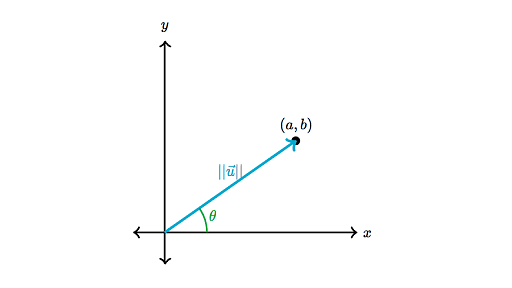
In the figure above, the blue line is a vector. It has some magnitude (||u||) and a direction is given by "theta".

In this figure, the blue and green rays are both unit vectors as their lengths are unity.
Also Read:
Unit Vector Formula
[Click Here for Previous year Questions]
As mentioned above, a unit vector is a vector with direction and unit magnitude. Consequently, a unit vector can be expressed as a division of a vector by its magnitude.
Unit Vector = (Vector)/Magnitude
The magnitude of a vector is

There are two ways to write a vector: Using brackets or as a linear combination of basis vectors x, y and z.
Read More: Vector Formula
For an arbitrary vector represented as

or

Its unit vector is given as
In Bracket Form:

In Linear Combination:

Where,
- is the Unit vector of unit magnitude along the direction of vector a.
- is a vector with any direction and magnitude.
- is the magnitude of the vector .
- x, y, and z are the values of the vector in the x-axis, y-axis and z-axis respectively.
- , , and are unit vectors bound for the positive axis x, y and z respectively.
Calculation of a Unit Vector
[Click Here for Sample Questions]
- A unit vector can be calculated from some given vector. This determines the direction pointed by the given vector. To do this, one needs both the vector expression and its magnitude.
- A vector with only magnitude and no direction is a scalar.
- Dividing the given vector by its magnitude gives the direction it is pointed at, as a unit vector. Here, the unit vector is termed the “direction vector.”
- By doing as mentioned, one reduces the size of the vector to unity only for its direction to remain.
- Conversely, multiplying a unit vector by some scalar, produces a vector, a = sâ where s is a scalar and â is a unit vector. The scalar gives magnitude to the unit vector transforming it into a regular vector.
Read More: Types of Vectors
Example:
Consider a vector a = 2i + 3j + 4k. Calculate its unit vector.
Solution: The given vector is a = 2i + 3j + 4k ------(1) To find the unit vector of some given vector,
Step 1: Find out the magnitude of the vector. The magnitude of any vector is the square root of the sum of squares of its direction cosines. Magnitude, |a| = a = √(x2 + y2 + z2) ------- (2)
From the given vector, x = 2; y = 3 and z = 4. Substitute the values in equation (2).
Magnitude, |a| = a = √(22 + 32 + 42) = √(4 + 9 + 16) = √(29) ----------(3)
Step 2: Dividing the given vector by its magnitude. Unit vector = Vector/Magnitude Hence, â = a/|a| = (xi + yj + zk)/√(x2 + y2 + z2).
Substituting values from equation (1) and (3) â = (2i + 3j + 4k)/√(29)
Step 3: Representation
- In Bracket form, â = ((2/√(29)), (3/√(29)), (4/√(29))
- As a linear combination, â = 2i/√(29) + 3j/√(29) + 4k/√(29))
Things to Remember
- Unit vectors have direction and unit magnitude.
- Unit vector = Vector/Magnitude.
- The unit vector derived from some vector points in its direction.
- Multiplying a unit vector by some magnitude produces a general vector.
- Any vector in the Cartesian Coordinate system can be represented as a linear combination of unit vectors that represent the axes of the system.
- The value of a unit vector is obtained by dividing each of the direction cosines of the vector by its magnitude.
Previous Year Questions
- Two Vectors A And B Inclined At An Angle Have A Re
- The Value Of P So That The Vectors 2 I J K I 2 J 3
- One Of The Following Vector Identities Which Is Fa
- Magnetic Dipole Moment Is A Vector Quantity Direct
- If We Add Two Vectors Of Equal Magnitudes But In O
- If Unit Vectors A And B Are Inclined At An Angle T
- If Subtraction Of Two Vectors Is Also A Unit Vecto
- If A Vector A Makes An Angles And Respectively Wit
- Average Acceleration Vector For A Particle Having
- Hydrostatic Pressure Is A Vector Quantity Pressure
- Among The Following Pseudo Vector Is
- A Vector Is Not Changed If
- A Vector Is Inclined At 30 To The Horizontal If It
- A Unit Vector In The Direction Of Resultant Vector
- If Vectors P A I A J 3 K And Q A I 2 J K Are Perpe
- Given Two Vectors A I 2 J 3 K And B 4 I 2 J 6 K Th
- The Reiation Between Electric Field Vector E The D
- For Any Two Vectors A And B If A B A B The Magnitu
Sample Questions
Ques 1. Find the unit vector in the direction of 4i + 3j. (3 Marks)
Ans. Let the given vector be ‘a’ a = 4i + 3j or (4,3)
Its magnitude is |a| = √(42 + 32) = √(16 + 9) = √(25) = 5 units.
Unit vector in the direction of a is â = a/|a| â = (4i + 3j)/5
Ques 2. Find the unit vector in the direction of 4i + 4j + 5k. (3 Marks)
Ans. Let the given vector be ‘a’ a = 4i + 4j + 5k or (4, 4, 5)
Its magnitude is |a| = √(42 + 42 + 52) = √(16 + 16 + 25) = √(57) units.
Unit vector in the direction of a is â = a/|a| â = (4i + 4j + 5k)/√(57)
Ques 3. Find the unit vector of the resultant of u = (4, -5, 9) and v = (-3, 8, 2). (3 Marks)
Ans. Let the sum of the given vectors be a = u + v a = (4-3, -5+8, 9+2) = (1, 3, 11) a = i + 3j + 11k
Its magnitude is |a| = √(12 + 32 + 112) = √(1 + 9 + 121) = √131 units.
The unit vector of a is â = a/|a| â = (i + 3j + 11k)/√131</p> <p><strong>
Ques 4. Find the unit vector in the direction of -4i + 3j. (3 Marks)
Ans. Let the given vector be ‘a’ a = -4i + 3j or (4,3)
Its magnitude is |a| = √((-4)2 + 32) = √(16 + 9) = √(25) = 5 units.
Unit vector in the direction of a is â = a/|a| â = (4i + 3j)/5
Ques 5. Find the unit vector in the direction of 64i. (3 Marks)
Ans. Let the given vector be ‘a’ a = 64i or (64)
Its magnitude is |a| = √(642) = √(4096) = 64 units.
Unit vector in the direction of a is â = a/|a| â = (64i)/64 = i
Ques 6. Find the magnitude of a = (4, 7). (2 Marks)
Ans.Let the given vector be ‘a’ a = 4i + 7j or (4, 7)
Its magnitude is |a| = √(42 + 72) = √(16 + 49) = √(65) units.
Ques 7. Find the magnitude of a = (5, 8, -12). (2 Marks)
Ans. Let the given vector be ‘a’ a = 5i + 8j - 12k or (5, 8, -12)
Its magnitude is |a| = √(52 + 82 + (-12)2) = √(25 + 64 + 144) = √(274) units.
Ques 8. Find the vector in the direction of 4i + 3j with a magnitude of 6 units. (3 Marks)
Ans. Let the given vector be ‘a’ a = 4i + 3j or (4,3)
Its magnitude is |a| = √(42 + 32) = √(16 + 9) = √(25) = 5 units.
The direction of a is â â = a/|a| â = (4i + 3j)/5
Let the vector in the direction of â with magnitude 6 units be b = 6*â b = 6*(4i + 3j)/5 = (24i + 18j)/5
Ques 9. Find the vector in the direction of 2i + 3j + 4k with a magnitude of (1/3) units. (3 Marks)
Ans. Let the given vector be ‘a’ a = 2i + 3j + 4k or (2, 3, 4)
Its magnitude is |a| = √(22 + 32 + 42) = √(4 + 9 + 16) = √(29) units.
The direction of a is â â = a/|a| â = (2i + 3j + 4k)/√(29)
Let the vector in the direction of â with magnitude (1/3) units be b = (1/3)*â b = (1/3)*(2i + 3j + 4k)/√(29) = (2i + 3j + 4k)/(3√(29))
Ques 10. Find the unit vector of the sum of u = (2, 3) and v = (-3, 4). (3 Marks)
Ans. Let the sum of the given vectors be a = u + v a = (2-3, 3+4) = (-1, 7) a = -i + 7j
Its magnitude is |a| = √((-1)2 + 72) = √(1 + 49) = √(50) units.
The unit vector of a is â = a/|a| â = (-i + 7j)/√50
For Latest Updates on Upcoming Board Exams, Click Here: https://t.me/class_10_12_board_updates
Do Check Out:



Comments