



Content Curator
Allylic Carbon can be defined as one carbon atom bonded to another carbon atom, which in turn is doubly bonded to another carbon atom. The allylic carbon provides distinct chemical properties to the allylic group. The presence of the allylic group in different compounds forms allylic compounds, which are in turn used to prepare a number of natural products like terpenes, natural rubber, and others.
| Table of Content |
Key Terms: Allylic Carbon, Carbon, Double Bond, Organic Compounds, Hydrocarbons, Carbon Atoms, Allylic Compounds
What is Allylic Carbon?
[Click Here for Sample Questions]
According to the modern periodic table of elements, all the known elements are arranged in increasing order by considering the atomic number of each element. Groups are composed of 18 vertical columns and periods are composed of 7 horizontal rows.
Carbon is one of the most widely used non-metals and is the basis of all other organic compounds.
There are two types of double-bonded carbon atoms:
- Vinylic Carbon Atoms
- Allylic Carbon Atoms
The general formula for the vinyl group is R-CH=CH2. There is a double bond between the carbon atoms of the vinyl group, where R is attached at the vinylic position.
- The position of the allylic carbon atom is also like a vinylic one.
- It is doubly bonded to the carbon atom in which it is found, making it an allylic carbon.
- R-CH2-CH=CH2 is the general formula of allyl, where the asterisk represents an allylic carbon atom.
- Because CH=CH2 bonds with allylic carbon atoms through covalent bonds, allylic carbon atoms are sp3 hybridized.
- Different compounds contain allylic carbons, which impart unique chemical properties to the allylic group.
- These compounds are used in the preparation of natural products like terpenes and natural rubber.
Allylic Carbon
Also Read:
| Related Articles | ||
|---|---|---|
| Carbon and Its Compounds | Chemical Properties of Carbon Compounds | Versatile Nature of Carbon |
| Carbon Tetrachloride | Claisen Rearrangement | Halides |
Allylic Carbon Atoms
[Click Here for Previous Year's Questions]
The allylic carbon atom is sp3 hybridized in the allylic group RCH2-CH=CH2 and bonded to the – CH=CH2 group.
As an example, in propene, the highlighted carbon atom is the allylic carbon atom (CH3-CH=CH2). Similar to cyclohexene, cyclohexene's carbon atoms next to the double bond are allylic carbon atoms.
Hydrocarbons
[Click Here for Sample Questions]
Different elements are bonded together with a parent carbon chain to form organic compounds. Organic compounds most commonly consist of hydrocarbons which mainly comprise carbon and hydrogen.
- The tetravalency of carbon allows it to form covalent bonds with four different elements or the same element four times.
- Carbon, because of its tetravalency, exhibits catenation and can form a wide variety of organic compounds.
- Covalent bonds can be formed between carbon or other elements through catenation.
- Carbon atoms are classified into primary, secondary, and tertiary carbon atoms based on how many carbon atoms bond with each other.
In chemistry, a primary carbon atom is one that is bonded to another carbon atom.
For instance, when the carbon atoms in an ethane molecule (CH3-CH3) are both bonded to one another, they are both the primary carbon atoms. There are two carbon atoms bonded together in a secondary carbon molecule, while there are three carbon atoms bonded together in a tertiary carbon molecule.
Allylic Carbocation
[Click Here for Previous Year's Questions]
An ionic species called carbocation carries a positive charge on the carbon atom. In chemical reactions, carbocations form intermediates. They are stable because of steric hindrance and the +I effect of alkyl groups attached to their C+.
The positive charge on the carbocation is reduced as the +I effect increases due to the positively charged carbon atom. Thus we can conclude that the stability of carbocation is directly proportional to the number of alkyl groups on C+.
We can write the stability order of carbocation like this:
Tertiary Carbocation > Secondary Carbocation > Primary Carbocation
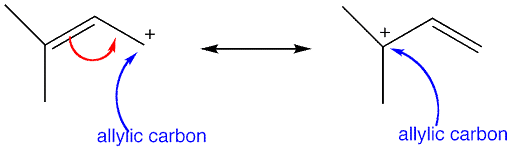
- Whenever an allylic carbon atom carries a positive charge, it forms an allylic carbocation. The allylic carbocation is stable because electrons delocalize on the carbon atom.
- Similarly, the formal charge of allylic carbon in the carbocation of cyclohexene is +1, and it is stabilized by resonance with the pi-bond.
- Primary allylic carbocations are formed when the allylic carbon atom is attached to one carbon atom and has a +1 charge. Here, the primary carbon atom has a formal charge of +1, so it is referred to as a primary allylic carbocation.
- Like cyclohexene cations, secondary allylic carbohydrate ions have a +1 formal charge on secondary carbon atoms.
- There is a +1 charge on a tertiary carbon atom of the cation in the case of a tertiary allylic carbocation.
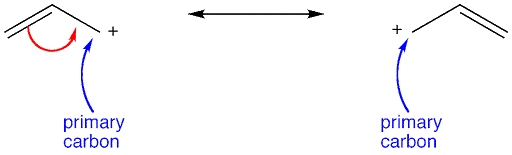
Primary Allylic Carbocation
Also Read:
Things to Remember
- Carbon is a non-metal commonly found in all organic compounds.
- The double-bonded carbon atoms can be classified into two types namely vinylic and allylic carbon atoms.
- Allylic Carbon is a carbon atom bonded to another carbon atom, which is then bonded doubly to another carbon atom.
- The general formula of allyl is R-CH2-CH=CH2, where the asterisk carbon atom is an allylic carbon atom.
- The allylic carbon atom is sp3 hybridized as it bonded with CH=CH2 through a single covalent bond.
- Allylic carbon offers unique chemical properties to the allylic group, which in turn form allylic compounds.
Previous Year Questions
- Which one of the following is not an allylic…
- Which one of the following is an allylic halide…
- In acetylene molecule, between the carbon atoms…
- Which one of the following is most reactive towards electrophilic…
- Isomers of a substance must have the same…
- In which of the following, homolytic bond fission…
- Which one of the following is NOT true regarding electromeric….
- Lassaigne's test is used in qualitative analysis to detect… (NEET1989)
- Which one of the following shows functional isomerism…
- In Kjeldahl's method for estimation of nitrogen present…
- Which of the following does, not show SN2 reaction…
- Which of the following species is not electrophilic in nature… (NEET 2010)
Sample Questions
Ques. Are allyl and vinyl similar? [3 Marks]
Ans. The carbon and hydrogen atoms make up the key structural difference between allyl and vinyl groups. Both groups have similar structures with small variations. Vinyl carbon is an atom that shares a double bond with the carbon atom next to it, whereas allylic carbon is the atom next to the double-bonded carbon atom.
Ques. How are Carbon atoms classified as primary, secondary, and tertiary carbon atoms? [3 Marks]
Ans. Carbon atoms are classified as primary, secondary, and tertiary based on how many carbon atoms bond with each other.
- A primary carbon atom is one that is bonded to another carbon atom.
- Two carbon atoms are bonded together in a secondary carbon molecule.
- Three carbon atoms bonded together in a tertiary carbon molecule.
Ques. Why is allylic more stable than vinyl? [3 Marks]
Ans. An sp hybridized carbon with allyl carbocation is much more stable than one with vinyl carbocation because of its resonance stabilization, while a hybridized carbon with vinyl carbocation has a highly unstable positive charge.
Ques. Why is allyl anion? What is meant by the substitution of alkyl? [3 Marks]
Ans. A typical allylation involves the addition of an allyl anion equivalent to an organic electrophile. Carbonyl allylation produces allylic tertiary alcohol by adding an activated allyl group to a carbonyl group.
A chemical compound with an allylic double bond that jumps to the next carbon atom is called allylic substitution.
Ques. How can benzylic carbon be identified? [3 Marks]
Ans. In benzylic carbon, on the left, we find benzyl bromide (or bromophenyl methane), and on the right, we find phenyl bromide (or bromobenzene). Benzylic carbons are simply saturated carbons, while benzyl groups are benzene rings attached to something else one carbon away.
Ques. How can we use allyl alcohol? [3 Marks]
Ans. The allylic alcohols are the smallest members of the alcohol family that are used to make compounds like flame-resistant materials, drying oils, and plasticizers. Allyl alcohol is used to make glycerol, but it is also used to make many specialized compounds such as flame-resistant materials, drying oils, or plasticizers.
Ques. Can we say that allylic carbocations are more stable than tertiary? [3 Marks]
Ans. The stabilized primary resonance carbocations are less stable than tertiary carbocations such as allyl cation, methoxymethyl cation and benzyl cation. However, stabilized secondary resonance carbocations are much more stable than tertiary carbocations.
Ques. How are allylic carbocations stable? How can we determine if the carbon is allylic? [3 Marks]
Ans. Allylic carbocations are a typical conjugated mechanism. In the sp2 hybridized carbon P orbital, there is a positive carbocation charge. By delocalizing the allyl carbocation, it becomes more stable than a typical primary carbocation.
Normally, allyl is made up of 2 carbon atoms attached to each other twice. This basic formula can be expressed as R-CH-CH=CH2, in which the asterisk carbon atom is an allylic carbon atom.
Ques. Which carbocation is considered most stable, allylic carbocation or substituted alkyl carbocation? [3 Marks]
Ans. An allylic carbocation is considered to be more stable in comparison to the substituted alkyl carbocations. This is because delocalization is associated with the resonance interaction between the positively charged carbon and the adjacent pie bond. The allyl cation can be depicted as a hybrid of two equivalent contributing structures.
Ques. What is the reason for vinyl carbonate being unstable? [3 Marks]
Ans. Vinyl cations are less stable because of the disparity in the hybridization of carbon-containing positive charges. Since sp hybridized carbons have fewer p-characters, they cannot donate more electrons to the positive charge in the empty p-orbital.
For Latest Updates on Upcoming Board Exams, Click Here: https://t.me/class_10_12_board_updates
Also Read:



Comments