



Education Journalist | Study Abroad Lead
1-Butanol is also known as n-butanol or butyl alcohol. When produced biologically, it is also known as biobutanol. It is alcohol comprising a 4 carbon structure having the molecular formula C4H10O. It is mostly used as a solvent, fuel, and as an intermediate in chemical synthesis as well. There exist mainly four isomeric structures for butanol: Straight-chain isomer with the alcohol at an internal carbon is 2-butanol, branched isomer with the alcohol at a terminal carbon named isobutanol, and the branched isomer with the alcohol at the internal carbon named tert-butanol. 1-Butanol is probably in small amounts by gut microbial fermentation via the butanoate metabolic pathway.
| Table of Content |
Key Terms: Butan-1-ol, n-butanol, butyl alcohol, carbon, alcohol, isomer, fermentation, branched isomer, solvent, fuel
What is Butan-1-Ol?
[Click Here for Sample Questions]
Butan-1-Ol is a pale liquid containing a harsh, alcoholic, and sweet banana-like odour. It is an acceptable edible flavouring agent generally used for the production of butter, fruit, rum, cream, whiskey, and ice cream. n-Butanol exists naturally as a minor by-product of the ethanol fermentation of sugars and other saccharides and is perhaps used in the production of a wide range of food and beverages.
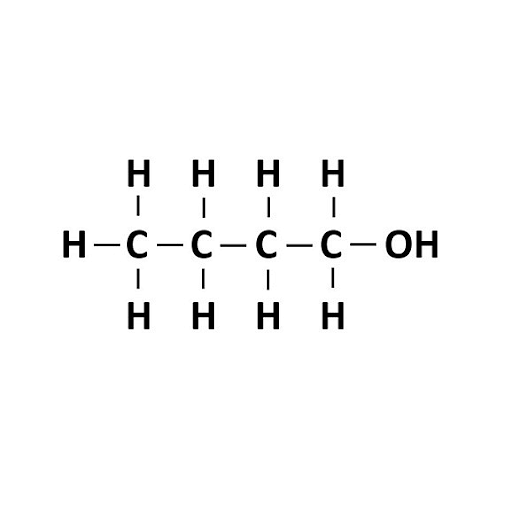
Structure of Butan-1-Ol
Also Read:
| Related Articles | ||
|---|---|---|
| Aldehyde | Formaldehyde | Difference Between Element And Compounds |
| Halogenation | Properties of Matter | Classification of Organic Compounds |
Chemical Properties of Butan-1-Ol
[Click Here for Sample Questions]
The Butan-1-Ol have chemical properties a few of which has been mentioned in the list below:
- The heat produced due to combustion is the energy discharged when a compound undergoes complete combustion with oxygen. The heat of combustion can be expressed as ΔHc.
- Whether a compound will react with water or air is referred to as Chemical stability
- Two of such reactions are Hydrolysis & oxidation and both of them are chemical changes
- Whether a compound will burn upon exposing it to flame is referred to as Flammability. Furthermore, burning is a chemical reaction- typically a high-temperature reaction occurring in the presence of oxygen.
- The lowest-energy oxidation state preferred oxidation state that metal will experience reactions to achieve.
Production of Butan-1-Ol
[Click Here for Sample Questions]
In former periods, butanol was produced from crotonaldehyde, which can also be obtained from acetaldehyde. Before the 1950s, Clostridium acetobutylicum was utilized in industrial fermentation for the production of butanol. Studies in the past few decades revealed different microorganisms that are capable of producing butanol through fermentation.
Since the 1950s, the production of 1-butanol is achieved by the method of hydroformylation of propene (oxo process) to preferentially form the butyraldehyde n-butanal. Butyraldehyde is afterward hydrogenated to produce butanol. Specific catalysts used during the procedure are based on cobalt and rhodium.
Butanol can also be produced by the fermentation of biomass by bacteria. Another technique used for the production of butanol involves the Reppe reaction of propylene with CO and water:
CH3CH =CH2 + H2O + 2 CO → CH3CH2CH2CH2OH + CO2
Physical Properties of Butan-1-Ol
[Click Here for Sample Questions]
Butan-1-Ol is a pale refractive fluid having a harsh, alcoholic, and sweet banana-like odour. It dissolves in water. n-Butanol appears naturally as a minor by-product of the fermentation of sugars and carbohydrates.
The rest of the other physical properties of Butan-1-Ol have been mentioned in the table below:
| Chemical formula | C4H10O |
| Molecular weight | 74.123 g·mol−1 |
| Boiling point | 117.7 °C (243.9 °F; 390.8 K) |
| Melting point | −89.8 °C (−129.6 °F; 183.3 K) |
| Density | 0.81 g/cm3 |
| Solubility | Can be easily soluble in acetone, ethyl ether, miscible with ethanol |
| Acidity (pKa) | 16.10 |
| Refractive index | 1.3993 (20 °C) |
| Dipole moment | 1.66 D |
Structural Formula for Butan-1-Ol
[Click Here for Sample Questions]
The molecular formula for Butan-1-Ol is:
C2 H10 O or C4 H9 OH
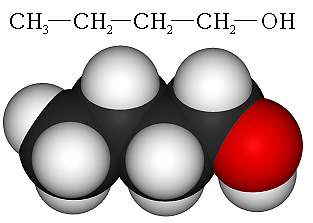
Butan-1-Ol
In extended form, it can also be represented as CH4 (CH2)3OH or CH3CH2CH2CH2OH
Butan-1-Ol is preliminary alcohol having 4 Carbon(C) atoms, 10 Hydrogen (H) atoms, and 1 Oxygen. The structures of Butan-1-Ol in different forms have been shown in the table below:
| 2D Structure |  |
| 3D Structure |  |
| Crystal Structure |  |
Things to Remember
- Butan-1-Ol is a short-chain preliminary fatty, alkyl alcohol that is butane in which the hydrogen of one of the methyl groups is replaced by a hydroxyl group. It is yielded in small quantities in humans by gut microbes. It also functions as an aprotic solvent, a human metabolite, and a mouse metabolite.
- It is a pale fluid or liquid having a strong, characteristic, and mildly alcoholic odour. It is mostly used in organic chemical synthesis, plasticizers, detergents, etc.
- Butan-1-Ol has different synonyms some of which are as follows: 1-butanol, Butan-1-Ol, butanol, n-butanol, butyl alcohol, etc.
- The applications of Butan-1-Ol can be observed in various categories including arts & crafts, cleaning products, household care, metal polish, lamp oil or lighter fuel, coating solvent, etc.
- It is even used mainly as an industrial intermediate in the production of ethers and butyl ether acetates, pharmaceuticals, polymers, and plastics. It is used to a lower extent as a solvent, reactant/diluent, and component in consumer and industrial products.
Also Read:
Sample Questions
Ques. Calculate the molar mass of Butan-1-Ol. (3 Marks)
Ans. Its formula is: C4H9OH.
So, its molar mass will be:
= 4×12.0107+9×1.00794+15.9994+1.00794
= 74.1216 grams per mol.
Thus, the molar mass of 1-Butanol is 74.1216 grams per mol.
Ques. Which one amongst Butan-1-Ol and butan-1-amine will be more soluble in water? Why? (3 Marks)
Ans. Among Butan-1-Ol and butan-1-amine, Butan-1-Ol will be more soluble than butan-1-amine as Butan-1-Ol has OH, and likewise, water is of H+ and OH- in brief, it can be said that OH groups are significantly more identical to that of water molecules. This can also be due to their polarity as they are more polar than N-H bonds so the intermolecular force will be more powerful.
Ques. Illustrate why does Butan-1-Ol has a higher boiling point than butan-2-Ol? (3 Marks)
Ans. Butan-1-Ol has a boiling point of 117 C whereas the boiling point of butan-2-Ol is 108 C. Obviously, Butan-1-Ol has a higher boiling point than that of butan-2-Ol while the H- bonding is common to both. Butan-1-Ol has a straight-chain structure whereas butan-2-Ol has a branched-chain structure accordingly, Butan-1-Ol has more surface area and hence stronger van der Waals forces.
Therefore, Butan-1-Ol has a higher boiling point.
Ques. State a few applications of butanol. (3 Marks)
Ans. Butanol is alcohol comprising a four-carbon arrangement along with the chemical formula C4H10O. It is used in the synthesis of 2-butoxyethanol. A primary application for butanol is that it is used as a reactant with acrylic acid to yield butyl acrylate which is a primary component of water-based acrylic paint. It is even used as a base for perfumes but has a highly alcoholic aroma on its own. It can also be utilized as a fuel in an internal combustion engine. It is more like gasoline than ethanol.
Ques. What would be the correct order of alcohol reactivity in the following reaction? (3 Marks)
R − OH + HCl → R− Cl + H2O (in presence of ZnCl2)
1. 10>20>30
2. 30>20>10
3. 30>10>20
Ans. The proper order for the reactivity of alcohols would be an option (2) i.e.: 30>20>10
R − OH + HCl → R− Cl + H2O (in presence of ZnCl2)
In the above substitution reaction, the hydroxide ion is substituted by the chloride ion.
It is used to categorize the alcohols with lower molecular weight into primary secondary and tert alcohols. The reagent used is named Lucas reagent.
Ques. Why is Butan-1-Ol is called butan-1? (3 Marks)
Ans. 1-Butanol, also known as Butan-1-Ol or n-butanol, is a primary alcohol with the chemical formula C4H9OH and a linear structure. It is alkyl alcohol in which the hydrogen of one of the methyl groups is replaced by a hydroxyl group.
Ques. What are the health hazards of Butan-1-Ol if any? (5 Marks)
Ans. Liquid 1-butanol, which is common in most organic solvents, is extremely irritating to the eyes. Its repeated contact with the skin can also provoke irritation. It is believed to be a generic impact of "defatting".
In the liquid or vapour phase,n-Butyl alcohol might cause irritation in the human eye. It can induce blurred vision, increased tear production, light sensitivity, and burning. n-Butyl alcohol may also render skin and upper respiratory tract irritation. Symptoms of central nervous system depression are the adverse effects possible with high quantities of n-butyl alcohol.
Ques. Among phenols and alcohols which one is more acidic and why? (3 Marks)
Ans. When compared to alcohols, phenols are more acidic as they contain a negative charge in the phenoxide ion that is not localized on the oxygen atom because it is in an alkoxide ion, but is delocalized as it is shared by a number of carbon atoms in the benzene ring.
Alcohols, therefore, are less acidic than phenol. Further electron-withdrawing group (such as– Cl) raises the acidity of phenol.
Ques. Write a short note on Alcohol. (3 Marks)
Ans. They are a type of organic compound that holds at least 1 hydroxyl functional group attached to a carbon atom.
- Usually have the hydroxyl group connected to aliphatic hydrocarbons.
- Less acidic as compared to phenols
- They are the main ingredient in alcoholic beverages. They are even used in ink, pharma, ink, and multiple other industries.
- They are mostly colourless and usually occur in a fluid state.
Ques. Give some main properties of Phenol. (3 Marks)
Ans. They are organic compounds having a hydroxyl group attached to an aromatic system of hydrocarbons (arene).
- Usually contain aromatic hydrocarbons.
- Relatively more acidic and therefore should be diluted prior to their usage.
- They are mainly used as antiseptic agents in medicinal products.
- They are pale solids that usually occur as crystals at STP.
For Latest Updates on Upcoming Board Exams, Click Here: https://t.me/class_10_12_board_updates
Check-Out:



Comments