



Content Writer
Alcohols, Phenols, and Ethers are formed by substituting one or more hydrogen atom(s) from a hydrocarbon with some other atom or a group of atoms. They are functional groups that are found in various naturally occurring molecules.
- Alcohols, Phenols, and Ethers are organic compounds that incorporate C—O bonds.
- Phenols are aromatic compounds that consist of OH groups.
- Alcohols are aliphatic compounds that consist of one or more hydroxyl (OH) group(s).
- Substitution of hydrogen atoms with alkoxy or aryloxy group results in the formation of ether.
- They are classified into monohydric, dihydric, trihydric, and polyhydric categories.
- It consists of two single bonds and two lone pairs of electrons.
- Alcohol and ether are highly soluble in water.
- They are sp3-hybridized with a bent molecular shape.
Key Terms: Alcohols, Phenols, and Ethers, Alcohol, Phenols, Ethers, Hydroxyl Group, Alkyl Group, Aryl Groups, Hydrocarbon, Molecules, Benzene, Functional Group
What are Alcohols, Phenols, and Ethers?
[Click Here for Sample Questions]
Alcohol is a compound that consists of one or more hydroxyl [OH] group(s), which are directly attached to a carbon atom(s) of an aliphatic system (CH3OH). A phenol contains -OH group(s) directly attached to a carbon atom(s) of an aromatic system (C6H5OH).
- Coming to ether, it is a compound formed when a hydrogen atom in a hydrocarbon is substituted by an alkoxy or aryloxy group (R-O/Ar-O).
- Simply, we can define alcohol, phenol, and ether as follows:
Alcohol
Alcohol is formed when a saturated carbon atom bonds to a hydroxyl (-OH) group. It is an organic compound that contains a hydroxyl functional group attached to a carbon atom.
Phenol
Phenol is formed when the -OH group replaces the hydrogen atom in benzene. It is an organic compound with a hydroxyl group directly attached to an aromatic hydrocarbon.
Ether
Ether is formed when an oxygen atom bonds to two alkyl or aryl groups. It is an organic compound with an oxygen atom connected to two aryl and alkyl groups.

Classification of Alcohols, Phenols, and Ethers
Read More:
| Related Concepts | ||
|---|---|---|
| Decarboxylation Reaction | Hydrolysis | Friedel Crafts reaction |
| Ortho Effect | Properties of Alcohol | Decomposition Reaction |
| Catalysis | Rosenmund reduction reaction | Methyl Ethyl Ketone |
Classification of Alcohols, Phenols, and Ethers
[Click Here for Sample Questions]
We classify compounds to make their study easy, systematic, and simplistic. The classification of these organic compounds can be done based on various factors, and we’ll study all those one by one. So the Classification of Alcohol, Phenol and Ether are as follows:
Classification of Alcohol
The Classification of Alcohol is done on the basis of -OH groups and on the number of carbon atoms attached to the -OH groups.
Based on the number of -OH groups that the alcohol contains.
- Monohydric Alcohols: Monohydric alcohols are those compounds that contain only one hydroxyl group in their structure.
Example of Monohydric Alcohols |

- Dihydric Alcohols: Dihydric alcohols are those compounds that contain two hydroxyl groups in their structure.
Example of Dihydric Alcohols
|

- Trihydric Alcohols: Trihydric alcohols are those compounds that contain three hydroxyl groups in their structure.
Example of Trihydric alcohols
|


Based on the number of carbon atoms that are directly attached to the carbon that is bonded to the -OH group
This property is also recognized as ‘hybridization of the carbon atom’. Based on this criterion, the alcohols are classified as primary alcohol, secondary alcohol, and tertiary alcohol.
- Primary Alcohols: Primary alcohols are the ones in which one carbon atom is directly attached to the -OH group.
- Secondary Alcohols: Secondary alcohols are the ones in which two carbon atoms are directly attached to the -OH group.
- Tertiary Alcohols: Tertiary alcohols are the ones in which three carbon atoms are directly attached to the -OH group.

Hybridization of the carbon atom
Classification of Phenol
Phenols are classified based on the number of hydroxyl groups attached to the compound. Based on this criterion, the Classification of Phenolare done as monohydric phenols, dihydric phenols, and trihydric phenol.
Monohydric Phenol
Monohydric phenols are those compounds in which only one -OH group is present.
Example of Monohydric PhenolExample: CH6H5-OH |
Dihydric Phenol
Dihydric phenols are those compounds in which two -OH groups are present. They could either be ortho-, meta- or para- derivatives.
Example of Dihydric PhenolExample: C6H4(OH)2 |
Trihydric Phenol
Trihydric phenols are those compounds in which three -OH groups are present.
Example of Trihydric PhenolExample: C6H3(OH)3 |

Classification of Ethers
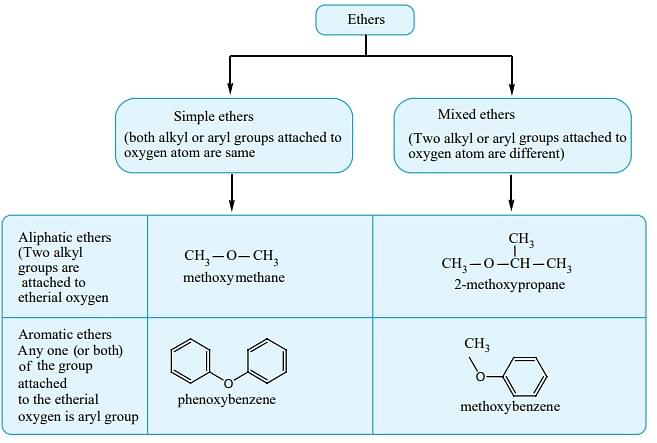
Ethers are classified on the basis of the alkyl or aryl groups attached to the oxygen atom of ether. On the basis of this property, the ethers are classified into two types; symmetrical ether andunsymmetrical ether.
Symmetrical Ethers
Symmetrical ethers are also known as simple ethers. They possess the same alkyl or the aryl group attached to either side of the oxygen atoms. Examples are CH3OCH3 and C2H5OC2H5.
Example of Symmetrical EthersExample: CH3OCH3 and C2H5OC2H5. |
Unsymmetrical Ethers
Unsymmetrical ethers are also known as mixed ethers. They possess different aryl or alkyl groups attached to either side of the oxygen atoms. Examples are CH3OC2H5 and C2H5OC6H5.
Example of Unsymmetrical EthersExample: CH3OC2H5 and C2H5OC6H5 |
Chemical reactions of Alcohol, Phenol, and Ether
[Click Here for Sample Questions]
An individual can understand the various chemical reactions of Alcohols, Phenols, and Ethers based on the following categories which are as follows:
Reaction of Alcohol
There are various chemical reaction involved in the reaction of alcohol which are as follows:
Reaction with Metal
When sodium metal is made to react with ethanol, hydrogen gas and sodium ethoxide is produced.
2ROH + Na → 2RO + Na- + H2
Reaction with Halides
Halogens (like chlorine and bromine) replace the -OH group in alcohol.
ROH + Zn + HCl → R-Cl + H2O
R2C-OH (alcohol) + HCl → R2CCL
Reaction with HNO3
In this reaction, oxidation along with a slow gas evolution takes place.
R-OH + HO-NO2 → R-O-NO2
Reaction with Carboxylic Acid (Esterification)
The reaction of an alcohol with the carboxylic acid in presence of an acid catalyst leads to the formation of ester. It is also called Fischer esterification.
R-OH + R’-COOH + H+ ⇔ R’-COOR
Dehydration of Alcohol
In this reaction, intra-molecular dehydration leads to the formation of alkene while intermolecular dehydration forms ether.
Haloform Reaction
Compound that has CH3CO group that is bonded with a carbon or a hydrogen, in presence of a mild alkali and a halogen gives haloform.
Reaction of Phenol
There are various chemical reaction involved in the reaction of phenol which are as follows:
Formation of Ester
To form phenyl esters, chlorides and anhydrides react with ArOH in the presence of a strong base.
- Consider the case of phenylacetate
(CH3CO)2O + C6H5OH + NaOH → CH3COONa + CH3COOC6H5 + H2O
- Consider the case of phenyl Benzoate
C6H5COCl+C6H5OH+NaOH → C6H5COOC6H5+NaCl+H2O

Formation of Ester
Hydrogenation
Hydrogenation of phenol leads to the formation of cyclohexanone.
Oxidation of Quinones
Phenols get easily oxidized to para-benzoquinone, and para-benzoquinone on further reduction forms quinones.
Electrophilic Substitution
Electrophilic substitution in phenols occurs in certain special mild conditions. This is because they are highly reactive and favor both oxidation and poly-substitution.
Halogenation
There is a formation of monobromophenol, on treating phenols with bromine in the presence of a solvent of low polarity like CHCl3 at low temperature.
Reaction of Ether
There are various chemical reaction involved in the reaction of ether which are as follows:
Air
Most aliphatic ethers convert to peroxides when brought in contact with air. The formation of red color indicates the presence of peroxides. The color will be visible only when the ether is shaken with an aqueous solution of potassium thiocyanate and ferrous ammonium sulfate.
Peroxide + Fe2+ → Fe3+ → Fe(SCN)(3-n)n
Halogenation of Ether
Halogenation of ether in dark leads to the formation of halogenated ethers. The hydrogen atom attached to the C atom is replaced by Halogens.

Electrophilic Substitution Reaction
In this reaction, the aromatic ring gets activated in the same way as in phenol. This is because of the presence of the alkoxy group (-OR) in aromatic ethers.
Physical properties of Alcohol, Phenol, and Ether
[Click Here for Sample Questions]
The important physical properties of Alcohol, Phenol, and Ether are as follows:
Physical properties of Alcohol
The various properties of alcohol are as follows:
- Alcohols have a high boiling point as compared to other hydrocarbons that have equal molecular mass.
- This is due to the presence of intermolecular hydrogen bonding between hydroxyl groups of the alcohol molecules.
- The solubility of alcohols is decided by the hydroxyl group in the alcohols.
- The reason is the hydroxyl group in the alcohol leads to the formation of intermolecular hydrogen bonding.
- With the increase in the size of the alkyl group, the solubility of alcohol decreases.
- The acidity of the alcohol reduces when an electron-donating group is attached to a hydroxyl group.
- The acidic nature of the alcohol is because of its polarity of -OH bond.
- On reacting with the active metal, alcohols form the corresponding alkoxide.
- It increases the electron density of the oxygen atom.
- Lower alcohols are colorless liquids and the alcohols of higher members are waxy solids.

Physical properties of Alcohol
Physical Properties of Phenol
The various properties of phenol are as follows:
- Phenols have higher boiling points when compared with other hydrocarbons of equal molecular mass.
- With an increase in the number of carbon atoms, the boiling point of phenols increases.
- Phenols are soluble in water.
- The reason is hydroxyl group which forms intermolecular hydrogen bonds.
- Hydrogen forms bonds between water and phenol molecules which makes phenol soluble in water.
- Phenols are more acidic than alcohol.
- They react with active metals and give the corresponding phenoxides.
- This reaction decreases the electron density of oxygen.
- Due to this delocalization of negative charge in the benzene ring, phenoxide ions are more stable than alkoxide ions.

Physical properties of Phenols
Physical Properties of Ethers
The various properties of ethers are as follows:
- Due to the polarity of C-O bonds, the ether molecules happen to have a net dipole moment.
- Ether is miscible in water.
- The boiling point of ethers is very low when compared to the alcohols.

Physical properties of Ethers
Preparation of Alcohol, Phenol, and Ether
[Click Here for Sample Questions]
There are so many ways of preparing alcohol, phenol, and ether which are as follows. Let us explore all the industrial and laboratory methods of preparing them one by one.
Preparation of Alcohol
The various techniques for preparation of alcohol are as follows:
Hydrolysis of Alkyl Halides
This is performed by the nucleophilic substitution reaction. Its by-product is olefins ion which makes it a less effective method.
R-X + KOH aq → R-OH
Oxymercuration and Demercuration of Alkanes
This method is most commonly used to make alcohol. In this method, alkenes react with mercuric acetate in the presence of tetrahydrofuran. H2O will produce an alkyl mercury compound.
Preparation of Alcohols from Grignard Reagent
The Grignard reagent is an organometallic compound. It gives upto three types of monohydric alcohols with carbonyl compounds. The general name of the Grignard reagent is alkyl magnesium halide.
- Its general formula is RMgX.
- The Grignard reagent is highly reactive, it reacts with numerous inorganic compounds and almost all organic compounds.
Reduction of Carbonyl Compound
In this method, we get alcohols by the reduction of aldehydes and ketones. The reason is aldehydes can be reduced to primary alcohols. Ketones can be reduced to secondary alcohols.
- This can be carried out by using catalytic hydrogenation.
- It can also be done by reducing agents like lithium aluminum hydride, LiAlH4.
Reduction of Acids to Alcohol
In this method, we use lithium aluminum hydride. LiAlH4 is one of the reagents that can reduce acid to alcohol. Lithium aluminum hydride is a common lab ingredient that is used for the reduction of several classes of compounds.
4RCOOH + 3LiAlH4 → 4RCH2OH
Fermentation
The decomposition of complex organic compounds to simpler organic compounds by the activity of enzymes is called fermentation. This process is followed by the evolution of gases like CH4 and CO2.
- This process is exothermic in nature and hence it releases a lot of energy.
- The process basically consists of the conversion of sugar to ethyl alcohols by yeast.

Preparation of Phenol
The various techniques for preparation of phenol are as follows:
Preparation of Phenols from Haloarenes
Imagine a haloarenes named chlorobenzene. We obtain chlorobenzene by performing the monosubstitution of a benzene ring. When the chlorobenzene is made to fuse with the sodium hydroxide (623K and 320 atm), it gives sodium phenoxide.
- The acidification of sodium phenoxide gives phenols.
Preparation of Phenols from Benzene Sulphonic Acid
On reacting benzene with oleum, we get Benzenesulphuric. Benzene sulphonic acid is then treated with the molten sodium hydroxide at a higher temperature. This process then brings us the penultimate product, sodium phenoxide.
- Finally, sodium phenoxide gives phenols on acidification.
Preparation of Phenols with the use of Diazonium Salts
When an aromatic primary amine is treated with nitrous acid at a temperature of 273-278K, we get diazonium salts. By nature, these salts of diazonium are highly reactive.
- Diazonium salts finally hydrolyze to phenols when introduced to warm water.
- Another way of obtaining phenols is by treating diazonium salts with dilute acids.
Preparation of Phenols from Cumene
Cumene can be obtained by performing the Friedel Crafts alkylation of benzene with propylene. It is an organic compound. When this cumene is oxidized in the presence of air, we obtain cumene hydroperoxide.
- On treating cumene hydroperoxide further with dilute acid, we obtain phenol.
- We also obtain acetone in large quantities as a by-product of this reaction.
- Hence, the purification of phenols obtained from this process is a must.

Preparation of Phenols
Preparation of Ether
The various techniques for preparation of ether are as follows:
Preparation of Ethers by Dehydration of Alcohols
Under different conditions, alcohols undergo dehydration to produce alkenes and ethers in the presence of protic acids (sulphuric acid). Say, we perform dehydration of ethanol at 443K in the presence of sulphuric acid.
- In this condition, the reaction yields ethoxyethane at 413 K.
- This is also considered to be the ideal method of preparation for primary alcohols.
Preparation of Ethers by Williamson Synthesis
Williamson synthesis is used for the preparation of symmetrical and asymmetrical ethers in laboratories. In this method, we conduct a reaction of alkyl halides with sodium alkoxide which gives us ether.
- This reaction generally follows the SN2 mechanism for primary alcohol.
- Williamson synthesis exhibits greater productivity in primary alkyl halides.

Preparation of Ethers
Nomenclature of Alcohol, Phenol and Ether
[Click Here for Sample Questions]
The nomenclature of a compound can tell us why certain compounds got the name that they have. Now, we shall look into the Nomenclature of Alcohols, Phenols and Ethers which are as follows:
Nomenclature of Alcohol
There are three major types of alcohols namely monohydric alcohol, dihydric alcohol, and trihydric alcohol.
Monohydric Alcohol
The general formula of monohydric alcohol is CnH2n+1OH (n=1,2,3 etc). They can also be represented as R-OH where R represents the alkyl group. There are three systems of reading the nomenclature of Monohydric Alcohol which are as follows:
Common System
In this system, the monohydric alcohols are named alkyl alcohols. We get the names by adding the name of alcohol after the alkyl group’s name.
| Example of Common System of Monohydric Alcohol Example: CH3-OH is called Methyl Alcohol. |
Carbinol System
In this system, the name carbinol is given to the methyl alcohols and the other alcohols are given names like alkyl or aryl derivatives of carbinol.
| Example of Carbinol System of Monohydric Alcohol Example: CH3-CH3-OH is methyl carbinol. |
IUPAC System
In IUPAC nomenclature, the alcohols are termed as alkanols. The name of alcohol is determined by replacing the last ‘e’ from the name of the corresponding alkane by ‘-ol’.
- Then we look for the carbon chain which is the longest and has an OH group as the parent chain.
- Next, number the chain in such a way that the OH group gets the smaller number.
| Example of IUPAC System of Monohydric Alcohol Example: CH3-OH is called Methyl Alcohol. |
Dihydric Alcohol
The general formula of dihydric alcohol is (CH2)n(OH)2 (n=1,2,3 etc.). These alcohols happen to have a sweet taste and hence we call them Glycols.
- They can classified as alpha, beta, and gamma glycols, depending upon the relative position of the two hydroxyl groups.
- There are two systems of reading the nomenclature of Dihydric Alcohol:
Common System
In the common system, we add glycol after the name of the alkene to name the alpha glycols. And the beta and gamma glycols get their name as polymethylene glycols.
| Example of Common System of Dihydric Alcohol Example: HO-CH2CH2CH2-OH is called Trimethylene Glycol. |
IUPAC system
In this system, we name the glycols as diols, their class name is said to be Alkanediols.
Trihydric Alcohol
The general formula of trihydric alcohol is (CH2)n(OH)3 (n=3,4,5 etc). There is no general rule for nomenclature. In the IUPAC system of trihydric alcohol, we call them alakanetriols.

Trihydric Alcohol
Nomenclature of Phenols
Phenol is the simplest derivative of benzene. It accepts both a common name and an IUPAC name. In the common and IUPAC names, we name the substituted phenols as the derivative of phenols.
- In the common system, we represent the substituent position of the benzene ring with respect to the -OH group.
- It is done by adding prefixes like Ortho (o-) for 1:2, meta (m-) for 1,3, and para (p-) for 1,4.
- The phenols have either carbonyl groups like aldehyde, ketonic, carboxyl, or an ester group.
- They are given names as hydroxyl derivatives of the parent aromatic compound.

Phenol
Nomenclature of Ether
There are two systems of reading the nomenclature of ether which are as follows:
Common System
We get the names of others by naming the two alkyl or aryl groups linked to the oxygen atom. In the case of symmetrical ethers, before the name of the alkyl or the aryl group, we use the prefix di.
IUPAC system
In the IUPAC system, alkoxyalkanes are ethers. The ethereal oxygen is taken with the smaller alkyl groups and also forms a part of the alkoxy group. On the other hand, the larger alkyl group is taken as part of the alkane.

Nomenclature of Ether
Commercially Important Alcohols
[Click Here for Sample Questions]
Each type of organic compounds has different uses and importance in industries and day-to-day life. Let us learn about all the commercial importance of all major compounds of alcohols which are as follows:
Methanol
Some important uses of methanol are as follows:
- Methanols are a very good polar organic solvent.
- They are also known as wood alcohol.
- It is very broadly used as an industrial solvent.
- Methanols are very good for vehicles, for they have high octane rating and low emission of pollutants.

Methanol
Ethanol
Some important uses of ethanol are as follows:
- Ethanol has high octane ratio and low emission, which makes it a very good motor fuel.
- It is easy to manufacture and hence it is easily available.
- It can be made of natural products such as corn or sugar.
- The alcohol mixes really well with gasoline.
- It can be easily used as an alternative in many cars without any repercussions.

Ethanol
Isopropyl Alcohol
Some important uses of isopropyl are as follows:
- Isopropyl alcohol happens to be a very good solvent, and hence it is called an industrial solvent.
- It is also used in cosmetics because it is rubbing alcohol, hence it is considered safe for skin.
Ethylene Glycol
Some important uses of ethylene are as follows:
- Ethylene glycol is widely used as an automotive antifreeze.
- It is a constant ingredient in hydraulic fluids, printing inks, and paint solvents.
- The reagent is used in making polyesters, explosives, resins, synthetic waxes, and explosives.

Ethylene Glycol
< /div>Things to Remember
- Alcohols, Phenols, and Ethers are organic compounds that are derivatives of alkanes or alkyl groups.
- They are colourless volatile liquids that are highly flammable in nature.
- The compounds are polar organic solvents that are used as industrial solvents.
- Alcohols, phenols, and ethers are naturally organic molecules that are used in glucose, glycerol, and cholesterol.
- They are made of hydroxyl (⎯OH) functional groups.
Read More:
Sample Questions
Ques. Name some common alcohols? (4 marks)
Ans. Some common alcohols are as follows:
- Methanol: It is found in wood smoke and contribute to the creation of new wine. They are metabolized in the body in the form of formaldehyde and formic acid.
- Ethanol: This is the main class of alcohol beverage. It is prepared by the fernentation of honey, grains and fruit juice. They are metabolized in the body in the form of acetaldehyde.
- Isopropanol: It is a colourless liquid that is used in regular household items. The compound can also be used in pharmaceuticals industry.
- Ethylene: It is sweet colourless and viscous liquid that is used in automotive antifreeze.
Ques. What is the difference between alcohol and phenol? (4 marks)
Ans. The difference between alcohol and phenol are as follows:
| Alcohol | Phenol |
|---|---|
| Alcohol are organic compound that consists of atleast one hydroxyl functional group attached to carbon atom. | Phenol are organic compound that consists of atleast one hydroxyl functional group attached to aromatic compound. |
| They are less acidic compounds. | They are more acidic compounds. |
| Alcohol are colourless liquid. | Phenol are colourless solid. |
| They do not react when checked on litmus paper. | They will change the blue litmus paper red. |
Ques. Explain the nomenclature process of alcohol and phenol? (5 marks)
Ans. The nomenclature process of alcohol and phenol are as follows:
- Determine the longest chain to which the hydroxyl group is attached.
- The name is obtained by removing e from the hydrocarbon parent name.
- It is replaced by the ol group.
- Put the number of the longest chain of the hydroxyl group.
- This will determine the lowest carbon atom of the group.
- Determine the position of the hydroxyl group on the basis of carbon atom.
- Lastly, combine the name of the hydroxyl group.
Ques. Name the physical properties of alcohol? (3 marks)
Ans. The physical properties of alcohol are as follows:
- The boiling point of alcohol increases with the increase in the number of carbon atoms.
- They are highly soluble in water.
- The acidity of the alcohol decreases with the addition of an electron-donating group.
- Alcohol is a colourless liquid.
Ques. Name some phenols? (3 marks)
Ans. Some common examples of phenols are as follows:
- Cresol: It is also known as ortho-cresol, or 2-methylphenol. The compound is used as solvents, in disinfectants and deodorizers.
- Orthophenol: It is also known as 2-phenylphenol that is used as an ingredient in Lysol, and in agricultural fungicide.
- Xyleno: It is also known as dimethylphenols. The compound is used in pesticides, and are also used in the manufacture of many other compounds.
Ques. What is the difference between ether and phenol? (4 marks)
Ans. The difference between alcohol and phenol are as follows:
| Ether | Phenol |
|---|---|
| Ether are organic compound that when oxygen atom is attached to alkyl or aryl group. | Phenol are organic compound that consists of atleast one hydroxyl functional group attached to aromatic compound. |
| They are less acidic compounds. | They are more acidic compounds. |
| Ether are miscible in water | Phenol are soluble in water |
| They have low chemical reactivity. | They have high chemical reactivity. |
Ques. Explain the fermentation process of alcohol? (3 marks)
Ans. In the fermentation process of alcohol, the decomposition of complex organic compound to simpler organic compound take place in presence of enzymes. The fermentation process is followed by evolution of gases like CH4 and CO2.
- It will release a lot of energy as it is an exothermic process.
- The process will convert sugar into ethyl alcohol by the use of yeast.
Ques. Explain the Zaitsev Rule? (3 marks)
Ans. Zaitsev Rule is used for dehydration of alcohol to produce required alkene. The alcol will undergo elimination reaction to produce requirec alkene. It result in the removal of hydrogen bond in place of beta carbon.
- The process was named by Alexander Zaitsev.
- In this the alpha carbon is attached to the leaving group.

Ques. What are the chemical reaction used in the preparation of ester? (2 marks)
Ans. The chemical reaction used in the preparation of ester are as follows:
(CH3CO)2O + C6H5OH + NaOH → CH3COONa + CH3COOC6H5 + H2O
C6H5COCl+C6H5OH+NaOH → C6H5COOC6H5+NaCl+H2O
Ques. In how many categories ether group are categorized? (2 marks)
Ans. Ether group are categorized into two groups which are as follows:
- Symmetrical Ethers: Symmetrical Ethers possess the same alkyl or the aryl group attached to either side of the oxygen atoms. They are also known as simple ether. Some common examples are CH3OCH3 and C2H5OC2H5.
- Unsymmetrical Ethers: Unsymmetrical ethers possess different aryl or alkyl groups attached to either side of the oxygen atoms. They are are also known as mixed ethers. Some common examples are CH3OC2H5 and C2H5OC6H5.
Ques. What is the difference between ester and ether? (4 marks)
Ans. The difference between ester and ether are as follows:
| Ester | Ether |
|---|---|
| Ester are made up of the carbonyl group | Ether are not up of the carbonyl group |
| They are derived from carboxylic acids | They are derived from alcohols. |
| Ester consists of double between carbon and hydrogen atom. | Ether consists of single between carbon and hydrogen atom. |
| They do not have symmetrical structures. | They have symmetrical structures. |
For Latest Updates on Upcoming Board Exams, Click Here: https://t.me/class_10_12_board_updates
Check-Out:



Comments