



Education Journalist | Study Abroad Lead
Crystalline Solids are the most prevalent type of solid substance present in nature. In a highly organized microscopic structure, crystalline materials are made up of atoms, ions, and molecules arranged in precise and recurring three-dimensional patterns, generating a crystal lattice that stretches in all directions. Crystalline solids, unlike amorphous substances, have distinct melting points. Metallic, ionic, network atomic, and molecular solids are all crystalline solids, as are real solids. Crystals have relatively sharp, well-defined melting points; that is, the regularity of the crystalline lattice provides similar local environments. As a result, the solid's intermolecular interactions are uniform, and the same amount of thermal energy is required to break each contact at the same time. Quartz, calcite, sugar, mica, diamonds, snowflakes, rock, calcium fluoride, silicon dioxide, and alum are examples of crystalline solids. In this article, we will have a look at the definition of Crystalline Solids, as well as its classification and sample questions.
| Table of Content |
Key Takeaways: Crystalline Solids, Covalent Solids, Metallic Solids, Ionic Solids, Amorphous Solids, Quartz, calcite, sugar, mica, diamonds, snowflakes, rock, calcium fluoride, silicon dioxide, alum
What is a Crystalline Solid?
[Sample Questions on Crystalline Solids]
Solids are defined by a three-dimensional arrangement of atoms, ions, or molecules in which the constituents are mostly fixed in their places. A crystalline solid is formed by arranging the components in a regular repeating three-dimensional array (a crystal lattice), whereas an amorphous solid is formed by arranging them more or less randomly. Crystalline substances have sharp melting points, well-defined edges, and faces, and diffract x-rays. Amorphous solids, curved surfaces, make x-ray diffraction patterns with an inadequate resolution and melt over a wide range of temperatures.
The particles that make up a solid substance, whether ionic, molecular, covalent, or metallic, are kept together by strong attraction forces between them with few exceptions.
- When we talk about solids, we're talking about atoms, molecules, and ions' locations in space, which are basically fixed, rather than their movements (which are more important in liquids and gases).
- A solid's elements can aggregate in one of two ways: they can form a regular repeating three-dimensional structure called a crystal lattice, resulting in a crystalline solid, or they can aggregate in any sequence, resulting in an amorphous solid (from the Greek ámorphos, meaning "shapeless").
Internal structures of crystalline solids, or crystals, are unique, which leads to separate flat surfaces, or faces. The characteristic angles are independent of the crystal's size; they represent the atoms, molecules, or ions' regular repeating arrangement in space.

Also Read:
| Related Articles | ||
|---|---|---|
| Metallic Bonds | Bravais Lattices | Close Packing in One,Two and Three Dimensions |
| Gay-Lussac’s Law | Dalton’s atomic theory | Nucleophilic Substitution |
Classification of Crystalline Solids
[Sample Questions on Crystalline Solids]
On the basis of the type of bonding inherent in their component particles, these solids are divided into four classes:
Molecular Solids
Molecules are the particles that make up these solids. The weak Van der Waal forces of attraction hold these molecules together. These solids are soft by nature due to the existence of weak forces. As there are no free electrons in molecular solids, they are poor conductors of electricity. They evaporate readily because their melting and boiling temperatures are low. For instance, ice, solid CO2 (dry ice), and so on.
The following are the three classes of molecular solids:
-
Polar Molecular Solids
The molecules in these molecular solids are connected by a polar covalent link. The difference in electronegativity of the atoms involved in bonding causes polarity to form in their connection. As a result, partial charges occur on atoms, forming a dipole-dipole interaction force that keeps the solid together. For instance, SO2.
-
Non-Polar Molecular Solids
Atoms/elements in these solids create a molecule, which is then joined by a non-polar bond to produce a molecular solid. These solids are soft because their Van Der Waals forces are weak. The bonds between these substances have no polarity since they are made up of the same atoms or molecules, such as Cl2 (one chlorine atom is bonded to another by a single non-polar bond).
Hydrogen-Bonded Molecular Solids
A hydrogen bond is formed when hydrogen bonds with fluorine, oxygen, or nitrogen. These are polar covalent bonds with relatively high strength. The electronegativity difference between hydrogen and the other element, which might be N/O/F, causes polarity to emerge in hydrogen bonds. Hydrogen-bonded molecular solids are solids that include these linkages. For instance, hydrogen fluoride (HF), water (H2O), and so on.
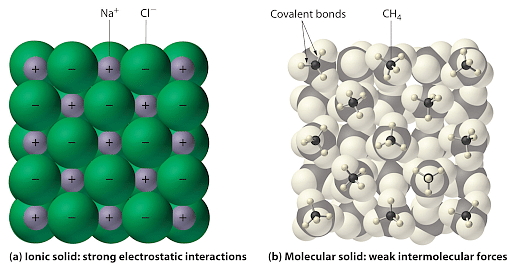
Ionic Vs Molecular Solid
Ionic Solids
Ionic Solids are the solids that ions produce. The strong electrostatic forces of attraction within the material bring these ions together. Ions are charged particles that come in two types: cations (positively charged) and anions (negatively charged). In the ionic solid, these ions are organized in a systematic manner.
Electrostatic attraction is the force of attraction that exists between cations and anions. These powerful forces contribute to the solids' hardness, brittleness, and high melting points. Only in a molten/aqueous condition do these substances conduct electricity. The reason for this is that ions are only free to travel in these states, as opposed to solid states where they are fixed.
Sodium chloride (NaCl), lithium fluoride (LiF), and other ionic solids.
Covalent Solids
Covalent Solids are also known as network solids since they're made up of a dense network of covalent connections between the atoms that make up the solid. The component atoms/elements are neutral atoms that can be the same as diamond (all carbon atoms are linked together by covalent bonds) or different, such as silicon carbide (SiC), also known as carborundum.
Diamond is the world's hardest material and is a covalent solid. Because of its hardness, it is employed in the glass cutting business. Because all of the electrons of the component atoms are shared to create covalent bonds, covalent solids are also poor conductors of electricity.

Metallic Solids
The structure of metallic solids has fixed positive ions surrounded by free electrons. Metallic solids are strong conductors of electricity and heat because of these unbound electrons. In the case of metallic materials, the pool of electrons contains positive ions. Metallic solids' melting and boiling values can range from moderate to high. They might be firm or soft solids (like sodium and potassium).
Copper, nickel, and manganese are some examples of metallic solids.
Properties of Crystalline Solids
[Sample Questions on Crystalline Solids]
Anisotropic crystalline solids have physical qualities such as electrical resistance or refractive index that vary when measured in various orientations inside the same crystal. Because of their long-range order and uneven arrangements in all directions, amorphous solids are isotropic. The different properties of Crystalline Solids are:
- Crystalline solids have three-dimensional patterns that contribute to crystal lattice development.
- In nature, crystalline solids are anisotropic, meaning they have distinct characteristics in various directions.
- A rigid structure exists in a crystalline solid.
- The geometry of a crystalline solid is perfectly regular.
- Cleavage of crystalline materials into two smooth surfaces is possible.
- Crystalline solids have a defined fusion heat.
- They have a very high melting point.

Difference between Crystalline and Amorphous Solid
[Sample Questions on Crystalline Solids]
| Crystalline solids | Amorphous solids |
|---|---|
| The component particles are organized in a regular pattern that includes both short- and long-range order. | The individual particles are not grouped in any particular order. There may only be a very short-term order. |
| Crystalline solids are geometrically defined. | They have a variety of forms. |
| They have extremely high melting points. | Amorphous solids melt at various temperatures. |
| Crystalline solids are anisotropic in nature. | They're isotropic. |
| They have a distinct fusion heat. | Amorphous solids don't have a distinct fusion heat. |
| Crystalline solids have a smooth cleavage. | They are carved in an uneven pattern. |
| They are solids in every sense of the word. | Amorphous solids are either supercooled liquids or pseudo solids. |
| Quartz, for example, is crystalline SiO2. | Silica glass, for example, is made up of amorphous SiO2. |
The video below explains this:
Amorphous and Crystalline Solids Detailed Video Explanation:
Read More:
Things to Remember
- In nature, crystalline solids are not isotropic. They are anisotropic, meaning they have distinct characteristics in various directions.
- Sharp melting point, extended-range order, and defined regular geometry are all characteristics of crystalline solids.
- The atoms, ions, or molecules in crystalline materials have a particular regular geometry.
- In general, crystalline solids produce crystal lattices that extend in all directions.
- True solids are also known as crystalline solids.
- Covalent solids, ionic solids, molecular solids, and metallic solids are the four forms of crystalline solids.
- Diamond, sodium chloride, and sodium nitrate are examples of crystalline solids.
Sample Questions
Ques. Why Graphite, being a covalent solid, is a good conductor of electricity? (3 marks)
Ans. All of the elements of graphite are connected by covalent bonds, making it a covalent solid. Because there are no free electrons to move within the crystal, covalent solids are often poor conductors of electricity. Graphite, on the other hand, is an exception, since the carbon atoms are connected in a hexagonal configuration and the hexagons are present in layers. One electron out of every four carbon atoms is free to flow out of each layer for the purpose of conducting electricity, thanks to this hexagon layered structure.
Ques. Differentiate between Crystalline and Amorphous Solids. (5 marks)
Ans. The differences between amorphous and crystalline solids are as follows:
- Amorphous solids do not have a regular arrangement, whereas crystalline solids have.
- As a result of this arrangement, crystalline solids have both short- and long-range orders, whereas amorphous solids only have a shorter range order.
- Amorphous materials melt across a wide range of temperatures, whereas crystalline solids have a sharper melting point.
- Amorphous solids do not have a particular heat of fusion, whereas crystalline solids do.
- When a crystalline solid is cut with a knife, the edge is cleaner and clear, however, when an amorphous solid is sliced with a knife, random patterns appear.
- In nature, crystalline materials are anisotropic, whereas amorphous solids are isotropic.
Ques. Is glass a crystalline solid? (3 marks)
Ans. Glass is a non-crystalline amorphous solid with a transparent appearance that is used in a variety of glass utilitarian, technological, and ornamental applications, such as window panes, dinnerware, and optics. Glass is most usually generated by the rapid cooling of a molten form (quenching); but, some glasses, such as volcanic glass, develop spontaneously.
Ques. Is rubber a crystalline solid? (2 marks)
Ans. In contrast to crystalline solids, an amorphous solid lacks an organized interior structure. Amorphous solids include rubber, silicone, and gels, to name a few. Unlike crystalline materials with typical cleavage planes, amorphous solids have the same physical characteristics in both orientations.
Ques. Which is better crystalline or amorphous solid? (2 marks)
Ans. Inherently, amorphous is less effective than crystalline, with a light transmission efficiency of just 7-10% compared to 12-15% for a crystalline panel of the same size. crystalline, on the other hand, maintains roughly 95% of its declared operating performance during its lifetime.
Ques. What do crystalline solids have in common? (5 marks)
Ans. The following are the qualities of a crystalline solid:
- The structure of crystalline solids is three-dimensional.
- The ions in crystalline solids are arranged in a more orderly fashion.
- The bonds that bind atoms, molecules, and ions together are extremely strong.
- The melting points of crystalline solids are quite high.
- Electrical conductivity, thermal conductivity, mechanical strength, and refractive index are all diverse physical qualities of crystalline solids, as are the various orientations.
- When compared to other solids, crystalline solids are among the most stable.
Ques. Is a crystalline solid ionic? (2 marks)
Ans. Amorphous solids have no order in their configurations. Electrostatic attraction keeps positive and negative ions together. They have extremely high melting temperatures, are brittle, and are poor conductors in the solid form.
Ques. How are solids classified into crystalline and amorphous? (3 marks)
Ans. Solid can be categorized into crystalline and amorphous. The crystalline or amorphous kind, which is the most prevalent, has regular crystal lattices, or long-range order. Amorphous solids, on the other hand, are hard, but their structure lacks repetitive periodicity or long-range order.
Ques. How is the classification of crystalline solids done on the basis of intermolecular forces? (2 marks)
Ans. Weak dispersion forces, also known as London forces, hold the molecules of non-polar molecular solids together. Softness is a property of non-polar molecular solids. Electricity does not conduct through non-polar molecular solids. The melting points of non-polar molecular solids are low.
Ques. Why do crystalline solids are anisotropic in nature and amorphous solids are isotropic in nature? (2 marks)
Ans. Anisotropic crystals have various physical characteristics, such as electrical resistance or refraction index, that display different values when measured in different directions in the same crystal. Because of their long-range order and uneven groupings, amorphous solids are isotropic.
For Latest Updates on Upcoming Board Exams, Click Here: https://t.me/class_10_12_board_updates
Check-Out:



Comments