



Exams Prep Master
External Fertilization is a type of fertilization that occurs outside the body of an organism, which usually requires a water body for successful fertilization. For instance, the sperms and eggs are released in an external environment. Generally, external fertilization takes place during spawning when the female body releases the egg and the male body releases the sperm in the same environment. Gametes are sex cells created through meiosis. The joining of two gametes (one from male and the other from female) to form a zygote is known as fertilization. The zygote now contains the genetic material of both parents.
Read More: Internal Fertilization
| Table of Content |
Key Terms: External Fertilization, Fertilization, Gametes, Zygote, Egg, Sperm, Spawning, Reproduction, Pollination, Pollen grains, Meiosis
What is Fertilization?
[Click Here for Sample Questions]
Fertilization is a complex process which involves fusion of two gametes to produce a new individual. The sperm nucleus of paternal origin with a sperm nucleus of maternal origin forms the primary nucleus of an embryo. The transfer of genetic material is the most primitive form of fertilization. The fusion of the membranes of the two gametes paves way for a passage for the genetic material to transfer from one cell to another. In plants, this process occurs as an advanced from called pollination where it is the pollen grains which get transported. In the case of animals, fusion is followed by the penetration of the egg resulting into a zygote which further undergoes cell division and forms a new offspring.
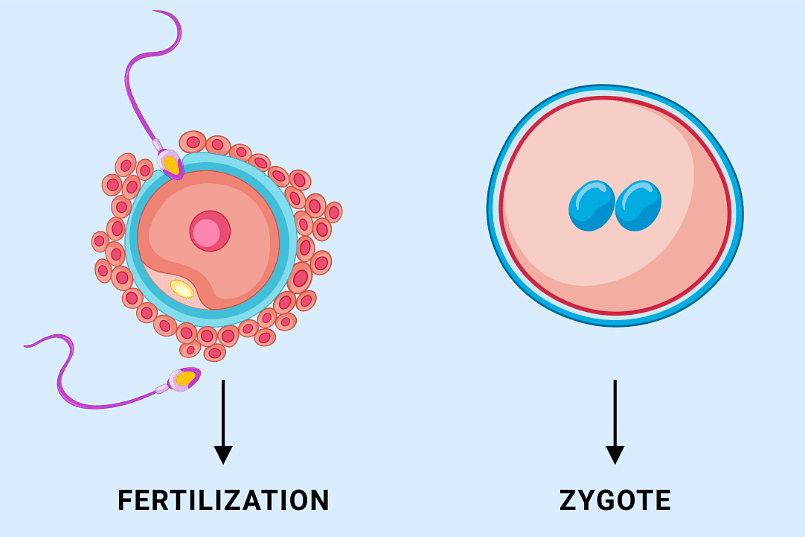
Fertilization and Zygote Formation
Read More: Fertilization in Plants
What is External Fertilization?
[Click Here for Previous Year Questions]
External fertilization is a type of reproduction in which the sperm of a male creature fertilizes a female organism's egg outside the latter’s body. Spawning is the process in which the eggs and sperm are released into the water. External fertilization takes place outside of an animal's body, commonly in water, which provides a moist environment as well as a means of transit and spread. Animals toss their gametes into the water, hoping that the two generations will cross paths.
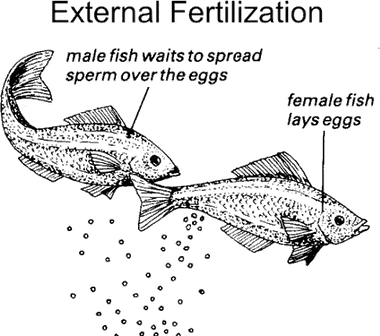
External Fertilization in Fishes
Also Check:
| Important Topics Related to External Fertilization | ||
|---|---|---|
| Asexual Reproduction | Reproduction in Animals | Reproduction in Plants |
| Sexual and Asexual Reproduction | How do Organisms Reproduce? | Sexual Reproduction in Plants |
| Binary Reproduction | Double Fertilization | Fragmentation |
Features of External Fertilization
[Click Here for Sample Questions]
Some of the important features of external fertilization are listed below:
- The aquatic or moist environment is very crucial since it prevents the eggs from drying out.
- The female lays many eggs as the chance of surviving the eggs is very low.
- The fertilization should take place inside the water only or else the sperm would die outside the water.
- External fertilization is an easy process that does not need the involvement of many hormones, which are usually needed for reproduction.
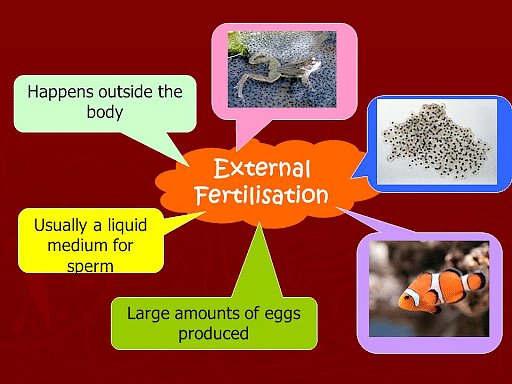
Features of External Fertilization
Advantages of External Fertilization
[Click Here for Previous Year Questions]
Some of the advantages of external fertilization are:
- It takes a little energy to produce gametes.
- The gametes can travel great distances.
- Young ones can colonize huge aquatic areas very quickly.
- As females lay hundreds of eggs there success ratio is quite higher.
Disadvantages of External Fertilization
[Click Here for Sample Questions]
Some of the disadvantages of external fertilization are:
- Due to the aquatic environment and type of water, some of the gametes do not meet zygote.
- Different animals usually eat the zygote or it can die due to normal causes.
- The offspring are not protected from predators.
Also Check: Apomixis
Examples of External Fertilization
[Click Here for Previous Year Questions]
Just like frogs many other aquatic animals also perform external fertilization. Let us look at some examples as follows:
Sea Urchins
Sea urchins have evolved a system to bring the gametes together, including coordinating spawning and chemotaxis of the sperm towards the eggs, to avoid the sperm and eggs from being washed away and diluted.
- During fertilization in sea urchins, events occur that allow sperm to detect and fuse with the egg, followed by responses that prohibit more sperm from entering the egg.
- These enzymes break down the jelly, allowing sperm to reach the egg through the acrosomal process.

Sea Urchins
Coy Corals
Corals can reproduce both internally and externally, and they can fertilize each other.
- When corals spawn, they discharge a large volume of gametes into the ocean.
- Although only a small percentage of the eggs released will be fertilized by sperm, this is enough to maintain coral populations high.

Coy Corals
Fishes
In most fish species, fertilization is done externally. Both females and males simultaneously release massive numbers of eggs and sperm into the sea. During spawning, members of a species cluster in a large group and release their eggs and sperm at the same time.
Starfish
The starfish is an echinoderm, and it fertilizes itself. The eggs of the majority of starfish species are released directly into the water. The male starfish then spits sperm onto the discharged eggs, fertilizing them and forming zygotes.
External Fertilization in Humans
[Click Here for Sample Questions]
A woman's egg and sperm are normally fertilized inside her body. A baby is born roughly 9 months after the fertilized egg attaches to the uterine lining and continues to grow. In humans, this is referred to as the natural process. Because a small percentage of females have difficulty conceiving naturally, humans use external fertilization, which involves taking the male's sperm and the female's eggs and storing them in a Petri dish for a few days. The egg is expelled inside the female's body after a few days.
External Fertilization in Humans
Things to Remember
- External fertilization, often known as spawning, is the release of both sperm and eggs into the environment, with the sperm fertilizing the egg outside of the organism.
- Fertilization has an extremely low success rate. Unlike internal fertilization, the male and female must produce a significant quantity of gametes to assure reproductive success.
- To start external fertilization, a body of water will be needed. On land, the sperm would perish.
- Water is used to externally fertilize the female gamete by the male gamete because it allows for a longer duration of gamete survival and easier migration of sperms towards the egg.
Also Check:
| Important Topics From Chapter 1: Reproduction in Organisms | ||
|---|---|---|
| Polyembryony | Vegetative Propagation in Plants | Pollination by Insects |
| Gene Vs Allele | Female reproductive System | Budding |
| Reproductive System of Earthworm | Reproductive Health | Reproductive Health MCQs |
Previous Year Questions
- Meiosis takes place in? [NEET 2013]
- The sexual reproduction is absent in? [NEET 1995]
- Which occurs first between scion and stock? [NEET 1990]
- What is a clone? [KCET 2011]
- Animals which possess cleidoic eggs exhibit? [KCET 2011]
- Which is not a post fertilization event? [KCET 2016]
- Human chorionic gonadotropin is secreted by? [KEAM]
- Find out the correct order. [KEAM]
- What is the type of asexual reproduction found in hydra. [KEAM]
- Which has longitudinal binary fission. [KEAM]
- Banana is vegetavily propagated by? [AMUEEE 2012]
- Vegetative propagation in leaves is seen in? [JKCET 2010]
- Vegetative propagation in Water Hycinth takes place by? [AMUEEE 2013]
- Apomixis in plants means? [BHU UET 2008]
- In which plant artifical vegetative propagation is possible by cutting of roots. [GUJCET 2006]
- Isogamy is found in? [CUCET 2010]
- The mode of asexual reproduction in Euglena is? [CUCET 2010]
Sample Questions
Ques. How does external fertilization in algae occur? (3 marks)
Ans. When a male spermatium is carried by water currents and collides with the enlarged part of the female carpogonium, fertilization takes place, resulting in the fusing of two gametes. Algae reproduce through external fertilization. Fertilization of sperm in a single process, similar to how animals and plants do it, by fusing gametes.
Ques. What is the difference between internal fertilization and external fertilization? (3 marks)
Ans. Internal fertilization is the process by which syngamy (the union of male and female gametes) occurs inside the female body following copulation insemination. External fertilization, on the other hand, is syngamy that occurs outside of the female body, specifically in water bodies.
Ques. Where external fertilization does occur? (2 marks)
Ans. To promote the transport of sperm to the egg, external fertilization is usually done in water or a moist environment. The process of releasing eggs and sperm into the ocean is known as spawning. Females of motile species frequently go to a suitable spot to release their eggs.
Ques. Does sea horse have external fertilization? (2 marks)
Ans. The male secretes sperm into his marsupium, allowing the eggs to be fertilized externally. The eggs are then brooded by the male sea horse in his pouch until they hatch. Soon later, the swimming, self-sufficient young are freed to live in the outside world.
Ques. How external fertilization does takes place in chordate? (2 marks)
Ans. The life cycle of a chordate begins with fertilization (the union of sperm and egg). Fertilization takes place outside, in the water, in its simplest form. In tunicates and some vertebrates, asexual reproduction occurs (females of some fish and lizards can reproduce without fertilization).
Ques. Which animals use external fertilization? (2 marks)
Ans. External fertilization is most common in amphibians and fish among vertebrates. Coral, sea anemones, and tube-dwelling polychaetes are examples of invertebrates that use external fertilization. They are generally benthic, sessile, or both.
Ques. Why is external fertilization not common on land? (2 marks)
Ans. External fertilization can only take place in water because the eggs which are released by the female need water to survive and the sperm needs water to swim and reach the eggs. If there will no water the sperm would not be able to reach the egg. That’s why external fertilization can happen only underwater.
For Latest Updates on Upcoming Board Exams, Click Here: https://t.me/class_10_12_board_updates
Do Check Out:



Comments