



Education Journalist | Study Abroad Lead
Hematite is known as the ore of Iron. Hematite is a dark red rock by which we get iron. Also, it has a brown or red colour with an earthy lustre. It is known as the most important iron ore worldwide. It is found in sedimentary and igneous rocks. It is one of the inexpensive materials. Also, it has economic importance as it is hard and has strength. It has various purposes which differ in different iron and steel industries. It has a property of opaque transparency and not equal fractures. It is harder than pure iron ore. Also, it is an abundant mineral on the surface of Earth.
| Table of Content |
Key Terms: Hematite, Magnetite, Lustre, Sedimentary Rocks, Igneous Rocks, Iron, Rocks, Iron Ore, Oxide Mineral, Siderite, Limonite, Minerals
What is Hematite?
[Click Here for Sample Questions]
The ore of iron is known as Hematite. Hematite is a dark red rock from which we get iron. It is a hard oxide mineral that constitutes iron ore and it is heavy. According to its red colour, it is known for blood in allusion.
Considered to be the most important iron ore, it is found in sedimentary and igneous rocks. It is an abundant mineral on the surface of Earth.
Sometimes, it is present as a result of volcanic activity. It has a paramagnetic nature and the hematite crystals are known for specular iron ore that has a steel grey colour with a metallic lustre. The micaceous hematite is a thin scaly ore. This ore has opaque transparency and uneven fractures. It is harder than pure iron ore.
Also, it has economic importance as it is hard and has strength. It has various purposes which differ in different iron and steel industries. On Earth, iron ore is present in different kinds of which, hematite is one of the finest quality iron ores.

Hematite
Also Read:
| Related Articles | ||
|---|---|---|
| Rock Cycle | Atomic And Molecular Masses | Metamorphic Rocks |
| Iron Oxide | Difference Between Element And Compounds | Reactivity Series |
Hematite Ore
[Click Here for Sample Questions]
Iron is an element that has the properties of a natural substance. Also, it is a common element according to its mass and usage. According to the research, the metal is hard and strong and is used by manufacturing industries on a large scale. The industries choose it as it has great strength and has magnetic properties.
This element is found in four major types:
- Magnetite
- Hematite
- Siderite
- Limonite
These types contain different percentages of metallic iron in them. According to the research, magnetite contains 72% of iron which has the best quality iron in black colour. The hematite contains 60% - 70% iron which has the finest quality with red & brown colour. Also, it has silica in a small amount. When there is moist air and a high temperature, it corrodes on exposure. It is present in the purest form.
The siderite has 48% iron with brown colour and has the most impurities in it. Also, it is known for low-grade iron ore with Limonite. Limonite has 30% to 40% iron with yellow colour.
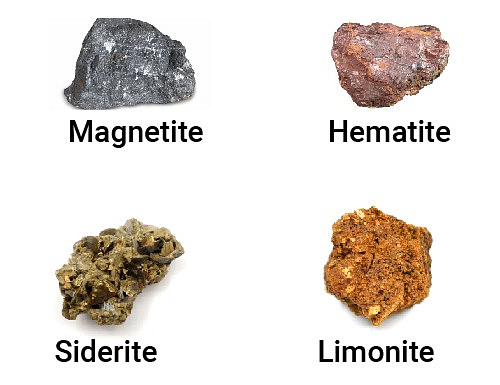
Types of Iron Ore
Properties of Hematite
[Click Here for Sample Questions]
The properties of Hematite are given below:
- The chemical properties of hematite fall under the chemical classification that is oxide mineral and its composition are Fe2O3.
- According to its physical properties, it has metallic grey or red colour which has a bright red streak to dark red. It is opaque and has a mohd hardness of 6.5 with a specific gravity of 5.26. Also, it has a density of 5,26g/ cm3 and 5.255 g/ cm3.
- It is uneven, brittle and trigonal mineral, and magnetic after heating.
- Also, according to its optical properties, it is anisotropic with brownish-red colour to yellowish red. It has a penetration twin at the composition plane. Uniaxial is the optic sign which has a high relief and birefringence.
Uses of Hematite
[Click Here for Sample Questions]
There are many uses of hematite which includes:
- It is economically important, and it is the finest ore worldwide. Also, it is known for being the most important pigment mineral.
- It is one of the inexpensive materials and it is dense.
- The use of hematite is as ballast for ships, gemstones, or jewellery. Also, it is used for protective and calming properties.
- Sometimes, it is used for polishing compounds.
- People used it in the house for energy and for the mind to focus.
Distribution of Hematite
[Click Here for Sample Questions]
Brazil and Australia are the top countries that produce iron ore. Also, China is the largest producer of iron ore in the world. Brazil and Australia are followers of China. Also, it is found in the United Kingdom, South Africa, India, the North American continent, Russia and Ukraine.
The important regions are discussed below for the distribution of iron ore in different continents:
- The fine quality of iron is found in Europe which includes France, Ukraine, Germany, the United Kingdom, and Sweden.
- It is found in North America which includes USA and Canada. The regions of lake superior, Wright, Alabama State, Sept Isles regions include in it, and many more.
- It is also found in South America which includes Brazil (the major producer), Venezuela, Chile. It includes Orinoco Valley and La Sarena.
- It is found in major regions of South Africa, Morocco, Algeria, Liberia, and Tunisia.
- The famous producer is Australia which includes Pilbara, Mt Goldsworthy, Kalanooka Region, Queensland, New South Wales and Tasmania, Tailoring peak, Mt. Tom Price.
- Also, it is found in Asia which includes India, Russia, the Philippines, and China.
Things to Remember
- Hematite is an Iron ore which is a dark red rock from which we get iron. It has a brown or red colour with an earthly lustre.
- It is the most important iron ore worldwide and is found in sedimentary and igneous rocks.
- Iron is basically found in four major types namely Magnetite, hematite, limonite, siderite.
- The chemical properties of hematite fall under the chemical classification that is oxide mineral and its composition are Fe2O3.
- The use of hematite is as ballast for ships, gemstones, or jewellery. Also, it is used for protective and calming properties.
- Brazil and Australia are the top countries that produce iron ore. Also, China is the largest producer of iron ore in the world.
Also Read:
Sample Questions
Ques. From which mineral, Hematite, and Siderite ores come? (3 Marks)
Ans. Hematite and Siderite are the ores that come from Iron. Hematite contributes 37% of ore and siderite contributes very less as it is low-grade iron ore. Hematite ore consists of 60 to 70% of iron ore which has a red & brown colour. It is known for its finest quality. The Siderite is a brown colour that has 48% iron with impurities.
Ques. Is hematite found in the African continent? (3 Marks)
Ans. Yes, hematite is found in the African continent which includes major areas of South Africa, Morocco, Algeria, Tunisia, and Liberia. Apart from them, it is found in the Australian region which includes Pilbara, Mt Goldsworthy, Kalanooka Region, Queensland, New South Wales and Tasmania, Tailoring peak, Mt. Tom Price. Out of all, China is the largest producer of iron ore in the world that is followed by Brazil and Australia.
Ques. What do you understand from the term Hematite? (3 Marks)
Ans. Hematite is a term used for iron ore. The colour of Hematite is dark red. Also, it is heavy and called hard oxide mineral which has iron ore. It is an abundant mineral that is present in the shallow crust. It is found in igneous rocks and sedimentary rocks. It consists of crystals that have a steel grey colour.
Ques. How is Iron taken out from Hematite? (3 Marks)
Ans. Hematite has a chemical formula of Fe2O3. From the process, iron is taken out in a blast furnace. It is when the ore is led into the furnace top together with the coke and limestone. Then the limestone is decomposed into the hot furnace which formed calcium oxide. Now, to form a slag, it has to be reacting with silicon dioxide which is a sandy impurity.
Then, hematite reacts with carbon to provide pure iron and carbon monoxide gas. The gas escapes. It shows as Fe2O3 + 3C → 2Fe + 3CO.
Ques. Where is Hematite used in daily life? (3 Marks)
Ans. Hematite is used in daily life and has various uses. It includes the production of pigments, to support and balance the healing of the person's body, ballast, radiating shield, preparation for heavy media separation. Also, it is used in making jewellery.
Ques. What are the optical properties of Hematite? (3 Marks)
Ans. The optical properties of Hematite include that it is a type of anisotropic which is a mineral type. The colour varies from brownish red to yellowish-red. At the composition plane, penetration twins at {0001} or {1010}. Uniaxial is the optic sign that has a birefringence of δ= 0.280 with very high relief.
Ques. Write a short note on Iron. (3 Marks)
Ans. All the elements including iron are natural substances. Iron is a type of metal that is the most common chemical element according to its mass. The physical properties of the metal are it is hard, strong, and manufactured at a large scale. The industries choose it as it has great strength and has magnetic properties.
Ques. What are the physical properties of Hematite? (3 Marks)
Ans. The physical properties of iron ore of Hematite are it is opaque. It has a mohd hardness of 6.5 with a specific gravity of 5.26. Also, it has a density of 5,26g/ cm3 and 5.255 g/ cm3. It has metallic grey or red in colour. Due to the red colour, it has a bright red streak to dark red.
For Latest Updates on Upcoming Board Exams, Click Here: https://t.me/class_10_12_board_updates
Check-Out:



Comments