



Education Journalist | Study Abroad Lead
Lucas Test is a chemical procedure that uses a mixture of strong hydrochloric acid and anhydrous zinc chloride to classify primary, secondary, and tertiary alcohols. Lucas Test is also called Lucas Reagent.
Howard Lucas developed the Lucas Test in 1930. Lucas Reagent is a mixture of anhydrous zinc chloride and strong hydrochloric acid. When the reagent's clear and colorless characteristics change to turbid, foggy, and hazy ones, indicating the development of a chloroalkane, Lucas Test for alcohol shows a positive indication. Alcohol is classified based on how quickly chloroalkane gets formed.
| Table of Content |
Key Terms: Lucas test, Lucas reagent, Alcohols, Primary, Secondary, Tertiary, SN1 mechanism, haloalkane, chloroalkane, zinc chloride, hydroxyl group
Lucas Reagent
[Click Here for Sample Questions]
Lucas reagent is used to carry out Lucas tests. The Lucas reagent is a mixture of strong hydrochloric acid and zinc chloride. Thus, it is also known as a solution of anhydrous zinc chloride in concentrated hydrochloric acid. Lower molecular weight alcohols have been categorized using this acid.
When it reacts with the reagent, hydroxyl group in the alcohol gets replaced by chloride, which is a substitution process. This forms a clear, colorless solution with turbid state that denotes formation of chloroalkanes. To create the reagent, equal amounts of concentrated HCl and ZnCl2 are used.
Important Facts on Lucas Reagent
- The test was first used to identify primary, secondary, and tertiary alcohol in the year 1930, and since then it has evolved into the accepted standard.
- Stability of carbocation intermediate formed during the reaction, determines that Lucas Reagent reacts with alcohols and produces various results.
- While using zinc chloride as a catalyst, the chloride ion of hydrochloric acid combines with an alkyl group of alcohol to produce alkyl chloride.
- The Lucas Test's foundation is the different rates at which primary, secondary, and tertiary alcohols react with the Lucas reagent.
Also check:
Lucas Test
[Click Here for Sample Questions]
Lucas Test is used to differentiate between primary, secondary, and tertiary alcohols. The reactivity of primary, secondary, and tertiary alcohols with hydrogen halide is determined by the SN1 reaction. It is the basis for this test. The general reaction which is carried out in the Lucas test is given in the diagram below:
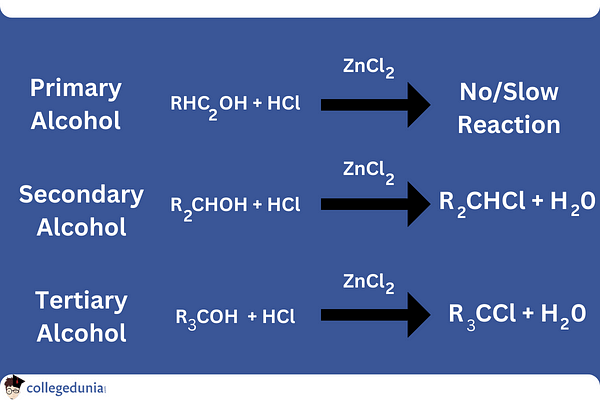
Lucas Test Reaction
The varying ease of production of the respective carbocations is caused by variation in the degrees of alcohol's reactivity. The first carbocation, followed by the secondary carbocation, and the most stable tertiary carbocation are formed by the tertiary alcohols. The test's reagent is an equimolar combination of concentrated HCl and zinc chloride (ZnCl2).
When the alcohol is protonated, the water molecule that is created exits, creating the carbocation, and the excess nucleophile Cl quickly attacks the carbocation to create the chloroalkane. The aqueous mixture's low solubility of organic chloride causes the tertiary alcohol to react quickly within five minutes, which is visible as turbidity. The intermediate tertiary carbocation is significantly more stable in tertiary alcohol, which is why the tertiary alcohols separate from their respective halides much more quickly than the primary or secondary alcohols do.
Mechanism of Lucas Test
[Click Here for Sample Questions]
Typically, the reaction takes place in the two-step SN1 nucleophilic reaction. Highly reactive alcohols develop into carbocation intermediates and then show a rapid response. The primary and secondary alcohols both display the SN1 nucleophilic reaction. The two steps are written below:
Step 1: Protonation of the Hydroxyl group
The alcohol's negatively charged hydroxyl ion, or -OH, will be protonated by the hydrogen halide's H+ proton in the first step. Because the chlorine ion is a stronger nucleophile than the water that is linked to the carbon atom, the chlorine ion displaces the water. A carbocation is created as a result of this.
Step 2: Formation of alkyl chloride
Chloride ion attacks a carbocation as a nucleophile, forming alkyl chloride in the process. Water is created when the hydroxyl group and H+ of HCl react due to the higher entropy of water. Zinc chloride used as a catalyst is eliminated as is.
The entire mechanism is depicted below:
Mechanism of Lucas Test
Result of Lucas Test
[Click Here for Sample Questions]
A unimolecular nucleophilic substitution reaction mechanism is used to explain how primary, secondary, and tertiary alcohols react with the Lucas reagent. All three forms of alcohol result in the intermediate formation of a carbocation. This carbocation's stability varies.
Tertiary alcohol produces results quickly since the resulting carbocation is quite stable. While the primary alcohol doesn't provide any results because of a highly unstable carbocation, secondary alcohols have a reasonably stable carbocation that results in a result after around 5 minutes.
As a result, the carbocation's stability can be expressed as follows: 3o > 2o > 1o. The different results seen are summarised in the table below:
| Alcohol | Observations |
|---|---|
| Primary Alcohol | It gives very slow reactions or no reaction at all. On heating it gives slight turbidity after 30 to 45 mins |
| Secondary Alcohol | Within 3 to 5 minutes, the solution becomes murky and an oily film forms. |
| Tertiary Alcohol | Immediately after the addition of the reagent, the solution becomes turbid, and an oily coating forms. |
Things to remember
- The Lucas Test is a chemical procedure that uses a mixture of strong hydrochloric acid and anhydrous zinc chloride to distinguish and classify primary, secondary, and tertiary alcohols. The Lucas reagent is another name for this mixture. Howard Lucas developed the Lucas test and gave it his name in 1930.
- The reagent's clear and colourless characteristics change to turbid, foggy, and hazy ones, indicating the development of a chloroalkane, the Lucas test for alcohol yields a positive indication. The kind of alcohol is determined by how quickly the chloroalkane forms.
- The Lucas reagent is a mixture of strong hydrochloric acid and zinc chloride. As a result, it is also known as a solution of anhydrous zinc chloride in concentrated hydrochloric acid. It is an equimolar concentration of hydrochloric acid and zinc chloride.
- Typically, the reaction takes place in the two-step SN1 nucleophilic reaction. Highly reactive alcohols develop into carbocation intermediates and then show a rapid response. The primary and secondary alcohols both display the SN1 nucleophilic reaction.
- A transition from clear and colourless to cloudy, signifying the development of a chloroalkane, indicates a positive test. Additionally, tertiary alcohols show the greatest results for this test because, because of the intermediate tertiary carbocation's better stability, they can produce the corresponding alkyl halides more quickly.
Also check:
Sample Questions
Question 1: What is the Lucas test? (2 Marks)
Answer: The Lucas Test is a chemical technique that separates and categorises primary, secondary, and tertiary alcohols using a solution of strong hydrochloric acid and anhydrous zinc chloride. This mixture is also known as the Lucas reagent. The Lucas test was created by Howard Lucas, who gave it his name in 1930.
Question 2: How to perform the Lucas test? (2 Marks)
Answer: The steps to performing the Lucas test are as follows:
- Make a solution using equal parts of concentrated HCl and zinc chloride to prepare the Lucas Reagent.
- Put a very small amount of the sample that was provided in a test tube.
- After that, combine 2 ml of the Lucas reagent with the test tube containing the supplied sample.
- Keep track of how long it takes the solution to turn hazy or turbid.
Question 3: What is the Lucas reagent? (2 Marks)
Answer: A combination of zinc chloride and strong hydrochloric acid makes up the Lucas reagent. As a result, it is often referred to as a concentrated hydrochloric acid solution of anhydrous zinc chloride. It has been used to classify alcohols with lower molecular weights. Equal parts of concentrated HCl and ZnCl2 are used to make the reagent.
Question 4: How does ZnCl2 act as a catalyst in the Lucas test? (2 Marks)
Answer: Zinc chloride reacts with alcohol and forms a carbocation intermediate and loss of leaving group takes place. ZnClâ behaves as lewis acid. The oxygen atom lends its electrons to zinc, which then forms a connection with it. Zinc receives a negative charge as a result, whereas an oxygen atom receives a positive charge. As an electronegative element, the electron-deficient oxygen atom now receives electrons from the alkyl group. A carbocation is created as a result.
Question 5: How does the Lucas test function? (2 Marks)
Answer: Typically, the reaction takes place in the two-step SN1 nucleophilic reaction. Highly reactive alcohols develop into carbocation intermediates and then show a rapid response. The primary and secondary alcohols both display the SN1 nucleophilic reaction.
Question 6: What are the different observations of the Lucas test? (1 Mark)
Answer: Primary alcohol gives very slow reactions or no reaction at all. On heating, it gives slight turbidity after 30 to 45 mins. Secondary alcohol gives turbidity in 3 to 5 mins, and tertiary alcohol gives turbidity immediately.
Question 7: Why does tertiary alcohol give turbidity the fastest? (2 Marks)
Answer: All three forms of alcohol result in the intermediate formation of a carbocation. This carbocation's stability varies. Tertiary alcohol produces results quickly since the resulting carbocation is quite stable. While the primary alcohol doesn't provide any results because of a highly unstable carbocation, secondary alcohols have a reasonably stable carbocation that results in a result after around 5 minutes.
Question 8: How can one tell whether a Lucas test result is positive or negative? (1 Mark)
Answer: If a cloudy, turbid characteristic is seen after the reaction with the Lucas reagent within 5–6 minutes, it is a good sign. Negative signs are present if there is no visible change.
Question 9: What reagent is responsible for the visible change seen during a successful Lucas test? (1 Mark)
Answer: In a positive Lucas test, the Lucas reagent is what causes the observed visual change from a clear and colourless characteristic to a turbid, foggy, and hazy characteristic.
Question 10: What other tests can differentiate amongst alcohols? (2 Marks)
Answer: The Victor Meyer test is another method for identifying different types of alcoholic beverages. In this test, the unidentified alcohol is transformed into the matching nitroalkane, which is then subjected to nitrous acid treatment before the solution is alkalinized. The supplied alcohol is primary if a blood-red colouring occurs; secondary if a blue colouration appears; and tertiary if the solution remains colourless.
For Latest Updates on Upcoming Board Exams, Click Here: https://t.me/class_10_12_board_updates
Also check:



Comments