



Education Journalist | Study Abroad Lead
Transition elements are D-block elements present in the periodic table. They are called transition elements because each and every element will have multiple stable oxidation states. A Transition Element can be defined as an element containing a d-orbital that is partially filled with its atom or simple ion. Corresponding to the filling of 3d, 4d and 5d orbitals; the three series of the transition elements are well recognized in an order. All the transition elements exhibit metallic properties such as –high tensile strength, ductility, malleability, thermal and electrical conductivity, and metallic character.
In our daily life, we come across many transition metals like iron, copper, gold, silver, etc. The d-block elements are the transition elements and the remaining f-block elements are the inner transition elements. The metallic properties are very useful in our daily lives. There are many useful applications of the d- and f-block elements and their compounds, notable among them being in varieties of steels, catalysts, complexes, organic syntheses, etc.
| Table of Content |
Key Takeaways: Transition Elements, Oxidation State, Paramagnetic, Diamagnetic, Periodic Table
Transition Elements & Properties
[Click Here for Sample Questions]
A transition element can be defined as the element which has an incompletely filled d orbital in its ground state or in any other oxidation state.
There are generally 3 series of transition elements which are as follows:
- 3d series (Sc to Zn).
- 4d series (Y to Cd).
- 5d series (La to Hg, omitting Ce to Lu).
- The fourth 6d series which begins with Ac is still incomplete.
- The two series of the inner transition metals, (4f and 5f) are known as lanthanoids and actinoids respectively.
Zinc, cadmium, and mercury that belong to group 12, have complete d10 configuration in their ground state as well as in their common oxidation states of the ions and hence, they are not regarded as transition metals.
Many precious metals such as silver, gold, and platinum and industrially important and valuable metals like iron, copper, and titanium form part of the transition metals.
The general electronic configuration of the d block elements are given by (n-1) d 1–10ns 1–2
The video below explains this:
Magnetic Properties of Substances value Detailed Video Explanation:
Check Out:
| Related Concepts | ||
|---|---|---|
| Praseodymium | Promethium | Raney Nickel |
| Dysprosium | Holmium | Einsteinium |
| Dichromate | Europium | Gadolinium |
Magnetic Properties
[Click Here for Sample Questions]
In the magnetic properties, we must know two terms clearly: they are paramagnetic and diamagnetic.
Paramagnetic
Paramagnetic materials are weakly attracted towards a magnet or magnetic field. Hence, the paramagnetic materials are basically weakly attracted under the effect of any of the applied magnetic fields.
Examples: Aluminum, copper
Diamagnetic
The diamagnetic materials or substances will oppose the magnetism under the applied magnetic field.
Examples: antimony, glass

Paramagnetic and Diamagnetic
The electrons are paired up and they have opposite spins in the atomic orbitals. The magnetic field is generated by the same pair of electrons that have equal and opposite magnetic fields.
The magnetic properties of the d-block elements are determined by the number of unpaired electrons present in them.
The magnetic moment of the transition element or ion is determined by the number of unpaired electrons and is calculated by using the ‘spin-only magnetic moment’ formula,
μ= √[n (n+2)]
Here, n is the number of unpaired electrons of a particular element or the ion.
µ is the magnetic moment in units of Bohr magneton (BM).
A single unpaired electron has a magnetic moment of 1.73 Bohr magnetons (BM).
For the metal complex, orbital construction is usually quenched due to the non-spherical environment so the magnetic moment is given by the spin only formula.
Most of the transition elements show paramagnetism due to the presence of unpaired electrons. But Zn, Cd, Hg ions show diamagnetism.
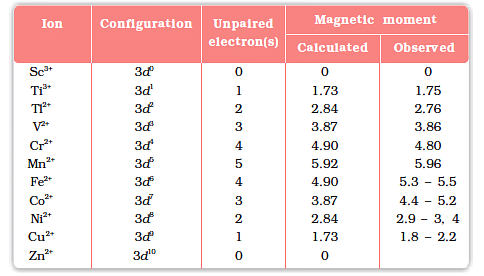
Magnetic Properties of the first series of the Transition Elements
The above table shows the few magnetic properties of the first series of the transition elements.
Trends of Magnetic Properties in Periodic Table
[Click Here for Sample Questions]
In 4d and 5d series magnetic moment is given by spin and orbital contribution.
In the first transition series, low spin Fe+³ ion, high spin Fe+²; same case with the cobalt ions.
Orbital angular momentum generated due to rotation around the nucleus (via orbital).
In most metals, this momentum is quenched due to the restricted rotation and the outer environment.
For orbital angular momentum to contribute, there must be one or more empty or half-filled orbitals similar in energy to the orbitals occupied by unpaired electrons. Here the orbital should be of appropriate energy.

Shapes of different d orbitals
This orbital should not possess electrons of the same spin like that of rotating electrons. So the electrons can use this nearby orbital to circulate around the nucleus and generate orbital momentum and the electron circulates perpendicular to the XY plane which can be seen from the below-shown diagram.
The magnetic moment of the d block elements increases from 1 to the fifth element of the series, as long as the unpaired electron number increases from 1 to 5. Hence In every series, the diamagnetization decreases, and the Para magnetism increases.
The d block elements will have paired electrons in the (n-1)d shell and hence show some diamagnetism. Many metals contain the paramagnetic property as they have more no of unpaired electrons. They also possess ferromagnetism which is mainly exhibited by the elements like cobalt and nickel along with iron.
Magnetic Properties in Transition Element
[Click Here for Sample Questions]
The atomic size and the electronic configurations of the transition elements play a vital role in the magnetizing properties of the elements. The spin of the electron will also help in achieving the magnetism of any compound.
Some of the compounds formed by the transition elements also show the magnetic properties and the extent of the magnetization can also be determined by the total no of unpaired electrons.
Formation of colored ions: Whenever an electron from a low energy d orbital is excited to a high energy d-orbital, the energy of excitation will correspond to the frequency of the light absorbed. That light is exhibited by the corresponding compound and is taken as the characteristic colour.
In aqueous solutions where water molecules are the ligands, the colours of the ions are observed.
Formation of Complex Compounds: Complex compounds are the compounds in which the metal ions bind to a number of anions or neutral molecules that give complex species with characteristic properties.
The transition metals form a large number of complex compounds. This is due to the comparatively very small sizes of the metal ions.
Example: : [Fe(CN)6 ]-³, [PtCl4]²-.
Catalytic Properties: Most of the transition elements show catalytic properties. This activity is well described as their ability to adopt multiple oxidation states and to form complexes.
Some common examples are
- Vanadium(V) oxide (in Contact Process)
- Finely divided iron (in Haber’s Process)
- Nickel (in Catalytic Hydrogenation)
Formation of Interstitial Compounds: Interstitial compounds are those which are formed when small atoms like H, C or N are trapped inside the crystal lattices of metals.
They do not follow the stoichiometric rules some of them are TiC, Mn4N, Fe3H, VH0 .56 and TiH1.7.
Alloy Formation: Alloys are formed by atoms with metallic radii that are within about 15 percent of each other. Because of the similar radius of the atomic orbitals and other similar characteristics of transition metals, alloys are easily formed by these metals.
The best is the ferrous alloys: chromium, tungsten, vanadium, molybdenum, and manganese are very used for the production of a variety of steels.
Applications of Magnetic Properties
[Click Here for Sample Questions]
Some of the daily life uses and applications of the transition elements and their compounds are as follows:
- The photographic industry relies on the special light-sensitive properties of AgBr.
- V2O5 catalyzes the oxidation of SO2 in the manufacture of sulphuric acid.
- The elements of Group 11 are still worthy of being called the coinage metals.
- Nickel complexes are useful in the polymerization of alkynes and other organic compounds such as benzene.
- Because of similar properties and different magnetic behavior they are used as alternatives for many expensive elements.
Things to Remember
[Click Here for Sample Questions]
- The total number of unpaired electrons present in outermost cells will help in predicting the magnetic property of that particular element.
- Transition metals and many of their complex compounds show paramagnetic behaviour.
- Transition metals and their many compounds act as good catalysts and intermediates.
- The transition metals react with a number of non-metals like oxygen, nitrogen, sulfur, and halogens to form binary compounds.
- Very High boiling and melting points are achieved by the Transition Elements due to their magnetic properties.
- The outermost shell of the Transition Elements has various valencies due to which they show various oxidation stages.
Check Out:
Sample Questions
Ques. Explain why the Cu+ ion is not too stable in aqueous solutions? (3 marks)
Ans: This behaviour is because although some energy is required to remove one electron from Cu+ to Cu²+, high hydration energy of Cu²+ will compensate for it. Therefore, Cu+ ion in an aqueous solution is very unstable. It disproportionates to give Cu²+ and Cu ions in return. This is because of the valence electrons.
Ques. Calculate the ‘spin only’ magnetic moment of M²+ (aq) ion (Z = 27). (3 marks)
Ans: This means that the ion has 3 unpaired electrons.
Z = 27 = [Ar] 3d74s²
μ= √3 (3+2) = √15 μ
= 3.87BM
the ‘spin only’ magnetic moment of M2+ (aq) ion is 3.87 BM
Ques. Which is a stronger reducing agent Cr²+ or Fe²+ and explain why? (3 marks)
Ans: Cr²+ is the stronger reducing agent than Fe²+.
This can be explained on the basis of the standard electrode potential values E° (Cr³+ /Cr²+ = –0.41 V) and E° (Fe³+ /Fe²+ = + 0.77 V).
This means that Cr²+ can be easily oxidized to Cr³+, but Fe²+ does not get oxidized to Fe³+ easily.
Thus Cr²++is easily oxidized to Cr³+ but Fe²+ cannot be oxidized to Fe³+.
Ques. Explain what are the paramagnetic and diamagnetic behaviors and differences? (5 marks)
Ans:
Paramagnetic:
The paramagnetic materials are weakly attracted towards a magnet or magnetic field. Hence, the paramagnetic materials are basically weakly attracted under the effect of any of the applied magnetic fields.
Examples: Aluminium, copper
Diamagnetic:
The diamagnetic materials or substances will oppose the magnetism under the applied magnetic field.
Examples: antimony, glass
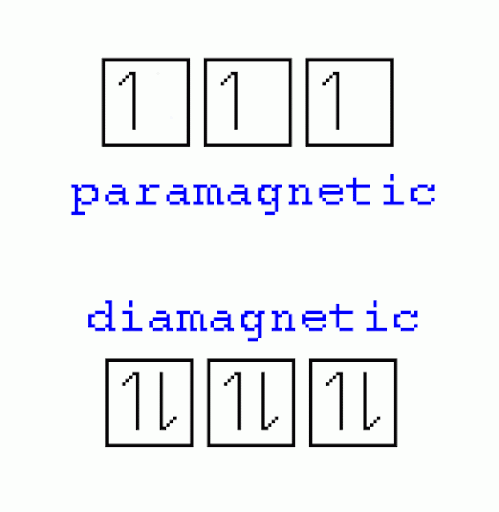
Differences:
| Diamagnetic Material | Paramagnetic Material |
| When diamagnetic material is kept in an external magnetic field it moves towards the weaker region of the field from the strong region of field i.e. it moves in a direction where the magnitude of the external field is decreasing | When a paramagnetic material is kept in an external magnetic field it moves towards the strong region of the field from the weaker region of the field i.e. it moves in a direction where the magnitude of the external field is increasing |
| A diamagnetic Material is weakly repelled by a magnet i.e. repelled an external magnetic field | A Paramagnetic Material is weakly attracted by a magnet i.e. Attracted towards an external magnetic field |
| A diamagnetic Material aligns itself perpendicular to the Magnetic field | The paramagnetic Material get aligned along the direction of the field |
| A diamagnetic Material allows magnetic field lines to pass through it and field lines contract lengthwise | A paramagnetic material does not allow magnetic field lines to pass through it and field lines expand lengthwise. |
Ques. Are All the Transition Elements Magnetic or Not? (3 marks)
Ans: Out of all 38 elements, 12 belong to transition elements and all elements will have almost identical properties in comparison to the metals.
The valence electrons are present in the transition elements and their interactions with other elements make them combine with the other elements. Some of the changes in the electronic configuration are made by the electrons of the reacting elements.
Due to the above reasons, there are some changes in the context of non-magnetic and magnetic behavior. In the case of no unpaired electrons present, the magnetic behavior of the transition elements loses as it creates in the magnetic field.
Ques. Silver atom had completely filled d orbitals (4d¹0) in its ground state. How can one say that it is a transition element? (3 marks)
Ans: In the ground state of the atom, the silver atom has a 4d¹0 configuration which shows that it has completely filled d- orbitals. But, however in its most stable oxidation state +1; its configuration is 4d9 in which there is a partially filled d-orbital.
So, it can generally be regarded as the transition element as per the definition of transition elements.
Ques. How do you find the paramagnetic properties of transition metals? (3 marks)
Ans: The paramagnetic character of transition metals increases on moving from left to the right as the total number of unpaired electrons increases from 1 to 5. The middle elements are found to have the maximum paramagnetic property. Hence they can be found from the middle part of the periodic table.
Ques. What are the General Characteristics of Transition Elements? (3 marks)
Ans: The d-block elements are known for their:
- Large charge: radius ratios.
- High melting points and boiling points.
- High densities and hardness.
- Formation of paramagnetic compounds.
- Alloy formation.
- Catalytic properties.
- Formation of interstitial compounds.
- Formation of colored ions/compounds.
- Ability to form stable complexes.
For Latest Updates on Upcoming Board Exams, Click Here: https://t.me/class_10_12_board_updates
Check Out:



Comments