



Content Curator
The proton is a subatomic particle that can be found in all living things. It is one of the fundamental building components of all atoms in the universe. The mass of a proton is 1.67262192369 x 10⁻²⁷ kg.
- It is a positively charged constituents particles of the nucleus.
- The charge on a proton is 1.6 x 10⁻¹⁹ C.
- Proton is made up of three quarks.
- It contains two up quarks and one down quark.
- According to the modern theory of the nuclear force, most of the proton mass is explained by special relativity.
- The mass of a proton is greater than the sum of the rest masses of its three quarks by about 80–100 times.
- The mass of a proton is slightly less than the mass of a neutron and 1836 times the mass of an electron.
| Mass of Proton in Kilogram | 1.67262192369 x 10⁻²⁷ kg |
| Mass of the proton in grams | 1.67262192369 x 10⁻²⁴ kg |
| Mass of proton in Atomic mass unit (AMU) | 1.007276466879 u |
| Proton mass in MeV | 938.27208816 MeV/c2 |
| Table of Content |
Key Terms: Electron, Proton, Neutron, Proton mass, Atoms, Charge to mass ratio, Quarks, Goldstein Experiment, Molar mass
Read More: Williamson Ether Synthesis
Atom, Neutron, Electron, and Proton
[Click Here for Sample Questions]
Atoms are the building blocks of matter. Atoms consist of three basic particles:
- Electrons
- Protons
- Neutrons
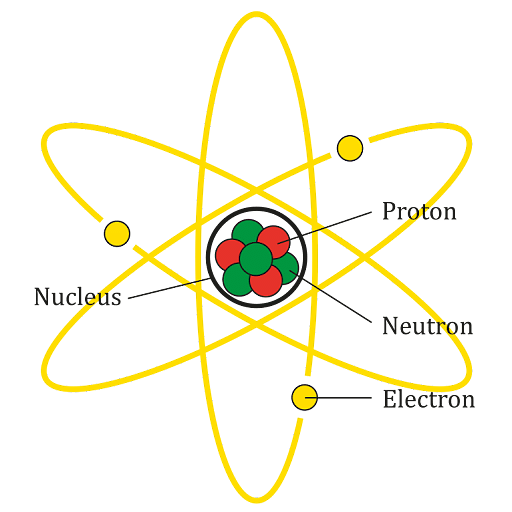
Subatomic Particles
Atom
The entire universe is made up of atomic particles called atoms. Furthermore, an atom is an element's smallest particle.
- An atom has a small positively charged core called a nucleus where the whole mass and positive charge of the atom were supposed to be concentrated.
- An electron revolves around the nucleus with a definite fixed energy in a circular path of a fixed radius.

Atoms
Read More: Tollen’s Test
Neutron
The center subatomic particle of an atom is the neutron. It can be found in the nucleus of an atom.
- The neutron has no charge.
- The mass of the neutron is 1.67 x 10⁻²⁷ kg.
- The mean life of a free neutron is about 16.6 minutes.
- The neutron inside the nucleus is stable.
Electron
A subatomic particle that spins around the nucleus of an atom is called an electron.
- It has a negative charge of magnitude 1.6 x 10⁻¹⁹ C.
- The mass of an electron is 9.1093837 x 10⁻³¹ kg.
Proton
The proton is a subatomic particle that can also be found in an atom's nucleus.
- The proton has a positive charge of magnitude 16 x 10-19 C.
- The number of protons in a nucleus gives the atomic number of the chemical elements.
- The mass of a proton is 1.67262192369 x 10⁻²⁷ kg or 1.007276 u.
Also Read:
| Related Articles | ||
|---|---|---|
| Properties of Matter | Atoms and Molecules | Difference between Elements and Compounds |
| Redox Titration | Volumetric Analysis | SN1 Reaction |
Atomic Mass of Proton
[Click Here for Sample Questions]
The weight of subatomic particles is referred to as atomic mass. Goldstein discovered in 1886 that the charge-to-mass ratio of positive particles is entirely dependent on the type of gas present in the discharge tube. As a result, the charge, which is the mass ratio represented by e/m, varied depending on the gas.

Goldstein Experiment
He saw that in the discharge tube, the charge, which is the mass ratio of the positive rays, was the highest in the case of hydrogen gas.
- This is because hydrogen is the lightest atom, hence m will be the smallest, resulting in the largest e/m ratio in this situation.
- A proton is a particle that appears in positive rays and appears in the discharge tube.
- When an electron from a hydrogen atom is removed, a proton is created.
- As a result, we can see that H (hydrogen atom) → H- (proton) + e- (electron)

Hydrogen Atom
Read More: Energy Level Diagram
Significance of Proton Mass
[Click Here for Sample Questions]
Almost all of science is concerned with baryonic matter and how fundamental interactions affect it. There is a type of matter known as baryonic matter, which is made up of quarks and particles made up of quarks are protons and neutrons. The half-life of free neutrons is 613.9 seconds. We can assert that to the best of our knowledge because electrons and protons appear to be stable in general.
- According to proton decay theories, the proton has a half-life of at least 1032 years.
- There has been no experimental evidence of proton decay too far.
- The proton is the most important baryon, while the electron is the most significant lepton because they are stable components of all normal atoms and govern their chemical properties.
- The proton mass, represented by mp, is mostly made up of gluons and the quarks that make up the proton, the up quark, and the down quark.

Quarks
Read More: SN2 Reaction
Ways to Calculate the Mass of Proton
[Click Here for Sample Questions]
There are three methods for determining a proton's mass. Furthermore, each of these methods employs a distinct way of determining an object's atomic mass. These are the three methods:
- Theoretical calculation
- Atomic molar mass is a measure of the mass of an atom.
- Comparisons of charge/mass with electrons

Mass of proton
Theoretical Calculations
The mass of a proton is calculated using this method, which is based on quantum and relativity theory. Internally, protons have three forces (quarks) that are bound together by attraction forces (gluons).
- According to naive rules, each quark should have around 1/3 the mass of a proton.
- However, quark mass does not account for 95 to 98 percent of a proton's mass.
- In actuality, the majority of a proton's mass is derived from quark-quark interaction energy.

Theoretical Calculations
Read More: Orbitals
By Atomic Molar Mass
One mole is equal to 6.022 x 10²³ in a hydrogen atom, just as one dozen is equal to 12 and one pair is equal to two. One mole of hydrogen weighs 1.0079 g in the given hydrogen atom. One hydrogen atom contains one mole of the proton, which weighs 1.0079 g.
- Furthermore, one mole is equal to 6.022 x 10²³ units, and a proton weighs 1.0079 g.
- After dividing proton mass by mole number, we get (1.0079/ 6.022 x 10²³ ) proton mass of 1.6737 x 10⁻²⁴ g.
- Note that the proton charge in the atom is balanced by an electron.
- This experiment can also be done with any element from the periodic table.

Molar Mass
Read More: Clemmensen Reduction Reaction
Electron Charge / Mass Comparisons
When an atom enters a specified magnetic or electric field, this approach detects how far it bends. Furthermore, the bending magnitude can be used to calculate proton mass by comparing it to electron mass.
- Most notably, the concept of an experiment is comparable to that of causing a rolling ball to roll.
- Furthermore, a constant force (mechanical force) will always deflect a heavy proton from moving in a straight line to some extent.

Mass Comparisons
Also Read:
| Related Articles | ||
|---|---|---|
| Solutions | Types of Solutions | Solubility |
| Group 15 Elements | Group 16 Elements | Group 18 Elements |
Things to Remember
- The proton is a subatomic particle and it is one of the fundamental building components of all atoms in the universe.
- It is made up of quarks that are currently in use. p or p+ are the symbols for this. The protons are found inside the nucleus.
- An atom is an element's smallest particle. The atom, in particular, is made up of three particles: neutron, proton, and electron.
- The proton mass, represented by mp, is mostly made up of gluons and the quarks that make up the proton, the up quark, and the down quark.
- As a result, mp and, by extension, the ratio μ are considered to have easily observable strong force effects. In reality, the chiral limit mp, which is proportional to the QCD energy scale denoted by ΛQCD.
Sample Questions
Ques. When the gluons have zero rest mass, how can they make up 99 percent of the proton's mass energy? (2 marks)
Ans. The missing 99 percent is not made up of the rest mass of the gluons. It's the gluon-mediated binding energy between quarks. When it comes to electromagnetism, the mechanism is very different, but the principle is the same: Although photons have no mass, this does not negate the fact that the electric and magnetic fields both transport energy and quite large amounts of it.
Ques. What is the relationship between the interstellar medium, proton mass density, and interstellar gas mass? (3 marks)
Ans. 68 percent of the universe's energy is in the form of whirling fundamental mass particles, each with a mass of 7.36x10-51 kg and a mass of h/c2. It is nearly uniform throughout the universe. It can be found in every interstellar space. It has to be contained. As a result, due to their inherent gravity, all of the constellations are not colliding with one another. Free protons account for less than a quarter of the universe's total energy. They also assist the fundamental particles in their work. Furthermore, their inherent gravity causes them to give birth to new stars.
Ques. Because the mass of a proton is constant and is derived mostly from the energy of its gluons, the energy of the gluons is also constant. How is that possible? (3 marks)
Ans. According to the Schrödinger equation, if the gluons individually follow a wave function, the wave function dictates the energy, and a stationary state wave function must have constant energy. This is similar to the energy of an electron in a hydrogen state. The wave function is stationary, the energy of that state is constant, and while we might think the energy of the particle varies instantaneously, the total energy of the state remains constant over time due to the Uncertainty Principle, e.g. when the electron has a probability of being very close to the nucleus perforce it could be argued to have potential energy that exceeds twice the total energy required by the virial theorem. The same is true for gluons. Instantaneous energy has no meaning at the quantal level; what matters is energy dictated by the wave duration.
Ques. To extract a single quark from a proton, how much force in foot pounds is required? (2 marks)
Ans. Colour-charged particles (such as quarks and gluons) cannot be isolated and thus cannot be directly observed in normal conditions below the Hagedorn temperature of approximately 2 Terakelvin (corresponding to energies of approximately 130–140 MeV per particle), according to the principle of confinement in quantum chromodynamics. Hadrons are formed when quarks and gluons clump together. At this temperature, though, instead of extracting a single quark, we'd be evaporating the entire proton.
Ques. Is there a half-life for protons? (2 marks)
Ans. If proton decay has a half-life of 1037 seconds, we should be able to detect it. We'd just have to keep a watch out for protons decaying at an average rate of one per second in that quantity of water, which contains around 1037 protons. Protons, according to some physicists, are unstable and decay spontaneously into other particles such as neutral pions and positrons. However, this has yet to be observed. If the idea is confirmed, it means that protons have a half-life or a period during which a proton has a 50–50 probability of decaying.
Ques. What is Quantum Chromodynamics? (3 marks)
Ans. The colour charge is a characteristic that exists in quarks. There are three different kinds of colour charges. Each quark has a distinct colour. The strong interaction is a mechanism of attraction and repulsion between coloured quarks that are mediated by force-carrying particles known as gluons. Gluons, like photons, have no mass, a spin of one, and no electric charge, but they carry a colour charge. Quantum Chromodynamics is the theory that describes strong interactions (QCD).
Ques. Why is the proton so much heavier than the electron, even though they have the same charge? (3 marks)
Ans. Protons are made up of three quarks, whereas the electron is a single item that is not made up of other objects (as far as we know). Quarks also exert and experience the strong force, which is nature's most powerful force that acts between individual quanta. The forces between the three quarks are highly strong and contain a lot of interaction energy, as Frank Wilczek demonstrated in a Nobel Prize-winning theoretical calculation, making the proton quite heavy (because of E=mc^2). The interaction energy accounts for nearly all of a proton's mass; individual quarks are significantly less heavy than the proton.
Ques. Why are protons in a nucleus not attracted to one other? Why does the nucleus not disintegrate? (3 marks)
Ans. Protons in a nucleus repel each other, but in light nuclei, the Coulomb forces are overcome by the short-range strong attraction between protons and neutrons. This is roughly true until the nuclei become as heavy as iron, which occurs when Z reaches 26. The nuclei continue to grow in volume above the iron group, but the strong force attraction, which has a relatively short range, has saturated, meaning it can only grow as fast as the nucleus' volume after that.
Ques. What about the other 99 percent of the mass, given that the Higgs mass accounts for only 1% of the total mass? (2 marks)
Ans. It arises from the mass-energy equivalence (E = mc²) of QCD binding energy.
This has to do with the kinetic energy of quarks, which are bouncing around inside protons and neutrons at nearly the speed of light, and the strong force mediated by gluons, which keeps them locked together. The mass of the quarks is derived from the Higgs field; however, it accounts for only 1% of the system's total mass.
Electrons have no quarks and acquire their mass solely from the Higgs force. (Neutrons and protons are 1842x and 1837x heavier than electrons.)
Ques. Is it possible to split a proton? (3 marks)
Ans. Yes. Protons aren't fundamental particles. Quarks, specifically two up quarks and one down quark make them up. Gluons are responsible for holding these quarks together. It's crucial to note, however, that we couldn't just disassemble a proton and examine its constituent components. The attractive force holding quarks together (mediated by the gluons) rises as the distance between them increases.
This is the polar opposite of what we see in the real world, where a force like gravity weakens as the distance between objects grows. Because of this strange quark law, separating them requires a tremendous amount of energy, and even if separation is achieved, the energy required will result in the creation of new quarks, ensuring that they are never isolated! (Energy is the same as mass)
As a result, we'll never be able to isolate the quarks that make up the proton because they like to be in pairs (mesons) or threes (baryons). The proton, on the other hand, can be split and analyzed by smashing a large number of them together.
For Latest Updates on Upcoming Board Exams, Click Here: https://t.me/class_10_12_board_updates
Check-Out:



Comments