



Education Journalist | Study Abroad Lead
RMS value of alternating current is equal to the amount of DC current which produces the same heating effect flowing through the same resistance during the same time. RMS Value is provided by Direct current flowing through a resistance. RMS value or Root Mean Square value is the amount of steady alternating current that is flowing through a given conductor for a given period of time. The formula for finding RMS value of AC is given by,
\(I_{rms} = \frac{I_0}{\sqrt{2}} = 0.707 I_0\)
Key Terms: RMS Value of Alternating Current, Resistance, Sine Current Wave, Sinusoidal, Non-sinusoidal, Alternating current, Dc current, Conductor
What is an Alternating Current?
[Click Here for Previous Year Questions]
Alternating current is described as a current whose magnitude varies over time and periodically reverses direction. The peak value of an alternating current is referred to as IoIo.
The general equation is given by,
II = Io sin ωtIo sin ωt
II = Io cos ωtIo cos ωt
| Frequently Asked Questions Ques. What is difference between AC & DC? Ans. Electric current flows in two ways: alternating current (AC) or direct current (DC). In alternating current, current switches directions periodically: forward and backward. Whereas, in direct current, it flows in a single direction steadily. Ques. Is house electricity an example of Alternating Current or Direct Current? Ans. When household electrical items are plugged into the outlet in the house, they get AC - Alternating Current. |
RMS Value of Alternating Current
[Click Here for Sample Questions]
- The Root-Mean-Square of instantaneous current values is known as RMS.
- Alternating current is defined as the value of steady current that, when sustained across the same resistance for the same amount of time, generates the same amount of heat as A.C. current when maintained across the same resistance for the same amount of time.

- AC has an RMS value that is higher than the average.
- The area covered in half-cycle can be used to calculate the RMS value of a sine current wave. This holds true for all waves, including sinusoidal, non-sinusoidal, symmetrical, and asymmetrical waves.
- The R.M.S. value of alternating current is also known as the effective value or virtual value. Irms, Ieff, or Iv are the characters that represent it.

RMS Value of Alternating Current
Check out:
RMS Value of Alternating Voltage
[Click Here for Previous Year Questions]
The RMS value of Alternating Voltage is:
- Alternating voltage's root mean square or R.M.S. value, is defined as the value of stable Potential Difference that would generate the same amount of heat in a given resistance in a given time, as A.C. voltage would when sustained across the same resistance for the same time.
- The effective value or virtual value of alternating voltage is also known as the R.M.S. value. Vrms, Veff, or Vv are the symbols for it.
Formula for RMS Value of Alternating Current
RMS Value of AC is given by the formula,
\(I_{rms} = \frac{I_0}{\sqrt{2}} = 0.707 I_0\)
| Solved Example on RMS of Alternating Current Example: Find the RMS current when Peak value of AC current is \(4\sqrt{2}\). Solution: The RMS current Irms is related to the peak current I0 as: \(I_{rms} = \frac{I_0}{√2}\) Given that: The peak value of current, I0 = 4√2 RMS value of current, \(I_{rms} = \frac{I_0}{√2} = \frac{4\sqrt2}{√2} = \) 4 A |
Expression for RMS value of Alternating Voltage
[Click Here for Sample Questions]
On the same lines, the RMS value of Alternating Voltage can be calculated. Alternating Voltage produces a modest amount of heat in a short period of time.
\(dt = \frac{(E_0 Sin \omega t)^2}{R} dt\)
We get E v 2T/R by integrating it from 0 to T and equating it with the heat produced by DC at the same time.
\(E_v = \frac{E_0}{\sqrt{2}}\)
RMS Value of AC Derivation
[Click Here for Previous Year Questions]
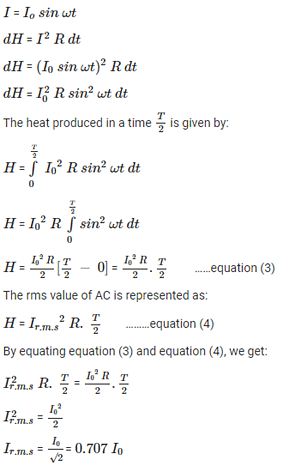
RMS Value of AC Derivation
Check out:
Things to Remember
- Alternating current is defined as a current whose amplitude changes over time and reverses direction on a regular basis.
- The RMS value of AC is higher than the average.
- The effective value or virtual value of alternating current is also known as the R.M.S. value. It is represented by the symbols Irms, Ieff, or Iv.
- The R.M.S. value refers to the effective or virtual value of alternating voltage. The RMS value is also denoted through these symbols Vrms, Veff, or Vv.
- The formula of RMS value of AC is: \(I_{rms} = \frac{I_0}{\sqrt{2}} = 0.707 I_0\)
Previous Year Questions
- If the current in the primary of the transformer is 5A , and its efficiency is 90%, the output current would be….[JEE Main 2018]
- A series LCR circuit is connected to an ac voltage source… [NEET 2020]
- A transformer having efficiency of 90% is working on 200V and 3kW power… [NEET 2014]
- An AC voltage is applied to a resistance R and an inductor L in series… [NEET 2011]
- A current of 5A is flowing at 220V in the primary coil of a transformer… [KCET 2008]
- A step-up transformer operates on a 230 V line and a load current of… [KCET 2018]
- An electric heater rated 220V and 550W is connected to AC mains… [KCET 2009]
- In R−L−C series circuit, the potential differences across each element is… [KCET 2013]
- An inductor 20mH, a capacitor 50μF and a resistor 40Ω are connected in… [NEET 2016]
- In the given circuit the reading of voltmeter V1 and V2 are 300 volts each… [NEET 2010]
- Which of the following combinations should be selected for better tuning of… [NEET 2016]
- In an A.C. circuit, V and I are given by V=150 sin(150t) volt and… [KCET 2011]
- A transformer works on the principle of… [KCET 2011]
- A voltage VPQ=V0cosωt (where V0 is a real amplitude) is applied between… [KEAM]
- A transformer is used to light 100W−110V lamp from 220V mains… [KCET 2015]
- In an L−C−R circuit, at resonance… [KCET 2015]
- The average power dissipated in a pure inductor is… [KCET 2015]
- In a series LCR circuit an alternating emf(v) and current (i) are given by… [KCET 2016]
- A coil is self-inductance L is connected in series with a bulb… [NEET 2013]
- A condenser of capacity C is charged to a potential difference of V1… [NEET 2010]
Sample Questions
Ques. What is the RMS Value of Alternating Current? (2 Marks)
Ans. RMS Value of Alternating current is defined as that value of steady current, which would generate the same amount of heat in a given resistance is given time, as is done by A.C. current, when maintained across the same resistance for the same time
Ques. What do you understand by peak value? (2 Marks)
Ans. The peak value is defined as the highest value achieved by an alternating quantity in a single cycle.
Ques. What is the RMS Value of Alternating Voltage? (2 Marks)
Ans. R.M.S. value of Alternating voltage is defined as that value of steady Potential Difference, which would generate the same amount of heat in a given resistance is given time, as is done by A.C. voltage, when maintained across the same resistance for the same time.
Ques. The r.m.s value of an alternating current of 50Hz is 10 A. The time is taken by the alternating current in reaching from zero to maximum value and the peak value of current will be. (3 Marks)
Ans. The given a.c. current has a frequency of 50 Hz. The time period of this supply will be therefore,
T= 1/50 =0.02
T=150=0.02 s.
The time period is referred to as the time taken for one whole cycle to pass. One whole cycle consists of a crest and a trough. One-fourth of this wave can be considered as the distance between zero and the first peak. This is depicted below:

The time period will also becomes one-fourth. Thus, the required time to reach the peak, starting from zero is:
T/4 = 0.02/4 = 5 x 10⁻³ s.
Now, the peak value of the current can be found out from the r.m.s. value of the current as:
I0= √2 Irms = √2 ×10 = 14.14 A
Ques. A resistance of 20Ω is connected to a source of alternating current rated 110V,50Hz. Then the time is taken by the current to changes from its maximum value to the r.m.s. value is. (3 Marks)
Ans. We know that,
i = i0 cos2πft
i=i0/2
Time taken to move maximum value to rms value on comparing,
t = 1/8f
t = 1/(8 x 50)
t = 2.5×10⁻³ sec
Ques. A resistance of 20Ω is connected to a source of an alternating potential V=220 sin(100 πt). The time taken by the current to change from the peak value to rms value is. (3 Marks)
Ans. I=V/R=11sin(100πt)
Ipeak=11=11sin(π/2)=11sin(100π2001)
Irms=11/2=11sin(3π/4)=11sin(100π4003)
Therefore time taken by current to change from peak to RMS value = 3/400- 1/200 = 1/400 =2.5ms
Ques. Alternating current in the circuit is given by I=I0 sin2πnt. Then the time taken by the current to rise from zero to R.M.S. value is equal to (3 Marks)
Ans. The alternating current is,
i = i0 sin2πnt
Rms value of the current irms = i0 /√2
Let us assume the time taken to reach the zero to rms value be t,
Therefore, i0 /√2 = i0 sin2πnt
Or, sin π/4 = 2(sinπnt)
Or, π/4 = 2πnt
Or, t = 1/8n
Ques. What are the methods that help us to determine the RMS values? (1 mark)
Ans. The methods that are used to determine rms value are:
- Graphical method
- Analytical method
Ques. What do you mean by average value? (2 Marks)
Ans. The average of all the instantaneous values of an alternating voltage as well as currents over one complete cycle gives the average Value.
For Latest Updates on Upcoming Board Exams, Click Here: https://t.me/class_10_12_board_updates
Do Check Out:



Comments