


What is Ohm's Law graph?

Ohm’s law gives the relationship between the current and the voltage across the terminals of a metallic wire.

Mathematically, the law is represented as:

V = IR

where R is the constant that denotes resistance.

The following graph represents the current-voltage relationship of a conductor, as per Ohm’s law:
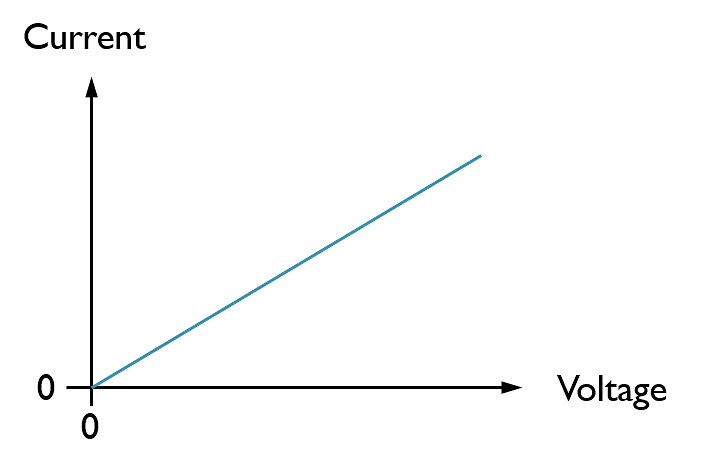
V-I Graph for Ohm's Law

Read More: Ohm’s Law and its Limitations


Related Questions

  1. What is the necessary condition for a conductor to obey Ohm's Law?
  2. Why is the curve representing Ohm's law linear?
  3. State Ohms law. How can it be verified experimentally?
  4. How do you find the resistance to Ohm's law?
  5. What are the 3 forms of Ohm's law
  6. What are the limitations of Ohm's Law?
  7. What are the applications of ohm's law used in daily life?
  8. State Ohms Law. Express It Mathematically. Define Si Unit Of Resistance.
  9. Is resistance constant in Ohm's law?
  10. Draw a circuit diagram to verify ohm’s law.

Read More:

CBSE CLASS XII Related Questions

  • 1.
    Assertion (A) : All atoms have a net magnetic moment. Reason (R) : A current loop does not always behave as a magnetic dipole.

      • Both Assertion (A) and Reason (R) are true and Reason (R) is the correct explanation of the Assertion (A).
      • Both Assertion (A) and Reason (R) are true, but Reason (R) is not the correct explanation of the Assertion (A).
      • Assertion (A) is true, but Reason (R) is false.
      • Both Assertion (A) and Reason (R) are false.

    • 2.
      Two small identical metallic balls having charges \( q \) and \( -2q \) are kept far at a separation \( r \). They are brought in contact and then separated at distance \( \frac{r}{2} \). Compared to the initial force \( F \), they will now:

        • attract with a force \( \frac{F}{2} \)
        • repel with a force \( \frac{F}{2} \)
        • repel with a force \( F \)
        • attract with a force \( F \)

      • 3.
        A square loop of side 0.50 m is placed in a uniform magnetic field of 0.4 T perpendicular to the plane of the loop. The loop is rotated through an angle of 60° in 0.2 s. The value of emf induced in the loop will be:

          • 5 V
          • 3.5 V
          • 2.5 V
          • Zero V

        • 4.
          Two heaters rated as \((P_1,V)\) and \((P_2,V)\) are connected in series across a dc source of \(V/2\) volt. The power consumed by the combination will be –

            • \((P_1+P_2)\)
            • \(\dfrac{P_1+P_2}{2}\)
            • \(\dfrac{P_1P_2}{2(P_1+P_2)}\)
            • \(\dfrac{P_1P_2}{4(P_1+P_2)}\)

          • 5.
            Write any two features of nuclear forces.


              • 6.
                Assertion (A) : The mass of a nucleus is less than the sum of the masses of the constituent nucleons. Reason (R) : Energy is absorbed when the nucleons are bound together to form a nucleus.

                  • Both Assertion (A) and Reason (R) are true and Reason (R) is the correct explanation of the Assertion (A).
                  • Both Assertion (A) and Reason (R) are true, but Reason (R) is not the correct explanation of the Assertion (A).
                  • Assertion (A) is true, but Reason (R) is false.
                  • Both Assertion (A) and Reason (R) are false.
                CBSE CLASS XII Previous Year Papers

                Comments


                No Comments To Show
