



Education Journalist | Study Abroad Lead
Analog and digital signals are the two types of signals that carry information. A major difference between analog and digital signals is that analog signals have continuous electrical signals, while digital signals carry non-continuous electrical signals. An electromagnetic or electrical current that transports data from one system or network to another is known as a signal. In electronics, a signal is typically a time-varying voltage that also serves as an information-carrying electromagnetic wave, though it can also be current.
Also Read: Uses of Inductor
Key Terms: Analog Signal, Digital Signal, Electromagnetic Field, Capacitors, Frequency Modulation, Communication, Resistors, Voltage
What is Analog Signal?
[Click Here for Previous Year Questions]
Analog signals are continuous and time-varying in nature. These signals are continuous in both time and values.
- An Analog signal is a form of electrical energy for which there is a linear relationship between electrical quantity and the value representing the signal.
- The amplitude of the signal can take any value in a continuous range.
- Analog Signals are continuous in nature which vary with respect to time. They can be either periodic or non-periodic.
Read More: Ground Wave Propagation
What is Digital Signal?
[Click Here for Sample Questions]
A Digital signal is a signal where data is represented as a series of discrete values.
At any given time, a digital signal can only take on one value from a finite set of possible values. The physical quantity representing the information in digital signals can be any of the following:
- Electric current or voltage that varies
- An electromagnetic field's phase or polarisation.
- Pressure acoustic
- A magnetic storage medium's magnetization
All digital electronics use digital signals. The signal takes only limited values. Digital signals are discrete as they contain only distinct values.
Difference between Analog and Digital Signal
[Click Here for Previous Year Questions]
The primary difference between analog signal and digital signal is that analog signals are continuous, whereas digital signals are discrete.
| Analog Signals | Digital Signals |
|---|---|
| Analog signals are continuous signals. | Digital signals are discrete signals. |
| Sine waves are used to represent analog signals | Square waves are used to represent digital signals |
| Analog signals have a continuous range of values. | Digital signals have discontinuous values. |
| Sound waves are recorded in real-time as they are in analog signals. | Digital signals convert waveform to binary waveform. |
| These signals are only used in analog devices. | Digital Signals are suitable for digital electronics such as computers, mobile phones, and other similar devices. |
| Examples of analog signals – Natural sound, human voice, and analog electronic devices | Examples of digital signals – Computers, optical drives, and other electronic devices. |
| Troubleshooting analog signals is difficult. | Troubleshooting digital signals is simple. |
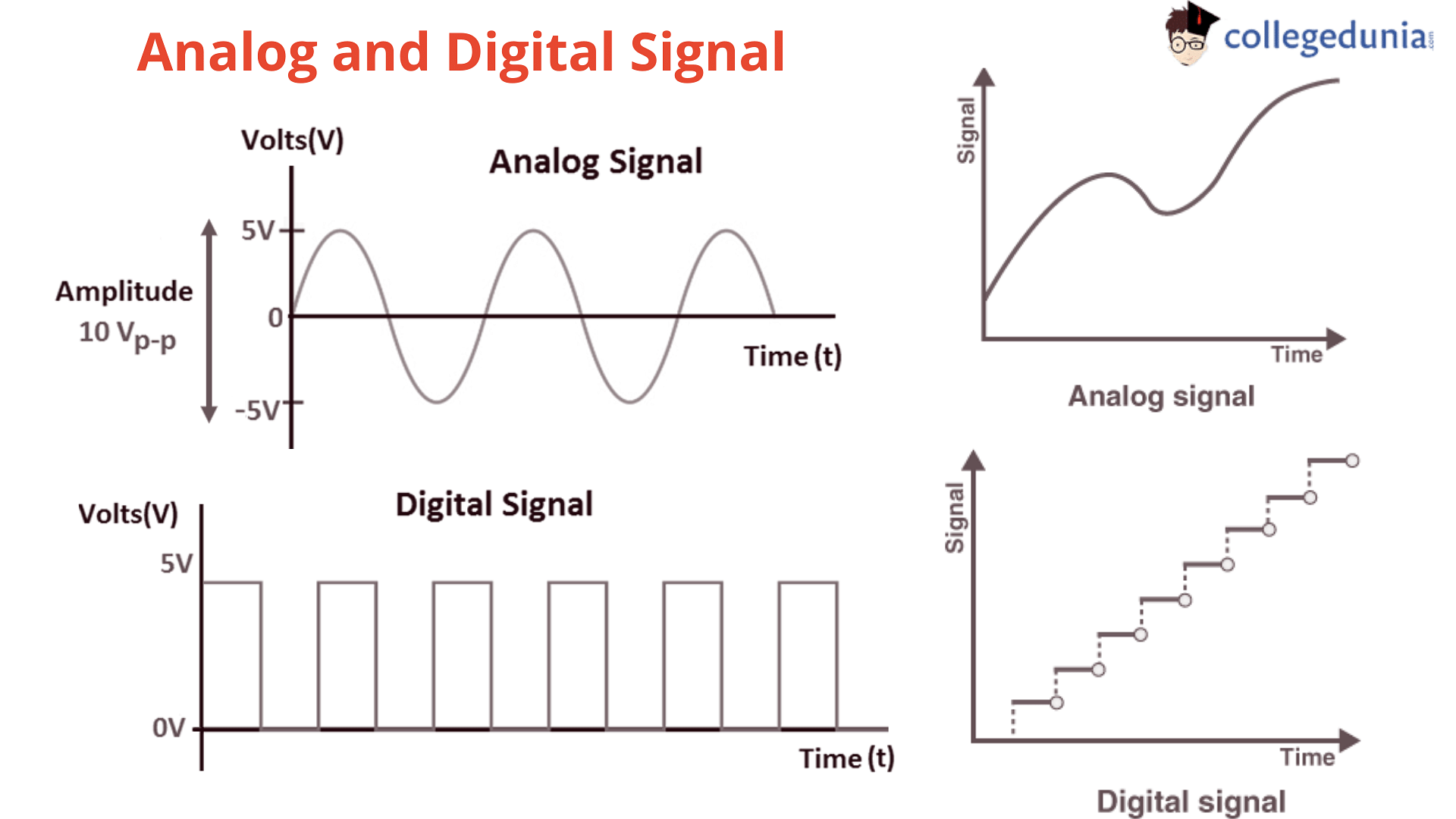
Difference between analog and digital signal
Also Read: Pulse Amplitude Modulation
Characteristics Of Analog Signal
[Click Here for Sample Questions]
Some of the essential characteristics of Analog Signal are –
- They are time-varying.
- Analog signals can either be periodic or non-periodic.
- They work on continuous data.
- Its accuracy is not high as compared to the digital signal.
- Analog signal output form is like a curve, graph, or line.
| Key Note of Analog Signals Analog transmission can be accomplished in a variety of ways:
Analog circuits use these methodologies to interface with the real world and to accurately capture and process signals in electronics, much like the human body uses eyes and ears to capture sensory information. |
Read more: Difference Between AM and FM
Characteristics of Digital Signals
[Click Here for Previous Year Questions]
The characteristics of Digital signals are –
- They are time-separated signals.
- Digital signals can be processed and transmitted in a better way as compared to an analog signal.
- Digital signals are widely used as they are versatile.
- The accuracy of the digital signal is better than the analog signal.
Also Check:
Advantages and Disadvantages of Analog Signals
[Click Here for Sample Questions]
The advantages and disadvantages of analog signals are –
Advantages of Analog Signals
The advantages of analog signals are –
- They are easier to process.
- Analog signals are of low cost and are portable.
- They are best suited for audio and video transmission.
- Analog signals are the natural form of sound.
- They have higher density and therefore can present refined information.
- They use less bandwidth than digital sounds.
Disadvantages of Analog Signals
The disadvantages of analog signals are –
- They have a lower quality of the signal.
- The cost is high and not easily portable.
- The data of these signals can be corrupted.
Also Check: Types of Switch
Advantages and Disadvantages of Digital Signals
[Click Here for Previous Year Questions]
The advantages and disadvantages of digital signals are –
Advantages of Digital Signals
- Digital data can be compressed easily.
- The information can be encrypted.
- Equipment is common and less expensive.
- The data is easy to transmit over networks.
Disadvantages of Digital Signals
- Sampling can cause a loss of information.
- The speed of the processor is limited.
- It requires greater bandwidth
Also Read: Space Travel Equipment
Things to Remember
- An electromagnetic or electrical current that transports data from one system or network to another is known as a signal.
- An analog signal is time-varying and generally limited to a range (e.g., +12V to -12V), but it can take on an infinite number of values.
- In Analog signals, Sine waves are used to represent analog signals whereas, in digital signals, Square waves are used to represent them.
- When compared to the analog transmission of the same information, digital communication requires a higher bandwidth.
- Analog signals have continuous electrical signals, while digital signals have non-continuous electrical signals.
Also Check:
Previous Year Questions
- The process of superimposing message signal … [KCET 2016]
- The radius of the Earth is 6400 km. If the height of an antenna … [KCET 2018]
- A basic communication system consists of … [KCET 2017]
- The frequency of an FM transmitter without signal input is called … [VITEEE 2011]
- Sky wave propagation is used in … [VITEEE 2011]
- In amplitude modulation, the amplitude of carrier wave … [VITEEE 2019]
- Sinusoidal carrier voltage of frequency … [VITEEE 2010]
- The attenuation in optical fibre is mainly due to … [VITEEE 2010]
- Amplitude modulation has … [KCET 2015]
- The wireless communication frequency bands … [COMEDK UGET 2015]
- A message signal of frequency … [COMEDK UGET 2015]
- The increase in the height of the tower of height … [COMEDK UGET 2014]
- The TV signals have a bandwidth of … [COMEDK UGET 2014]
- The layer in earth's atmosphere which reflects radio waves … [COMEDK UGET 2012]
- Advantages of optical fibre communications over two wire … [GUJCET 2008]
- In an amplitude modulation with modulation index … [KEAM]
- A ground receiver in line-of-sight communication … [KEAM]
- A ground receiver receives a signal at … [KEAM]
Sample Questions
Ques: What is the distinction between an analog and a digital signal? (2 marks)
Ans: The types of signals that carry information are analog and digital signals. The main difference between the two signals is that analog signals have continuous electrical signals, whereas digital signals do not.
Ques: Why are digital signals superior to analog signals? (2 marks)
Ans: Distortion, noise, and interference have a much smaller impact on digital signals because they are less affected. Digital circuits have a higher level of reliability. Analog circuits are more difficult to design and more expensive than digital circuits. Digital circuits have more flexibility in terms of hardware implementation than analog circuits.
Ques: Is it better to have an analog or digital signal? (2 marks)
Ans: Analog signals have a smaller bandwidth requirement than digital signals. Changes in physical phenomena such as sound, light, temperature, position, or pressure are better represented by analog signals. Electrical tolerance is less sensitive in analog communication systems.
Ques: Is 4 20mA digital or analogue? (2 marks)
Ans: The 4-20mA current loop, which is widely used for process control in industrial applications, is perhaps one of the more well-known analog signaling protocols.
Ques: Are human speech signals digital or analog? (2 marks)
Ans: Human voice, thermometers, analog phones, and other analog signals are examples. Computers, digital phones, digital pens, and other digital devices are examples of digital signals.
Ques: Mention the major difference between analog and digital signals. (2 marks)
Ans: The major difference between analog and digital signals is that in analog signals there is a presence of a continuous electrical system while in digital signals there is no such presence of a continuous electrical system.
Ques: Mention some examples of analog signals. (2 marks)
Ans: Some examples of analog signals are as follows:
- Photocopiers
- Old landline lines
- Audio tapes
- Old television
- VCRs
Ques: In which category does current fall under analog or digital signals? (1 mark)
Ans: Current or dc that is direct current falls under analog signal.
For Latest Updates on Upcoming Board Exams, Click Here: https://t.me/class_10_12_board_updates
Also Checkout:



Comments