


NCERT Solutions For Class 12 English Prose Chapter 4: The Rattrap

Jasmine Grover logo

Jasmine Grover

Education Journalist | Study Abroad Lead

NCERT Solutions for Class 12 English The Rattrap can be found in this article. In this story, the Swedish author, Selma Lagerlof has beautifully illustrated the idea of how humans are always running behind materialistic happiness, where love, respect, and relationships need to be cherished. The narration of the story The Rattrap is fairytales-like with a profound moral.


NCERT Solutions for Class 12 English Prose Chapter 4 The Rattrap

Download: NCERT Solutions for Class 12 English Chapter 4 pdf
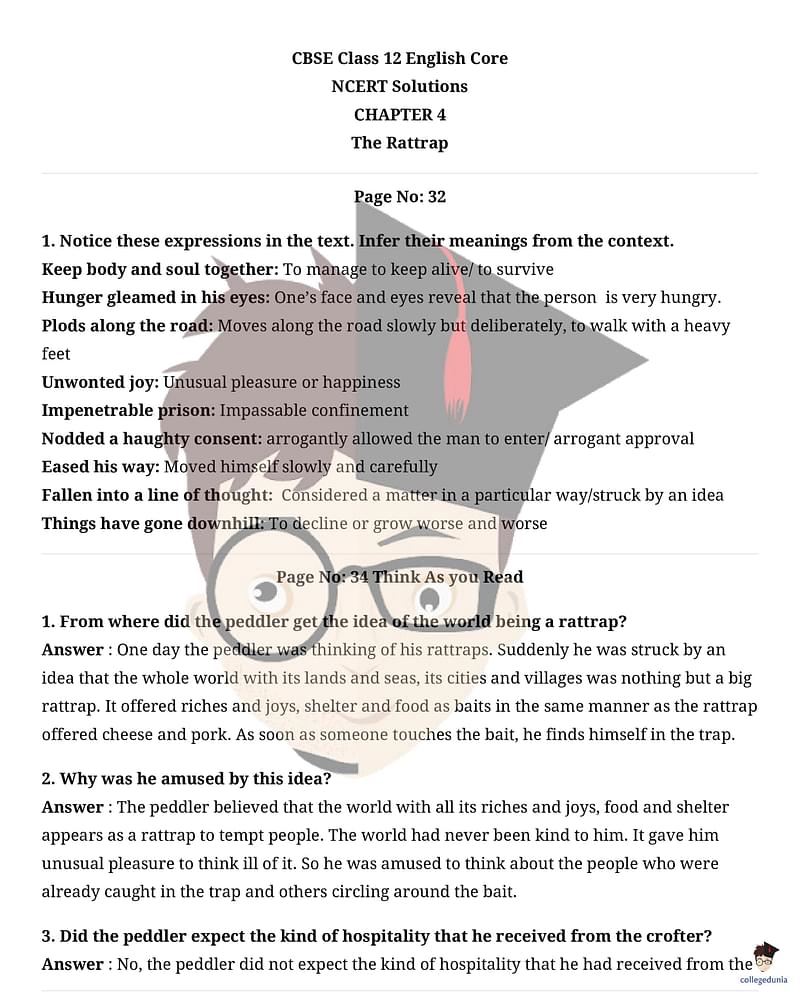
NCERT Solution

NCERT Solution

NCERT Solution

NCERT Solution

NCERT Solution

NCERT Solution

NCERT Solution

NCERT Solution

NCERT Solution


The Rattrap Summary

The Rattrap is a story of an old man who sells small handmade rat traps around the city. The readers will read this story from the point of view of a third-person narrator. Besides selling rat traps, the old man had to beg and steal sometimes to survive. He realized that the whole world is just like a big rat trap. And all the people were running behind the baits- that is the materialistic achievements.

  • One winter night, the old rat trap seller took shelter at a house. The owner of the house was a man who was a crofter at the Ramsjo Ironwork. And now that he is not able to work all day, he survived with the cow he had and earns around thirty kronor monthly.
  • The next day when the man who owns the cottage leaves, the rat trap seller broke one of the windows and stole thirty kronor.
  • The rat trap seller then decides to follow the wood as he was afraid of traveling by road with the stolen money. By the time evening came, the rattrap peddler was lost in the woods.
  • To survive the night he followed the sounds of hammer strokes he could hear and reached a place of Ironwork. Incidentally, the Ironmaster misunderstood the rattrap seller as his friend Nils Olof and invited him to spend the Christmas at his house where he and his elder daughter-Edla Willmansson lives.
  • Once the rattrap seller reached the house of the Ironmaster, he was introduced to the elder daughter who was very kind to him, which made him wonder what was the need to steal that much money. On the other hand, Edla doubted that either this old man had broken out of jail or had stolen something, but Edla welcomed him and assured him he can leave whenever he wishes.
  • On the next morning, it became clear to the Ironmaster that he had made a mistake and the old rattrap seller is not his old friend. As the Ironmaster wanted to inform the sheriff, the rattrap explained his concept of the whole world being a rattrap. At that moment the elder daughter came back and asked her father to let the rattrap man stay for Christmas at least.
  • Edla was too kind to the old man, giving him food to eat and new clothes to wear. This made the old rattrap seller realize the mistake he had made by robbing the old man in that house.
  • The next day, after coming back from the Church, the daughter found a wrapper with a rattrap and three ten kronor notes with a letter stating that the kronor bills needed to be returned to the old man of the house. The story ends with an underlined note that it is not the materialistic things that are important, rather being kind, and respectful is the best thing to achieve.

Also Read:

Check-Out: 

CBSE CLASS XII Related Questions

  • 1.

    (Answer in about 50 words.) You are Ritu/Ritesh, President of the Environment Club of your school. Your school is organising a week-long class clean-up competition. Draft a notice informing the students of Classes VI – X about the competition. Invent necessary details. Put your notice in a box.


      • 2.

        How does Eco find the time to write so much ? (The Interview)


          • 3.

            Why did Gandhi agree to a settlement of a 25-percent refund to the farmers ? (Indigo)


              • 4.

                (Answer in 120 – 150 words.) From individual celebrations to community festivals — there is a move to strengthen community cohesion and bring people together. In a society of increasing loneliness, it is important to create these bonds for both the individual, and the overall health of the community. You are Raksha/Rakesh. Write an article for your school magazine on ‘The Importance of Community Festivals’. You may use the following cues with ideas of your own to compose the article.

                • brings people together and builds community ties
                • promotes, preserves, showcases culture
                • creates shared memories


                  • 5.

                    (Answer in 120 – 150 words.) You are Manisha/Mahesh of Saket Colony, Mumbai. You have recently come across the following advertisement and wish to apply for the position. Write an application for the position along with your bio-data.

                    Next Gen Solutions Requires Digital Marketing Executives
                    • Qualifications : Degree in Marketing/Business Administration/Digital communication with minimum 1 year experience in planning and executing digital marketing campaigns across various platforms
                    • Skills Required : Knowledge of SEO, Social media marketing, content creation and basic

                    Apply to the Marketing Manager, Next Gen Solutions, Marine Drive, Mumbai.


                      • 6.

                        (Answer in 120 – 150 words.) As president of the RWA, you have introduced a Youth Volunteer Initiative – Youth Warriors. Children from the resident community volunteer, engage and partner with the community through various projects. As a programme, it has been very successful and the residents too have appreciated and encouraged these champions of change. Write a letter to the editor sharing your views on the need to encourage youth engagement. You may use the following cues along with your own ideas.

                        • youth participation in community development
                        • understanding community issues and civic responsibilities
                        • demonstrating collaboration and a shared commitment
                        • simple projects – environment clean-up, senior citizen outreach, and waste management awareness

                          Comments


                          No Comments To Show
