



Education Journalist | Study Abroad Lead
Roots, stems, and leaves undergo modification to perform additional functions in plants. Each of these parts has separate functions to perform. The main job of the roots is to absorb and transport water. However, at special times, roots may undergo modification to store food, help in respiration and provide support. Similarly, the primary function of the stem is to produce and support lateral add-ons and conduct food and minerals. However, it gets modified to perform additional tasks like storage of food, and protection. Leaves are mainly involved in photosynthesis. Besides photosynthesis and transpiration, they can provide support to managing water loss by reducing transpiration.
Related Links
- Appearing for NEET, Download NEET PYQ for all subjects
- Appearing for CUET, Download CUET PYQ for all subjects
| Table of Contents |
Key Terms: Modification, Roots, Stem, Leaves, Plants, Tap Root, Monocotyledonous, Dicotyledonous, Seeds, Photosynthesis
Aim
[Click Here for Sample Questions]
To study different modifications in different parts of plants like roots stems and leaves.
Theory
[Click Here for Previous years Questions]
Angiosperms or flowering plants are separated into flowers, stems, roots, and leaves. These flowering plants bear seeds that enclose the fruit and on the basis of seed type, they can be classified into two main types:
- Monocotyledonous: These plants have seeds with a single cotyledon.
- Dicotyledonous: They have two cotyledons.
Materials Required
[Click Here for Sample Questions]
- Forceps.
- Scissors.
- Hand lens.
- Glass slides.
- Dissecting microscope.
- Orchid/pea/barley (complete dicot plant).
- Rose/legumes/wheat/cacti plant (complete monocot plant).
Read More: Monocot Dicot Plants Anatomy
Procedure
[Click Here for Previous years Questions]
- Select a monocot plant. Dissect the plant for various parts like the stem, root, flower, and leaves of this plant using scissors. Now, pick and set up these different parts on separate slides with the help of forceps.
- Repeat the same process for a dicot plant as well.
- Make observations comparing different external features of stem, root, leaves, and flower of the dicot and monocot plants with the help of a hand lens and thereafter by dissecting with the help of a microscope.
Do Check Out:
Observations
[Click Here for Sample Questions]
(A) Roots
The root system is an integral part of the plant. It serves many purposes such as anchoring the plant into the soil, helping in getting it the water and nutrients it requires, and at times, storing the excess food that the leaves produce which would be used in times of crunch. Other than that, the roots do a lot more work by modifying themselves in various specialized forms in different plants according to their needs. Roots have evolved in different ways in plants based on the place they grow and the needs of the plant.
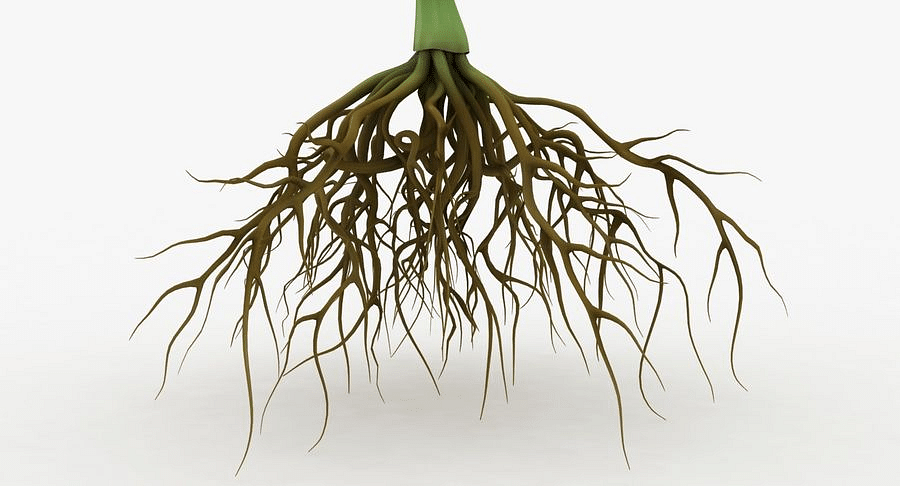
Plant Roots
Read More: Modification of Roots
Modifications of Tap Roots
- Conical roots are modified into roughly cone-shaped structures. They are broad at the top and go on decreasing at the other end. In these roots, the broad end is attached to the plant and the free end is tapering to end in a sharp point. Example: Carrot.
- Fusiform roots are a little swollen in the middle when compared to both ends. This root is another modification to store reserved food. Example: Radish.
- Napiform roots are swollen at the anterior end and suddenly taper to a pointy end at the posterior end. This is also reserved for food storage in the form of starch and sugar. Example: Beetroot.
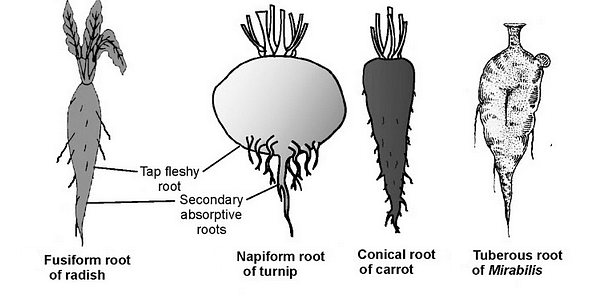
Modifications of Tap Roots
Modifications of Adventitious Roots
- Tuberous roots have tubers which are a modification of the stem and have buds while tuberous roots don’t have buds on them. Both mainly act as storage organs in plants. Example: Sweet potato.
- Fasciculated roots occur in tufts immediately. They look similar to tuberous roots but occur as tufts of roots. Example: Dahlia.
- Nodulose roots are those roots that get swollen to store extra energy although they have rhizomes that store food. Example: Mango.
- Moniliform roots look like beads on a string. They have nodules like thicken at regular intervals. Example: Grass.
- In Annulated roots, the roots look like they are made up of concentric rings. The rings appear like they have been placed on one another consequently that gives a strange appearance. Example: Ipecac.
- Few trees develop strong roots that emerge from under their branches, grow downwards into the soil, and strengthen their enormous branches. These are called prop roots. Example: Banyan tree.
- Some plants have also developed some roots from their base, just above the soil, and anchor the plant or the tree to the soil which is known as the Stilt roots. Example: Maize
- Some plants don’t use tendrils or twine around their support like other climbers. These plants have Climbing roots at the nodes that hold to the surface firmly, helping the climbers climb huge trees in the rainforests. Example: Araceae
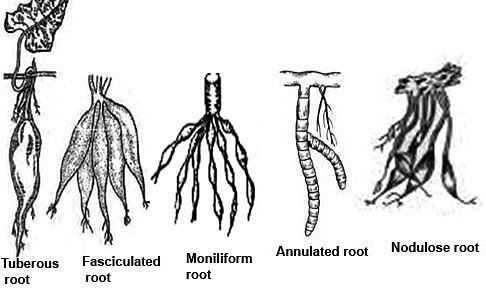
Adventitious Root System
Read More: Difference Between Rhizome and Tuber
(B) Stems
The stem is the axis of the plant that bears shoots, leaves, buds, and the basal end-roots. It transports water, minerals, and food to other parts of the plant body through various systems. In some plants, the stem is modified to perform various other functions such as storage of food, support, vegetative propagation, and protection. These are known as modified stems.
Underground Stem Modification
Plants that possess underground modifications of stem utilize it for perennation and storage of food. They look like roots but can be distinguished with various characteristics.
- The rhizome is a non-green, fleshy underground stem with nodes and internodes. The adventitious roots basically arise from the lower sides. Root-stock rhizome refers to the rhizome stem that grows obliquely and when they grow horizontally they are known as straggling rhizomes. Example: Ginger.
- Bulb modification is a type of modified stem that looks like a highly condensed discoid stem. Usually, there are many adventitious roots present at the base of the bulb. These bulbs can be scaly or tunicated. A dry membranous scale leaves called a tunic covers the tunicated bulb. Example: Onion
- The corm is a condensed rhizome that grows in a vertical form. It has a flattening base and is almost spherical in shape. The nodes have scale leaves and axillary buds and the adventitious roots are located at the base or all over the body area. Example: Colocasia.
- The Tuber is the swollen tip of an underground lateral stem and is covered by a corry. There are several depressions in the skin which are known as eyes. Each eye is a node and has one or more buds subtended by a leaf scar. Example: Potato
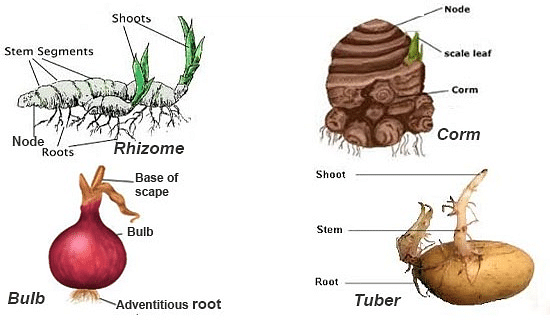
Underground Stem Modification
Subaerial Modification of Stem
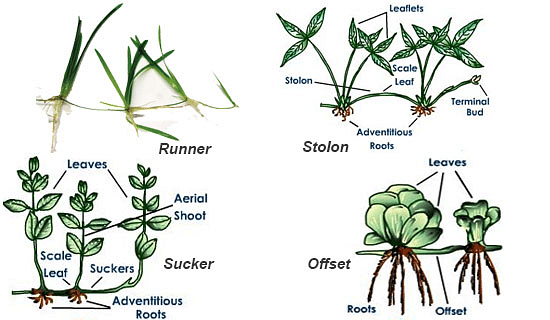
- Runners can be defined as a type of creeping stem with long internodes that usually run horizontally on the soil surface and bear scale leaves, adventitious roots, and scale leaves. This type of steam arises from an axillary bud. Example: Wood sorrel
- Sucker stem basically rises from the basal underground part of the main stem and they grow horizontally for a distance below the soil and then grow upwards obliquely. The stem develops a leafy shoot and adventitious roots before they separate from the mother plant. Example: Pudina
- A stolon is a weak lateral stem that rises from the main stem base. After growing erect for a while it bends downwards to touch the ground. Example: Jasmine
- Offset is defined as a short runner with one lone internode. The offset basically develops from a leaf axil. It, then, grows as a short horizontal branch and produces a rosette of leaves above and adventitious roots below. Example: Pistia
Subaerial Modification of Stem
Read More: Modifications of Stem
Aerial Stem Modifications
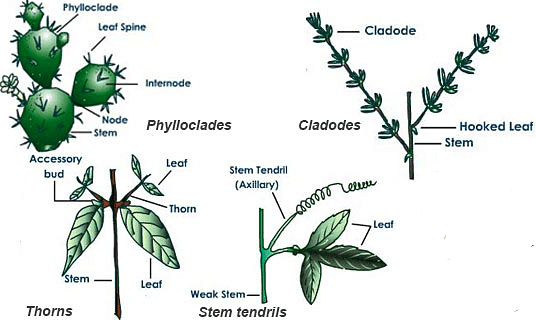
The six types of aerial stem modifications are elaborated in detail below:
- Tendrils are the green thread-like leafless structures that are formed when the stem of the plant or the branches are modified and are used for climbing. Example: Antigonon.
- Thorns are pointed, hard, or woody structures and sometimes bear leaves and flowers. They can also be branched. Thorns are used for defense or climbing. They also regulate respiration.
- Phylloclades are fleshy in nature and are flattened or cylindrical branches. The leaves transform into spines or scales and they also regulate transpiration. Example: Euphorbia.
- Cladodes are these flattened or cylindrical branches that help in photosynthesis. There are two long internodes observed in Ruscus, whereas in asparagus one long internode is observed.
- Bulbil is modified floral or vegetative buds with stored food for the plant body. They are meant for vegetative propagation. Bulbils detach to become new plants. Example: Dioscorea
- Thalamus can be described as a condensed stem axis that bears floral organs such as the corolla, calyx, androecium, and gynoecium.
Aerial Stem Modifications
Read More: Sexual Reproduction in Flowering Plants
(C) Leaf
The several leaves of plants get modified into different forms based on the purpose of the plant and its environment.
Modification of Leaves
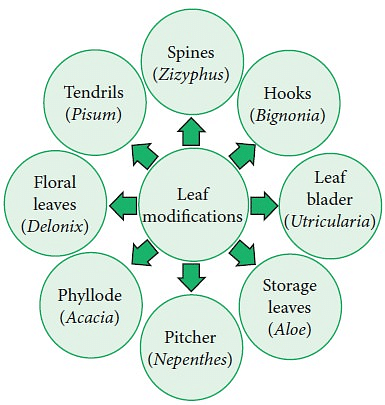
- Storage Leaves: Some xerophytic plants and Crassulaceae plants generally have highly thickened and succulent leaves with tissues to store water. This kind of adaptation helps plants to conserve a very limited supply of water and resists drying up.
- Leaf Tendrils: In plants with weak stems, leaves or a part of the leaf gets modified into green threadlike structures called tendrils which help in climbing around the support. Example: Wild pea.
- Leaf-spines: Leaves of certain plants become wholly or partially modified for defensive purposes into sharp, pointed structures known as spines. Example: Aloe
- Scale-leaves: Scale leaves are typically thin, dry, stalkless, membranous structures, that are usually brownish in color or sometimes colorless. They protect the axillary bud that they bear in their axil. Example: Asparagus.
- Leaflet Hooks: In Bignonia unguis cati the three terminal leaflets of the leaf get modified into claw-like hooks which help them in climbing.
- Leaf Roots: In the case of Salvinia, three leaves are present at one node. Out of these, two leaves are normal and the third gets modified into adventitious roots which help in floating over the surface of the water.
- Phyllode: In a few plants, the petiole or any part of the rachis becomes flattened or winged taking the shape of the leaf and turning green in color. This winged petiole or rachis is referred to as the phyllode. Example: Australian Acacia.
- Insect Catching Leaves: In insectivorous plants, the leaves are specially adapted to catch and digest insects to fulfill their nitrogen requirement. Example: Venus fly trap.
Modification of Leaves
Read More: Tropism in Plants
Things to Remember
- Each part of the plant originally evolved in the context of specific environmental imperatives related to terrestrial life and they undergo modification to perform additional functions.
- However, each lineage of plants has followed its own unique evolutionary path through time, and in many plant groups stems, roots and leaves have become secondarily modified.
- Roots anchor the plant and help in the absorption of water and mineral nutrients. However, at special times, roots may undergo modification to store food, help in respiration and provide support.
- Leaves were conformed to optimize photosynthesis. Besides photosynthesis and transpiration, they can provide support to managing water loss by reducing transpiration.
- Stems boost the leaves, serve as a conduit from the roots to the leaves, and also generate new growth. However, it gets modified to perform additional tasks like storage of food, and protection.
Previous Years Questions
- As a tree grows older, which of the following increases more rapidly in thickness? [NEET 1994]
- The cork cambium, cork, and secondary cortex are collectively called [NEET 2011]
- At maturity, which of the following is non- nucleated? [NEET 1997]
- Which of the statements given below is not true about the formation of Annual Rings in trees? [NEET 2019]
- The age of a tree can be estimated by [NEET 2013]
- Angular collenchyma occurs in [NEET 1991]
- Axillary bud and terminal bud derived from the activity of [NEET 2002]
- Tracheids differ from other tracheary elements in [NEET 2014]
- Abnormal/anomalous secondary growth occurs in [NEET 1993]
- Closed vascular bundles lack [NEET 2012]
Sample Questions
Ques. Why are stems modified? (3 Marks)
Ans. Stems are modified to take part in various functions in the plant body. For instance, aerial stem modification thorns regulate transpiration and help in keeping the loss of water from the plant body in check. The primary role of these stems is to defend the plant from outside harm. Another example can be the runner that plays a part in vegetative propagation. Underground modified stems act as food storage units for the plant body.
Ques. What are modified leaves? (3 Marks)
Ans. Leaves can be modified in the form of spines that reduce water loss and also act as a defense. Some leaves are modified into tendrils in order to provide support to the plant. Some leaves are thick which helps in water storage.
Ques. What is the modification of parts of plants? (3 Marks)
Ans. Modified parts refer to the part that has been specialized to perform various other functions as well. They undergo modification in order to adapt to their surroundings and environmental conditions. They help them in survive.
Ques. Why is onion a modified stem? (3 Marks)
Ans. The onion bulb is a modified stem as it consists of large numbers of fleshy scale leaves. At the base, the root appears as a thread-like structure. The stem is enclosed by a covering of leaves and is underground.
Ques. Is a flower a modified leaf? (3 Marks)
Ans. The flower is a highly specialized reproductive shoot. The sepals and petals may be regarded as modified leaves. Leaves in some species have to be modified to have various colors and look like petals. Their main purpose is to attract pollinators.
Ques. Are potatoes a root or stem? (3 Marks)
Ans. Potatoes are stem tubers, enlarged stolons that thicken to develop into storage organs. The tuber has all parts of a normal step which includes nodes and internodes. Tubers develop from an underground stem that acts as storage for food/ scratch which is later used by the plant.
Ques. Is carrot a modified stem? (3 Marks)
Ans. Carrots are modified tap roots. They have a tap root, no nodes and they can never bear leaves or flowers. Roots serve as food storage organs, absorbing nutrients and moisture, providing physical support as well as anchoring the plant in the soil.
Ques. Is garlic a root? (2 Marks)
Ans. Garlic roots are long, slender tap roots of the garlic plant, belonging to the lily family along with onions. Garlic is a modified underground stem similar to onions.
Ques. Is the bulb a modified leaf? (3 Marks)
Ans. True bulbs are mostly made up of modified leaf tissues. If the bulbs are cut in half, the layers of these scales would be seen with the main growing points in the center. It is an underground storage organ formed from the plant stem and leaves.
Ques. Are petals modified leaves? (3 Marks)
Ans. Petals are modified leaves that surround the reproductive parts of flowers. They are mostly brightly colored or shaped to attract pollinators. They evolved to protect the reproductive part of a flower and to attract or repel specific pollinators.
Also Check Out:



Comments