



Education Journalist | Study Abroad Lead
Carbon tetrachloride or tetrachloromethane is an organic compound with the chemical formula CCl4. It is artificially manufactured through the chlorination of different hydrocarbons such as carbon disulphide, methane, ethane, propane and methyl chloride. Under normal temperature and pressure conditions, carbon tetrachloride is a colourless liquid with a very distinctive smell. Carbon tetrachloride has wide applications in the industrial sector.
- Carbon tetrachloride is widely used in cleaning agents.
- It was used in fire extinguishers.
- However, prolonged exposure to this chemical compound can have adverse effects on the human body due to its toxicity.
Read Also: Elements in Chemistry
Key Takeaways: Carbon Tetrachloride, Chlorination, Polyhalogenated Organic Compound, Tetrahedral Molecular Geometry
Carbon Tetrachloride
[Click Here for Sample Questions]
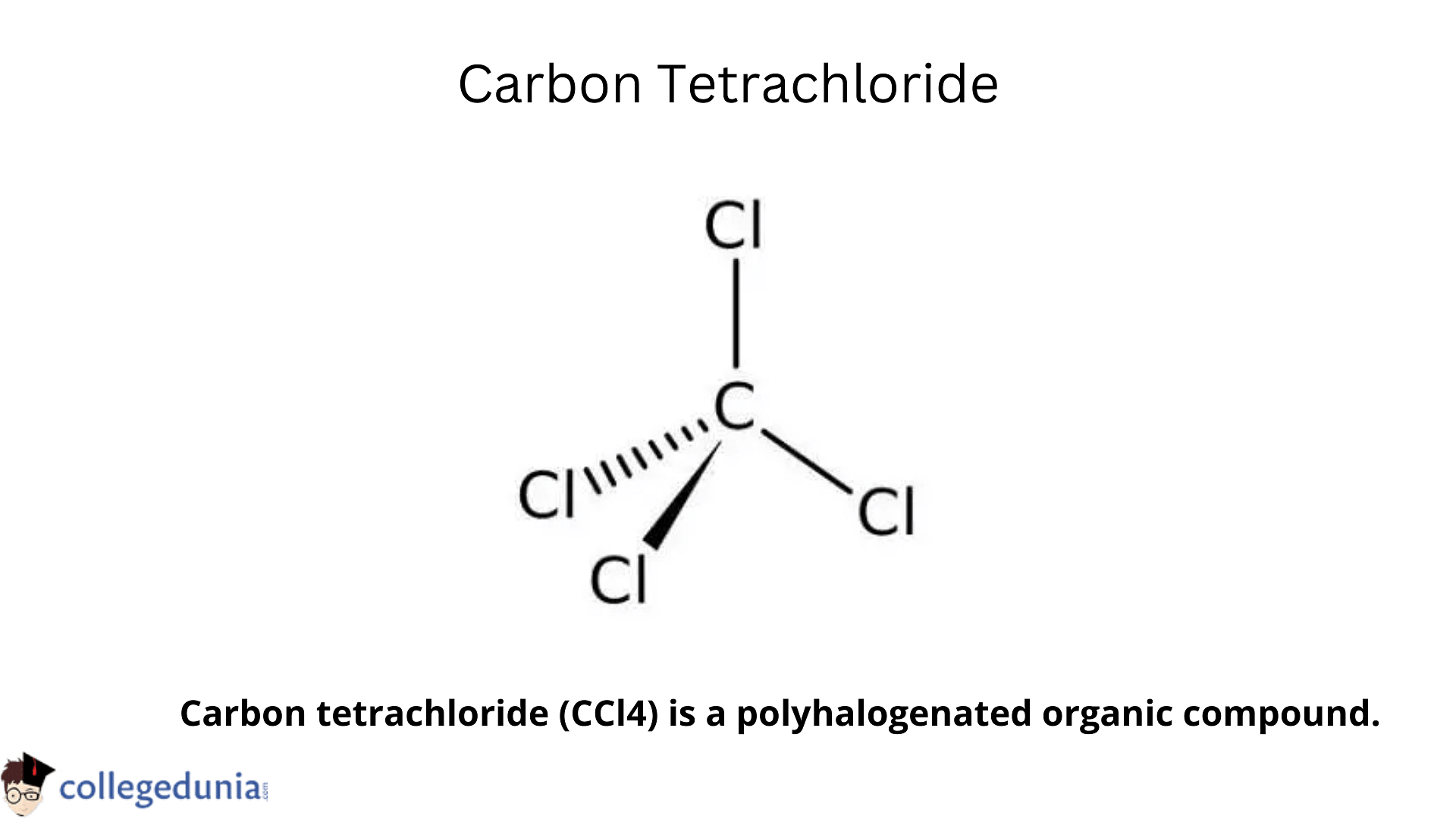
Carbon tetrachloride (CCl4), popularly known as tetrachloromethane, is a polyhalogenated organic compound. A polyhalogenated organic compound can be defined as a carbon compound that is attached to at least one halide functional group. It is a clear and colourless liquid having a distinctive sweet odour that can be easily detected at low levels.
Carbon Tetrachloride
- Carbon tetrachloride can be artificially manufactured by the process of chlorination, which is the introduction of chlorine atoms into an organic compound by either addition or substitution reaction.
- The use of the compound has been eliminated by various governments due to its toxicity.
- Exposure to a large quantity of carbon tetrachloride can cause serious damage to vital organs like the liver and kidney and also have negative effects on CNS (Central Nervous System).
- In 1839, it was initially prepared by reacting chloroform with chlorine.
- However, at present, carbon tetrachloride can be easily prepared through the chlorination of several hydrocarbons such as carbon disulphide, methane, ethane, propane and methyl chloride.
- Among these, the reaction of carbon disulphide with chlorine at temperatures between 105°C and 130°C is the most preferable method of preparation of carbon tetrachloride.
CS2 + 3Cl2 → CCl4 + S2Cl2
Read More:
Structure of CCl4
[Click Here for Previous Year Questions]
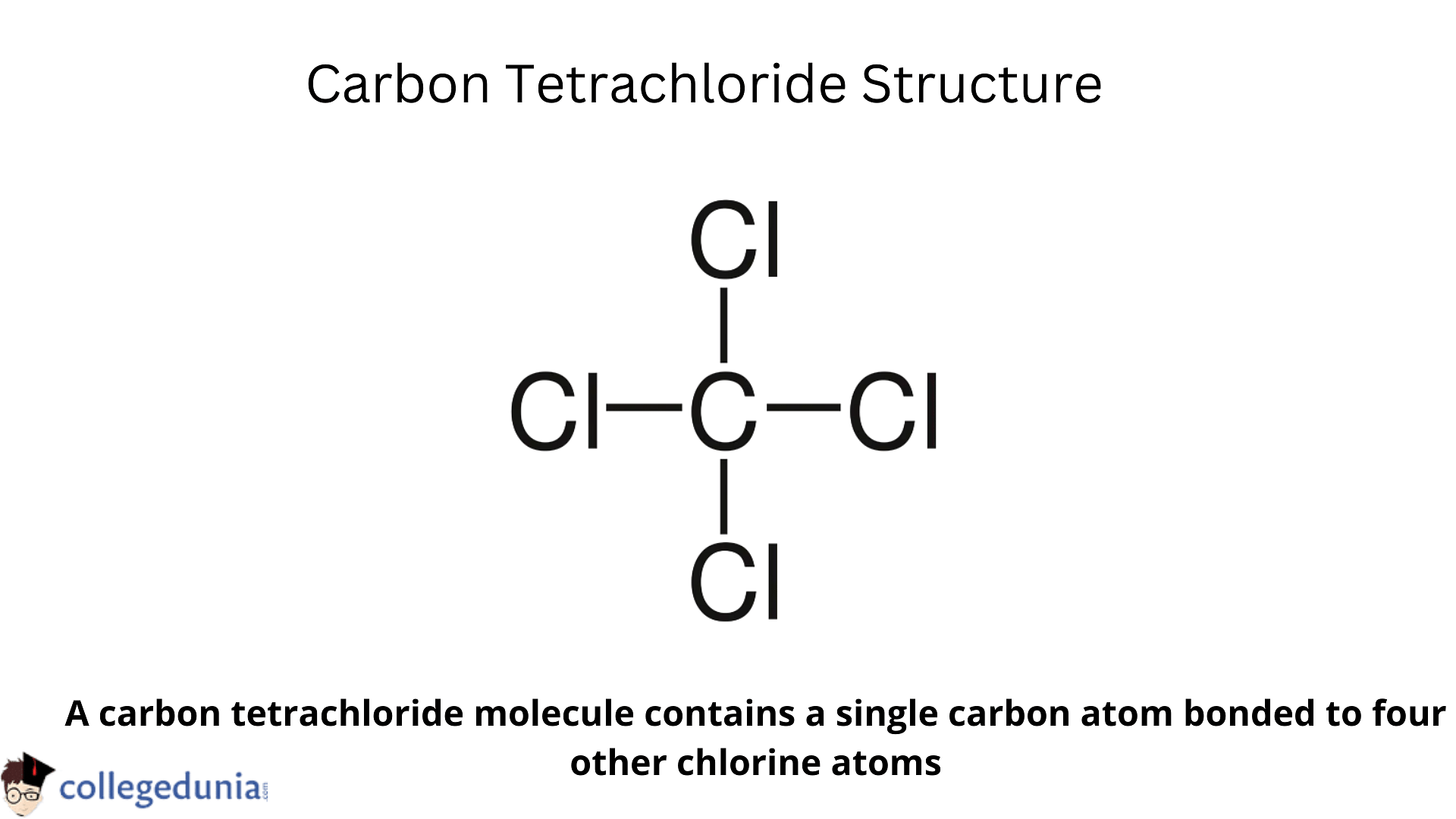
The molecular structure of carbon tetrachloride and methane gas is quite similar. A carbon tetrachloride molecule contains a single carbon atom that is bonded to four other chlorine atoms that are, in turn, arranged in a symmetric manner. Thus, it has a tetrahedral molecular configuration. The IUPAC name of carbon tetrachloride is 1,1,1,1 – tetrachloromethane. This name is given to the compound in nomenclature as the central atom – carbon is surrounded by the functional groups of 4 chlorine atoms.
Structure of CCl4
- This can be better illustrated in the diagram, where four chlorine atoms are arranged symmetrically at each corner around a central carbon atom with the help of single covalent bonds.
- Carbon tetrachloride exhibits non-polar properties due to the molecular geometry of the compound.
- The molecular structure of CCl4 is similar to CH4 (methane gas).
Also Read: Chemical Kinetics
Properties of Carbon Tetrachloride
[Click Here for Sample Questions]
Some of the physical and chemical properties of carbon tetrachloride are as follows:
- The molar mass of carbon tetrachloride has been found to be 153.81 grams per mole.
- Under normal conditions of temperature and pressure, carbon tetrachloride exists in the liquid state. It occurs as a clear and colourless liquid having a distinctive sweet odour.
- Under standard conditions of temperature and pressure, the average density of carbon tetrachloride is found to be 1.5867 grams per cubic centimetre.
- The melting and boiling point of carbon tetrachloride is -22.93°C and 76.72°C, respectively.
- Carbon tetrachloride has a tetrahedral molecular configuration with a central carbon atom that is bonded with four chlorine atoms that are arranged in a symmetrical fashion.
- On account of the tetrahedral molecular structure observed in tetrachloromethane, this chemical compound exhibits non-polar properties.
- Despite being soluble in other non-polar solvents such as chloroform, benzene, ethers, alcohol and formic acid, carbon tetrachloride is comparatively less soluble in water – approximately 1 gram of carbon tetrachloride is soluble in one litre of water at a temperature of 25°C.
- Carbon tetrachloride crystallises and forms a monoclinic crystal lattice.
- The heat capacity or thermal capacity of carbon tetrachloride has been found to be 132.6 Joules per mole – Kelvin.
- The standard molar entropy of carbon tetrachloride is 214.42 Joules per mole Kelvin.
Check Also: Zinc Chloride Formula
Applications of Carbon Tetrachloride
[Click Here for Previous Year Questions]
Some of the key applications of carbon tetrachloride are as follows:
- Carbon tetrachloride was primarily used for the production of chlorofluorocarbon (CFC) refrigerants during the 1980s.
- Carbon tetrachloride was also used for the manufacture of fire extinguishers and as a cleaning agent.
- The compound is used for the generation of chlorine in the Appel reaction.
- Carbon tetrachloride is used to disclose the watermarks placed on stamps without causing any damage to the stamp during the process.
- The compound is used for the manufacture of lava lamps.
- In the medical field, carbon tetrachloride is also used in proton NMR spectroscopy.
Effects of Carbon Tetrachloride
[Click Here for Sample Questions]
Carbon tetrachloride can have a grave impact on the environment as well as the health of individuals. These are further explained in the following points:
- The use of carbon tetrachloride in refrigeration results in the depletion of the ozone layer in the atmosphere.
- The ozone layer is important for the sustenance of life on earth as it protects us from the harmful ultraviolet radiation of the Sun.
- Short-term exposure to carbon tetrachloride can result in headaches, dizziness, lethargy, weakness, nausea and vomiting.
- Carbon tetrachloride has serious impacts on the liver and kidneys of all individuals. It also causes great damage to the Central Nervous System (CNS).
- Exposure to carbon tetrachloride can also lead to centrilobular hepatic necrosis.
- Prolonged exposure to carbon tetrachloride can often lead to coma and even death.
- Chronic exposure to carbon tetrachloride has also been found to develop cancer in some individuals.
This compound was widely used as a precursor to CFCs. However, since the 1980s, there has been a sharp decline in the production of this compound due to environmental concerns.
Read More: Sulphuric Acid
Carbon Tetrachloride Toxicity
[Click Here for Previous Year Questions]
People can be exposed to carbon tetrachloride in the following manners:
- People can be exposed to this chemical compound through its accidental release into the surrounding soil and atmosphere.
- Carbon tetrachloride is commonly ejected in landfills from where it can easily get evaporated into the atmosphere or leach into the groundwater.
- Carbon tetrachloride is commonly used as a cleaning agent in houses.
- People can also get exposed to carbon tetrachloride by drinking contaminated water.
- The workers involved in the manufacturing of carbon tetrachloride in the industrial sector also become significantly exposed to this chemical compound.
Prevention of Carbon Tetrachloride Poisoning
[Click Here for Sample Questions]
People often get exposed to carbon tetrachloride. In short quantities, it might not be able to cause great damage to the human body. However, chronic exposure to this chemical compound may cause serious health hazards and sometimes, even death.
The possible ways to avoid carbon tetrachloride poisoning are as follows:
- Individuals must always check the labels of household products and switch to safer chemical-free alternatives.
- The parents must keep products containing carbon tetrachloride out of reach of children.
- The products containing carbon tetrachloride must be discarded with great caution after their use.
- The workers involved in the manufacture of carbon tetrachloride must wear all necessary equipment including masks, gloves and protective clothing in order to reduce their level of exposure to the chemical compound.
Check More: Important questions in Chemical Reactions
Treatment for Carbon Tetrachloride Poisoning
[Click Here for Previous Year Questions]
Proper treatment for carbon tetrachloride is yet to be found. The course of treatment for carbon tetrachloride poisoning usually depends on the level of exposure to this chemical compound.
- In cases where carbon tetrachloride enters the eyes, the individuals must wash their eyes thoroughly and seek medical attention immediately.
- In case the skin is exposed to this chemical compound, the individual must immediately get rid of the contaminated clothes and wash the affected area thoroughly with soap. The individual must also make sure to seek medical attention as soon as possible.
- Immediate medical help must also be sought for individuals in case they swallow or inhale carbon tetrachloride.
Read More:
Things to Remember
- Carbon tetrachloride is an artificially manufactured organic compound that is prepared through the process of chlorination of different hydrocarbons.
- Carbon tetrachloride has a tetrahedral molecular geometry. As a result, it exhibits non-polar properties.
- Carbon tetrachloride is a colourless and clear liquid with a distinctive sweet odour and several unique physical and chemical characteristics.
- People can be exposed to carbon tetrachloride by using cleaning agents, drinking water, in industries and through accidental releases in the surrounding environment.
- Carbon tetrachloride has wide applications in the industrial and medical fields.
- Short-term or chronic exposure to carbon tetrachloride is harmful to both the environment and the human body.
- Carbon tetrachloride must be handled with utmost caution in order to avoid being poisoned by it. Treatment for carbon tetrachloride poisoning is not definite.
Check More: Oxidation and Reduction
Previous Year Questions
- By Wurtz reaction, a mixture of methyl iodide and ethyl iodide gives... [BCECE 2006]
- Friedel - Craft's reaction is not related to... [UPSEE 2016]
- Iodine value is used to determine... [COMEDK UGET 2008]
- In benzene, each carbon atom undergoes... [COMEDK UGET 2009]
- Isopropyl chloride and isobutyl chloride react... [COMEDK UGET 2011]
- When 2-bromopentane is heated with an alcoholic solution… [COMEDK UGET 2014]
- Which of the following is not used to distinguish ethane from ethene? [COMEDK UGET 2010]
- 1, 3, 5, 7-Octatetraene contains…
- At room temperature, the eclipsed and staggered forms of ethane cannot be isolated because...
- One mole of a symmetrical alkene on ozonolysis gives two moles…
- Isomers of hexane, based on their branching, can be divided into three distinct classes as shown… [JEE Advanced 2014]
- The synthesis of 3-octyne is achieved by adding a… [JEE Advanced 2010]
- The correct statement(s) about the compound… [JEE Advanced 2009]
- Among the following, which is the least stable conformation of cyclohexane? [JKCET 2012]
- Anti-Markownikoff addition of HBr is not observed in... [JKCET 2012]
Sample Questions
Ques: Explain the molecular structure of carbon tetrachloride. (2 marks)
Ans. The molecular structure of carbon tetrachloride and methane gas is quite similar. A carbon tetrachloride molecule contains a single carbon atom that is bonded to four other chlorine atoms that are, in turn, arranged in a symmetric manner. Thus, it has a tetrahedral molecular configuration.
This can be better illustrated in the adjoining diagram, where four chlorine atoms are arranged symmetrically at each corner around a central carbon atom with the help of single covalent bonds.
Ques: Mention two physical properties of carbon tetrachloride. (2 marks)
Ans. The physical properties of carbon tetrachloride are as follows:
- Under normal conditions of temperature and pressure, carbon tetrachloride exists in the liquid state. It occurs as a clear and colourless liquid having a distinctive sweet odour.
- The melting and boiling point of carbon tetrachloride is -22.93°C and 76.72°C, respectively.
Ques: Why does carbon tetrachloride exhibit non-polar properties? (2 marks)
Ans. Carbon tetrachloride has a tetrahedral molecular configuration with a central carbon atom that is bonded with four chlorine atoms that are arranged in a symmetrical fashion. As a result, it exhibits non-polar properties.
Ques: Mention the IUPAC name of carbon tetrachloride. (1 mark)
Ans. The IUPAC name of carbon tetrachloride (CCl4) is 1,1,1,1 – tetrachloromethane.
Ques: Discuss four applications of carbon tetrachloride. (3 marks)
Ans. The primary applications of carbon tetrachloride are as follows:
- In the medical field, carbon tetrachloride is used in proton NMR spectroscopy.
- Carbon tetrachloride is used for the manufacture of cleaning agents to be used in households.
- Carbon tetrachloride is used to disclose the watermarks placed on stamps without causing any damage to the stamp during the process.
- Carbon tetrachloride is used for the manufacture of lava lamps.
Ques: Discuss the different health hazards that are associated with prolonged exposure to carbon tetrachloride. (3 marks)
Ans. Prolonged exposure to carbon tetrachloride can have serious impacts on the health of individuals. These have been discussed below:
- Carbon tetrachloride is a hepatotoxin and can cause serious damage to the liver in the long run.
- Chronic exposure to carbon tetrachloride can also damage the kidneys and the Central Nervous System (CNS) of different individuals.
- Prolonged exposure to carbon tetrachloride can often lead to coma and even death.
- Chronic exposure to carbon tetrachloride has also been found to develop cancer in some individuals.
Ques: Name two sources of carbon tetrachloride. (3 marks)
Ans. People get exposed to carbon tetrachloride (CCl4) in the following manners:
- Sometimes, individuals can get exposed to carbon tetrachloride by drinking contaminated water.
- People can also be exposed to carbon tetrachloride through its accidental release into the surrounding soil and atmosphere. This chemical compound is commonly ejected in landfills from where it can easily get evaporated into the atmosphere or leach into the groundwater.
Ques: Discuss three methods of prevention of carbon tetrachloride poisoning. (3 marks)
Ans. The three possible ways to avoid carbon tetrachloride poisoning are as follows:
- Individuals must always check the labels of household products and switch to safer chemical-free alternatives.
- The products containing carbon tetrachloride must be discarded with great caution after their use.
- The workers involved in the manufacture of carbon tetrachloride must wear all necessary equipment including masks, gloves and protective clothing in order to reduce their level of exposure to the chemical compound.
Ques: How can carbon tetrachloride poisoning be treated? (3 marks)
Ans. There is no definite method of treating carbon tetrachloride. The course of treatment for carbon tetrachloride poisoning usually depends on the level of exposure to this chemical compound.
- In cases where carbon tetrachloride enters the eyes, the individuals must wash their eyes thoroughly and seek medical attention immediately.
- In case the skin is exposed to this chemical compound, the individual must immediately get off the contaminated clothes and wash the affected area thoroughly with soap. The individual must also make sure to seek medical attention as soon as possible.
- Immediate medical help must also be sought for individuals in case they swallow or inhale carbon tetrachloride.
Ques: Name two non-polar solvents that can dissolve carbon tetrachloride. (2 marks)
Ans. The two non-polar solvents that can very easily dissolve carbon tetrachloride are chloroform and benzene.
Check Out:



Comments