



Education Content Expert
Carbonic Acid is a chemical compound consisting of hydrogen, carbon, and oxygen.
- The chemical formula of carbonic acid H2CO3.
- Carbonic acid is formed in small amounts when carbon dioxide dissolves in water.
- It is frequently referred to as a respiratory acid as it is the only acid exhaled in the gaseous state by the human lungs.
- It is a weak acid that produces bicarbonate and carbonate salts.
Key Terms: Carbonic Acid, Carbon Dioxide, Chemical Equilibrium, Weak Acid, Hydrogen, Carbon, Dihydrogen Carbonate, Acid
What is H2CO3?
[Click Here for Sample Questions]
Carbonic Acid is a carbon-containing compound with the chemical formula H2CO3.
- It is a compound made up of the elements hydrogen, carbon, and oxygen.
- It is an inorganic weak acid that exists only as a solution.
- It is formed in small amounts when its anhydride carbon dioxide dissolves in water.
- Carbonic acid is also known as dibasic acid, acid of air, aerial acid, or dihydrogen carbonate.
- Carbonic acid forms two kinds of salts namely carbonates and bicarbonates.
- The ph of carbonic acid is 4.68 in 1mM.
Read More:
Structure of Carbonic Acid
[Click Here for Previous Years’ Questions]
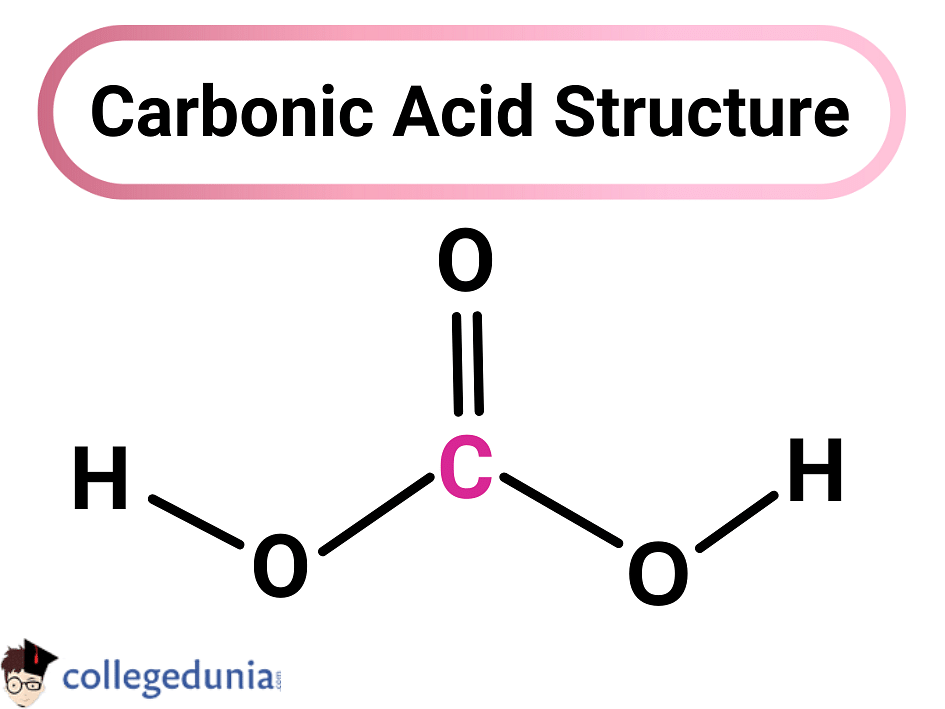
Carbonic Acid consists of one carbon-oxygen double bond and two carbon-oxygen single bonds.
- The oxygen atoms participate in a single bond with the carbon, each contains one hydrogen atom attached to them.
- Carbonic acid is both unstable, and weak.
- It dissociates quickly into the bicarbonate ions (HCO3–) and hydrogen ions (H+).
The Structure of Carbonic Acid is as follows:
Preparation of Carbonic Acid
[Click Here for Sample Questions]
Preparation of carbonic acid is specified as follows:
- One carbon-oxygen double bond and two carbon-oxygen single bonds make up the structure of carbonic acid.
- One hydrogen atom is joined to each of the oxygen atoms involved in a single bond with the carbon.
- In many temperate habitats, carbonic acid is created when CO2 dissolves and hydrolyzes in water.
- Due to its weakness and instability, carbonic acid quickly splits into hydrogen ions (H+) and bicarbonate ions (HCO3-).
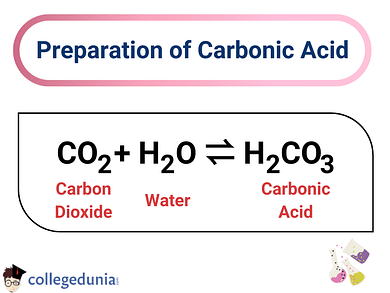
When CO2 is dissolved in water, it participates in the chemical equilibrium to create Carbonic Acid. The reaction for the preparation of Carbonic Acid is as follows:
| CO2 + H2O ⇌ H2CO3 |
Only a small amount of carbon dioxide is converted into carbonic acid in the chemical equilibrium described above.
Properties of Carbonic Acid
[Click Here for Previous Years’ Questions]
The physical and chemical properties of Carbonic Acid are as follows”
Physical Properties of Carbonic Acid
- The molar mass of carbonic acid is 62.024 grams per mole.
- The pKa value of the molecule H2CO3 is 3.6.
- In normal conditions, carbonic acid has a density of 1.668 grams per cubic centimeter.
- This compound often occurs as a solution.
- However, it has been claimed that NASA scientists have created solid samples of H2CO3.
- Bicarbonate is the conjugate base that corresponds to carbonic acid.
Chemical Properties of Carbonic Acid
- H2CO3 is a weak acid that is unstable in nature.
- It partially dissociates in the presence of water to produce HCO2- (bicarbonate) and H+ ions.
- Carbonic acid is a diprotic acid, so it may produce both carbonates and bicarbonates as salts.
- Bicarbonate salts are produced when a modest amount of base is added to H2CO3.
- Whereas carbonate salts are produced when a base is added in excess.
- Carbonic acid can be produced via industrial fermentation techniques or by the large-scale industrial combustion of fossil fuels.
Uses of Carbonic Acid
[Click Here for Sample Questions]
H2CO3 is an essential compound with a wide range of applications. Here are a few uses of carbonic acid:
- Carbonic acid is used in the production of sparkling wine, carbonated water, and other aerated beverages.
- The precipitation of different ammonium salts, such as ammonium persulfate, may be done using H2CO3.
- It aids in the removal of carbon dioxide from the human body.
- Numerous bases in the blood serum that contain nitrogen are protonated by H2CO3.
- Treatment for ringworm and other dermatitides involves applying carbonic acid to the afflicted region.
- Cleaning contact lenses with solutions containing this chemical is substantially more efficient.
- It can be taken orally whenever necessary to cause vomiting (such as, in the case of a drug overdose).
Importance of Carbonic Acid in Blood
[Click Here for Previous Years’ Questions]
The importance of carbonic acid in the blood is as specified below:
- The bicarbonate ion functions as an intermediary in the process of respiratory gas exchange.
- It transports carbon dioxide out from the human body.
- Carbon dioxide's hydration processes go very slowly, especially when a sufficient catalyst is not present.
- However, the carbonic anhydrases enzyme family is found in red blood cells, which speeds up the process.
- Carbonic anhydrases catalyze the transformation of water and carbon dioxide into the dissociated ions of carbonic acid.
- This results in the formation of bicarbonate anions, which dissolve in the blood plasma.
- In the lungs, the catalyzed reaction reverses, resulting in CO2, which is exhaled.
Importance Of Carbonic Acid in Oceans
[Click Here for Sample Questions]
The importance of carbonic acid in oceans is as follows:
- The pH of the ocean's water is thought to have changed by about -0.1.
- It is due to the absorption of the extra carbon dioxide present in the atmosphere.
- This increase is mostly an outcome of human activities.
- Ocean water and the absorbed carbon dioxide combine to make H2CO3.
- Ocean acidification is the term generally used to describe this phenomenon.
Things to Remember
- Carbonic Acid is an unstable and weak acid with the chemical formula H2CO3.
- There is one carbon-oxygen double bond in Carbonic Acid.
- It is formed due to the reaction of carbon dioxide dissolved in water.
- The reaction for the formation of Carbonic Acid is CO2 + H2O ⇌ H2CO3.
- Carbonic acid is important in blood for transporting carbon dioxide.
- Calcium bicarbonate (Ca(HCO3)2) is formed by dissolving limestone with H2CO3.
- It is found in small amounts in human blood, carbonated beverages, and rainwater.
Check More:
Previous Year Questions
|
Sample Questions
Ques. What are the uses of Carbonic Acid? (3 Marks)
Ans. The uses of Carbonic Acid are as follows:
- Soft drinks, artificially carbonated sparkling wines, and other frothy beverages are frequently made with carbonic acid.
- It helps to transport carbon dioxide out of the body.
- Bicarbonates, or carbonates of hydrogen, and carbonates are the salts of carbonic acid.
- It is consumed orally in order to induce vomiting whenever required.
Ques. What do you mean by the Acidity of Carbonic Acid? (2 Marks)
Ans. In carbonic acid, the substituted hydroxyl group is present, which is classified as a carboxylic acid, known as polyprotic acid. This chemical has two protons that separate from the main parent molecule since it is diprotic. As a result, there are two dissociation constants, the first of which governs the formation of the bicarbonate ion.
Ques. What is the role of Carbonic Acid in the blood? (3 Marks)
Ans. Bicarbonate ion acts as an intermediate for pushing the carbon dioxide out of the human body through the respiratory gas exchange process.
- In the absence of a suitable catalyst, the hydration reactions undergone by carbon dioxide are very slow.
- Carbonic anhydrases present in the red blood cells will result in an increase in reaction rate.
- They work to catalyze the conversion of water and carbon dioxide into dissociated carbonic acid ions.
- It will lead to the formation of the bicarbonate anions that get dissolved in the plasma of the blood.
- This catalyzed reaction will then get reversed in the lungs, leading to the formation of CO2, and then exhaled.
Ques. Is Carbonic Acid a Strong Acid? (3 Marks)
Ans. No, Carbonic acid is not a powerful acid.
- A proton (H+ cation) and a bicarbonate ion are produced when the weak acid H2CO3 dissociates (HCO3- anion).
- In aqueous solutions, this chemical dissociates only partially.
- Bicarbonate ion, the conjugate base of carbonic acid, is a somewhat strong base.
- Due to these factors, carbonic acid is considered a weak acid rather than a strong acid.
Ques. List the physical properties of carbonic acid. (5 Marks)
Ans. The physical properties of carbonic acid are as follows:
- Appearance: Carbonic acid is a greyish-white solid.
- Melting point: Its melting point is 210 oC.
- Boiling Point: Its boiling point is -78 oC.
- Molecular Weight: The molecular weight of carbonic acid is 62.024 g/mol.
- pH Value: Its pH value is less than 7.
- Taste: It is odorless and has an alkaline taste.
Ques. Is carbonic acid dangerous? (1 Mark)
Ans. Due to its natural presence in the human body, carbonic acid is not considered toxic or dangerous. The respiratory tract and the eyes can be irritated by exposure to high concentrations of H2CO3.
Ques. Explain the formation of Carbonic Acid. (3 Marks)
Ans. The formation of Carbonic Acid is as follows:
- It is formed by the hydrolysis and dissolution of CO2 in water.
- When CO2 is dissolved in water, it participates in the chemical equilibrium which is expressed as follows: CO2 + H2O ⇌ H2CO3.
- A small amount of carbon dioxide is converted into carbonic acid in this reaction.
Ques. What is the amount of acid present in the human body? (2 Marks)
Ans. There are around 500 amino acids in nature, yet just 20 amino acids make up the proteins found in the human body. Inside the human body, human blood has a pH of about 7.40. There are also many distinct types of acids present in the human body and each has its own function.
Ques. Is Carbonic Acid organic or inorganic acid? (3 Marks)
Ans. The structure of Carbonic Acid makes it an inorganic acid even though it has carbon and hydrogen in it.
- There are two hydrogen, one carbon, and three oxygen atoms in Carbonic acid.
- A compound is considered organic if it has carbon and hydrogen and at least one hydrogen is bonded to carbon.
- However, in carbonic acid, no hydrogen bonds to the central carbon atom.
- Thus, carbonic acid is an inorganic acid.
Ques. How strong acid is Carbonic Acid? (1 Mark)
Ans. Carbonic Acid is not a very strong acid as indicated on the pH scale. This acid is about a 5 on the pH scale, which is considered an acid, but it is very close to the neutral 7, which is why it is referred to as a weak acid.
Check-Out:



Comments