



Education Journalist | Study Abroad Lead
Synthesis refers to the formation of complex chemical compounds from simpler compounds in Chemistry. This process can be implemented to attain any kind of compounds that can be used in the day to day life but in general, mainly it is used to synthesize the organic compounds or molecules. To understand the chemical structures, chemists tend to synthesize the chemical compounds of the naturally occurring substances and the substances that do not occur naturally. However, the process of synthesis is used to obtain the products or compounds in higher quantities.
| Table of Content |
Key Terms: Synthesis, Synthesis Reaction, Organic Compounds, Molecules, Chemical Bond, Chemical Reaction, Endothermic Reaction, Combustion, Displacement Reaction, Substitution
Synthesis in Science
[Click Here for Sample Questions]
The atoms that are constituted by different elements are responsible for forming a chemical compound. However, chemical synthesis is responsible for creating new compounds from the existing ones. A complex synthesis of molecules at a large scale contains a chain of chemical reactions starting from the available entities to the desired result. However, generally, every stage at a time requires a chemical reaction at one single chemical bond.
Read More:
| Related Concepts | ||
|---|---|---|
| Redox Titration | Volumetric Analysis | Conformation |
| SN1 Reaction | SN2 Reaction | Wurtz Reaction |
Synthesis Reaction
[Click Here for Sample Questions]
A reaction in which two compounds react to form a new compound is called a synthesis reaction in which there is a release of energy, heat, and time. In general, there is a probable chance of an endothermic reaction that takes place. However, the most common type of reactions that comes under the category of synthesis reaction is the combustion reaction, single displacement reaction, and double displacement reaction.
The reactions that are based on the synthesis reactions are complicated. They are not in the form of A+B=C types of reactions. There can be a demand for more starting reactants than two. The intermediate reactions can be responsible for the formation of by-products. However, the quality of the product can be distorted as per the byproducts and results formed by the collision of the reactant molecules.
There are many kinds of reactions that are under the synthesis reactions like the nucleophilic, substitution, and electrophilic reactions can be the reason for the conduction of the several synthesis reactions. The result, in turn, is the result of the several conditions or the parameters that are responsible for the synthesis reaction to take place.

Synthesis Reaction
Factors Affecting Synthesis Process
[Click Here for Sample Questions]
In an efficient synthesis reaction, the quantity of results is high when the residual products are less. However, the most efficient reactions of synthesis require a deep knowledge of reaction variable effects, reaction mechanisms, and kinetics.
- The quality or the efficiency of catalysts, reactants, and reagents- The starting or raw materials with the best quality and the modesty along with the consistent sources of these starting materials directly affects the efficiency and the repeatability of the synthesis processes and reactions.
- Reaction Kinetics- To attain the optimal end product along with the minimum number of by-products can only be achieved with the help of detailed knowledge of kinetic rates.
- The process of chemical synthesis is conducted at elevated temperatures as the chemical reaction’s rate increases with an increase in temperature, such as, when nitric acid is synthesized in the industry with the starting materials like oxygen and ammonia at the temperature of 900 degrees Celsius. In these reactions, the catalysts are responsible for increasing or decreasing the reaction time of any reaction. The increase in temperature in turn increases the rate possessed by the reaction.
- To have an effective and accurate synthesis reaction, certain factors are responsible for achieving it. These factors include pressure, dosing rate, and temperature. The precision, accuracy, and monitoring of the reaction parameters are done automatically by the chemical synthesis reactor.
- The chemical synthesis of any substance is majorly done with the help of two different compounds. This reaction is conducted only when the substances are kept nearby. This proximity is maintained when these reactants are either in the liquid or the gaseous state or when there are involatile solid reactants in the solution. The molecules of these substances changes either with the change in heat or with the change of electric current or the radiations like the ultraviolet light.
- When it comes to the pharmaceutical industry, the synthesis reaction takes place in batch mode. The classic round bottom flask is now replaced and the improvised physical configuration reactors are in the form due to the agitation performance and the surface area. To analyze the real-time performance of continuous flow and batch synthesis, the continuous flow processes are more in demand and popular.
Examples of Synthesis Reaction
[Click Here for Sample Questions]
- Sodium Chloride or the common salt is formed when two units of sodium react with the chloride. 2Na + Cl2 → 2NaCl
- The synthesis reaction of potassium chlorate and oxygen gas yields the product of potassium chloride.
- The reaction between the metal that is magnesium and the oxygen generates the magnesium oxide which in turn is a combustible reaction. The metal can be any other metal as well. 2Mg + O2→2MgO
- The reaction where the metallic carbonate is formed with the reaction of CO2 and calcium oxide is also a kind of synthesis reaction.
- The reaction of Zinc along with the oxygen forms zinc oxide is an oxidation reaction as well as the synthesis reaction also includes the loss of electrons. The reaction of the same is given by: 2Zn + O2→2ZnO
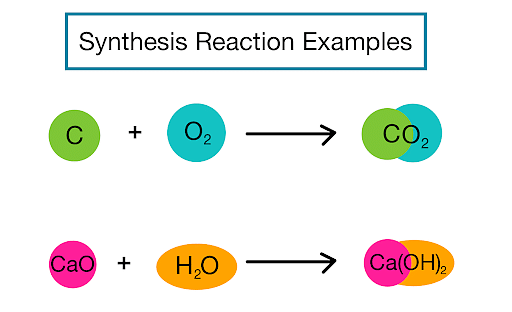
Synthesis Reaction Examples
Things to Remember
- Synthesis is a reaction in chemistry in which there is a formation of the resultant product with the help of two or more compounds.
- The synthesis reactions are generally exothermic and can emit energy, heat, etc.
- The types of synthesis reactions may include substitution, nucleophilic, and electrophilic reactions.
- The catalysts used in the chemical reactions to speed up the process are one of the major factors affecting the synthesis reactions.
- It is important to keep the reactants nearby usually in liquid or the gaseous form to conduct the process of synthesis.
- The most common example of synthesis is the formation of common salt from the starting reactants sodium and chloride.
- The oxidation reaction like the formation of Zinc oxide is also one of the important examples that fall under the synthesis reactions.
Read More:
Sample Questions
Ques. What is meant by the term ‘synthesis’ in chemistry? (3 Marks)
Ans. ‘Synthesis’ in chemistry is a reaction in which the result is obtained using two different reactants. In this reaction, the reactants tend to be the simpler compounds that give rise to the product which in turn is a complex compound. The process of synthesis is important as it is used in manufacturing the substances in larger quantities. This process breaks the previously formed chemical bonds and develops new chemical bonds.
Ques. Give an example to show the synthesis reaction. (3 Marks)
Ans. The reaction of synthesis is possible when a single product or result is obtained using two or more reactants or the starting reactants. This is a complex process and the equation for this process can be of the form: A+B=AB. An example of a synthesis reaction can be the common salt or sodium chloride. It is formed by the reaction of Sodium and Chloride.
2Na + Cl2 \(\to\) 2NaCl
Ques. Give the different chemical reactions to show the process of synthesis. (3 Marks)
Ans. The different chemical reactions to show the process of synthesis are given below:
- The reaction between sodium and chloride forms sodium chloride. 2Na + Cl2 \(\to\) 2NaCl
- The formation of Zinc Oxide with the help of Zinc and Oxygen. 2Zn + O2→2ZnO
- When Magnesium Oxide is formed using the compounds of magnesium and oxygen. 2Mg + O2→2MgO
Ques. What kind of a reaction is a synthesis reaction? (3 Marks)
Ans. A synthesis reaction is generally an exothermic reaction as it releases heat when the product is formed. The reactions tend to release the energy in several kinds like heat and light. However, the reaction can sometimes be endothermic as well. An exothermic reaction is a process in synthesis reaction as when two reactants combine the heat is generally released rather than absorbed.
Ques. State the processes that can come under the category of a synthesis reaction. (3 Marks)
Ans. When a synthesis reaction takes place, several other processes occur simultaneously. These reactions can be nucleophilic, substitution reactions, or electrophilic reactions. The other reactions that include in the synthesis reaction are the oxidation and reduction processes. Also, the single displacement reaction, combustion reaction, and double displacement reaction are the reactions in the synthesis reaction.
Ques. What are the conditions to perform synthesis reactions? (3 Marks)
Ans. The synthesis reaction is performed when the reactants are kept in proximity to each other. This is achieved when these reactants are either in the liquid state or the gaseous state or are involatile solids. The molecules of these reactants change according to the temperature, heat, the energy released, or the light/radiation emitted or absorbed.
Ques. What is an important factor that contributes to the synthesis reaction? (3 Marks)
Ans. The process of synthesis can be affected by many factors. The process is supposed to generate the result with the utmost efficiency and less or no by-products. An important factor to affects synthesis reaction can be the use of catalysts. The catalysts are the agents that are used to support the reaction by reducing the time consumption of the reaction.
Check-Out:



Comments