



Exams Prep Master
In chemistry, column chromatography implies a method that is used to isolate a chemical compound from a mixture. Chromatography separates substances on the basis of differential adsorption of compounds to the adsorbent and compounds move through the column at different rates, enabling them to separate into fractions. Here, we will discuss the concept in detail along with few important questions.
Key Terms: Separation, chromatography, purification, adsorbent, adsorption, Column chromatography, chemical compound
What is Column Chromatography?
[Click Here for Sample Questions]
Column chromatography is described as simple and the most used separation and purification technique. Column chromatography helps in separating and purifying both solid and liquid samples. It separates samples based on differential adsorption of compounds to the adsorbent because the compounds pass through the column at different rates which allows them to get separated infractions.

Column Chromatography
Column Chromatography can be used on a small scale in addition to large scale to purify substances that can be used in future experiments. Five types of column chromatography are used in the process of liquid and solid from a solution.
Also Read:
Types of Column Chromatography
[Click Here for Sample Questions]
There are basically five types of chromatography that can be applied to the basic principle of chromatography.
- Gas chromatography
- Chiral Liquid chromatography
- Ion Exchange chromatography
- Size Exclusion chromatography
- Affinity chromatography

Types of Column Chromatography
Column Chromatography Principle
[Click Here for Sample Questions]
The concept behind column chromatography is adsorption. In the mobile phase, a mixture of components is dissolved and introduced into the column and the components move depending upon their relative accordance. The component having lower adsorption and affinity to the stationary phase travels faster as compared to the component with greater adsorption and affinity with the stationary phase. The components that move fast are removed first and the components that move slowly are last longer in the process.

Column Chromatography Principle
The adsorption of solute molecules to the column happens reversibly. The rate of movement of the components can be defined as:
Rf = The distance traveled by solute or solvent
Rf = Retardation factor
Column Chromatography Procedure
[Click Here for Sample Questions]
There are multiple phases involved in the Column Chromatography :
Mobile Phase
It performs the following functions:
- It acts as a solvent
- It acts as a developing agents
- It acts as an editing agent
- Ethanol, acetone, water, acetic acid, pyridine, etc. are some solvents used as a mobile phase based on their polarity.
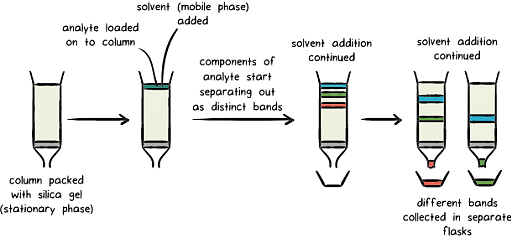
Column Chromatography Procedure
Stationary Phase
It is basically a solid material with good adsorption properties and should meet the below criteria:
- Size and Shape of particles: Particles should have sizes in the range of 60-200 μ in diameter and should have a uniform size.
- Stability of particles: particles should have high stability and be chemically inert. Also, no reaction with any solvents during the experiment.
- It should be readily available, colorless, and inexpensive.
- It should allow free flow
- It should be appropriate for the separation of mixtures.
Column Chromatography Experiment
[Click Here for Sample Questions]
- With the assist of solvent, the stationary phase is made wet as it is the upper level of the mobile phase and the stationary phase should match it. The mobile phase is either solvent or a combination of solvents.

Column Chromatography Experiment
- Initially, the compound mixture is added from the top of the column needs to be separated, without disturbing the top level. The adsorption process on the surface of silica begins as soon as the tap is turned on.
- Solvent mixture is added slowly throughout the process as per the requirement by touching the sides of the without disturbing the stationary phase.
- To initiate the movement of the compound in the mixture, the tap needs to be turned on. The movement is totally based on the polarity of the molecules. The non-polar components move at a greater speed as compared to the polar components.

Column Chromatography Experiment
- For example, a compound mixture has three different compounds that are red, blue, green then their order based on the polarity will be blue>red>green.
- From the above order of polarity of the comp
- ounds, the polarity of green is less hence, it will move first. It is collected in a clean test tube as soon as it arrives at the end of the column. After this, this process will be followed for the red and blue compounds as well. All these compounds are separated in separate test tubes.
Column Chromatography Applications
[Click Here for Sample Questions]
Column Chromatography is used in :
- Separating compound mixtures.
- Determining drug estimation from drug formulations
- Remove impurities
- Isolation of metabolites from biological fluids.
Advantages of Column Chromatography
[Click Here for Sample Questions]
Column Chromatography has some advantages such as:
- It helps in the separation of any mixture.
- It helps in the separation of impurities from any kind of mixture.
- Any variety and quantity separation are possible through column chromatography.
- Varieties of solvent can be used in the process of separation based on the required results.
- The process can be automated as well.
- It is less expensive.
Disadvantages of Column Chromatography
[Click Here for Sample Questions]
Column Chromatography has some disadvantages as well which includes:
- It is a time-consuming process.
- Only a large quantity can be used for separation.
- Column Chromatography is expensive as compared to the thin paper column chromatography process.
- It’s a long process. So, need attention and focus are required.
- If the process becomes automated in the future, then it will become expensive.
Things to Remember
- Chromatography is a technique used to separate mixtures.
- The principle behind column chromatography is adsorption, wherein a mixture of components is dissolved in the mobile phase into the column and moves based on their relative affinities.
- The mixture that is to be separated is dissolved in a fluid called the mobile phase which helps to carry the mixture through a stationary phase.
- The compounds are separated as they will move through the stationary phase at different speeds.
- The main types are thin-layer chromatography, gas-liquid chromatography, and HPLC.
Also Read:
Sample Questions
Ques. Name the type of solvents that are generally employed in chromatography. (1 mark)
Ans: Generally the solvents that have low viscosities, are employed in chromatography. This is due to the fact that the rate of flow of a solvent differs inversely from its viscosity.
Ques. Name some chromatographic techniques. (1 mark)
Ans: Paper chromatography, column chromatography, thin-layer chromatography, gas chromatography.
Ques. Which compounds equilibrate first in this technique? (1 mark)
Ans. The compound that will get educated out first is non-polar compounds. Because the polar compounds strongly commune with the silica as compared to the non-polar compounds.
Ques. What is the main principle of column chromatography? (1 mark)
Ans. The principle behind Column Chromatography is to absorb solutes of the solution with the help of stationary phase and future separate the mixture into discrete components.
Ques. What is the one major advantage of Column Chromatography? (2 marks)
Ans. The one major advantage of using Column Chromatography for the separation of compounds is it uses a stationary phase and that is less expensive and can be easily disposed of as it goes under recycling.
Ques. In which type of chromatography, the stationary phase held in a narrow tube, and the mobile phase is forced through it under pressure? (2 marks)
Ans. In the Column Chromatography, the stationary phase is held in a narrow tube, and the mobile phase is forced through its under pressure. Then, it is carried out in a long glass column which have a stop cock near the bottom.
Ques. In Column Chromatography, from which the mobile phase is made of? (1 mark)
Ans. In Column Chromatography, the mobile phase can be composed of liquid or gas. It can’t be any solid material or compound.
Ques. What do you mean by column chromatography? (2 marks)
Ans: Column chromatography is described as simple and the most used separation and purification technique. Column chromatography helps in separating and purifying both solid and liquid samples. It separates samples based on differential adsorption of compounds to the adsorbent because the compounds pass through the column at different rates which allows them to get separated infractions. Column Chromatography can be used on a small scale in addition to large scale to purify substances that can be used in future experiments.
Ques. How are compounds separated in this technique? (1 mark)
Ans: The separation is quite equivalent to that of TLC where the compound mixture is carried by a mobile phase through a stationary phase.
Ques. State the disadvantages of column chromatography. (2 marks)
Ans: Column Chromatography has some disadvantages as well which includes:
- It is a time-consuming process.
- Only a large quantity can be used for separation.
- Column Chromatography is expensive as compared to the thin paper column chromatography process.
- It’s a long process. So, need attention and focus are required.
Ques. Where can column chromatography be used up? (2 marks)
Ans: Column Chromatography is used in :
- Separating compound mixtures.
- Determining drug estimation from drug formulations
- Remove impurities
- Isolation of metabolites from biological fluids.
Ques. Name the different types of column chromatography. (2 marks)
Ans: There are basically five types of chromatography that can be applied to the basic principle of chromatography.
- Gas chromatography
- Chiral Liquid chromatography
- Ion Exchange chromatography
- Size Exclusion chromatography
- Affinity chromatography
For Latest Updates on Upcoming Board Exams, Click Here: https://t.me/class_10_12_board_updates
Check-Out:



Comments