



Content Curator
Constitutional isomers are molecules of different connectivity. These connectivities range from analogous to simple bracelets in which the order of red and green beads is different. The second category is stereoisomers. In stereoisomers, connectivity is the same, but parts are oriented differently in space.
- Isomers are classified as: Constitutional Isomers, Stereoisomers, Enantiomers, and Diastereomers.
- If there are structural differences in bonding patterns, compounds are constitutional or structural isomers.
- If compounds have the same structural connections, but spatial orientations are different, then the compounds are called stereoisomers.
Key Terms: Isomers, Chain Isomerism, Functional Isomerism, Positional Isomerism, Tautomerism, Metamerism,
Isomers
[Click Here for Sample Questions]
Isomers are compounds with the same empirical formula, and the same number of atoms, but they differ in the way the atoms are arranged.
There are two major classes of isomers
- Constitutional Isomers: Constitutional isomers are also known as structural isomers. Constitutional isomers have the same chemical properties and different physical properties. Example: Butane melts at -138.4°C and boils at -0.5°C, while isobutane melts at -159.6°C and boils at -11.7°C.
- Stereoisomers: Stereoisomers are the ones that are connected in the same way but have the arrangement of the atoms is different. Generally defined, stereoisomers are isomers that have the same composition (that is, the same parts) but that differ in the orientation of those parts in space. There are two kinds of stereoisomers: enantiomers and diastereomers.

Isomers
Read More: Stereoisomerism
Constitutional Isomers
[Click Here for Sample Questions]
Constitutional Isomers, also known as structural isomers, are connected differently and have different bonding sequences. Basically, Constitutional isomers have the same molecular formula but different structural formulas.
Example: Constitutional isomers with the same molecular formula but different connectivity. Cyclohexane C6H12.
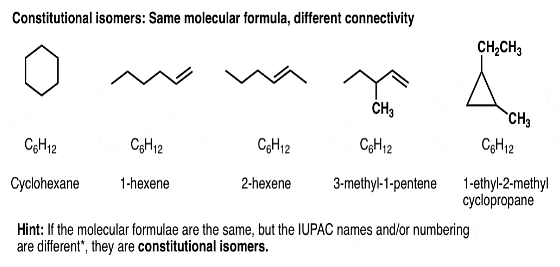

Constitutional Isomers
One way by which you can identify constitutional isomers is if the molecular formulae are the same but different IUPAC names or numbering are different that is considered Constitutional Isomers.
Also check:
Types Of Constitutional Isomers
[Click Here for Sample Questions]
The different types of Constitutional Isomers are:
- Chain Isomers/ Skeletal isomers
- Positional Isomers/regio isomers
- Functional Isomers or functional group isomers
- Metamerism
- Tautomerism
- Ring chain isomerism.

Types of Constitutional Isomers
Chain Isomers
Chain isomers, also known as skeletal, are constitutional isomers with the same molecular formula but different carbon skeleton i.e only differs in the Chain length.
Chain Isomers can be more commonly observed in organic compounds which contain long carbon chains.
Example: Let's consider butane and isobutane.

Structure of Butane and Isobutane
- N-butane: As we can see there is no branching in n-butane and it contains only one four-membered carbon chain.
- Isobutane: Here the branching is in the second position and consists of a three-membered carbon chain. Example: CH3CH2CH2CH2CH3 (Pentane)
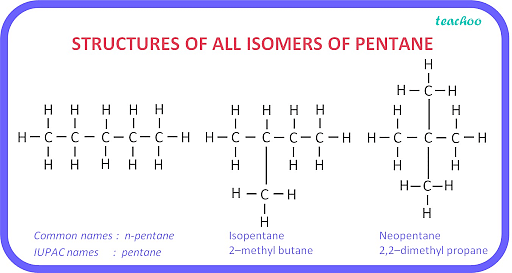
Structure of All Isomer of Pentane
Positional Isomers
Positional isomers, also known as regio isomers, have the same molecular formula but the position of the substituent is different.
Example: Here the position of the double bond in 1-butene shifted and the resulting structure is 2-butene. This is a positional isomer where the molecular formula is the same but the position of the substituent changes.

Positional Isomers
Functional Isomers or Functional Group Isomers
Functional isomers are isomers that have the same molecular formula but different functional groups.
Example: Butanol in aldehyde and keto form. As we can see the molecular formula is the same but different functional groups exist i.e aldehyde and keto groups. Therefore, they are known as functional isomers.
Metamerism
In simple terms, we can say metamerism has the same molecular formula, and the same functional group but the alkyl group surrounding that functional group changes, and they are called metamers.
Metamerism is most commonly shown by divalent oxygen atoms.
Example: Ether of four carbon and the general formula is C4H10O.
We can write ether as CH3CH2OCH2CH3 or CH3OCH2CH2CH3
Above two ethers has the same molecular formula and the same functional group. In CH3OCH2CH2CH3 the alkyl group (methyl group) surrounding the ethereal oxygen is different and in CH3CH2OCH2CH3 two ethyl groups are surrounded. This phenomenon is Metamerism.
Tautomerism
Functional group changes when tautomerism takes place. It is most commonly observed in ketones which can be easily converted into enol form (enol which means it contains alkene and alcohol in it) and is called “Keto-enol” Tautomerism.
Example: Keto-enol Tautomerism

Keto-enol Tautomerism
Ring Chain Isomerism
Ring chain Isomerism has the same molecular but different chain structures connected in a cyclic or ring pattern.
Example: Butene and cyclobutane.
Here’s a tabulated description of different types of Constitutional Isomers:
| Types of Isomers | Description | Examples |
|---|---|---|
| Chain Isomers | Same molecular formula but a different carbon skeleton & different carbon chain length | Example: CH3CH2CH2CH2CH3 (Pentane)
|
| Positional isomers | same molecular formula but the position of the substituent is different. | Example: The position of the double bond in 1-butene shifted and the resulting structure is 2-butene.
|
| Functional Isomers | same molecular formula but different functional groups. | Example: Butanol in aldehyde and keto form.
Aldehyde form keto form |
| Metamerism | the alkyl group surrounding that functional group changes | In CH3OCH2CH2CH3 the alkyl group (methyl group) surrounding the etherial oxygen is different and in CH3CH2OCH2CH3 two ethyl groups are surrounded. |
| Tautomerism | Functional group changes when tautomerism takes place. | Example: Keto-enol Tautomerism.
|
| Ring Chain Isomerism | same molecular but different chain structures connected in a cyclic or ring pattern. | Example: Butene and cyclobutane. |


Things to Remember
- Isomers have the same empirical formula, and the same number of atoms they only differ in the way the atoms are arranged.
- Constitutional isomers are structural isomers that have the same molecular formula but different structural formulas.
- Chain isomers are also known as skeletal isomers.
- Chain isomers have the same molecular formula but different carbon skeletons and different carbon chain lengths.
- Functional isomers have the same molecular formula but different functional groups.
- Positional isomers are the type of isomers in which only the position of the functional group is different but has the same molecular formula.
- Tautomerism is the phenomenon in which the functional group changes from ketone to enol and is known as keto-enol Tautomerism.
- In Metamerism the functional group changes when it is surrounded by an alkyl group and is most commonly seen in divalent oxygen.
Also check:
Sample Questions
Ques. What are Constitutional Isomers? (2 marks)
Ans: Isomers that have the same molecular formula but different structural formulas and the ones that are connected differently with different bonding sequences.
Ques. Enlist various types of constitutional isomers. (3 marks)
Ans: There are three types of Constitutional isomers. They are as follows:
- Chain Isomers
- Positional Isomers
- Functional Isomers
- Metamerism
- Tautomerism
- Ring Chain Isomerism
Ques. Explain any two types of constitutional Isomers with suitable examples. (3 marks)
Ans: a. Chain Isomers: They have the same molecular formula but different carbon skeleton i.e only differs in the Chain length. They can be commonly seen in organic compounds which contain long carbon chains.
Example: Pentane.
The molecular formula of pentane is C5H12.
The structural formula is the same but it only differs in the length of the carbon chain.

- Positional Isomers: Positional isomerism has the same molecular formula but a different position of the substituent.

Ques. State any one difference between Metamerism and Tautomerism. (2 marks)
Ans: In Metamerism, there is the same functional group but the alkyl group surrounding that functional group changes whereas when Tautomerism takes place the functional group changes. Example: Functional group keto changes to the enol group.
Ques. Give an example of Keto-enol Tautomerism. (2 marks)
Ans: Keto-enol Tautomerism.

Ques. Chain Isomer is also known as? (1 mark)
Ans: Skeletal Isomer.
Ques. In which phenomenon does the functional group changes when it is surrounded by an Alkyl group? (1 mark)
Ans: Metamerism.
Ques. Explain Constitutional Isomers in detail with an example. (4 marks)
Ans: Constitutional isomers, also called structural isomers, are connected differently and have different bonding sequences. They have the same molecular formula but different structural formulas.
Example: Constitutional isomers with the same molecular formula but different connectivity. Cyclohexane C6H12


Check Out:



Comments