



Education Journalist | Study Abroad Lead
Instantaneous rate of change is the change in the rate at a specific time. It is different from the average rate of change as it tells us the mean value of the rate of change calculated over a period. For example, the rate of change of temperature after 5 minutes of keeping the food in the refrigerator.
Mathematically, the Instantaneous rate of change is calculated by differentiating the function at a specific value (limits).
| Table of Contents |
Key Takeaways: Instantaneous Rate of Change, Momentum, Speedometer, Instantaneous Velocity, Specific value, Time, Temperature, Refrigerator
Instantaneous Rate of Change
[Click Here for Sample Questions]
Rate of change basically means the momentum of the change. Instantaneous rate of change defines the change in the rate at a particular instant. Suppose you are riding a bike; you may increase or decrease the speed several times during the journey. At one-time speed maybe 20 Km/hour whereas a few minutes after the speed maybe 30 Km/hour.
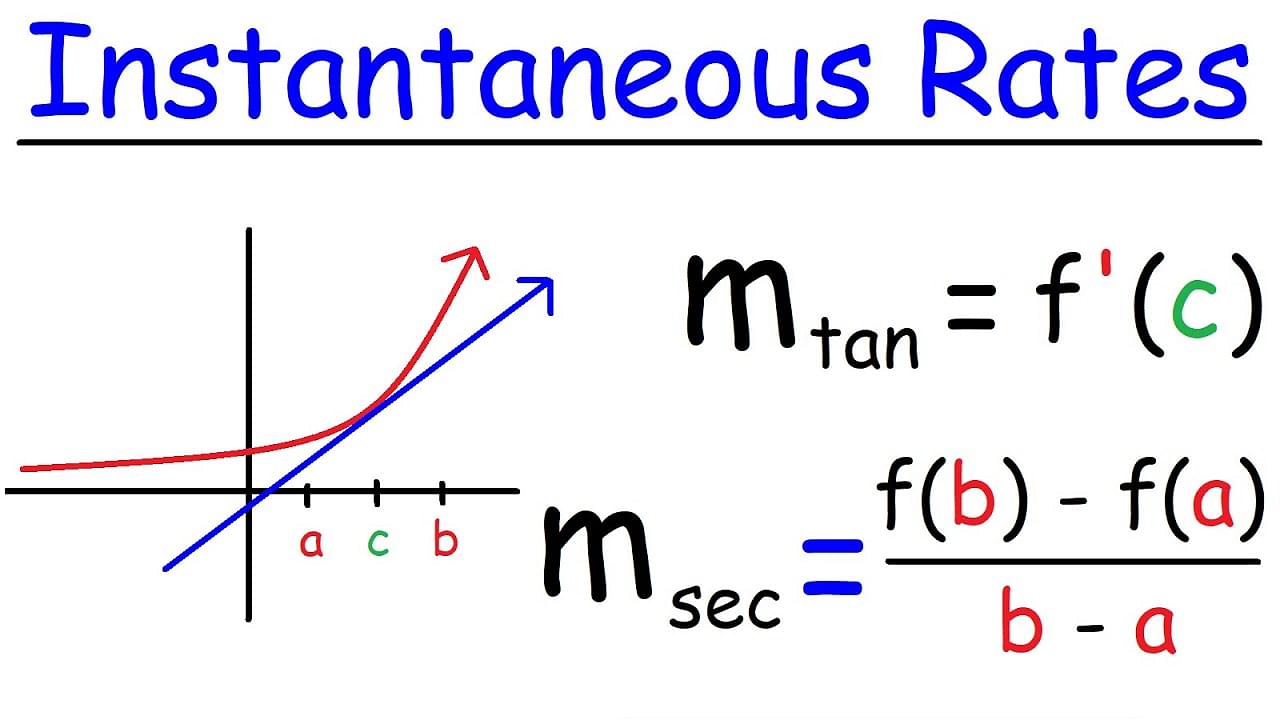
Instantaneous Rate of Change
Instantaneous rate of change will tell the speed at a specific instant of time. Thus, we can say that the instantaneous rate of change depends on time. Graphically, the instantaneous rate of change can be calculated by plotting the slope of the tangent at a point on the curve.
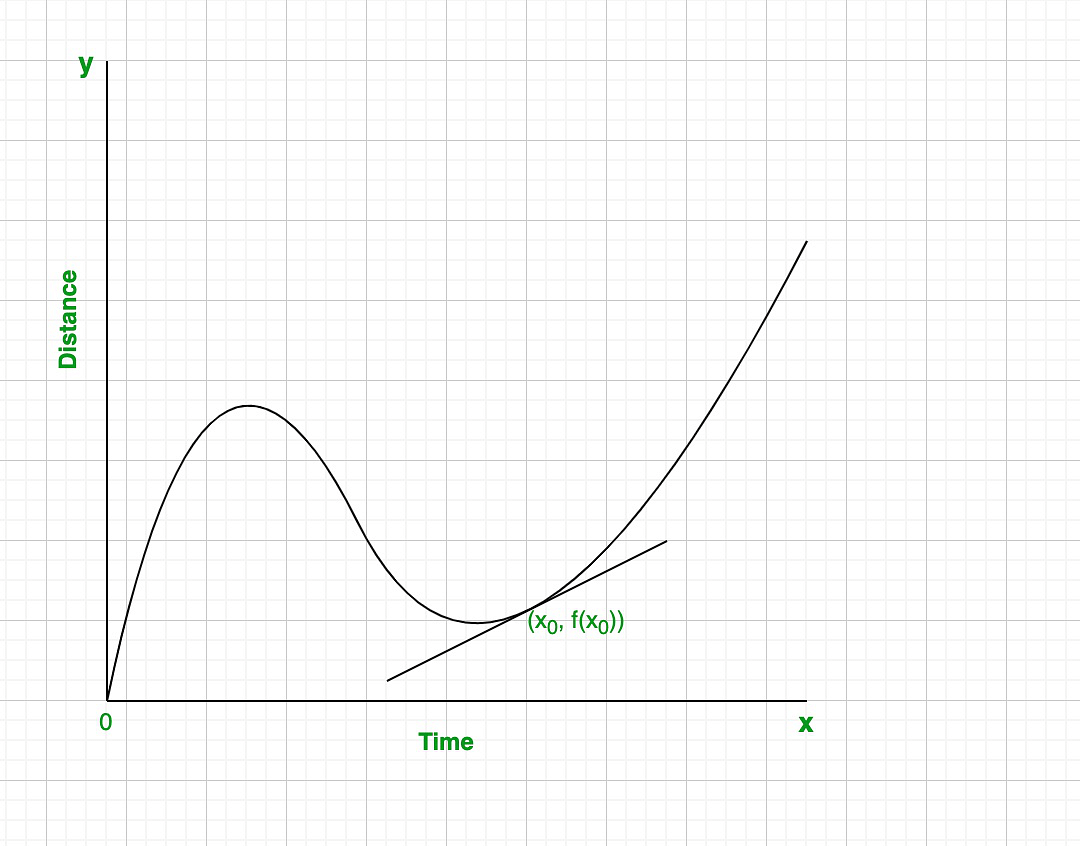
Graphical Representation of Instantaneous Rate of Change
Also Read:
Derivation of Formula for Instantaneous Rate of Change
[Click Here for Sample Questions]
If we assume change two variables x and y. We need to find the instantaneous change of y with respect to x. For the average rate of change, in the function y = f(x) we used the values of x1 and x2 (two intervals). The formula for the average rate of change of function y = f(x) is:
A(x) = [f(b) - f(a)] / (b - a)
Where,
A(x) → Average Rate of Change
f(a) → Value of function f(x) at a
f(b) → Value of function f(x) at b
But for instantaneous rate of change we need to find the value of the function at a specific value of x i.e., at x = a. Using x = a in the above formula we have:
We set h = a - x, where h≠0.
Note that the value of x tends to zero because the change in rate is decreasing with time.
Graphical Representation of Instantaneous Rate of Change
[Click Here for Sample Questions]
From the graph, we must draw the tangent and then find the slope to calculate the instantaneous rate of change. The slope of the line denotes how much the value of the function is increasing or decreasing corresponding to the change in x.
Suppose the given function is 2x2+6, at (1,6).
Differentiating the function using the power rule we get, 4x. If we put the value of x i.e., 1 in 4x we get 4(1) = 4. Thus, the slope of the line is 4 which is also the instantaneous rate of change at x = 1.
For finding the equation of the slope we have to use the point-slope method.
We know that, y – y1 = m (x – x1)
Here, m is the slope of the line.
Putting the values of x and y from the given coordinate (1,6) we get,
→ y – 6 = 4 (x – 1)
→ y – 6 = 4x – 4
→ y = 4x + 2 which is in the form of y = mx + c
Real-life Application of Instantaneous Rate of Change
[Click Here for Sample Questions]
The speedometer in motorbikes and cars are perfect examples of instantaneous rate of change. The speedometer shows the exact speed of the vehicle at each instant which is why it always fluctuates. Similarly, the speedometer in ships, aircraft and every other vehicle measures the instantaneous speed.

Instantaneous Speed in Speedometer
Things to Remember
- The instantaneous rate of change must not be confused with the average rate of change. The average rate of change calculates the rate over a certain duration for example from 5 to 15. Whereas the instantaneous rate of change is the change at a particular value, for example value of y when x is 5. [ y = f(x) at x = 5 where f(x) = ax2+c]
- The tangent at the point on the curve should not cross the curve.
- The slope of the tangent will also be a curve.
- In the Instantaneous rate of change, we calculate the limit of the position function as the change in time tends to zero.
Also Read:
Sample Questions
Ques 1. Define instantaneous rate of change. (2 Marks)
Ans. Instantaneous rate of change is the rate of change of a variable with respect to another variable at a specific time. For example, the speed of the car when time = 1 hour. It can represent mathematically using function y = f(x). The value of the function y at a specific value of x is the instantaneous rate of change.
Ques 2. Give an example where an instantaneous rate of change is used? (1 Mark)
Ans. The best example of instantaneous rate of change is in the speedometer of vehicles that tells the exact speed at each instant.
Ques 3. Find out instantaneous rate of change for the function y = f(x),where f(x) = 2x2 + 5 at x = 6. (2 Marks)
Ans. Using power rule, f’(x) =2*2x + 0
=> f’(x) = 4x
=> Put the value of x in the above result to calculate instantaneous rate of change at x.
=> Given, x = 6
=> f’(x) = 4*6 = 24 is the instantaneous rate of change.
Ques 4. What will be the instantaneous rate of change if f(x) = 4x3 + 3x2 + 2x + 3 at x = 0? (2 Marks)
Ans. First order derivative of the function is f’(x) = 4*3x2 + 3*2x + 2 + 0
=> f’(x) = 12x2 + 6x + 2
=> At x = 0, f’(x) = 2
Thus, the instantaneous rate of change at x = 0 is 2.
Ques 5. What is the graphical method of finding the instantaneous rate of change? (2 Marks)
Ans. Draw the tangent to the given point on the curve. Find the slope of the tangent at that point with help of the coordinates of the point. The slope of the tangent is the instantaneous rate of change at that point.
Ques 6. What is the formula for finding the slope of the tangent? (1 Marks)
Ans. The formula for slope is y – y1 = m (x – x1), where m is the slope and x and y are coordinates of the point at which you need to calculate the instantaneous rate of change.
Ques 7. What are the things to keep in mind while drawing the tangent at the point on the curve? (2 Marks)
Ans.
- The tangent on the point should not cross the curve.
- The tangent should not use a touch more than one point on the curve.
Ques 8. Can the instantaneous rate of change be negative? (1 Marks)
Ans. Yes, a negative instantaneous rate of change means acceleration (which is the rate of change of velocity) is decreasing. This is quite common during any motion as the velocity increases or decreases several times before reaching the destination.
For Latest Updates on Upcoming Board Exams, Click Here: https://t.me/class_10_12_board_updates
Check-Out:



Comments