



Pivot joints are a type of synovial joint that allow rotational movement of bones around a single axis. They are essential for many body movements and functions, including the rotation of the neck, forearm, and other body parts.
- The structure of pivot joints consists of two bones.
- One of them is the axis bone, which is usually a long, cylindrical bone.
- The other one is the bone that rotates around it.
- This bone is smaller in size with a round shape.
- The bones are held together by ligaments that provide stability and prevent dislocation.
Also Read: Locomotion and Movement
| Table of Content |
Key Terms: Pivot joints, Joints, Ligament, Rotational movement, Atlantoaxial joint, Radioulnar joint, Joint capsule.
Functions of Pivot Joints
[Click Here for Sample Questions]
Pivot joints are vital in movement and body functions. It enables various rotational movements around the central axis. Some of the critical functions of pivot joints are as follows.
Rotation
Pivot joints are primarily responsible for rotational movement around a central axis. For example, the pivot joint in the neck allows the head to rotate from side to side. This type of movement is essential for activities such as looking around, driving, and playing sports.
Stability
Pivot joints rely on stable ligaments and bones to stabilize and prevent dislocation. This stability is crucial for supporting the body's weight and preventing injury during physical activities.
Coordination
Pivot joints coordinate with other joints and muscles to coordinate movement. For example, the pivot joint in the forearm works with the elbow joint and muscles to induce movements such as holding, pushing or pulling.
Proprioception
Proprioception is the sense of relative position and movement of different body parts. Pivot joints provide feedback to the brain about the position and movement of bones and muscles. This feedback is essential for maintaining balance, coordination, and overall body awareness.
Adaptation
Pivot joints can adapt to different loads and stresses. It is important for activities like weightlifting or playing sports, where the joints must withstand the high levels of stress and strain.
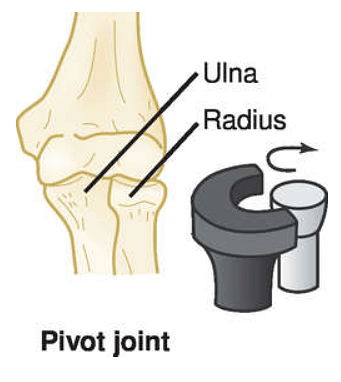
Pivot Joints
Also Read:
| Related Articles | ||
|---|---|---|
| Skeletal System | Pelvic Bone | Epiphysis |
| Bones of the Wrist | Saddle Joints | Location and Movement MCQs |
Structure of Pivot Joints
[Click Here for Sample Questions]
Pivot joints are classified as uniaxial as they move around only one axis. Below are some of the key structural features of pivot joints:
Bones
Pivot joints consist of two bones, the axis bone and the bone that rotates around it. The axis bone is usually long and cylindrical in shape. The other bone is typically smaller and has a round shape that fits into the axis bone.
- Examples of pivot joints in the human body include the atlantoaxial joint in the neck.
- The first cervical vertebra rotates around the second cervical vertebra.
- Another example is the radioulnar joint in the forearm.
- In this joint, the radius bone rotates around the ulna bone.
Axis
The axis is a small, bony projection around which the other bone rotates. In the case of the atlantoaxial joint, the pivot point (axis) is a small projection on the atlas bone called the dens, which fits into a socket on the axis bone. In the radioulnar joint, the pivot point is the projection on the ulna bone that fits into a socket on the radius bone.
Joint capsule
Joint capsules are muscular and fibrous tissues that wrap and stabilize joints. They are found around pivot joints. A synovial membrane lines the joint capsule, which produces synovial fluid to lubricate and lessen the friction between the bones.
Ligaments
Ligaments are strong bands of connective tissue that provide stability and prevent joint dislocation. They hold the bones and pivot joints together. For instance, in the atlantoaxial joint, the dens are kept in position by a number of powerful ligaments that hold the bones together.
Muscles
Muscles attach to the bones that make up the pivot joints and work together to produce rotational movement. For example, the muscles in the neck attach to the bones of the atlantoaxial joint and work together to rotate the head.
Also Read: Fibrous Joints
Types of Pivot Joints
[Click Here for Sample Questions]
The human body has two pivot joints - the atlantoaxial joint in the neck and the radioulnar joint in the forearm.
Atlantoaxial joint
This is located between the first two cervical vertebrae in the neck. These vertebrae are called the atlas (C1) and the axis (C2). It allows rotational movement of the head. The atlantoaxial joint allows the body to rotate around a central axis, with the dens (a bony protrusion on the axis). This joint is responsible for about half of the total rotation of the head.
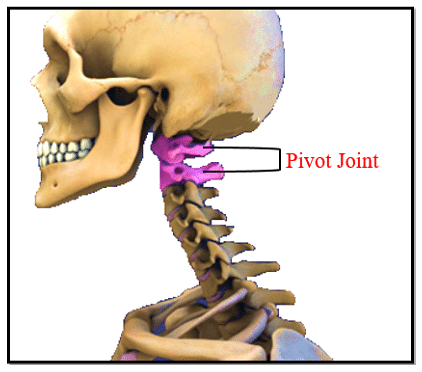
Pivot joint in head
Radioulnar joint
This joint is located between the radius and ulna bones in the forearm. It allows rotational forearm movement, such as turning a doorknob or twisting a screwdriver.
- There are two radioulnar joints in the forearm- proximal radioulnar and distal radioulnar.
- The proximal radioulnar joint is located near the elbow.
- The distal radioulnar joint is located near the wrist.
- Both joints allow rotational movement of the forearm.
- The proximal joint allows a greater range of motion as compared to the distal joint.
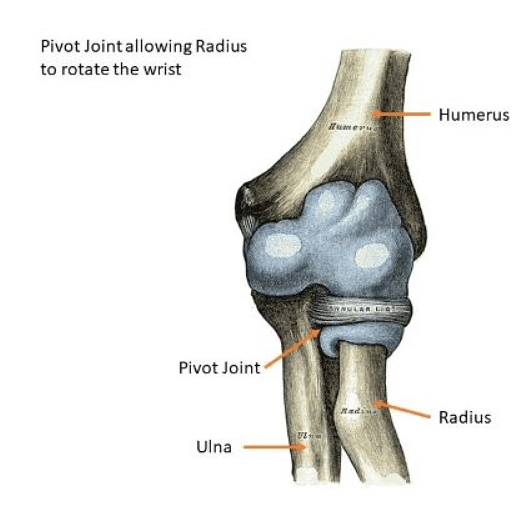
Radioulnar joint
Common Disorders of Pivot Joints
[Click Here for Sample Questions]
Disorders of these joints can lead to significant pain, limited range of motion, and other complications.
Cervical Radiculopathy
It is a condition that affects the neck's nerves. It can result in discomfort, numbness, and weakness in the arms and hands. This disorder is caused by the compressed nerves in the pivot joint at the top of the neck.
Rotator Cuff Tear
A collection of muscles and tendons is called the rotator cuff. It surrounds the shoulder joint and aids in stabilizing and rotating the arm. A torn rotator cuff can cause pain, numbness, and restricted motion in the shoulder pivot joint at the top of the arm bone.
Radial Head Fracture
The area of the elbow joint that articulates with the humerus bone is called the radial head. A fracture in this region may result in discomfort, edema, and a restricted range of motion in the elbow's pivot joint.
Tennis Elbow
Tennis elbow is a disorder that results in pain and tenderness in the pivot joint and the outer part of the elbow joint. The muscles and tendons in the humerus bone are frequently subjected to recurrent stress or overuse, which results in this condition.
Arthritis
Any joint in the body, including pivot joints, can become afflicted by this degenerative joint disease. Arthritis can impair a range of motion and cause pain, edema, and stiffness in the joint..
Rheumatoid arthritis
In rheumatoid arthritis, the synovial membrane that lines the joints, particularly the pivot joint, is inflamed and harmed by an autoimmune disease.
Atlantoaxial instability
This condition occurs when there is excessive movement between the atlas (C1) and axis (C2) vertebrae in the neck. It can be caused by congenital abnormalities, trauma, and rheumatoid arthritis. Symptoms include neck pain, headache, and neurological problems like tingling and numbness in the limbs.
Things to Remember
- Pivot joints allow rotational movements around one axis.
- They are essential for various functions, including rotation, stability, coordination, proprioception, and adaptation.
- Pivot joints consist of two bones, an axis, a joint capsule, ligaments, and muscles.
- The human body has two pivot joints.
- One of them is the neck's atlantoaxial joint and another is the forearm's radioulnar joint.
- Injury in pivot joints can lead to pain, numbness, and limited range of motion.
Sample Questions
Ques. What are pivot joints, and what is their role in the human movement? (2 marks)
Ans. Pivot joints, also known as rotary joints or trochoid joints, are a type of synovial joint in which bone rotates around another bone or an axis. These joints allow for rotational movement and are found in the neck, wrist, and ankle. The role of pivot joints in human movement is to enable the rotation and turning of body parts, which is essential for a range of everyday activities such as walking, running, and grasping objects.
Ques. What is the structure of pivot joints, and what are the key features of their anatomy? (2 marks)
Ans. The structure of pivot joints includes an axis, which is a bony protrusion or process around which one bone rotates. The axis is surrounded by a sleeve or ring of cartilage or ligamentous tissue, which provides stability and prevents excessive movement. The bone that rotates around it is called the pivot bone, while the other bone that remains fixed is called the stationary bone. Key features of the anatomy of pivot joints include a synovial membrane, which lines the joint capsule and produces synovial fluid for lubrication, and articular cartilage, which covers the bone ends and allows for smooth movement.
Ques. What is the difference between uniaxial and multiaxial joints? (2 marks)
Ans. Uniaxial joints or hinge joints, are joints that allow movement in only one plane or axis, such as the elbow and knee joints. Multiaxial joints, on the other hand, allow movement in multiple planes or axes, such as the shoulder and hip joints. While uniaxial joints are limited to flexion and extension, multiaxial joints allow for a greater range of movement, including abduction, adduction, rotation, and circumduction.
Ques. How do pivot joints provide stability and prevent dislocation? (2 marks)
Ans. Pivot joints provide stability and prevent dislocation through the surrounding ligaments and cartilage that hold the bones in place. The pivot point of the joint is designed to allow rotation but not excessive movement, which could lead to dislocation. The ligaments that surround the joint capsule also help to prevent excessive movement and provide additional stability.
Ques. What is proprioception, and how do pivot joints contribute to it? (2 marks)
Ans. Proprioception, or the perception of the relative location and motion of bodily components, is crucial for balanced and coordinated movement. By giving the brain information about the location and movement of the bones they connect, pivot joints help with proprioception. The brain uses this input, which is sent by the nerves, to coordinate movements and, if necessary, correct posture and balance.
strong>Ques. What is the atlantoaxial joint? Write about its role in the rotation of the head. (2 marks)
Ans. The first and second neck vertebrae form a pivot joint called the atlantoaxial joint. It is one of the two types of pivot joints in the human body. Its role in the rotation of the head is to allow for the turning of the head from side to side. This joint is essential for everyday activities such as driving and looking over the shoulder and is also crucial for athletes in sports such as football and hockey, which require frequent head movements.
Ques. How do muscles work with pivot joints to produce rotational movement? (2 marks)
Ans. Muscles work with pivot joints to squeeze and pull on the bones around the joint to create rotational movement. The muscles that attach to the pivot bone contract, while the muscles that attach to the stationary bone relax. This creates a rotational force around the pivot point, allowing for movement in a specific direction. The specific muscles involved in producing rotational movement depend on the joint and the desired movement.
Ques. What is the radioulnar joint? What movements is it responsible for in the forearm? (5 marks)
Ans. The radioulnar joint is located in the forearm and consists of two articulations between the radius and ulna bones. It is a pivot joint that allows for rotational movement of the forearm, which is essential for many everyday tasks, such as turning a doorknob or using a screwdriver.
The proximal radioulnar joint is located near the elbow and allows the radius bone to rotate around the ulna, which is fixed in place. This joint is responsible for pronation (inward rotation) and supination (outward rotation) of the forearm.
During pronation, the radius bone rotates around the ulna bone, causing the palm to face downward. In contrast, during supination, the radius rotates in the opposite direction, causing the palm to face upward.
The distal radioulnar joint is located near the wrist and allows for movement between the radius and ulna at the distal end of the forearm. This joint is also involved in pronation and supination but to a lesser extent than the proximal radioulnar joint.
The movement of the radioulnar joint is coordinated by several muscles, including the pronator teres, pronator quadratus, supinator, and biceps brachii. These muscles work together to produce the rotational movement of the forearm, allowing for a wide range of functional activities.
Ques. What are the common disorders of pivot joints? (5 marks)
Ans. Pivot joints are relatively simple joints that have limited mobility, and they are less prone to injury than other joints such as the knee or the shoulder. However, there are still some disorders that can affect pivot joints, including:
- Arthritis: Arthritis is a common condition that affects joints throughout the body, including pivot joints. The most common types of arthritis that affect pivot joints are rheumatoid arthritis and osteoarthritis. These conditions can cause pain, stiffness, and swelling in the joint, which can limit its mobility and cause discomfort.
- Dislocation: Dislocation of the pivot joint can occur as a result of trauma or injury. When the joint becomes dislocated, the bones that form the joint move out of their normal position, causing pain, swelling, and limited mobility.
- Fracture: A fracture in the bone that forms the pivot joint can also occur as a result of trauma or injury. When a bone fractures, it can cause pain, swelling, and limited mobility.
- Ligament sprains: Ligaments are bands of tissue that connect bones to each other, and they help to stabilize the joint. When the ligaments are stretched or torn, it can cause pain, swelling, and instability in the joint.
- Tendinitis: Tendinitis is a condition that occurs when the tendons that attach muscles to bones become inflamed. This can cause pain and limited mobility in the joint.
- Bursitis: Bursitis is a condition that occurs when the bursae, small fluid-filled sacs that help to cushion and lubricate the joint, become inflamed. This can cause pain and swelling in the joint.
For Latest Updates on Upcoming Board Exams, Click Here: https://t.me/class_10_12_board_updates
Do Check Out:



Comments