




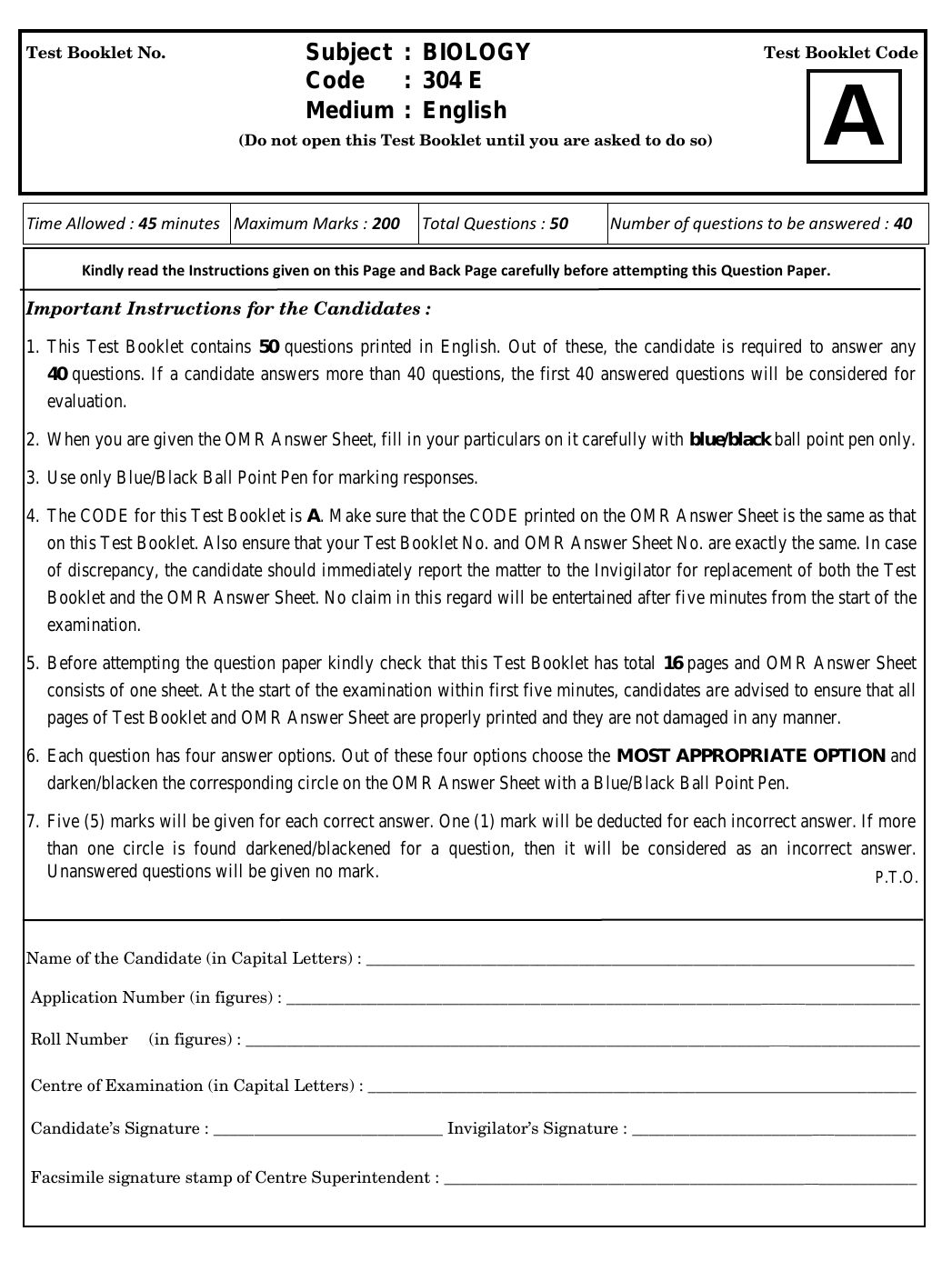
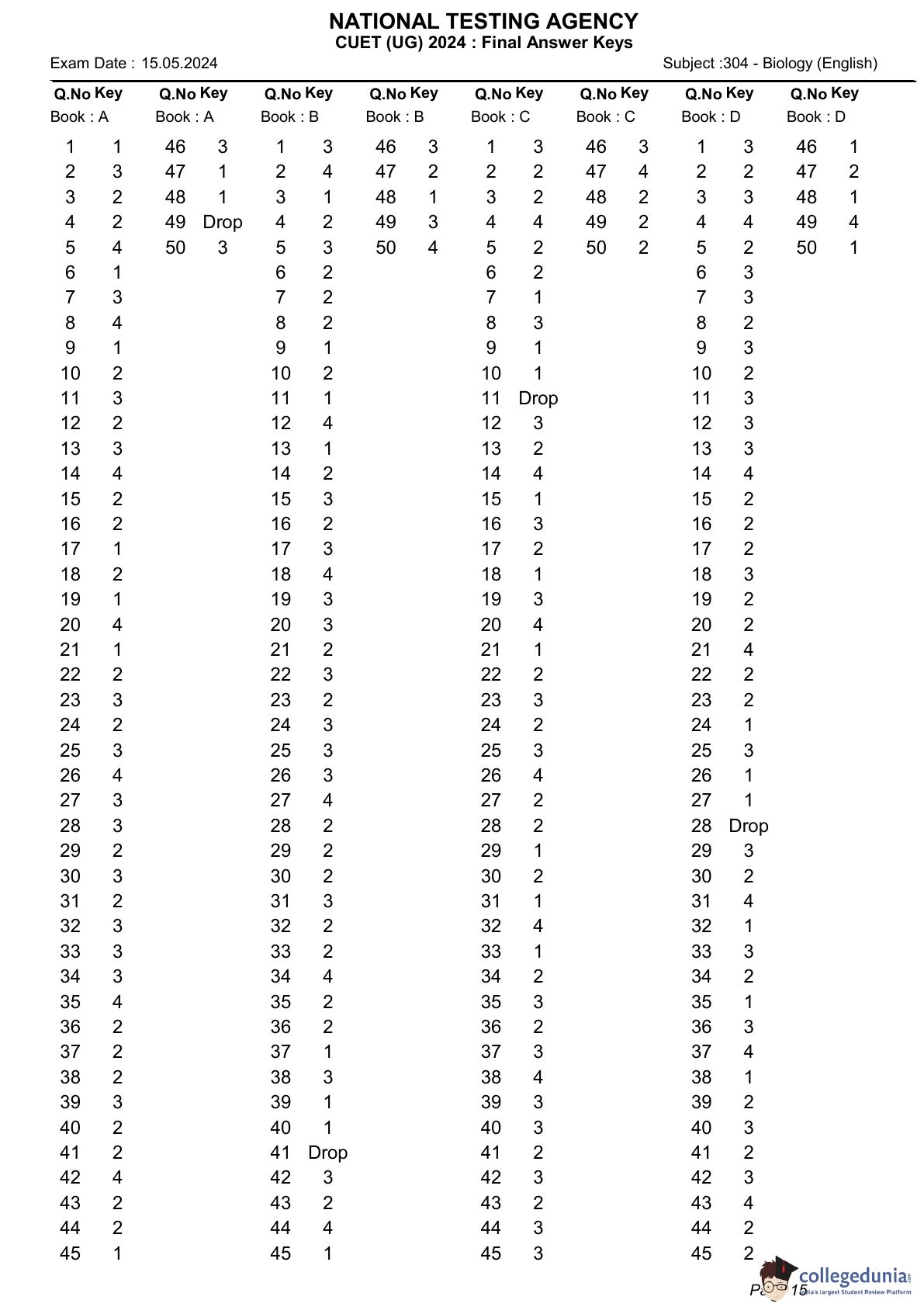
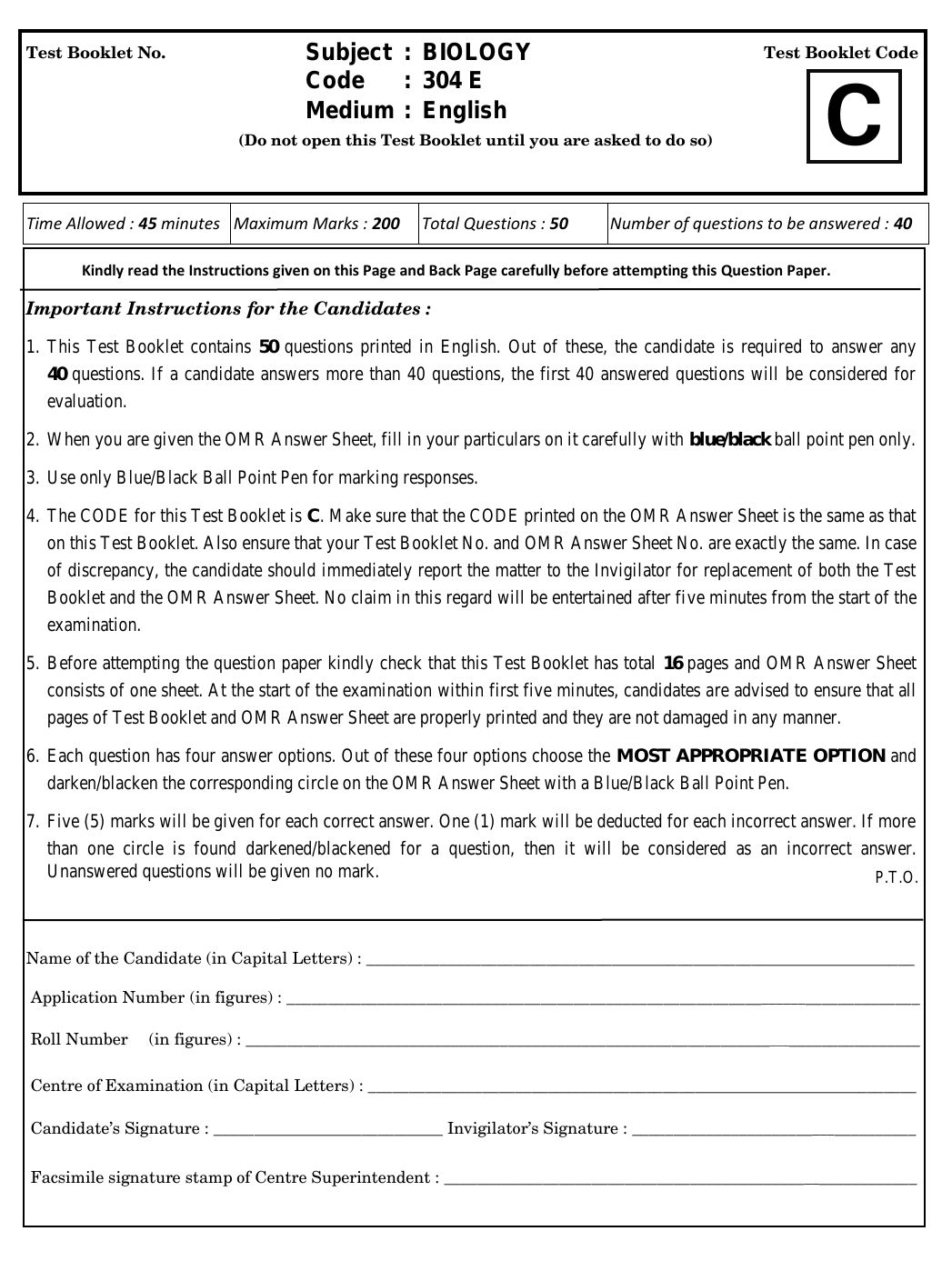
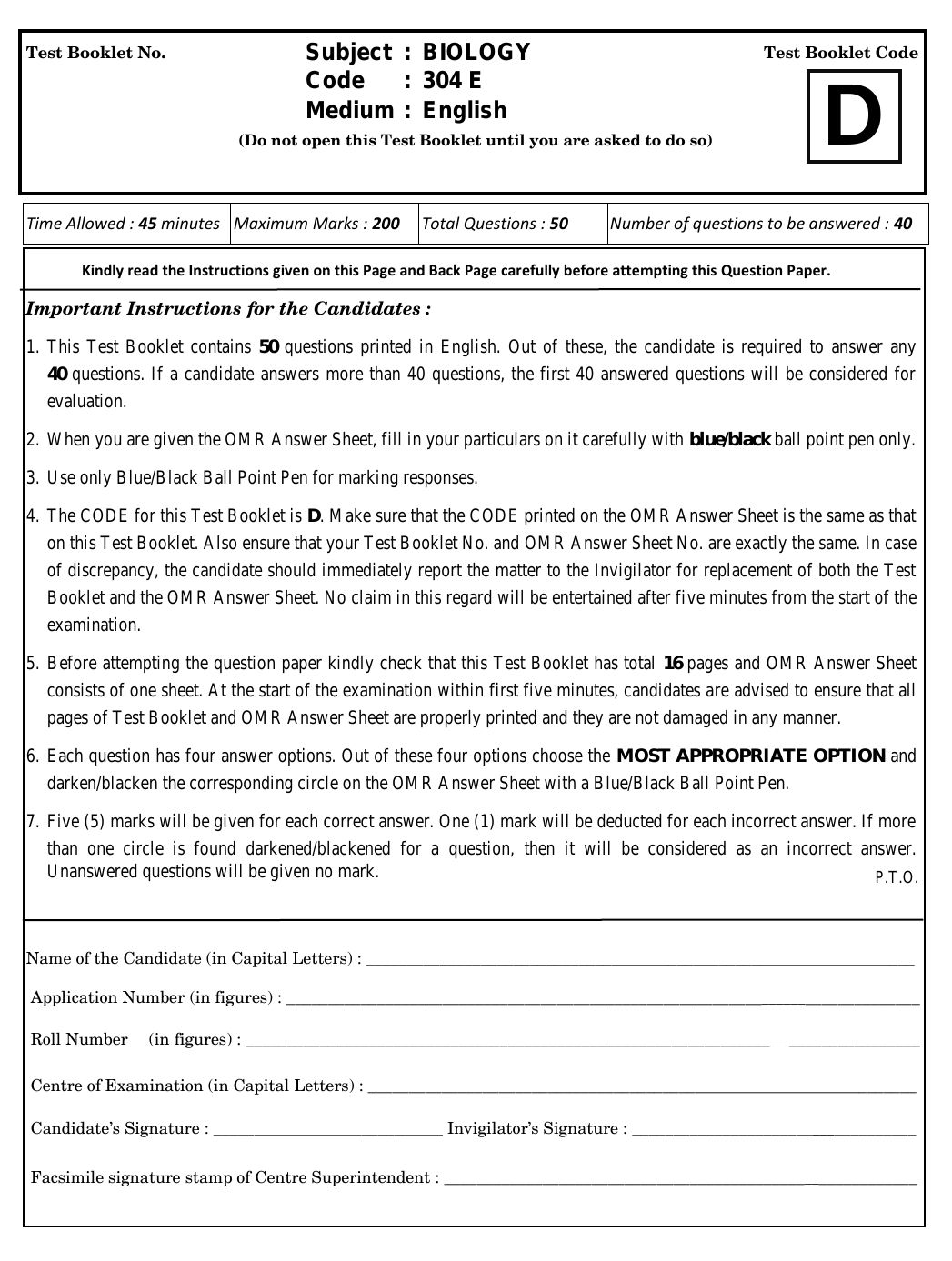
CUET Biology Question Paper 2024 is available for download here. NTA conducted CUET 2024 Biology paper on 15 May in Shift 1B from 12:15 PM to 1 PM. CUET Biology Question Paper 2024 is based on objective-type questions (MCQs). Candidates get 45 minutes to solve 40 MCQs out of 50 in CUET 2024 question paper for Biology.
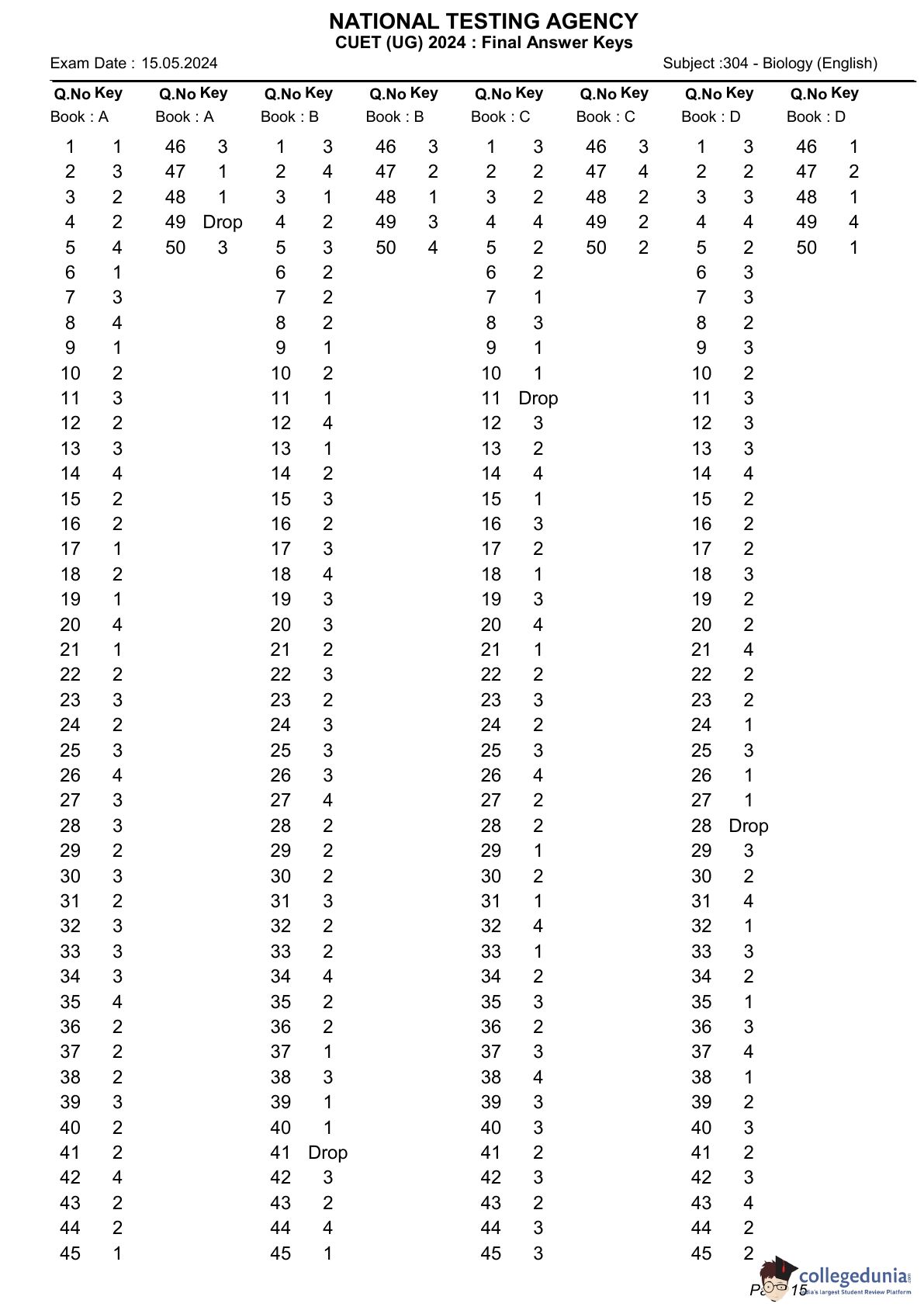
CUET Biology Question Paper with Answer Key 2024
| CUET 2024 Biology Question Paper with Answer key Set A |  Download Download |
Check Solutions |
| CUET 2024 Biology Question Paper with Answer Key Set B | Download |
Check Solutions |
| CUET 2024 Biology Question Paper with Answer Key Set C | Download |
Check Solutions |
| CUET 2024 Biology Question Paper with Answer Key Set D | Download |
Check Solutions |
CUET Biology (New) Question Paper with Answer Key 2024
| CUET 2024 Biology(New) Question Paper with Answer key Set A | Download |
Check Solutions |
| CUET 2024 Biology(New) Question Paper with Answer Key Set B | Download |
Check Solutions |
| CUET 2024 Biology(New) Question Paper with Answer Key Set C | Download |
Check Solutions |
| CUET 2024 Biology(New) Question Paper with Answer Key Set D | Download |
Check Solutions |
CUET 2024 Biology Set A Questions with Solutions
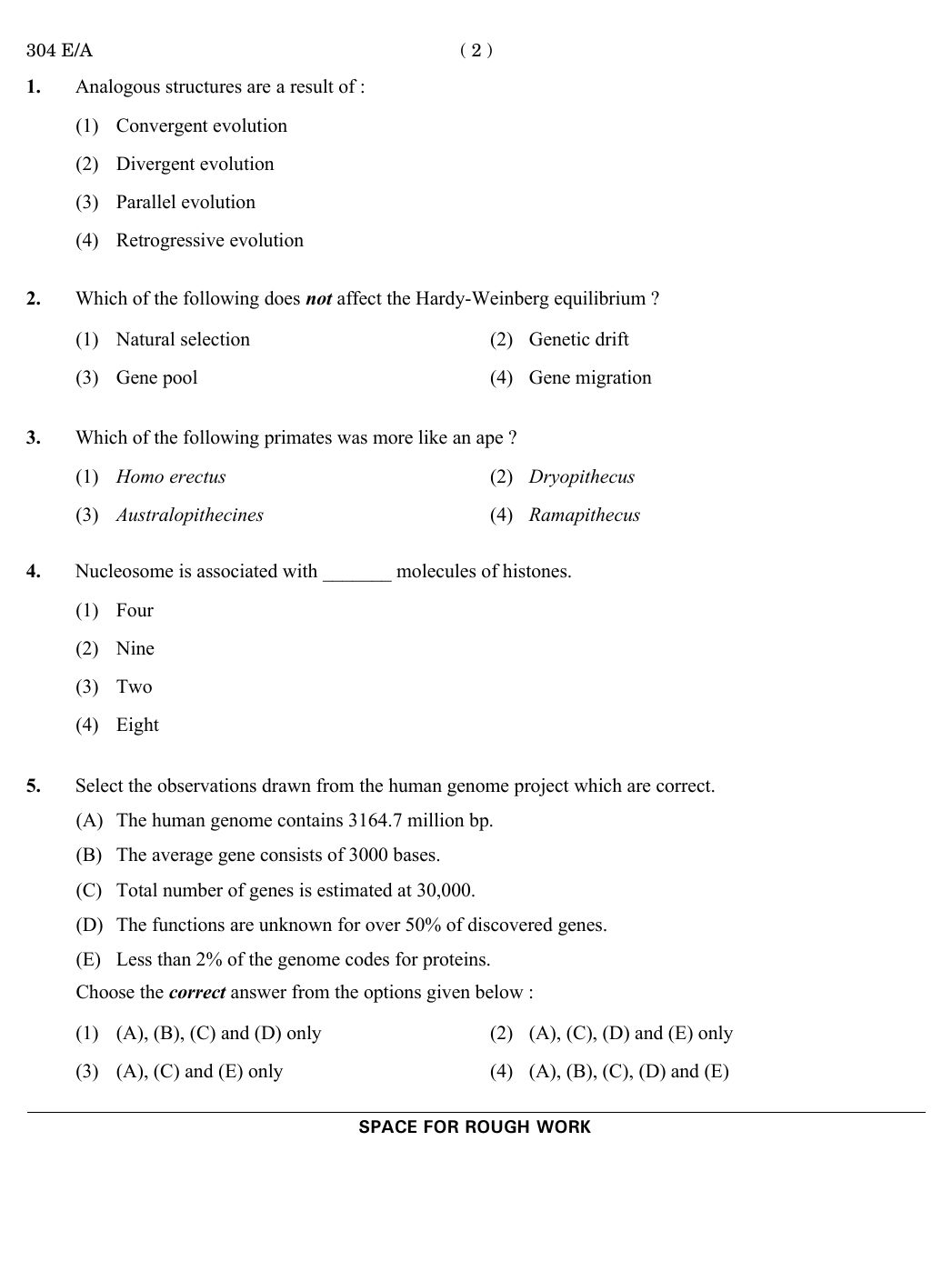
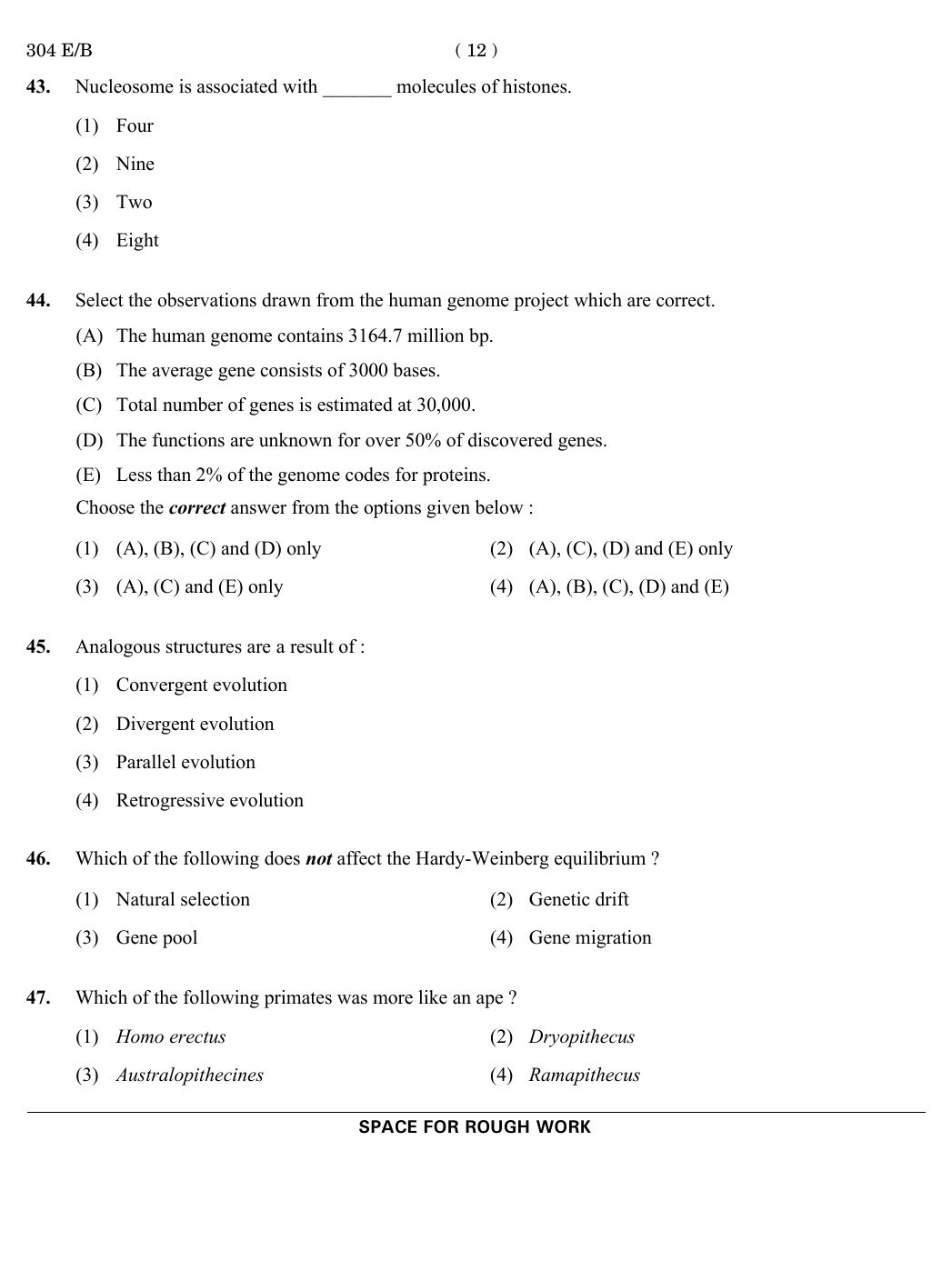
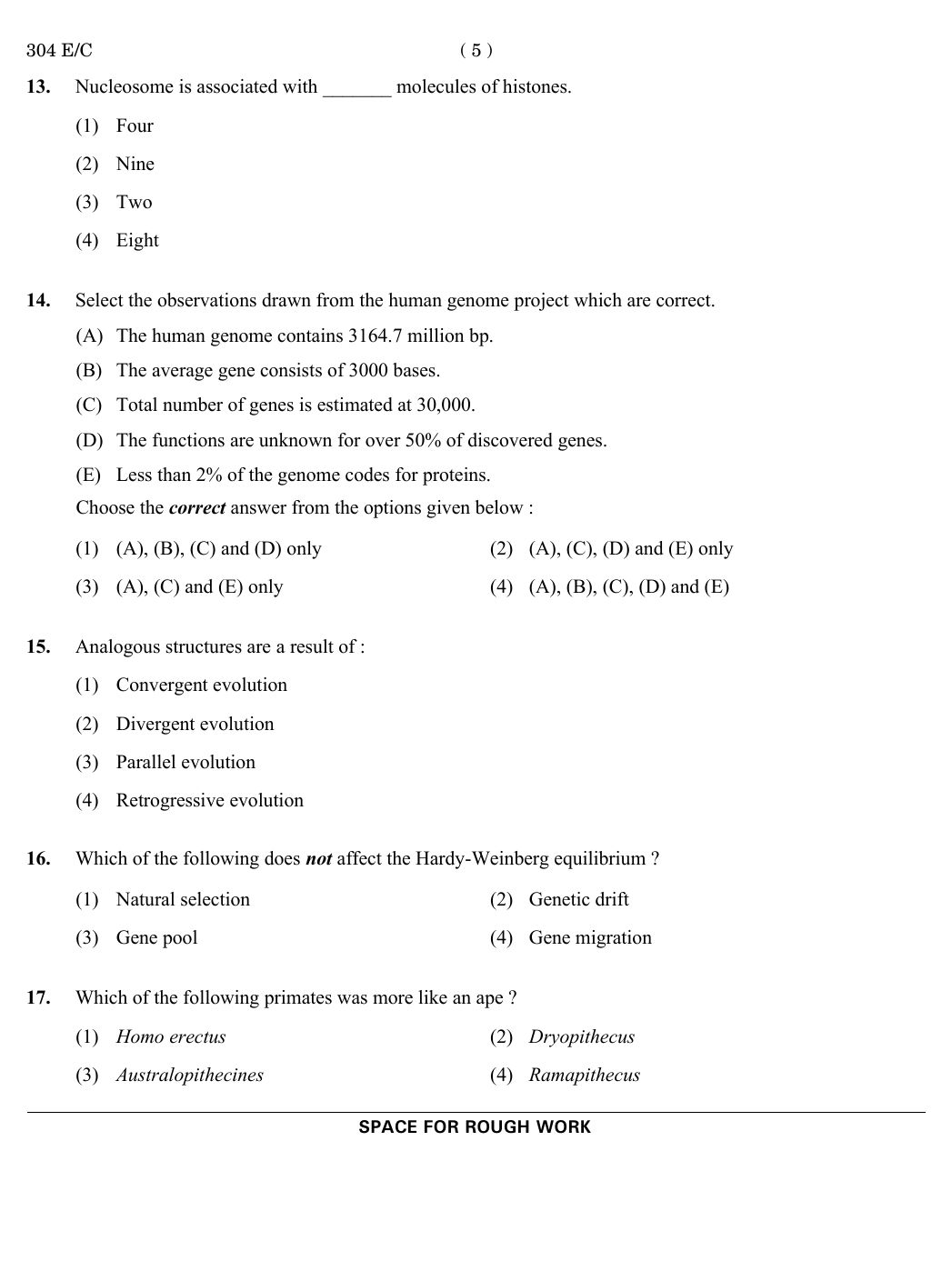
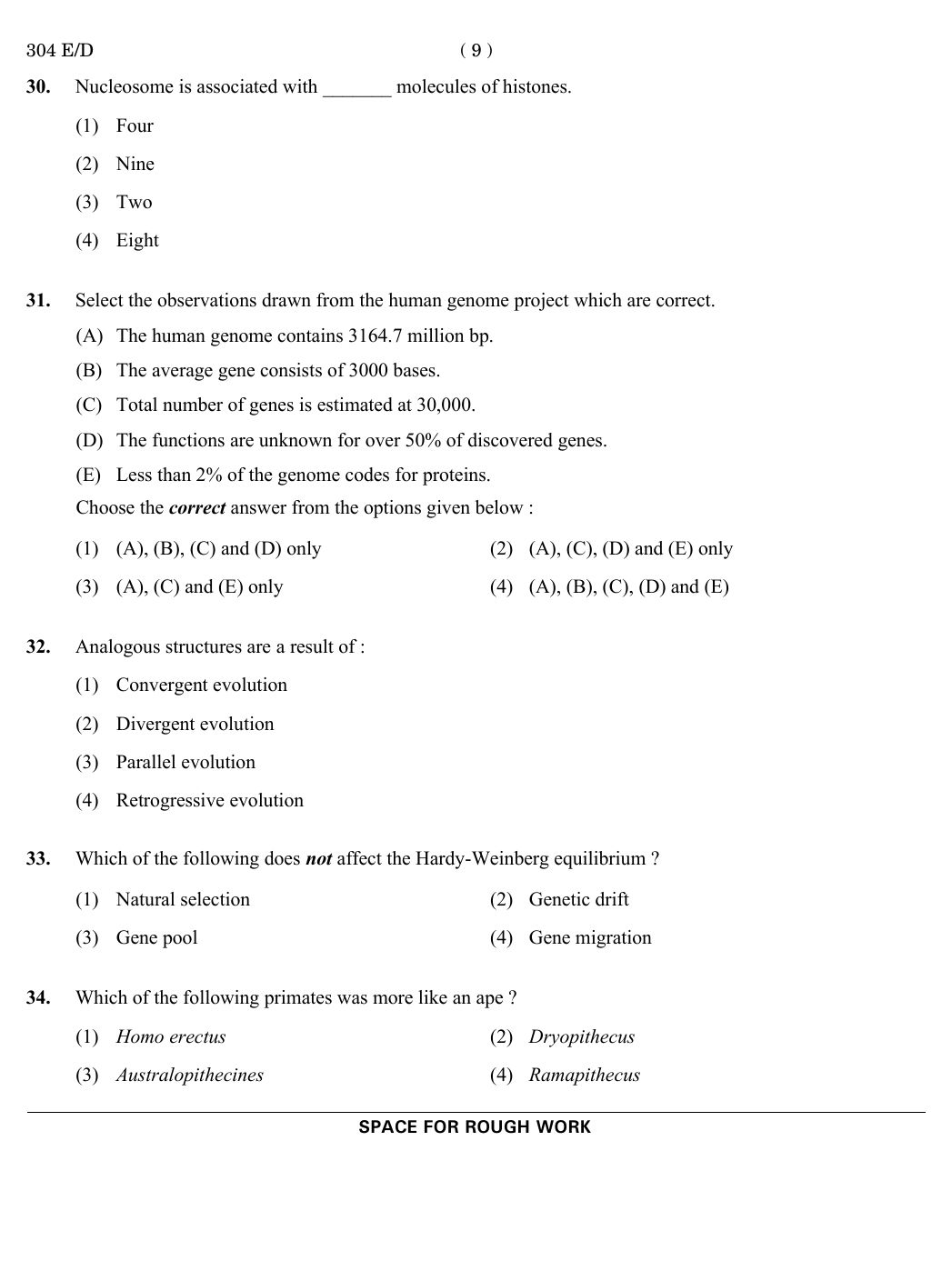
Analogous structures are a result of:
View Solution
Which of the following does not affect the Hardy-Weinberg equilibrium?
View Solution
Which of the following primates was more like an ape?
View Solution
Nucleosome is associated with molecules of histones.
View Solution
Select the observations drawn from the human genome project which are correct.
(A) The human genome contains 3164.7 million bp.
(B) The average gene consists of 3000 bases.
(C) Total number of genes is estimated at 30,000.
(D) The functions are unknown for over 50% of discovered genes.
(E) Less than 2% of the genome codes for proteins.
Choose the correct answer from the options given below:
View Solution
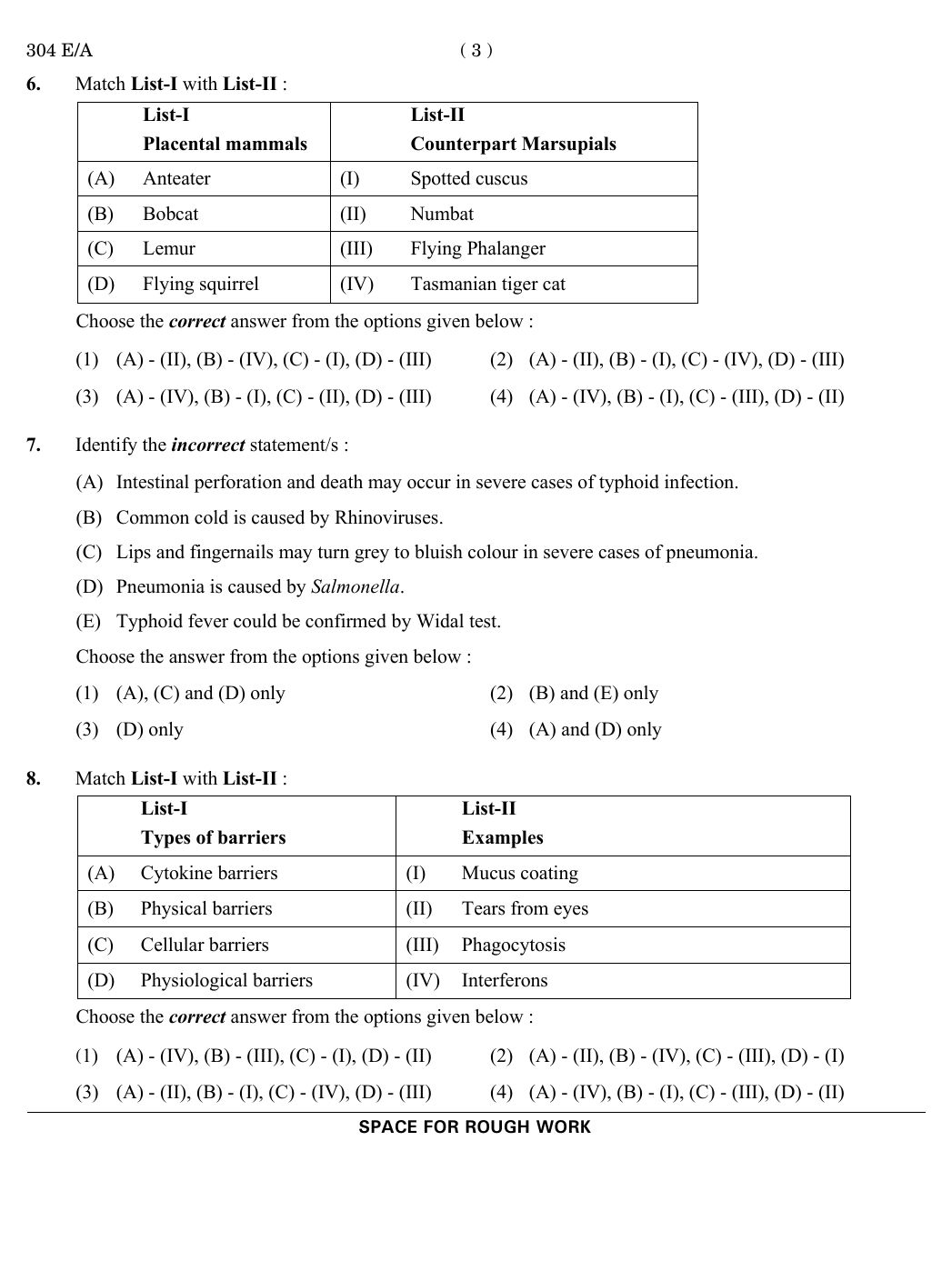
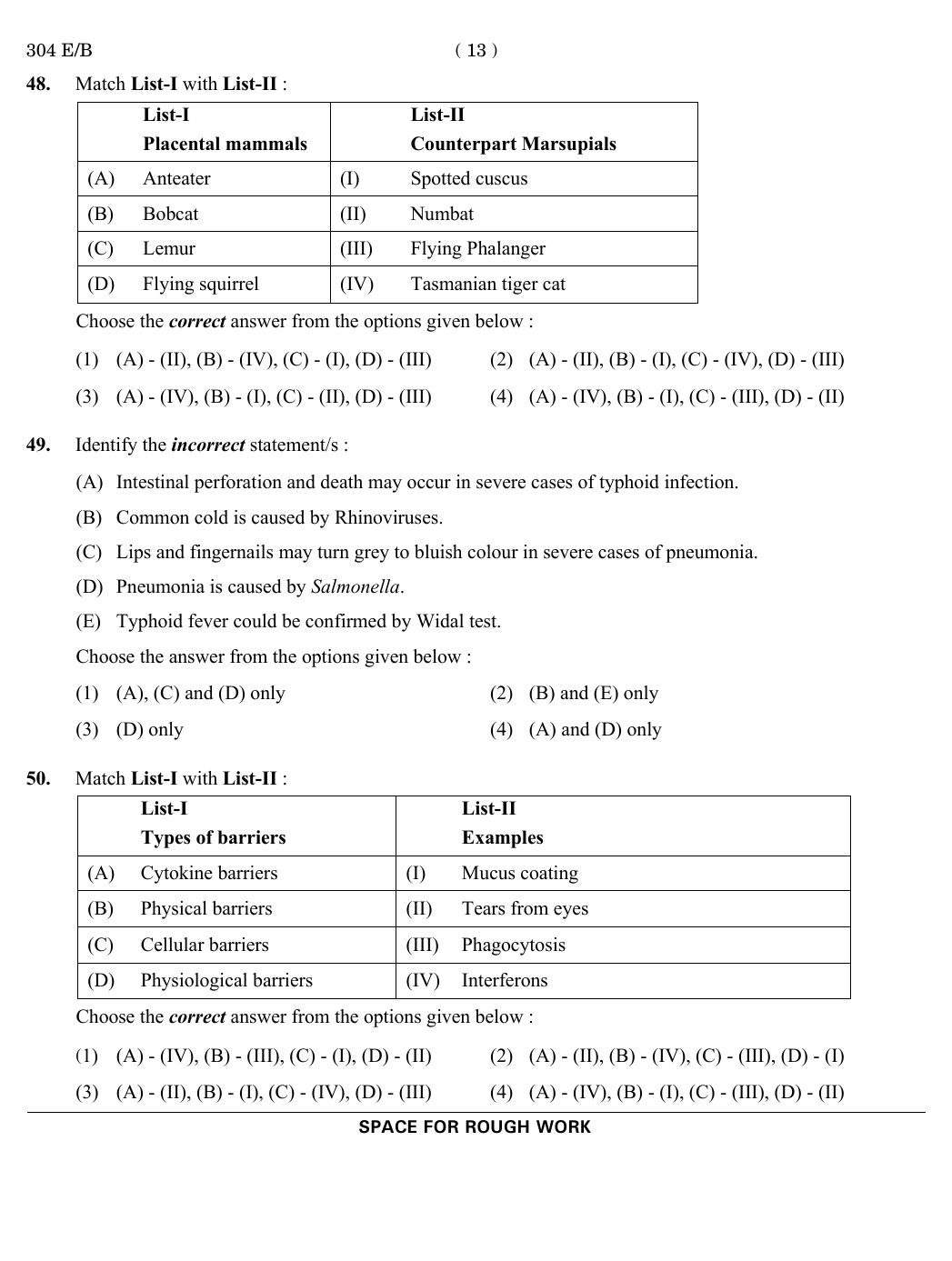
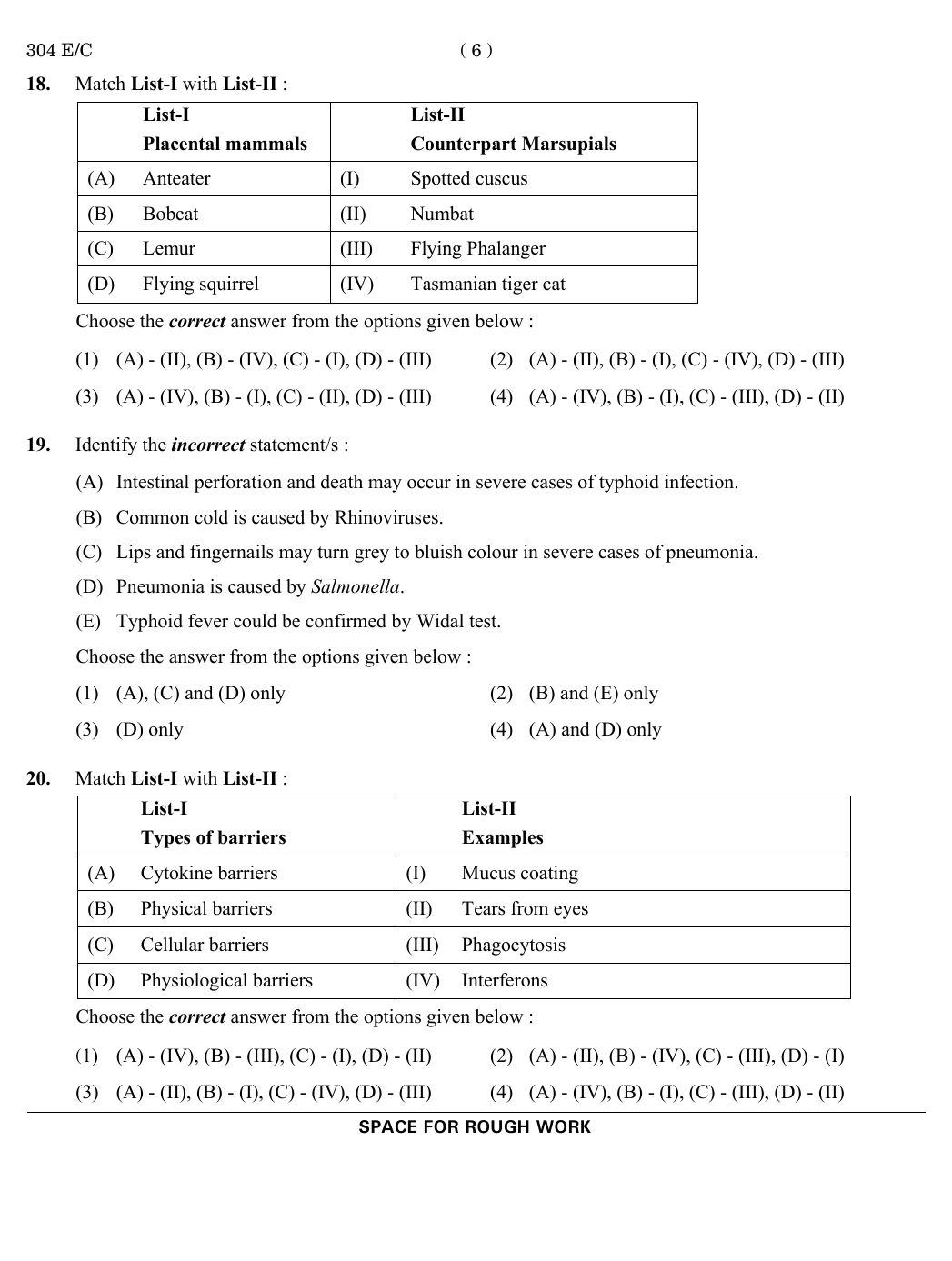
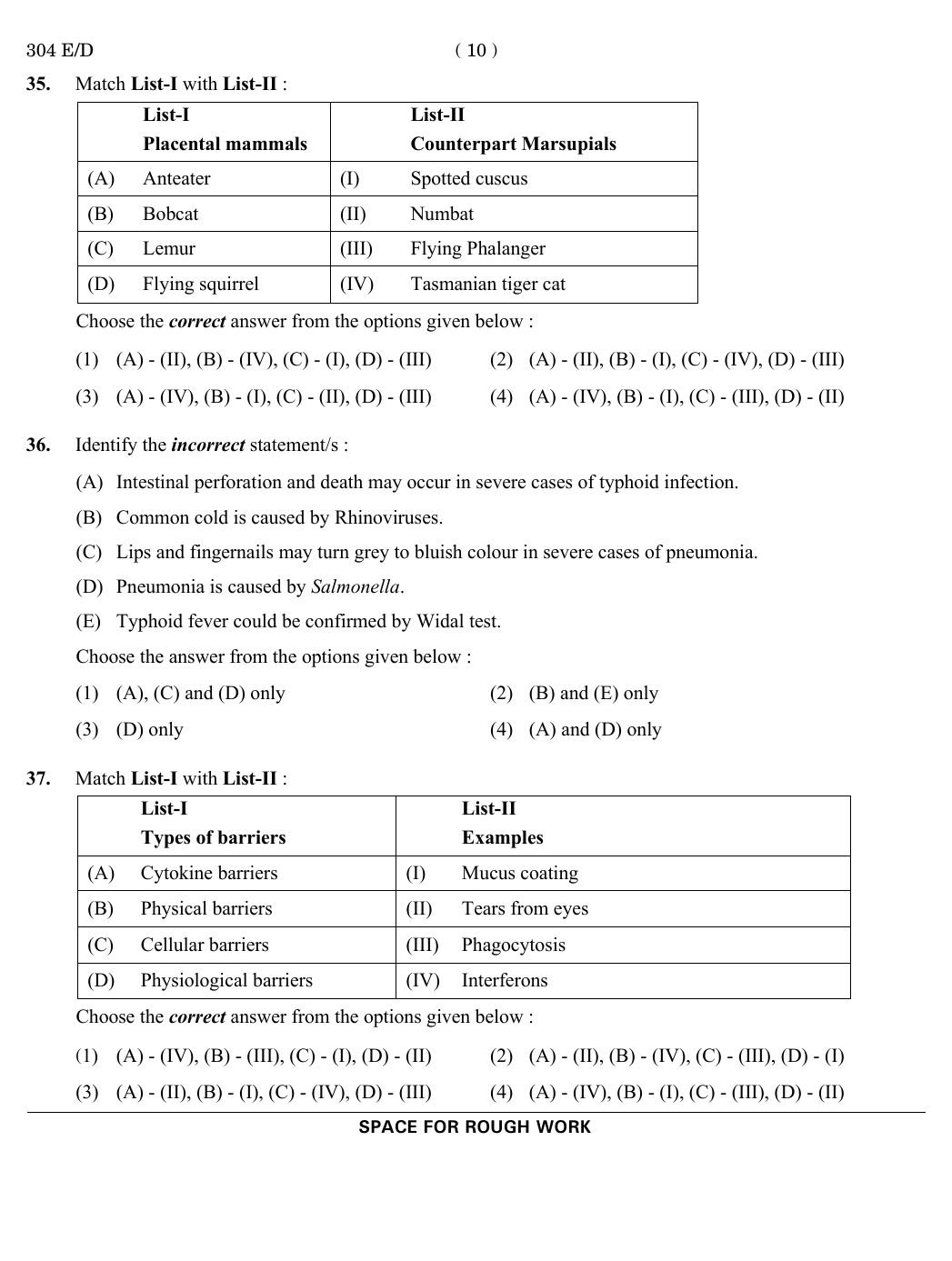
Match List-I with List-II:
List-I
(A) Anteater
(B) Bobcat
(C) Lemur
(D) Flying squirrel
List-II
(I) Spotted cuscus
(II) Numbat
(III) Flying Phalanger
(IV) Tasmanian tiger cat
Choose the correct answer from the options given below:
View Solution
Identify the incorrect statement/s:
(A) Intestinal perforation and death may occur in severe cases of typhoid infection.
(B) Common cold is caused by Rhinoviruses.
(C) Lips and fingernails may turn grey to bluish colour in severe cases of pneumonia.
(D) Pneumonia is caused by Salmonella.
(E) Typhoid fever could be confirmed by Widal test.
Choose the correct answer from the options given below:
View Solution
Match List-I with List-II:
List-I
(A) Cytokine barriers
(B) Physical barriers
(C) Cellular barriers
(D) Physiological barriers
List-II
(I) Mucus coating
(II) Tears from eyes
(III) Phagocytosis
(IV) Interferons
Choose the correct answer from the options given below:
View Solution
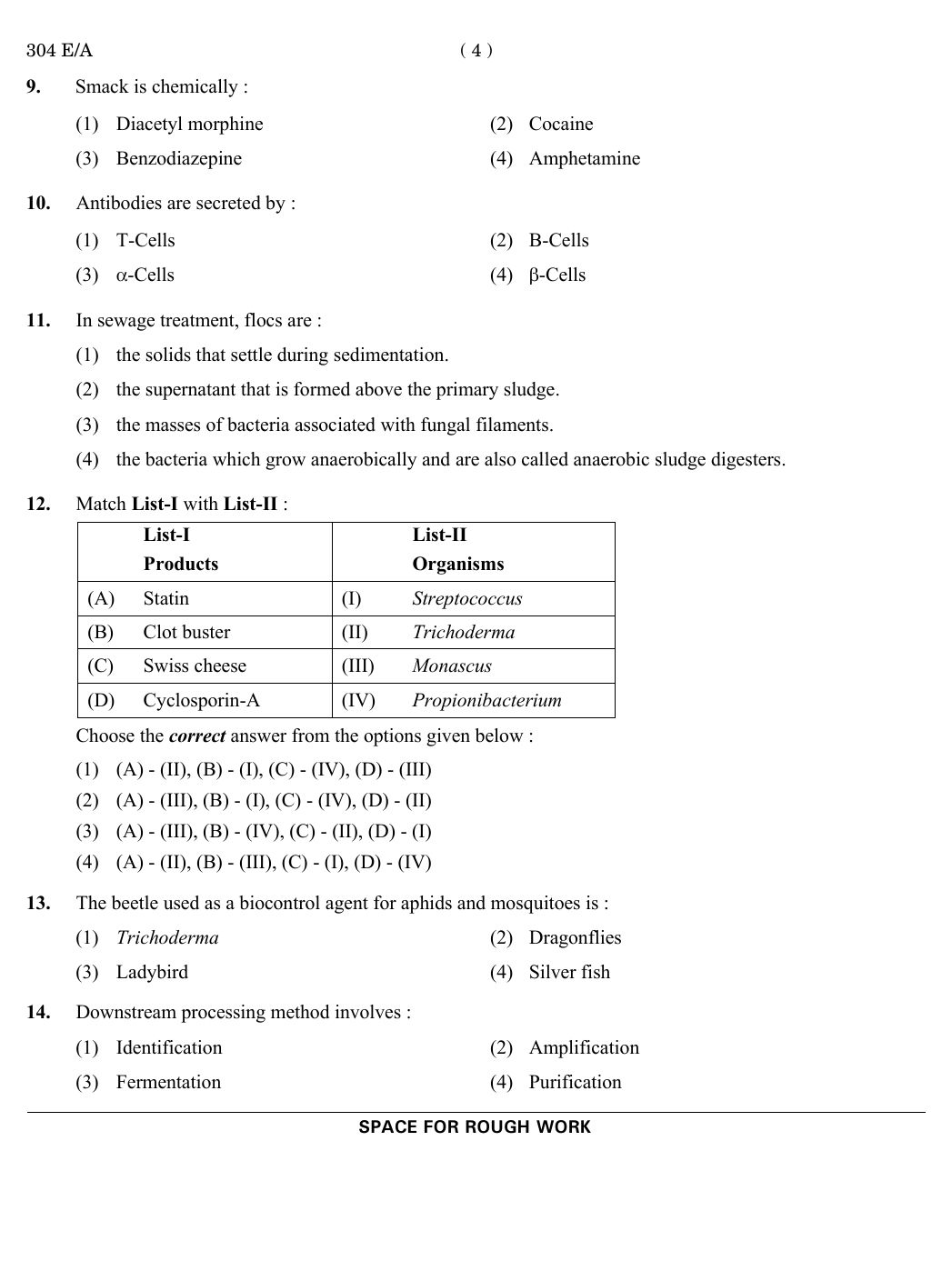
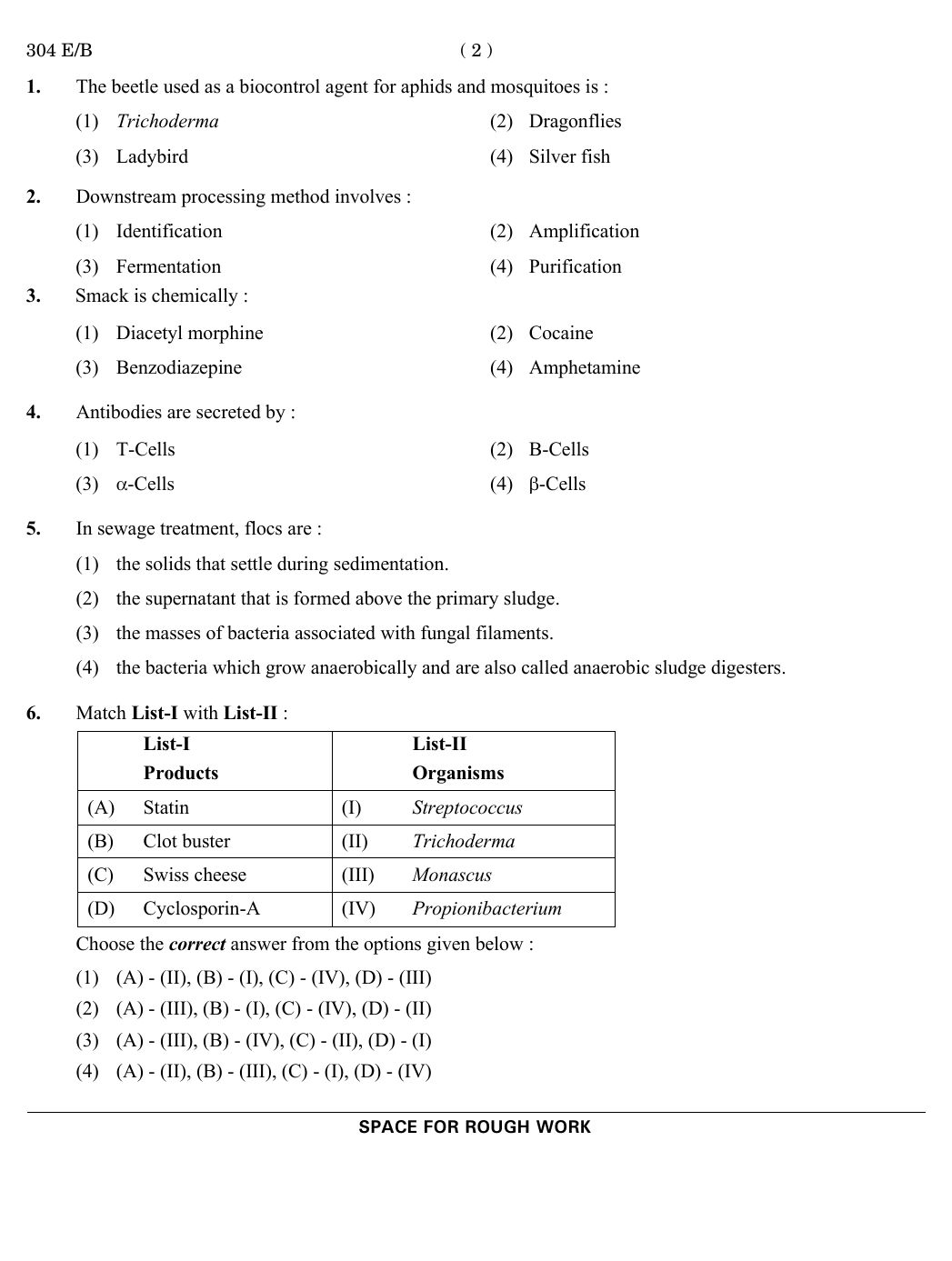
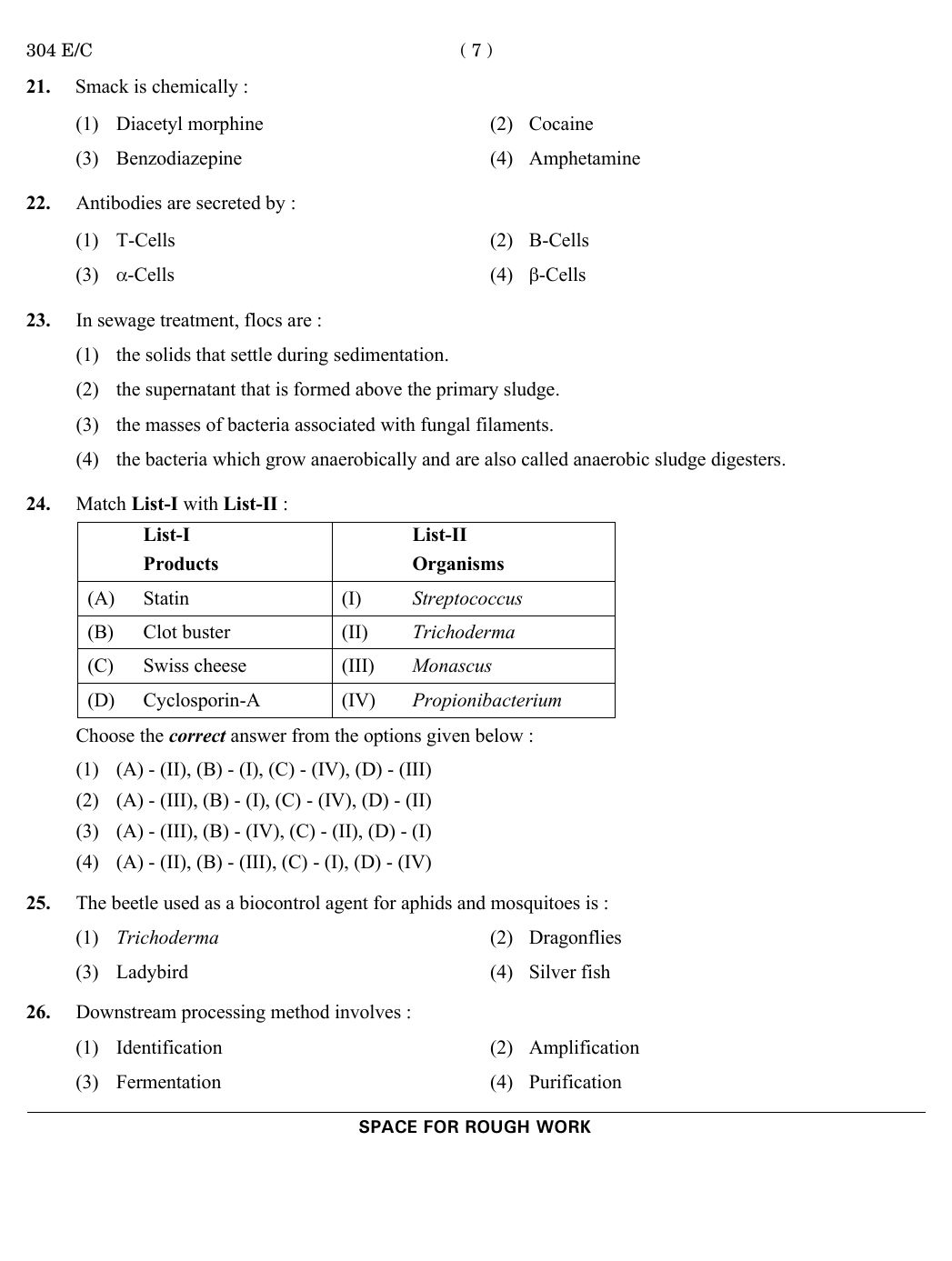
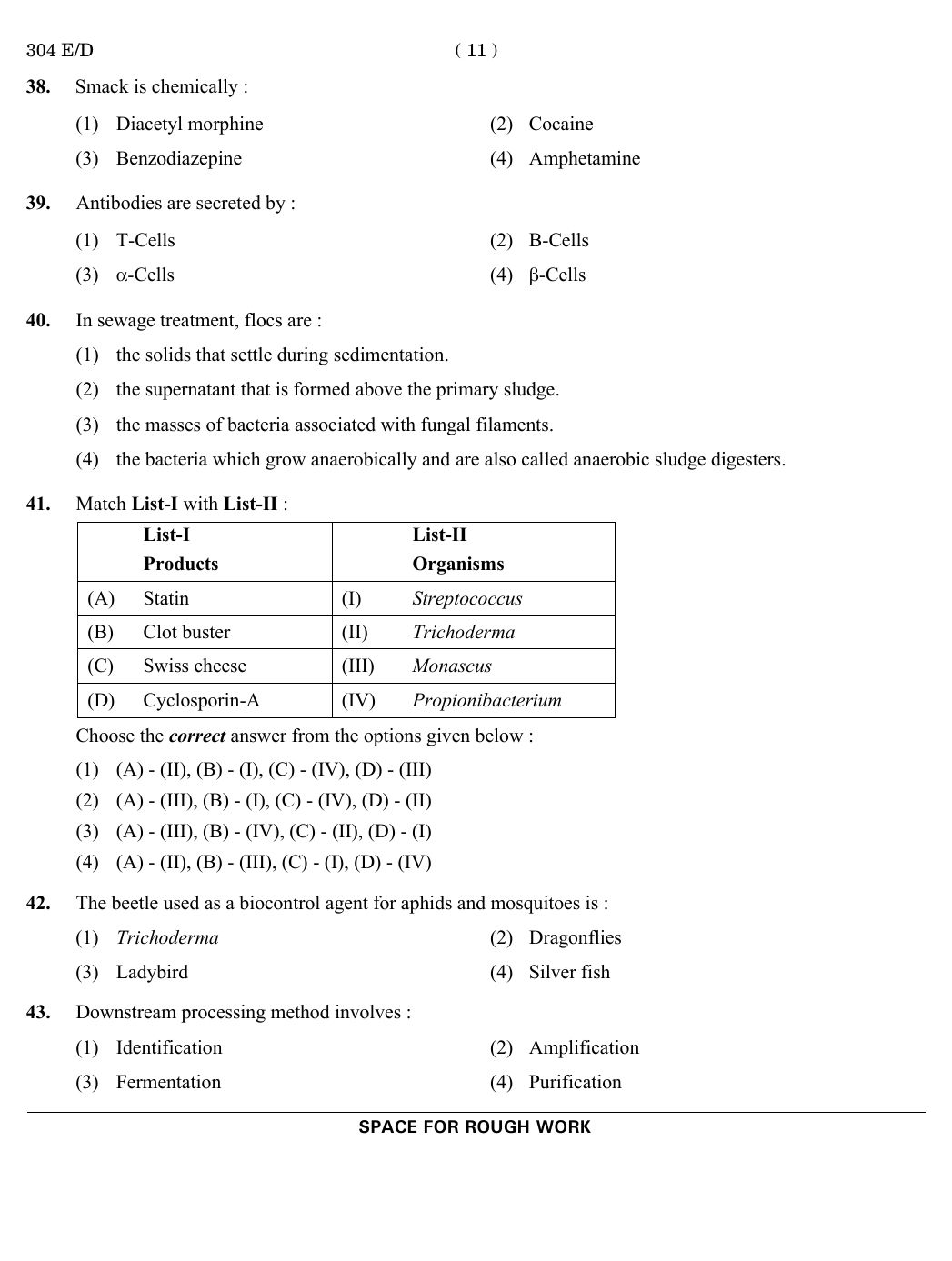
Smack is chemically:
View Solution
Antibodies are secreted by:
View Solution
In sewage treatment, flocs are:
View Solution
Match List-I with List-II:
List-I
(A) Statin
(B) Clot buster
(C) Swiss cheese
(D) Cyclosporin-A
List-II
(I) Streptococcus
(II) Trichoderma
(III) Monascus
(IV) Propionibacterium
Choose the correct answer from the options given below:
View Solution
The beetle used as a biocontrol agent for aphids and mosquitoes is:
View Solution
Downstream processing method involves:
View Solution
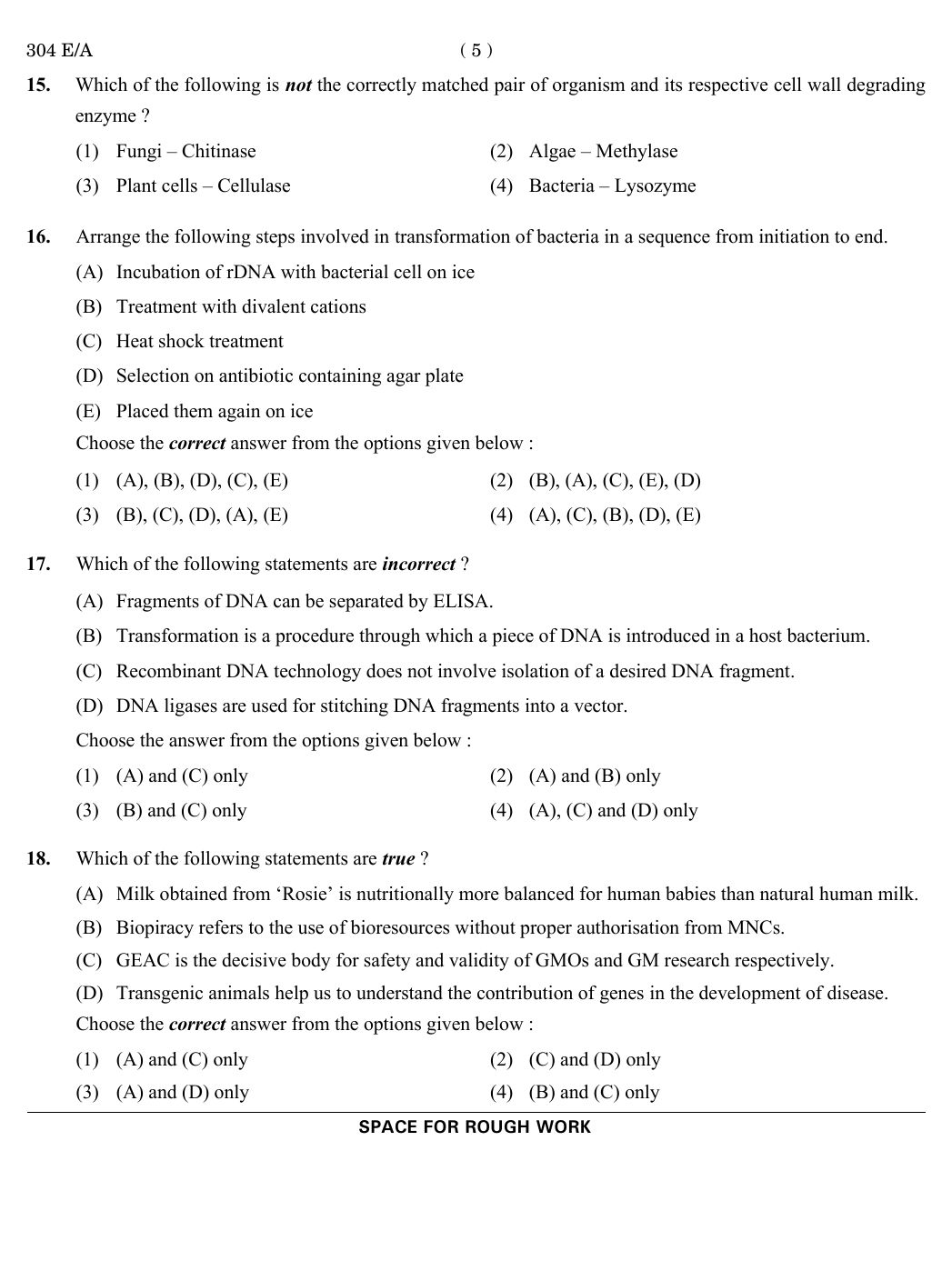
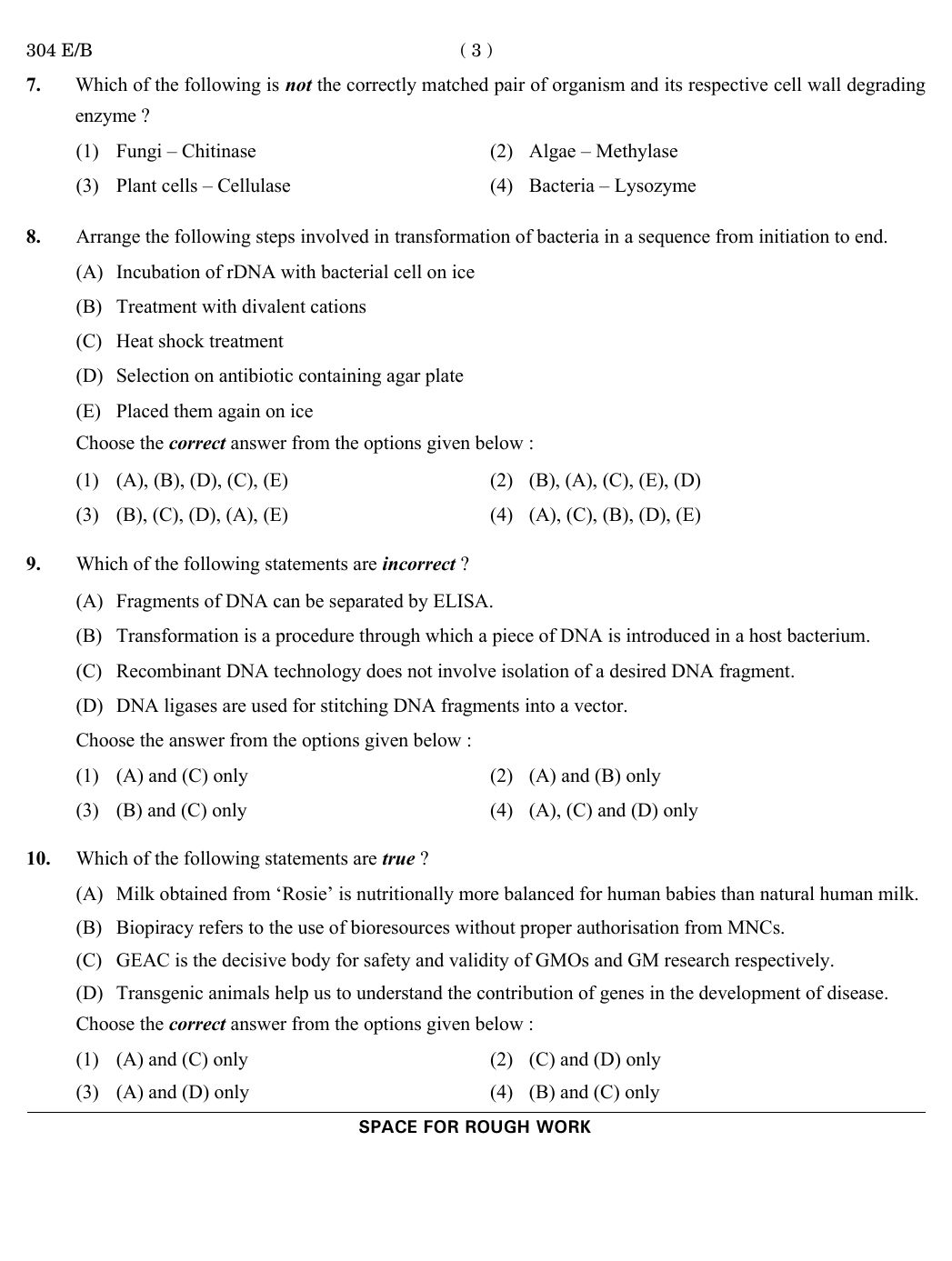
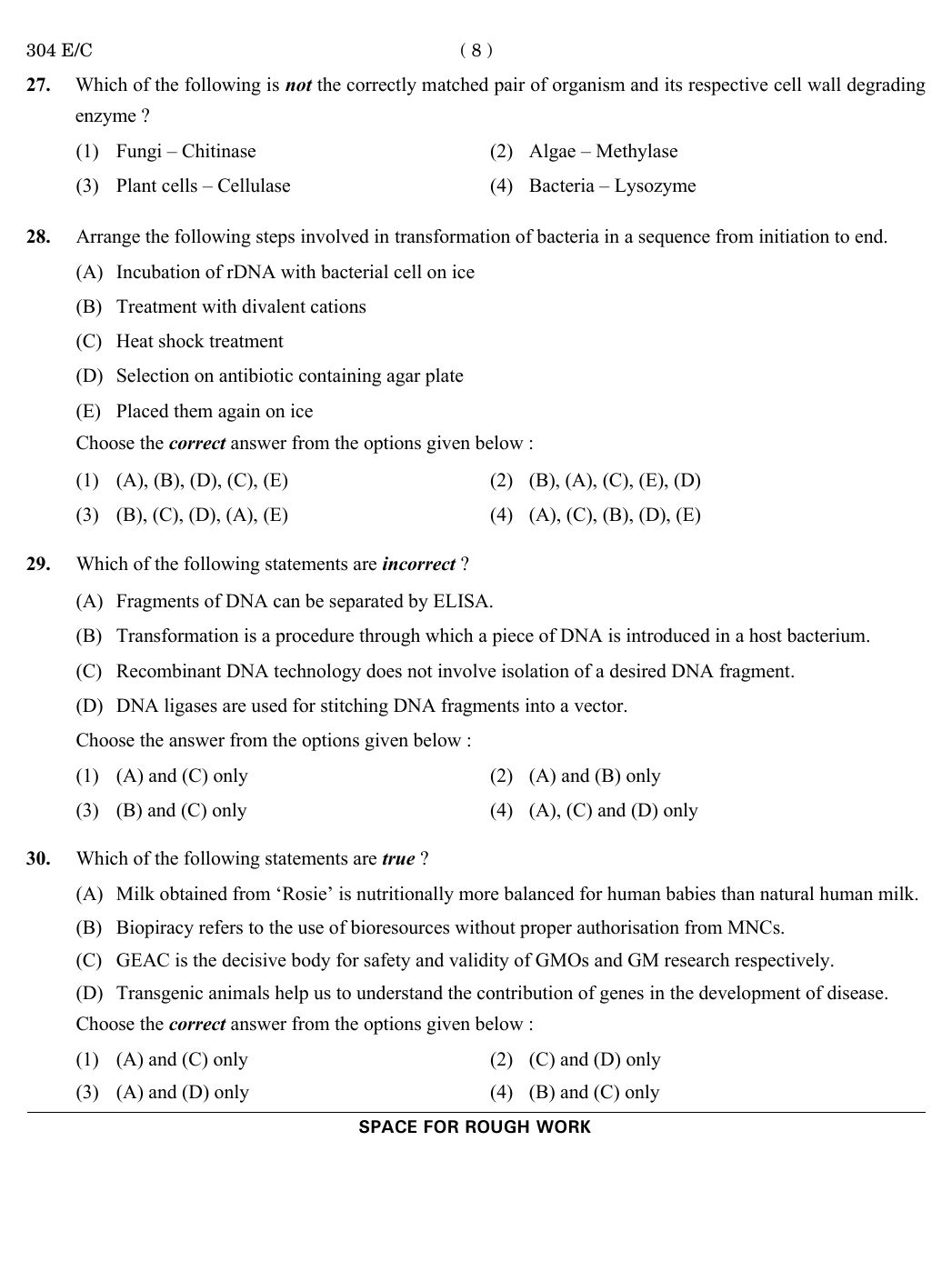
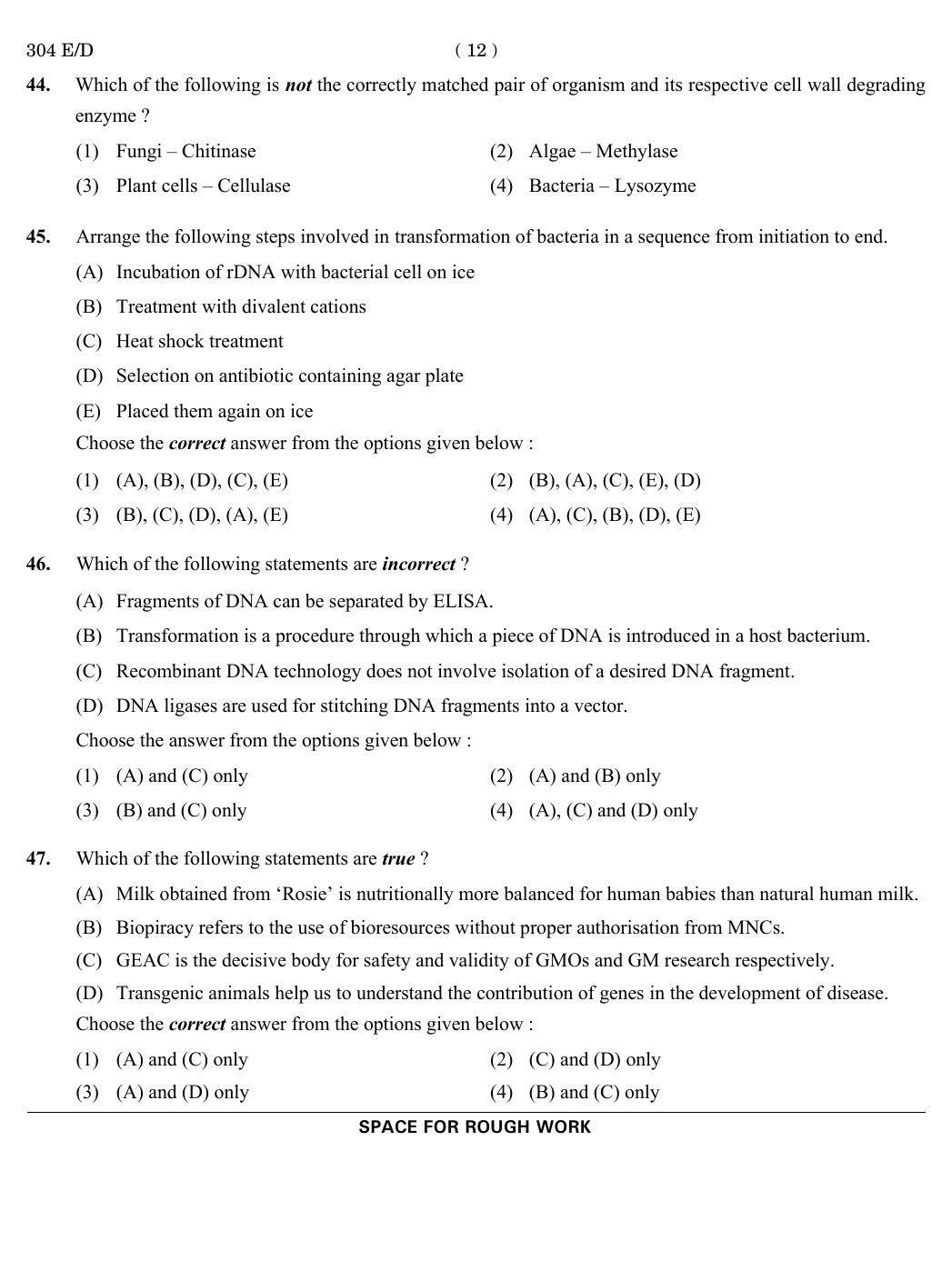
Which of the following is not the correctly matched pair of organism and its respective cell wall degrading enzyme?
View Solution
Arrange the following steps involved in the transformation of bacteria in a sequence from initiation to end.
(A) Incubation of rDNA with bacterial cell on ice
(B) Treatment with divalent cations
(C) Heat shock treatment
(D) Selection on antibiotic containing agar plate
(E) Placed them again on ice
Choose the correct answer from the options given below:
View Solution
Which of the following statements are incorrect?
(A) Fragments of DNA can be separated by ELISA.
(B) Transformation is a procedure through which a piece of DNA is introduced in a host bacterium.
(C) Recombinant DNA technology does not involve isolation of a desired DNA fragment.
(D) DNA ligases are used for stitching DNA fragments into a vector.
Choose the answer from the options given below:
View Solution
Which of the following statements are true?
(A) Milk obtained from ‘Rosie’ is nutritionally more balanced for human babies than natural human milk.
(B) Biopiracy refers to the use of bioresources without proper authorization from MNCs.
(C) GEAC is the decisive body for safety and validity of GMOs and GM research respectively.
(D) Transgenic animals help us to understand the contribution of genes in the development of disease.
Choose the correct answer from the options given below:
View Solution
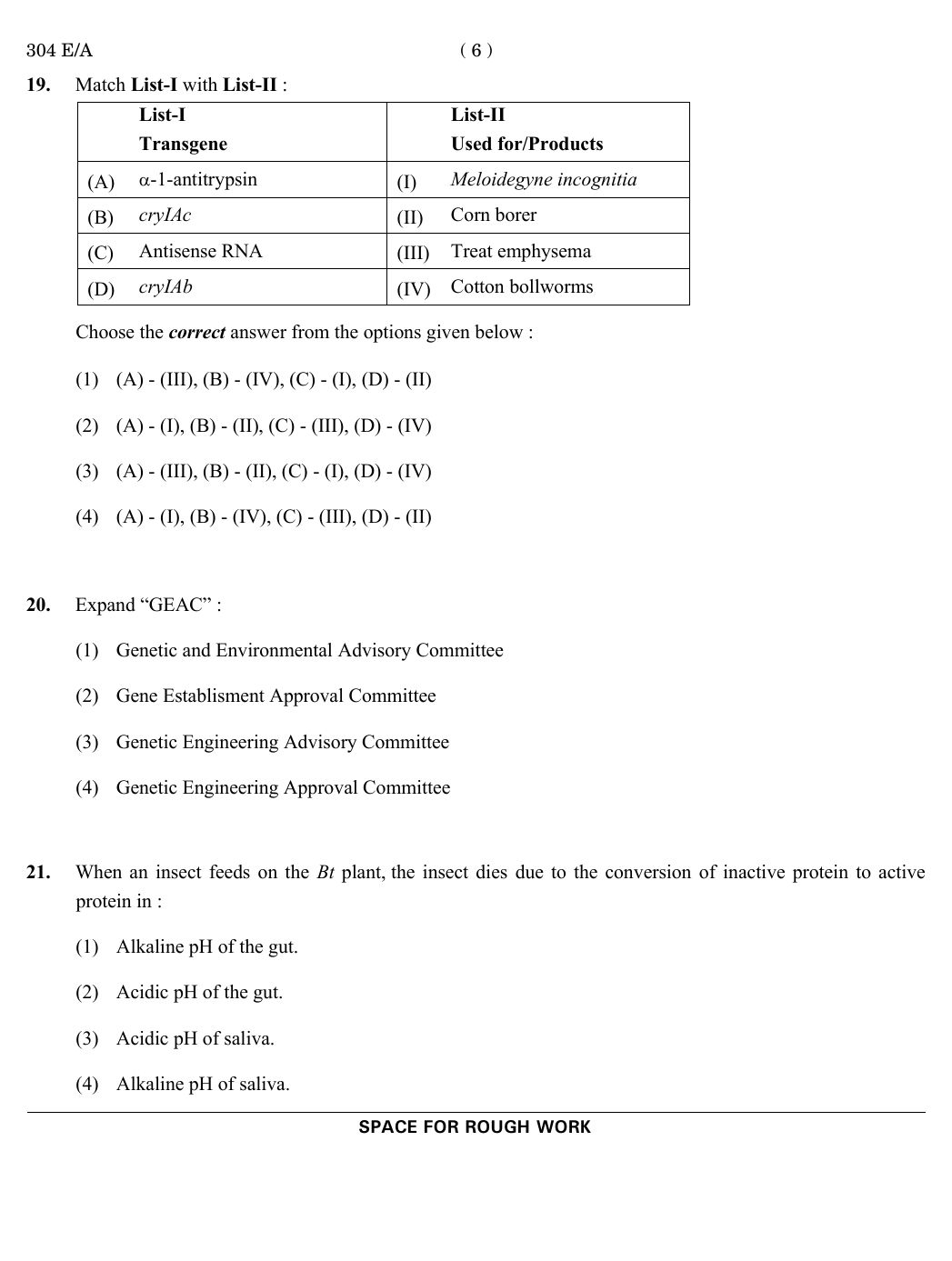
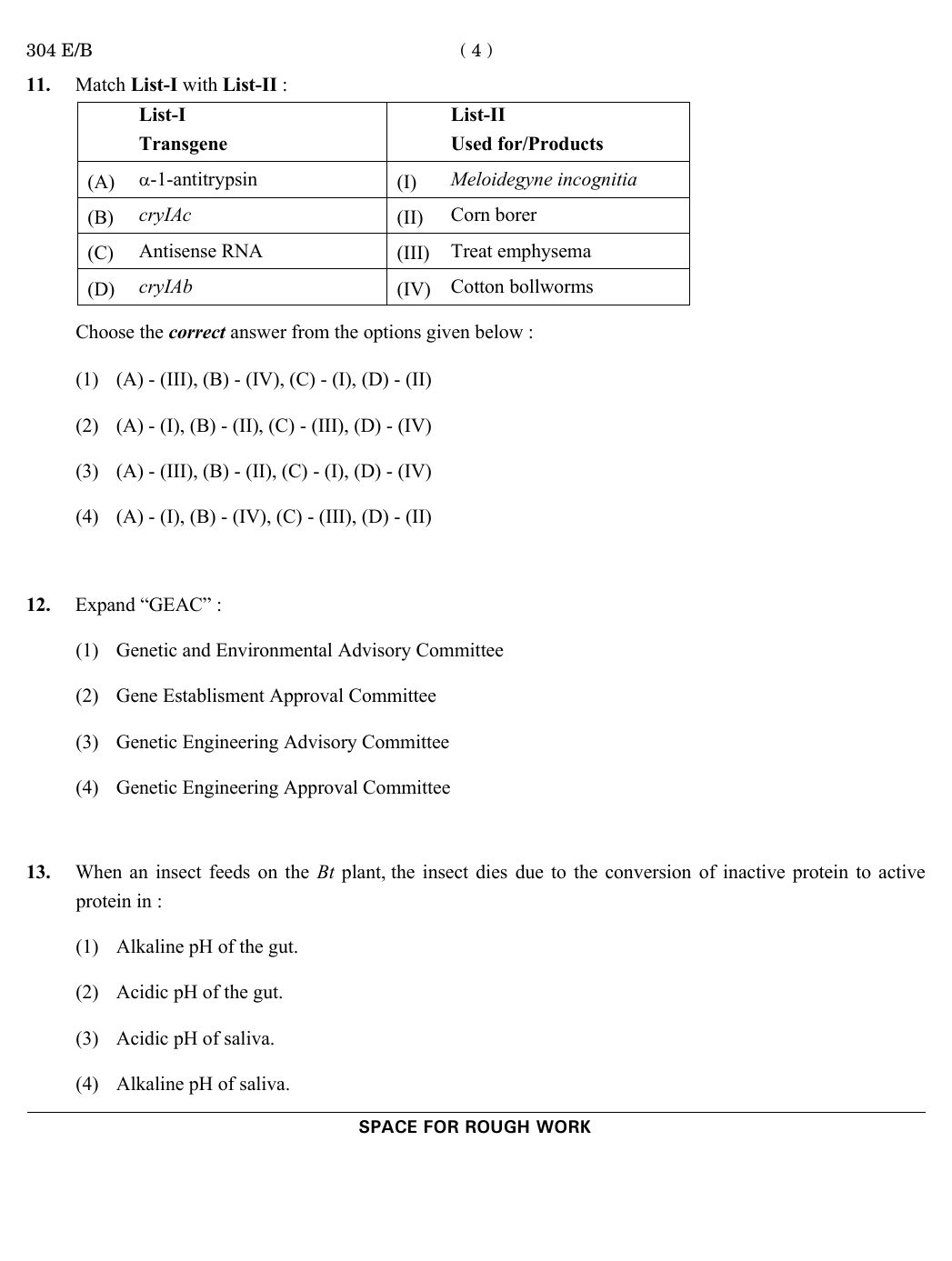
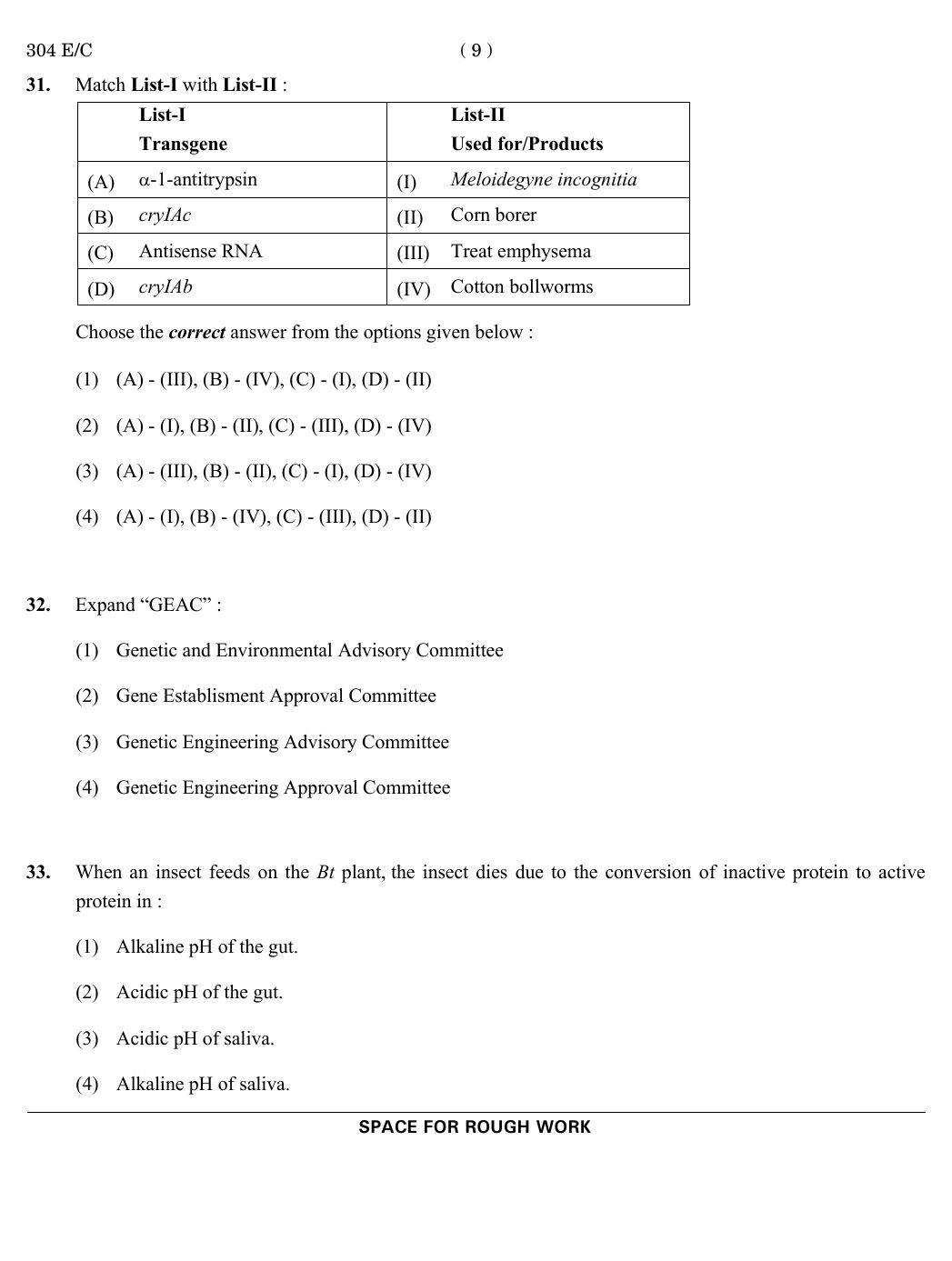
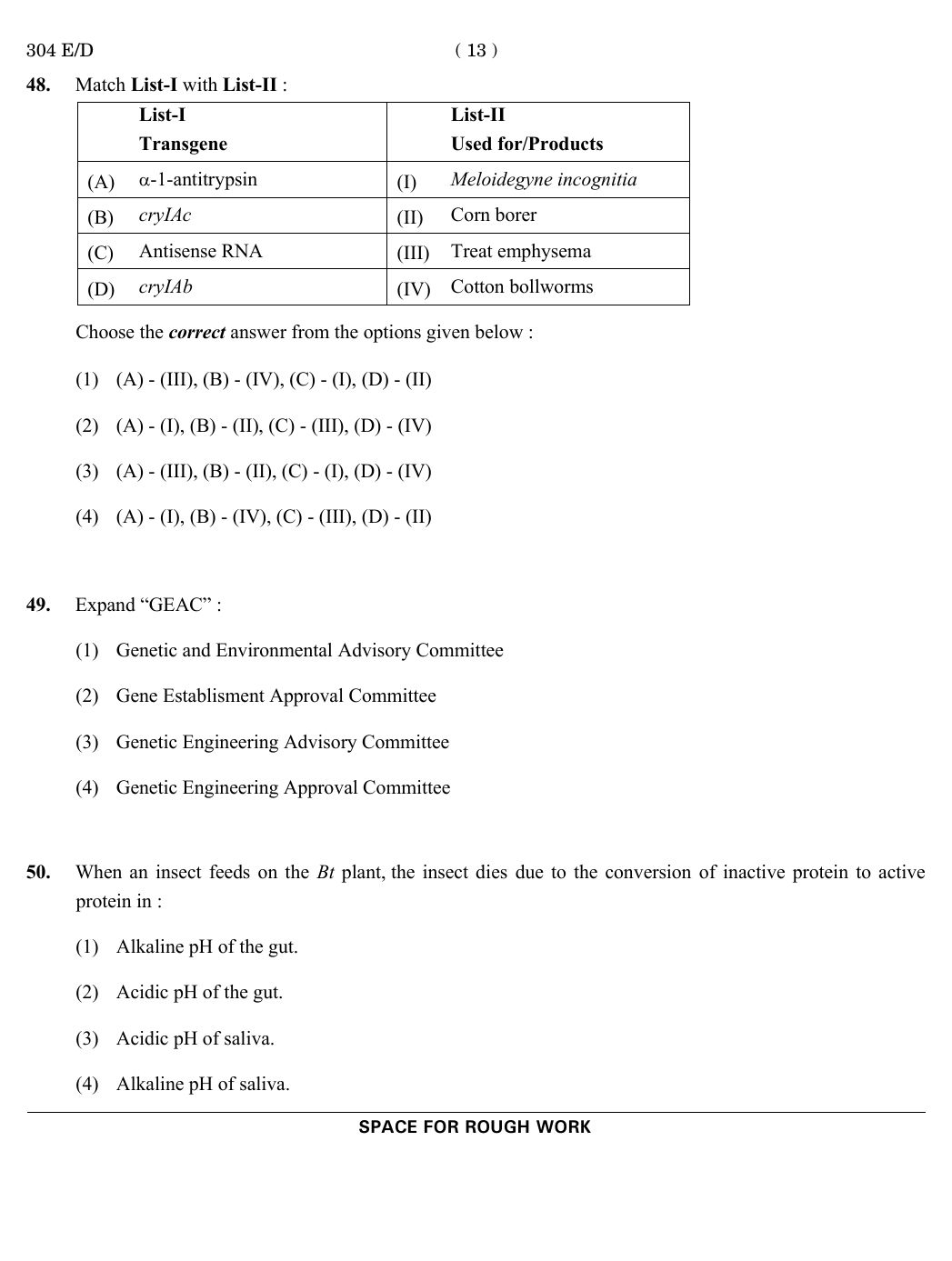
Match List-I with List-II:
List-I
(A) α-1-antitrypsin
(B) cryIAc
(C) Antisense RNA
(D) cryIAb
List-II
(I) Meloidegyne incognitia
(II) Corn borer
(III) Treat emphysema
(IV) Cotton bollworms
Choose the correct answer from the options given below:
View Solution
Expand “GEAC”:
View Solution
When an insect feeds on the Bt plant, the insect dies due to the conversion of inactive protein to active protein in:
View Solution
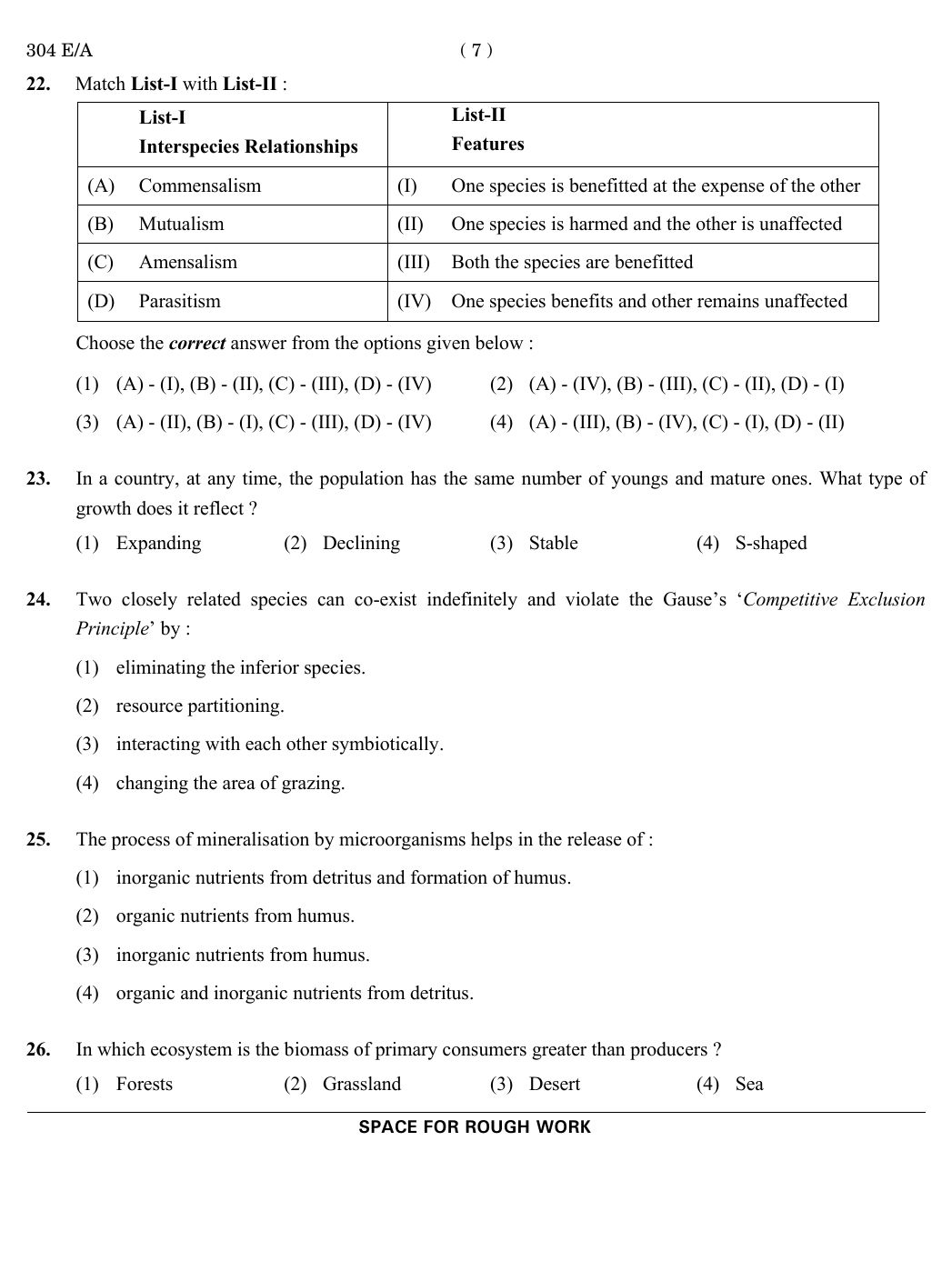
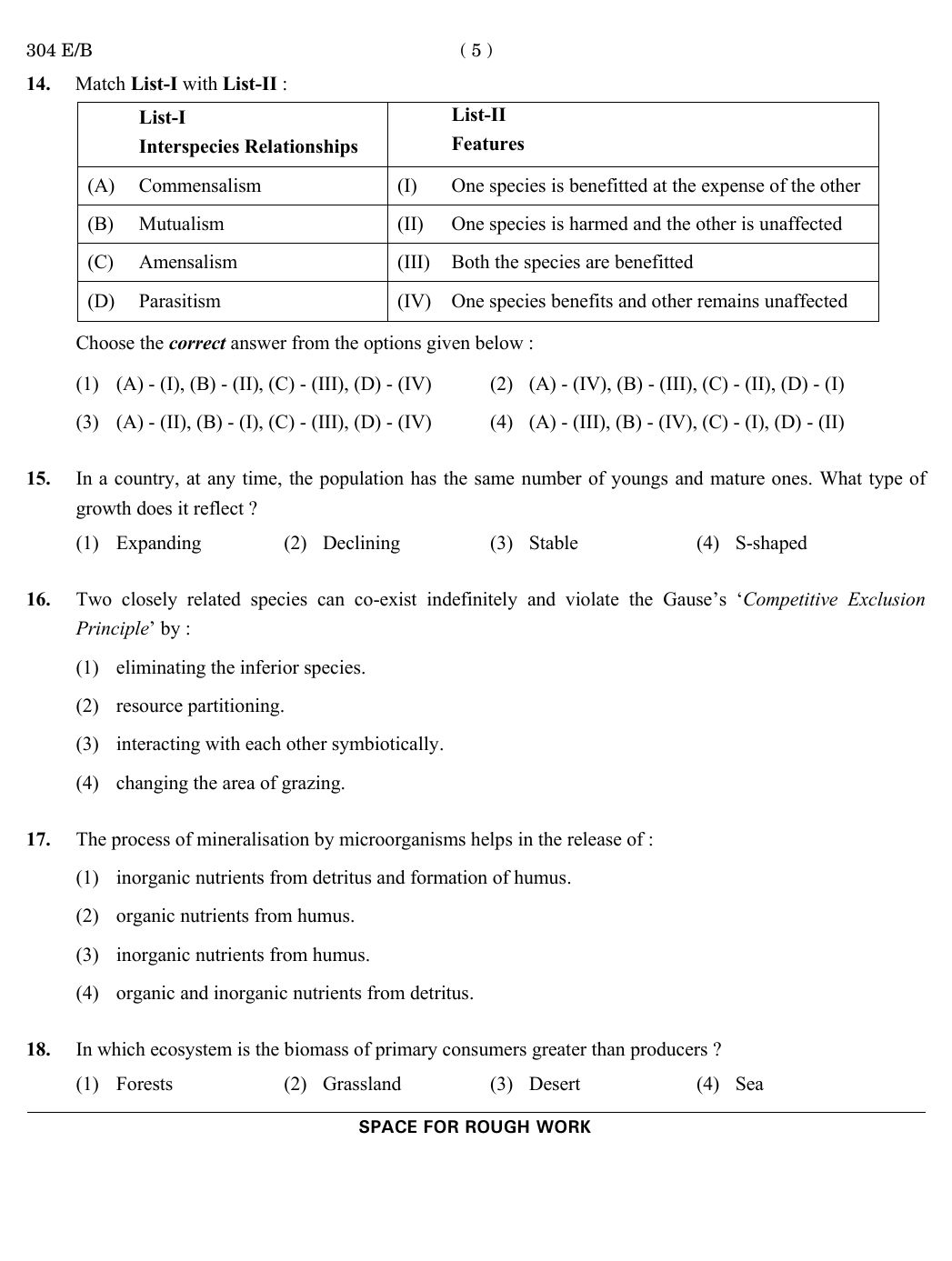
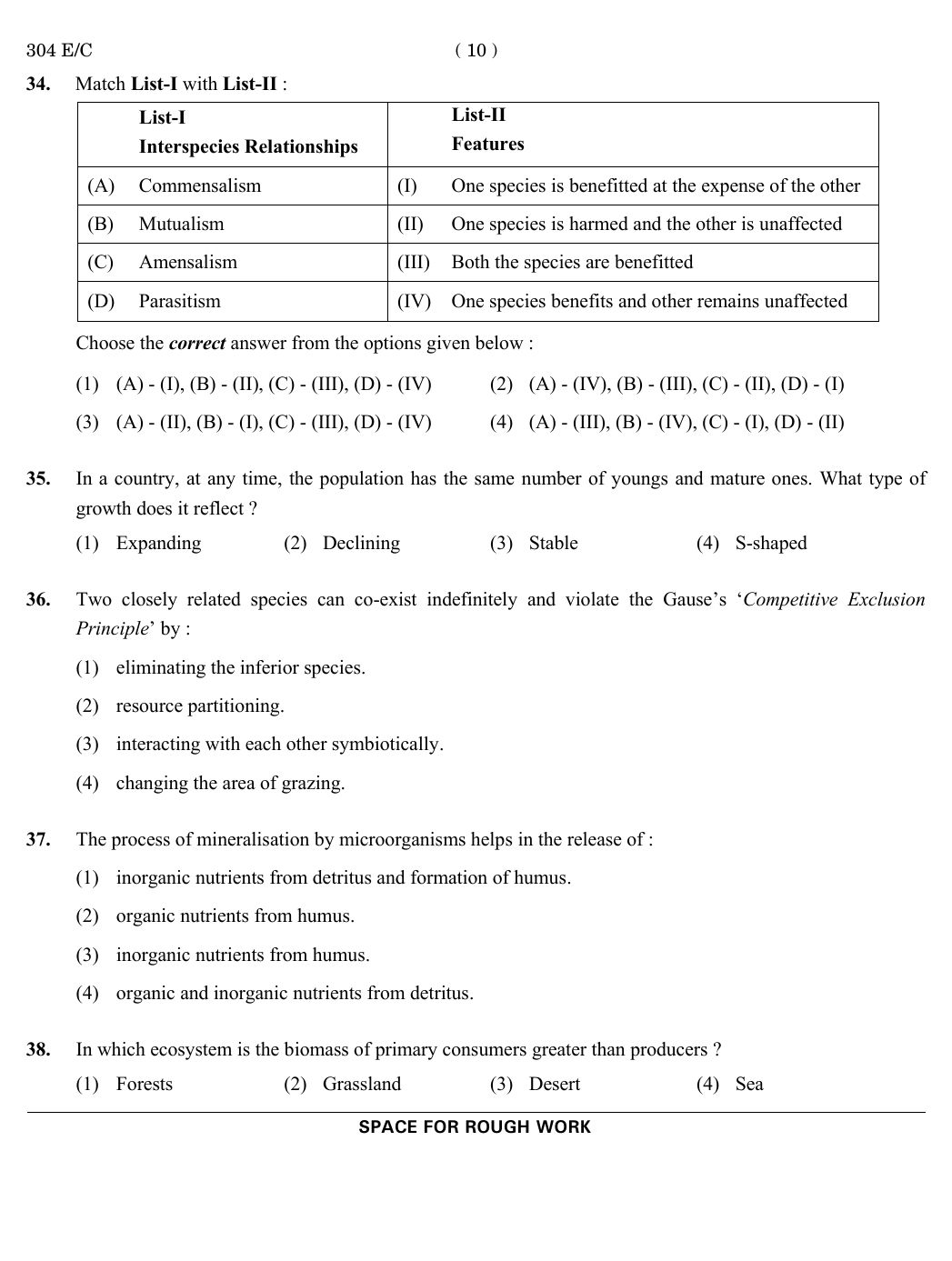
Match List-I with List-II:
List-I
(A) Commensalism
(B) Mutualism
(C) Amensalism
(D) Parasitism
List-II
(I) One species is benefitted at the expense of the other
(II) One species is harmed and the other is unaffected
(III) Both the species are benefitted
(IV) One species benefits and other remains unaffected
Choose the correct answer from the options given below:
View Solution
In a country, at any time, the population has the same number of young and mature ones. What type of growth does it reflect?
View Solution
Two closely related species can co-exist indefinitely and violate the Gause’s ‘Competitive Exclusion Principle’ by:
View Solution
The process of mineralisation by microorganisms helps in the release of:
View Solution
In which ecosystem is the biomass of primary consumers greater than producers?
View Solution
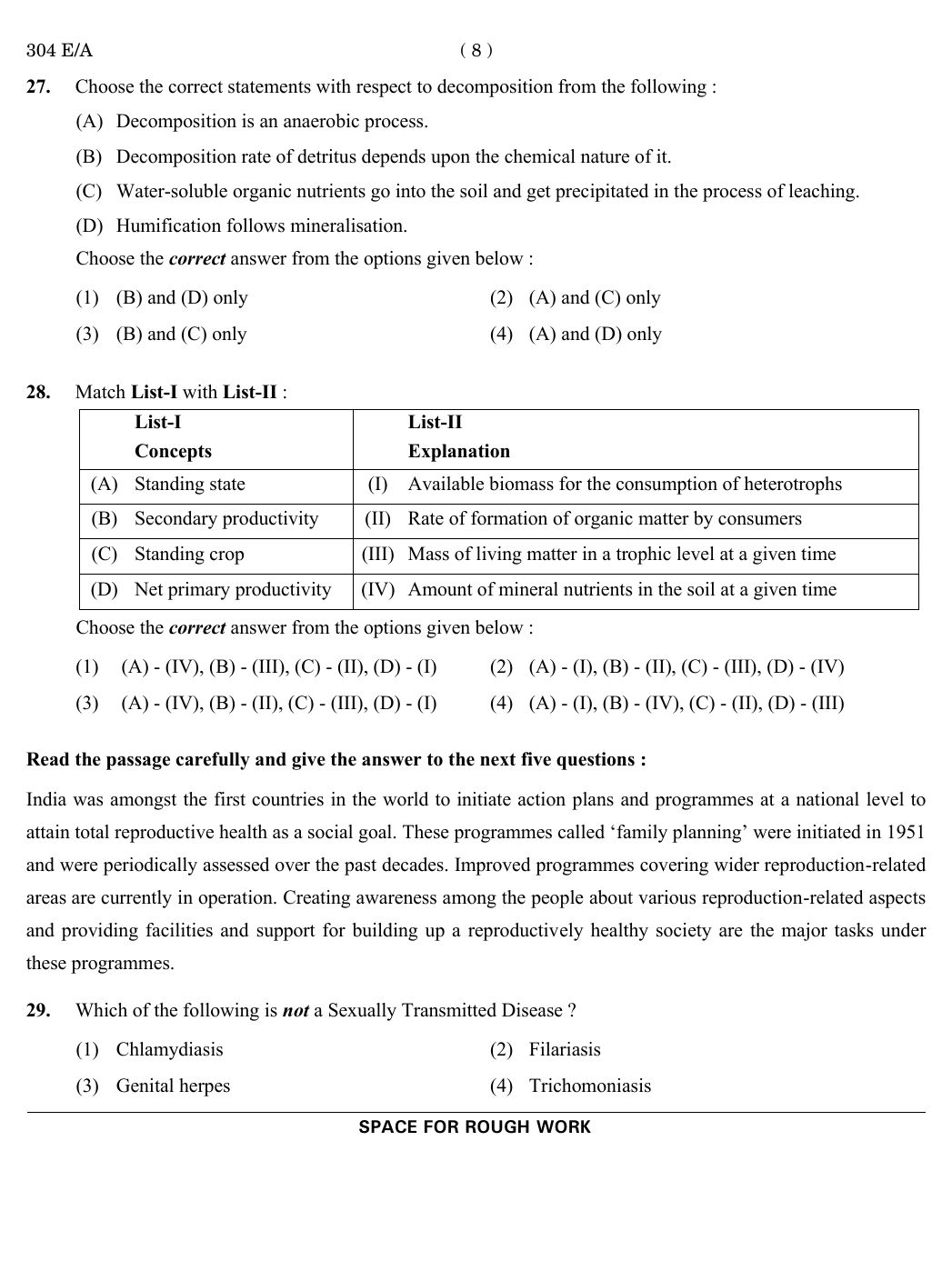
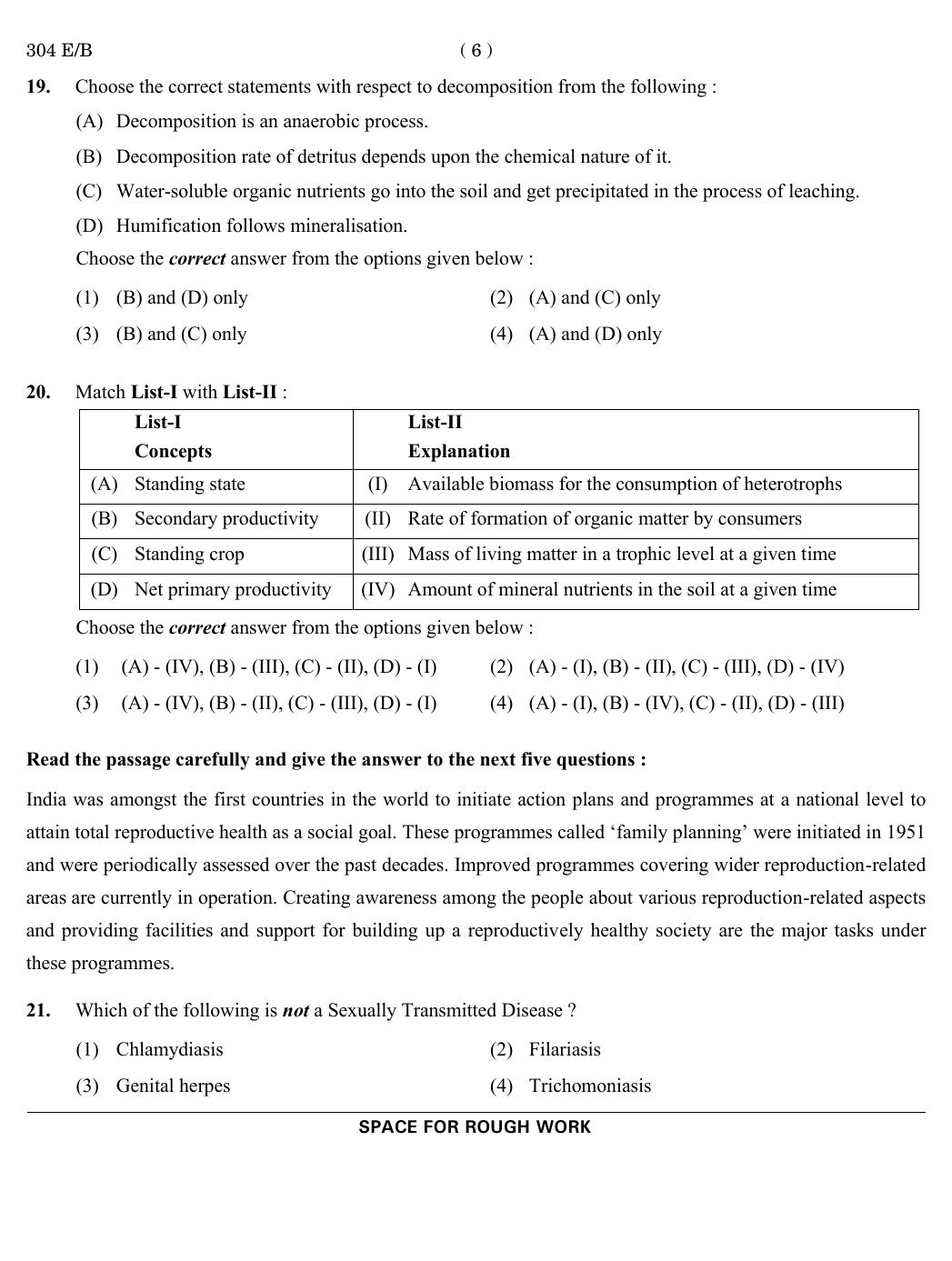
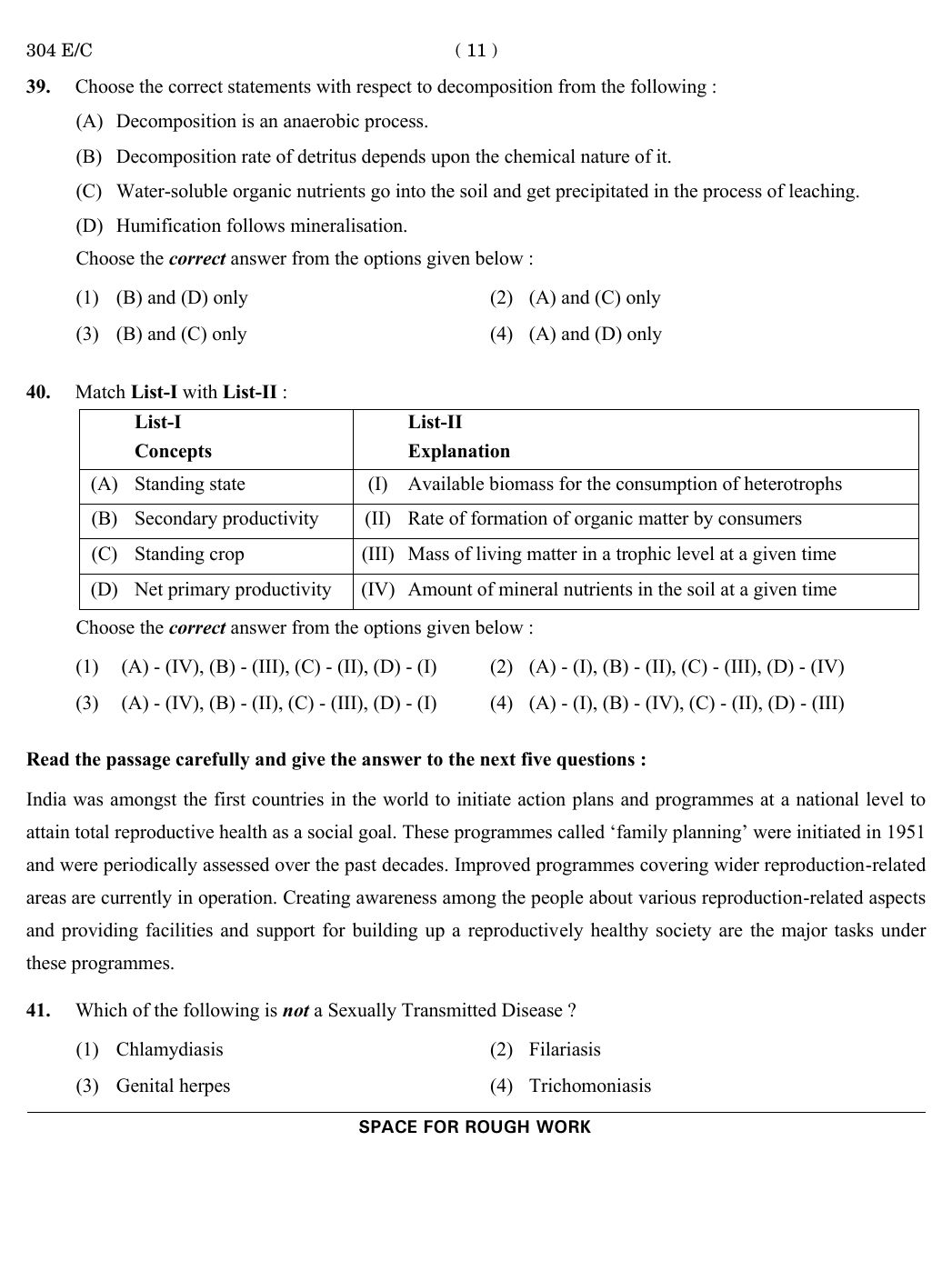
Choose the correct statements with respect to decomposition from the following:
(A) Decomposition is an anaerobic process.
(B) Decomposition rate of detritus depends upon the chemical nature of it.
(C) Water-soluble organic nutrients go into the soil and get precipitated in the process of leaching.
(D) Humification follows mineralisation.
Choose the correct answer from the options given below:
View Solution
Match List-I with List-II:
List-I (Concepts) List-II (Explanation)
(A) Standing state (IV) Amount of mineral nutrients in the soil at a given time
(B) Secondary productivity (II) Rate of formation of organic matter by consumers
(C) Standing crop (III) Mass of living matter in a trophic level at a given time
(D) Net primary productivity (I) Available biomass for the consumption of heterotrophs
Choose the correct answer from the options given below:
View Solution
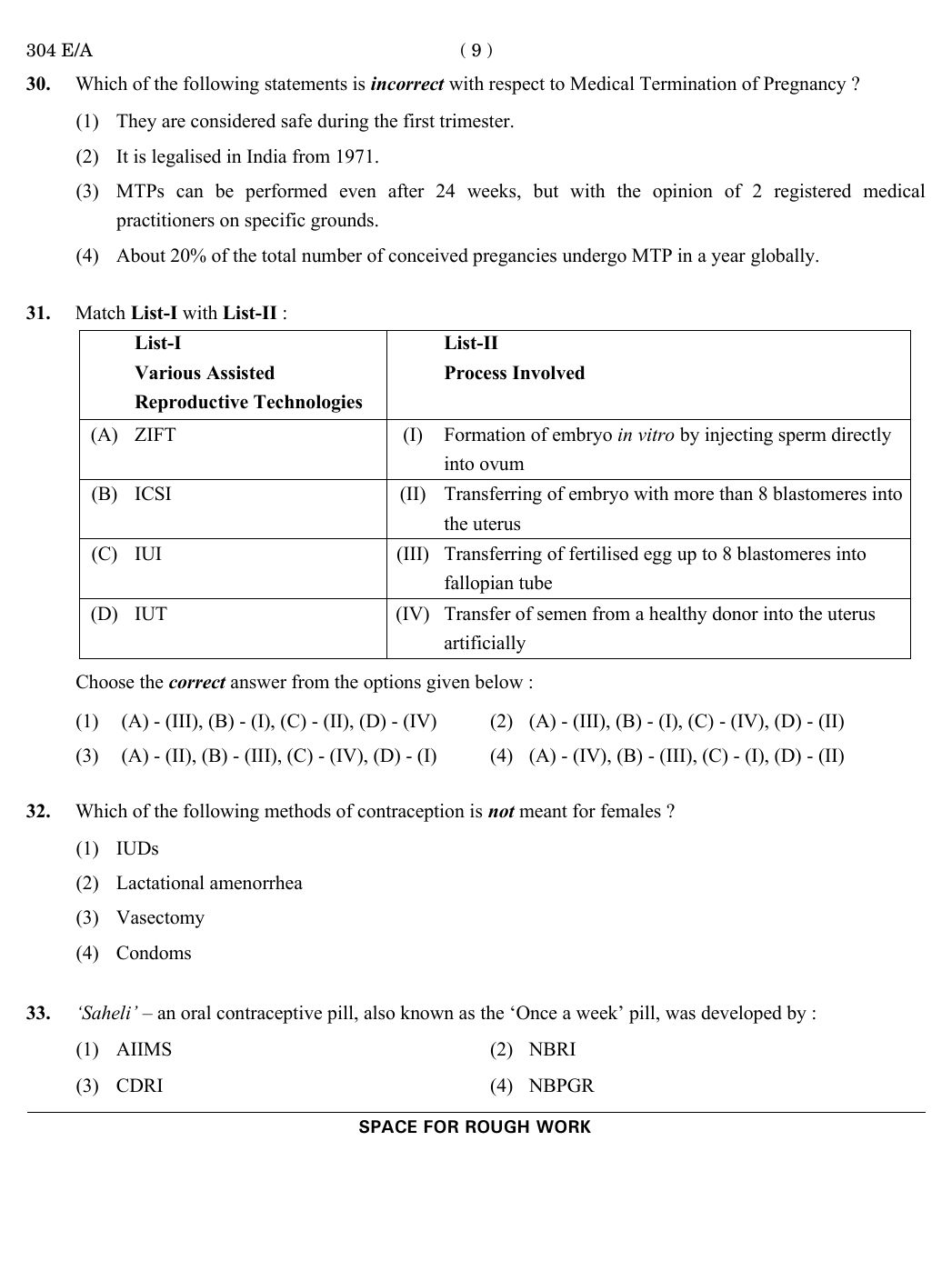
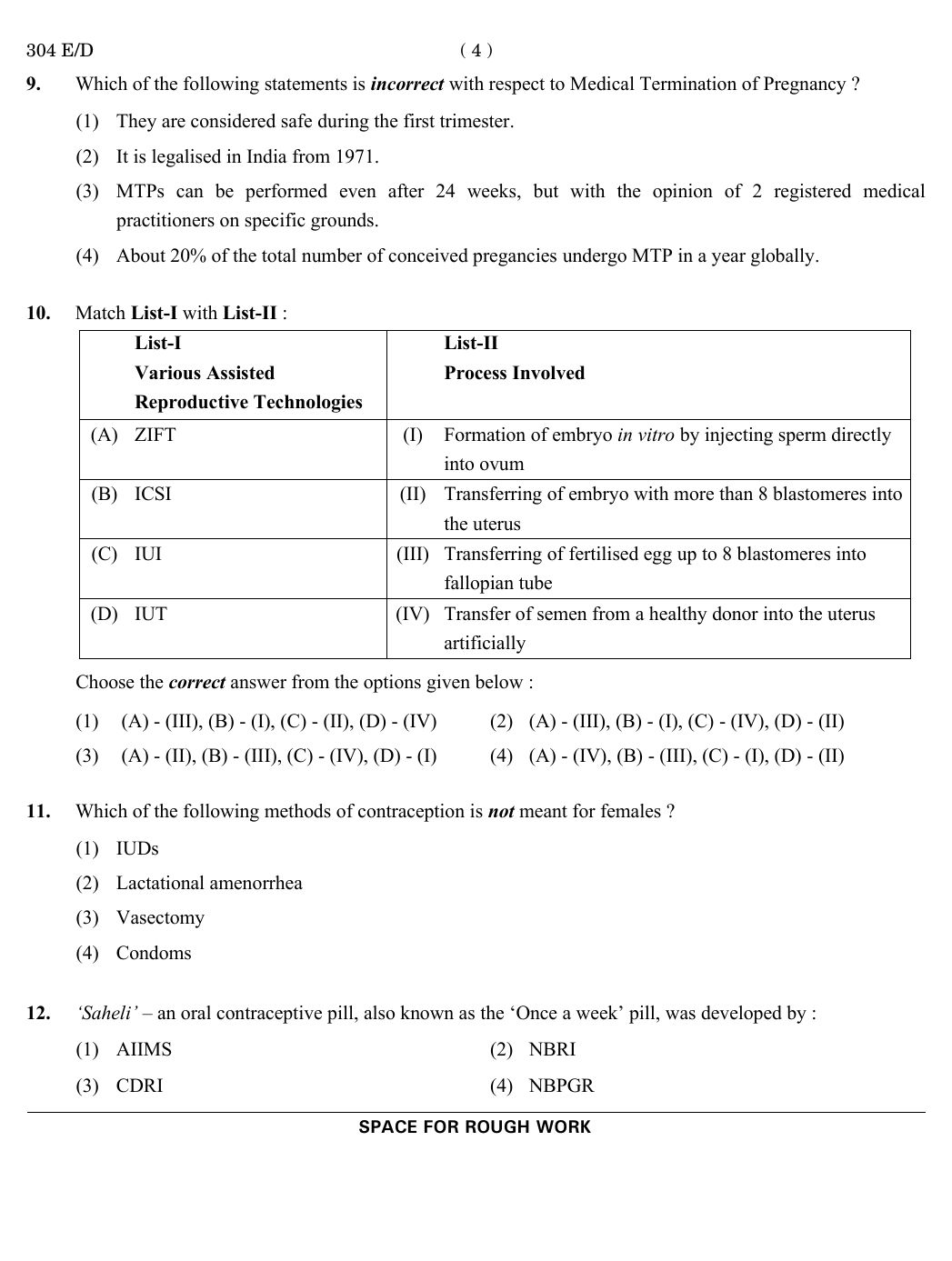
Which of the following is not a Sexually Transmitted Disease?
View Solution
Filariasis is not a sexually transmitted disease. It is caused by parasitic wormsand transmitted by mosquitoes, whereas the other options are sexually transmitted
diseases
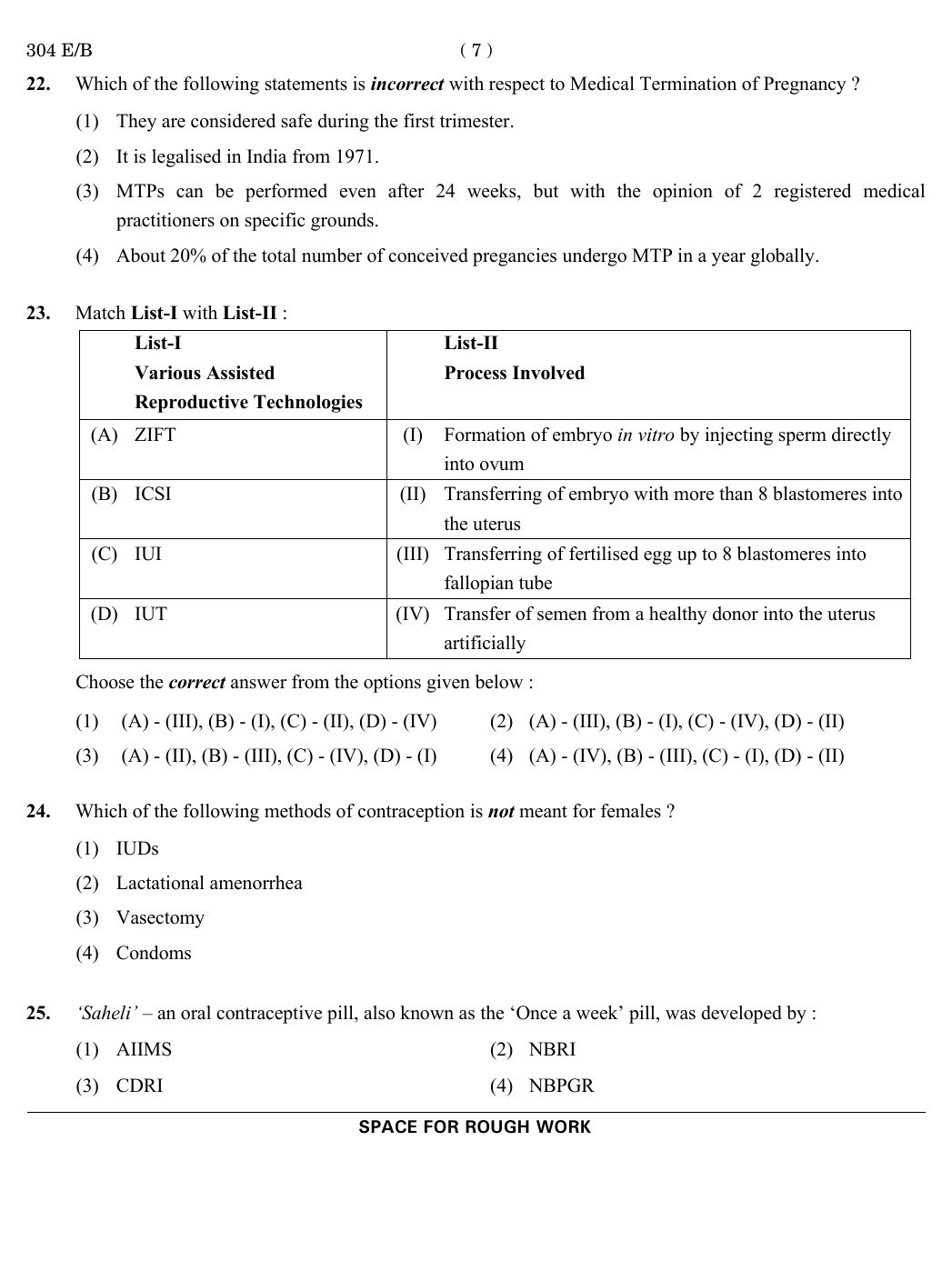
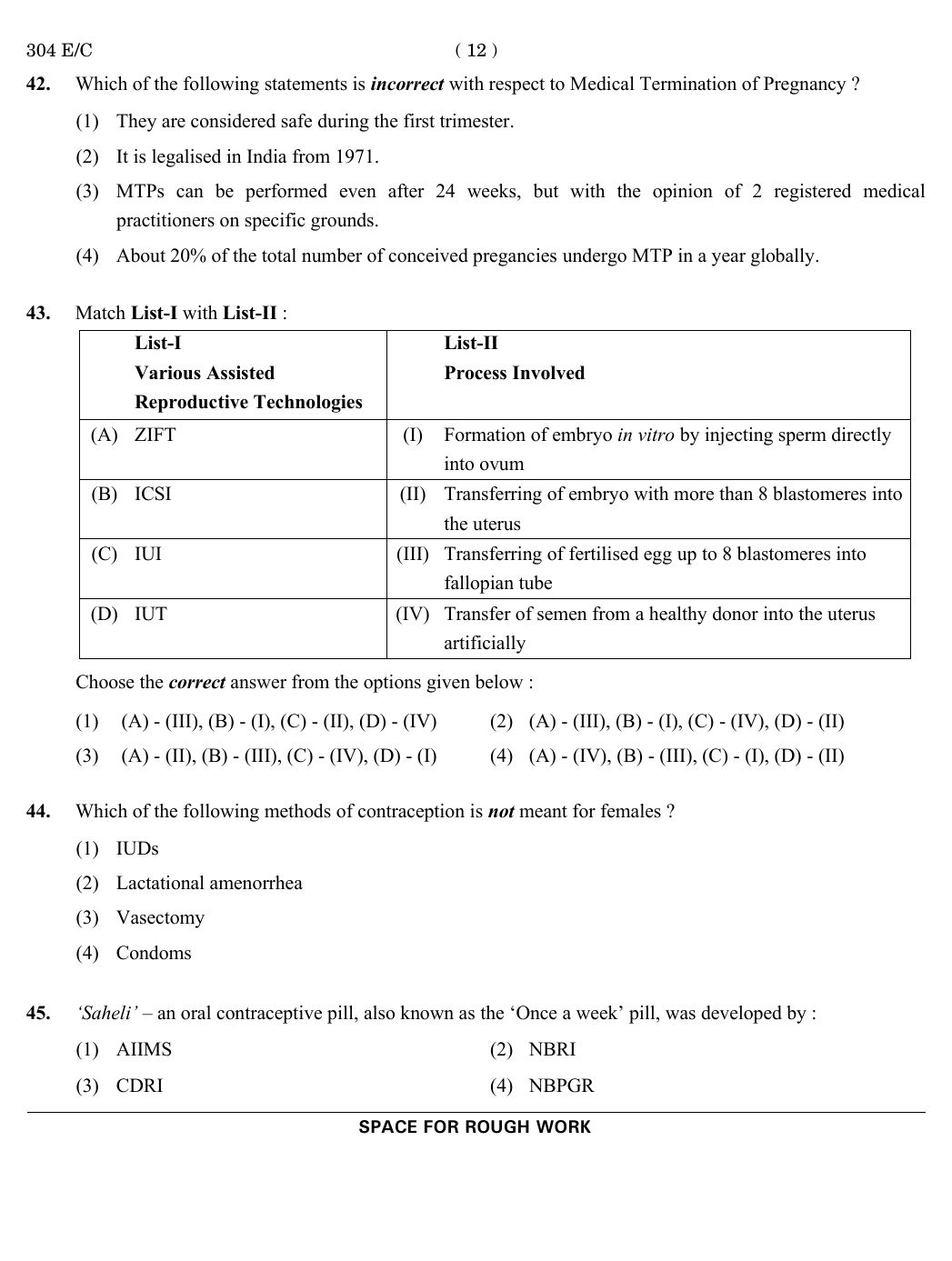
Which of the following statements is incorrect with respect to Medical Termination of Pregnancy (MTP)?
View Solution
The statement ”About 20% of the total number of conceived pregnancies undergo MTP in a year globally” is incorrect. The actual percentage is much lower, with MTP usually being performed in the first trimester.Match List-I with List-II:
List-I (Assisted Reproductive Technologies) List-II (Process Involved)
(A) ZIFT (I) Transfer of semen from a healthy donor
(B) ICSI (II) Transfer of fertilised egg up to 8 blastomeres
(C) IUI (III) Formation of embryo in vitro by injecting sperm
(D) IUT (IV) Transferring of embryo with more than 8 blastomeres
Choose the correct answer from the options given below:
View Solution
(A) ZIFT involves transferring fertilized egg (up to 8 blastomeres) into the fallopian tube. (B) ICSI involves injecting sperm directly into the ovum in vitro. (C) IUI refers to the artificial insemination of sperm into the uterus. (D) IUT involves transferring embryos with more than 8 blastomeres into the uterusWhich of the following methods of contraception is not meant for females?
View Solution
Vasectomy is a method of male sterilization that involves cutting the vas deferens. All other options refer to contraception methods used by or for females.‘Saheli’ — an oral contraceptive pill, also known as the ‘Once a week’ pill, was developed by:
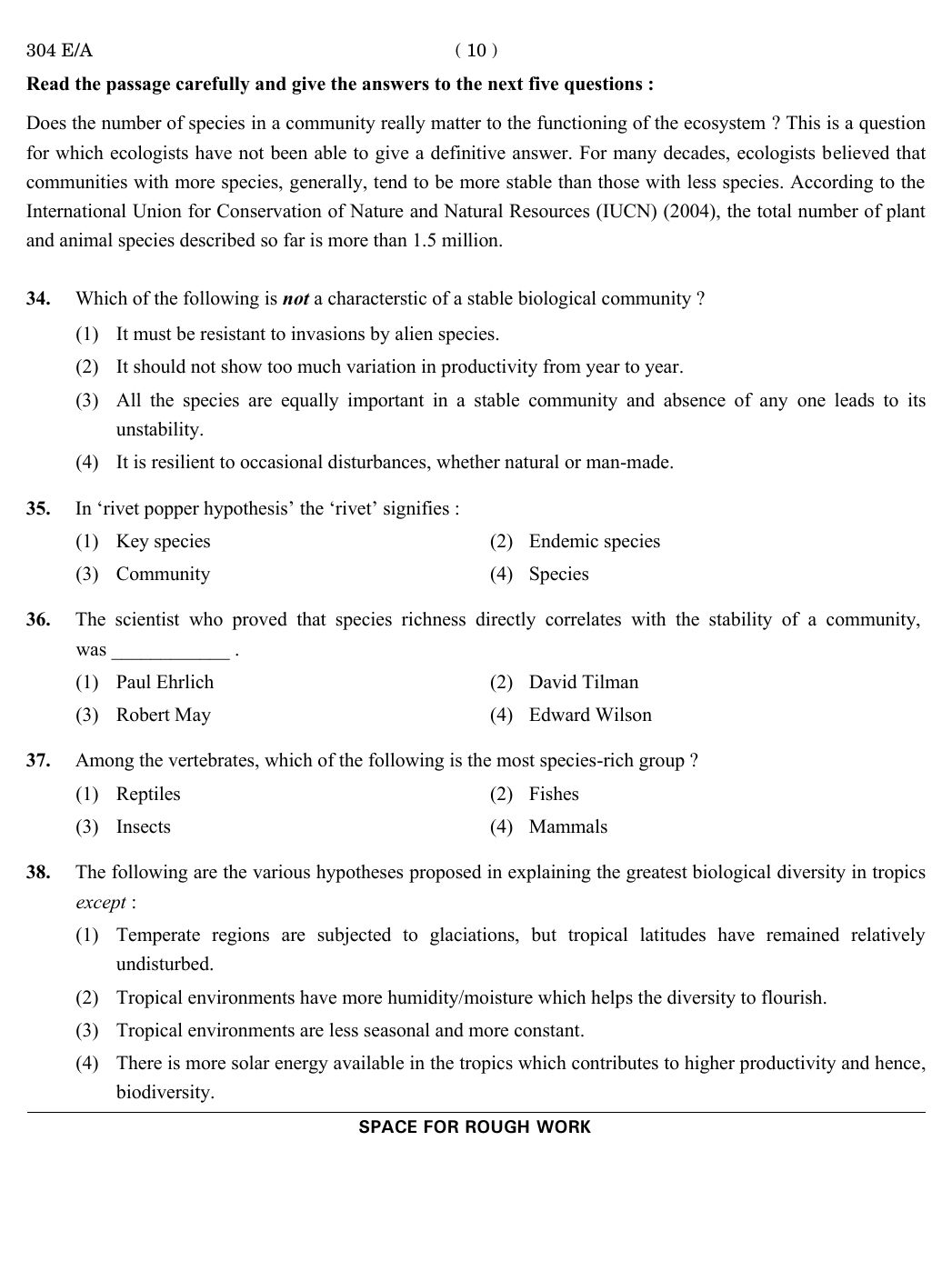
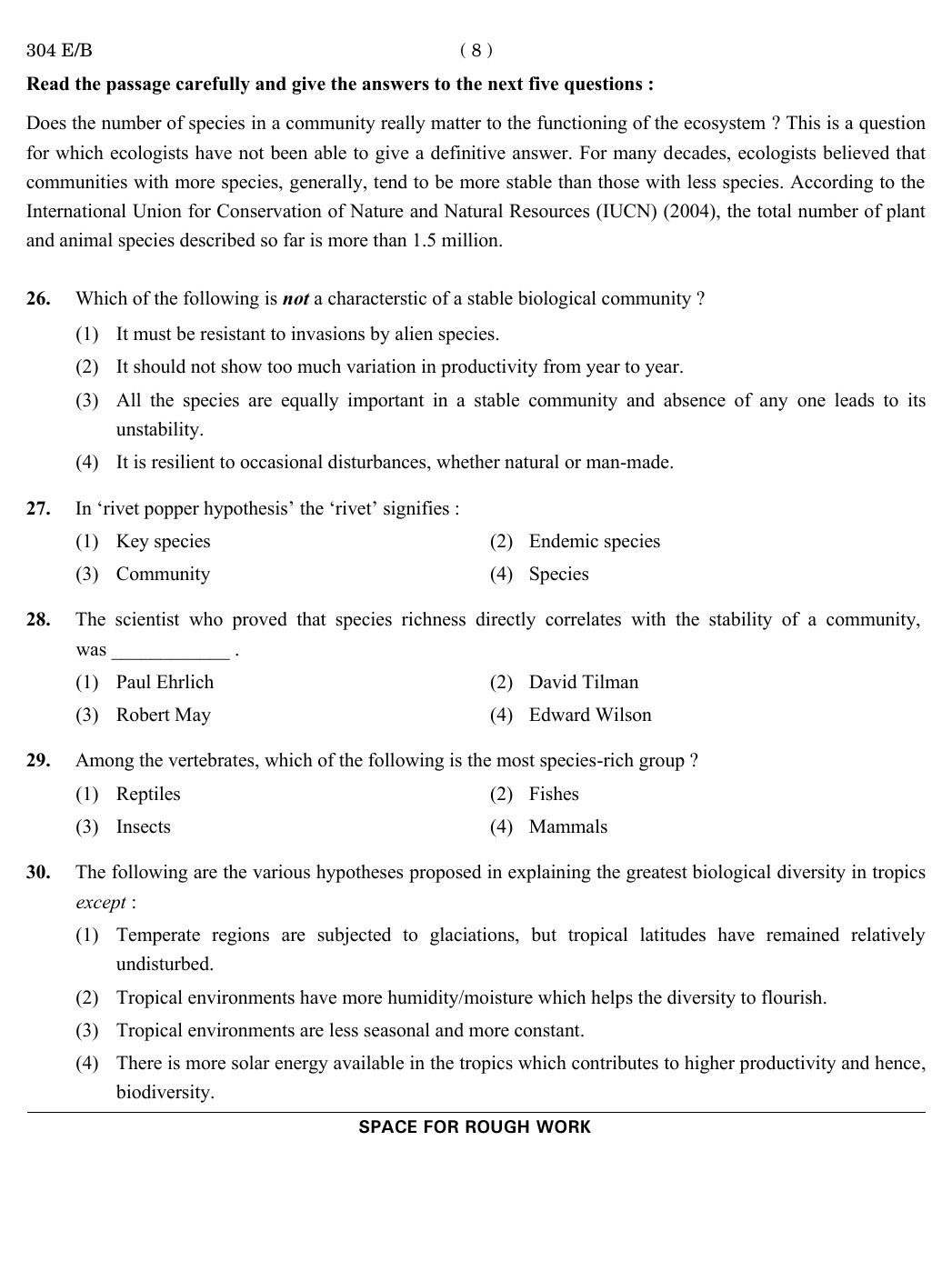
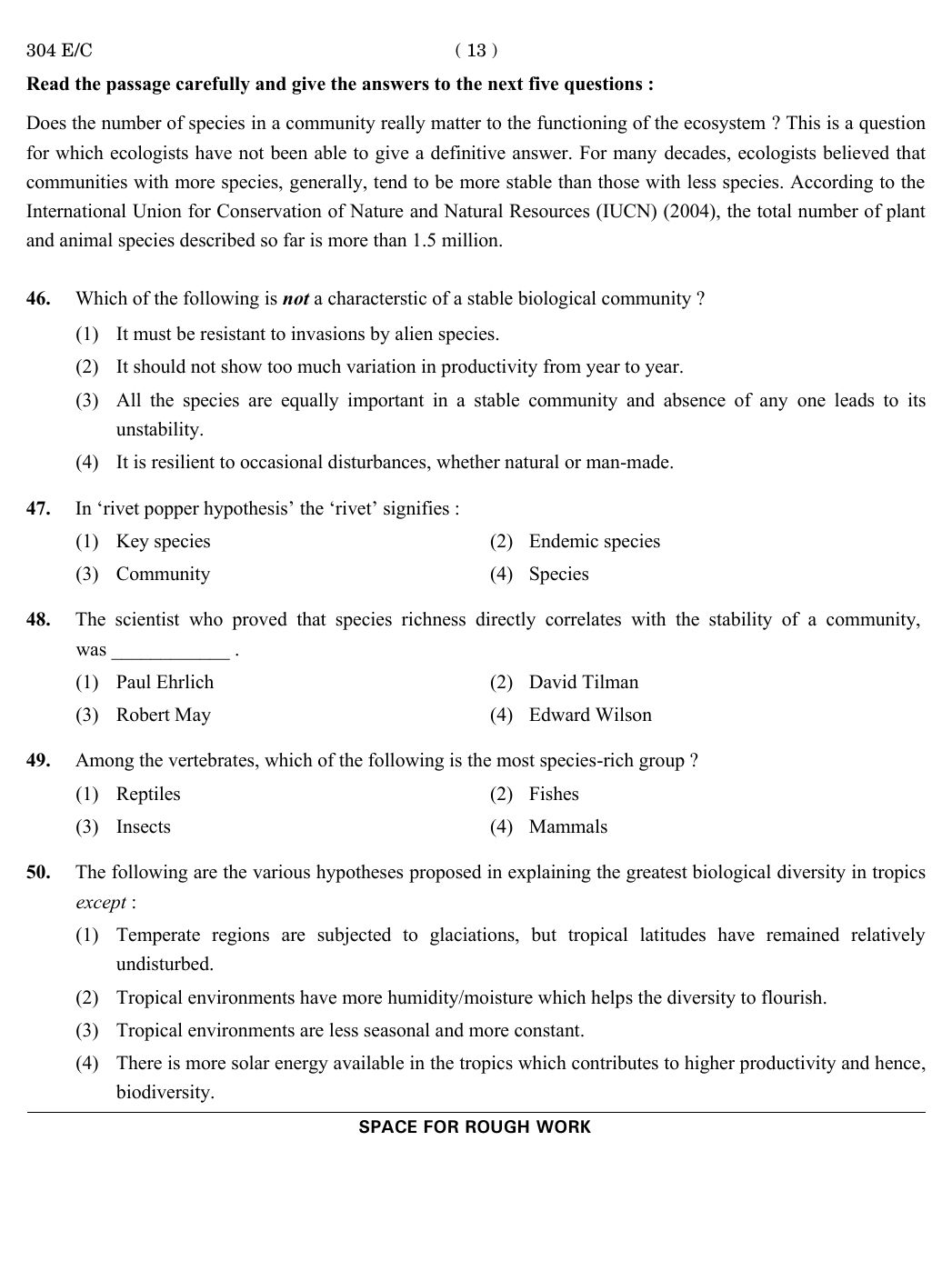
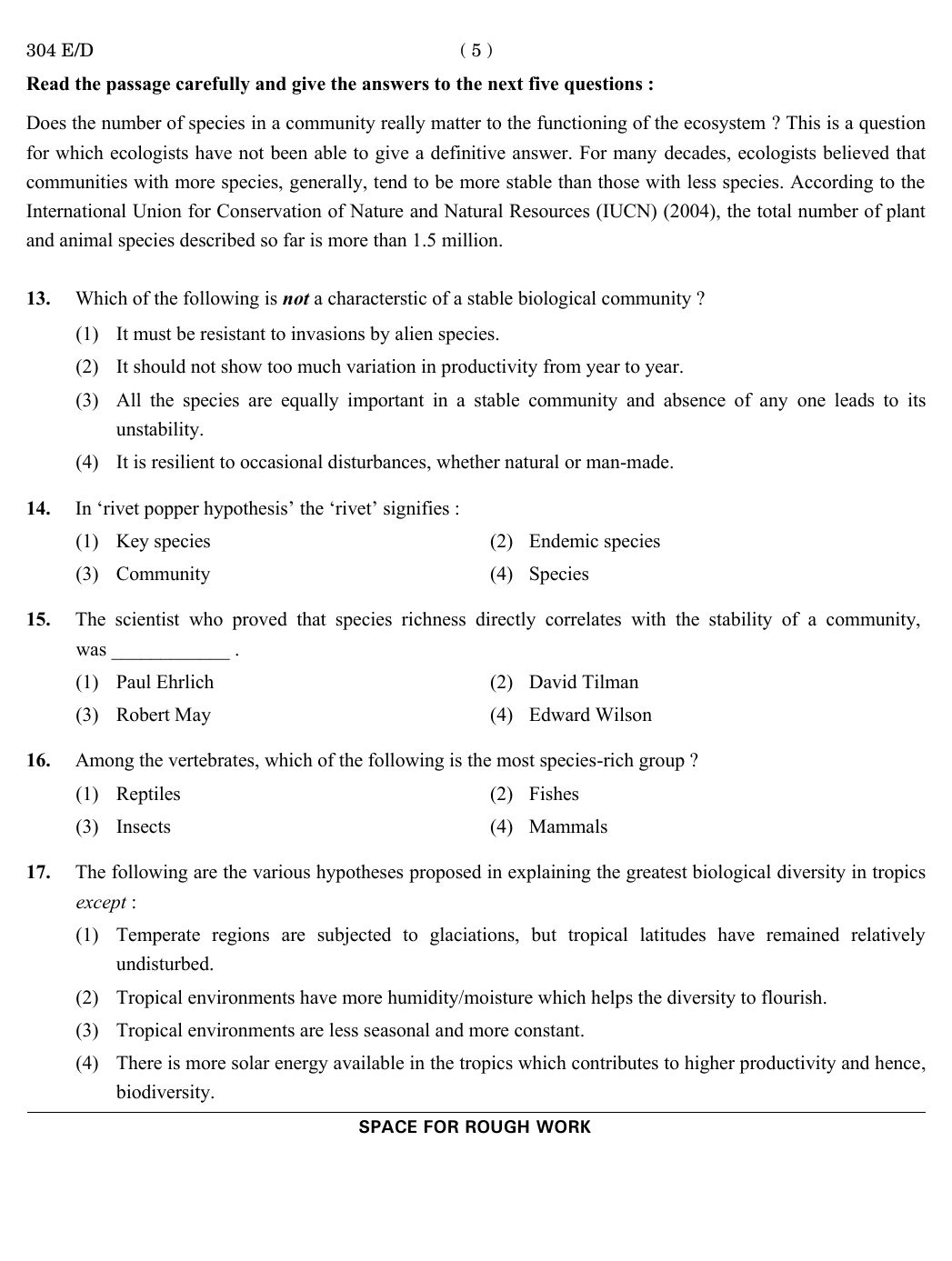
Which of the following is not a characteristic of a stable biological community?
View Solution
In the 'rivet popper hypothesis' the 'rivet' signifies:
View Solution
The scientist who proved that species richness directly correlates with the stability of a community was:
View Solution
Among the vertebrates, which of the following is the most species-rich group?
View Solution
The following are the various hypotheses proposed in explaining the greatest biological diversity in tropics except:
View Solution
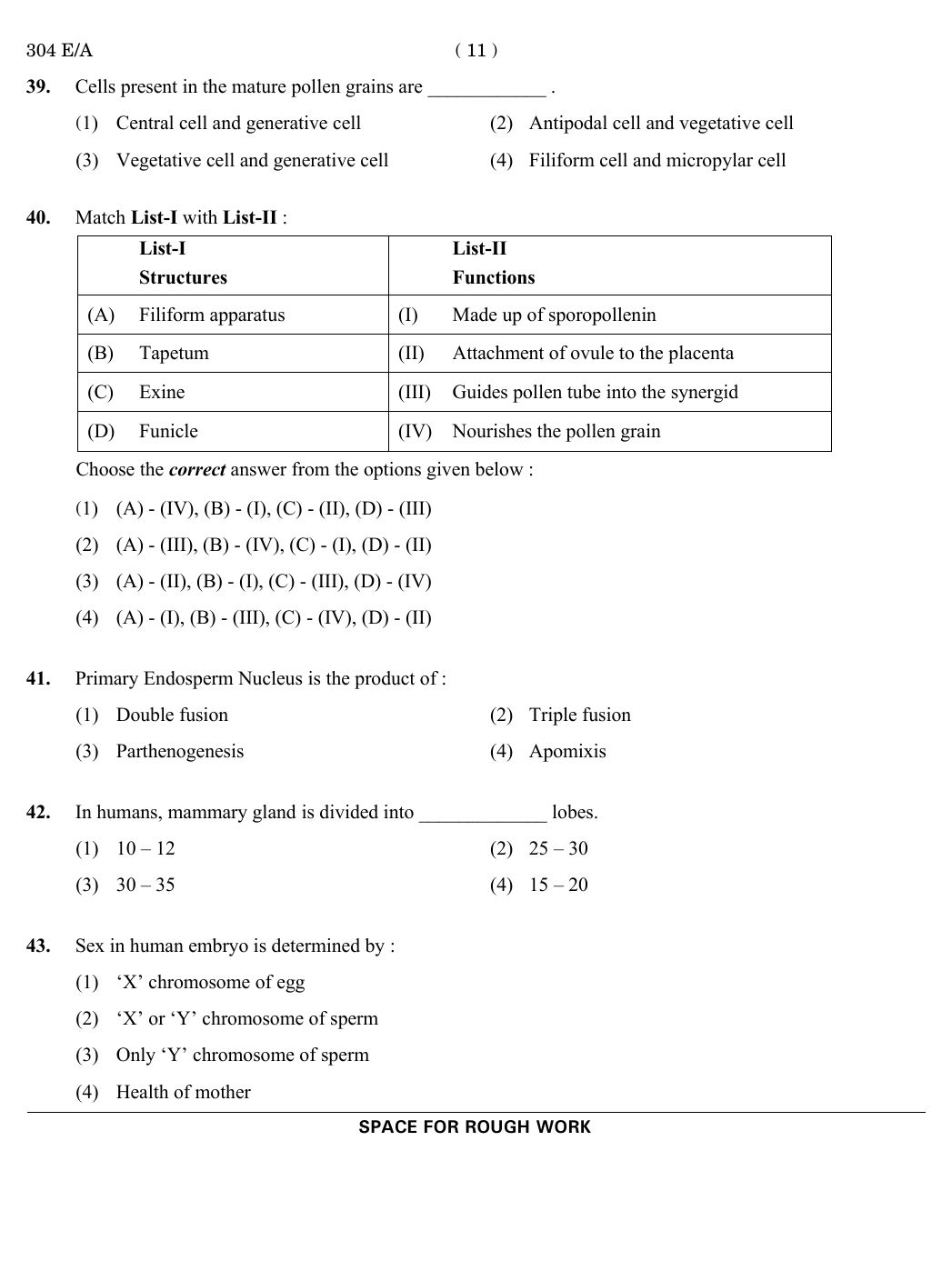
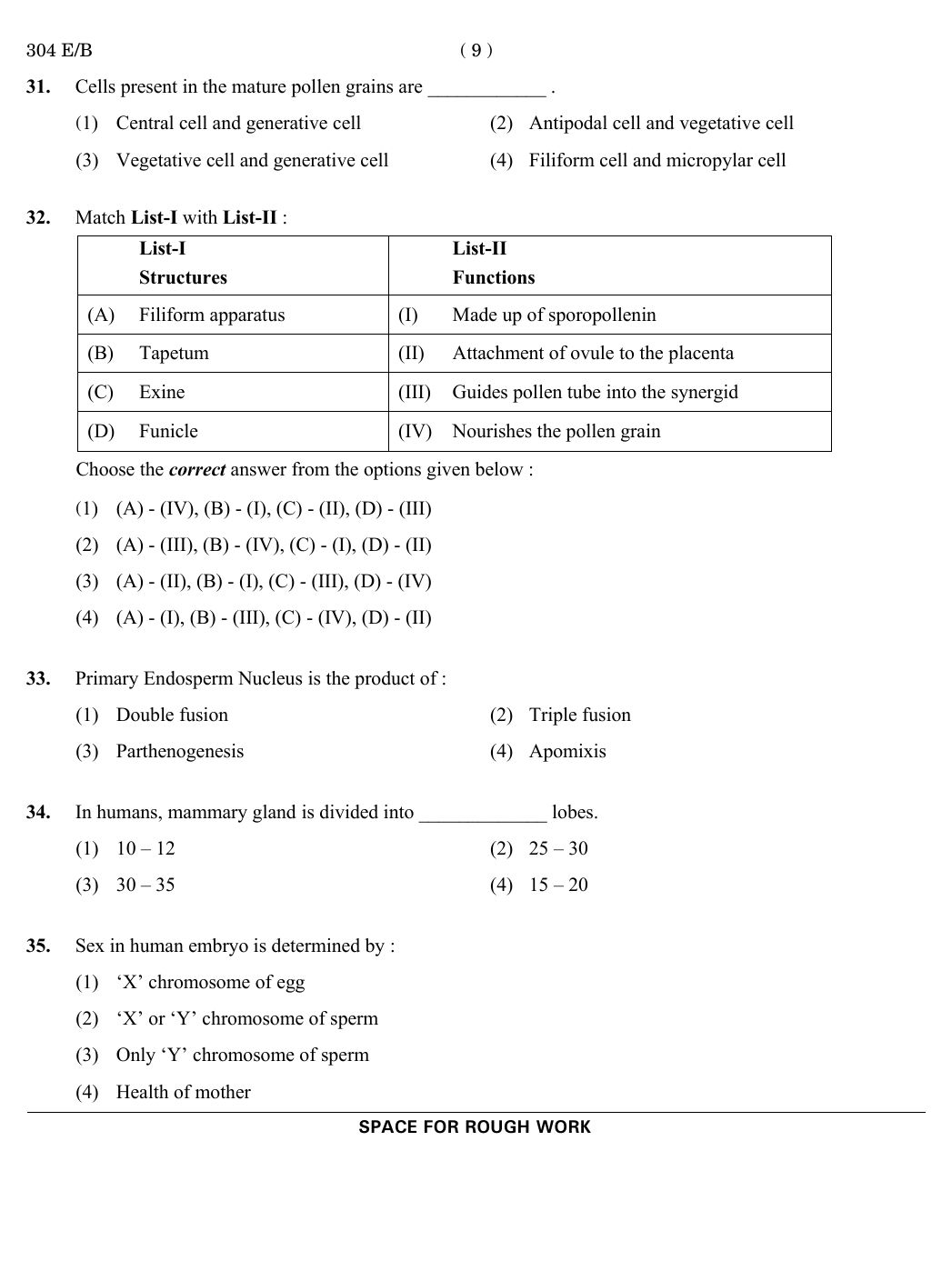
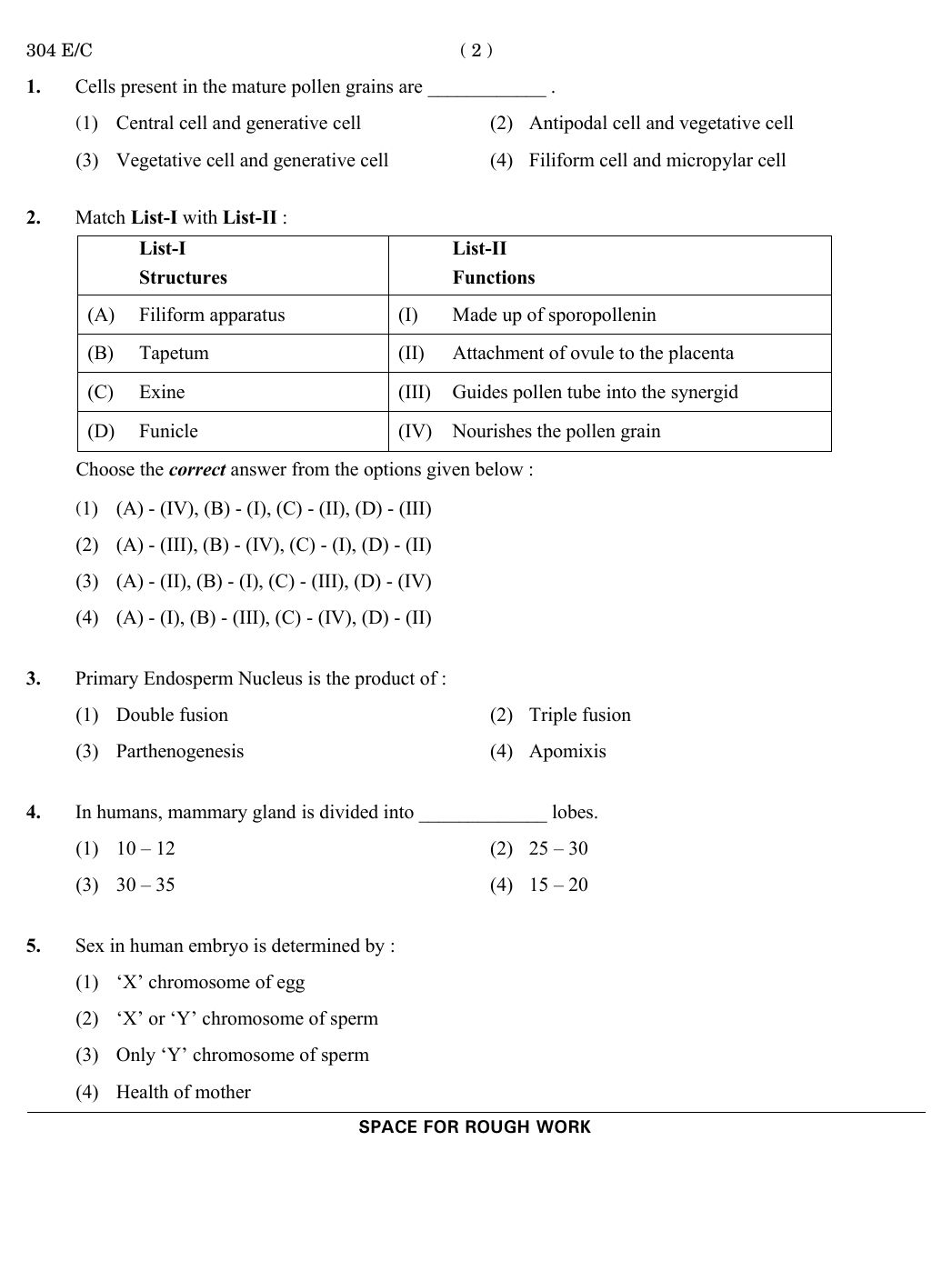
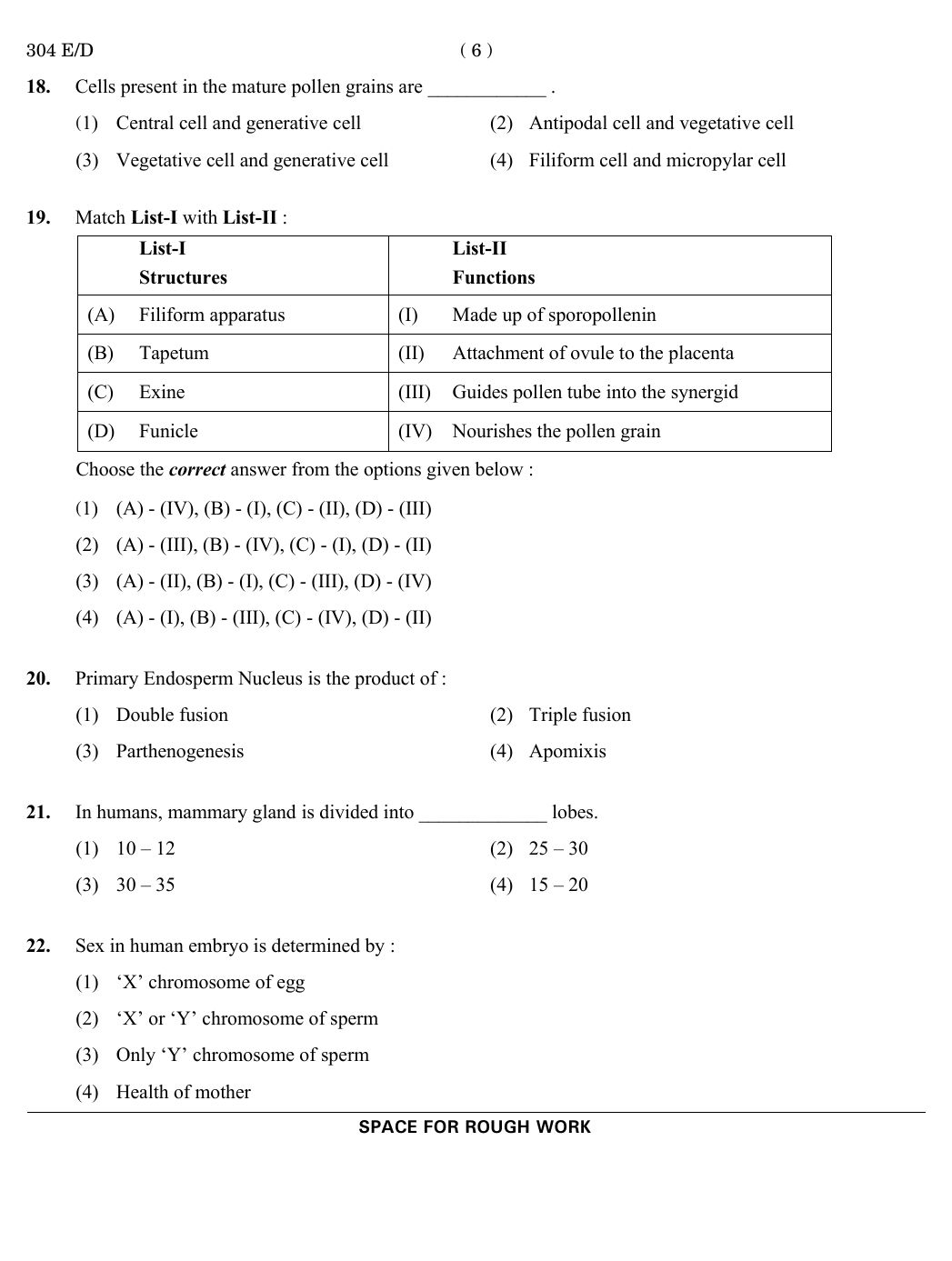
Cells present in the mature pollen grains are:
View Solution
Match List-I with List-II:
List-I (Structures) List-II (Functions)
(A) Filiform apparatus (I) Made up of sporopollenin
(B) Tapetum (II) Attachment of ovule to the placenta
(C) Exine (III) Guides pollen tube into the synergid
(D) Funicle (IV) Nourishes the pollen grain
Choose the correct answer from the options given below:
View Solution
Primary Endosperm Nucleus is the product of:
View Solution
In humans, the mammary gland is divided into lobes:
View Solution
Sex in a human embryo is determined by:
View Solution
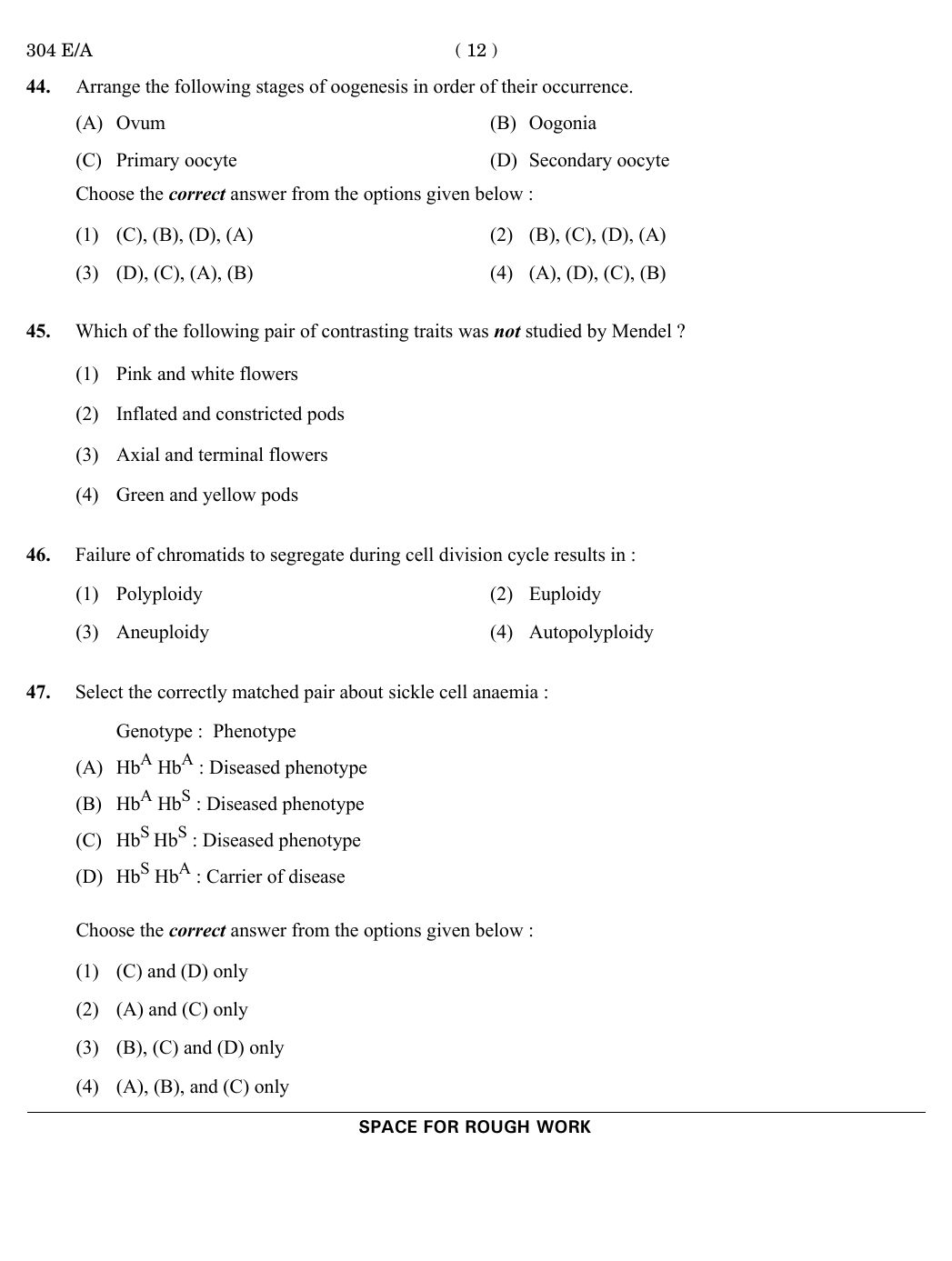
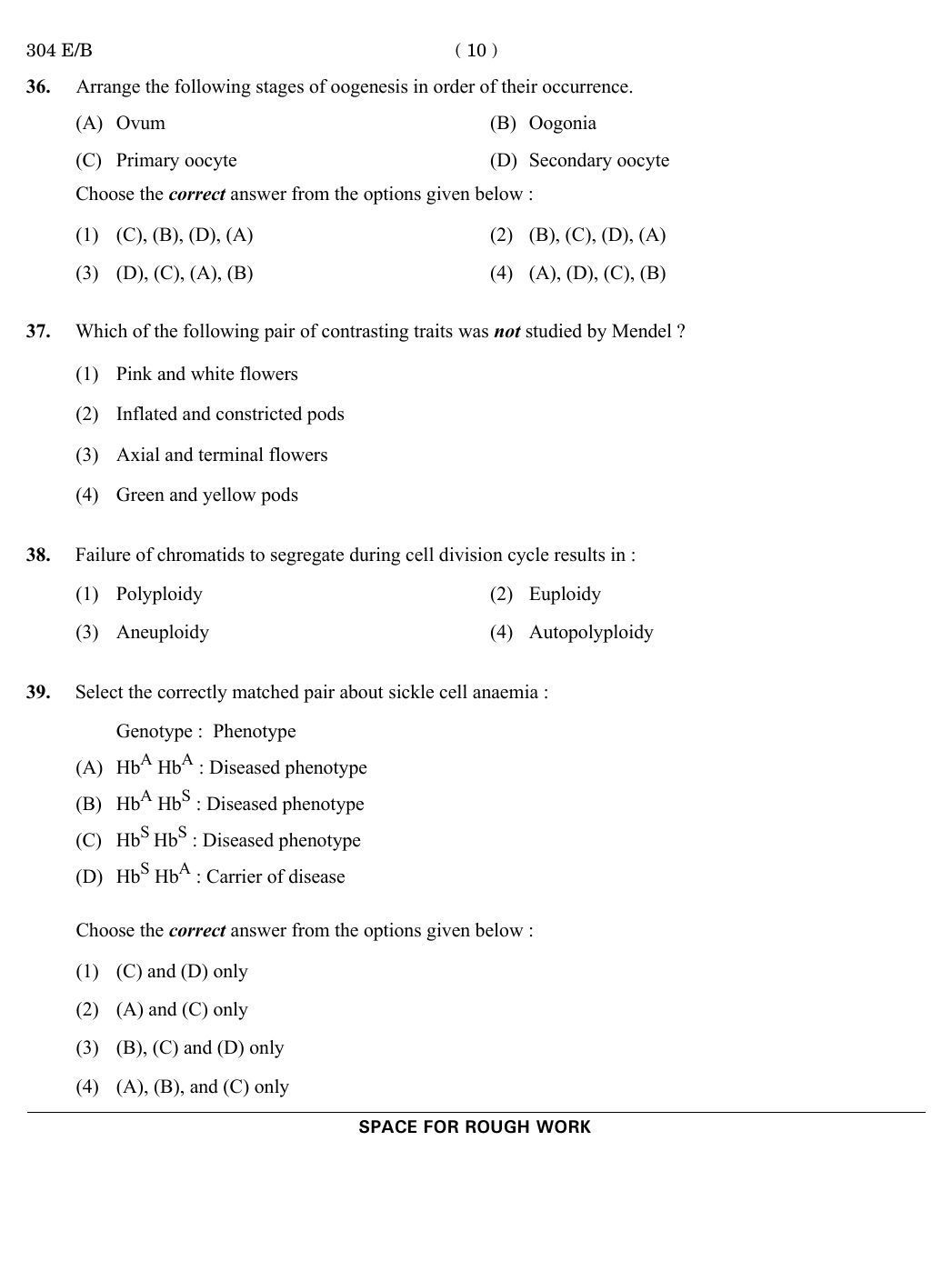
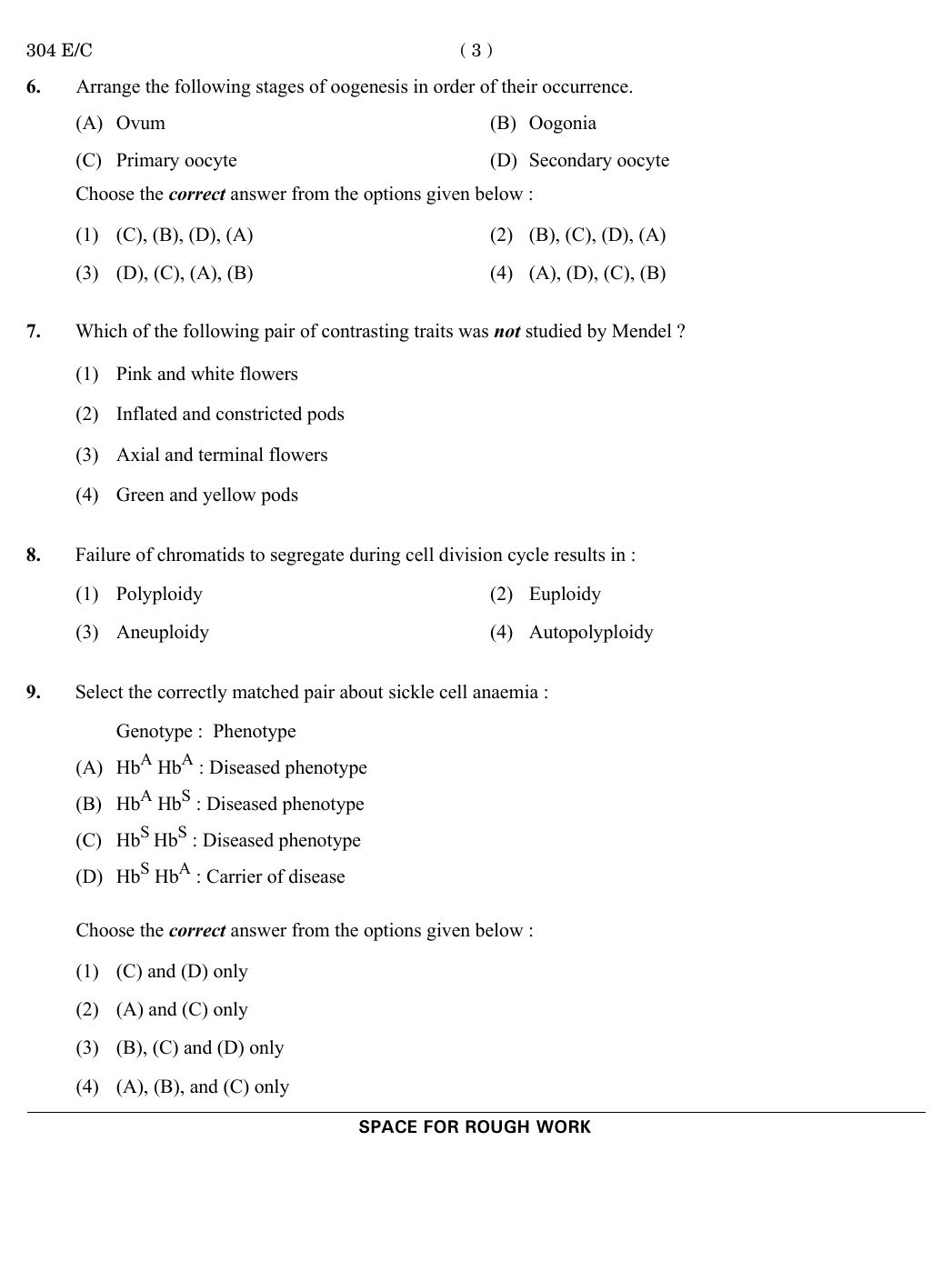
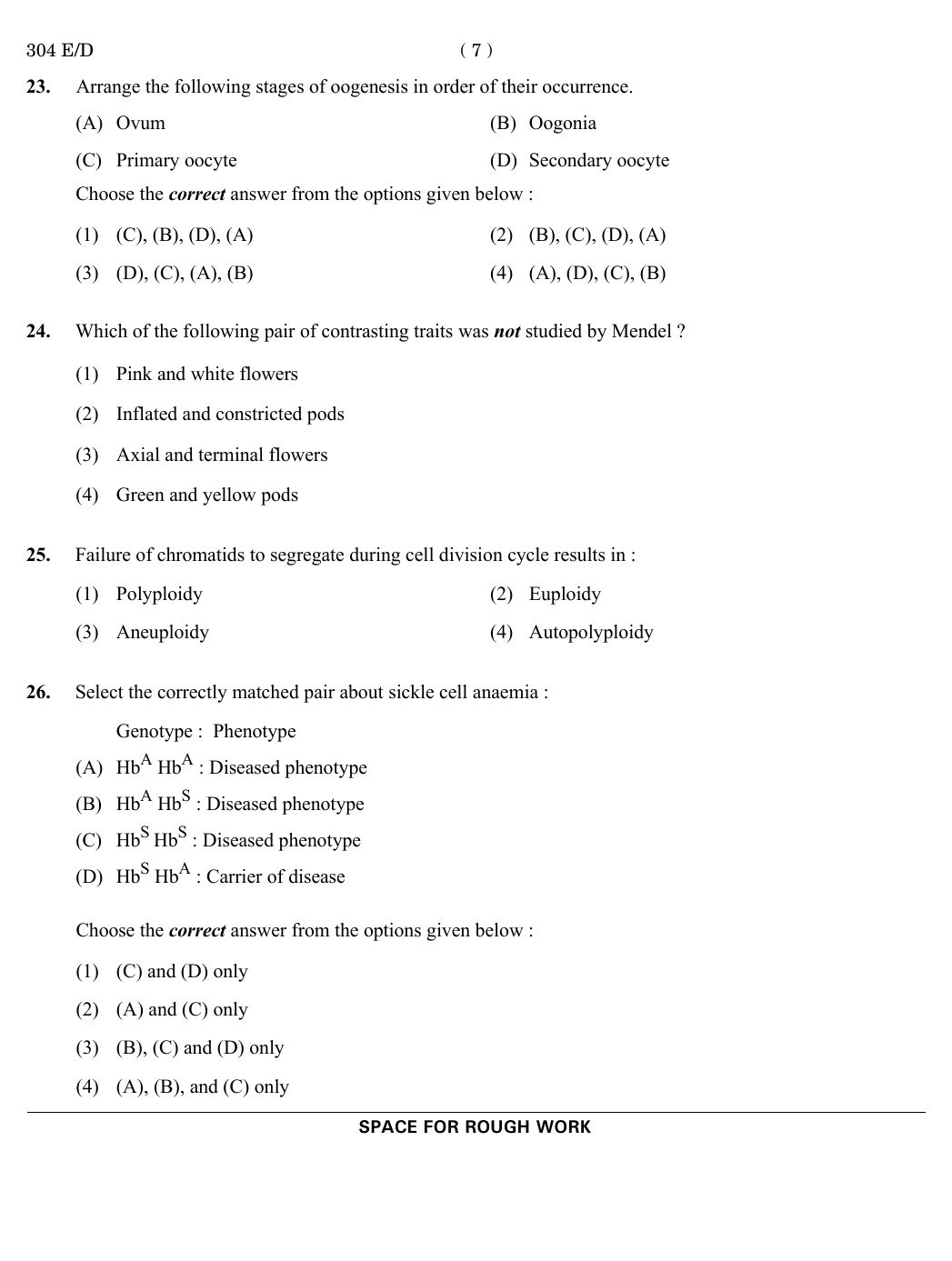
Arrange the following stages of oogenesis in order of their occurrence:
(A) Ovum
(B) Oogonia
(C) Primary oocyte
(D) Secondary oocyte
Choose the correct answer from the options given below:
View Solution
Which of the following pairs of contrasting traits was not studied by Mendel?
View Solution
Failure of chromatids to segregate during the cell division cycle results in:
View Solution
Select the correctly matched pair about sickle cell anemia:
Genotype: Phenotype
(A) HbA HbA : Diseased phenotype
(B) HbA HbS : Diseased phenotype
(C) HbS HbS : Diseased phenotype
(D) HbS HbA : Carrier of disease
Choose the correct answer from the options given below:
View Solution
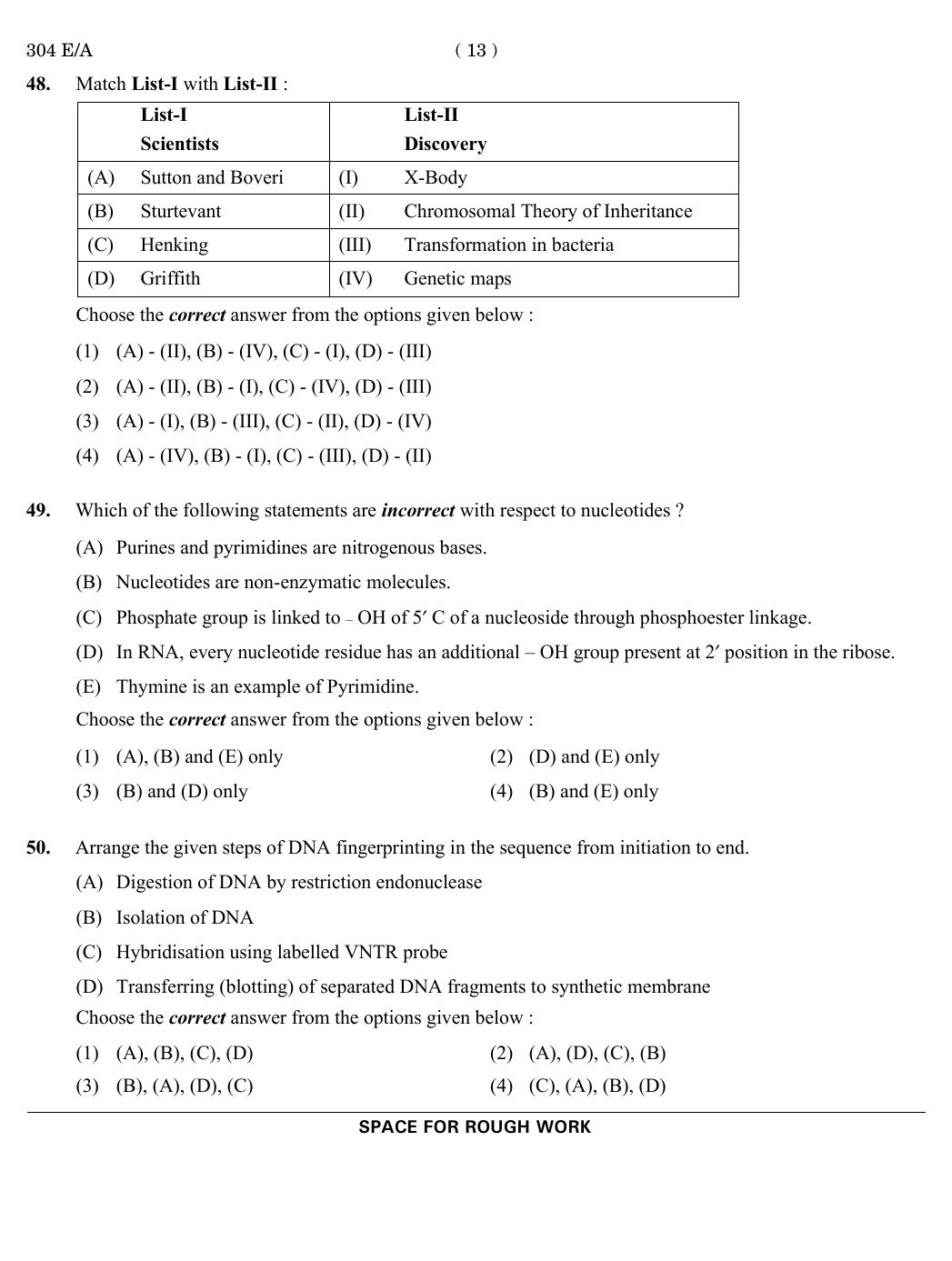
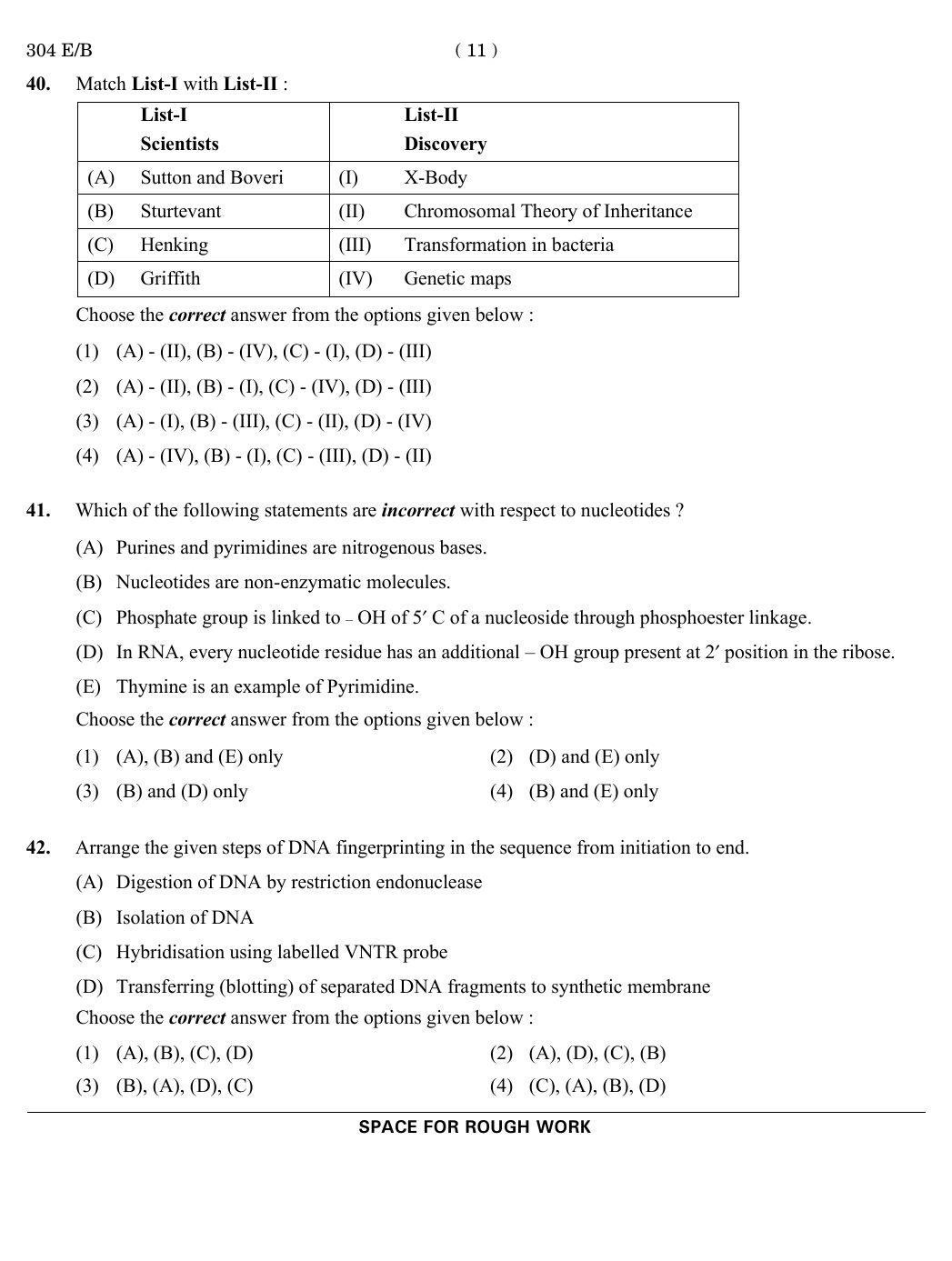
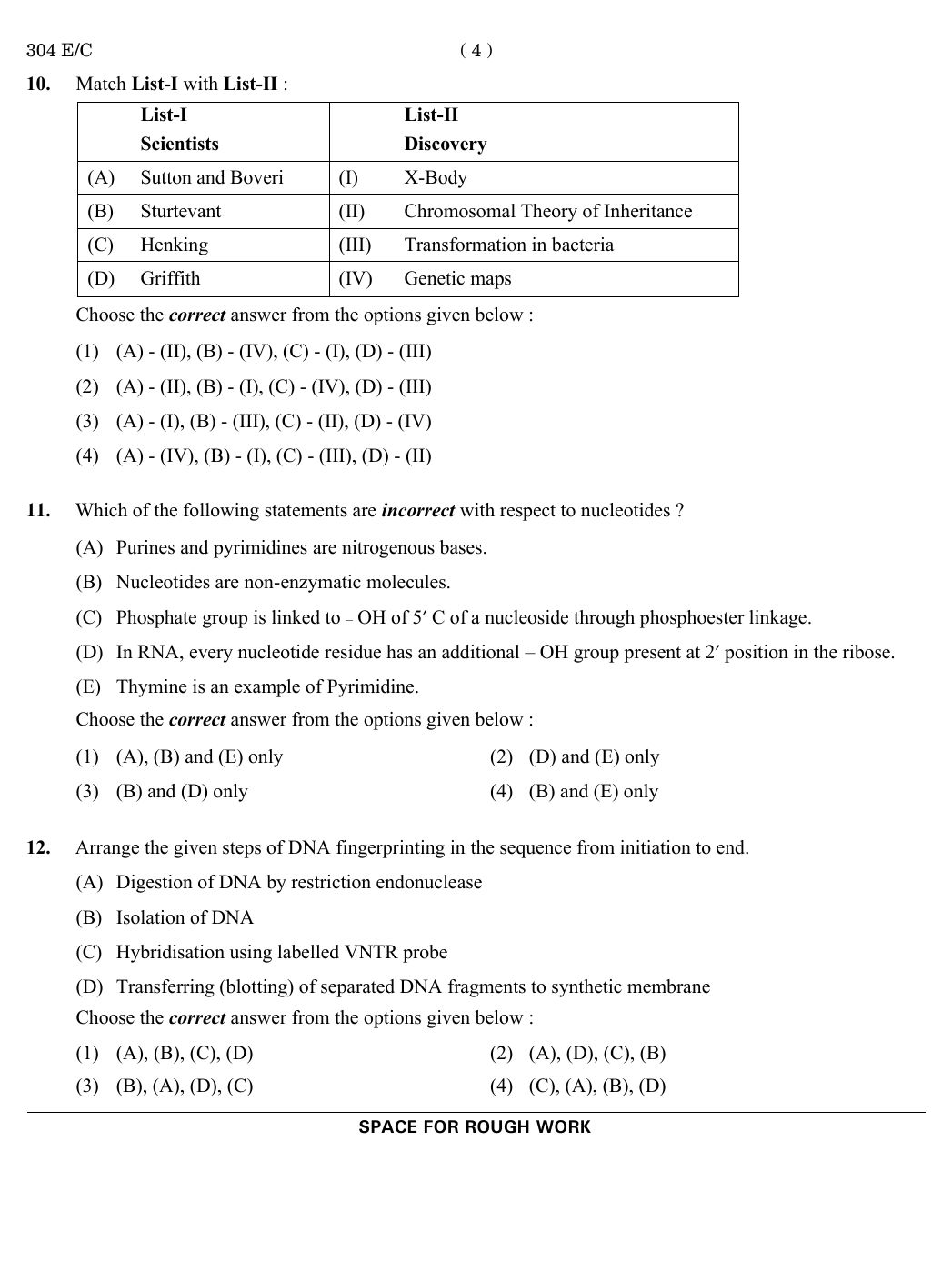
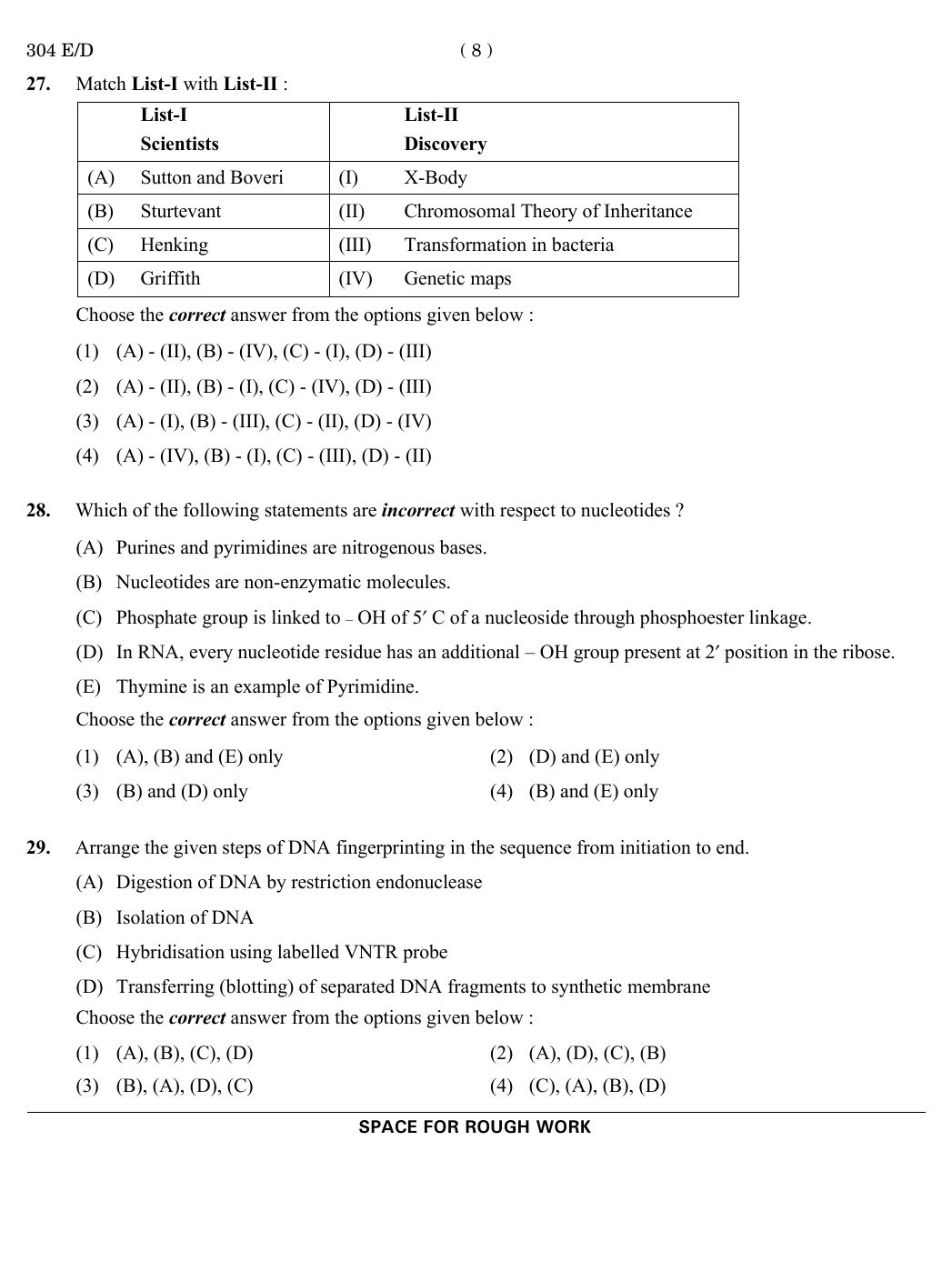
Match List-I with List-II:
List-I (Scientists) List-II (Discovery)
(A) Sutton and Boveri (II) Chromosomal Theory of Inheritance
(B) Sturtevant (IV) Genetic maps
(C) Henking (I) X-Body
(D) Griffith (III) Transformation in bacteria
Choose the correct answer from the options given below:
View Solution
Which of the following statements are incorrect with respect to nucleotides?
(A) Purines and pyrimidines are nitrogenous bases.
(B) Nucleotides are non-enzymatic molecules.
(C) Phosphate group is linked to – OH of 5′ C of a nucleoside through phosphoester linkage.
(D) In RNA, every nucleotide residue has an additional – OH group present at 2′ position in the ribose.
(E) Thymine is an example of Pyrimidine.
Choose the correct answer from the options given below:
View Solution
Arrange the given steps of DNA fingerprinting in the sequence from initiation to end:
(A) Digestion of DNA by restriction endonuclease
(B) Isolation of DNA
(C) Hybridisation using labelled VNTR probe
(D) Transferring (blotting) of separated DNA fragments to synthetic membrane
Choose the correct answer from the options given below:
View Solution
CUET 2024 Biology Set B Questions with Solutions
The beetle used as a biocontrol agent for aphids and mosquitoes is:
View Solution
Downstream processing method involves:
View Solution
Smack is chemically:
View Solution
Antibiotics are secreted by:
View Solution
In sewage treatment, flocs are:
View Solution
Match List-I with List-II:
List-I List-II
(A) Statin (I) Streptococcus
(B) Clot buster (II) Trichoderma
(C) Swiss cheese (III) Monascus
(D) Cyclosporin-A (IV) Propionibacterium
Choose the correct answer from the options given below:
View Solution
Which of the following is not the correctly matched pair of organism and its respective cell wall-degrading enzyme?
View Solution
Arrange the following steps involved in the transformation of bacteria in a sequence from initiation to end:
(A) Incubation of rDNA with bacterial cells on ice
(B) Treatment with divalent cations
(C) Heat shock treatment
(D) Selection on antibiotic-containing agar plate
(E) Placed back on ice
Choose the correct answer from the options given below:
View Solution
Match List-I with List-II:
List-I List-II
Transgene Used for/Products
(A) α-1-antitrypsin (I) Meloidegyne incognitia
(B) cryIAc (II) Corn borer
(C) Antisense RNA (III) Treat emphysema
(D) cryIAb (IV) Cotton bollworms
Choose the correct answer from the options given below:
View Solution
Expand "GEAC":
View Solution
When an insect feeds on the Bt plant, the insect dies due to the conversion of inactive protein to active protein in:
View Solution
Match List-I with List-II:
List-I List-II
Interspecies Relationships Features
(A) Commensalism (I) One species is benefitted at the expense of the other
(B) Mutualism (II) One species is harmed and the other is unaffected
(C) Amensalism (III) Both the species are benefitted
(D) Parasitism (IV) One species benefits and other remains unaffected
Choose the correct answer from the options given below:
View Solution
In a country, at any time, the population has the same number of young and mature ones. What type of growth does it reflect?
View Solution
Two closely related species can co-exist indefinitely and violate the Gause’s ‘Competitive Exclusion Principle’ by:
View Solution
The process of mineralisation by microorganisms helps in the release of:
View Solution
In which ecosystem is the biomass of primary consumers greater than producers?
View Solution
Choose the correct statements with respect to decomposition from the following:
(A) Decomposition is an anaerobic process.
(B) Decomposition rate of detritus depends upon the chemical nature of it.
(C) Water-soluble organic nutrients go into the soil and get precipitated in the process of leaching.
(D) Humification follows mineralisation.
View Solution
Match List-I with List-II:
List-I List-II
(A) Standing state (IV) Amount of mineral nutrients in the soil at a given time
(B) Secondary productivity (II) Rate of formation of organic matter by consumers
(C) Standing crop (III) Mass of living matter in a trophic level at a given time
(D) Net primary productivity (I) Available biomass for the consumption of heterotrophs
Choose the correct answer from the options given below:
View Solution
Which of the following is not a Sexually Transmitted Disease?
View Solution
Which of the following statements is incorrect with respect to Medical Termination of Pregnancy?
View Solution
The statement ”About 20% of the total number of conceived pregnancies undergo MTP in a year globally” is incorrect. The actual percentage is much lower, with MTP usually being performed in the first trimester.Match List-I with List-II:
List-I List-II
(A) ZIFT (I) Transfer of semen from a healthy donor
(B) ICSI (II) Transfer of fertilised egg up to 8 blastomeres
(C) IUI (III) Formation of embryo in vitro by injecting sperm
(D) IUT (IV) Transferring of embryo with more than 8 blastomeres
Choose the correct answer from the options given below:
View Solution
(A) ZIFT involves transferring fertilized egg (up to 8 blastomeres) into the fallopian tube. (B) ICSI involves injecting sperm directly into the ovum in vitro. (C) IUI refers to the artificial insemination of sperm into the uterus. (D) IUT involves transferring embryos with more than 8 blastomeres into the uterusWhich of the following methods of contraception is not meant for females?
View Solution
Vasectomy is a method of male sterilization that involves cutting the vas deferens. All other options refer to contraception methods used by or for females.'Saheli' – an oral contraceptive pill, also known as the 'Once a week' pill, was developed by:
Which of the following is not a characteristic of a stable biological community?
In the 'rivet popper hypothesis', the 'rivet' signifies:
View Solution
The scientist who proved that species richness directly correlates with the stability of a community was:
View Solution
Among vertebrates, which of the following is the most species-rich group?
View Solution
The following are the hypotheses explaining the greatest biological diversity in tropics, except:
View Solution
Cells present in the mature pollen grains are:
View Solution
Match List-I with List-II:
List-I List-II
(A) Filiform apparatus (I) Made up of sporopollenin
(B) Tapetum (II) Attachment of ovule to the placenta
(C) Exine (III) Guides pollen tube into the synergid
(D) Funicle (IV) Nourishes the pollen grain
Choose the correct answer from the options given below:
View Solution
Primary Endosperm Nucleus is the product of:
View Solution
In humans, mammary glands are divided into lobes:
View Solution
Sex in a human embryo is determined by:
View Solution
Arrange the following stages of oogenesis in order of their occurrence:
(A) Ovum
(B) Oogonia
(C) Primary oocyte
(D) Secondary oocyte
View Solution
Which of the following pair of contrasting traits was not studied by Mendel?
View Solution
Failure of chromatids to segregate during cell division results in:
View Solution
Select the correctly matched pair about sickle cell anemia:
Genotype : Phenotype
(A) HbA HbA : Diseased phenotype
(B) HbA HbS : Diseased phenotype
(C) HbS HbS : Diseased phenotype
(D) HbS HbA : Carrier of disease
View Solution
Match List-I with List-II:
List-I (Scientists) List-II (Discovery)
(A) Sutton and Boveri (II) Chromosomal Theory of Inheritance
(B) Sturtevant (IV) Genetic maps
(C) Henking (I) X-Body
(D) Griffith (III) Transformation in bacteria
Choose the correct answer from the options given below:
View Solution
Which of the following statements are incorrect with respect to nucleotides?
(A) Purines and pyrimidines are nitrogenous bases.
(B) Nucleotides are non-enzymatic molecules.
(C) Phosphate group is linked to –OH of 5’ C of a nucleoside through phosphoester linkage.
(D) In RNA, every nucleotide residue has an additional –OH group present at 2’ position in the ribose.
(E) Thymine is an example of Pyrimidine.
View Solution
Arrange the given steps of DNA fingerprinting in the sequence from initiation to end:
(A) Digestion of DNA by restriction endonuclease
(B) Isolation of DNA
(C) Hybridisation using labeled VNTR probe
(D) Transferring (blotting) of separated DNA fragments to synthetic membrane
View Solution
Nucleosome is associated with molecules of histones:
View Solution
Select the observations drawn from the human genome project that are correct:
(A) The human genome contains 3164.7 million bp.
(B) The average gene consists of 3000 bases.
(C) The total number of genes is estimated at 30,000.
(D) The functions are unknown for over 50% of discovered genes.
(E) Less than 2% of the genome codes for proteins.
View Solution
Analogous structures are a result of
View Solution
Which of the following does not affect the Hardy-Weinberg equilibrium?
View Solution
Which of the following primates was more like an ape?
View Solution
Match List-I with List-II:
List-I
Placental mammals Counterpart Marsupials
(A) Anteater
(B) Bobcat
(C) Lemur
(D) Flying squirrel
List-II
Marsupials
(I) Spotted cuscus
(II) Numbat
(III) Flying Phalanger
(IV) Tasmanian tiger cat
Choose the correct answer from the options given below:
View Solution
Identify the incorrect statement/s:
(A) Intestinal perforation and death may occur in severe cases of typhoid infection.
(B) Common cold is caused by Rhinoviruses.
(C) Lips and fingernails may turn grey to bluish in severe cases of pneumonia.
(D) Pneumonia is caused by Salmonella.
(E) Typhoid fever could be confirmed by the Widal test.
View Solution
Match List-I with List-II:
List-I
Types of barriers Examples
(A) Cytokine barriers
(B) Physical barriers
(C) Cellular barriers
(D) Physiological barriers
List-II
Examples
(I) Mucus coating
(II) Tears from eyes
(III) Phagocytosis
(IV) Interferons
Choose the correct answer from the options given below:
View Solution
CUET 2024 Biology Set C Questions with Solutions
Cells present in the mature pollen grains are:
View Solution
Match List-I with List-II:
List-I (Structures) List-II (Functions)
(A) Filiform apparatus (I) Made up of sporopollenin
(B) Tapetum (II) Attachment of ovule to the placenta
(C) Exine (III) Guides pollen tube into the synergid
(D) Funicle (IV) Nourishes the pollen grain
Choose the correct answer from the options given below:
View Solution
Primary Endosperm Nucleus is the product of:
View Solution
In humans, mammary gland is divided into lobes:
View Solution
Sex in human embryo is determined by:
View Solution
Arrange the following stages of oogenesis in order of their occurrence:
(A) Ovum
(B) Oogonia
(C) Primary oocyte
(D) Secondary oocyte
Choose the correct answer from the options given below:
View Solution
Which of the following pair of contrasting traits was not studied by Mendel?
View Solution
Failure of chromatids to segregate during cell division cycle results in:
View Solution
Select the correctly matched pair about sickle cell anemia:
Genotype: Phenotype
(A) HbA HbA : Diseased phenotype
(B) HbA HbS : Diseased phenotype
(C) HbS HbS : Diseased phenotype
(D) HbS HbA : Carrier of disease
Choose the correct answer from the options given below:
View Solution
Match List-I with List-II:
List-I (Scientists) List-II (Discovery)
(A) Sutton and Boveri (II) Chromosomal Theory of Inheritance
(B) Sturtevant (IV) Genetic maps
(C) Henking (I) X-Body
(D) Griffith (III) Transformation in bacteria
Choose the correct answer from the options given below:
View Solution
Which of the following statements are incorrect with respect to nucleotides?
(A) Purines and pyrimidines are nitrogenous bases.
(B) Nucleotides are non-enzymatic molecules.
(C) Phosphate group is linked to – OH of 5′ C of a nucleoside through phosphoester linkage.
(D) In RNA, every nucleotide residue has an additional – OH group present at 2′ position in the ribose.
(E) Thymine is an example of Pyrimidine.
Choose the correct answer from the options given below:
View Solution
Arrange the given steps of DNA fingerprinting in the sequence from initiation to end:
(A) Digestion of DNA by restriction endonuclease
(B) Isolation of DNA
(C) Hybridisation using labelled VNTR probe
(D) Transferring (blotting) of separated DNA fragments to synthetic membrane
Choose the correct answer from the options given below:
View Solution
Nucleosome is associated with molecules of histones.
(1) Four
(2) Nine
(3) Two
(4) Eight
View Solution
Select the observations drawn from the human genome project which are correct.
(A) The human genome contains 3164.7 million bp.
(B) The average gene consists of 3000 bases.
(C) Total number of genes is estimated at 30,000.
(D) The functions are unknown for over 50% of discovered genes.
(E) Less than 2% of the genome codes for proteins.
Choose the correct answer from the options given below:
View Solution
Analogous structures are a result of:
View Solution
Which of the following does not affect the Hardy-Weinberg equilibrium?
View Solution
Which of the following primates was more like an ape?
View Solution
Match List-I with List-II:
List-I
Placental mammals | Counterpart Marsupials
(A) Anteater
(B) Bobcat
(C) Lemur
(D) Flying squirrel
List-II
Marsupials
(I) Spotted cuscus
(II) Numbat
(III) Flying Phalanger
(IV) Tasmanian tiger cat
Choose the correct answer from the options given below:
View Solution
Identify the incorrect statement/s:
(A) Intestinal perforation and death may occur in severe cases of typhoid infection.
(B) Common cold is caused by Rhinoviruses.
(C) Lips and fingernails may turn grey to bluish colour in severe cases of pneumonia.
(D) Pneumonia is caused by Salmonella.
(E) Typhoid fever could be confirmed by Widal test.
Choose the correct answer from the options given below:
View Solution
Match List-I with List-II:
List-I | List-II
Types of barriers | Examples
(A) Cytokine barriers | (I) Mucus coating
(B) Physical barriers | (II) Tears from eyes
(C) Cellular barriers | (III) Phagocytosis
(D) Physiological barriers | (IV) Interferons
Choose the correct answer from the options given below:
View Solution
Smack is chemically:
View Solution
Antibodies are secreted by:
View Solution
In sewage treatment, flocs are:
View Solution
Match List-I with List-II:
List-I | List-II
Products | Organisms
(A) Statin | (I) Streptococcus
(B) Clot buster | (II) Trichoderma
(C) Swiss cheese | (III) Monascus
(D) Cyclosporin-A | (IV) Propionibacterium
Choose the correct answer from the options given below:
View Solution
The beetle used as a biocontrol agent for aphids and mosquitoes is:
View Solution
Downstream processing method involves:
View Solution
Which of the following is not the correctly matched pair of organism and its respective cell wall-degrading enzyme?
View Solution
Arrange the following steps involved in the transformation of bacteria in a sequence from initiation to end:
(A) Incubation of rDNA with bacterial cell on ice
(B) Treatment with divalent cations
(C) Heat shock treatment
(D) Selection on antibiotic containing agar plate
(E) Placed them again on ice
Choose the correct answer from the options given below:
View Solution
Which of the following statements are incorrect?
(A) Fragments of DNA can be separated by ELISA.
(B) Transformation is a procedure through which a piece of DNA is introduced in a host bacterium.
(C) Recombinant DNA technology does not involve isolation of a desired DNA fragment.
(D) DNA ligases are used for stitching DNA fragments into a vector.
Choose the answer from the options given below:
View Solution
Which of the following statements are true?
(A) Milk obtained from ‘Rosie’ is nutritionally more balanced for human babies than natural human milk.
(B) Biopiracy refers to the use of bioresources without proper authorization from MNCs.
(C) GEAC is the decisive body for safety and validity of GMOs and GM research respectively.
(D) Transgenic animals help us to understand the contribution of genes in the development of disease.
Choose the correct answer from the options given below:
View Solution
Match List-I with List-II:
List-I | List-II
Transgene | Used for/Products
(A) α-1-antitrypsin | (I) Meloidegyne incognitia
(B) cryIAc | (II) Corn borer
(C) Antisense RNA | (III) Treat emphysema
(D) cryIAb | (IV) Cotton bollworms
Choose the correct answer from the options given below:
View Solution
Expand "GEAC":
View Solution
When an insect feeds on the Bt plant, the insect dies due to the conversion of inactive protein to active protein in:
View Solution
Match List-I with List-II:
List-I | List-II
Interspecies Relationships | Features
(A) Commensalism | (I) One species is benefitted at the expense of the other
(B) Mutualism | (II) One species is harmed and the other is unaffected
(C) Amensalism | (III) Both the species are benefitted
(D) Parasitism | (IV) One species benefits and other remains unaffected
Choose the correct answer from the options given below:
View Solution
In a country, at any time, the population has the same number of young and mature individuals. What type of growth does it reflect?
View Solution
Two closely related species can co-exist indefinitely and violate Gause's ‘Competitive Exclusion Principle’ by:
View Solution
The process of mineralization by microorganisms helps in the release of:
View Solution
In which ecosystem is the biomass of primary consumers greater than producers?
View Solution
Choose the correct statements with respect to decomposition from the following:
(A) Decomposition is an anaerobic process.
(B) Decomposition rate of detritus depends upon the chemical nature of it.
(C) Water-soluble organic nutrients go into the soil and get precipitated in the process of leaching.
(D) Humification follows mineralisation.
Choose the correct answer from the options given below:
View Solution
Match List-I with List-II:
List-I (Concepts) | List-II (Explanation)
(A) Standing state | (IV) Amount of mineral nutrients in the soil at a given time
(B) Secondary productivity | (II) Rate of formation of organic matter by consumers
(C) Standing crop | (III) Mass of living matter in a trophic level at a given time
(D) Net primary productivity | (I) Available biomass for the consumption of heterotrophs
Choose the correct answer from the options given below:
View Solution
Which of the following is not a sexually transmitted disease?
View Solution
Filariasis is not a sexually transmitted disease. It is caused by parasitic wormsand transmitted by mosquitoes, whereas the other options are sexually transmitted
diseases
Which of the following statements is incorrect with respect to Medical Termination of Pregnancy?
View Solution
The statement ”About 20% of the total number of conceived pregnancies undergo MTP in a year globally” is incorrect. The actual percentage is much lower, with MTP usually being performed in the first trimester.Match List-I with List-II:
List-I (Assisted Reproductive Technologies) | List-II (Process Involved)
(A) ZIFT | (I) Transfer of semen from a healthy donor
(B) ICSI | (II) Transfer of fertilised egg up to 8 blastomeres
(C) IUI | (III) Formation of embryo in vitro by injecting sperm
(D) IUT | (IV) Transferring of embryo with more than 8 blastomeres
Choose the correct answer from the options given below:
View Solution
(A) ZIFT involves transferring fertilized egg (up to 8 blastomeres) into the fallopian tube. (B) ICSI involves injecting sperm directly into the ovum in vitro. (C) IUI refers to the artificial insemination of sperm into the uterus. (D) IUT involves transferring embryos with more than 8 blastomeres into the uterusWhich of the following methods of contraception is not meant for females?
View Solution
Vasectomy is a method of male sterilization that involves cutting the vas deferens. All other options refer to contraception methods used by or for females.'Saheli' – an oral contraceptive pill, also known as the 'Once a week' pill, was developed by:
View Solution
The oral contraceptive pill ‘Saheli’, taken once a week, was developed by CDRI (Central Drug Research Institute) in India.Which of the following is not a characteristic of a stable biological community?
View Solution
In the 'rivet popper hypothesis,' the 'rivet' signifies:
View Solution
The scientist who proved that species richness directly correlates with the stability of a community was:
View Solution
Among the vertebrates, which of the following is the most species-rich group?
View Solution
The following are the various hypotheses proposed in explaining the greatest biological diversity in tropics except:
View Solution
CUET 2024 Biology Set D Questions with Solutions
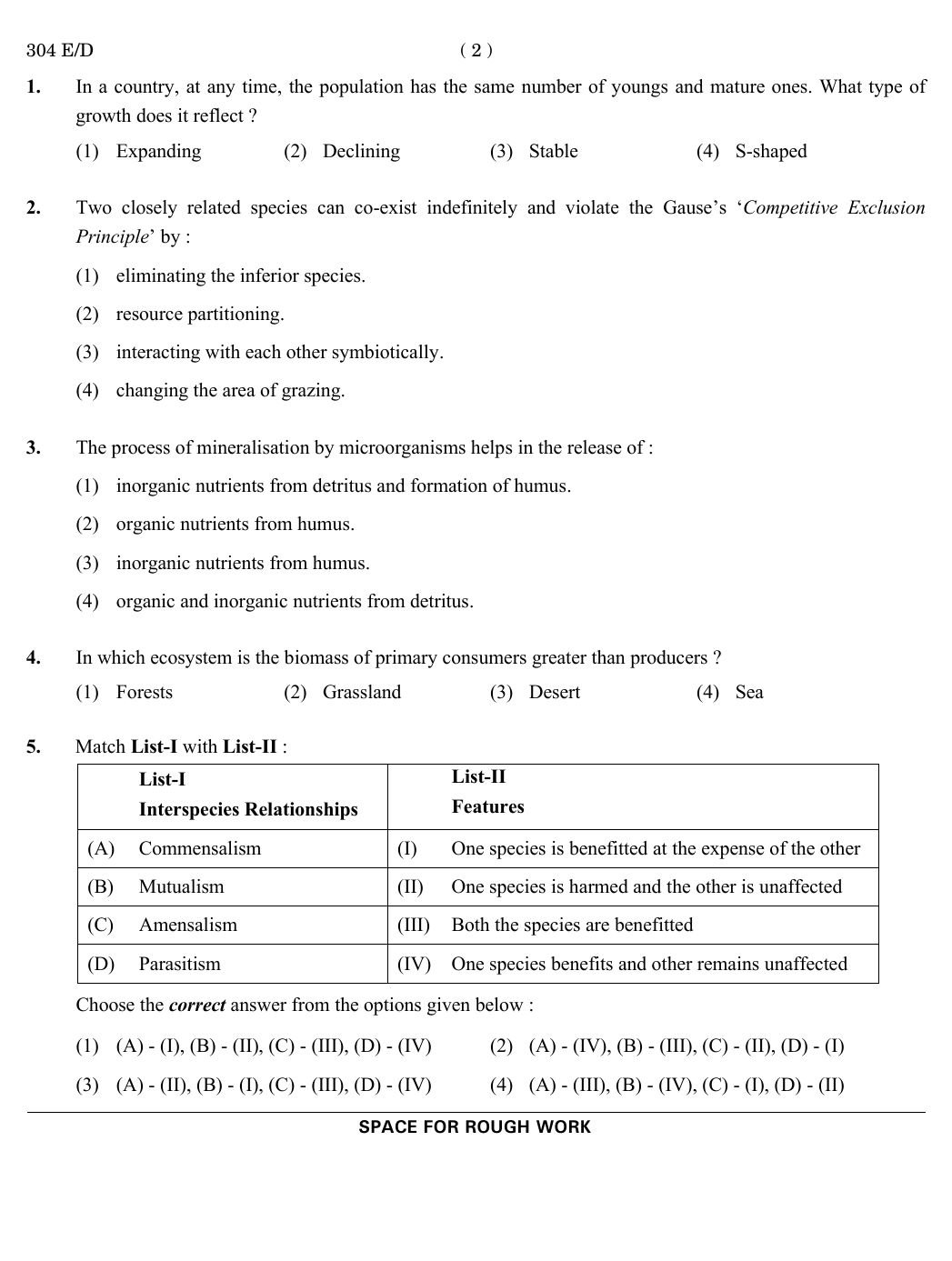
In a country, at any time, the population has the same number of young and mature ones. What type of growth does it reflect?
View Solution
Two closely related species can co-exist indefinitely and violate Gause’s ‘Competitive Exclusion Principle’ by:
View Solution
The process of mineralisation by microorganisms helps in the release of:
View Solution
In which ecosystem is the biomass of primary consumers greater than producers?
View Solution
Match List-I with List-II:
List-I (Interspecies Relationships)
(A) Commensalism
(B) Mutualism
(C) Amensalism
(D) Parasitism
List-II (Features)
(I) One species is benefitted at the expense of the other
(II) One species is harmed and the other is unaffected
(III) Both species are benefitted
(IV) One species benefits and the other remains unaffected
Choose the correct answer:
View Solution
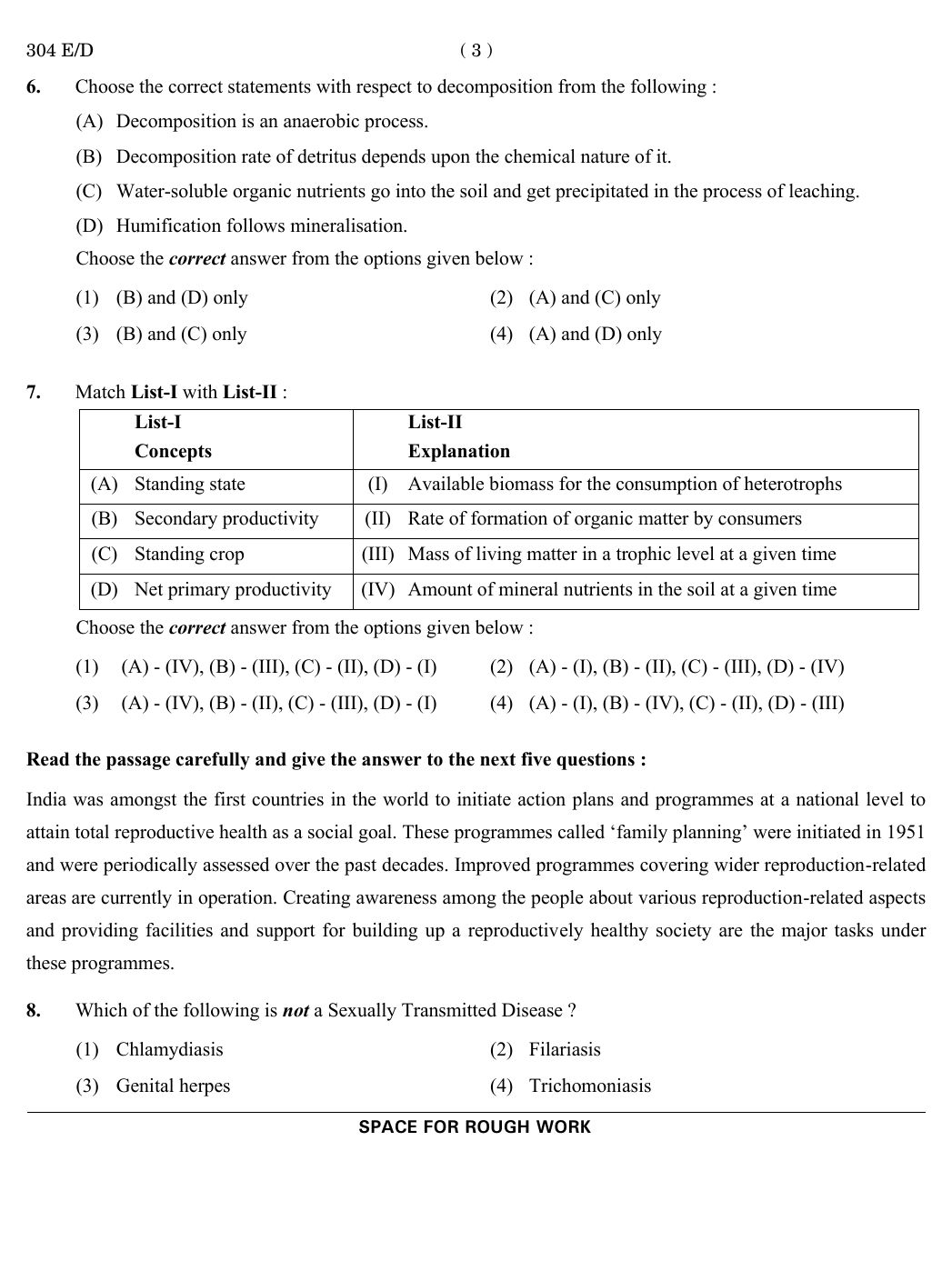
Choose the correct statements with respect to decomposition from the following:
(A) Decomposition is an anaerobic process.
(B) Decomposition rate of detritus depends upon the chemical nature of it.
(C) Water-soluble organic nutrients go into the soil and get precipitated in the process of leaching.
(D) Humification follows mineralisation.
Choose the correct answer:
View Solution
Match List-I with List-II:
List-I (Concepts)
(A) Standing state
(B) Secondary productivity
(C) Standing crop
(D) Net primary productivity
List-II (Explanation)
(I) Available biomass for the consumption of heterotrophs
(II) Rate of formation of organic matter by consumers
(III) Mass of living matter in a trophic level at a given time
(IV) Amount of mineral nutrients in the soil at a given time
Choose the correct answer:
View Solution
Which of the following is not a Sexually Transmitted Disease?
View Solution
Filariasis is not a sexually transmitted disease. It is caused by parasitic wormsand transmitted by mosquitoes, whereas the other options are sexually transmitted
diseases
Which of the following statements is incorrect with respect to Medical Termination of Pregnancy?
View Solution
The statement ”About 20% of the total number of conceived pregnancies undergo MTP in a year globally” is incorrect. The actual percentage is much lower, with MTP usually being performed in the first trimester.Match List-I with List-II:
List-I (Assisted Reproductive Technologies)
(A) ZIFT
(B) ICSI
(C) IUI
(D) IUT
List-II (Process)
(I) Formation of embryo in vitro by injecting sperm directly into ovum
(II) Transferring of embryo with more than 8 blastomeres into the uterus
(III) Transferring of fertilized egg up to 8 blastomeres into fallopian tube
(IV) Transfer of semen from a healthy donor into the uterus artificially
Choose the correct answer:
View Solution
(A) ZIFT involves transferring fertilized egg (up to 8 blastomeres) into the fallopian tube. (B) ICSI involves injecting sperm directly into the ovum in vitro. (C) IUI refers to the artificial insemination of sperm into the uterus. (D) IUT involves transferring embryos with more than 8 blastomeres into the uterusWhich of the following methods of contraception is not meant for females?
View Solution
Vasectomy is a method of male sterilization that involves cutting the vas deferens. All other options refer to contraception methods used by or for females.‘Saheli’ – an oral contraceptive pill, also known as the ‘Once a week’ pill, was developed by:
View Solution
The oral contraceptive pill ‘Saheli’, taken once a week, was developed by CDRI (Central Drug Research Institute) in India.Which of the following is not a characteristic of a stable biological community?
View Solution
In the ‘rivet popper hypothesis’, the ‘rivet’ signifies:
View Solution
The scientist who proved that species richness directly correlates with the stability of a community was:
View Solution
Among the vertebrates, which of the following is the most species-rich group?
View Solution
The following are the various hypotheses proposed in explaining the greatest biological diversity in the tropics except:
View Solution
Cells present in the mature pollen grains are:
View Solution
Match List-I with List-II:
List-I (Structures)
(A) Filiform apparatus
(B) Tapetum
(C) Exine
(D) Funicle
List-II (Functions)
(I) Made up of sporopollenin
(II) Attachment of ovule to the placenta
(III) Guides pollen tube into the synergid
(IV) Nourishes the pollen grain
Choose the correct answer:
View Solution
Primary Endosperm Nucleus is the product of:
View Solution
In humans, the mammary gland is divided into lobes:
View Solution
Sex in human embryo is determined by:
View Solution
Arrange the following stages of oogenesis in order of their occurrence:
(A) Ovum
(B) Oogonia
(C) Primary oocyte
(D) Secondary oocyte
View Solution
Which of the following pair of contrasting traits was not studied by Mendel?
View Solution
Failure of chromatids to segregate during the cell division cycle results in:
View Solution
Select the correctly matched pair about sickle cell anaemia: Genotype : Phenotype
View Solution
Match List-I with List-II:
List-I (Scientists)
(A) Sutton and Boveri
(B) Sturtevant
(C) Henking
(D) Griffith
List-II (Discovery)
(I) X-Body
(II) Chromosomal Theory of Inheritance
(III) Transformation in bacteria
(IV) Genetic maps
Choose the correct answer:
View Solution
Which of the following statements are incorrect with respect to nucleotides?
(A) Purines and pyrimidines are nitrogenous bases.
(B) Nucleotides are non-enzymatic molecules.
(C) Phosphate group is linked to – OH of 5’ C of a nucleoside through phosphoester linkage.
(D) In RNA, every nucleotide residue has an additional – OH group present at 2’ position in the ribose.
(E) Thymine is an example of Pyrimidine.
Choose the correct answer:
View Solution
Arrange the given steps of DNA fingerprinting in the sequence from initiation to end:
(A) Digestion of DNA by restriction endonuclease
(B) Isolation of DNA
(C) Hybridisation using labelled VNTR probe
(D) Transferring (blotting) of separated DNA fragments to synthetic membrane
Choose the correct answer:
View Solution
Nucleosome is associated with molecules of histones:
View Solution
Select the observations drawn from the human genome project which are correct:
(A) The human genome contains 3164.7 million bp.
(B) The average gene consists of 3000 bases.
(C) Total number of genes is estimated at 30,000.
(D) The functions are unknown for over 50% of discovered genes.
(E) Less than 2% of the genome codes for proteins.
Choose the correct answer:
View Solution
Analogous structures are a result of:
View Solution
Which of the following does not affect the Hardy-Weinberg equilibrium?
View Solution
Which of the following primates was more like an ape?
View Solution
Match List-I with List-II:
List-I (Placental mammals)
(A) Anteater
(B) Bobcat
(C) Lemur
(D) Flying squirrel
List-II (Counterpart Marsupials)
(I) Spotted cuscus
(II) Numbat
(III) Flying Phalanger
(IV) Tasmanian tiger cat
Choose the correct answer:
View Solution
Identify the incorrect statement/s:
(A) Intestinal perforation and death may occur in severe cases of typhoid infection.
(B) Common cold is caused by Rhinoviruses.
(C) Lips and fingernails may turn grey to bluish colour in severe cases of pneumonia.
(D) Pneumonia is caused by Salmonella.
(E) Typhoid fever could be confirmed by Widal test.
Choose the correct answer:
View Solution
Match List-I with List-II:
List-I (Types of barriers)
(A) Cytokine barriers
(B) Physical barriers
(C) Cellular barriers
(D) Physiological barriers
List-II (Examples)
(I) Mucus coating
(II) Tears from eyes
(III) Phagocytosis
(IV) Interferons
Choose the correct answer:
View Solution
Smack is chemically:
View Solution
Antibodies are secreted by:
View Solution
In sewage treatment, flocs are:
View Solution
Match List-I with List-II:
List-I (Products)
(A) Statin
(B) Clot buster
(C) Swiss cheese
(D) Cyclosporin-A
List-II (Organisms)
(I) Streptococcus
(II) Trichoderma
(III) Monascus
(IV) Propionibacterium
Choose the correct answer:
View Solution
The beetle used as a biocontrol agent for aphids and mosquitoes is:
View Solution
Downstream processing method involves:
View Solution
Which of the following is not the correctly matched pair of organism and its respective cell wall degrading enzyme?
View Solution
Arrange the following steps involved in transformation of bacteria in a sequence from initiation to end:
(A) Incubation of rDNA with bacterial cell on ice
(B) Treatment with divalent cations
(C) Heat shock treatment
(D) Selection on antibiotic containing agar plate
(E) Placed them again on ice
Choose the correct answer:
View Solution
Which of the following statements are incorrect?
(A) Fragments of DNA can be separated by ELISA.
(B) Transformation is a procedure through which a piece of DNA is introduced in a host bacterium.
(C) Recombinant DNA technology does not involve isolation of a desired DNA fragment.
(D) DNA ligases are used for stitching DNA fragments into a vector.
Choose the correct answer:
View Solution
Which of the following statements are true?
(A) Milk obtained from ‘Rosie’ is nutritionally more balanced for human babies than natural human milk.
(B) Biopiracy refers to the use of bioresources without proper authorisation from MNCs.
(C) GEAC is the decisive body for safety and validity of GMOs and GM research respectively.
(D) Transgenic animals help us to understand the contribution of genes in the development of disease.
Choose the correct answer:
View Solution
Match List-I with List-II:
List-I (Transgene)
(A) α-1-antitrypsin
(B) cryIAc
(C) Antisense RNA
(D) cryIAb
List-II (Used for/Products)
(I) Meloidegyne incognitia
(II) Corn borer
(III) Treat emphysema
(IV) Cotton bollworms
Choose the correct answer:
View Solution
Expand “GEAC”:
View Solution
When an insect feeds on the Bt plant, the insect dies due to the conversion of inactive protein to active protein in:
View Solution











Comments