




CUET UG syllabus 2027 has 3 sections, including Languages (Section IA and IB), Domain Subjects (Section II), and General Test (Section III). NTA releases the CUET UG Syllabus for 13 Language Papers, 23 Domain subjects, and one General Test paper.
- CUET UG syllabus 2027 for all language papers includes Verbal Ability and Reading Comprehension.
- CUET UG syllabus 2027 for domain subjects is based on NCERT Class 12 curriculum.
- CUET UG syllabus for Economics includes topics from Microeconomics, Macroeconomics, and Indian Economic Development.
- CUET UG syllabus for Political Science includes topics from Politics in India Since Independence and Contemporary World Politics.
- CUET UG Syllabus 2027 for General Test is based on topics like General Knowledge, Current Affairs, General Mental Ability, Numerical Ability, Reasoning, Logical and Analytical Reasoning, General Science, and Environmental Literacy.
To prepare for CUET UG examination, you can consider NCERT textbooks for each domain subject. Around 80% of the questions are directly asked from NCERT textbooks for Class 12 subjects.
Related Articles:
Key Summary
- A total of 50 questions will be asked in each CUET UG test paper, distributed among the topics included in the CUET UG syllabus 2027.
- You can expect 80-85% of questions in domain subjects directly from NCERT textbooks.
- Solving the remaining 20% of questions may require a deeper understanding of concepts.
- CUET UG PCB/PCM syllabus covers Class 12 chapters from NCERT Physics, Chemistry, and Biology/Maths.
- You can choose a minimum of 3 and a maximum of 5 subjects in CUET UG 2027 irrespective of your Class 12 subjects.
What’s New in CUET UG Syllabus?
NTA made some changes last year in the number of total subjects and removed some papers and replaced them with the General Aptitude Test.
- NTA reduced the number of test papers from 63 to 37 in 2026, and students can choose up to 5 test papers.
- NTA removed the Entrepreneurship, Legal Studies, and Teaching Aptitude papers last year and replaced them with the General Aptitude Test paper for admissions to related courses.
CUET UG Syllabus 2027 Overview
NTA will publish the CUET UG syllabus 2027 on the official website at cuet.nta.nic.in. NTA releases the syllabus every year for Language Papers, Domain Subjects, and General Aptitude Test.
- CUET syllabus 2027 for language papers tests for Reading Comprehension, Literary Aptitude, and Vocabulary.
- Syllabus for domain subjects is designed as per the NCERT curriculum for class 12 subjects.
| Particulars | Details |
|---|---|
| CUET UG 2027 Syllabus | To be released by NTA |
| Language Syllabus | Reading Comprehension, Literary Aptitude & Vocabulary |
| Domain Subject Syllabus | Based on prescribed Class 12 NCERT syllabus |
| General Aptitude Test Syllabus | GK, Current Affairs, Numerical Ability, Quantitative Reasoning, Logical & Analytical Reasoning |
| Language Subjects | English, Hindi and other regional languages |
| Domain Subjects | Accountancy, Biology, Chemistry, Economics, History, Mathematics, Physics, Political Science and others |
| Official Syllabus Source | NTA CUET UG website |
CUET UG Syllabus 2027 PDF- Domain Subjects
| CUET UG Test Paper | CUET UG Syllabus PDF |
|---|---|
| English | Download PDF |
| Hindi | Download PDF |
| Assamese | Download PDF |
| Bengali | Download PDF |
| Gujarati | Download PDF |
| Kannada | Download PDF |
| Malayalam | Download PDF |
| Marathi | Download PDF |
| Odia | Download PDF |
| Punjabi | Download PDF |
| Tamil | Download PDF |
| Telugu | Download PDF |
| Urdu | Download PDF |
CUET UG Syllabus 2027 PDF- Language Subjects
| CUET UG Test Paper | CUET UG Syllabus PDF |
|---|---|
| Accountancy / Book-Keeping | Download PDF |
| Agriculture | Download PDF |
| Anthropology | Download PDF |
| Biology/ Biological Science/ Biotechnology /Biochemistry | Download PDF |
| Business Studies | Download PDF |
| Chemistry | Download PDF |
| Environmental Science | Download PDF |
| Computer Science / Information Practices | Download PDF |
| Economics / Business Economics | Download PDF |
| Fine Arts/Visual Arts/Commercial Arts | Download PDF |
| Geography / Geology | Download PDF |
| History | Download PDF |
| Home Science | Download PDF |
| Knowledge Tradition-Practices in India | Download PDF |
| Mass Media / Mass Communication | Download PDF |
| Mathematics / Applied Mathematics | Download PDF |
| Performing Arts - (Dance, Drama and Music) | Download PDF |
| Physical Education (Yoga, Sports) | Download PDF |
| Physics | Download PDF |
| Political Science | Download PDF |
| Psychology | Download PDF |
| Sanskrit | Download PDF |
| Sociology | Download PDF |
CUET UG Syllabus 2027 for General Aptitude
CUET UG 2027 syllabus for General Aptitude includes Quantitative Aptitude, Logical Reasoning, and General Awareness. As per experts, 50-60% of questions are asked from Quantitative Aptitude alone.
| Section | CUET GAT Syllabus 2027 |
|---|---|
| Quantitative Aptitude |
|
| Logical Reasoning |
|
| General Awareness |
|
CUET UG Syllabus 2027 for English
English is the most chosen subject in the CUET UG examination, with 914653 appearances last year. CUET syllabus 2026 for English includes 2 sections: Reading Comprehension and Verbal Ability.
- Reading Comprehension will include 3 types of passages, with a maximum word limit of 300 words.
- You can expect around 16-19 questions from Reading Comprehension in CUET UG syllabus 2027 for English.
| Section | CUET UG Syllabus 2027 |
|---|---|
| Reading Comprehension | 3 types of passages with up to 300 words each
|
| Verbal Ability |
|
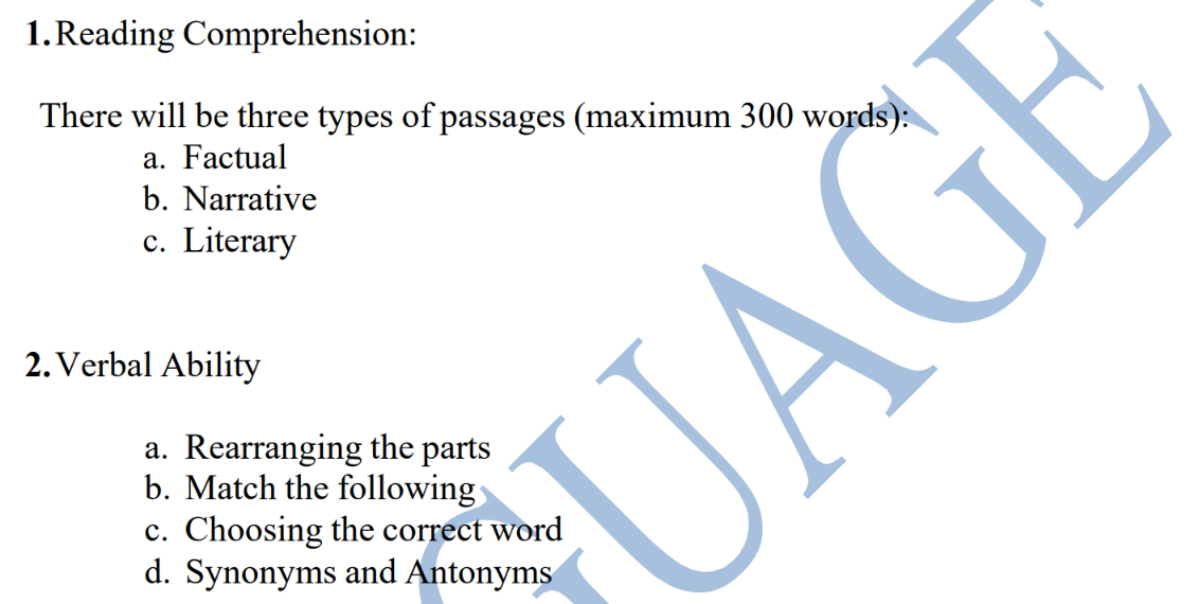
Source: Official CUET UG English Syllabus
Also Read
“Basic Shiksha” expert on YouTube shared a detailed analysis of CUET UG syllabus 2027. The video explains each topic in detail with an analysis of topic-wise weightage.
CUET UG Syllabus 2027 for Chemistry
CUET UG syllabus 2027 for Chemistry has a total of 10 units. The syllabus for CUET UG Chemistry is based on the NCERT curriculum for Class 12. High-weightage units in the CUET UG Chemistry syllabus include Electrochemistry, D&F Block Elements, Coordination Compounds, Aldehydes, Ketones, and Carboxylic Acids, etc.
CUET UG Chemistry Topic-Wise Weightage
Chapters like Electrochemistry, d and f block elements, coordination compounds, aldehyder, ketones and carboxylic acids and Amines carry the maximum weightage, with each carrying 3-5 questions. You can expect 3-4 questions each from Haloalkanes and Haloarenes, and Alcohols, Phenols, and Ethers.
| Topic | Weightage (Number of Questions) |
|---|---|
| Electrochemistry | 3-5 |
| d and f Block Elements | 3-5 |
| Coordination Compounds | 3-5 |
| Aldehydes, Ketones and Carboxylic Acids | 3-5 |
| Amines | 3-5 |
| Biomolecules | 3-5 |
| Haloalkanes and Haloarenes | 3-4 |
| Alcohols, Phenols, and Ethers | 3-4 |
| Solutions | 2-4 |
| Chemical Kinetics | 2-4 |
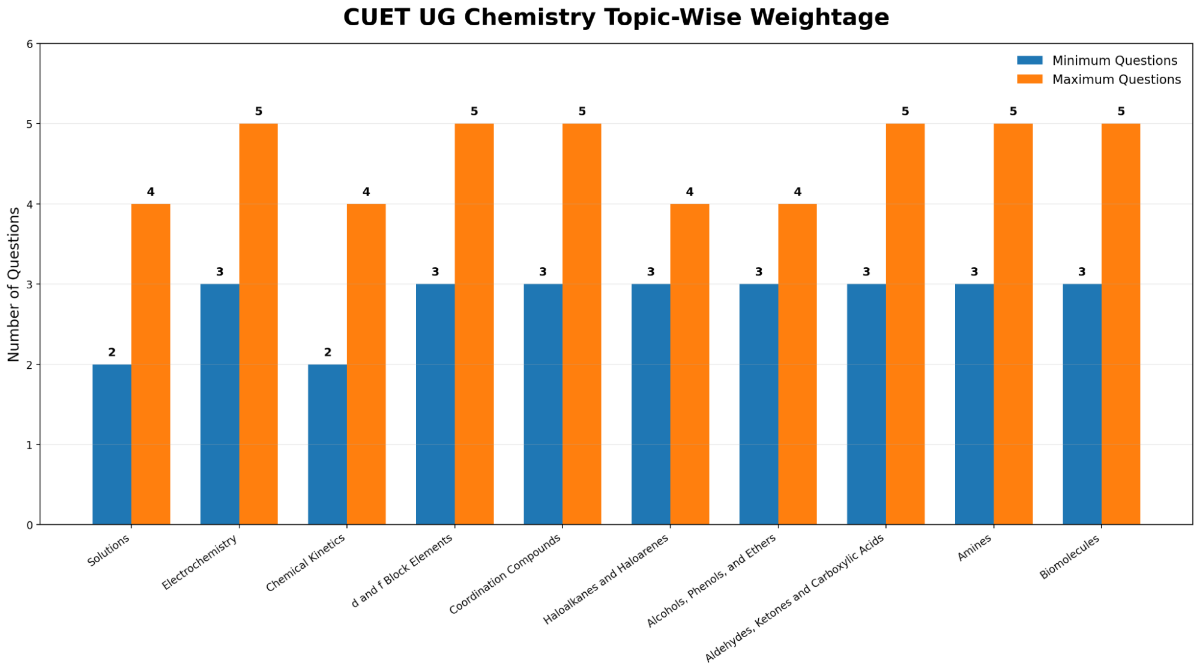
Source: YouTube
Check Here:
CUET UG Syllabus 2027 for Physics
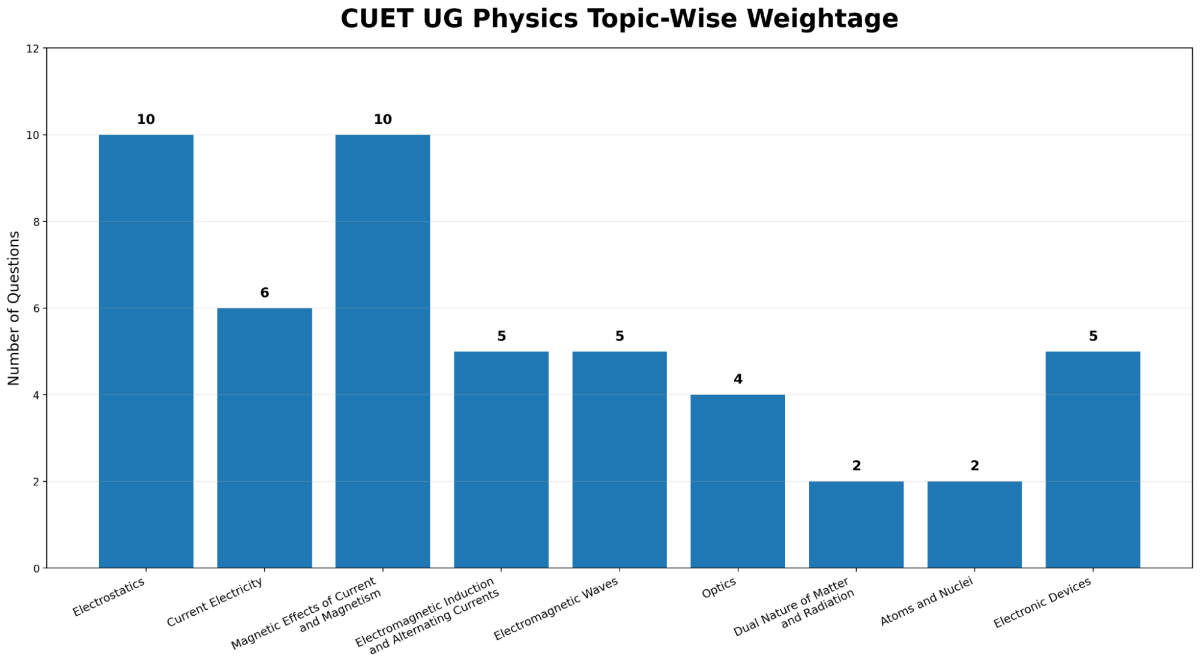
CUET UG syllabus 2027 is based on the chapters included in the NCERT Class 12 curriculum. There are a total of 9 units in the CUET UG 2027 Physics syllabus. Important chapters in CUET UG Physics include Electrostatics, Current Electricity, and Magnetism.
CUET UG Physics Topic-Wise Weightage
Topics with the highest weightage in CUET UG syllabus include electrostatics and magnetic effects of current and magnetism, each carrying around 10 questions.
- Current Electricity is expected to carry around 6 questions in the CUET UG syllabus 2026.
- EMIAC, Electromagnetic Waves, and Electronic Devices will each carry around 5 questions.
| Topic | Weightage (Number of Questions) |
|---|---|
| Electrostatics | 10 |
| Magnetic Effects of Current and Magnetism | 10 |
| Current Electricity | 6 |
| Electromagnetic Induction and Alternating Currents | 5 |
| Electromagnetic Waves | 5 |
| Electronic Devices | 5 |
| Optics | 4 |
| Dual Nature of Matter and Radiation | 2 |
| Atoms and Nuclei | 2 |
Also Read:
CUET UG Syllabus for Mathematics
CUET UG syllabus for Mathematics includes 6 units, with important topics being matrices, Continuity and Differentiability, Linear Programming, Probability, Application of Derivatives, etc. You can expect 3-6 questions from each of these topics.
CUET UG Mathematics Topic-Wise Weightage
Topics carrying highest weightage in CUET UG mathematics include Matrices, Linear Programing, and Probability, with each carrying around 4-6 questions.
- You can expect 4-5 questions from Continuity and Differentiability.
- Topics like Application of Derivatives, Integrals, Differential Equations, and Vector Algebra each carry around 3-7 questions
| Topic | Weightage (Number of Questions) |
|---|---|
| Matrices | 4-6 |
| Linear Programing | 4-6 |
| Probability | 4-6 |
| Continuity and Differentiability | 4-5 |
| Application of Derivatives | 3-7 |
| Integrals | 3-6 |
| Differential Equations | 3-5 |
| Vector Algebra | 3-4 |
| Application of Integrals | 3 |
| Relations and Functions | 2-4 |
| Determinants | 2-7 |
| Inverse Trigonometry | 1-3 |
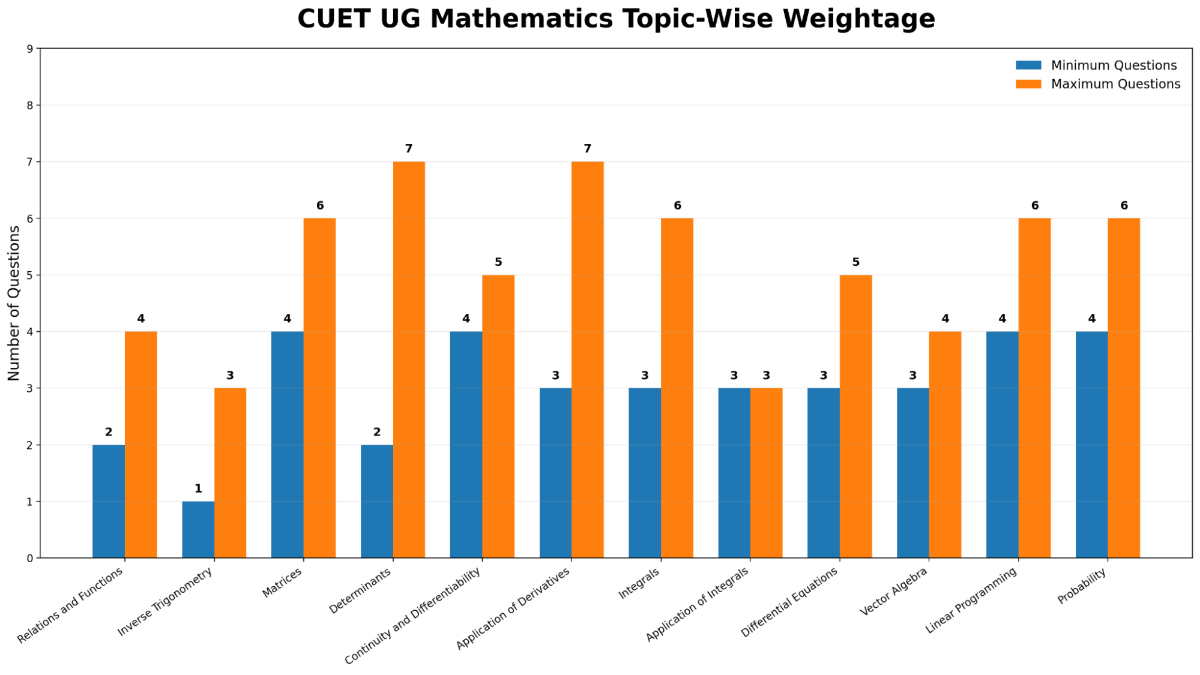
Source: YouTube
Also Read:
CUET UG Syllabus for Biology
CUET UG syllabus 2027 for Biology includes a total of 5 units from NCERT class 12 curriculum. Some of the high-weightage topics that you should prioritize include Molecular Basis of Inheritance, Human Health and Disease, Biotechnology: Principle and Process, Biotechnology and Its Applications, etc.
| Units | Weightage (Number of Questions) |
|---|---|
| Reproduction | |
| Genetics and Evolution | |
| Biology and Human Welfare | |
| Biotechnology and its Applications | |
| Ecology and Environment |
CUET UG Biology Topic-Wise Weightage
Topics in CUET UG Biology syllabus carrying the highest weightage include Human Health and Disease, Biotechnology: Principle and Process, Biotechnology and Its Applications, and Biodiversity.
- You can expect 3-5 questions from each of the high-weightage chapters in CUET UG Biology.
- Chapters like Organisms and Population and Ecosystem each carry around 2-6 questions.
- Human Reproduction, Principles of Inheritance, and Evolution are likely to carry around 2-3 questions each.
| Topic | Weightage |
|---|---|
| Human Health and Disease | 4-8 |
| Biotechnology and Its Applications | 3-7 |
| Biotechnology: Principle and Process | 3-5 |
| Molecular Basis of Inheritance | 3-5 |
| Biodiversity and Conservation | 3-4 |
| Organisms and Population | 2-6 |
| Ecosystem | 2-6 |
| Sexual Reproduction in Flowering Plants | 2-5 |
| Human Reproduction | 2-3 |
| Principle of Inheritance | 2-3 |
| Evolution | 2-3 |
| Microbes in Human Welfare | 3 |
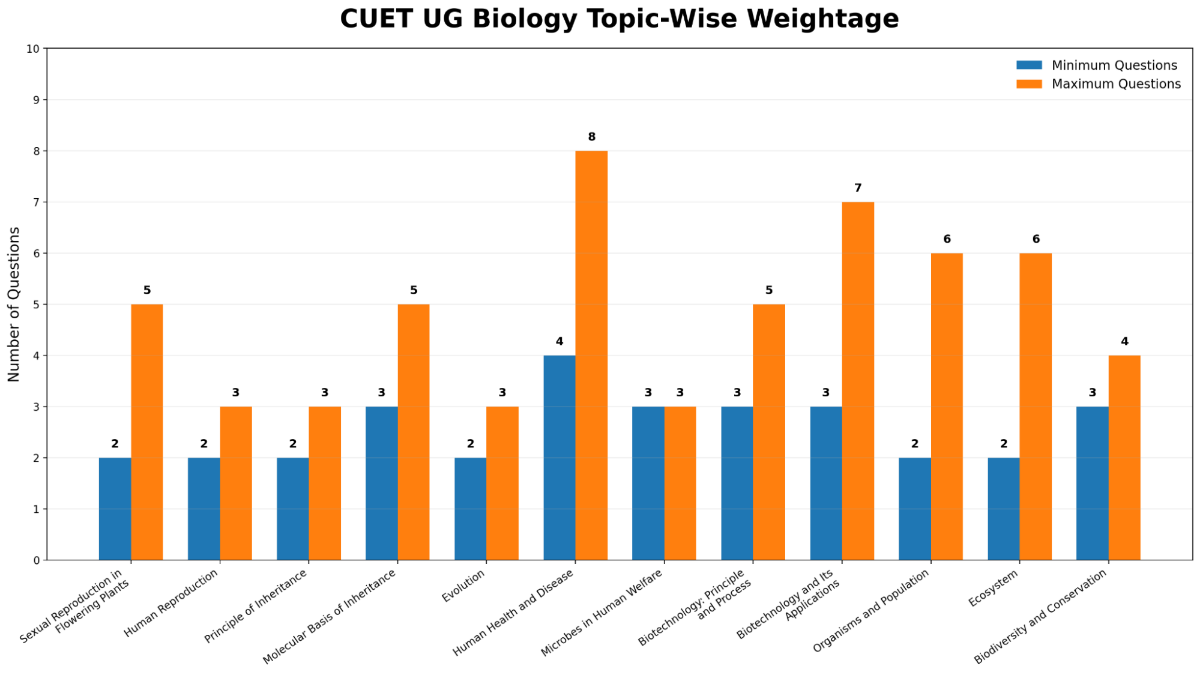
Also Read:
CUET UG Syllabus for Economics
CUET UG syllabus 2027 for economics is divided into 3 courses, including Microeconomics, Macroeconomics, and Indian Economic Development. There are a total of 13 units in CUET UG 2027 syllabus for Economics.
| Course | Units |
|---|---|
| Introductory Microeconomics | |
| Introductory Macroeconomics | |
| Indian Economic Development |
|
Read More:
CUET UG Syllabus for Business Studies
CUET UG syllabus 2027 for Business Studies includes a total of 12 units. High weightage topics in CUET UG economics syllabus 2027 are Principles of Management, Business Environment, Directing, Financial Management, and Marketing.
| Nature and Significance of Management | Principles of Management | Business Environment |
| Planning | Organising | Staffing |
| Directing | Controlling | Business Finance |
| Financial Markets | Marketing | Consumer Protection |
Read More:
CUET UG Syllabus for Accountancy
CUET UG syllabus 2027 for Accountancy includes 6 units from NCERT class 12 course study. During preparation, you must prioritize topics like Reconstitution of Partnership, Analysis of Financial Statements, and Accounting for Share and Debenture Capital to score higher in the examination.
Read More:
CUET UG Syllabus for Political Science
CUET UG syllabus 2027 for Political Science is divided into 2 sections including Political in India Since Independence, and Contemporary World Politics. There are a total of 16 units that students must prepare for CUET UG examination.
| Course | Units |
|---|---|
| Political in India Since Independence |
|
| Contemporary World Politics |
|
Read More:
Ques. What is the CUET syllabus for PCM students?
Ans. PCM students must cover the syllabus prescribed for Physics, Chemistry, and Mathematics. You should cover topics from the NCERT Class 12 curriculum for each subject.
On Quora, a user asked about the latest syllabus for Science students for CUET UG 2027. Syllabus for CUET UG 2027 is yet to be released. However, based on last year's CUET UG syllabus, students should prepare the Class 12 curriculum prescribed by NCERT for Physics, Chemistry, Mathematics, and Biology.
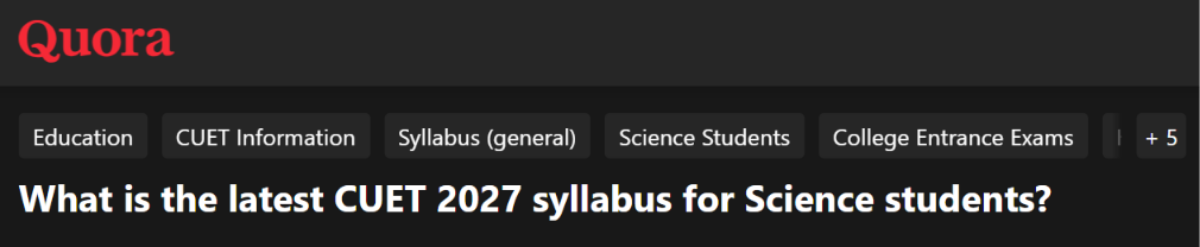
Source: Quora
CUET UG 2026 Important Books
To cover the CUET UG syllabus 2027 for domain subjects, you can consider NCERT textbooks as maximum portion of CUET question paper is based on NCERT textbooks. However, for English and General Aptitude, you should consider standard books for each section of the subject like Word Power Made Easy, Objective General English, Analytical Reasoning
M.K. Pandey, etc.
For domain subjects, you can also consider some reference books for each subject to get a deeper understanding of the concepts.
CUET UG Books for English
| Book Name | Author/Publisher |
|---|---|
| High School English Grammar & Composition | Wren & Martin |
| Word Power Made Easy | Norman Lewis |
| Objective General English | S.P. Bakshi (Arihant) |
| English Grammar in Use | Raymond Murphy |
| Competitive English Grammar & Composition | Arihant |
CUET UG Books for General Test
| Book Name | Author/Publisher |
|---|---|
| Quantitative Aptitude for Competitive Examinations | R.S. Aggarwal |
| A Modern Approach to Logical Reasoning / Verbal & Non-Verbal Reasoning | R.S. Aggarwal |
| Analytical Reasoning | M.K. Pandey |
| Lucent’s General Knowledge | Lucent Publications |
| General Knowledge / Current Affairs Yearbooks | Arihant / Manohar Pandey / Disha Experts |
| Shortcuts in Quantitative Aptitude | Disha Experts |
CUET UG Books for Science
| Book Name | Author/Publisher |
|---|---|
| NCERT Physics / Chemistry / Biology / Mathematics (Class 11 & 12) + Exemplars | NCERT |
| Concepts of Physics (Vol 1 & 2) | H.C. Verma |
| Objective Physics / Understanding Physics | D.C. Pandey |
| Fundamental Physics | Pradeep |
| Physical Chemistry | O.P. Tandon |
| Organic Chemistry | Morrison & Boyd |
| Concise Inorganic Chemistry | J.D. Lee |
| Handbook of Chemistry / Organic Chemistry Objective | Arihant |
| Trueman’s Biology (Vol 1 & 2) | Trueman |
| Objective Biology | Dinesh / Ansari |
| R.D. Sharma Mathematics / RS Aggarwal Class 12 Maths | R.D. Sharma / R.S. Aggarwal |
| Handbook of Mathematics / Complete Mathematics | Arihant / Lucent |
CUET UG Books for Commerce
| Book Name | Author/Publisher |
|---|---|
| NCERT Accountancy / Business Studies / Economics (Class 11 & 12) | NCERT |
| Double Entry Book Keeping / Accountancy | T.S. Grewal |
| Business Studies | Poonam Gandhi |
| Economics / Business Economics | Sandeep Garg / Arihant Experts |
| Indian Economy | Ramesh Singh |
| CUET-specific guides (Accountancy, Business Studies, Economics) | Arihant / Oswaal / Disha / GKP |
CUET UG Books for Humanities / Arts
| Book Name | Author/Publisher |
|---|---|
| NCERT History / Geography / Political Science / Psychology / Sociology etc. (Class 11 & 12) | NCERT |
| India’s Ancient Past | R.S. Sharma |
| CUET History / Political Science / Geography / Psychology guides | Arihant / GKP / Oswaal / Disha |
| Geography: A Comprehensive Study Guide | Mahesh Kumar Barnwal |
Also Read:
CUET UG 2027 Exam Pattern
CUET UG 2027 will be conducted for a total of 37 test papers, including 13 Indian Languages, 23 Domain Subjects, and the General Aptitude Test. The examination will be conducted in CBT mode in multiple shifts.
- In each test paper, a total of 50 MCQs will be asked.
- Each test paper in CUET UG 2027 will be conducted for a duration of 60 minutes.
- For each correct response, you will get +5 marks, and each incorrect answer will deduct -1 mark from the overall score.
| Particulars | Details |
|---|---|
| Mode of Examination | CBT mode |
| Shift | Multiple Shifts |
| Total Test Papers | 37 (13 Languages, 23 Domain Subjects, and General Aptitude Test) |
| Total Questions in CUET | 50 in each test paper |
| Type of Questions | MCQs |
| Duration of CUET Exam | 60 minutes for each test paper |
| Marking Scheme |
|
| CUET Total Marks | 250 marks for each subject paper
|
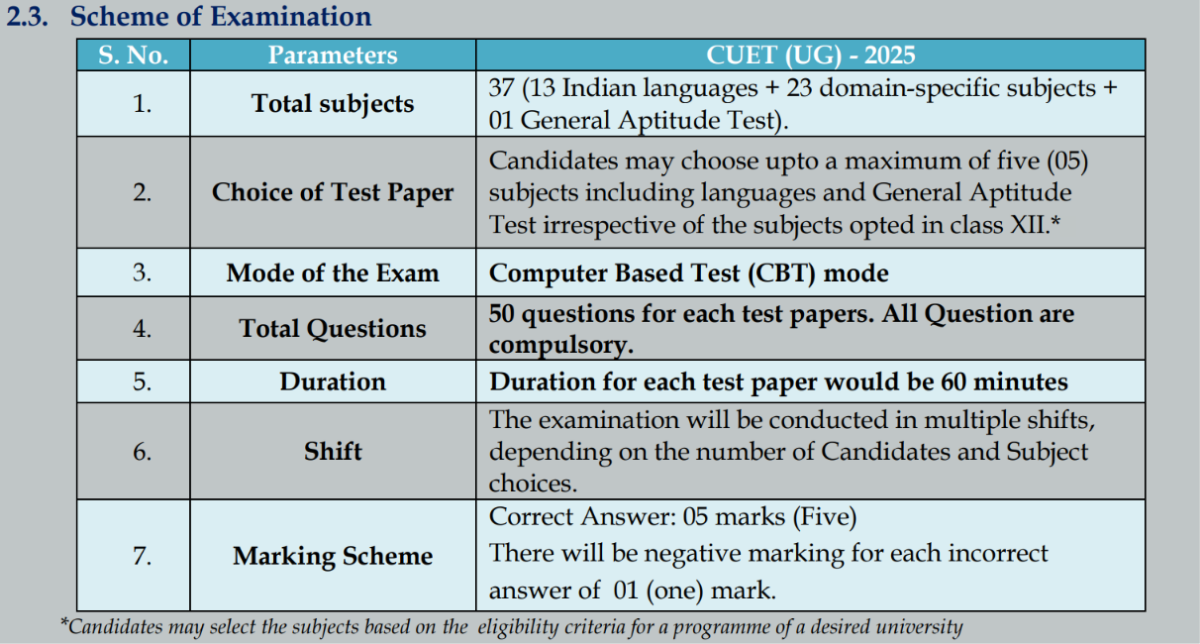
Source: CUET Information Bulletin
Ques. What is the total marks for CUET UG 2027?
Ans. Total marks in CUET UG 2027 depend on the number of subjects chosen by you. For 5 subjects, the total marks are 1250, and for 4 subjects is 1000 marks. For 3 subjects in CUET UG 2027, the total marks are 750.
How to Prepare for CUET UG 2027 Exam?
- Check and Understand CUET Syllabus: Check the CUET UG syllabus for the subjects you have to appear for in CUET UG 2027.
- Identify High Weightage Topics: Identify which topics carry the highest weightage.
- Prioritize High Weightage Topics: Prioritize the preparation for CUET UG 2027 high-weightage topics in your chosen subjects.
- Practice Previous Years’ Papers: Solve CUET UG papers from past years to understand the level and type of questions asked in the examination.
- Attempt Mock Tests: Attempt regular mock tests with at least 1 mock test every week to improve time management.
- Analyze Weak Areas: Analyze weak areas after attempting mock tests and improve them by practicing more on those areas.
Also Read:
CUET UG 2027 Question Papers
| CUET UG Exam Year | CUET Question Paper PDF |
|---|---|
| CUET UG 2026 | Download Question Paper PDF With Solutions |
| CUET UG 2025 | Download Question Paper PDF With Solutions |
| CUET UG 2024 | Download Question Paper PDF With Solutions |
| CUET UG 2023 | Download Question Paper PDF With Solutions |
| CUET UG 2022 | Download Question Paper PDF With Solutions |
| CUET UG 2021 | Download Question Paper PDF With Solutions |
CUET UG 2027 Mock Tests
| CUET Test Paper | Mock Test Link |
|---|---|
| Physics | Attempt Here |
| Mathematics | Attempt Here |
| Geography | Attempt Here |
| English | Attempt Here |
| General Test | Attempt Here |
| Economics | Attempt Here |
| Business Economics | Attempt Here |
| Accountancy | Attempt Here |
| Political Science | Attempt Here |
| History | Attempt Here |
| Chemistry | Attempt Here |
| Sociology | Attempt Here |
Read More:
CUET UG 2027 FAQs
Ques. What is the weightage of Electrostatics in CUET UG syllabus for Physics?
Ans. Electrostatics is considered to be among the highest-weightage chapters in CUET UG Physics syllabus. You can expect around 10 questions from the Electrostatics chapter of CUET UG 2027 Physics syllabus.
Ques. What is the CUET syllabus for PCB students in 2027?
Ans. CUET syllabus for PCB students includes Physics, Chemistry, and Biology subjects. Each subject carries units and topics from the NCERT Class 12 curriculum, with around 80% of questions directly asked from NCERT textbooks.
Ques. Is CUET UG 2027 syllabus only based on Class 12?
Ans. Yes, CUET UG 2027 syllabus is based on the Class 12 NCERT curriculum. While preparing for CUET UG exam, you can consider NCERT textbooks to cover the CUET UG 2027 syllabus.
Ques. What are the high-weightage topics in CUET UG maths syllabus?
Ans. In Mathematics syllabus for CUET UG 2027, high-weightage topics include Matrices, Determinants, Continuity and Differentiability, Application of Derivatives, Integrals, Differential Equations, Linear Programming, and Probability. Each of these topics carries around 4-6 questions on average.
| High Weightage Topics | Weightage (Number of Questions) |
|---|---|
| Matrices | 4-6 |
| Determinants | 2-7 |
| Continuity and Differentiability | 4-5 |
| Application of Derivatives | 3-7 |
| Integrals | 3-6 |
| Differential Equations | 3-5 |
| Linear Programing | 4-6 |
| Probability | 4-6 |
Ques. How many questions are asked from calculus in CUET UG Maths syllabus?
Ans. From Calculus, you can expect around 3-6 questions from chapters of Calculus. Continuity and Differentiability carry around 4-5 questions, Application of Derivatives carries 3-7 questions, Integrals carry 3-6 questions, Differential Equations carry 3-5 questions, and Application of Integrals carries 3 questions.
| Topics | Weightage (Number of Questions) |
|---|---|
| Continuity and Differentiability | 4-5 |
| Application of Derivatives | 3-7 |
| Integrals | 3-6 |
| Differential Equations | 3-5 |
| Application of Integrals | 3 |



Comments
Found 4 Comments
Students registering for CUET exam are allowed to select a maximum of 6 subjects from the available 27 domain subjects during the registration. You have to take the examination for domain subjects you are interested in and 45 minutes will be allotted for each domain-specific subject chosen.
There are various books to prepare for CUET B.Ed exam. Some of the most recommended publishers for CUET B.Ed preparation books include Arihant, Pearson, Disha, Lucent, RS Aggarwal, RD Sharma, etc.
The syllabus for CUET is done in four sections- section IA, IB, II, and III that include the first 13 languages (which can be opted for the CUET exam), 20 languages, domain-specific subjects and general tests.
The best books for Master of a social worker are saving normal, a trick of the light, double- double, three little words, Prozac nation, breaking night, it gets better and many more.