The Common University Entrance Test (CUET) 2026 is a national-level entrance exam conducted by the National Testing Agency (NTA) for undergraduate admissions across 230+ central, state, deemed and private universities in India. CUET UG 2026 was held from 11 May to 31 May 2026 in computer-based mode, and the provisional answer key with the response sheet was released on 9 June 2026 at cuet.nta.nic.in. More than 15.68 lakh candidates registered for CUET UG 2026, making it one of the largest entrance exams in the country.
- Final Answer Key: The CUET UG 2026 final answer key is expected between 20-25 June 2026. Last year, NTA released the final key around 7-10 days after the objection window closed.
- Result: CUET UG 2026 result is expected between 26 June and 30 June 2026. In 2025, the result was declared on 4 July 2025, around a month after the exam ended.
- Counselling: CUET-based counselling at participating universities like DU (CSAS), BHU, JNU and Jamia Millia Islamia is expected to begin in the first week of July 2026, soon after the result.
- Cutoff: University-wise cutoffs are expected by the second week of August 2026. The top central universities such as DU’s SRCC, Hindu College and Miranda House usually demand 99+ percentile in General category for B.Com (Hons) and BA Economics.
What is CUET 2026?
The Common University Entrance Test (CUET) 2026 is a centralised entrance exam for undergraduate (UG) admissions to central, state, deemed and private universities across India. The exam is conducted by the National Testing Agency (NTA) under the Ministry of Education, Government of India. CUET was introduced in 2022 to replace separate entrance tests and individual cutoffs of universities and provide a single, merit-based platform for UG admissions.
CUET UG 2026 was held in Computer-Based Test (CBT) mode from 11 May to 31 May 2026 across 379 test cities in India and 26 cities abroad. More than 15.68 lakh candidates registered for the exam this year, slightly higher than the 13.5 lakh registrations in CUET UG 2025. The exam scores are accepted by 230+ universities, including 47 central universities like Delhi University (DU), Jawaharlal Nehru University (JNU), Banaras Hindu University (BHU), Jamia Millia Islamia (JMI) and Aligarh Muslim University (AMU).
| Particulars | Details |
|---|---|
| Exam Name | Common University Entrance Test (Undergraduate) 2026 |
| Short Form | CUET UG 2026 |
| Conducting Body | National Testing Agency (NTA) |
| Exam Level | National-Level UG Entrance Exam |
| Exam Frequency | Once a year |
| Exam Mode | Computer-Based Test (CBT) |
| Exam Duration | 60 minutes per subject |
| Total Marks | 250 per subject |
| Medium | 13 Indian languages |
| Total Registrations 2026 | More than 15.68 lakh |
| Participating Universities | 230+ (47 Central, 30+ State, 150+ Private & Deemed) |
| Official Website | cuet.nta.nic.in |
CUET 2026 Latest Updates: Answer Key and Response Sheet Released
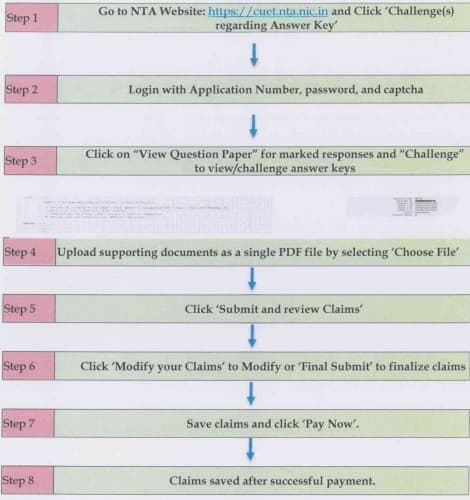
The NTA released the CUET UG 2026 provisional answer key along with the recorded responses (response sheet) and question papers on 9 June 2026 at cuet.nta.nic.in. Candidates who appeared for the exam between 11 May and 31 May 2026 can log in with their application number and password to download these documents.
The objection window stayed open from 9 June to 11 June 2026. Candidates had to pay a non-refundable fee of Rs. 200 per question to challenge any answer. If a challenge is found valid by the subject expert panel, the fee is refunded to the candidate’s account.
With the objection window now closed, the next steps in the CUET UG 2026 timeline are as follows:
- The final answer key is expected between 20 June and 25 June 2026, after NTA reviews all challenges.
- The CUET UG 2026 result is expected between 26 June and 30 June 2026. Some sources also predict the first week of July 2026.
- The scorecard will be available for download from the candidate login a few days after the result.
- University-wise counselling (DU’s CSAS, BHU UET-based counselling, JMI admission portal etc.) is likely to begin in early July 2026.
You should download a copy of your response sheet and provisional answer key for future reference. NTA will not provide these documents after the result is declared.
Source - cuet.nta.nic.in
CUET 2026 Important Dates
The CUET UG 2026 calendar was released by NTA on 3 January 2026 along with the official notification. As of 13 June 2026, the registration, exam and answer key phases are over, and the result is the next major milestone. The table below lists every key event in CUET UG 2026, with upcoming events first followed by past events in chronological order.
| Event | Date | Status |
|---|---|---|
| CUET UG 2026 Final Answer Key | 20-25 June 2026 (Expected) | Upcoming |
| CUET UG 2026 Result Declaration | 26-30 June 2026 (Expected) | Upcoming |
| Scorecard Download | Late June 2026 / Early July 2026 | Upcoming |
| DU CSAS Counselling Begins | First week of July 2026 (Expected) | Upcoming |
| BHU / JMI / AMU Counselling | Second week of July 2026 onwards | Upcoming |
| University-wise Cutoff Release | Second week of August 2026 (Expected) | Upcoming |
| CUET UG 2026 Official Notification | 3 January 2026 | (Over) |
| Registration Window | 3 January - 26 February 2026 | (Over) |
| Application Correction Window | 9-11 February 2026 | (Over) |
| City Intimation Slip | Last week of April 2026 | (Over) |
| CUET UG 2026 Admit Card | 5 May 2026 | (Over) |
| CUET UG 2026 Exam Dates | 11-31 May 2026 (28 May shifted) | (Over) |
| Provisional Answer Key & Response Sheet | 9 June 2026 | (Over) |
| Answer Key Objection Window | 9-11 June 2026 | (Over) |
The 28 May 2026 shift was postponed by NTA due to a change in the Id-ul-Zuha holiday date and was rescheduled within the same exam window.
CUET 2026 Eligibility Criteria
The CUET UG 2026 eligibility criteria are broad and open. There is no age limit to appear for the exam, and candidates from any stream can apply. However, you should also meet the specific eligibility set by the university and course you are applying to.
Age Limit: There is no upper or lower age limit for CUET UG 2026. NTA only checks Class 12 qualification. Some universities may set their own age cap for specific programmes.
Educational Qualification:
- You must have passed Class 12 (or equivalent) from a recognised board, or be appearing in Class 12 in 2026.
- You can choose any CUET subject regardless of the stream studied in Class 12, but the university or programme you apply to may require specific subjects.
- Candidates who pass Class 12 through NIOS or any other recognised open board are also eligible.
Minimum Marks:
- General / EWS: At least 50% aggregate in Class 12 for most BA, BSc and BCom programmes.
- OBC-NCL / SC / ST / PwD: At least 45% aggregate in Class 12.
- B.Tech (e.g. JMI, BHU IIT): Minimum 45% for General and 40% for reserved categories with PCM.
Nationality: Indian nationals, NRIs, OCIs, PIOs and foreign nationals are eligible to appear for CUET UG 2026. The exam was also conducted at 26 international centres for outside-India candidates.
CUET 2026 Application Process and Fee
The CUET UG 2026 application form was available from 3 January to 26 February 2026 at cuet.nta.nic.in. The registration window closed on 26 February at 11:50 PM. The correction window was open from 9 to 11 February 2026, allowing candidates to edit limited fields like exam city, photo, and category.
The application process was completed in five steps. You should remember these steps for future reference and for the next cycle:
- Registration: New users had to register using a unique mobile number, email ID and Aadhaar-based identification.
- Form Filling: You had to enter personal details, academic details, category, and choose up to 5 subjects (2 languages + 5 domain subjects + General Test, with a total cap of 5).
- Document Upload: Scanned photograph (10-200 KB), signature (4-30 KB) and Class 10 passing certificate were required.
- Fee Payment: Fee was paid online through net banking, credit card, debit card, or UPI.
- Confirmation Page Download: A confirmation page is generated. You should keep a printout for the entire admission cycle.
CUET UG 2026 Application Fee
| Category | Up to 3 Subjects | Each Additional Subject |
|---|---|---|
| General | Rs. 1,000 | Rs. 400 |
| OBC-NCL / EWS | Rs. 900 | Rs. 375 |
| SC / ST / PwD / Third Gender | Rs. 800 | Rs. 350 |
| Outside India Centres | Rs. 4,500 | Rs. 1,800 |
The CUET UG application fee is non-refundable. NTA does not refund fees in case of incomplete forms, rejected applications, or absence from the exam.
CUET 2026 Exam Pattern and Marking Scheme
The CUET UG 2026 exam was conducted in Computer-Based Test (CBT) mode and is divided into three sections. NTA has reduced the total number of papers in CUET UG 2026 to 37, down from 63 papers earlier. The number of subjects a candidate can choose has also been capped at 5, instead of the earlier 6.
| Section | Subjects | No. of Questions | Duration | Marks |
|---|---|---|---|---|
| Section IA | 13 Languages | 50 | 60 minutes | 250 |
| Section IB | 20 Additional Languages | 50 | 60 minutes | 250 |
| Section II | 23 Domain Subjects | 50 | 60 minutes | 250 |
| Section III | General Test | 50 | 60 minutes | 250 |
CUET UG 2026 Marking Scheme
- Each correct answer carries +5 marks.
- Each wrong answer carries -1 mark (negative marking).
- Unattempted questions get 0 marks.
- All 50 questions are compulsory; there is no choice within a paper.
- Maximum marks per subject = 250.
Section IA Languages (13)
Tamil, Telugu, Kannada, Malayalam, Marathi, Gujarati, Odia, Bengali, Assamese, Punjabi, English, Hindi and Urdu.
Section II Domain Subjects (23)
Accountancy, Agriculture, Anthropology, Biology, Business Studies, Chemistry, Computer Science / Informatics Practices, Economics, Engineering Graphics, Environmental Studies, Geography, History, Home Science, Knowledge Tradition and Practices of India, Legal Studies, Mass Media, Mathematics / Applied Mathematics, Performing Arts, Physical Education, Physics, Political Science, Psychology, Sanskrit, Sociology and Teaching Aptitude.
You should choose your CUET 2026 subjects based on what universities ask for the course you want. For example, BA (Hons) Economics at DU usually needs Mathematics, Economics, English and the General Test.
CUET 2026 Syllabus
The CUET UG 2026 syllabus is fully based on the NCERT Class 12 curriculum. NTA designs the question paper so that students who have studied Class 12 thoroughly should be able to attempt it. There is no need to study from outside the Class 12 syllabus for domain subjects.
Section IA & IB - Language Papers: 50 questions based on reading comprehension (factual, literary and narrative), vocabulary and grammar.
Section II - Domain Subjects: Strictly NCERT Class 12 syllabus. For example:
- Physics: Electrostatics, Magnetism, Optics, Modern Physics, Semiconductors and EM Waves.
- Chemistry: Organic, Inorganic and Physical Chemistry from Class 12 NCERT.
- Mathematics: Relations & Functions, Calculus, Algebra, Vectors, 3D Geometry and Probability.
- Biology: Reproduction, Genetics, Biotechnology, Ecology and Human Physiology.
- Business Studies: Principles of Management, Business Finance, Marketing, Consumer Protection.
- Economics: Macroeconomics, Indian Economic Development, Statistics for Economics.
Section III - General Test: General Knowledge, Current Affairs, Mental Ability, Numerical Ability (basic Class 8 to 10 Mathematics), Logical and Analytical Reasoning.
The General Test is mainly required for BA (Hons) Economics, B.Com (Hons), Business Administration, and integrated law programmes at central universities.
CUET 2026 Admit Card
NTA released the CUET UG 2026 admit card on 5 May 2026, six days before the first exam date. The admit card was issued in two phases for different exam dates between 11 May and 31 May 2026. You can download it from cuet.nta.nic.in using your application number and password.
Before the admit card, NTA also released the city intimation slip in the last week of April 2026, which informed candidates only about the allotted exam city. The complete admit card with the exact centre, date and shift was released later.
Details on the CUET UG 2026 Admit Card
- Candidate’s name, application number and roll number.
- Photograph and signature as uploaded during application.
- Date and shift of exam.
- Reporting time and gate closing time.
- Exam centre name and full address.
- Subject(s) opted for.
- General instructions and dress code.
You should carry a printout of the admit card and a valid government ID (Aadhaar, PAN, Voter ID, Passport or Driving Licence) to the exam centre. Soft copies on mobile phones are not accepted.
CUET 2026 Answer Key and Response Sheet
The CUET UG 2026 provisional answer key was released by NTA on 9 June 2026 along with the candidate’s recorded responses and the question paper. The objection window was open from 9 June to 11 June 2026.
The answer key is released in two stages:
- Provisional Answer Key (Released 9 June 2026): Open for objections. Candidates could challenge any answer by paying Rs. 200 per question.
- Final Answer Key (Expected 20-25 June 2026): Released after experts review the challenges. The final key is used to compute the result. It cannot be challenged.
How to Download CUET 2026 Answer Key and Response Sheet
- Visit the official website cuet.nta.nic.in.
- Click on the "CUET UG 2026 Answer Key" link.
- Enter your application number and password (the one set during registration).
- Your subject-wise question paper, response sheet and provisional answer key will be displayed.
- Download all three for your records before the link is taken down.
The response sheet is important because it shows the exact options you marked during the exam. You can match your responses with the final answer key to estimate your raw marks before the result.
CUET 2026 Result and Scorecard
The CUET UG 2026 result is expected between 26 June and 30 June 2026, although some sources suggest the first week of July 2026. NTA will declare the result on cuet.nta.nic.in after releasing the final answer key. As per last year’s pattern, the CUET 2025 result was declared on 4 July 2025, around a month after the exam window closed.
The scorecard shows the raw marks, NTA score (percentile), category, percentile rank and subject-wise breakdown. NTA uses normalisation because CUET is held in multiple shifts and on multiple days. The raw marks are converted into percentile to bring all shifts on a common scale.
How NTA Score is Calculated
The NTA score for each subject is a normalised percentile score. The formula compares your performance with all candidates who took the same shift. The percentile shows what percentage of candidates scored at or below your raw marks in that shift.
For example, if your NTA percentile in Physics is 99.5, it means you scored higher than 99.5% of candidates who took Physics in your shift.
How to Check CUET UG 2026 Result
- Go to cuet.nta.nic.in.
- Click on "CUET UG 2026 Result / Scorecard".
- Enter application number, date of birth and security pin.
- The scorecard with subject-wise marks and percentile will open.
- Download and save the PDF for university counselling.
You should download multiple copies of your scorecard. Different universities require a copy at every stage of counselling.
CUET 2026 Cutoff for Top Universities
The CUET UG 2026 cutoff is set separately by each participating university. NTA does not release a single common cutoff. The cutoff depends on the course, category, number of applications received, total seats and overall difficulty of the exam.
For most top central universities, the CUET 2026 expected cutoff for the General category will be in the 98-99th percentile range for high-demand courses. The first cutoff list from universities is expected by the second week of August 2026.
CUET 2026 Expected Cutoff for Delhi University (DU)
Delhi University does not release a single cutoff. Allotment is based on the preference and percentile through the Common Seat Allocation System (CSAS). However, expected cutoff trends are as below.
| Course | Top Colleges | Expected Cutoff (General) |
|---|---|---|
| B.Com (Hons) | SRCC, Hindu, Hansraj | 99.5+ percentile |
| BA (Hons) Economics | SRCC, Hindu, LSR | 99+ percentile |
| BA (Hons) English | Hindu, LSR, Miranda House | 98+ percentile |
| BA (Hons) Political Science | Hindu, LSR, Hansraj | 97.5+ percentile |
| BSc (Hons) Mathematics | Hindu, St. Stephen’s, Hansraj | 98+ percentile |
| B.Com (Programme) | Kirori Mal, Ramjas | 95+ percentile |
CUET 2026 Expected Cutoff for BHU
BHU cutoff is expected to be released in the second week of August 2026. For popular courses, the expected marks (out of 750 across three subjects) are:
| Course | Expected Marks (Out of 750) |
|---|---|
| B.Com (Hons) | 590-630 |
| BA (Hons) Economics | 590-620 |
| BSc Maths Group | 470+ |
| BSc Bio Group | 570+ |
| Shastri (Sanskrit) | 350+ |
The CUET cutoff trends at other top universities like JNU, JMI, AMU, Allahabad University, Hyderabad University and Tata Institute of Social Sciences (TISS) generally follow the 95-99 percentile band for in-demand courses.
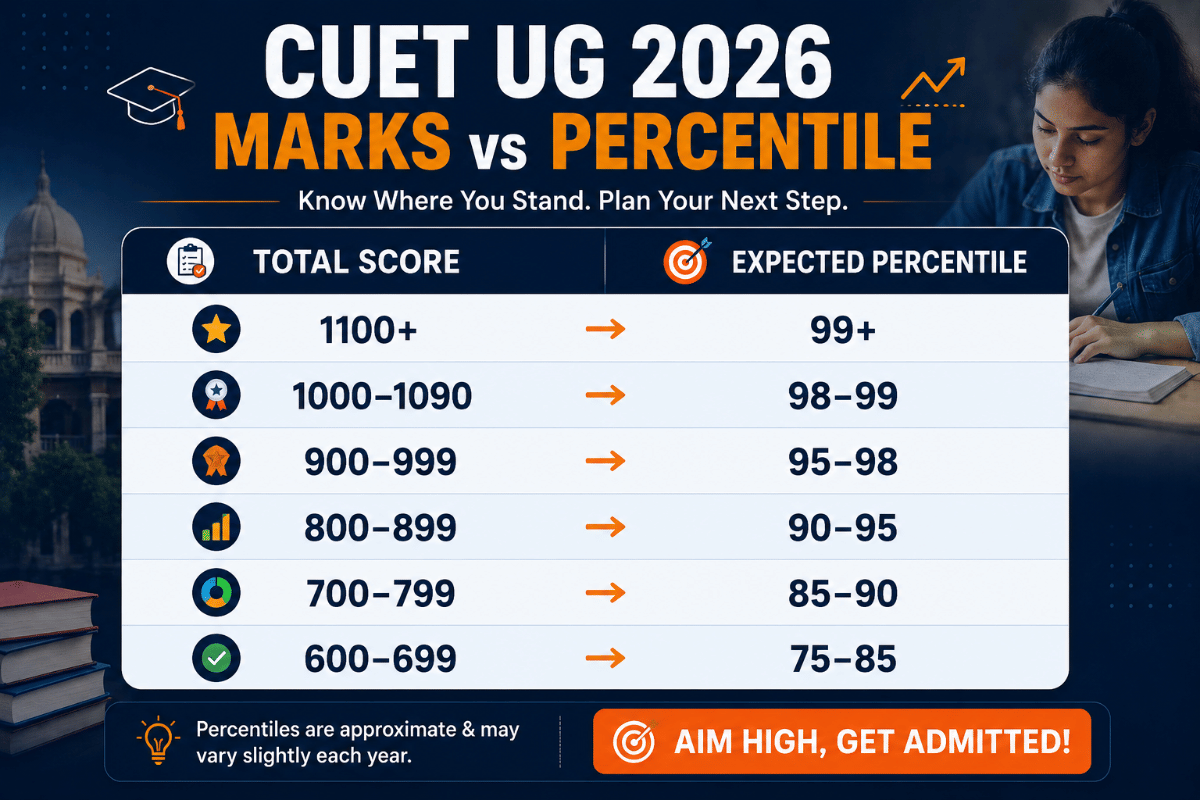
CUET 2026 Marks vs Percentile
The CUET UG 2026 percentile depends on your raw marks and the shift difficulty. The same raw marks can give different percentiles in different shifts. The table below shows the approximate marks vs percentile range based on last year’s pattern.
| Raw Marks (out of 250) | Expected Percentile | Rank Range |
|---|---|---|
| 225-250 | 99.5 - 100 | 1 - 5,000 |
| 200-224 | 98 - 99.4 | 5,001 - 30,000 |
| 180-199 | 96 - 97.9 | 30,001 - 65,000 |
| 160-179 | 93 - 95.9 | 65,001 - 1,10,000 |
| 140-159 | 88 - 92.9 | 1,10,001 - 1,90,000 |
| 120-139 | 80 - 87.9 | 1,90,001 - 3,15,000 |
| 100-119 | 70 - 79.9 | 3,15,001 - 4,70,000 |
| Below 100 | Below 70 | Above 4,70,000 |
These are approximate values. Actual percentile depends on the total candidates in your shift, raw marks distribution and normalisation.
CUET 2026 Counselling Process
NTA does not conduct CUET UG 2026 counselling. Each participating university runs its own counselling using the CUET scorecard. The first counselling round at major universities like DU, BHU, JMI and AMU is expected to begin in the first week of July 2026.
Delhi University CSAS Counselling
Delhi University uses the Common Seat Allocation System (CSAS). The process has three phases:
- Phase 1: Registration on the CSAS portal with CUET application number and scorecard details.
- Phase 2: Programme + College preference filling (you should list as many combinations as possible).
- Phase 3: Seat allotment, document verification, fee payment.
BHU Counselling
BHU releases a separate merit list based on the CUET scorecard. Counselling is held in multiple rounds, with document verification at the campus.
JNU Counselling
JNU runs the JNU Admission Portal (JNUEE) and uses CUET scores for most UG courses. The admission portal usually opens in mid-July.
Documents Required for CUET Counselling
- CUET UG 2026 Scorecard
- Class 10 and Class 12 marksheet and passing certificate
- Category certificate (SC/ST/OBC-NCL/EWS, if applicable)
- PwD certificate (if applicable)
- Aadhaar card and passport-size photographs
- Income certificate for fee waiver schemes
NTA releases the qualifying CUET score, but the actual admission cutoff is set by the participating university. The same scorecard can give different outcomes at different universities.
CUET 2026 Top Participating Universities
More than 230 universities accept CUET UG 2026 scores for UG admissions, including 47 central universities, 30+ state universities and a large number of private and deemed universities. Below is a list of the top participating universities for 2026.
| Category | Top Universities |
|---|---|
| Central Universities | Delhi University (DU), Jawaharlal Nehru University (JNU), Banaras Hindu University (BHU), Jamia Millia Islamia (JMI), Aligarh Muslim University (AMU) |
| University of Hyderabad, Pondicherry University, Allahabad University, Tezpur University, Central University of Punjab | |
| State Universities | Tamil Nadu Open University, Jammu University, Sambalpur University, Devi Ahilya Vishwavidyalaya, Madan Mohan Malviya University |
| Deemed Universities | TISS Mumbai, Gandhi Institute of Technology, Sri Sri University, Shoolini University, Galgotias University |
| Private Universities | Bennett University, Chandigarh University, Lovely Professional University (LPU), SRM University AP, ICFAI Foundation |
You should check each university’s website for the list of courses that accept CUET scores. Some universities like DU, JNU and JMI use CUET for almost every UG programme, while others use it only for selected courses.
CUET 2026 Preparation Tips
Since CUET UG 2026 is now over, these tips are useful for next year’s aspirants and for repeaters who plan to attempt CUET UG 2027. The CUET preparation strategy is different from JEE or NEET because the syllabus is mostly from Class 12 NCERT and the question pattern is straightforward.
- Stick to NCERT: Read your NCERT books for each domain subject line by line. Almost every question is based on the Class 12 NCERT, with very limited Class 11 overlap.
- Plan the section split: Make a separate study plan for the language section, domain subjects and General Test. Each needs different practice material.
- Solve previous year papers: Practise CUET 2022, 2023, 2024 and 2025 question papers. This helps you understand the difficulty, pattern and time required.
- Take mock tests: NTA releases free mock tests on the official portal. You should take at least 15-20 full mocks before the exam.
- Manage negative marking: You lose 1 mark for every wrong answer. If you are not sure of an answer, skip the question instead of guessing.
- Time per question: You have 60 minutes for 50 questions. So plan for around 1 minute per question and 10 minutes for review.
- For General Test: Focus on current affairs of the last 12 months, simple quantitative ability (Class 8-10 maths) and basic reasoning.
- Revise consistently: Revise every chapter at least 3 times before the exam. The CUET syllabus is wide, so regular revision is important.
CUET 2026 FAQs
Ques. When will the CUET UG 2026 result be declared?
Ans. The CUET UG 2026 result is expected between 26 June and 30 June 2026. Some sources also predict the first week of July 2026. The result will be declared at cuet.nta.nic.in after NTA releases the final answer key.
Ques. Has the CUET UG 2026 answer key been released?
Ans. Yes. NTA released the CUET UG 2026 provisional answer key on 9 June 2026, along with the response sheet and question papers. The objection window was open from 9 June to 11 June 2026 and has now closed. The final answer key is expected between 20-25 June 2026.
Ques. What is a good score in CUET 2026?
Ans. A good CUET 2026 score depends on the university you target.
- 200+ out of 250 per subject (98+ percentile) is excellent for DU, JNU and BHU.
- 180-200 (95-98 percentile) is good for most central universities.
- 150-180 (88-95 percentile) is decent for state universities.
Ques. How many candidates appeared for CUET UG 2026?
Ans. More than 15.68 lakh candidates registered for CUET UG 2026. This is the third-largest entrance exam in India by registrations, after NEET UG and JEE Main.
Ques. Is CUET 2026 tough?
Ans. CUET UG 2026 is generally moderate in difficulty because it is based on the NCERT Class 12 syllabus. The competition, however, is very high due to large registration numbers. You should focus on accuracy rather than attempting all 50 questions.
Ques. What is the age limit for CUET 2026?
Ans. There is no age limit to appear for CUET UG 2026. However, some universities may have their own age criteria for specific UG programmes. You should check the university’s prospectus before applying.
Ques. How many subjects can you choose in CUET 2026?
Ans. You can choose a maximum of 5 subjects in CUET UG 2026. This includes any combination of language papers, domain subjects and the General Test, with the total capped at 5. This is a reduction from the earlier cap of 6 subjects.
Ques. Will there be a CUET UG 2026 re-exam?
Ans. NTA has not announced any re-exam for CUET UG 2026. The 28 May 2026 shift was rescheduled within the same exam window due to a change in the Id-ul-Zuha holiday. The exam ended on 31 May 2026 as planned for the remaining shifts.
Ques. Is there negative marking in CUET 2026?
Ans. Yes. CUET UG 2026 has negative marking. You lose 1 mark for every wrong answer, while a correct answer carries +5 marks. There is no penalty for unanswered questions.
Ques. How is CUET UG 2026 normalisation done?
Ans. CUET UG 2026 is held in multiple shifts over many days. To bring all shifts on a common scale, NTA uses percentile normalisation. Your raw marks are converted into an NTA score (percentile) based on your relative performance within your shift.
Ques. Does Delhi University release a separate CUET cutoff?
Ans. No. Delhi University does not release a single CUET cutoff list. Instead, it uses the Common Seat Allocation System (CSAS), which assigns seats based on your CUET percentile and the preferences you fill on the CSAS portal.
Ques. Which universities accept CUET UG 2026 scores?
Ans. More than 230 universities accept CUET UG 2026 scores. This includes 47 central universities like DU, JNU, BHU, JMI, AMU and the University of Hyderabad, as well as state, deemed and private universities like TISS, Bennett University, LPU and Chandigarh University.
Disclaimer: All dates and details mentioned above are based on official NTA notifications and verified sources available as of 13 June 2026. Candidates are advised to check the official CUET website at cuet.nta.nic.in for the latest updates on the result, counselling and university-wise cutoffs.


Comments
Found 868 Comments
Based on your scores (52.8% in PCB and 58.9% overall), you have a solid chance at securing admission to reputable private and state-affiliated agriculture colleges. Consider institutions like Lovely Professional University (LPU), Amity University, Chandigarh University, and GD Goenka University, which offer excellent infrastructure for B.Sc. Agriculture. You can also explore state agriculture universities with management quota seats or college-specific entrance tests. Focus on ICAR-accredited programs to ensure better career and higher education opportunities.
Getting B.Com (Hons) at the BHU Main Campus (Faculty of Commerce) with 429 out of 750 is difficult if you belong to the General, EWS, or OBC categories, where cutoffs stay above 450–500. However, you have an excellent chance for admission into top BHU-affiliated colleges like DAV PG, VCW, or AMPGC.
Securing a top-tier central university like DU or BHU is difficult with a CUET UG score of 233 out of 1000. However, you can still target newer regional central universities, such as the Central Universities of Kashmir, Kerala, or Haryana, for less competitive or vocational programs during later counseling rounds.
Yes, you can secure a seat in a central university, but you must target lower-competition options. While top universities like DU or BHU require much higher marks, regional central universities (like the Central Universities of Kashmir, Kerala, or South Bihar) and specialized vocational courses accept scores in this range, especially during spot counseling rounds.
Government law colleges admitting undergraduate students through CUET UG (like BHU or Allahabad University) require at least 350 to 550+ marks out of 650/1250 for their BA LLB programs. A total language and GAT score of 200 makes securing a seat in premium government institutions highly difficult, but you can target lower-tier state or private universities.
Getting a government college depends on your normalized score, subject combinations, and category rank. Since NTA doesn't give a single overall rank, each university creates its own merit list based on your CUET scores for their specific course criteria, making your seat allocation dependent on those individual rank cut-offs.
A score of 498 across five subjects is competitive. For medical/allied health programs like BSc Biomedical Science, Biochemistry, or Microbiology, your main subject combination (like Physics, Chemistry, Biology) will dictate your rank. You have solid chances at mid-tier Delhi University colleges, Banaras Hindu University (BHU), Central University of Rajasthan, and Jamia Hamdard.
With a score of 231/500 in English and the General Test, admission into top-tier central universities like DU for Journalism or BHU for Psychology is difficult. However, you stand a good chance at state and private institutions like Dr. B.R. Ambedkar University Delhi, Sharda University, and Galgotias University.
A score of 154.75 out of 750 makes it highly difficult to secure high-demand honors courses in top-tier central universities. However, past cutoffs show that students with similar scores successfully cleared spot rounds for off-campus Delhi University colleges (like Aditi Mahavidyalaya or Deshbandhu) in specific language or niche B.A. programs, or targeted regional state universities and private colleges.
You can check here for the CUET 2025 question paper available: Download subject-wise question paper with solutions. CUET UG 2025 has 37 subjects (13 Languages, 23 Domain Subjects, 1 General Test), out of which candidates can choose a maximum of 5 subjects.
The official CUET 2026 B.Sc cutoff for Dr. Harisingh Gour Vishwavidyalaya has not been released yet. Based on previous trends, B.Sc Biology cutoff may remain around 300–340 marks, while B.Sc Mathematics can be around 150–200 marks. Cutoffs vary by category, course demand, and counselling rounds.
For 99 percentile in CUET UG 2026, you need around 190–200 marks out of 200 per subject in Physics, Chemistry, and Mathematics. This means attempting almost all questions correctly with very high accuracy. Exact cutoffs vary yearly based on difficulty level and competition.
For B.Sc Mathematics admission at University of Allahabad through CUET UG, marks are considered from Mathematics domain subject, plus Language (English/Hindi), and sometimes General Test. Your CUET score combination and merit list decide selection, depending on university criteria.
Admission to B.Sc Biotechnology through the Common University Entrance Test (CUET-UG) requires students to first register online on the official CUET portal. After appearing for the exam, universities release cut-offs and merit lists based on CUET scores. Qualified candidates participate in university counselling, verify documents, and complete fee payment to confirm admission.
To get admission in B.Sc Biotechnology through the Common University Entrance Test, choose Biology as your domain subject, English as the language test, and appear for the General Test (Mental Aptitude). After the exam, apply to participating universities, check cut-offs, and complete counselling and document verification for seat allotment.
If you are a PCB student and want to pursue Arts through CUET, you can choose subjects based on the course requirements of the university. Generally, you may appear in CUET with your Class 12 science subjects or select Arts subjects like History or Geography, depending on the eligibility criteria.