CUET Economics Question Paper 2024 (Set C) is available for download here. NTA conducted CUET 2024 Economics paper on 16 May in Shift 1A from 10 AM to 11 AM. CUET Economics Question Paper 2024 is based on objective-type questions (MCQs). Candidates get 60 minutes to solve 40 MCQs out of 50 in CUET 2024 question paper for Economics.
Download CUET 2025 Question Paper with Solution PDFs
CUET Economics Question Paper 2024 Set C PDF Download
CUET Economics Question Paper with Answer Key and Solution
1. Casualization of the workforce would result in:
- (1) Decrease in the vulnerability of the workforce.
- (2) Increase in the vulnerability of the workforce.
- (3) Increase in the number of regular workers.
- (4) Income and employment stability.
Correct Answer: (2) Increase in vulnerability of the workplace
View Solution
2. Choose the correct chronological sequence in ascending order (earliest to latest):
- (1) (A), (B), (C), (D)
- (2) (A), (C), (B), (D)
- (3) (D), (A), (B), (C)
- (4) (D), (C), (A), (B)
3. Under flexible exchange rate, when the price of domestic currency in terms of foreign currency increases, it is called:
- (1) Depreciation of domestic currency
- (2) Appreciation of domestic currency
- (3) Devaluation of domestic currency
- (4) Revaluation of domestic currency
Correct Answer: (2) Appreciation of domestic currency
View Solution
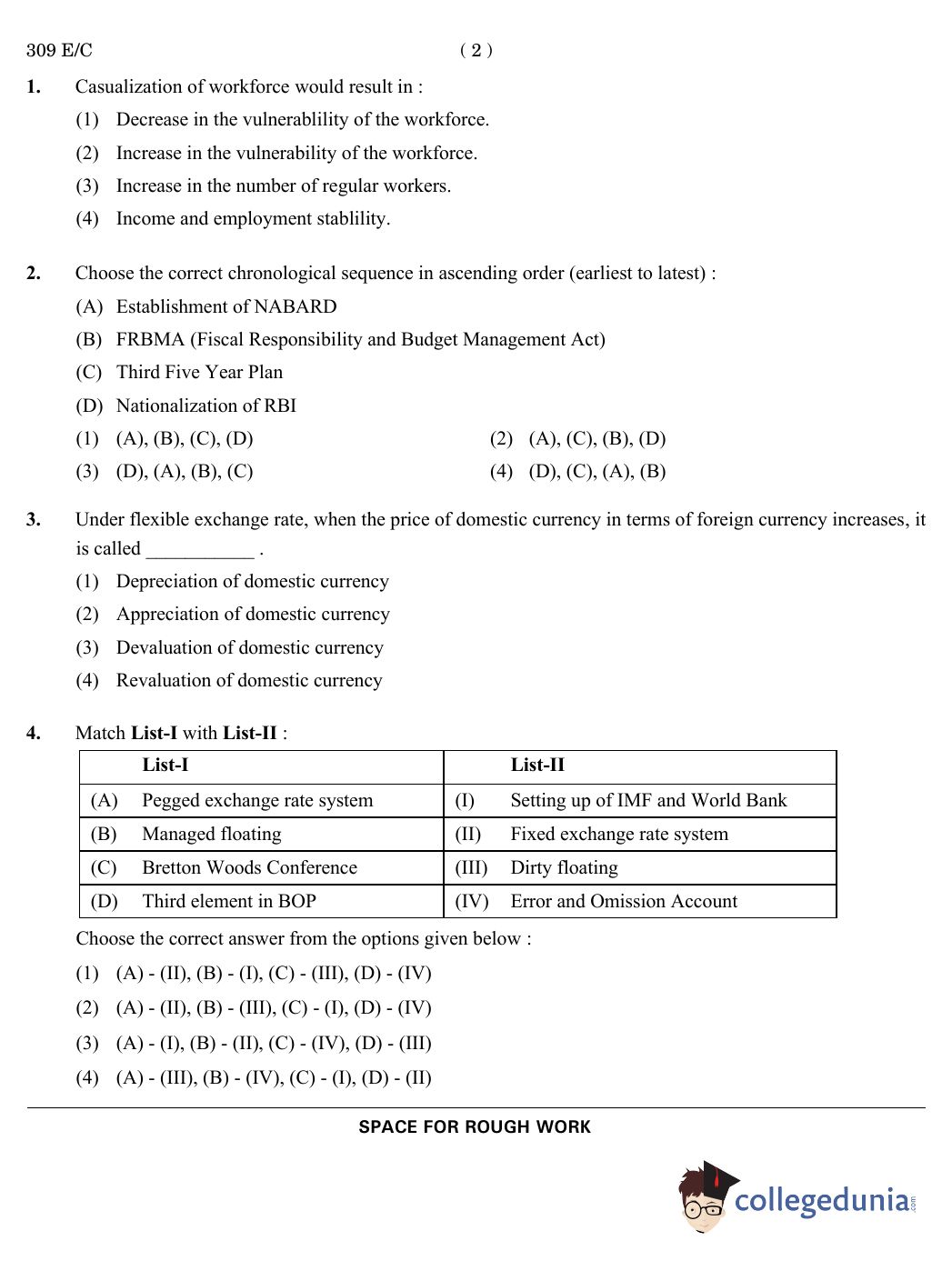
4. Match List-I with List-II:
![]()
Choose the correct answer from the options given below :
- (1) (A) - (II), (B) - (I), (C) - (III), (D) - (IV)
- (2) (A) - (II), (B) - (III), (C) - (I), (D) - (IV)
- (3) (A) - (I), (B) - (II), (C) - (IV), (D) - (III)
- (4) (A) - (III), (B) - (IV), (C) - (I), (D) - (II)
Correct Answer: (2) (A) - (II), (B) - (III), (C) - (I), (D) - (IV)
View Solution
5. __________ implies that resource extraction is not above the rate of regeneration of resources and the wastes generated are within the assimilating capacity of the environment.
- (1) Absorptive capacity
- (2) Carrying capacity
- (3) Subsistence capacity
- (4) Exhaustive capacity
6. The Government of India enacted the Right to Education Act in 2009 to make free education a Fundamental Right of all children in the age group of __________ years.
- (1) 4 – 10
- (2) 6 – 12
- (3) 6 – 14
- (4) 8 – 15
7. Following are the sources of electricity generation in India. Arrange them in correct sequence on the basis of total power generation capacity (higher to lower):
(A) Nuclear
(B) Thermal
(C) New and renewable energy
(D) Hydro
- (1) (A), (B), (C), (D)
- (2) (A), (C), (B), (D)
- (3) (B), (C), (D), (A)
- (4) (B), (D), (C), (A)
8. Arrange the following items in the correct sequence:
(A) Competition Act
(B) FEMA
(C) FERA
(D) MRTP
Choose the correct answer from the options given below :
- (1) (A), (B), (C), (D)
- (2) (A), (C), (B), (D)
- (3) (D), (C), (B), (A)
- (4) (C), (B), (D), (A)
9. The Great Leap Forward (GLF) campaign was initiated in __________.
Options:
- (1) 1948
- (2) 1938
- (3) 1958
- (4) 1942
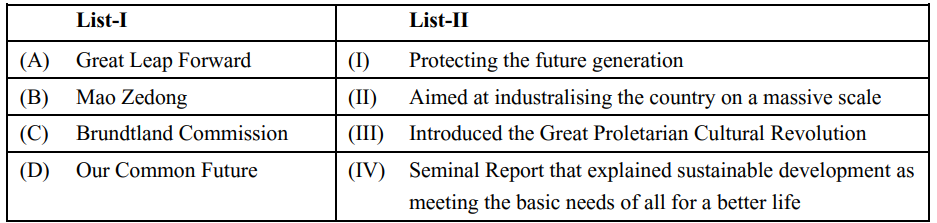
10. Match List-I with List-II:
![]()
Choose the correct answer from the options given below :
- (1) (A) - (I), (B) - (III), (C) - (IV), (D) - (II)
- (2) (A) - (II), (B) - (III), (C) - (I), (D) - (IV)
- (3) (A) - (I), (B) - (III), (C) - (IV), (D) - (III)
- (4) (A) - (III), (B) - (IV), (C) - (I), (D) - (II)
Correct Answer: (2) (A) - (II), (B) - (III), (C) - (I), (D) - (IV)
View Solution
11. The second phase of the Green Revolution is termed from:
- (1) mid 1960s to mid 1970s
- (2) mid 1970s to mid 1980s
- (3) mid 1950s to mid 1960s
- (4) mid 1980s to mid 1990s
12. During the 1980s, the growth rate in Pakistan improved on account of which of the following reasons?
- (1) Institutionalised process of technical change
- (2) A good harvest
- (3) Sustainable export of manufactured goods
- (4) High amount of foreign direct investment inflow
13. When there is an unexpected rise in sales __________.
- (1) Aggregate demand would decline.
- (2) There will be unplanned accumulation of inventories.
- (3) There will be unplanned decumulation of inventories.
- (4) Normal profit would be lower
Correct Answer: (3) There will be unplanned decumulation of inventories.
View Solution
An unexpected rise in sales leads to a depletion of inventory as more goods are sold than anticipated.
14. During the festive season, the currency deposit ratio __________.
- (1) decreases
- (2) increases
- (3) has no impact on it
- (4) first decreases then increases
15. European Monetary Union was created in __________.
- (1) 1996
- (2) 1994
- (3) 1999
- (4) 2002
16. Identify the correct statement in the context of Circular Flow of Income in a two-sector economy:
- (1) Household receives factor services from firms.
- (2) Household invests while firm saves.
- (3) Firms produce goods and services.
- (4) Household supplies factor services to Government
Correct Answer: (3) Firms produce goods and services
View Solution
17. Identify the correct set of statements:
(A) Ex Ante Saving represents what is actually planned to save.
(B) Ex Post Saving represents what is actually planned to save.
(C) Ex Post Saving depicts what has actually happened.
(D) Ex Ante Post Saving represents what is actually saved.
Choose the correct answer from the options given below :
- (1) (A) and (D) only
- (2) (A) and (C) only
- (3) (B) and (D) only
- (4) (C) and (D) only
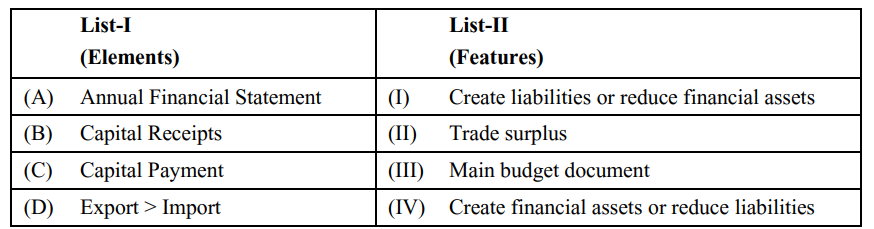
18. Match List-I with List-II:
![]()
- (1) (A) - (I), (B) - (II), (C) - (III), (D) - (IV)
- (2) (A) - (III), (B) - (I), (C) - (IV), (D) - (II)
- (3) (A) - (I), (B) - (II), (C) - (IV), (D) - (III)
- (4) (A) - (III), (B) - (IV), (C) - (I), (D) - (II)
Correct Answer: (2) (A) - (III), (B) - (I), (C) - (IV), (D) - (II)
View Solution
Read the following passage and answer the next five questions :
In our quest to increase agricultural production during the last five decades or so, we almost totally neglected the use of compost and completely switched over to chemical fertilizers. The result is that large tracts of productive land have been adversely affected, water bodies including ground water system have suffered due to chemical contamination and demand for irrigation has been going up year after year. Farmers, in large numbers all over the country, have again started using compost made from organic wastes of different types. In certain parts of the country, cattle are maintained only because they produce dung which is an important fertilizer and soil conditioner. Earthworms can convert organic matter into compost faster than the normal composting process. This process is now being widely used. Indirectly, the civic authorities are benefitted too as they have to dispose reduced quantity of waste.
19. How is civic authority getting benefited due to biocomposting?
- (1) They have to dispose increased quantity of waste.
- (2) They don’t have to dispose any waste.
- (3) Because civic authority has no role in waste management.
- (4) They have to dispose reduced quantity of waste.
Correct Answer: (4) They have to dispose reduced quantity of waste.
View Solution
20. Choose the correct statement concerned with the passage:
- (1) Earthworm takes equal time to convert organic matter into compost with respect to normal composting process.
- (2) Earthworm takes more time to convert organic matter into compost with respect to normal composting process.
- (3) Earthworm takes less time to convert organic matter into compost with respect to normal composting process.
- (4) Comparison between earthworm based composting and normal composting cannot be made.
Correct Answer: (3) Earthworm takes less time to convert organic matter into compost with respect to normal composting process.
View Solution
21. Water bodies, including the groundwater system, have suffered due to:
- (1) Biocomposting
- (2) Chemical contamination and increased demand for irrigation
- (3) Organic farming
- (4) Increased fertility of land
Correct Answer: (2) Chemical contamination and increased demand for irrigation
View Solution
22. In certain parts of the country, cattle are maintained only because they __________.
- (1) Produce milk to increase income of farmers
- (2) Produce dung which is an important fertilizer and soil conditioner
- (3) Work as insect repellants
- (4) Are a symbol of traditional ethics and values
Correct Answer: (2) Produce dung which is an important fertilizer and soil conditioner
View Solution
Read the following passage and answer the next five questions.
India had an independent economy before the advent of the British rule. Though agriculture was the main source of livelihood for most people, yet, the country’s economy was characterised by various kinds of manufacturing activities. India was particularly well known for its handicraft industries in the fields of cotton and silk textiles, metal and precious stone works etc. These products enjoyed a worldwide market based on the reputation of the fine quality of material used and the high standards of craftsmanship seen in all imports from India. The economic policies pursued by the colonial government in India were concerned more with the protection and promotion of the economic interests of their home country than with the development of the Indian economy. Such policies brought about a fundamental change in the structure of the Indian economy — transforming the country into a supplier of raw materials and consumer of finished industrial products from Britain. Obviously, the colonial government never made any sincere attempt to estimate India’s national and per capita income. Some individual attempts which were made to measure such incomes yielded conflicting and inconsistent results. Among the notable estimators — Dadabhai Naoroji, William Digby, Findlay Shirras, V.K.R.V. Rao and R.C. Desai — it was Rao, whose estimates during the colonial period were considered very significant. However, most studies did find that the country’s growth of aggregate real output during the first half of the twentieth century was less than two per cent coupled with a meagre half per cent growth in per capita output per year.
23. What should be the suitable title for the above passage?
- (1) Biocomposting
- (2) Biopest Control
- (3) Traditional Knowledge and Practice
- (4) Uses of Chemical Fertilizers
24. Before the British rule, India was well known for which manufacturing industries’ products?
- (1) Cotton and Silk or Khadi textiles
- (2) Cotton and Engineering products
- (3) Cotton and Silk textiles, metal and precious stones, etc
- (4) Engineering goods and precious metals
Correct Answer: (3) Cotton and Silk textiles, metal, and precious stones, etc.
View Solution
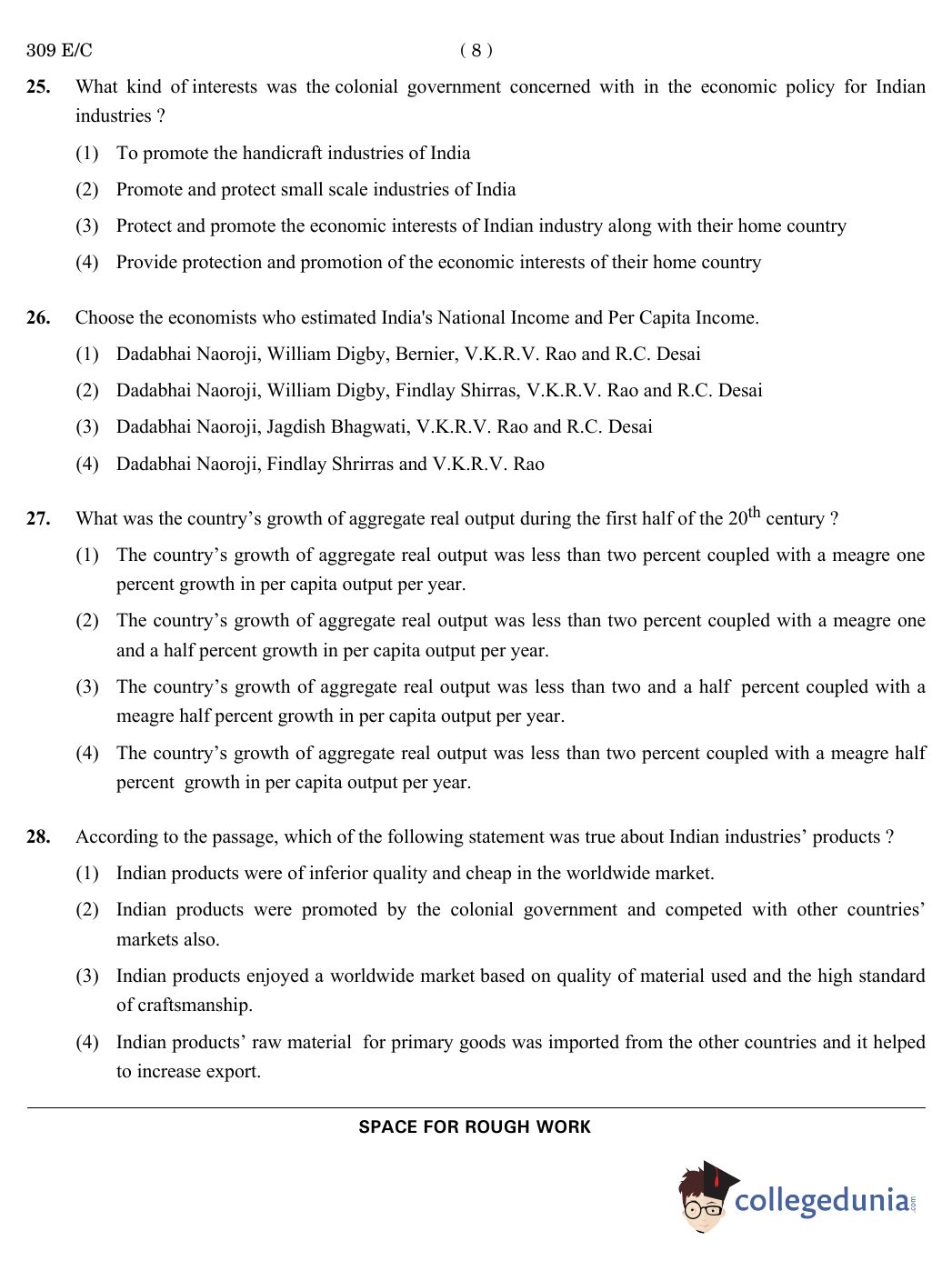
25. What kind of interests was the colonial government concerned with in the economic policy for Indian industries?
- (1) To promote the handicraft industries of India
- (2) Promote and protect small scale industries of India
- (3) Protect and promote the economic interests of Indian industry along with their home country
- (4) Provide protection and promotion of the economic interests of their home country
Correct Answer: (4) Provide protection and promotion of the economic interests of their home country
View Solution
26. Choose the economists who estimated India's National Income and Per Capita Income:
- (1) Dadabhai Naoroji, William Digby, Bernier, V.K.R.V. Rao and R.C. Desai
- (2) Dadabhai Naoroji, William Digby, Findlay Shirras, V.K.R.V. Rao and R.C. Desai
- (3) Dadabhai Naoroji, Jagdish Bhagwati, V.K.R.V. Rao and R.C. Desai
- (4) Dadabhai Naoroji, Findlay Shrirras and V.K.R.V. Rao
Correct Answer: (2) Dadabhai Naoroji, William Digby, Findlay Shirras, V.K.R.V. Rao, and R.C. Desai
View Solution
27. What was the country’s growth of aggregate real output during the first half of the 20th century?
- (1) The country’s growth of aggregate real output was less than two percent coupled with a meagre one percent growth in per capita output per year.
- (2) The country’s growth of aggregate real output was less than two percent coupled with a meagre one and a half percent growth in per capita output per year.
- (3) The country’s growth of aggregate real output was less than two and a half percent coupled with a meagre half percent growth in per capita output per year.
- (4) The country’s growth of aggregate real output was less than two percent coupled with a meagre half percent growth in per capita output per year.
Correct Answer: (4) The country’s growth of aggregate real output was less than two percent coupled with a meagre half percent growth in per capita output per year.
View Solution
28. According to the passage, which of the following statements was true about Indian industries’ products?
- (1) Indian products were of inferior quality and cheap in the worldwide market.
- (2) Indian products were promoted by the colonial government and competed with other countries’ markets also.
- (3) Indian products enjoyed a worldwide market based on quality of material used and the high standard of craftsmanship.
- (4) Indian products’ raw material for primary goods was imported from the other countries and it helped to increase export.
Correct Answer: (3) Indian products enjoyed a worldwide market based on quality of material used and the high standard of craftsmanship.
View Solution
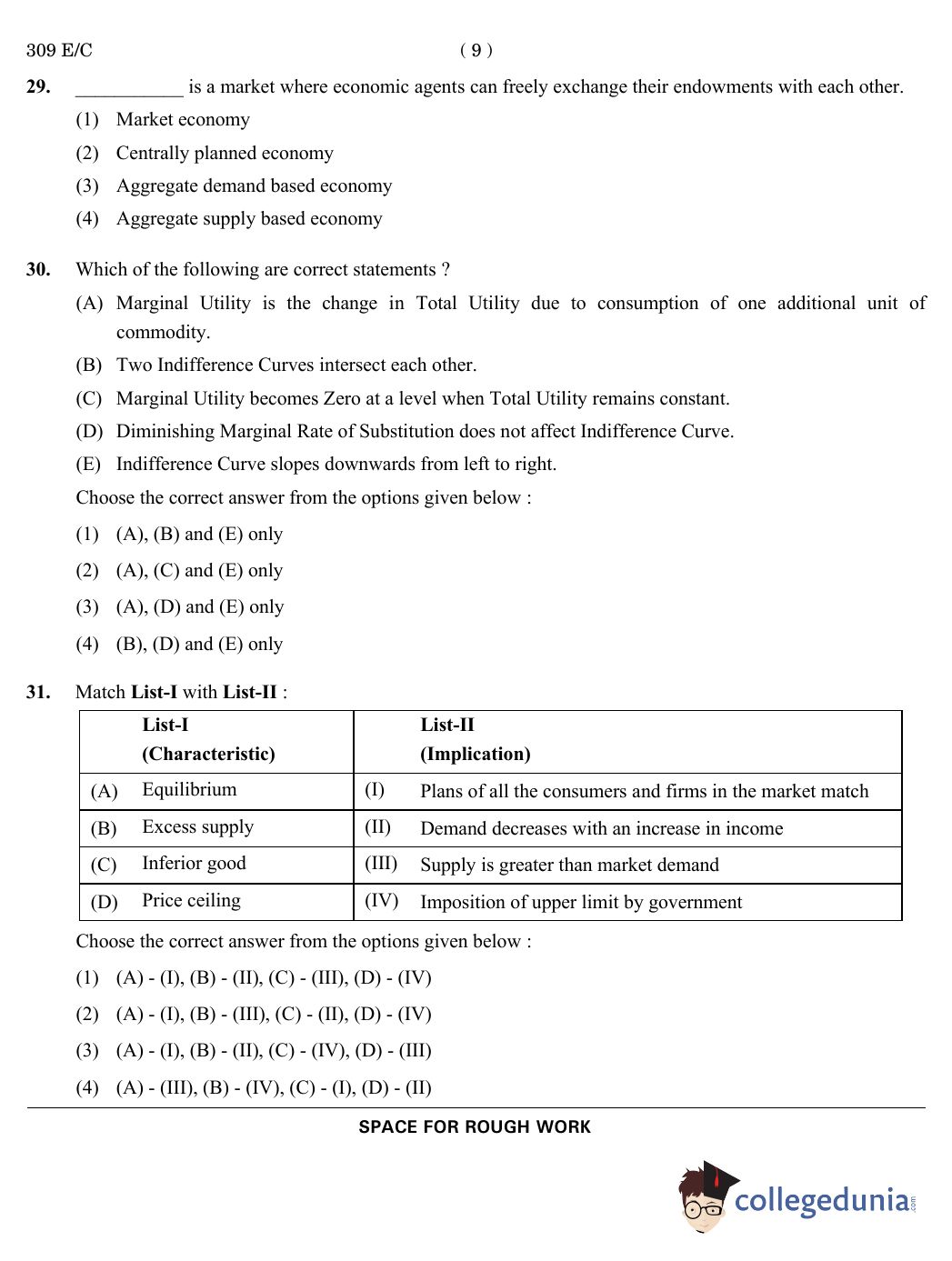
29. ___________ is a market where economic agents can freely exchange their endowments with each other.
- (1) Market economy
- (2) Centrally planned economy
- (3) Aggregate demand based economy
- (4) Aggregate supply based economy
30. Which of the following are correct statements?
(A) Marginal Utility is the change in Total Utility due to consumption of one additional unit of commodity.
(B) Two Indifference Curves intersect each other.
(C) Marginal Utility becomes Zero at a level when Total Utility remains constant.
(D) Diminishing Marginal Rate of Substitution does not affect Indifference Curve.
(E) Indifference Curve slopes downwards from left to right.
Choose the correct answer from the options given below :
- (1) (A), (B) and (E) only
- (2) (A), (C) and (E) only
- (3) (A), (D) and (E) only
- (4) (B), (D) and (E) only
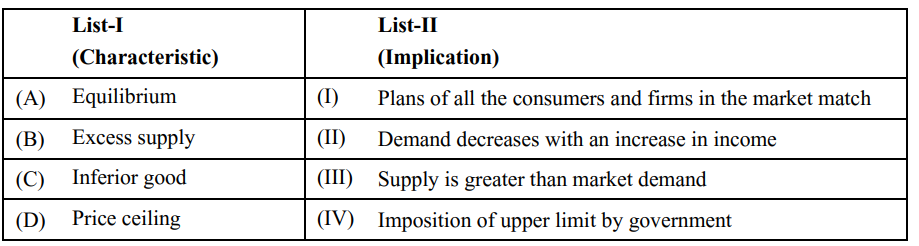
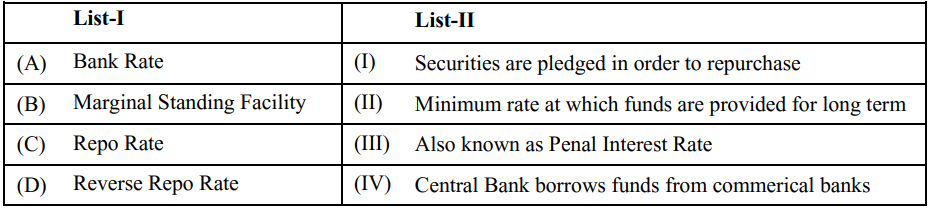
31. Match List-I with List-II:
![]()
- (1) (A) - (I), (B) - (II), (C) - (III), (D) - (IV)
- (2) (A) - (I), (B) - (III), (C) - (II), (D) - (IV)
- (3) (A) - (I), (B) - (II), (C) - (IV), (D) - (III)
- (4) (A) - (III), (B) - (IV), (C) - (I), (D) - (II)
Correct Answer: (2) (A) - (I), (B) - (III), (C) - (II), (D) - (IV)
View Solution
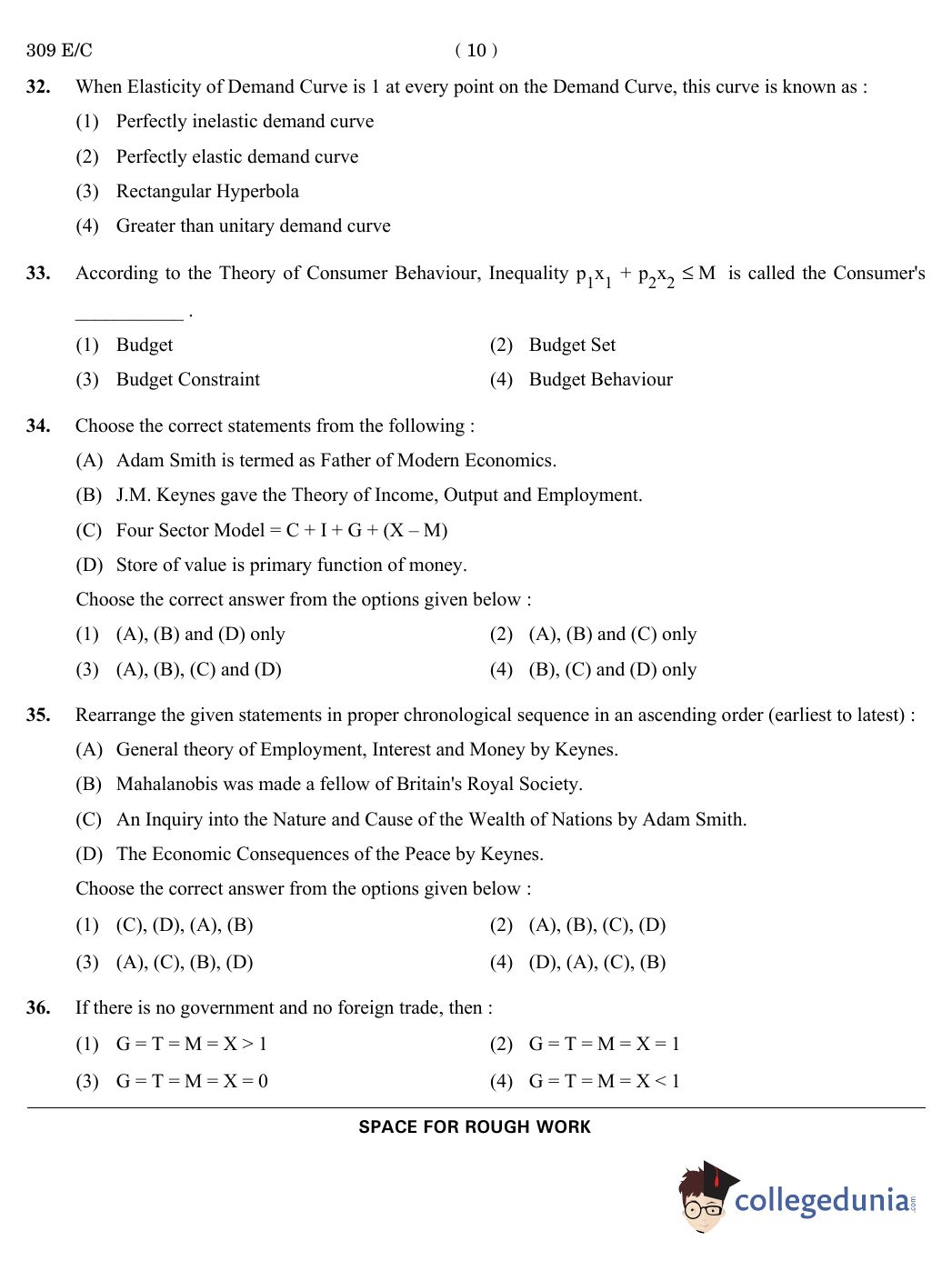
32. When the Elasticity of Demand Curve is 1 at every point on the Demand Curve, this curve is known as:
Options:
- (1) Perfectly inelastic demand curve
- (2) Perfectly elastic demand curve
- (3) Rectangular Hyperbola
- (4) Greater than unitary demand curve
33. According to the Theory of Consumer Behaviour, the inequality p1 x1 + p2 x2 ≤ is called the Consumer's __________.
- (1) Budget
- (2) Budget Set
- (3) Budget Constraint
- (4) Budget Behaviour
Correct Answer: (3) Budget Constraint
View Solution
This inequality represents the budget constraint, showing the combinations of goods a consumer can afford given their income and the prices of goods.
34. Choose the correct statements from the following :
(A) Adam Smith is termed as Father of Modern Economics.
(B) J.M. Keynes gave the Theory of Income, Output and Employment.
(C) Four Sector Model = C + I + G + (X – M)
(D) Store of value is primary function of money.
Choose the correct answer from the options given below :
- (1) (A), (B) and (D) only
- (2) (A), (B) and (C) only
- (3) (A), (B), (C) and (D)
- (4) (B), (C) and (D) only
35. Rearrange the given statements in proper chronological sequence in an ascending order (earliest to latest) :
(A) General theory of Employment, Interest and Money by Keynes.
(B) Mahalanobis was made a fellow of Britain's Royal Society.
(C) An Inquiry into the Nature and Cause of the Wealth of Nations by Adam Smith.
(D) The Economic Consequences of the Peace by Keynes.
Choose the correct answer from the options given below :
- (1) (C), (D), (A), (B)
- (2) (A), (B), (C), (D)
- (3) (A), (C), (B), (D)
- (4) (D), (A), (C), (B)
36. If there is no government and no foreign trade, then:
- (1) G = T = M = X > 1
- (2) G = T = M = X = 1
- (3) G = T = M = X = 0
- (4) G = T = M = X < 1
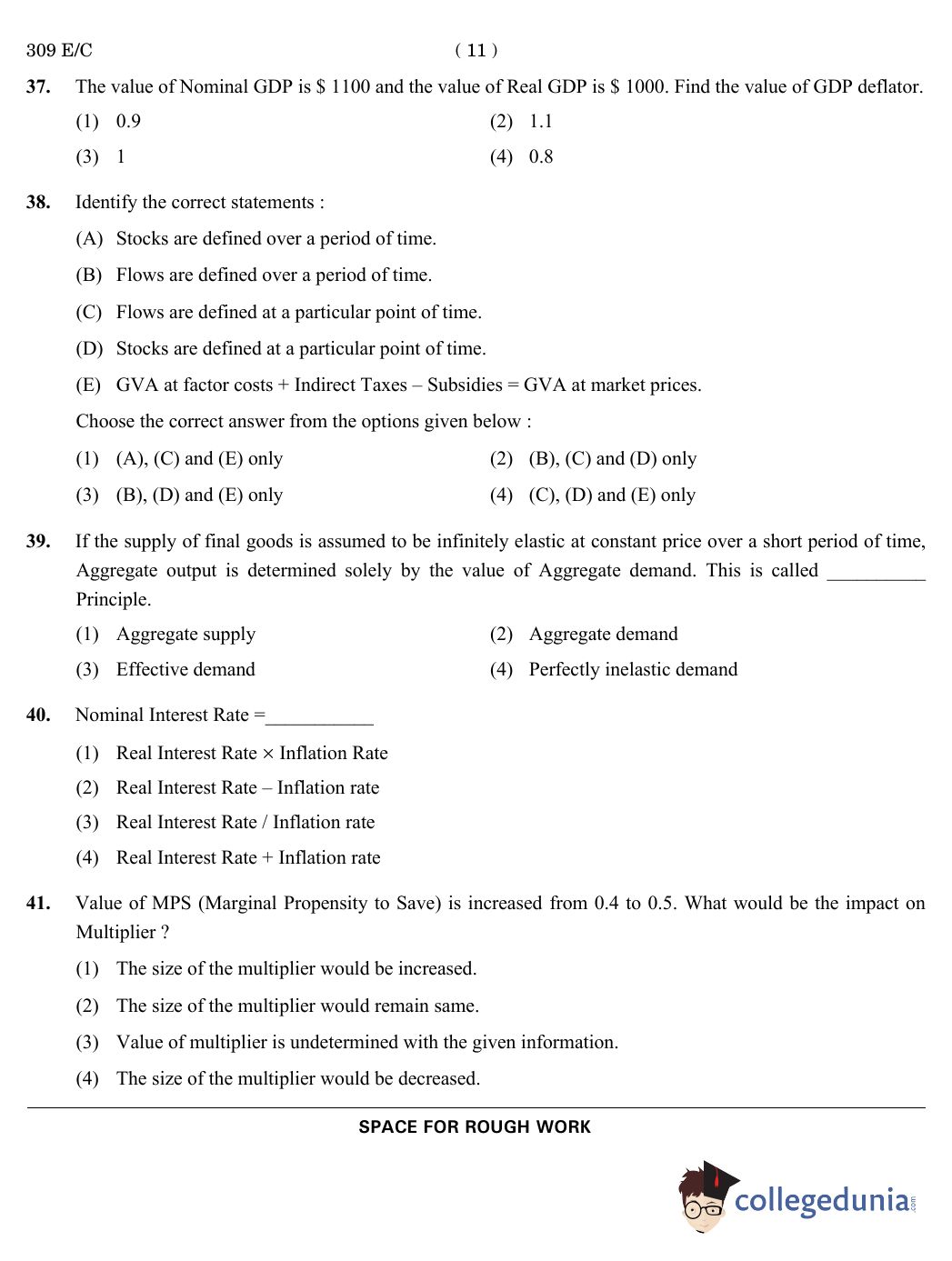
37. The value of Nominal GDP is $1100 and the value of Real GDP is $1000. Find the value of GDP deflator:
- (1) 0.9
- (2) 1.1
- (3) 1
- (4) 0.8
38. Identify the correct statements:
(A) Stocks are defined over a period of time.
(B) Flows are defined over a period of time.
(C) Flows are defined at a particular point of time.
(D) Stocks are defined at a particular point of time.
(E) GVA at factor costs + Indirect Taxes – Subsidies = GVA at market prices.
Choose the correct answer from the options given below :
- (1) (A), (C) and (E) only
- (2) (B), (C) and (D) only
- (3) (B), (D) and (E) only
- (4) (C), (D) and (E) only
39. If the supply of final goods is assumed to be infinitely elastic at constant price over a short period of time, Aggregate output is determined solely by the value of Aggregate demand. This is called __________ Principle.
- (1) Aggregate supply
- (2) Aggregate demand
- (3) Effective demand
- (4) Perfectly inelastic demand
40. Nominal Interest Rate = ___________
- (1) Real Interest Rate * Inflation Rate
- (2) Real Interest Rate – Inflation rate
- (3) Real Interest Rate / Inflation rate
- (4) Real Interest Rate + Inflation rate
Correct Answer: (4) Real Interest Rate + Inflation rate
View Solution
41. Value of MPS (Marginal Propensity to Save) is increased from 0.4 to 0.5. What would be the impact on Multiplier?
- (1) The size of the multiplier would be increased.
- (2) The size of the multiplier would remain same.
- (3) Value of multiplier is undetermined with the given information.
- (4) The size of the multiplier would be decreased.
Correct Answer: (4) The size of the multiplier would be decreased
View Solution
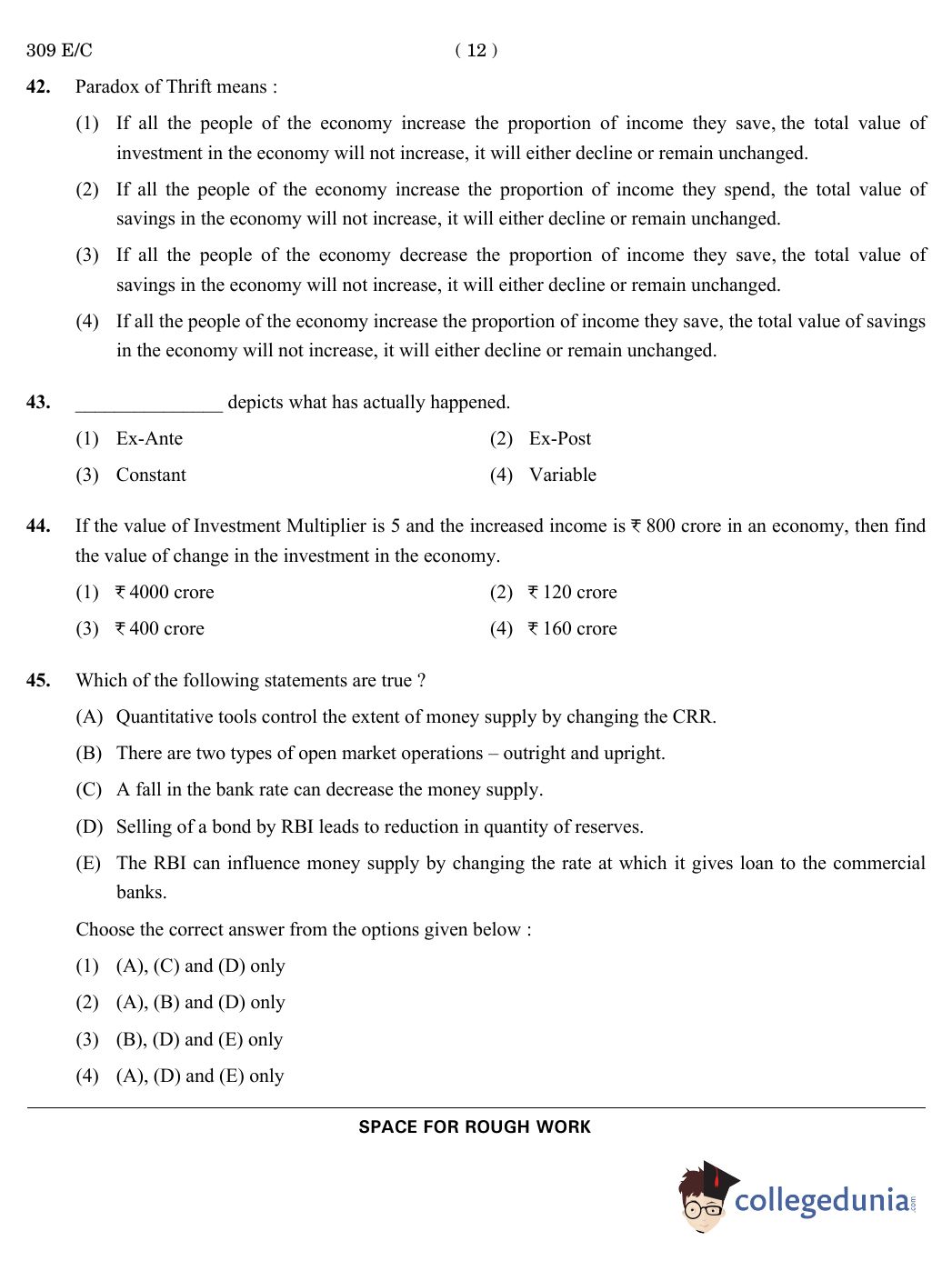
42. Paradox of Thrift means:
- (1) If all the people of the economy increase the proportion of income they save, the total value of investment in the economy will not increase, it will either decline or remain unchanged.
- (2) If all the people of the economy increase the proportion of income they spend, the total value of savings in the economy will not increase, it will either decline or remain unchanged.
- (3) If all the people of the economy decrease the proportion of income they save, the total value of savings in the economy will not increase, it will either decline or remain unchanged.
- (4) If all the people of the economy increase the proportion of income they save, the total value of savings in the economy will not increase, it will either decline or remain unchanged.
Correct Answer: (4) If all the people of the economy increase the proportion of income they save, the total value of savings in the economy will not increase, it will either decline or remain unchanged.
View Solution
43. What depicts what has actually happened?
- (1) Ex-Ante
- (2) Ex-Post
- (3) Prediction
- (4) Forecast
44. If the value of Investment Multiplier is 5 and the increased income is ₹800 crore, then find the value of change in the investment in the economy.
Options:
- (1) ₹4000 crore
- (2) ₹120 crore
- (3) ₹400 crore
- (4) ₹160 crore
45. Which of the following statements are true?
(A) Quantitative tools control the extent of money supply by changing the CRR.
(B) There are two types of open market operations – outright and upright.
(C) A fall in the bank rate can decrease the money supply.
(D) Selling of a bond by RBI leads to reduction in quantity of reserves.
(E) The RBI can influence money supply by changing the rate at which it gives loan to the commercial banks. Choose the correct answer from the options given below :
- (1) (A), (C), and (D)
- (2) (A), (B), and (D)
- (3) (B), (D), and (E)
- (4) (A), (D), and (E)
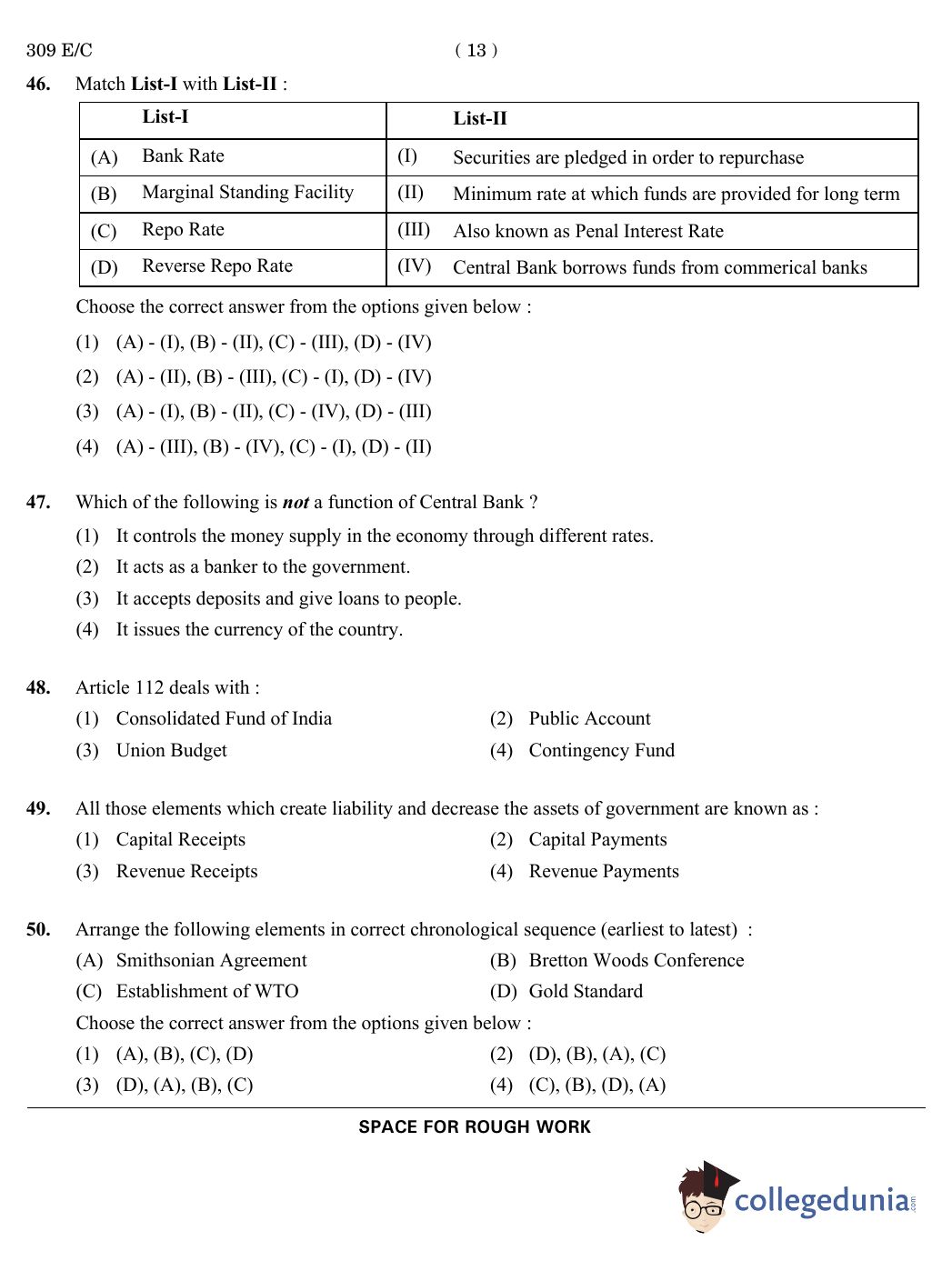
46. Match List-I with List-II:
![]()
- (1) (A) - (I), (B) - (II), (C) - (III), (D) - (IV)
- (2) (A) - (II), (B) - (III), (C) - (I), (D) - (IV)
- (3) (A) - (I), (B) - (II), (C) - (IV), (D) - (III)
- (4) (A) - (III), (B) - (IV), (C) - (I), (D) - (II)
Correct Answer: (2) (A) - (II), (B) - (III), (C) - (I), (D) - (IV)
View Solution
47. Which of the following is not a function of the Central Bank?
- (1) It controls the money supply in the economy through different rates.
- (2) It acts as a banker to the government
- (3) It accepts deposits and gives loans to people
- (4) It issues the currency of the country.
Correct Answer: (3) It accepts deposits and gives loans to people.
View Solution
48. Article 112 of the Indian Constitution deals with:
- (1) Consolidated Fund of India
- (2) Public Account
- (3) Union Budget
- (4) Contingency Fund
49. All those elements which create liability and decrease the assets of government are known as:
- (1) Capital Receipts
- (2) Capital Payments
- (3) Revenue Receipts
- (4) Revenue Payments
50. Arrange the following elements in correct chronological sequence (earliest to latest):
(A) Smithsonian Agreement
(B) Bretton Woods Conference
(C) Establishment of WTO
(D) Gold Standard
Choose the correct answer from the options given below :
- (1) (A), (B), (C), (D)
- (2) (D), (B), (A), (C)
- (3) (D), (A), (B), (C)
- (4) (C), (B), (D), (A)





 Download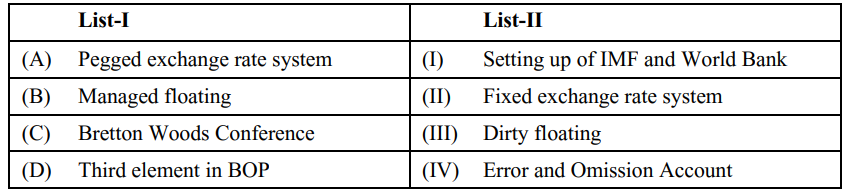





Comments