




CUET History Question Paper 2024 is available here for download. NTA conducted CUET 2024 History paper on 18 May in Shift 1A from 1:30 PM to 2:15 PM. CUET History Question Paper 2024 is based on objective-type questions (MCQs). Candidates get 45 minutes to solve 40 MCQs out of 50 in CUET 2024 question paper for History.
CUET History Question Paper 2024 PDF Download
| CUET History Question Paper 2024 Set A |  Download Download |
Check Solution |
| CUET History Question Paper 2024 Set B | Download |
Check Solution |
| CUET History Question Paper 2024 Set C | Download |
Check Solution |
| CUET History Question Paper 2024 Set D | Download |
Check Solution |
| CUET History Online Question Paper 2024 | Download |
Check Solution |
CUET History Question Paper 2024 (Set A) Solutions
The Draft Constitution of India had how many volumes?
View Solution
There was substantial agreement among the leaders on one central feature of the Constitution. It was _______.
View Solution
The Indian Constitution adopted the principle of universal adult suffrage, ensuring voting rights to every adult Indian irrespective of caste, gender, or literacy.
During the Salt Satyagraha, who persuaded Gandhiji not to restrict the protests to men alone?
View Solution
Kamaladevi Chattopadhyay played a pivotal role in encouraging Gandhiji to allow women's participation in the Salt Satyagraha, marking a significant step toward women's involvement in the freedom struggle.
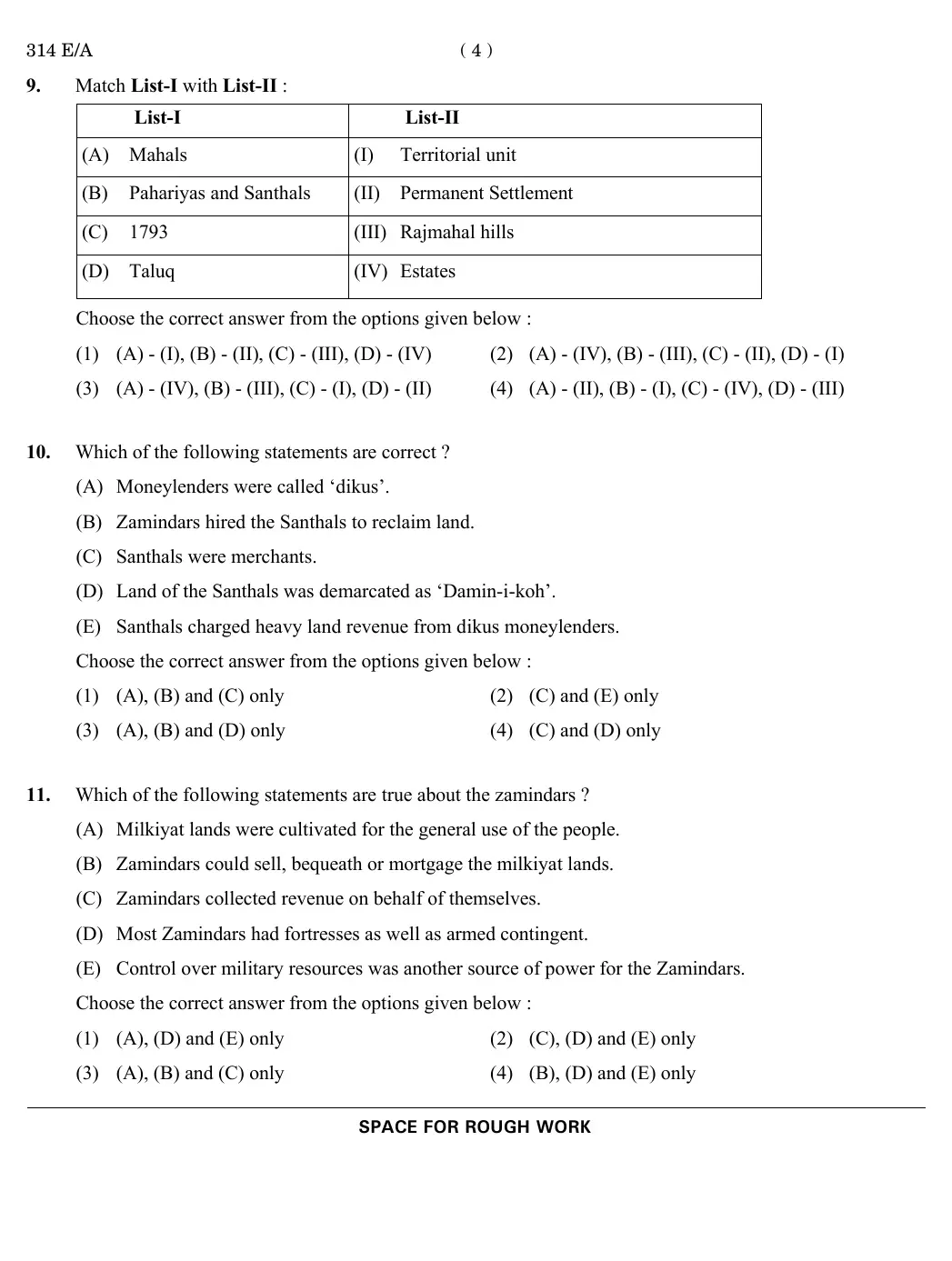
Match List-I with List-II:
List-I
List-II
Choose the correct answer from the options given below:
View Solution
The mutinous Sepoys arrived at the gates of the Red Fort early in the morning on ______.
View Solution
The revolt of 1857 began on 10 May in Meerut, and the sepoys reached the Red Fort in Delhi early on the morning of 11 May 1857.
During 1857 taluqdars and peasants carried out intense and long-lasting resistance in ______.
View Solution
Awadh witnessed some of the most intense resistance during the 1857 Revolt, particularly by taluqdars and peasants under leaders like Begum Hazrat Mahal.
Match List-I with List-II:
List-I
List-II
Choose the correct answer from the options given below:
View Solution
Karaikkal Ammaiyar was a devotee of _______ adopted the path of extreme asceticism in order to attain her goal.
View Solution
Francis Buchanan’s survey of _______ district in North Bengal gave us a vivid description of the rich peasants known as jotedars.
View Solution
Francis Buchanan conducted detailed surveys of districts in Bengal and Bihar. His survey of Dinajpur provided insights into rural social structures, including the role of jotedars—wealthy peasants.
The _______ stated that if payment did not come in by sunset of the specified date, the zamindari was liable to be auctioned.
View Solution
The Sunset Law required zamindars to pay revenue to the British by sunset on a fixed date. If they failed, their land was auctioned. It was a harsh regulation under the Permanent Settlement system.
Which leader demanded justice for women, not reserved seats or separate electorates?
View Solution
Hansa Mehta was a member of the Constituent Assembly and a prominent advocate for women's rights. She insisted on equal justice for women rather than token representation through reservations or separate electorates.
The Constitution of India, which came into effect on 26th January 1950, has the distinction of being ______ in the world.
View Solution
The Constitution of India is the longest written constitution of any sovereign country in the world. It originally had 395 Articles in 22 Parts and 8 Schedules.
The protests in the Punjab became particularly intense after the institution of which act?
View Solution
The Rowlatt Act of 1919 allowed the British government to arrest and detain individuals without trial, sparking widespread protests, particularly in Punjab, culminating in the Jallianwala Bagh massacre.
Name the symbol of the freedom movement that could make the poor earn supplementary income and make them self-reliant.
View Solution
The Charkha (spinning wheel) was promoted by Mahatma Gandhi as a symbol of self-reliance and swadeshi. It encouraged the poor to spin khadi and earn income independently.
"Relief of Lucknow" was painted by:
View Solution
The Governor General who introduced Enfield rifles using greased cartridges was ________.
View Solution
The introduction of the Enfield rifle with cartridges believed to be greased with cow and pig fat led to resentment among Indian sepoys and was a major trigger for the Revolt of 1857. Lord Hardinge was the Governor-General around this time.
Nayanars were devotees of which God?
View Solution
The Nayanars were a group of Tamil Shaivite saints devoted to Lord Shiva, known for their poetry and intense devotion during the bhakti movement in South India.
Where was Fort St. George located?
View Solution
Fort St. George, the first English fortress in India, was established in Madras (now Chennai) in 1644 by the British East India Company.
Ajita Kesakambalin was a ________.
View Solution
Match List-I with List-II:
List-I
List-II
Choose the correct answer from the options given below:
View Solution
Who said separate electorates was a "poison that has entered the body politic of country" during the Constituent Assembly debates?
View Solution
Sardar Vallabhbhai Patel opposed the idea of separate electorates in post-independence India and referred to it as "poison that has entered the body politic."
_________ was sent from Britain to India to try and forge a compromise with Gandhiji and Indian National Congress.
View Solution
Stafford Cripps came to India in 1942 with the Cripps Mission to negotiate support for British efforts in World War II in exchange for post-war dominion status, which was rejected by Indian leaders.
Match List-I with List-II:
List-I
List-II
Choose the correct answer from the options given below:
View Solution
Arrange the following in a chronological order:
- (A) Rani Jhansi killed in battle
- (B) British suffer defeat in the Battle of Chinhat
- (C) Shah Mal killed in battle
- (D) Rising in Lucknow
- (E) British forces under Havelock and Outram enter the Residency in Lucknow
Choose the correct answer from the options given below:
View Solution
Rani of Jhansi was represented as a ________ figure chasing the enemy, slaying British soldiers and valiantly fighting till her last.
View Solution
Rani of Jhansi is portrayed in nationalist literature and folklore as a heroic figure who fearlessly led troops against the British during the 1857 revolt.
Match List-I with List-II:
List-I
List-II
Choose the correct answer from the options given below:
View Solution
Subsidiary Alliance system was introduced by ________:
View Solution
Virupaksha, the guardian deity of Vijayanagara Kingdom, is also recognized as a form of:
View Solution
Which traveller described the hilly zone as impenetrable and dangerous in 19th century Bengal?
View Solution
Francis Buchanan described parts of Bengal, especially hilly areas, as dangerous and difficult to penetrate, based on his survey expeditions during British rule.
Who wrote the Memoir “Love is stronger than Hate: A Remembrance of 1947”?
View Solution
Khushdeva Singh, a physician and humanitarian, wrote this memoir recalling his efforts to provide care and aid to refugees during Partition with compassion and without bias.
Hastinapur is in which modern district?
View Solution
Jagannath temple is located at:
View Solution
Match List-I with List-II:
List-I
List-II
Choose the correct answer from the options given below:
View Solution
Match List-I with List-II:
List-I
List-II
Choose the correct answer from the options given below:
View Solution
The first detailed photographs of Hampi archaeological remains were taken by:
View Solution
Who among the following was associated with critical edition of the Mahabharata?
View Solution
V.S. Sukthankar was the General Editor of the Critical Edition of the Mahabharata, which was compiled at the Bhandarkar Oriental Research Institute, Pune.
Vijayanagara was noted for its market dealing in:
Choose the correct answer from the options given below:
View Solution
Lord Buddha belonged to which clan?
View Solution
Lord Buddha, also known as Siddhartha Gautama, was born into the Sakya clan of the Kshatriya varna in the region of Lumbini (modern-day Nepal).
Which of the following statements are correct?
Choose the correct answer from the options given below:
View Solution
Choose the correct answer from the following options:
Choose the correct answer from the options given below:
View Solution
Who was often addressed as the father of Indian Archaeology?
View Solution
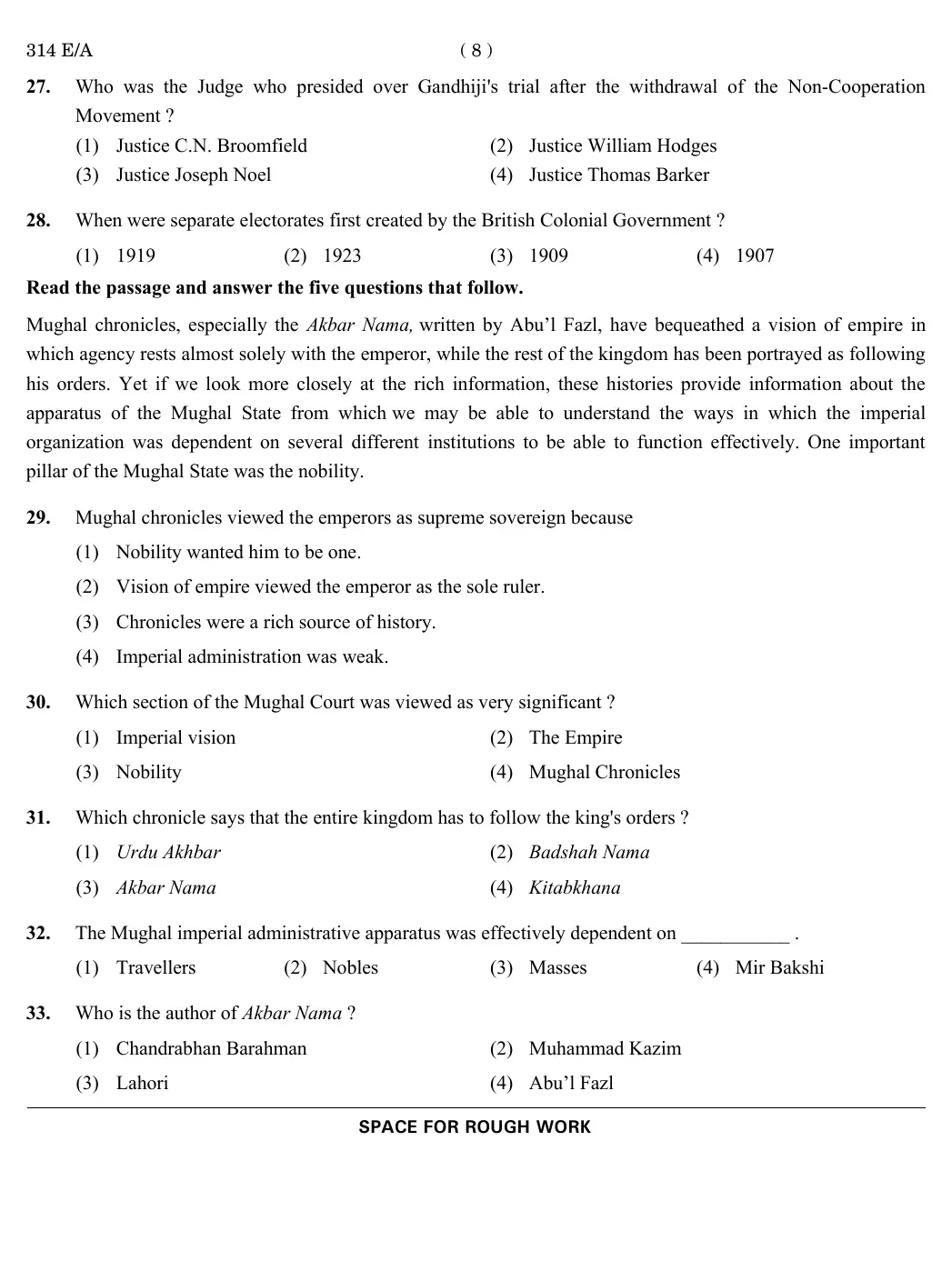
Read the passage below and answer the question:
Although Harappa was the first site to be discovered, it was badly destroyed by brick robbers. As early as 1875, Alexander Cunningham, the first Director-General of the Archaeological Survey of India, often called the father of Indian archaeology, noted that the amount of bricks taken from the ancient site was enough to lay bricks for “about 100 miles” of the railway line between Lahore and Multan. Thus, many of the ancient structures at the site were damaged. In contrast, Mohenjodaro was far better preserved.
Which of the following was the first site to be discovered?View Solution
Read the passage below and answer the question:
Although Harappa was the first site to be discovered, it was badly destroyed by brick robbers. As early as 1875, Alexander Cunningham, the first Director-General of the Archaeological Survey of India, often called the father of Indian archaeology, noted that the amount of bricks taken from the ancient site was enough to lay bricks for “about 100 miles” of the railway line between Lahore and Multan. Thus, many of the ancient structures at the site were damaged. In contrast, Mohenjodaro was far better preserved.
Who was the first Director-General of the Archaeological Survey of India (ASI)?View Solution
Read the passage below and answer the question:
Although Harappa was the first site to be discovered, it was badly destroyed by brick robbers. As early as 1875, Alexander Cunningham, the first Director-General of the Archaeological Survey of India, often called the father of Indian archaeology, noted that the amount of bricks taken from the ancient site was enough to lay bricks for “about 100 miles” of the railway line between Lahore and Multan. Thus, many of the ancient structures at the site were damaged. In contrast, Mohenjodaro was far better preserved.
Who destroyed the Harappan site?View Solution
Read the passage below and answer the question:
Although Harappa was the first site to be discovered, it was badly destroyed by brick robbers. As early as 1875, Alexander Cunningham, the first Director-General of the Archaeological Survey of India, often called the father of Indian archaeology, noted that the amount of bricks taken from the ancient site was enough to lay bricks for “about 100 miles” of the railway line between Lahore and Multan. Thus, many of the ancient structures at the site were damaged. In contrast, Mohenjodaro was far better preserved.
Harappan civilization bricks were used for the laying of railway line between:View Solution
Read the passage and answer the question:
Shah Jahan pursued sound fiscal policies and accumulated enough money to indulge his passion for building. Building activity in the monarchical cultures, as in the case of earlier rulers, was the most visible and tangible sign of dynastic power, wealth and prestige. In the case of Muslim rulers, it was also considered an act of piety. In 1648, the court, army and household moved from Agra to the newly completed imperial capital, Shahjahanabad. It was a new addition to the old residential city of Delhi, with the Red Fort, Jama Masjid, a tree-lined esplanade with Chandni Chowk.
Shah Jahan’s new city was more appropriate as a formal vision of a grand monarchy because:View Solution
Read the passage and answer the question:
Shah Jahan pursued sound fiscal policies and accumulated enough money to indulge his passion for building. Building activity in the monarchical cultures, as in the case of earlier rulers, was the most visible and tangible sign of dynastic power, wealth and prestige. In the case of Muslim rulers, it was also considered an act of piety. In 1648, the court, army and household moved from Agra to the newly completed imperial capital, Shahjahanabad. It was a new addition to the old residential city of Delhi, with the Red Fort, Jama Masjid, a tree-lined esplanade with Chandni Chowk.
Building activity under Shah Jahan was the most visible sign of ________.View Solution
Read the passage and answer the question:
Shah Jahan pursued sound fiscal policies and accumulated enough money to indulge his passion for building. Building activity in the monarchical cultures, as in the case of earlier rulers, was the most visible and tangible sign of dynastic power, wealth and prestige. In the case of Muslim rulers, it was also considered an act of piety. In 1648, the court, army and household moved from Agra to the newly completed imperial capital, Shahjahanabad. It was a new addition to the old residential city of Delhi, with the Red Fort, Jama Masjid, a tree-lined esplanade with Chandni Chowk.
Shah Jahan followed sound fiscal policies for his passion in ________.View Solution
Read the passage and answer the question:
Shah Jahan pursued sound fiscal policies and accumulated enough money to indulge his passion for building. Building activity in the monarchical cultures, as in the case of earlier rulers, was the most visible and tangible sign of dynastic power, wealth and prestige. In the case of Muslim rulers, it was also considered an act of piety. In 1648, the court, army and household moved from Agra to the newly completed imperial capital, Shahjahanabad. It was a new addition to the old residential city of Delhi, with the Red Fort, Jama Masjid, a tree-lined esplanade with Chandni Chowk.
The court, army and household moved from Agra to the Imperial Capital ________ in 1648.View Solution
Read the passage and answer the question:
Shah Jahan pursued sound fiscal policies and accumulated enough money to indulge his passion for building. Building activity in the monarchical cultures, as in the case of earlier rulers, was the most visible and tangible sign of dynastic power, wealth and prestige. In the case of Muslim rulers, it was also considered an act of piety. In 1648, the court, army and household moved from Agra to the newly completed imperial capital, Shahjahanabad. It was a new addition to the old residential city of Delhi, with the Red Fort, Jama Masjid, a tree-lined esplanade with Chandni Chowk.
Building activity in case of Muslim rulers was also considered an act of ________.View Solution












Comments