




CUET History Question Paper 2024 (Set A) is available here now. NTA conducted CUET 2024 History paper on 18 May in Shift 1A from 1:30 PM to 2:15 PM. CUET History Question Paper 2024 is based on objective-type questions (MCQs). Candidates get 45 minutes to solve 40 MCQs out of 50 in CUET 2024 question paper for History.
Download CUET 2025 Question Paper with Solution PDFs
CUET History Question Paper 2024 (Set A) PDF Download
| CUET 2024 History Question Paper Set A with Answer Key |  Download Download |
Check Solution |
CUET History Question Paper 2024 (Set A) Solution
Which Sufi teacher was also known as the 'Gharib Nawaz'?
(1) Shaikh Nizamuddin Auliya
(2) Khwaja Muinuddin
(3) Amir Khusrau
(4) Shaikh Qutbuddin Bakhtiyar Kaki
View Solution
Lord Jagannatha is a form of which God?
(1) Surya
(2) Vishnu
(3) Shiva
(4) Brahma
View Solution
Which among the following travellers visited the city of Vijayanagara during the 15th century?
(A) Domingo Paes
(B) Abdur Razzaq
(C) Afanasii Nikitin
(D) Fernao Nuniz
(E) Nicolo de Conti
Choose the correct answer from the options given below:
View Solution
Madras, Bombay and Calcutta were the anglicised names of _________ where the British first set up trading posts.
View Solution
Which of the following statements are correct?
(A) Guru Arjan compiled Guru Nanak's hymns in the Adi Granth Sahib.
(B) Guru Tegh Bahadur laid the foundation of the Khalsa Panth.
(C) Guru Nanak composed the Guru Granth Sahib.
(D) Mirabai was a Maratha princess.
(E) Mirabai was a Rajput princess.
Choose the correct answer from the options given below:
View Solution
Match List-I with List-II:
(A) Terracotta models of plough (I) Kalibangan
(B) Ploughed field (II) Shortughai
(C) Traces of canals (III) Dholavira
(D) Water reservoirs (IV) Cholistan
Choose the correct answer from the options given below:
View Solution
Who, amongst the following, founded the Vijayanagara Empire?
(1) Krishnadeva Raya
(2) Harihara and Bukka
(3) Raja Raya
(4) Rajendra II
View Solution
Match List-I with List-II:
(A) Shell (I) Shortughai
(B) Lapis-Lazuli (II) Nageshwar
(C) Carnelian (III) South Rajasthan
(D) Steatite (IV) Lothal
Choose the correct answer from the options given below:
View Solution
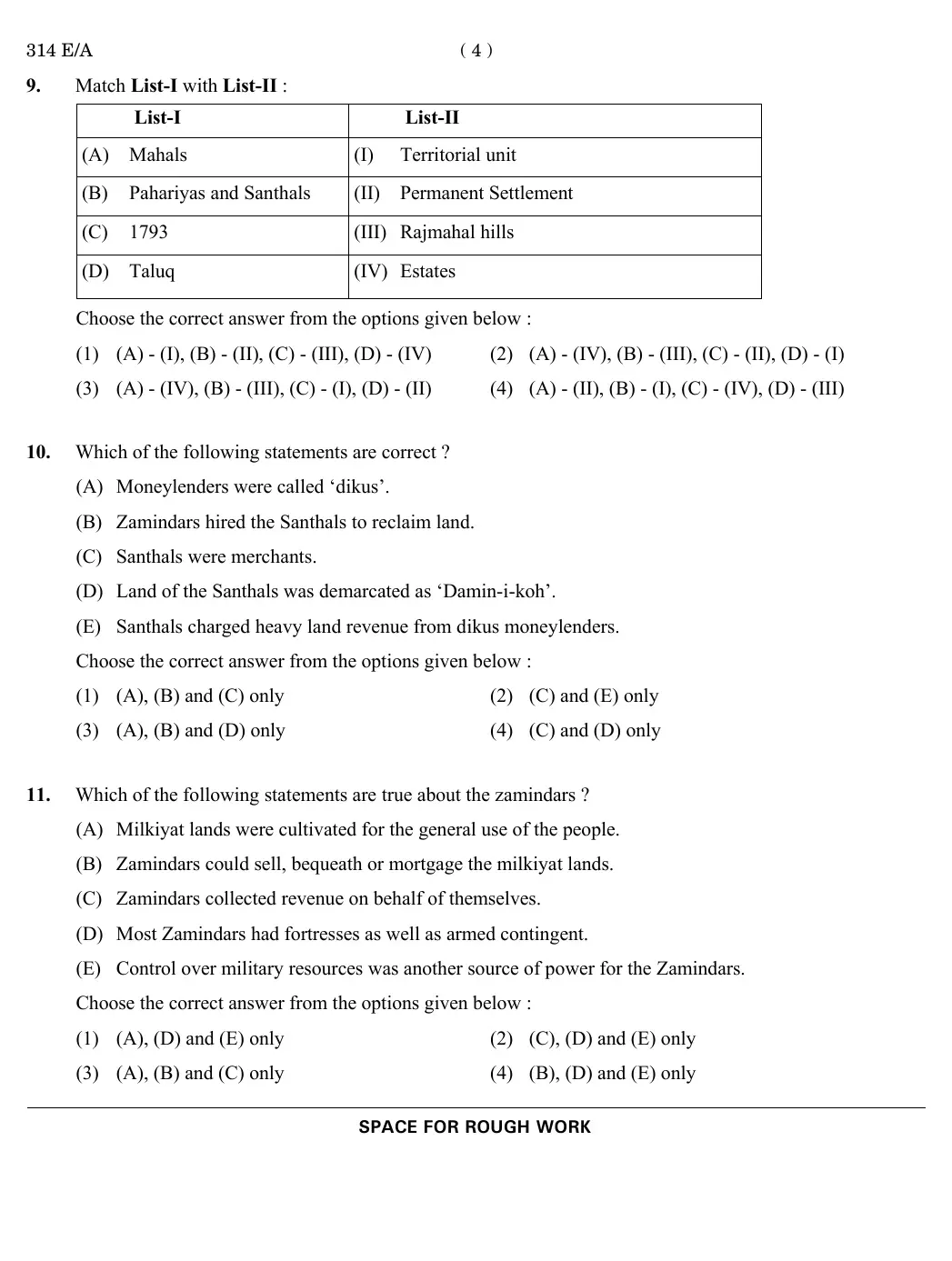
Match List-I with List-II:
(A) Mahals (I) Territorial unit
(B) Pahariyas and Santhals (II) Permanent Settlement
(C) 1793 (III) Rajmahal hills
(D) Taluq (IV) Estates
Choose the correct answer from the options given below:
View Solution
Which of the following statements are correct?
(A) Moneylenders were called 'dikus'.
(B) Zamindars hired the Santhals to reclaim land.
(C) Santhals were merchants.
(D) Land of the Santhals was demarcated as ‘Damin-i-koh'.
(E) Santhals charged heavy land revenue from dikus moneylenders.
Choose the correct answer from the options given below:
View Solution
Which of the following statements are true about the zamindars?
(A) Milkiyat lands were cultivated for the general use of the people.
(B) Zamindars could sell, bequeath or mortgage the milkiyat lands.
(C) Zamindars collected revenue on behalf of themselves.
(D) Most Zamindars had fortresses as well as armed contingents.
(E) Control over military resources was another source of power for the Zamindars.
Choose the correct answer from the options given below:
View Solution
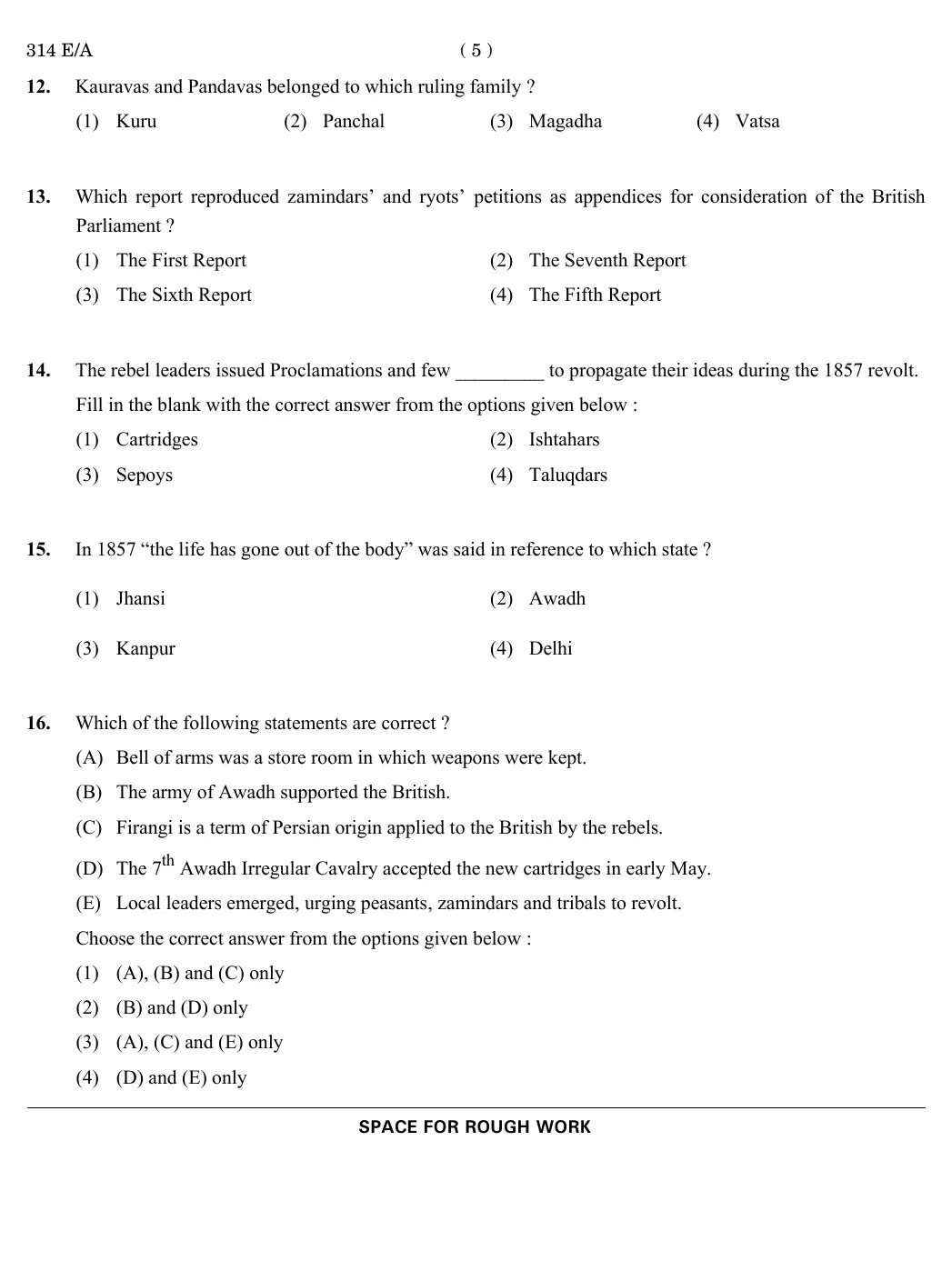
Kauravas and Pandavas belonged to which ruling family?
(1) Kuru
(2) Panchal
(3) Magadha
(4) Vatsa
View Solution
Which report reproduced zamindars' and ryots' petitions as appendices for consideration of the British Parliament?
(1) The First Report
(2) The Seventh Report
(3) The Sixth Report
(4) The Fifth Report
View Solution
The rebel leaders issued Proclamations and few ___________ to propagate their ideas during the 1857 revolt.
Fill in the blank with the correct answer from the options given below:
View Solution
In 1857 “the life has gone out of the body" was said in reference to which state?
(1) Jhansi
(2) Awadh
(3) Kanpur
(4) Delhi
View Solution
Which of the following statements are correct?
(A) Bell of arms was a store room in which weapons were kept.
(B) The army of Awadh supported the British.
(C) Firangi is a term of Persian origin applied to the British by the rebels.
(D) The 7th Awadh Irregular Cavalry accepted the new cartridges in early May.
(E) Local leaders emerged, urging peasants, zamindars and tribals to revolt.
Choose the correct answer from the options given below:
View Solution
Match List-I with List-II:
(A) Nana Sahib (I) Awadh
(B) Rani LakshmiBai (II) Arrah
(C) Kunwar Singh (III) Kanpur
(D) Birjis Qadr (IV) Jhansi
Choose the correct answer from the options given below:
View Solution
Who was the leader of the Santhal Revolt of 1855-56?
(1) Birsa Munda
(2) Gonoo
(3) Sidhu Manjhi
(4) Shah Mal
View Solution
Who fought in the famous Battle of Chinhat in which the British forces under Henry Lawrence were defeated?
(1) Shah Mal
(2) Maulvi Ahmadullah Shah
(3) Birjis Qadr
(4) Kunwar Singh
View Solution
Who was the Commissioner of Lucknow when the rebels besieged it during the Revolt of 1857?
(1) Colin Campbell
(2) Henry Lawrence
(3) James Outram
(4) Henry Havelock
View Solution
The Sunset Law was associated with __________.
(1) Zamindari System/Permanent Settlement
(2) British Navy
(3) Imperial Court
(4) Freedom Movement
View Solution
During his 'Salt March' Gandhiji began walking towards the ocean from his ashram, located at
(1) Ahmedabad
(2) Sabarmati
(3) Wardha
(4) Kochrab
View Solution
Mahatma Gandhi's Salt March was notable as the first nationalist activity focused on
(1) Women
(2) Lord Irwin
(3) Subhas Chandra Bose
(4) 15 March, 1930
View Solution
"Purna Swaraj" as the goal of nationalism in India was aimed to achieve __________.
(1) Partial freedom
(2) Complete independence
(3) Indian identity
(4) Partition
View Solution
Which of the following statements of Gandhiji made at the opening of Banaras Hindu University are true?
(A) Gandhiji charged the Indian elite with a lack of concern for the laboring poor.
(B) Gandhiji was not worried about the contrast between the "richly bedecked noblemen" and millions of poor Indians.
(C) Gandhiji said, “Our salvation can only come through lawyers, doctors, and rich landlords."
(D) Gandhiji emphasized that farmers are going to secure the salvation of India.
(E) Gandhiji told the privileged invitees, “Strip yourself of this jewelry and hold it in trust for your countrymen.”
Choose the correct answer from the options given below:
View Solution
Match List-I with List-II:
(A) Khilafat Movement (I) Mahatma Gandhi's biographer
(B) Jallianwala Bagh Massacre (II) Turkish ruler
(C) Kemal Ataturk (III) 1919
(D) Louis Fisher (IV) 1919-1920
Choose the correct answer from the options given below:
View Solution
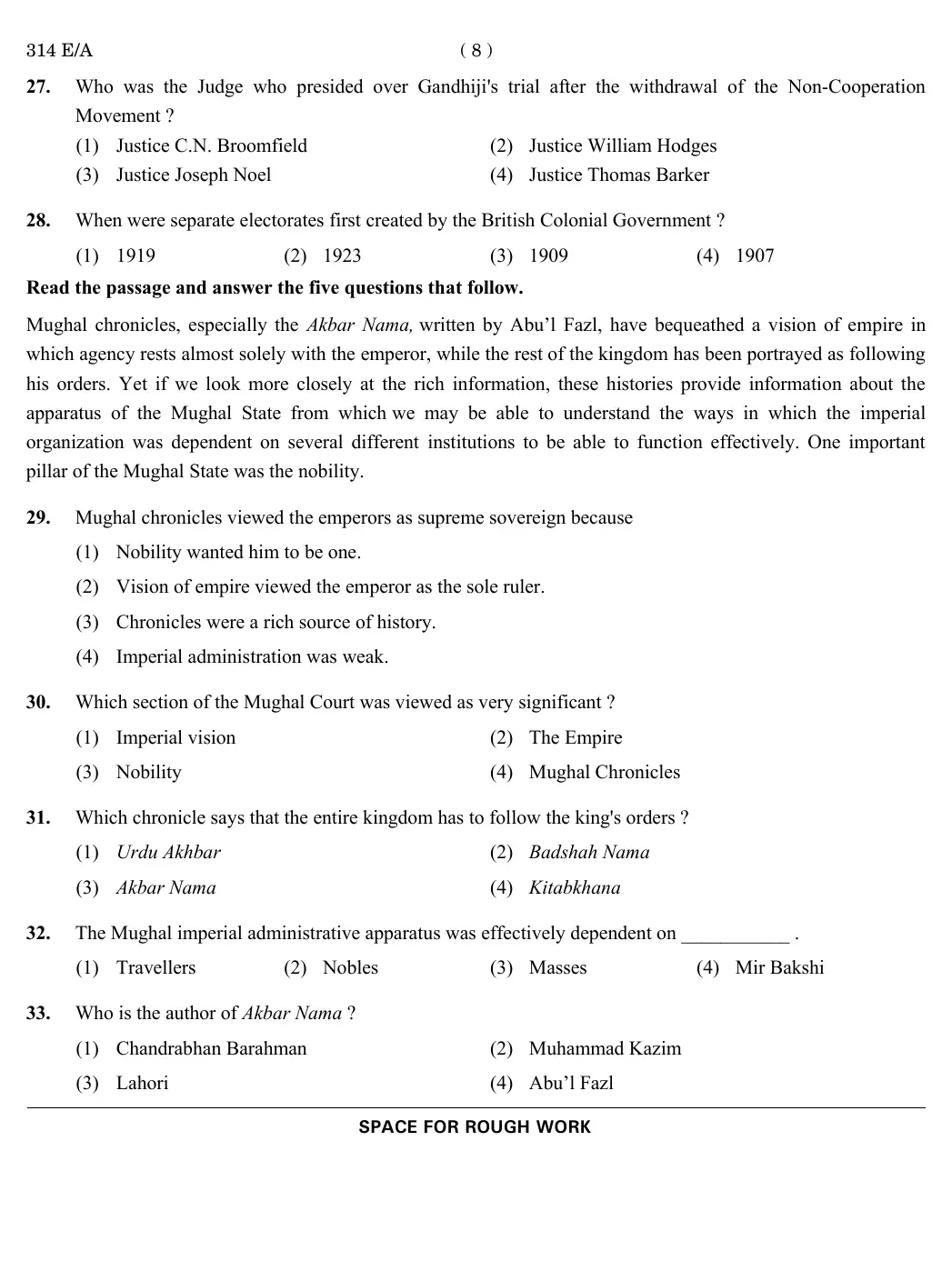
Who was the Judge who presided over Gandhiji's trial after the withdrawal of the Non-Cooperation Movement?
(1) Justice C.N. Broomfield
(2) Justice William Hodges
(3) Justice Joseph Noel
(4) Justice Thomas Barker
View Solution
When were separate electorates first created by the British Colonial Government?
(1) 1919
(2) 1923
(3) 1909
(4) 1907
View Solution
Mughal chronicles viewed the emperors as supreme sovereign because __________.
(1) Nobility wanted him to be one.
(2) Vision of empire viewed the emperor as the sole ruler.
(3) Chronicles were a rich source of history.
(4) Imperial administration was weak.
View Solution
Which section of the Mughal Court was viewed as very significant?
(1) Imperial vision
(2) The Empire
(3) Nobility
(4) Mughal Chronicles
View Solution
Okay, continuing with the remaining questions from the PDF:
Which chronicle says that the entire kingdom has to follow the king's orders?
(1) Urdu Akhbar
(2) Badshah Nama
(3) Akbar Nama
(4) Kitabkhana
View Solution
The Mughal imperial administrative apparatus was effectively dependent on __________.
(1) Travellers
(2) Nobles
(3) Masses
(4) Mir Bakshi
View Solution
Who is the author of Akbar Nama?
(1) Chandrabhan Barahman
(2) Muhammad Kazim
(3) Lahori
(4) Abu'l Fazl
View Solution
When did the Constitution of India come into force?
(1) 26th January, 1950
(2) 15th August, 1947
(3) 31st January, 1929
(4) 6th November, 1949
View Solution
Why is the Constitution of India described as the longest document in the world?
(1) It is a painstakingly drafted document.
(2) It is carefully worked out.
(3) It imbibes culture of hierarchy.
(4) The country size and diversity impacted the Constitution length.
View Solution
How can we say that the Constitution of India seeks to unify India?
(1) It deals with the country's problems.
(2) The area of the subcontinent was under its control.
(3) It was designed to keep the country's divided classes, communities and castes together.
(4) It was to nurture democratic institutions.
View Solution
In which body was the Constitution of India deliberated upon?
(1) Parliament of India
(2) Through Newspaper coverage
(3) Constituent Assembly
(4) Princely States
View Solution
The nature of the Constitution imbibed the right to __________.
(1) Cultural Rights
(2) Educational Rights
(3) Equality
(4) Religion
View Solution
Which of the following statements are correct?
(A) Harappan seal was a most distinctive artifact of the Harappan Civilization.
(B) Harappan seal motifs conveyed a meaning to those unable to read it.
(C) Harappan seals had Sanskrit script on them.
(D) Harappan seals had Pali and Prakrit inscriptions on them.
(E) Some Harappan seals show wider spacing of script from right and cramping on the left.
Choose the correct answer from the options given below:
View Solution
Match List-I with List-II:
(A) Kushanas (I) Piyadassi
(B) Ashoka (II) Devputra
(C) Samudragupta (IV) Prayaga Prashasti
(D) Harisena (III) Court-poet
Choose the correct answer from the options given below:
View Solution
Name the first site from where the Indus Valley Civilization was discovered.
(1) Harappa
(2) Rakhigarhi
(3) Hulas
(4) Sinauli
View Solution
Match List-I with List-II:
(A) Alexander Greenlaw (I) Documenting the inscriptions on the temple walls
(B) John Marshall (II) Visits Vijayanagara in 1800
(C) J.F. Fleet (III) Conservation works of Vijayanagara began under him
(D) Colin Mackenzie (IV) Detailed photography at Hampi
Choose the correct answer from the options given below:
View Solution
Match List-I with List-II:
(A) Duarte Barbosa (I) Morocco
(B) Marco Polo (II) Spain
(C) Ibn Battuta (III) Portugal
(D) Antonio Monserrate (IV) Italy
Choose the correct answer from the options given below:
View Solution
Match List-I with List-II:
(A) Pataliputra (I) Prakrit name of Rajgir, Bihar
(B) Rajgaha (II) Present day Coastal Odisha
(C) Kalinga (III) Present day Patna
(D) Arthasastra (IV) Kautilya
Choose the correct answer from the options given below:
View Solution
Which of the following statements are correct?
(A) Mahabharata has over 1,00,000 verses.
(B) Mahabharata was written by Valmiki.
(C) V.S. Sukthankar is associated with the critical edition of Mahabharata.
(D) The critical edition of Mahabharata took 47 years to complete.
(E) The critical edition of Mahabharata ran into over 13,000 pages.
Choose the correct answer from the options given below:
View Solution
Match List-I with List-II:
(A) Kula (I) Larger network of kinfolk
(B) Jati (II) Families
(C) Vamsha (III) People
(D) Jana (IV) Lineage
Choose the correct answer from the options given below:
View Solution
According to Manu, daughters had a right to __________.
(1) Their father's wealth
(2) Their mother's wealth
(3) Dowry
(4) Both A and C
View Solution
Why did the Buddha lay emphasis on conduct and values?
(1) For the overall well-being of humans.
(2) To make individuals socially responsible.
(3) To purify the soul.
(4) To connect humans to nature.
View Solution
Which of the following statements are correct about the Indus Valley Civilization?
(A) Craft specialization was in evidence.
(B) Tools and weapons were made of iron.
(C) Buildings were of different types.
(D) Harappan seals were used for correspondence.
(E) Seals were mainly used for religious rituals.
Choose the correct answer from the options given below:
View Solution
Which of the following were Harappan cities?
(A) Pataliputra
(B) Lothal
(C) Harappa
(D) Dholavira
(E) Banawali
Choose the correct answer from the options given below:
View Solution











Comments