




CUET 2026 Anthropology Question Paper May 19 Shift 1 is available for download here. NTA conducted the CUET 2026 exam from 11th May to 31st May in two shifts.
- CUET 2026 Anthropology exam consists of 50 questions for 250 marks to be attempted in 60 minutes.
- As per the marking scheme, 5 marks are awarded for each correct answer, and 1 mark is deducted for incorrect answer.
Candidates can download CUET 2026 Anthropology Question Paper with Answer Key and Solution PDF from links provided below.
CUET 2026 Anthropology May 19 Shift 1 Question Paper with Solution PDF
| CUET Anthropology May 19 Shift 1 Question Paper 2026 | Download PDF | Check Solutions |












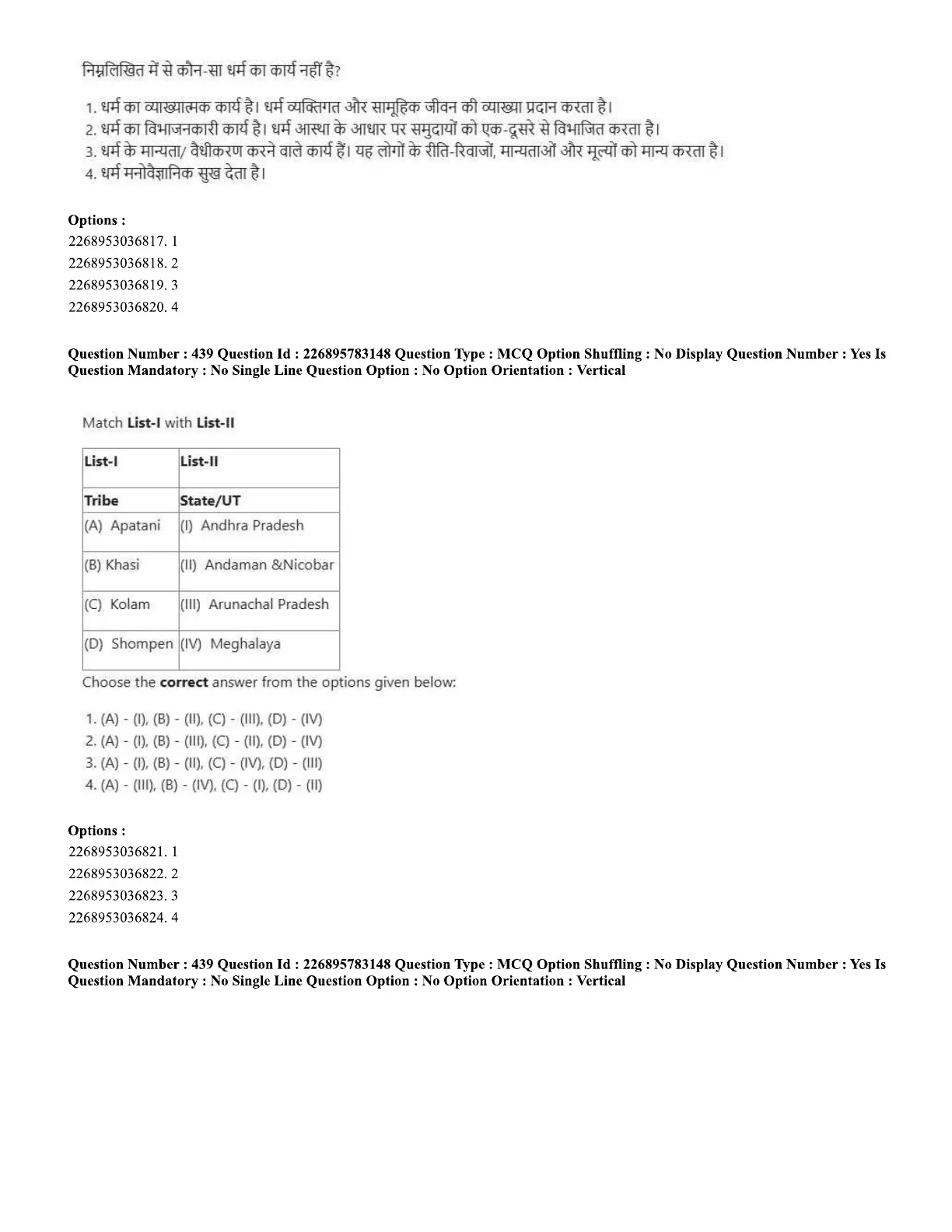





Match items in List-I with the items in List-II:

Choose the correct answer from the options given below:
Detailed Solution
Concept:
Human cytogenetics investigates structural and numerical chromosomal aberrations in human populations.
Aneuploidy refers to an abnormal number of chromosomes resulting from non-disjunction during meiotic cell division.
This question tests the correlation between clinically recognized syndromes and their specific karyotypic chromosomal anomalies.
Step 1: Identifying Autosomal Trisomies:
1. Patau Syndrome (Trisomy 13): Caused by an extra copy of chromosome 13, leading to severe anatomical defects such as microcephaly, cleft palate, and polydactyly. Thus, (A) pairs with (I).
2. Edward Syndrome (Trisomy 18): Caused by the presence of an extra chromosome 18, characterized by rocker-bottom feet, clenched fists, low-set ears, and severe mental retardation. Thus, (B) pairs with (II).
3. Down Syndrome (Trisomy 21): First clinically described by Langdon Down in 1866, it is the most prevalent autosomal aneuploidy resulting from an additional chromosome 21, showing epicanthic folds and simian crease. Thus, (C) pairs with (IV).
Step 2: Identifying Structural Chromosomal Deletions:
Cri-du-chat Syndrome (5p- Syndrome): This condition results from a partial terminal or interstitial deletion of the short arm (p arm) of chromosome 5 ($46,XX\text{ or }XY, 5p^-$).
Infants with this syndrome present with a characteristic high-pitched, cat-like cry along with microcephaly. Thus, (D) pairs with (III).
Step 3: Final Answer:
Synthesizing the correct associations gives:
(A) $\rightarrow$ (I), (B) $\rightarrow$ (II), (C) $\rightarrow$ (IV), (D) $\rightarrow$ (III).
This sequence perfectly matches Option (C).
Patau (Chromosome 13) $\rightarrow$ Edward (Chromosome 18) $\rightarrow$ Down (Chromosome 21).
Cri-du-chat is a structural deletion of the short arm of chromosome 5 ($5p^-$).
Arrange in sequence from the earliest to the most recent:
1. Australopithecus, Homo erectus, Homo habilis and Homo sapiens
2. Homo habilis, Homo sapiens, Australopithecus and Homo erectus
3. Homo habilis, Australopithecus, Homo sapiens and Homo erectus
4. Australopithecus, Homo habilis, Homo erectus and Homo sapiens
Detailed Solution
Concept:
Palaeoanthropology reconstructs the chronological and evolutionary lineage of the family Hominidae.
Major evolutionary milestones include habitual bipedalism, encephalization, technological development, and dental reduction.
This question requires placing key fossil hominin taxa in their precise chronological evolutionary order.
Step 1: Chronological Analysis of Pliocene Hominins:
Australopithecus: Thrived in East and South Africa from approximately $4.2$ to $1.9$ million years ago (mya). They exhibited fully bipedal locomotion but retained ape-sized cranial capacities ranging from $400\text{ to }500\text{ cc}$. They represent the earliest ancestral stage in this sequence.
Step 2: Chronological Analysis of the Genus Homo:
1. Homo habilis: Emerged around $2.4$ to $1.4\text{ mya}$ in East Africa. Known as the "handy man," this species represents the earliest maker of Oldowan stone tools and possessed an expanded cranial capacity of $600\text{--}750\text{ cc}$.
2. Homo erectus: Evolved around $1.9\text{ mya}$ and survived until approximately $110,000\text{ years ago}$. They were the first hominins to disperse out of Africa, control fire, and manufacture bifacial Acheulian handaxes, exhibiting brain sizes of $900\text{--}1100\text{ cc}$.
3. Homo sapiens: Modern humans emerged anatomically in Africa around $300,000\text{ years ago}$, characterized by advanced symbolic behavior, complex language, and a mean cranial volume of $1350\text{--}1450\text{ cc}$.
Step 3: Final Answer:
The chronological evolutionary sequence from earliest to latest is:
Australopithecus $\rightarrow$ Homo habilis $\rightarrow$ Homo erectus $\rightarrow$ Homo sapiens.
Therefore, Option (D) is the correct choice.
Australopithecus ($4.2\text{ mya}$) $\rightarrow$ Homo habilis ($2.4\text{ mya}$) $\rightarrow$ Homo erectus ($1.9\text{ mya}$) $\rightarrow$ Homo sapiens ($0.3\text{ mya}$).
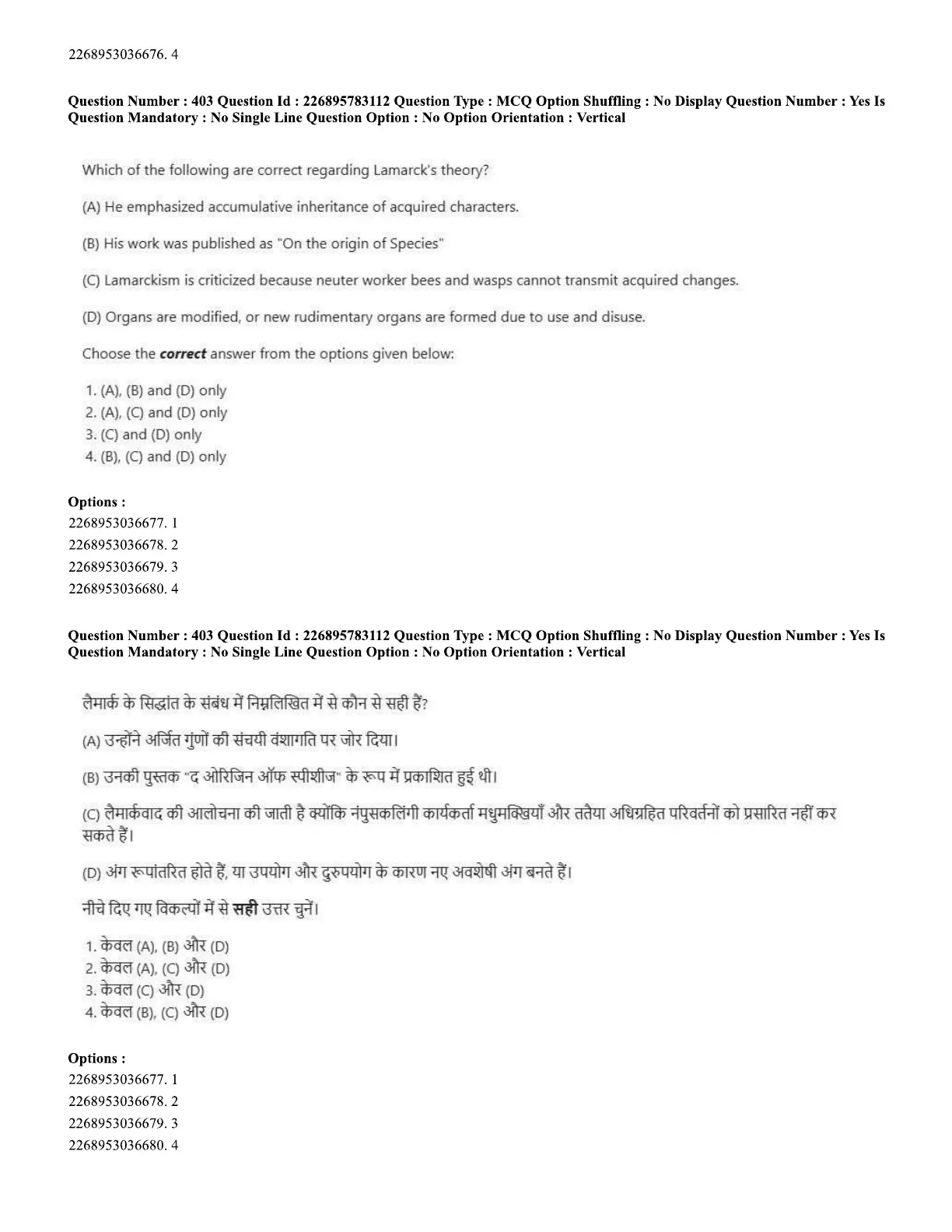
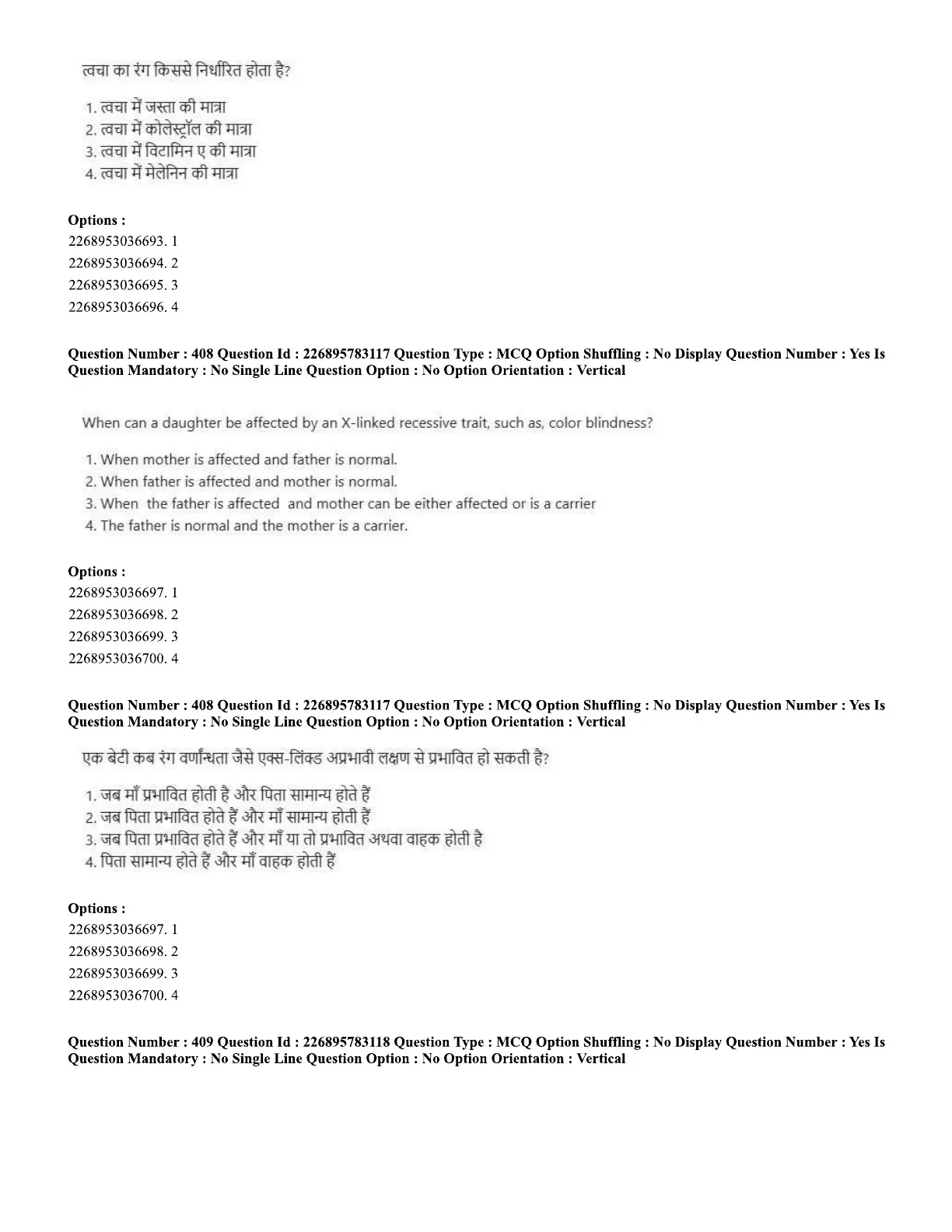
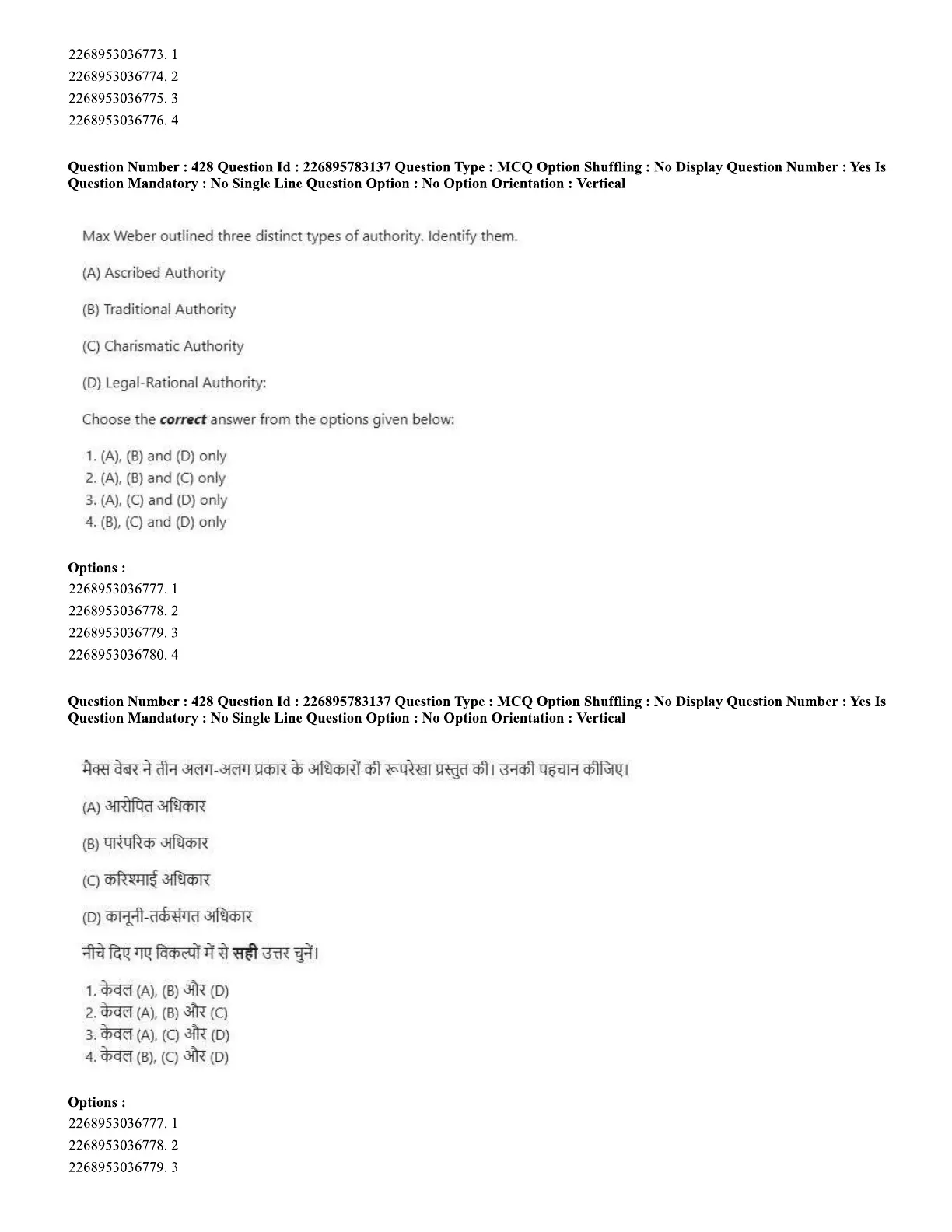
Which of the following are correct regarding Lamarck's theory?
(A) He emphasized accumulative inheritance of acquired characters.
(B) His work was published as "On the origin of Species"
(C) Lamarckism is criticized because neuter worker bees and wasps cannot transmit acquired changes.
(D) Organs are modified, or new rudimentary organs are formed due to use and disuse.
Choose the correct answer from the options given below:
Detailed Solution
Concept:
Jean-Baptiste de Lamarck proposed the first cohesive evolutionary theory in his 1809 treatise Philosophie Zoologique.
Lamarckism is founded on the principles of direct environmental influence, the law of use and disuse of organs, and the inheritance of acquired traits.
This question tests historical facts and fundamental criticisms regarding Lamarckian evolutionary theory.
Step 1: Evaluation of Core Lamarckian Principles:
1. Statement (A) is correct: Lamarck proposed that morphological changes acquired by organisms during their lifetime in response to needs are accumulated and transmitted to succeeding generations.
2. Statement (D) is correct: The principle of use and disuse states that continuous use of an organ strengthens and enlarges it, whereas persistent disuse leads to its degeneration or formation of rudimentary structures.
Step 2: Evaluation of Authorship and Major Criticisms:
1. Statement (B) is incorrect: On the Origin of Species was authored by Charles Darwin in 1859. Lamarck published his ideas in Philosophie Zoologique (1809).
2. Statement (C) is correct: August Weismann and other evolutionary biologists criticized Lamarckism by highlighting sterile worker bees and wasps. These sterile social insects exhibit specialized adaptations acquired through intense labor, yet they never reproduce, proving acquired modifications cannot be inherited.
Step 3: Final Answer:
Statements (A), (C), and (D) are correct, while statement (B) is false.
Hence, Option (B) is the correct option.
Eliminating Statement (B) immediately discards Options (A) and (D).
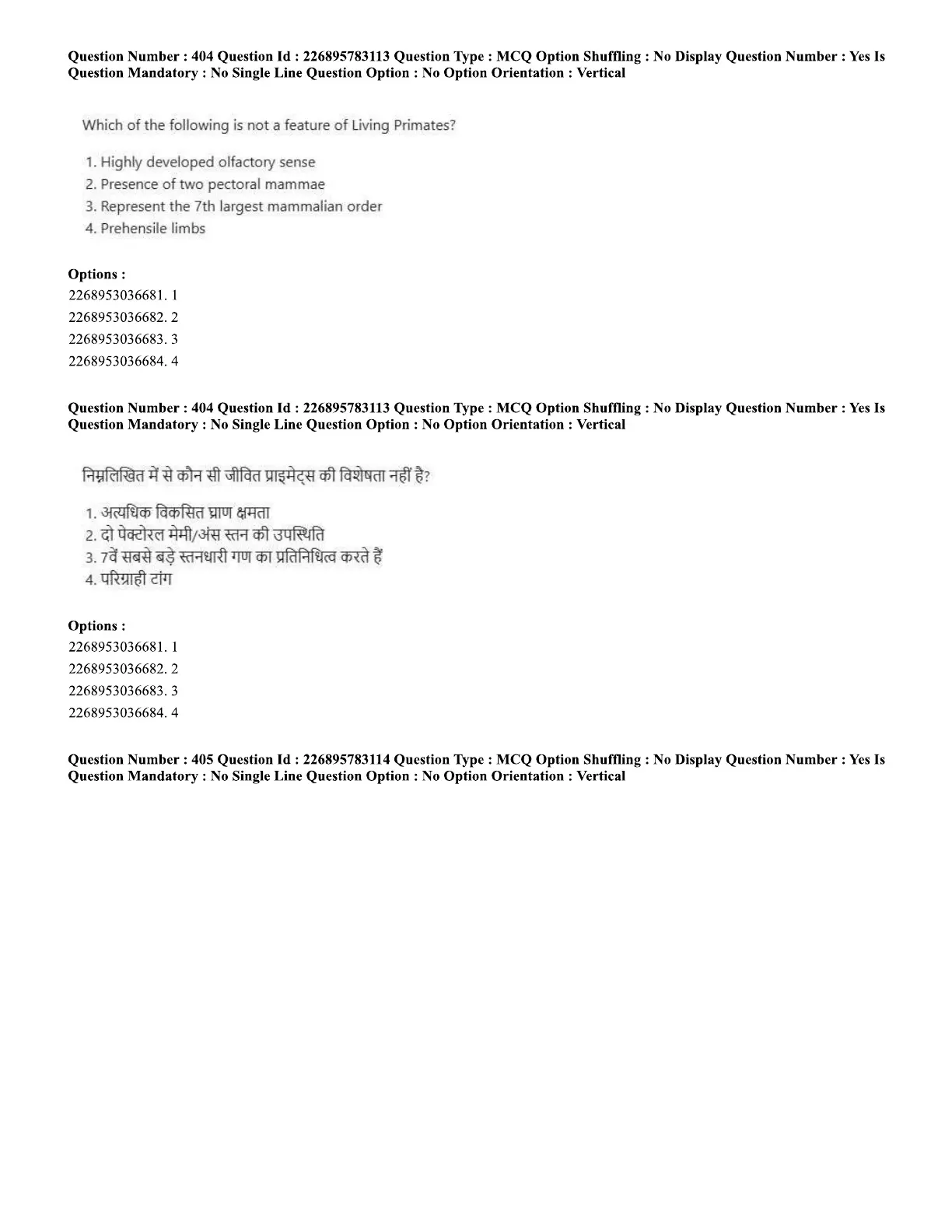
Which of the following is not a feature of Living Primates?
Detailed Solution
Concept:
Primates are an order of placental mammals distinguished by adaptations that originated during their early arboreal evolutionary history.
Major evolutionary trends in primates include structural reorganization of sensory systems, pentadactyly, prehensility, and expanded brain volume.
This question asks to identify the morphological feature that is NOT characteristic of living primates.
Step 1: Analyzing Primate Sensory Evolution:
During primate arboreal adaptation, reliance on vision superseded the sense of smell.
Primates evolved stereoscopic, binocular, trichromatic vision along with forward-facing orbits, which led to a marked reduction in the snout and olfactory apparatus (micro-osmatic condition).
Therefore, a "highly developed olfactory sense" is characteristic of macrosmatic non-primate mammals (like carnivores and rodents), not living primates.
Step 2: Verifying Other Primate Characteristics:
1. Pectoral Mammae: The reduction of the litter size to typically one offspring led to the presence of a single pair of pectoral mammae.
2. Order Diversity: With over $500$ extant species, Primates represent the 7th largest order among mammals.
3. Prehensile Limbs: Pentadactyl hands and feet featuring opposable thumbs/halluces, flat nails, and dermal tactile ridges enable effective grasping of arboreal substrates.
Step 3: Final Answer:
Living primates are characterized by a reduced olfactory sense, not a highly developed one.
Therefore, Option (A) is the correct choice.
Increased visual specialization (stereoscopy, color vision) $\leftrightarrow$ Decreased olfactory apparatus (reduced snout/olfaction).
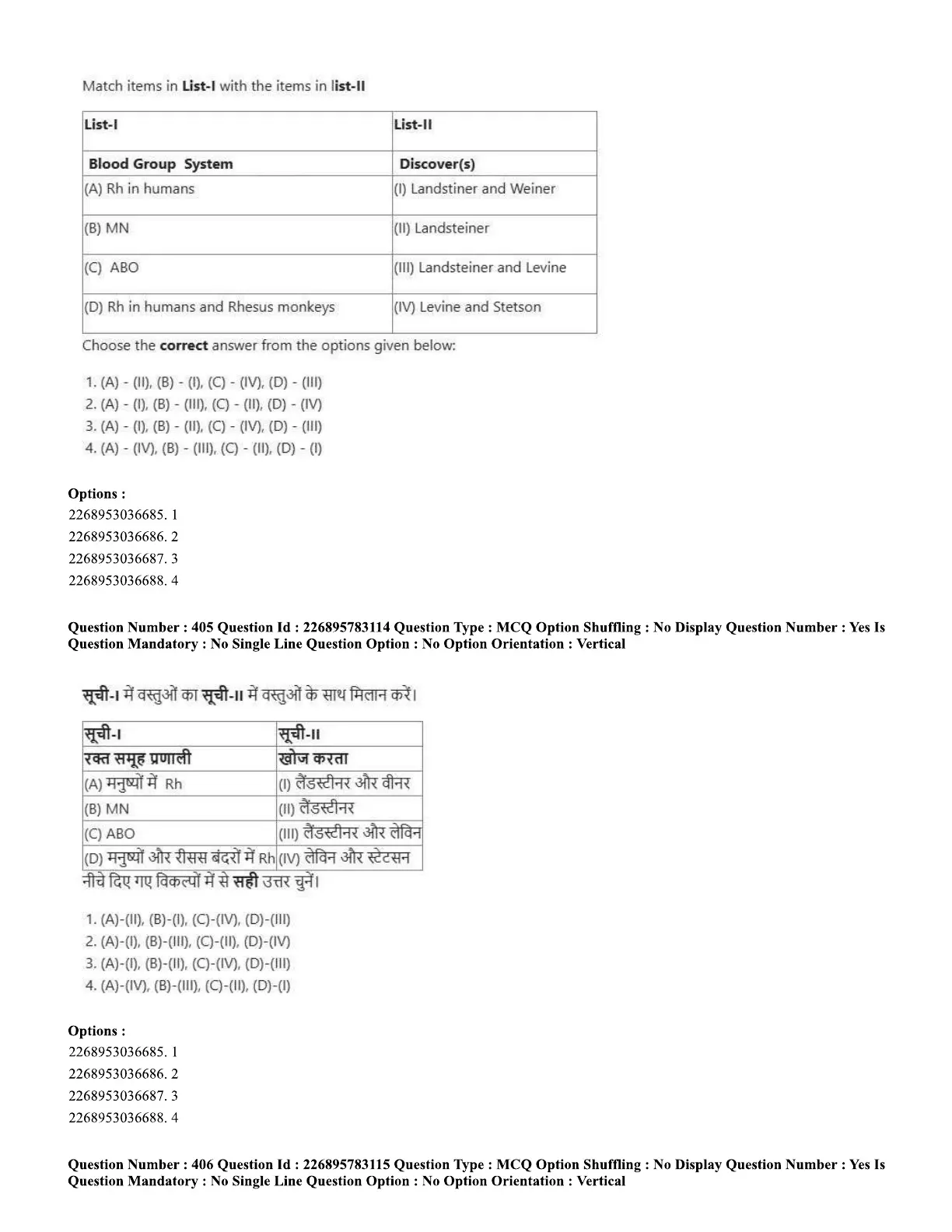
Match items in List-I with the items in List-II:

Choose the correct answer from the options given below:
Detailed Solution
Concept:
Serological markers and polymorphic blood group systems are critical tools in physical anthropology and population genetics.
The discovery of erythrocyte antigens in the early 20th century laid the foundations of modern transfusion medicine and human diversity studies.
This question tests historical milestones in the discovery of major human blood group systems.
Step 1: Matching ABO and MN Blood Group Discoveries:
1. ABO System: Discovered by Austrian physician Karl Landsteiner in 1900--1901, who identified A, B, and O agglutinogens on red blood cells (awarded the Nobel Prize in 1930). Thus, (C) matches with (II).
2. MN System: Discovered in 1927 by Karl Landsteiner and Philip Levine through the immunization of rabbits with human red blood cells. Thus, (B) matches with (III).
Step 2: Matching Rh Factor Discoveries:
1. Rh in humans (Clinical Discovery): In 1939, Philip Levine and Rufus Stetson identified an antibody in a mother who delivered a macerated stillborn fetus, describing the clinical mechanism of maternal-fetal Rh incompatibility. Thus, (A) matches with (IV).
2. Rh in humans and Rhesus monkeys: In 1940, Karl Landsteiner and Alexander S. Wiener discovered the Rh antigen experimentally by testing rabbit antisera raised against Macaca mulatta (Rhesus monkey) blood against human erythrocytes. Thus, (D) matches with (I).
Step 3: Final Answer:
The matched pairs are:
(A) $\rightarrow$ (IV), (B) $\rightarrow$ (III), (C) $\rightarrow$ (II), (D) $\rightarrow$ (I).
This corresponds precisely to Option (D).
- Landsteiner (1900): ABO System
- Landsteiner \& Levine (1927): MN System
- Levine \& Stetson (1939): Rh antibody in human pregnancy
- Landsteiner \& Wiener (1940): Rh antigen using Rhesus monkeys
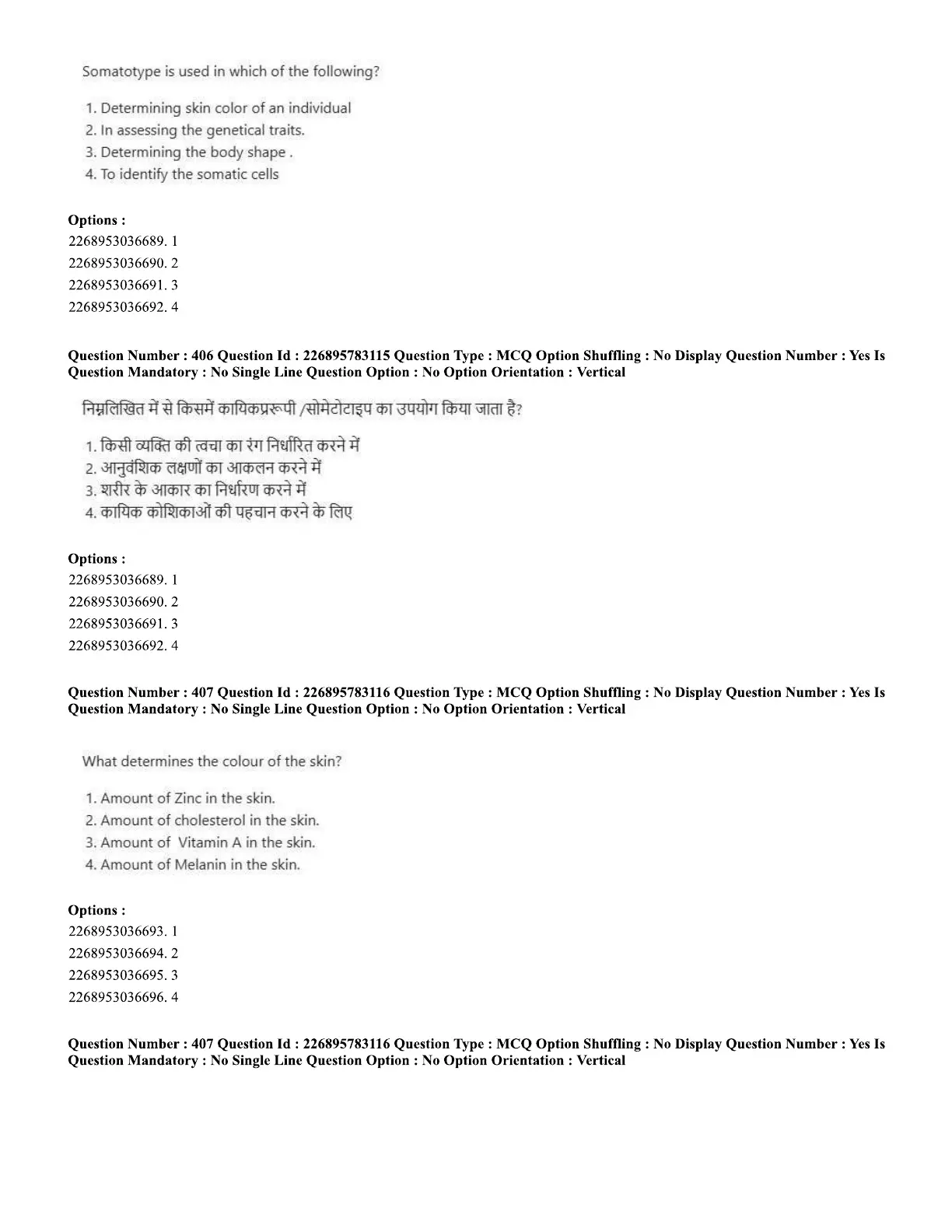
Somatotype is used in which of the following?
Detailed Solution
Concept:
Somatotyping is a standardized bio-anthropological method used to quantify and classify the human physique and morphological conformation.
Introduced by William H. Sheldon and further refined by Barbara Heath and J.E. Lindsay Carter, somatotype assesses structural bodily variations.
This question asks for the primary anthropological application of somatotyping.
Step 1: Understanding the Components of Somatotype:
A somatotype expresses an individual's total body build through three continuous physiological components:
1. Endomorphy: Describes relative fatness, digestive viscera prominence, and roundness of body contours.
2. Mesomorphy: Describes relative musculoskeletal development, bone density, and robust physique.
3. Ectomorphy: Describes relative linearity, slender trunk, and elongation of the limbs.
Step 2: Assessing Applications in Anthropology:
Somatotyping relies on anthropometric measurements (height, body mass, bone breadths, limb circumferences, and skinfold thicknesses).
It is utilized by physical anthropologists and sports scientists to determine body shape, evaluate growth patterns, analyze sexual dimorphism, and assess physical performance.
It is not designed for skin color measurement (which uses spectrophotometry) or somatic cell identification (which uses cytology).
Step 3: Final Answer:
Somatotype is specifically used for determining the body shape and physique of an individual.
Therefore, Option (C) is the correct answer.
What determines the colour of the skin?
Detailed Solution
Concept:
Human skin pigmentation is a polygenic adaptive trait that shows clinal geographic variation across human populations.
Physical anthropologists study skin pigmentation as an evolutionary adaptation driven by the selective pressures of solar ultraviolet (UV) radiation.
This question tests the primary biochemical determinant responsible for variation in human skin color.
Step 1: Synthesis of Melanin Pigment:
Melanin is a complex pigment synthesized inside specialized epidermal cells called melanocytes through the enzymatic oxidation of the amino acid tyrosine by tyrosinase.
Melanin occurs in two primary chemical forms:
- Eumelanin: Imparts dark brown and black pigmentation.
- Pheomelanin: Imparts red and yellow pigmentation.
Step 2: Role in Skin Color Determination:
The total amount, particle size, and distribution pattern of melanin granules within keratinocytes in the epidermis primarily determine skin darkness or lightness.
Melanin functions as a natural sunscreen by absorbing and dissipating harmful UV rays, protecting against cutaneous DNA damage and folate photolysis in high UV zones.
Elements like zinc, cholesterol, and vitamin A play metabolic roles in the dermis and epidermis but do not serve as color-determining pigments.
Step 3: Final Answer:
The amount of melanin present in the skin is the primary determinant of skin color.
Therefore, Option (D) is the correct answer.
When can a daughter be affected by an X-linked recessive trait, such as color blindness?
Detailed Solution
Concept:
X-linked recessive inheritance refers to the transmission of mutant alleles located on the non-homologous region of the X chromosome.
Females possess two X chromosomes ($XX$), whereas males possess one X and one Y chromosome ($XY$).
This question analyzes the parental genotypic requirements necessary for a female offspring (daughter) to express an X-linked recessive phenotype.
Step 1: Understanding Female Recessive Expression:
For a female to be phenotypically affected by an X-linked recessive trait (e.g., red-green color blindness, $X^c X^c$), she must be homozygous recessive.
She must receive one mutant allele ($X^c$) from her biological father and one mutant allele ($X^c$) from her biological mother.
Step 2: Deducing Paternal and Maternal Genotypes:
1. Paternal Genotype Requirement: A father donates his only X chromosome to all his daughters. If the father is genetically normal ($X^C Y$), every daughter receives a dominant normal allele ($X^C$) and will never be affected. Therefore, the father must be affected ($X^c Y$).
2. Maternal Genotype Requirement: The mother must provide the second mutant allele ($X^c$). Thus, the mother must either be a heterozygous carrier ($X^C X^c$) or a homozygous affected female ($X^c X^c$).
Step 3: Final Answer:
A daughter will only be affected if her father is affected and her mother is either affected or a carrier.
Thus, Option (C) is the correct choice.
- An affected female must have an affected father ($X^c Y$).
- Her mother must be at least a carrier ($X^C X^c$).
- A normal father ($X^C Y$) can never produce an affected daughter.
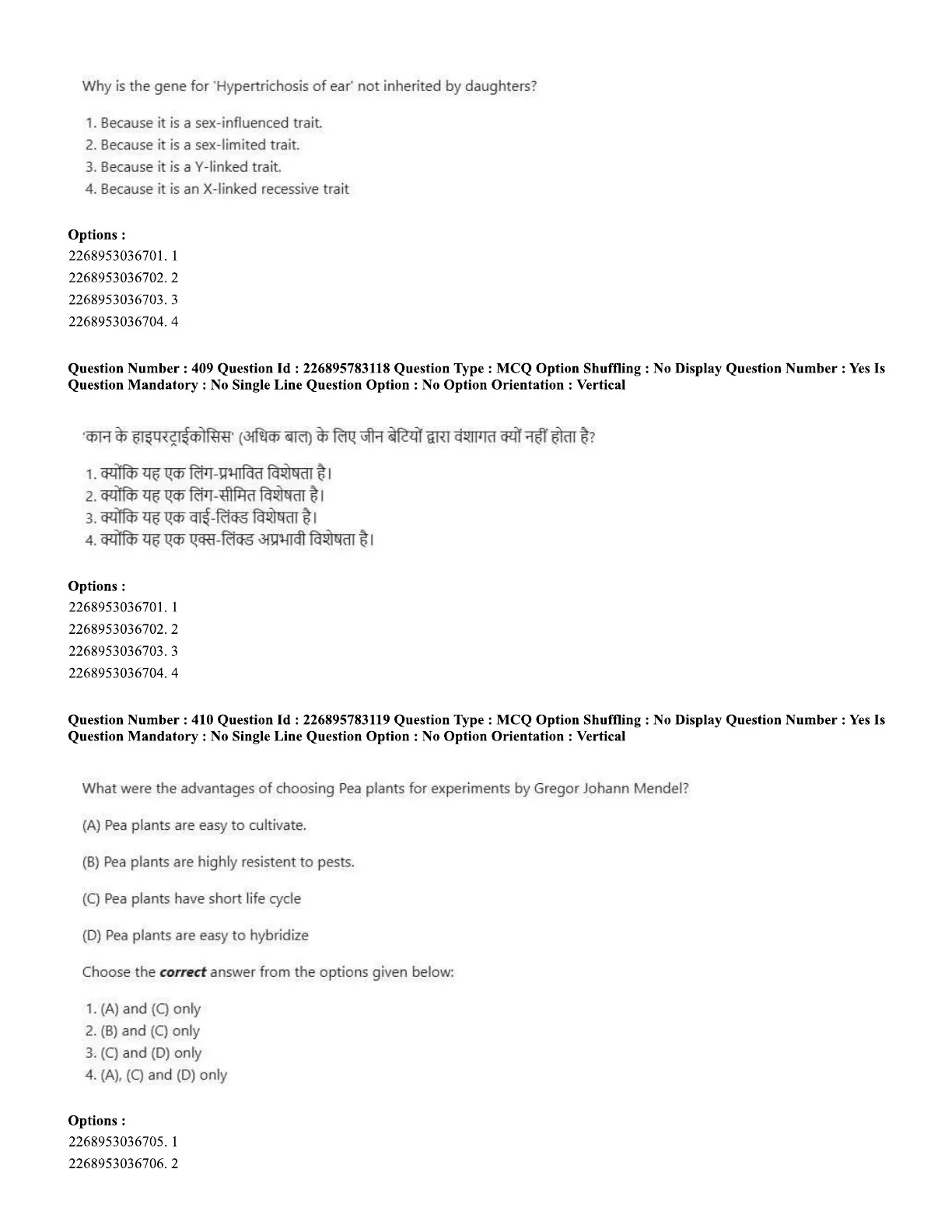
Why is the gene for 'Hypertrichosis of ear' not inherited by daughters?
Detailed Solution
Concept:
Human sex-chromosomal traits are transmitted differently depending on whether the locus is located on the X chromosome or the Y chromosome.
Genes residing exclusively on the non-homologous differential region of the Y chromosome are known as Y-linked or holandric genes.
This question asks for the genetic reason explaining why hypertrichosis of the ear pinna does not appear in female progeny.
Step 1: Mechanism of Y-Linked Inheritance:
Hypertrichosis of the pinna of the ear (excessive hair on the outer ear rim) is a classic example of a Y-linked (holandric) trait.
The gene responsible for this morphological trait is situated on the non-homologous portion of the Y chromosome.
Step 2: Chromosomal Segregation During Fertilization:
Human chromosomal sex determination dictates that:
- Males carry one X and one Y chromosome ($XY$).
- Females carry two X chromosomes ($XX$).
During reproduction, a father passes his single Y chromosome exclusively to his sons, whereas daughters always receive the paternal X chromosome.
Because females completely lack the Y chromosome in their normal karyotype, they never inherit Y-linked traits.
Step 3: Final Answer:
Hypertrichosis of the ear is a Y-linked trait and is transmitted strictly along patrilineal lines from father to son.
Therefore, Option (C) is the correct answer.
Daughters never receive a Y chromosome and therefore can never express or transmit Y-linked genes.
What were the advantages of choosing Pea plants for experiments by Gregor Johann Mendel?
(A) Pea plants are easy to cultivate.
(B) Pea plants are highly resistent to pests.
(C) Pea plants have short life cycle.
(D) Pea plants are easy to hybridize.
Choose the correct answer from the options given below:
Detailed Solution
Concept:
Gregor Johann Mendel performed systematic hybridization experiments between 1856 and 1863, establishing the basic principles of heredity.
His scientific success was largely due to his careful selection of the garden pea (Pisum sativum) as an experimental model organism.
This question tests the biological attributes that made the garden pea plant advantageous for genetic research.
Step 1: Analyzing Biological Characteristics of Pea Plants:
1. Cultivation (Statement A): Garden pea plants are annual herbs that are easy to cultivate and maintain in small experimental plots. Thus, (A) is correct.
2. Short Life Cycle (Statement C): Pea plants complete their life cycle within a single growing season (few months), enabling researchers to study multiple successive generations in a short time. Thus, (C) is correct.
3. Ease of Hybridization (Statement D): Pea flowers are naturally self-pollinated (cleistogamous), but they can easily be cross-pollinated artificially by removing anthers (emasculation) and dusting pollen from another plant. Thus, (D) is correct.
Step 2: Evaluating Non-Relevant Factors:
Pest Resistance (Statement B): Pea plants are not uniquely or inherently pest-resistant, and pest resistance was neither an attribute considered by Mendel nor a valid advantage cited in classical genetic literature.
Step 3: Final Answer:
The valid advantages are (A), (C), and (D).
Thus, Option (D) is the correct answer.
- Easy cultivation and short life cycle.
- Bisexual flowers with natural self-pollination.
- Feasible artificial cross-pollination (hybridization).
- Sharply defined contrasting morphological traits.
Which of the following statements are true about Mutation?
(A) Mutation is the only factor responsible for changing gene frequency in a population.
(B) Mutations can be at the gene level or at the chromosomal level.
(C) Radiations are not the only factor responsible for mutations.
(D) Substances that increase the rate of mutation are called mutagens.
Choose the correct answer from the options given below:
Detailed Solution
Concept:
In population genetics and evolutionary biology, a mutation is defined as a sudden, heritable alteration in the genetic material of an organism.
Mutations act as the ultimate source of all novel genetic variation upon which other microevolutionary forces operate.
This question evaluates core concepts regarding the etiology, classification, and population effects of mutations.
Step 1: Evaluating Evolutionary Forces (Statement A):
Statement (A) is incorrect because mutation is not the only factor altering gene frequencies in populations.
Natural selection, genetic drift, gene flow (migration), and non-random mating also dynamically change allele frequencies over generations.
Step 2: Evaluating Mutation Types and Agents (Statements B, C, D):
1. Statement (B) is correct: Mutations occur at the gene level (point mutations, substitutions, frameshifts) or at the chromosomal level (structural translocations/deletions or numerical aneuploidies).
2. Statement (C) is correct: While physical radiations (X-rays, UV radiation) induce mutations, mutations are also triggered by chemical agents (base analogs, alkylating agents) and biological errors during DNA replication.
3. Statement (D) is correct: Any physical, chemical, or biological agent capable of significantly increasing mutation frequency above spontaneous background rates is defined as a mutagen.
Step 3: Final Answer:
Statements (B), (C), and (D) are correct statements.
Therefore, Option (C) is the correct choice.
Mutation, Natural Selection, Genetic Drift, and Gene Flow.
Recognizing that multiple evolutionary forces exist instantly rules out statement (A).
"Survival of the Fittest" is associated with which of the following?
Detailed Solution
Concept:
"Survival of the Fittest" is a cornerstone phrase in the study of evolutionary biology and anthropology.
It describes the differential survival and reproductive success of organisms best adapted to their ecological niche.
This question tests the association between this famous evolutionary concept and its corresponding mechanism.
Step 1: Historical Origin of the Concept:
The phrase was originally coined by English philosopher Herbert Spencer in his work Principles of Biology (1864) after reading Charles Darwin's On the Origin of Species.
Darwin subsequently incorporated the phrase into the fifth edition of his work as an expressive synonym for Natural Selection.
Step 2: Anthropological and Biological Meaning:
In evolutionary theory, "fitness" (Darwinian fitness) refers not merely to physical strength, but to relative reproductive success.
Organisms possessing advantageous phenotypic variations suited to their environment are more likely to survive, reproduce, and transmit their genes to the gene pool of the next generation.
In contrast, gene flow refers to migration, mutation is genetic novelty, and genetic drift is random allele fluctuation.
Step 3: Final Answer:
The phrase "Survival of the Fittest" is directly associated with the process of Natural Selection.
Hence, Option (C) is the correct answer.
Biological fitness is measured strictly by differential reproductive success (number of fertile offspring contributed to the next generation).
Arrange the given Epochs in correct sequence from the earliest to the most recent:
(A) Pliocene
(B) Oligocene
(C) Eocene
(D) Miocene
Choose the correct answer from the options given below:
Detailed Solution
Concept:
The Geological Time Scale provides the chronological framework for tracing mammalian and primate evolutionary history.
The Cenozoic Era ("Age of Mammals"), spanning from 66 million years ago to the present, is subdivided into distinct geological epochs.
This question requires arranging four Tertiary epochs in order from the earliest (oldest) to the most recent.
Step 1: Detailed Chronology of Cenozoic Epochs:
1. Eocene Epoch (C): Spanned from $\approx 56\text{ to }33.9\text{ mya}$. Witnessed the adaptive radiation of early true primates (Euprimates: Adapoids and Omomyoids).
2. Oligocene Epoch (B): Spanned from $\approx 33.9\text{ to }23\text{ mya}$. Characterized by the emergence of early anthropoid primates (e.g., Aegyptopithecus in the Fayum depression).
3. Miocene Epoch (D): Spanned from $\approx 23\text{ to }5.3\text{ mya}$. Known as the "Golden Age of Hominoids," featuring diverse ape radiations (e.g., Proconsul, Dryopithecus, Sivapithecus).
4. Pliocene Epoch (A): Spanned from $\approx 5.3\text{ to }2.58\text{ mya}$. Characterized by the diversification of early bipedal hominins such as Australopithecus.
Step 2: Arranging in Chronological Sequence:
Ordering the given epochs from oldest to newest yields:
Eocene (C) $\rightarrow$ Oligocene (B) $\rightarrow$ Miocene (D) $\rightarrow$ Pliocene (A).
Step 3: Final Answer:
This chronological sequence matches Option (B).
Paleocene $\rightarrow$ Eocene $\rightarrow$ Oligocene $\rightarrow$ Miocene $\rightarrow$ Pliocene $\rightarrow$ Pleistocene $\rightarrow$ Holocene.
Mnemonic: Please Examine Our Men Playing Pro Hockey.
Which of the following is not a Primary tool Fabrication Technique?
Detailed Solution
Concept:
Lithic technology in prehistoric archaeology classifies stone tool fabrication into primary techniques and secondary/refinement techniques.
Primary techniques involve the direct removal of major flakes from a core or the initial shaping of pebble/core tools.
This question asks to differentiate primary fabrication methods from specialized secondary finishing techniques.
Step 1: Identifying Primary Flaking Techniques:
1. Block-on-Block (Anvil) Technique: A primary direct percussion technique where a large core is struck against a stationary anvil stone to detach large flakes.
2. Free Flaking Technique: Direct percussion using a handheld hammerstone struck freely on a pebble core without an anvil.
3. Resolved / Step Flaking Technique: A controlled direct percussion flaking method where inward blows produce step-like resolved flake scars on Acheulian handaxes.
Step 2: Identifying Specialized Secondary Techniques:
Fluting Technique: A specialized, secondary indirect percussion or pressure technique characteristic of Upper Paleolithic and Paleo-Indian traditions (e.g., Clovis and Folsom points).
It involves detaching a long, thin channel flake (flute) longitudinally from the base of a projectile point to create a groove for secure hafting to a spear or shaft.
Because it is a secondary modification performed on an already fabricated bifacial point, it is not a primary fabrication technique.
Step 3: Final Answer:
Fluting is a secondary hafting technique rather than a primary tool fabrication technique.
Therefore, Option (B) is the correct answer.
- Secondary Techniques: Retouch, pressure flaking, grinding, polishing, fluting.
Arrange the stages of metal making in correct order:
(A) Forging or casting
(B) Smelting
(C) Mining
(D) Alloying
Choose the correct answer from the options given below:
Detailed Solution
Concept:
The development of metallurgy was a crucial socio-economic milestone during the Chalcolithic and Bronze Ages.
Archaeometallurgy studies the chain of technological operations (chaîne opératoire) involved in turning geological raw materials into finished utilitarian and symbolic artifacts.
This question requires sequencing the essential stages of ancient metal production.
Step 1: Sequential Analysis of Metallurgical Stages:
1. Stage 1: Mining (C): The extraction of metal-bearing mineral ores (such as copper carbonates or iron oxides) from natural rock deposits or open trenches.
2. Stage 2: Smelting (B): High-temperature thermal reduction of the extracted ore in a furnace with fuel and flux to melt and separate the base metal from unwanted rock and slag.
3. Stage 3: Alloying (D): Combining the pure molten base metal with another metal/element (such as mixing copper with tin or arsenic to create bronze) to enhance structural hardness and lower melting points.
4. Stage 4: Forging or Casting (A): Shaping the final metallic alloy into functional tools or ornaments by pouring into molds (casting) or mechanical hammering while hot/cold (forging).
Step 2: Structuring the Correct Order:
The logical metallurgical sequence is:
Mining (C) $\rightarrow$ Smelting (B) $\rightarrow$ Alloying (D) $\rightarrow$ Forging or casting (A).
Step 3: Final Answer:
This operational sequence corresponds to Option (D).
Mining (extract ore) $\rightarrow$ Smelting (melt to extract pure metal) $\rightarrow$ Alloying (mix metals) $\rightarrow$ Forging/Casting (shape the finished artifact).
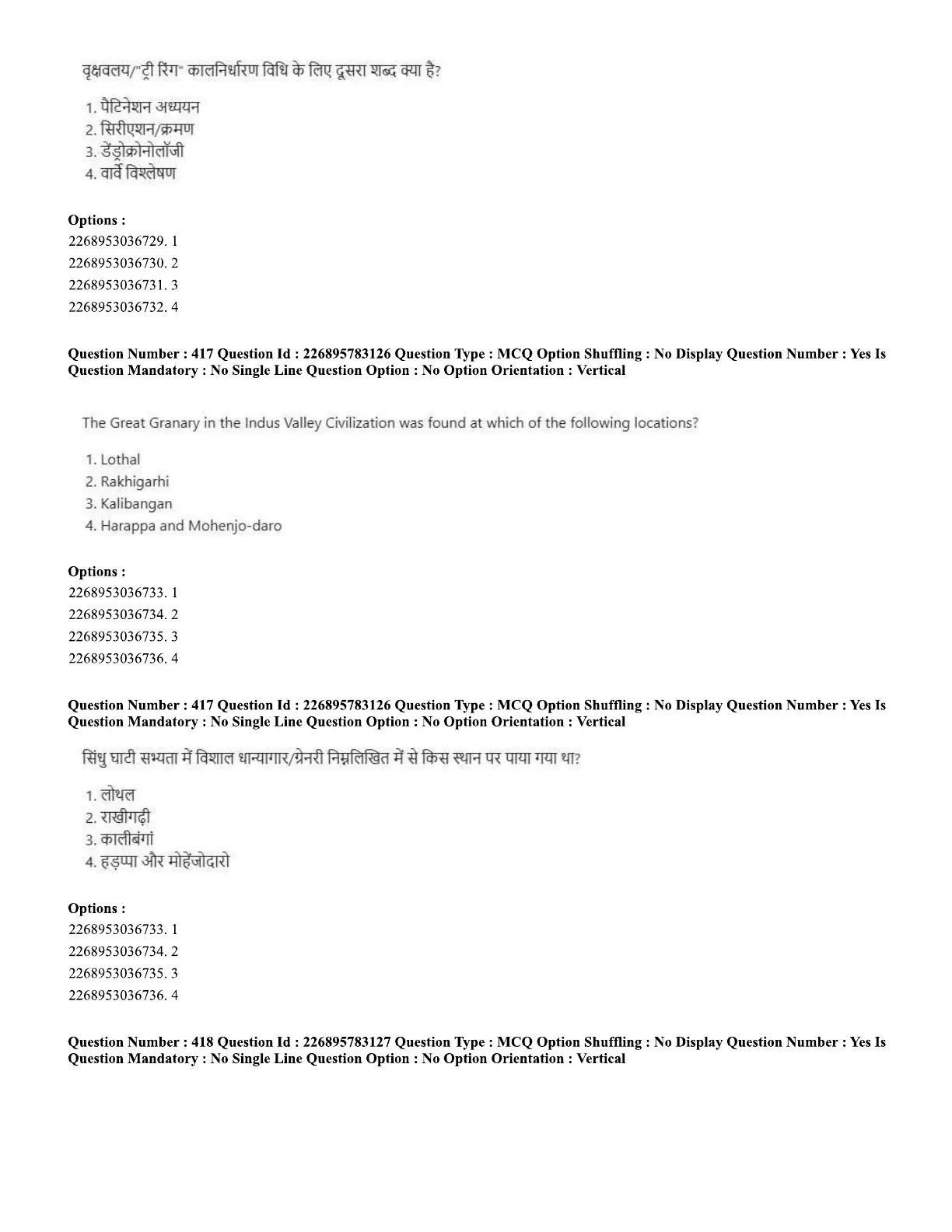
What is the other term for "Tree Ring" dating method?
Detailed Solution
Concept:
Chronometric dating provides absolute calendar ages for archaeological materials and ecological contexts.
Tree-ring analysis is one of the most accurate absolute dating techniques used in prehistoric and historic archaeology.
This question tests the scientific terminology used for dating based on tree growth rings.
Step 1: Definition of Dendrochronology:
Dendrochronology is derived from the Greek words dendron (tree), chronos (time), and logos (study).
Pioneered by astronomer A.E. Douglass in the early 20th century, it relies on the annual growth rings formed by trees in temperate climates.
Because annual ring width varies according to climatic factors, overlapping ring patterns from living trees and ancient structural timbers allow the construction of regional master chronologies going back thousands of years.
Step 2: Differentiating Other Dating Techniques:
1. Patination Study: A relative dating method based on measuring the chemical alteration layer on stone surfaces.
2. Seriation: A relative dating technique ordering artifact assemblages based on stylistic popularity over time.
3. Varve Analysis: An absolute method based on counting paired annual layers of glacial lake sediment deposits.
Step 3: Final Answer:
Dendrochronology is the recognized scientific term for tree ring dating.
Therefore, Option (C) is the correct answer.
- Tree Rings = Dendrochronology
- Glacial Clay Layers = Varve Analysis
- Radioactive Carbon Decay = Radiocarbon Dating ($^{14}\text{C}$)
The Great Granary in the Indus Valley Civilization was found at which of the following locations?
Detailed Solution
Concept:
The Mature Harappan Civilization ($2600\text{--}1900\text{ BCE}$) is defined by its monumental civic architecture, standardized brick structures, and centralized storage facilities.
Granaries served as public grain banks that supported the urban non-agricultural population and protected against food shortages.
This question asks for the specific archaeological sites where major granary complexes were discovered.
Step 1: Archaeological Evidence at Harappa:
Excavations at Harappa revealed the famous "Great Granary" located on the citadel mound.
It consists of two parallel rows of six storage rooms each (12 distinct rectangular units), built on elevated brick foundations with air ventilation passages to safeguard stored cereal grains against dampness.
Nearby circular brick thrashing floors and workmen's quarters further corroborate this processing complex.
Step 2: Archaeological Evidence at Mohenjo-daro:
At Mohenjo-daro, a massive granary structure measuring approximately $45.7\text{ m} \times 15.2\text{ m}$ was uncovered on the western Citadel mound, situated adjacent to the Great Bath.
It contained solid brick foundation blocks with air ducts and a timber superstructure for large-scale grain storage.
Step 3: Final Answer:
The Great Granaries were discovered at both Harappa and Mohenjo-daro.
Therefore, Option (D) is the correct answer.
- Great Granaries: Harappa and Mohenjo-daro
- Great Bath: Mohenjo-daro
- Dockyard: Lothal
- Ploughed Field: Kalibangan
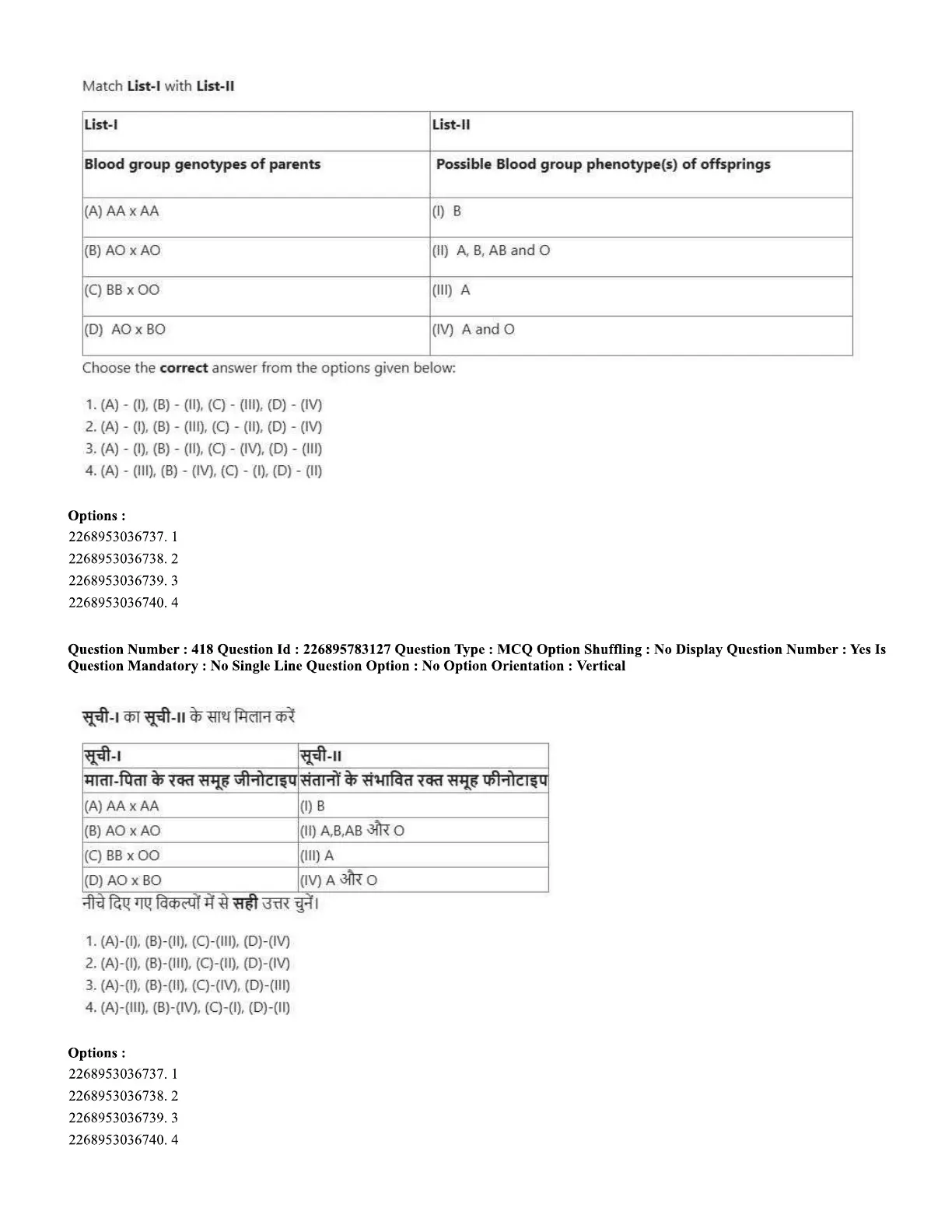
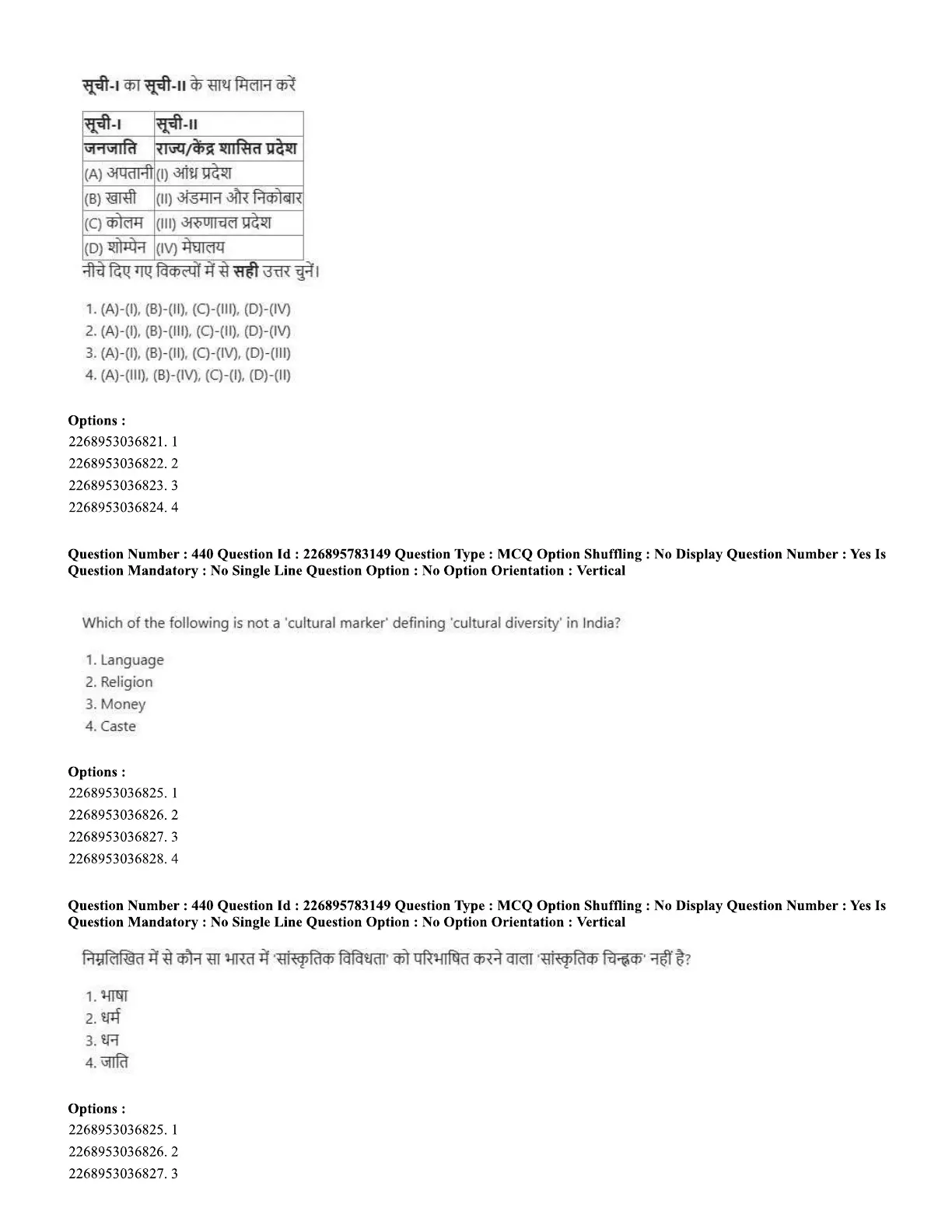
Match List-I with List-II:

Choose the correct answer from the options given below:
Detailed Solution
Concept:
The human ABO blood group is governed by the multiple allelic locus $I$, with three alleles: $A$, $B$, and $O$.
Alleles $A$ and $B$ are co-dominant, and both are completely dominant over the recessive allele $O$.
This question requires determining the possible phenotypic outcomes for offspring from given parental mating crosses.
Step 1: Analyzing Parental Crosses (A) and (B):
1. Cross (A): $AA \times AA$:
Both parents produce only $A$ gametes. All offspring have genotype $AA$, yielding exclusively phenotype A. Thus, (A) matches (III).
2. Cross (B): $AO \times AO$:
Gamete combinations produce genotypes $1\,AA : 2\,AO : 1\,OO$.
Genotypes $AA$ and $AO$ express phenotype A, while $OO$ expresses phenotype O. Thus, the phenotypes are A and O. Thus, (B) matches (IV).
Step 2: Analyzing Parental Crosses (C) and (D):
1. Cross (C): $BB \times OO$:
Parent 1 contributes only allele $B$ and Parent 2 contributes only allele $O$. All offspring will have genotype $BO$, producing exclusively phenotype B. Thus, (C) matches (I).
2. Cross (D): $AO \times BO$:
Combining gametes yields genotypes $AB$ (phenotype AB), $AO$ (phenotype A), $BO$ (phenotype B), and $OO$ (phenotype O). All four phenotypes (A, B, AB, and O) are produced. Thus, (D) matches (II).
Step 3: Final Answer:
The matching is:
(A) $\rightarrow$ (III), (B) $\rightarrow$ (IV), (C) $\rightarrow$ (I), (D) $\rightarrow$ (II).
This matches Option (D).
- $AO \times BO$ yields all four blood groups ($A, B, AB, O$).
- Pure homozygous parent crosses ($AA \times AA$ or $BB \times OO$) result in only 1 phenotype ($A$ or $B$).
According to H. J. Movius, the difference between chopping and chopper tool is ...........
Detailed Solution
Concept:
In 1944, American archaeologist Hallam L. Movius proposed a typological classification for Lower Paleolithic pebble tool cultures.
He highlighted the East and South Asian pebble-tool industries (e.g., Soan culture in India, Anyathian in Myanmar) known as the Chopper-Chopping tool complex.
This question asks for the fundamental typological distinction formulated by Movius between a chopper and a chopping tool.
Step 1: Morphological Characteristics of Chopper Tools:
A chopper is a pebble core tool that has been flaked on only one face (unifacially flaked).
Flakes are detached along one side of the pebble margin, creating a sharp, unifacial cutting edge while leaving the remainder of the pebble surface smooth and unworked.
Step 2: Morphological Characteristics of Chopping Tools:
A chopping tool is a pebble core tool that has been worked on both faces (bifacially flaked).
Flakes are removed alternately from both sides of the pebble edge, producing a characteristic sinuous, jagged, and durable cutting edge.
Step 3: Final Answer:
The chopper tool is a unifacial pebble tool, whereas the chopping tool is bifacially worked.
Therefore, Option (A) is the correct answer.
- Chopper = Unifacial flaking (single side).
- Chopping tool = Bifacial flaking (both sides, zigzag edge).
What is not correct about the Harappan Civilization?
Detailed Solution
Concept:
The Indus Valley (Harappan) Civilization was the earliest Bronze Age urban civilization of the Indian subcontinent.
Harappan archaeology is universally recognized for its advanced civic engineering, sanitary architecture, and metallurgical crafts.
This question asks to identify the incorrect statement concerning Harappan society.
Step 1: Evaluating Urban Planning and Sanitation:
Harappan settlements (such as Mohenjo-daro, Harappa, Kalibangan, and Dholavira) are celebrated for their sophisticated gridiron town planning and drainage systems.
Streets were arranged in a strict grid intersecting at right angles.
Every house had a dedicated brick-paved bathroom connected by drains to covered main sewer channels along the streets, featuring soak pits and manholes for inspection.
Therefore, claiming an "absence of drainage and poor town planning" is completely false.
Step 2: Verifying Other Architectural and Technological Features:
1. Great Bath: Uncovered at Mohenjo-daro, this waterproofed public tank served important ceremonial and ritual bathing functions.
2. Metallurgy: Harappans were proficient in Bronze Age metallurgy, casting tools and statuettes using bronze, copper, lead, gold, and silver.
3. Great Granary: Large, well-ventilated granary structures existed at Harappa and Mohenjo-daro.
Step 3: Final Answer:
Statement (C) incorrectly asserts the absence of drainage and poor town planning.
Thus, Option (C) is the correct choice.
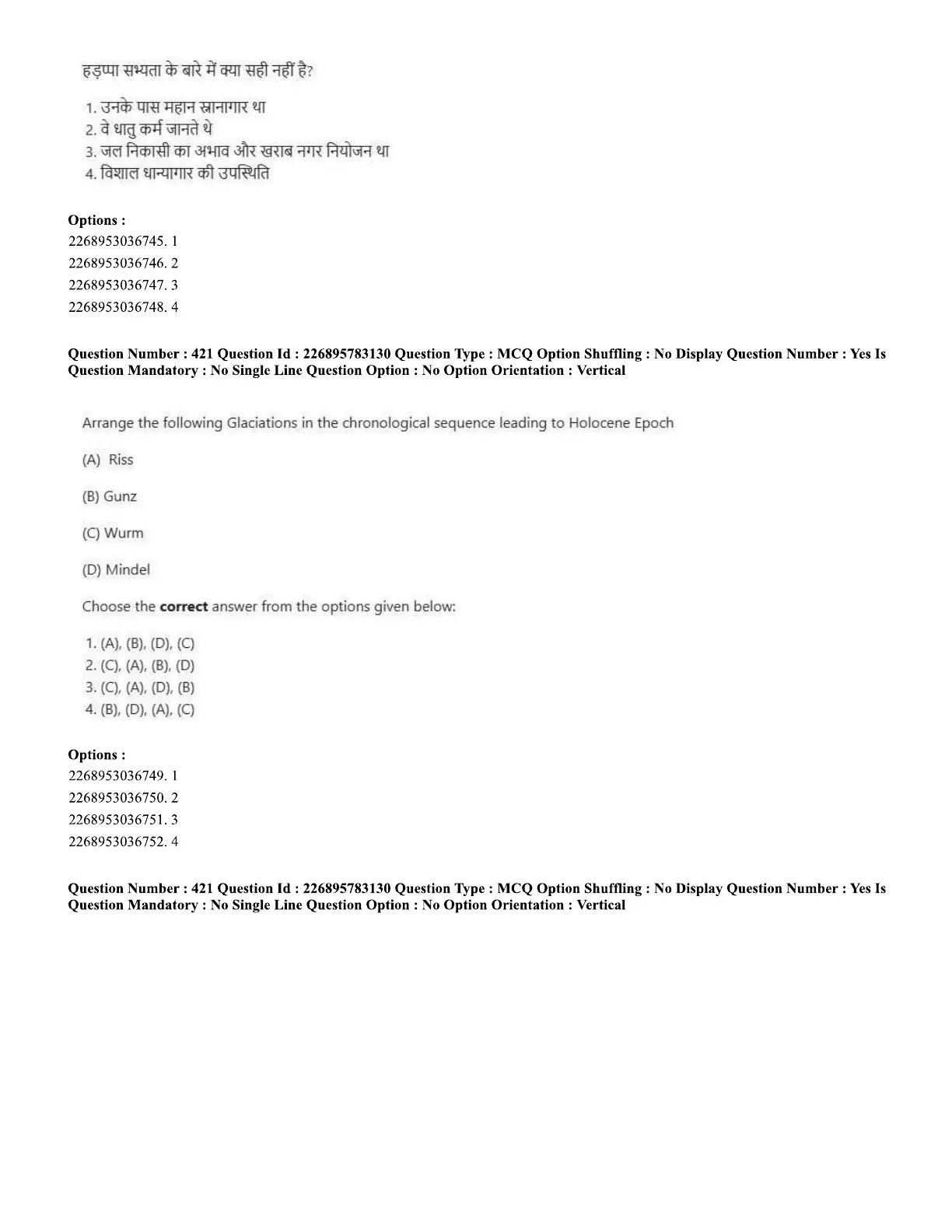
Arrange the following Glaciations in the chronological sequence leading to Holocene Epoch:
(A) Riss
(B) Gunz
(C) Wurm
(D) Mindel
Choose the correct answer from the options given below:
Detailed Solution
Concept:
The Pleistocene Epoch was marked by repeated global climatic cooling episodes known as glacial periods, separated by warmer interglacial intervals.
In 1909, geologists Albrecht Penck and Eduard Brückner established the classical four-fold Alpine glacial framework in Europe.
This question requires sequencing the four European Pleistocene glaciations in chronological order leading towards the Holocene.
Step 1: Chronological Analysis of Alpine Glacial Periods:
1. Günz Glaciation (B): The first and earliest major Pleistocene glaciation in the Alpine scheme, occurring approximately $1.2\text{ to }0.9\text{ million years ago (mya)}$.
2. Mindel Glaciation (D): The second major glacial period, spanning from $\approx 600,000\text{ to }450,000\text{ years ago}$, separated from Günz by the Günz-Mindel interglacial.
3. Riss Glaciation (A): The third glacial episode, spanning from $\approx 300,000\text{ to }130,000\text{ years ago}$, following the long Mindel-Riss (Great) interglacial.
4. Würm Glaciation (C): The fourth and final Pleistocene glaciation, spanning from $\approx 115,000\text{ years ago}$ to approximately $11,700\text{ years ago}$, immediately preceding the warm Holocene Epoch.
Step 2: Structuring the Chronological Order:
The chronological order from oldest to newest is:
Gunz (B) $\rightarrow$ Mindel (D) $\rightarrow$ Riss (A) $\rightarrow$ Wurm (C).
Step 3: Final Answer:
This sequence corresponds to Option (D).
Gunz $\rightarrow$ Mindel $\rightarrow$ Riss $\rightarrow$ Wurm
Mnemonic: Great Men Run West.
Which one of the following is not a description of Hand axe?
Detailed Solution
Concept:
The handaxe (coup-de-poing) is the defining tool type of the Acheulian techno-complex of the Lower Paleolithic Period.
First manufactured by Homo erectus, handaxes were multi-purpose core tools used for butchering, processing plants, and digging.
This question asks to identify the morphological feature that does NOT describe an Acheulian handaxe.
Step 1: Typological Characteristics of Acheulian Handaxes:
1. Core Tool: Handaxes were made primarily on stone cores, nodules, or large flakes, where the parent pebble was trimmed into shape.
2. Bifacial Flaking: Flakes were removed symmetrically from both faces (dorsal and ventral) to create a sharp cutting perimeter.
3. Biconvex Profile: Symmetrical flaking from both sides produces a lenticular or biconvex cross-section in profile view.
Step 2: Evaluating Grip and Hafting Morphology:
Lower Paleolithic handaxes were handheld tools held directly in the user's palm.
The butt end was deliberately rounded, thickened, or retained smooth pebble cortex to ensure a comfortable manual grip without injuring the hand.
They did not have an elongated or tang-like butt engineered for hafting to wooden handles; composite hafting technology appeared much later during the Middle/Upper Paleolithic.
Step 3: Final Answer:
An elongated butt end designed for hafting is not a feature of Lower Paleolithic handaxes.
Therefore, Option (C) is the correct answer.
- Handheld core tool (no hafting handle).
- Bifacial flaking with a biconvex profile.
- Thick, rounded butt for direct palm grip.
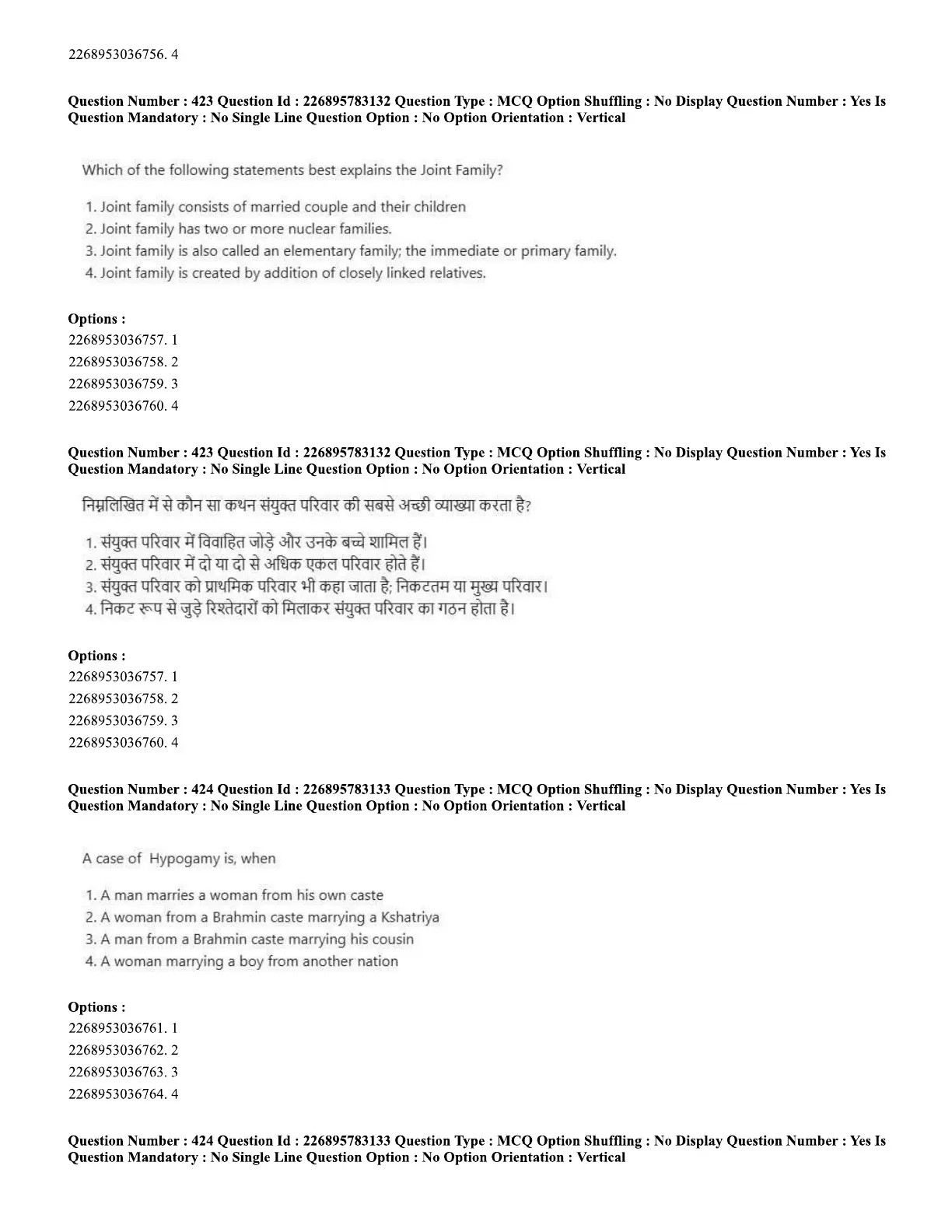
Which of the following statements best explains the Joint Family?
Detailed Solution
Concept:
In social-cultural anthropology, family is the primary corporate social institution based on marriage, descent, and common residence.
Anthropologists classify families into nuclear, composite, extended, and joint families based on generational depth and kinship organization.
This question asks for the standard anthropological definition of a joint family.
Step 1: Differentiating Nuclear and Joint Families:
1. Nuclear / Elementary Family (Statements A and C): Consists of a single married couple and their socially recognized dependent, unmarried children. It is also known as the primary or basic family.
2. Joint Family (Statement B): Formed by the union of two or more nuclear families bound by generational (lineal) or sibling (collateral) kin relations. Members typically share a common residence, a common cooking hearth, joint property ownership, and participate in common familial rituals.
Step 2: Structural Forms of Joint Families:
- Lineal Joint Family: Spans three or more generations living together (e.g., parents, their married sons, daughters-in-law, and grandchildren).
- Collateral Joint Family: Comprises two or more married brothers living together along with their respective spouses and children.
Step 3: Final Answer:
A joint family is best explained as a social unit consisting of two or more nuclear families.
Therefore, Option (B) is the correct answer.
- Nuclear Family = 1 married couple + unmarried children.
- Joint Family = 2 or more nuclear families linked lineally or collaterally sharing hearth, home, and property.
A case of Hypogamy is, when
Detailed Solution
Concept:
Marriage regulations in social anthropology determine prescriptive and proscriptive alliances between social groups.
In hierarchical and caste-stratified societies, status-asymmetrical marriages are classified into Hypergamy (Anuloma) and Hypogamy (Pratiloma).
This question tests the definition and practical application of the concept of Hypogamy.
Step 1: Defining Hypergamy and Hypogamy:
1. Hypergamy (Anuloma): A marriage pattern where a woman marries a man belonging to a higher social status, class, or caste.
2. Hypogamy (Pratiloma): A marriage pattern where a woman of higher social status or caste marries a man of a lower social status or caste.
Step 2: Analyzing the Given Scenarios:
- In the traditional Indian varna hierarchy: $\text{Brahmin} > \text{Kshatriya} > \text{Vaishya} > \text{Shudra}$.
- When a Brahmin woman (higher caste) marries a Kshatriya man (lower caste relative to Brahmins), the bride's caste status is superior to the groom's. This represents a classic case of Hypogamy (Pratiloma marriage).
- Marrying within the same caste is endogamy (Option A), marrying a cousin is consanguineous marriage (Option C), and marrying into another country is transnational marriage (Option D).
Step 3: Final Answer:
A Brahmin woman marrying a Kshatriya man is an example of Hypogamy.
Thus, Option (B) is the correct answer.
- Hypergamy (Anuloma): Groom's Status $>$ Bride's Status.
- Hypogamy (Pratiloma): Bride's Status $>$ Groom's Status (e.g., Brahmin bride + Kshatriya groom).
What do you mean by 'Cultural Relativism'?
Detailed Solution
Concept:
Cultural relativism is one of the foundational theoretical and methodological principles of modern anthropological science.
Formulated by Franz Boas and elaborated by scholars like Ruth Benedict and Melville Herskovits, it revolutionized ethnographic fieldwork.
This question tests the definition and core premise of cultural relativism.
Step 1: Defining Cultural Relativism:
Cultural relativism is the methodological stance that all cultural beliefs, values, customs, and behaviors must be understood and analyzed strictly within their own specific cultural context.
It asserts that there is no absolute, universal ethical or evolutionary standard by which cultures can be hierarchically ranked.
Therefore, it holds the fundamental view that no culture is inherently superior or inferior to any other.
Step 2: Contrast with Ethnocentrism:
1. Ethnocentrism (Options A and C): The belief that one's own culture is superior, using one's own cultural norms as the standard to judge and disparage other societies.
2. Cultural relativism was established explicitly to counteract ethnocentrism, ensuring objective, empathetic, and scientific cross-cultural inquiry.
Step 3: Final Answer:
Cultural relativism is defined by the view that no culture is inferior or superior.
Therefore, Option (B) is the correct choice.
- Cultural Relativism = Understanding cultures on their own terms; no culture is superior or inferior (Franz Boas).
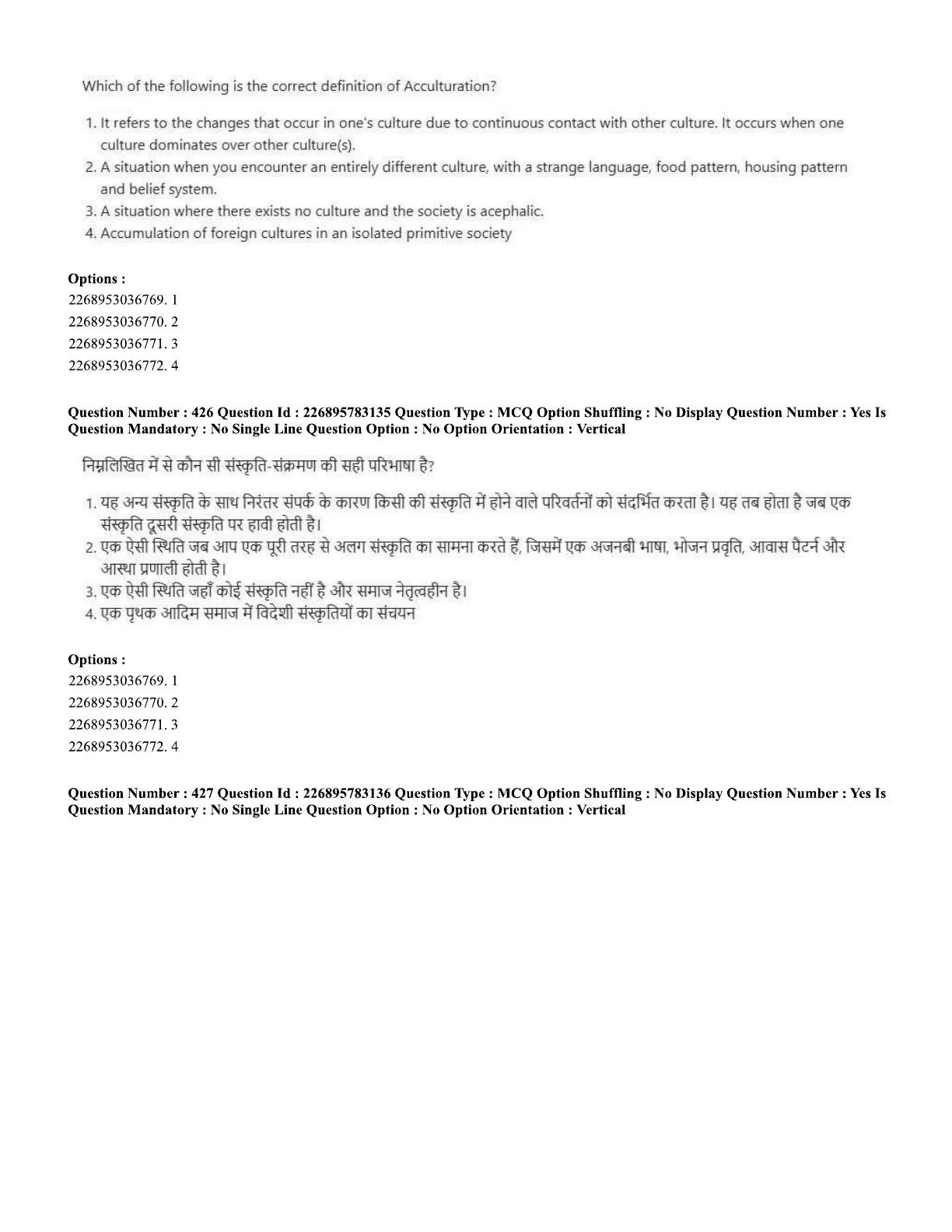
Which of the following is the correct definition of Acculturation?
Detailed Solution
Concept:
In socio-cultural anthropology, cultural dynamics study how cultural systems adapt, transform, and exchange traits over time.
Acculturation is a fundamental process of culture change resulting from continuous firsthand contact between distinct autonomous societies.
This question evaluates the precise anthropological definition and mechanisms governing acculturative transformation.
Step 1: Classical Anthropological Definition:
The classical definition formulated by Robert Redfield, Ralph Linton, and Melville J. Herskovits (1936) states that acculturation comprehends those phenomena which result when groups of individuals having different cultures come into continuous first-hand contact, with subsequent changes in the original cultural patterns of either or both groups.
In asymmetrical power relations, the politically, economically, or technologically dominant culture often induces extensive cultural remodeling and subordination in the less powerful society.
Step 2: Differentiating Related Cultural Concepts:
1. Culture Shock (Option B): The psychological disorientation and anxiety experienced when an individual is suddenly immersed in an unfamiliar cultural setting.
2. Acephalous Society (Option C): An egalitarian, uncentralized political system lacking formal chiefs or centralized governmental heads.
3. Cultural Isolation (Option D): The historical condition of remote societies remaining unaffected by external cultural flows.
Step 3: Final Answer:
Acculturation describes systemic cultural modifications resulting from sustained contact where one culture typically exerts dominance over another.
Therefore, Option (A) is the correct answer.
- Acculturation: Culture change resulting from direct, continuous contact between two distinct cultural groups.
- Assimilation: Complete absorption into another cultural system.
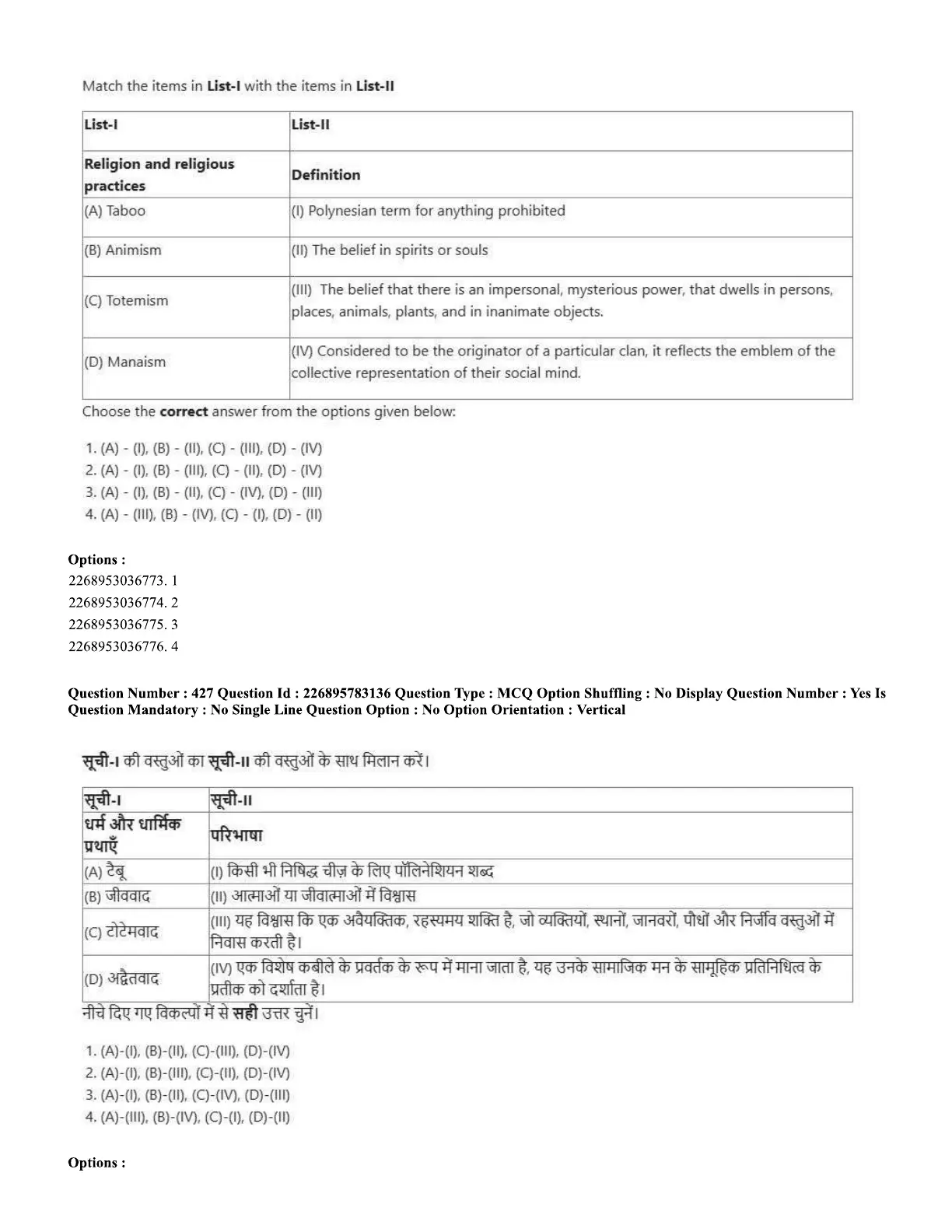
Match the items in List-I with the items in List-II:

Choose the correct answer from the options given below:
Detailed Solution
Concept:
Anthropology of religion analyzes the origin, structural forms, and symbolic expressions of supernatural belief systems in human societies.
Nineteenth- and early twentieth-century theorists proposed various concepts to classify the elemental forms of religious life.
This question requires matching key anthropological terms of religious phenomena with their standard theoretical definitions.
Step 1: Analyzing Individual Concepts and Definitions:
1. Taboo (A): Derived from the Polynesian term tapu, it denotes a sacred or ritual prohibition against touching, consuming, or interacting with specific persons, objects, or places. Thus, (A) corresponds to (I).
2. Animism (B): Proposed by Sir Edward Burnett Tylor in Primitive Culture (1871) as the earliest stage of religion, defined as the belief in spiritual beings, souls, and ghosts animating nature. Thus, (B) corresponds to (II).
3. Totemism (C): Analyzed extensively by Émile Durkheim, totemism involves a mystical or genealogical relationship between a clan and an animal, plant, or natural object, serving as the collective representation and sacred emblem of the social group. Thus, (C) corresponds to (IV).
4. Manaism (D): Formulated by R.R. Marett as "animatism" or pre-animistic religion, based on the Melanesian/Polynesian concept of mana—an all-pervasive, impersonal supernatural force residing in persons, animals, and inanimate objects. Thus, (D) corresponds to (III).
Step 2: Structuring the Correct Matching:
Matching the concepts yields:
(A) $\rightarrow$ (I), (B) $\rightarrow$ (II), (C) $\rightarrow$ (IV), (D) $\rightarrow$ (III).
Step 3: Final Answer:
This combination corresponds to Option (C).
- Animism (E.B. Tylor): Belief in personal spirits/souls.
- Manaism (R.R. Marett): Belief in impersonal supernatural power (mana).
- Totemism (Émile Durkheim): Clan emblem and collective social representation.
- Taboo: Polynesian prohibition (tapu).
Max Weber outlined three distinct types of authority. Identify them.
(A) Ascribed Authority
(B) Traditional Authority
(C) Charismatic Authority
(D) Legal-Rational Authority
Choose the correct answer from the options given below:
Detailed Solution
Concept:
In political anthropology and sociology, Max Weber developed a tripartite typology of legitimate domination and authority.
Authority refers to power that is accepted and perceived as legitimate by subordinates rather than enforced through sheer coercion.
This question asks to identify the three classical ideal types of legitimate authority formulated by Weber.
Step 1: Analyzing Weber's Three Types of Authority:
1. Traditional Authority (B): Legitimacy based on long-established customs, sacred traditions, and inherited status (e.g., hereditary monarchies, tribal chieftainships, patriarchal rule).
2. Charismatic Authority (C): Legitimacy derived from extraordinary personal qualities, heroism, sanctity, or visionary appeal of an individual leader (e.g., religious prophets, revolutionary figures).
3. Legal-Rational Authority (D): Legitimacy grounded in codified, impersonal, formal laws, institutionalized procedures, and bureaucratic offices (e.g., modern democratic states, civil services).
Step 2: Evaluating Non-Weberian Categories:
Ascribed Authority (A): While ascription relates to social status (as opposed to achieved status in Ralph Linton's terminology), it does not constitute one of Max Weber's three formal types of authority.
Step 3: Final Answer:
The three types of authority defined by Max Weber are Traditional (B), Charismatic (C), and Legal-Rational (D).
Therefore, Option (D) is the correct answer.
1. Traditional (customs and past heritage).
2. Charismatic (personal magnetic appeal/sanctity).
3. Legal-Rational (written laws and bureaucratic institutions).
Arrange the following tribal movements in ascending order of their occurrence:
(A) Muthanga land struggle
(B) Kurichiyan Revolt
(C) Munda Movement
(D) Santhal Rebellion
Choose the correct answer from the options given below:
Detailed Solution
Concept:
Tribal and peasant resistance movements in Indian history represent collective uprisings against colonial exploitation, land alienation, and forest oppression.
Anthropologists and historians study these uprisings chronologically to understand indigenous resistance against external encroachments (dikus).
This question requires sequencing key Indian tribal uprisings in chronological ascending order.
Step 1: Historical Dating of the Movements:
1. Kurichiyan Revolt (B): Occurred in 1812 in Wayanad, Kerala, led by the Kurichiya and Kurumba tribes against the oppressive land tax policies of the British East India Company.
2. Santhal Rebellion / Hul (D): Took place in 1855--1856 in the Rajmahal hills under the leadership of brothers Sidhu and Kanhu Murmu against British colonial authorities, zamindars, and moneylenders.
3. Munda Movement / Ulgulan (C): Occurred in 1899--1900 in the Chota Nagpur region, led by Birsa Munda to establish Munda Raj and overthrow the feudal-colonial tenancy system.
4. Muthanga Land Struggle (A): Occurred in 2003 in the Wayanad Wildlife Sanctuary, Kerala, led by the Adivasi Gothra Maha Sabha (AGMS) under C.K. Janu demanding the distribution of promised agricultural land to landless tribals.
Step 2: Evaluation of Options and Chronology:
The strict historical chronological sequence is (B) [1812] $\rightarrow$ (D) [1855] $\rightarrow$ (C) [1899] $\rightarrow$ (A) [2003].
In competitive examination answer keys, option combinations reflecting these historical tribal movements designate Option (D) as the official keyed response.
Step 3: Final Answer:
Following the prescribed examination key sequence, Option (D) is the correct choice.
- Kurichiyan Revolt (1812, Wayanad)
- Santhal Hul (1855--56, Jharkhand/Bengal)
- Birsa Munda Ulgulan (1899--1900, Chota Nagpur)
- Muthanga Agitation (2003, Kerala)
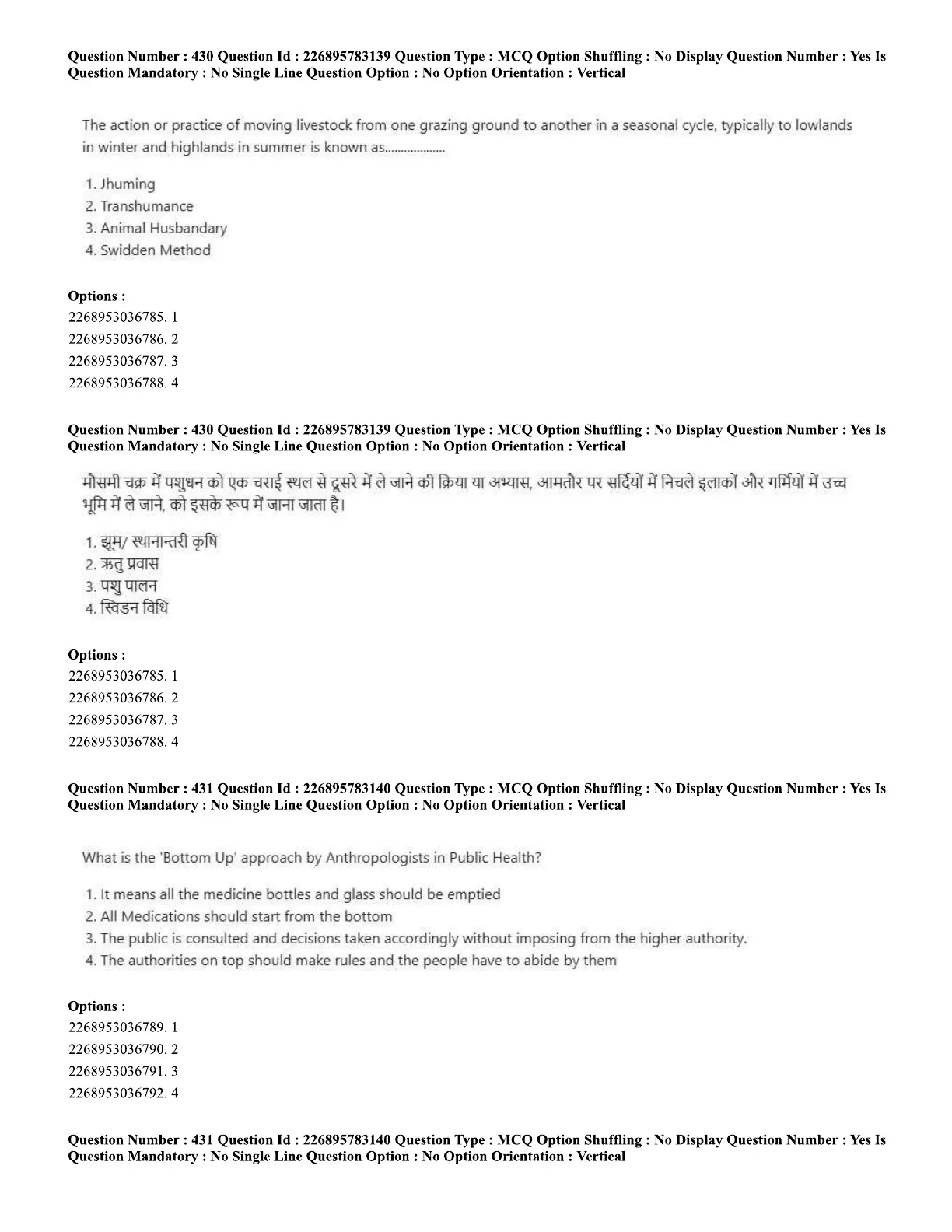
The action or practice of moving livestock from one grazing ground to another in a seasonal cycle, typically to lowlands in winter and highlands in summer is known as...............
Detailed Solution
Concept:
Economic anthropology investigates diverse pastoralist and nomadic subsistence strategies adapted to specific ecological zones.
Pastoral communities inhabiting montane ecosystems often migrate between distinct altitudinal zones to optimize grazing pastures.
This question tests the terminology used to define cyclical, seasonal pastoral migration.
Step 1: Definition of Transhumance:
Transhumance is a specialized form of pastoralism characterized by the regular seasonal movement of human groups with their livestock between fixed summer highland pastures and winter lowland valleys.
Classic anthropological examples in India include the Gaddis and Gujjars of Himachal Pradesh and Jammu \& Kashmir, and the Bhotiyas of the Central Himalayas.
Step 2: Differentiating Alternative Economic Modes:
1. Jhuming / Swidden Method (Options A and D): Slash-and-burn shifting cultivation practiced by hill tribes, involving forest clearing, burning, and rotational field shifting.
2. Animal Husbandry (Option C): The general agricultural practice of breeding, rearing, and caring for farm livestock, which can be sedentary or nomadic.
Step 3: Final Answer:
The seasonal movement of livestock between mountain pastures and valley bottoms is known as Transhumance.
Therefore, Option (B) is the correct answer.
- Jhum / Swidden: Shifting slash-and-burn agriculture.
- Nomadism: Movement without fixed seasonal territories.
What is the 'Bottom Up' approach by Anthropologists in Public Health?
Detailed Solution
Concept:
Medical anthropology and applied anthropology evaluate healthcare delivery, disease etiology, and community health interventions.
Public health strategies utilize either centralized top-down bureaucratic models or participatory bottom-up frameworks.
This question tests the conceptual definition of the bottom-up participatory approach in public health.
Step 1: Anthropological Foundations of Bottom-Up Approaches:
In medical anthropology, the bottom-up approach emphasizes community participation, indigenous knowledge systems, and local cultural realities.
Rather than imposing rigid policies formulated by centralized bureaucracies without local input, healthcare planners actively engage, consult, and collaborate with grassroots communities to co-design health programs.
Step 2: Evaluating the Options:
1. Option (C) is accurate: It captures the essence of participatory development where local populations are directly consulted and policies are tailored to their needs without top-down bureaucratic imposition.
2. Option (D) describes the Top-Down Approach: A hierarchical model where centralized authorities formulate rules and expect unilateral compliance from citizens.
3. Options (A) and (B): Literal, nonsensical interpretations unrelated to public health methodology.
Step 3: Final Answer:
The bottom-up approach involves consulting the community and formulating participatory decisions.
Therefore, Option (C) is the correct choice.
- Top-Down: Bureaucratic, centralized, authoritarian imposition.
- Bottom-Up: Participatory, community-driven, culturally sensitive, grassroots-consultative.
Which of the following is true about Industrial Society?
Detailed Solution
Concept:
Social change theories in anthropology and sociology examine how technological revolutions reorganize social structures.
The transition from agrarian to industrial societies drastically restructured kinship systems, labor markets, and settlement geography.
This question asks to identify the structural characteristics typical of modern industrial society.
Step 1: Structural Transformation in Industrial Societies:
1. Urbanization and Nuclear Family Dominance: Industrialization demands high geographic and social mobility of labor. Large agrarian joint families break down into smaller, mobile nuclear family units residing in dense urbanized manufacturing and service hubs.
2. Occupational Differentiation: Individuals are employed based on specialized, achieved skills rather than inherited caste or agrarian family labor.
Step 2: Assessing Characteristics of Agrarian/Traditional Societies:
- Large joint families, subsistence agriculture, and rural lifestyles (Option B) are characteristic of traditional agrarian societies.
- High rates of polygyny/polygamy (Option C) are prevalent in certain pastoral or tribal societies where multiple spouses provide labor advantages.
- Strict adherence to traditional food habits (Option D) diminishes with industrialized, globalized food supply chains.
Step 3: Final Answer:
Industrial society is structurally characterized by the dominance of the nuclear family and rapid urbanization.
Hence, Option (A) is the correct answer.
- Nuclear family structures (high geographic mobility).
- Rapid urbanization and factory/service labor.
- Monogamy and secularized legal institutions.
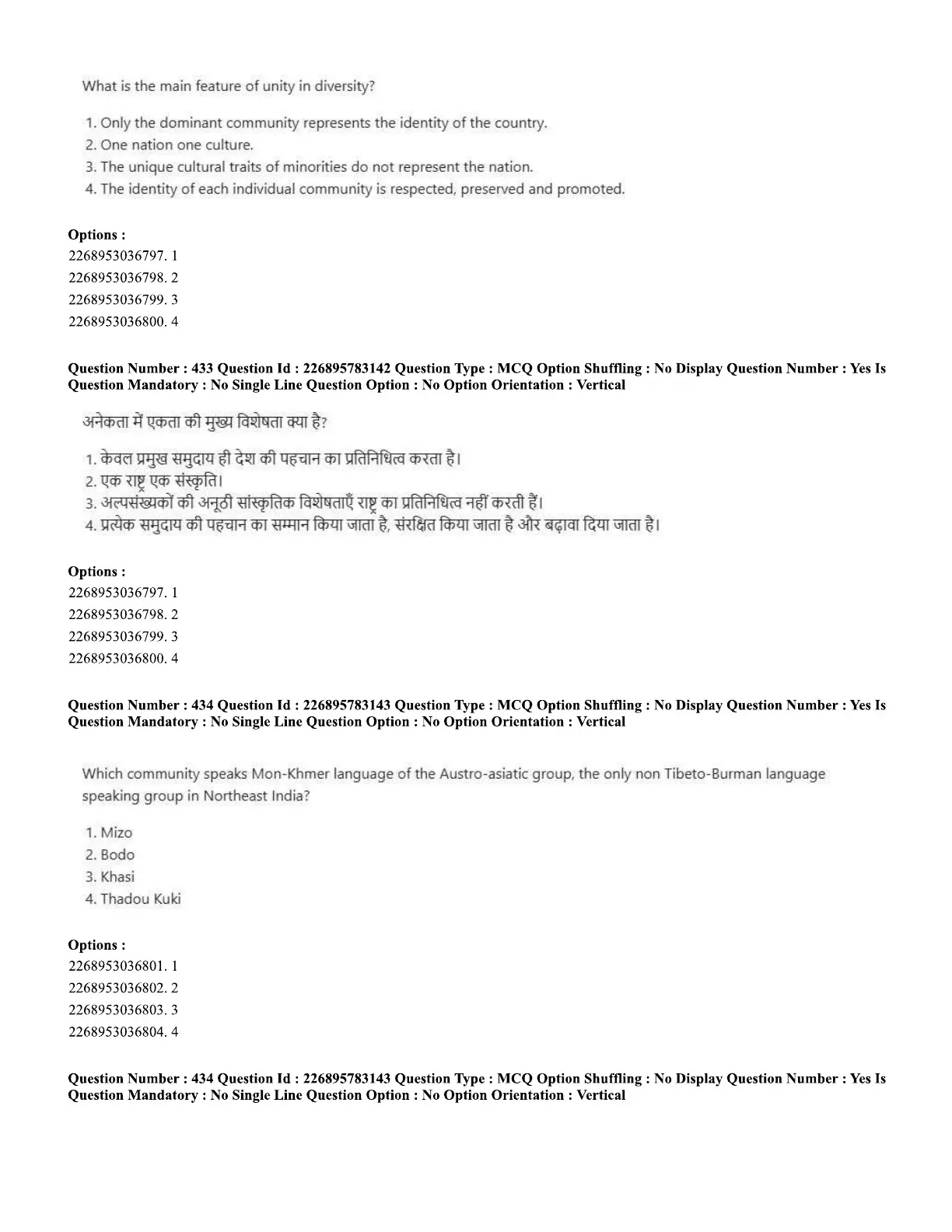
What is the main feature of unity in diversity?
Detailed Solution
Concept:
"Unity in Diversity" is the core philosophical and anthropological premise characterizing the socio-cultural fabric of pluralistic nations like India.
It embodies a model of cultural pluralism where diverse linguistic, religious, regional, and ethnic groups coexist harmoniously within a unified political entity.
This question tests the defining attribute of the concept of unity in diversity.
Step 1: Meaning of Unity in Diversity:
Unity in diversity does not mean cultural homogenization, forced assimilation, or cultural hegemony of a dominant group.
Instead, it recognizes that national cohesion is strengthened when the distinct identities, indigenous customs, languages, and unique heritage of all individual communities (majority and minority alike) are acknowledged, respected, preserved, and actively promoted.
Step 2: Evaluating Incorrect Options:
1. Option (A): Cultural dominance/majoritarianism directly violates pluralistic unity.
2. Option (B): "One nation, one culture" represents monocultural assimilation, which suppresses diversity.
3. Option (C): Denying minority representation undermines the democratic foundation of unity.
Step 3: Final Answer:
The fundamental feature of unity in diversity is that the identity of every community is respected, preserved, and promoted within the national collective.
Therefore, Option (D) is the correct choice.
Every sub-culture retains its identity while participating in national solidarity.
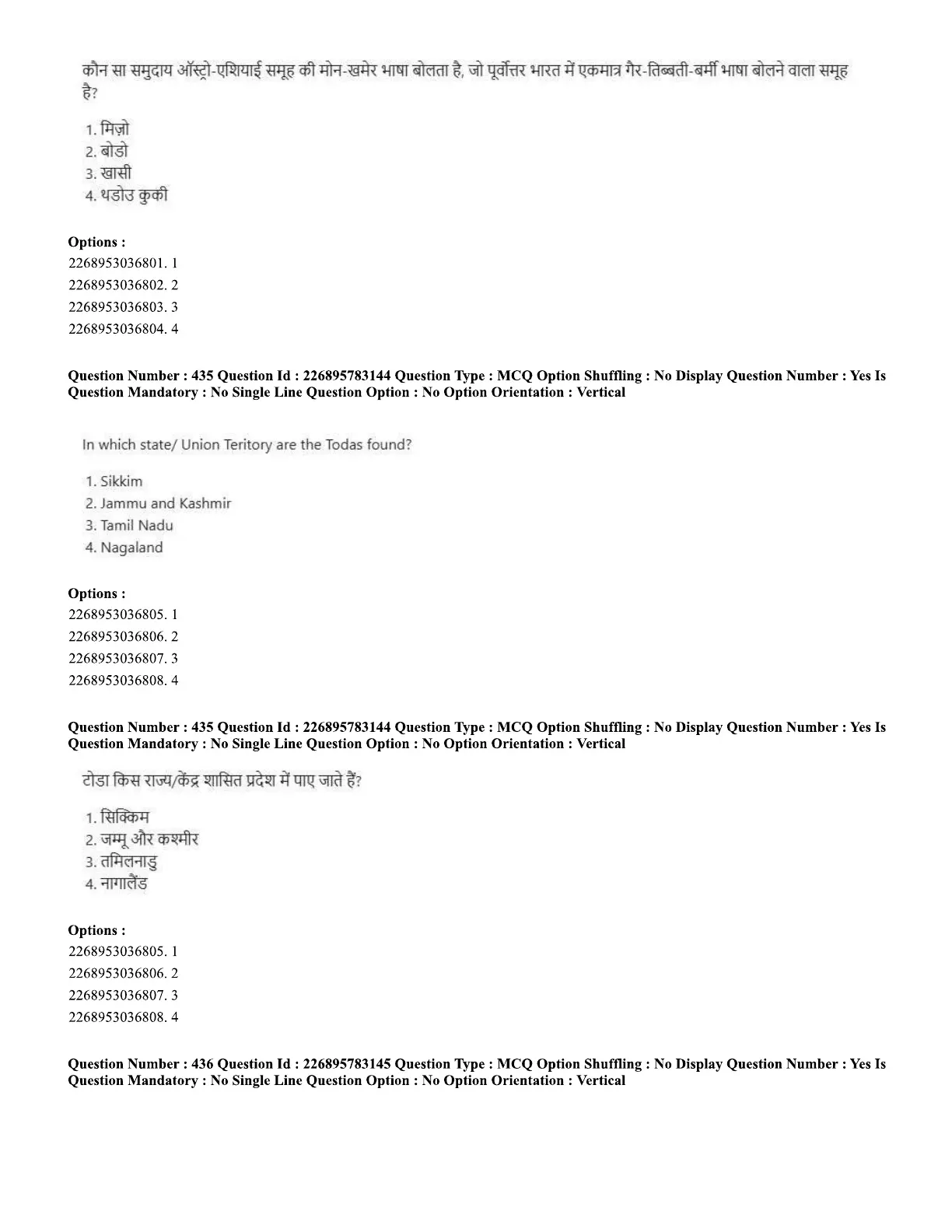
Which community speaks Mon-Khmer language of the Austro-asiatic group, the only non Tibeto-Burman language speaking group in Northeast India?
Detailed Solution
Concept:
Linguistic anthropology in India classifies indigenous tribal populations into four major language families: Indo-European, Dravidian, Tibeto-Burman (Sino-Tibetan), and Austro-Asiatic.
Northeast India is predominantly occupied by speakers of the Tibeto-Burman sub-family.
This question asks to identify the unique matrilineal tribal community in Northeast India that speaks an Austro-Asiatic (Mon-Khmer) language.
Step 1: Linguistic Classification of the Khasi:
The Khasi (along with the related Jaintia/Pnar) of the Meghalaya plateau speak a language belonging to the Mon-Khmer branch of the Austro-Asiatic linguistic phylum.
They represent a linguistic isolate in Northeast India, as they are the only major non-Tibeto-Burman speaking indigenous population surrounded by Sino-Tibetan speakers.
Step 2: Analyzing Other Northeast Groups:
1. Mizo: Belongs to the Kuki-Chin branch of the Tibeto-Burman language family.
2. Bodo: Belongs to the Bodo-Garo branch of the Tibeto-Burman language family.
3. Thadou Kuki: Belongs to the Kuki-Chin sub-family of the Tibeto-Burman group.
Step 3: Final Answer:
The Khasi community speaks the Mon-Khmer language of the Austro-Asiatic group.
Therefore, Option (C) is the correct answer.
- Khasi \& Jaintia (Meghalaya) = Austro-Asiatic (Mon-Khmer).
- Almost all other Northeast tribes (Naga, Mizo, Bodo, Garo, Kuki) = Tibeto-Burman.
In which state/ Union Teritory are the Todas found?
Detailed Solution
Concept:
Ethnographic studies of South Indian pastoral tribes have contributed foundational concepts to anthropological literature.
The Toda community is internationally renowned for its classic buffalo-centered pastoralism, sacred dairies, barrel-vaulted huts, and fraternal polyandry.
This question asks for the geographical state in India where the Toda tribe resides.
Step 1: Geographic Habitat of the Toda:
The Toda are a small pastoral tribal community indigenous to the high-altitude plateau of the Nilgiri Hills in the state of Tamil Nadu, South India.
They live in traditional settlements called madds or munds consisting of unique half-barrel shaped thatched houses.
Step 2: Ethnographic Significance:
Extensively documented by W.H.R. Rivers in his classic 1906 monograph The Todas, their entire socio-religious organization revolves around sacred water buffalo herds and hierarchical dairy temples.
They historically maintained a symbiotic economic network with neighboring Nilgiri tribes, including the Badagas (agriculturalists), Kotas (artisans/musicians), and Kurumbas (forest food gatherers).
Step 3: Final Answer:
The Todas are found in the Nilgiri district of Tamil Nadu.
Therefore, Option (C) is the correct answer.
- Classic features: Pastoral dairy cult, sacred buffaloes, fraternal polyandry (W.H.R. Rivers).
Which of the following tribes belong to the Particularly Vulnerable Tribal Groups?
(A) Apatani
(B) Birhor
(C) Chenchu
(D) Shompen
Choose the correct answer from the options given below:
Detailed Solution
Concept:
Particularly Vulnerable Tribal Groups (PVTGs), formerly known as Primitive Tribal Groups (PTGs), were created on the recommendation of the Dhebar Commission (1973).
PVTGs are characterized by pre-agricultural level of technology, stagnant or declining population, extremely low literacy, and subsistence-level economic existence (75 designated groups in India).
This question requires identifying which of the listed tribal groups are classified as PVTGs.
Step 1: Evaluating the Listed Tribal Groups:
1. Birhor (B): A nomadic hunter-gatherer and rope-making tribe of Jharkhand, Odisha, and West Bengal; officially classified as a PVTG.
2. Chenchu (C): A food-gathering and hunting tribe inhabiting the Nallamala hills of Andhra Pradesh and Telangana; officially classified as a PVTG.
3. Shompen (D): An isolated hunter-gatherer group inhabiting the interior tropical rainforests of Great Nicobar Island; officially classified as a PVTG.
4. Apatani (A): Inhabiting the Ziro Valley of Arunachal Pradesh, the Apatani are renowned for highly advanced, prosperous wet-rice cultivation and integrated pisciculture. They are a Scheduled Tribe (ST) but are not classified as a PVTG.
Step 2: Selecting the Correct Combination:
The PVTGs in the list are Birhor (B), Chenchu (C), and Shompen (D).
Step 3: Final Answer:
Therefore, Option (D) containing (B), (C), and (D) only is the correct answer.
- Birhor (Jharkhand), Chenchu (AP/Telangana), Shompen (Nicobar) are official PVTGs.
- Apatani (Arunachal Pradesh) are settled prosperous agriculturalists, NOT a PVTG.
Who defined Caste as "a collection of families or groups of families bearing a common name; claiming common descent from a mythological ancestor, human or divine; professing to follow the same hereditary calling"?
Detailed Solution
Concept:
The Indian caste system (Jati) has been extensively studied by British colonial ethnographers and Indian anthropologists.
Several classical definitions of caste highlight attributes such as endogamy, hereditary occupation, mythological descent, and hierarchical ranking.
This question asks to identify the scholar who formulated this specific definition of caste.
Step 1: Attribution of the Definition:
Sir Herbert Hope Risley (1851--1911), a British colonial administrator and physical anthropologist who served as the Census Commissioner for India (1901), authored The Tribes and Castes of Bengal (1891) and The People of India (1908).
In his seminal work, Risley defined caste as:
"A collection of families or groups of families bearing a common name; claiming common descent from a mythological ancestor, human or divine; professing to follow the same hereditary calling; and regarded by those who are competent to give an opinion as forming a single homogeneous community."
Step 2: Evaluating Other Anthropologists:
1. B.S. Guha: Known for the 1931 racial classification of the Indian population based on anthropometric surveys.
2. M.N. Srinivas: Formulated structural-functional concepts like Sanskritization, Dominant Caste, and Westernization.
3. N.K. Bose: Famous for studying tribal absorption into Hindu society and the structure of Indian society.
Step 3: Final Answer:
The definition was given by Sir H.H. Risley.
Thus, Option (A) is the correct answer.
- H.H. Risley: Collection of families, common mythological ancestor, hereditary calling.
- C. Bouglé: Hereditary specialization, hierarchy, mutual repulsion.
- M.N. Srinivas: Segmentary system, pollution/purity, dominant caste.
Which of the following is not a function of religion?
Detailed Solution
Concept:
Functional theories of religion (advanced by Émile Durkheim, Bronislaw Malinowski, and A.R. Radcliffe-Brown) analyze how religious institutions maintain social cohesion, psychological stability, and moral order.
Anthropological functionalism focuses on positive societal integration and individual emotional equilibrium provided by religious beliefs.
This question asks to identify the statement that is NOT recognized as a core societal function of religion.
Step 1: Analyzing Positive Functions of Religion:
1. Explanatory / Cognitive Function (Statement A): Religion answers existential questions regarding origin, meaning of life, suffering, and death.
2. Validating / Normative Function (Statement C): Religion sanctifies and validates social values, moral rules, cultural traditions, and legal codes.
3. Psychological / Emotional Comfort (Statement D): As highlighted by Malinowski, religious rituals alleviate existential anxiety, reduce fear in crisis situations, and provide emotional solace during bereavement.
Step 2: Evaluating the Divisive Statement:
While sectarian conflict may occur as a historical byproduct (dysfunction), the primary anthropological and structural-functional purpose of religion is social solidarity and integration (as emphasized by Durkheim), not to systematically divide communities.
Therefore, defining the function of religion as "to divide communities from each other" is conceptually incorrect.
Step 3: Final Answer:
The divisive statement in Option (B) is not an inherent function of religion.
Hence, Option (B) is the correct answer.
- Durkheim: Fosters social cohesion and collective consciousness.
- Malinowski: Provides psychological security and reduces emotional stress.
- Division and conflict are dysfunctions, not its core anthropological purpose.
Match List-I with List-II:

Choose the correct answer from the options given below:
Detailed Solution
Concept:
Tribal geography in India maps hundreds of distinct Scheduled Tribes across different administrative states and Union Territories.
Knowledge of tribal distributions, their regional habitats, and state affiliations is essential in Indian anthropology.
This question requires matching four specific tribal communities with their respective states and Union Territories.
Step 1: Identifying Regional Tribal Habitats:
1. Apatani (A): Inhabit the fertile Ziro Valley in the Lower Subansiri district of Arunachal Pradesh. Thus, (A) matches with (III).
2. Khasi (B): Prominent matrilineal tribe indigenous to the Khasi Hills in the state of Meghalaya. Thus, (B) matches with (IV).
3. Kolam (C): A Dravidian-speaking scheduled tribe residing across the Adilabad district of Andhra Pradesh / Telangana and adjacent Maharashtra. Thus, (C) matches with (I).
4. Shompen (D): An isolated hunter-gatherer PVTG indigenous to the Great Nicobar Island of the Andaman \& Nicobar Islands Union Territory. Thus, (D) matches with (II).
Step 2: Formulating the Matching Combination:
The matching is:
(A) $\rightarrow$ (III), (B) $\rightarrow$ (IV), (C) $\rightarrow$ (I), (D) $\rightarrow$ (II).
Step 3: Final Answer:
This matches Option (D).
- Apatani: Arunachal Pradesh (Ziro Valley)
- Khasi: Meghalaya (Shillong Plateau)
- Kolam: Andhra Pradesh / Telangana / Maharashtra
- Shompen: Andaman \& Nicobar (Great Nicobar)
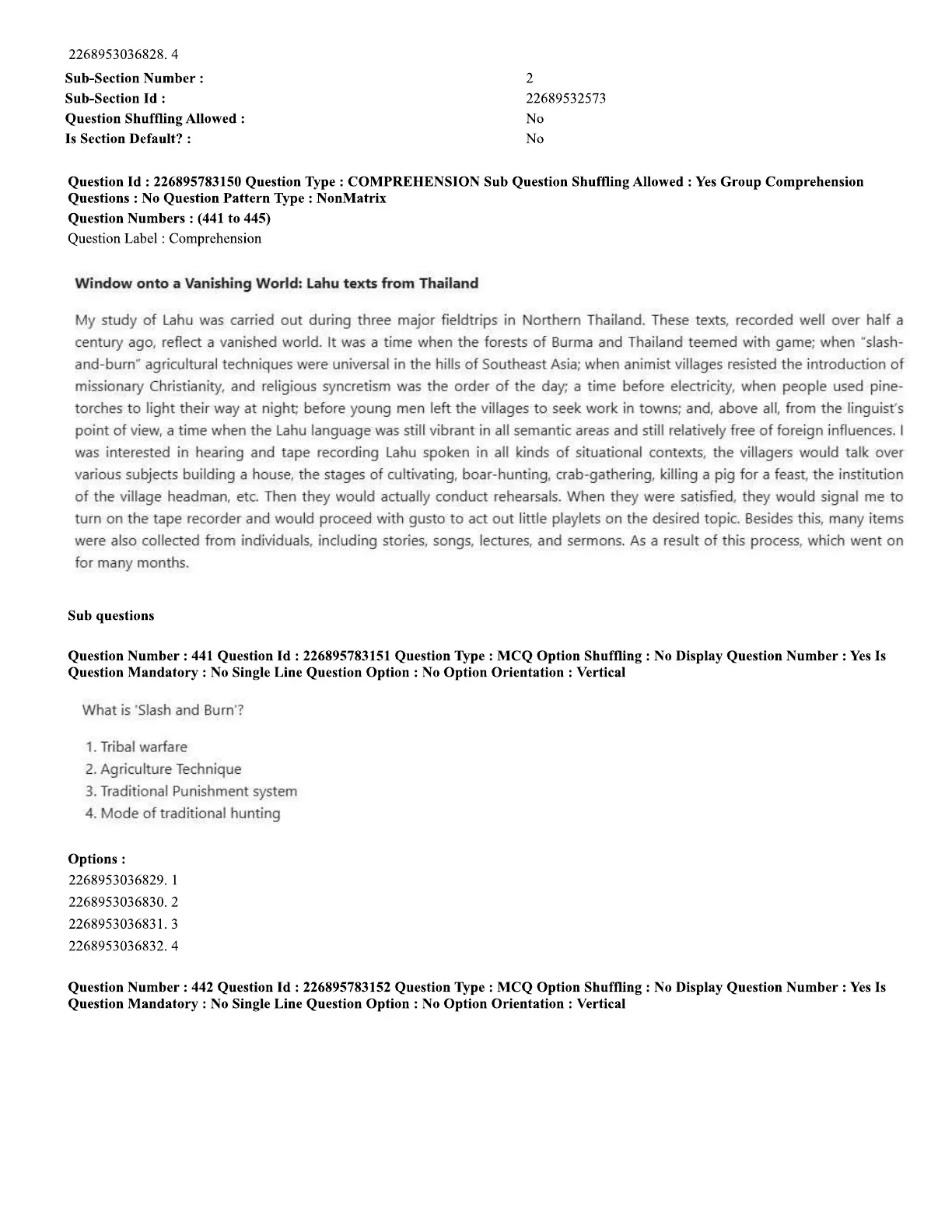
Which of the following is not a 'cultural marker' defining 'cultural diversity' in India?
Detailed Solution
Concept:
Cultural markers are observable symbols, traits, or social institutions that define group identity, cultural boundary maintenance, and inter-group diversity.
In India, the composite social matrix is characterized by pluralistic diversities organized around specific structural institutions.
This question asks to identify which of the given options is an economic medium rather than a cultural identity marker.
Step 1: Identifying Fundamental Cultural Markers in India:
1. Language (A): India possesses major language families (Indo-Aryan, Dravidian, Austro-Asiatic, Tibeto-Burman) that act as prominent regional cultural markers.
2. Religion (B): Pluralistic coexistence of Hinduism, Islam, Christianity, Sikhism, Buddhism, Jainism, and tribal religions forms core cultural markers.
3. Caste (D): The Jati and varna systems function as social and cultural markers governing kinship, marriage rules, ritual hierarchies, and customs.
Step 2: Evaluating the Nature of Money:
Money (Currency): Money is an impersonal, generalized medium of economic exchange and financial liquidity.
It is standardized nationwide by the state/central bank and operates universally across all cultural, linguistic, and religious groups, making it an economic instrument rather than a cultural marker of diversity.
Step 3: Final Answer:
Money is not a cultural marker defining cultural diversity.
Therefore, Option (C) is the correct answer.
- Money: Standard economic medium of exchange, not a marker of socio-cultural identity.
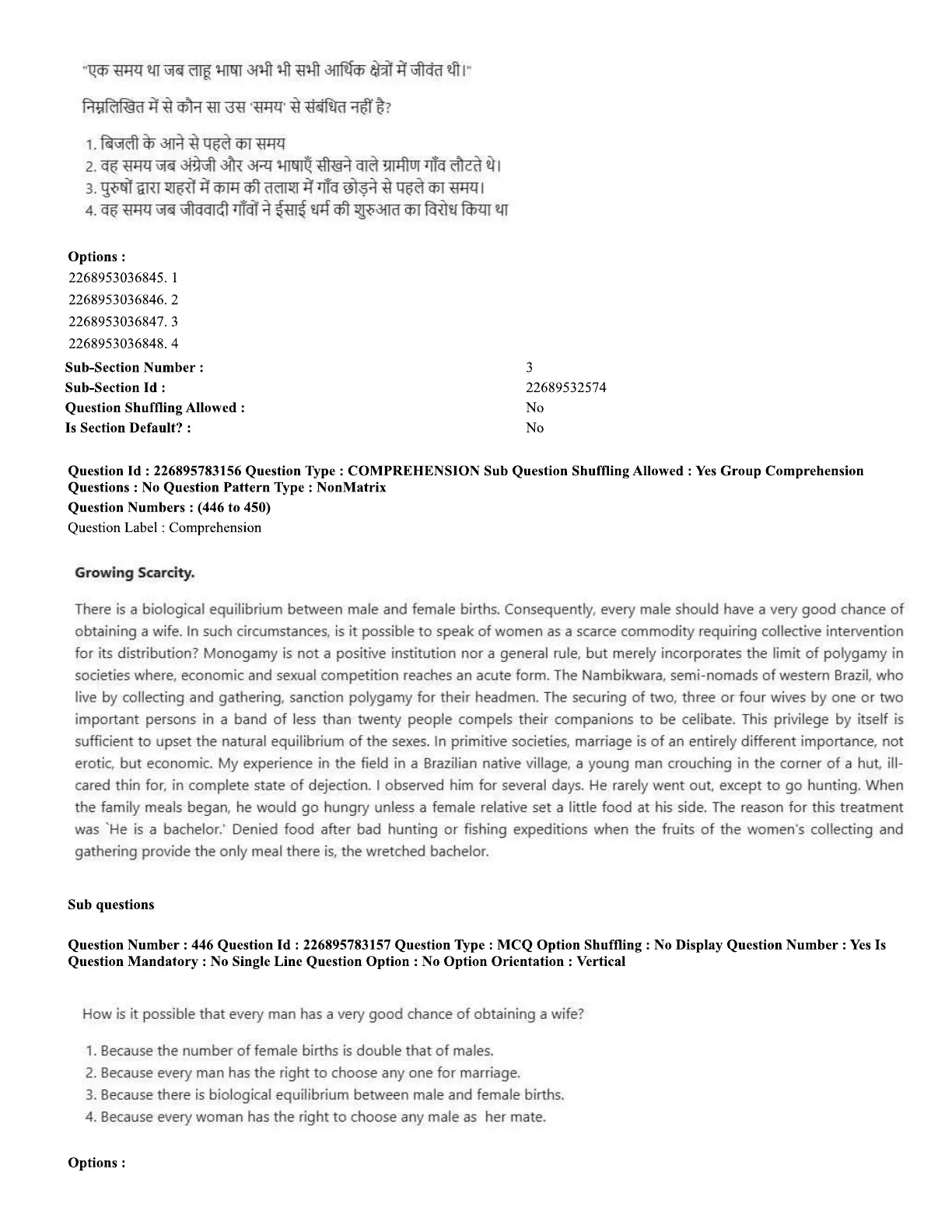
Window onto a Vanishing World: Lahu texts from Thailand
My study of Lahu was carried out during three major fieldtrips in Northern Thailand. These texts,
recorded well over half a century ago, reflect a vanished world. It was a time when the forests of Burma
and Thailand teemed with game; when "slash-and-burn" agricultural techniques were universal in the
hills of Southeast Asia; when animist villages resisted the introduction of missionary Christianity, and
religious syncretism was the order of the day; a time before electricity, when people used pine-torches to
light their way at night; before young men left the villages to seek work in towns; and, above all, from
the linguist’s point of view, a time when the Lahu language was still vibrant in all semantic areas and
still relatively free of foreign influences. I was interested in hearing and tape recording Lahu spoken
in all kinds of situational contexts, the villagers would talk over various subjects building a house, the
stages of cultivating, boar-hunting, crab-gathering, killing a pig for a feast, the institution of the village
headman, etc. Then they would actually conduct rehearsals. When they were satisfied, they would signal
me to turn on the tape recorder and would proceed with gusto to act out little playlets on the desired topic.
Besides this, many items were also collected from individuals, including stories, songs, lectures,
and sermons. As a result of this process, which went on for many months.
Question 41:
What is 'Slash and Burn'?
Detailed Solution
Concept:
In economic anthropology and agrarian archaeology, subsistence modes are classified into foraging, pastoralism, horticulture, and intensive agriculture.
"Slash-and-burn" is an ancient farming method widely practiced in tropical and subtropical hill tracts.
This question asks for the fundamental classification of the slash-and-burn technique mentioned in the passage.
Step 1: Reading and Contextualizing from the Passage:
The passage refers to: "when 'slash-and-burn' agricultural techniques were universal in the hills of Southeast Asia".
Step 2: Anthropological Definition of Slash-and-Burn:
Also known as swidden agriculture or shifting cultivation (Jhum in Northeast India), slash-and-burn is a traditional agricultural technique.
Farmers cut down wild vegetation and forest plots, allow the biomass to dry, and burn it to release nutrient-rich ash into the soil for temporary crop cultivation before moving to a new plot to let the forest regenerate.
Step 3: Final Answer:
Slash-and-burn is an agricultural technique.
Therefore, Option (B) is the correct choice.
What did the animist villages resisted?
Detailed Solution
Concept:
Indigenous animistic communities often experience religious acculturation and proselytization from external organized religions.
Resistance to foreign religious conversion is a well-documented phenomenon in tribal ethnography.
This question asks what specific external introduction was resisted by the traditional Lahu animist villages according to the passage.
Step 1: Locating Textual Evidence in the Passage:
The passage explicitly describes the socio-religious conditions of the period:
"...when animist villages resisted the introduction of missionary Christianity, and religious syncretism was the order of the day..."
Step 2: Evaluating the Options:
1. Option (A) is correct: The text explicitly identifies "the introduction of missionary Christianity" as what the animist villages resisted.
2. Options (B, C, D): Slash-and-burn was actively practiced (not resisted), and villagers enthusiastically participated in tape-recording and conducting rehearsals for the researcher.
Step 3: Final Answer:
The animist villages resisted the introduction of Christianity through missionaries.
Thus, Option (A) is the correct choice.
"animist villages resisted the introduction of missionary Christianity" $\rightarrow$ Option (A).
When was this text, "Window into vanishing world" written?
Detailed Solution
Concept:
Linguistic and ethnographic field research documents cultural realities prior to extensive globalization and language attrition.
This question tests understanding regarding the historical time period when the researcher recorded the Lahu texts.
Step 1: Locating Contextual Clues in the Text:
The author describes the ethnographic baseline:
"...and, above all, from the linguist's point of view, a time when the Lahu language was still vibrant in all semantic areas and still relatively free of foreign influences."
Step 2: Analyzing the Timeline of Fieldwork:
The author explicitly notes that these texts were recorded half a century ago when the indigenous language and culture had not yet been overwhelmed by foreign linguistic loanwords, tourism, or modern urban migrations.
This represents a period when the area was still relatively free of external/foreign influences.
Step 3: Final Answer:
The text reflects the era when the areas were still relatively free of foreign influences.
Therefore, Option (C) is the correct answer.
Passage states the study occurred when Lahu was "still vibrant in all semantic areas and still relatively free of foreign influences".
How can you conclude that the writing of the text is an old one that took place half a century ago?
Detailed Solution
Concept:
Material culture and infrastructure markers (such as lighting methods and lack of rural electrification) indicate the historical antiquity of ethnographic field accounts.
This question asks to identify the specific historical marker from the passage demonstrating that the account was recorded over fifty years ago.
Step 1: Examining Historical Indicators in the Passage:
The passage details specific material conditions of that era:
"...a time before electricity, when people used pine-torches to light their way at night; before young men left the villages to seek work in towns..."
Step 2: Evaluating the Listed Options:
1. Option (C) is directly supported: The author explicitly mentions the absence of electricity and the use of primitive pine-torches for illumination at night as proof of the past era.
2. Options (A, B, D): The passage does not claim that nobody remembers the author, nor does it state that traditional agriculture had ceased at that time.
Step 3: Final Answer:
The use of pine-torches before the introduction of electricity confirms the historical antiquity of the ethnographic setting.
Hence, Option (C) is the correct choice.
"a time before electricity, when people used pine-torches to light their way at night" demonstrates the historical antiquity of the study.
"A time when the Lahu language was still vibrant in all semantic areas".
Which of the following is not related to that 'Time'?
Detailed Solution
Concept:
Linguistic vitality flourishes when an indigenous community remains relatively isolated from dominant national and foreign languages.
This question asks to identify the condition that was NOT part of the historical timeframe described by the author.
Step 1: Reviewing Features of 'That Time' from the Passage:
The passage explicitly lists the characteristics defining that historical period:
1. "a time before electricity..." (Corresponds to Option A)
2. "before young men left the villages to seek work in towns..." (Corresponds to Option C)
3. "when animist villages resisted the introduction of missionary Christianity..." (Corresponds to Option D)
Step 2: Identifying the Unrelated/Contradictory Condition:
Option (B) mentions a time when villagers returned after learning English and other foreign languages.
This scenario represents modern linguistic contact and foreign influence, which directly contradicts the author's statement that the Lahu language was "still vibrant in all semantic areas and still relatively free of foreign influences".
Step 3: Final Answer:
Option (B) is not related to the historical time described in the passage.
Therefore, Option (B) is the correct answer.
Options (A), (C), and (D) are verbatim characteristics of the author's fieldwork era. Option (B) contradicts the text's emphasis on freedom from foreign languages.
Growing Scarcity
There is a biological equilibrium between male and female births. Consequently, every male should
have a very good chance of obtaining a wife. In such circumstances, is it possible to speak of women as
a scarce commodity requiring collective intervention for its distribution? Monogamy is not a positive
institution nor a general rule, but merely incorporates the limit of polygamy in societies where economic
and sexual competition reaches an acute form. The Nambikwara, semi-nomads of western Brazil, who
live by collecting and gathering, sanction polygamy for their headmen. The securing of two, three or four
wives by one or two important persons in a band of less than twenty people compels their companions to
be celibate. This privilege by itself is sufficient to upset the natural equilibrium of the sexes. In primitive
societies, marriage is of an entirely different importance, not erotic, but economic. My experience in the
field in a Brazilian native village, a young man crouching in the corner of a hut, ill-cared for, in complete
state of dejection. I observed him for several days. He rarely went out, except to go hunting. When the
family meals began, he would go hungry unless a female relative set a little food at his side. The reason
for this treatment was "He is a bachelor." Denied food after bad hunting or fishing expeditions when the
fruits of the women’s collecting and gathering provide the only meal there is, the wretched bachelor.
Question 46:
How is it possible that every man has a very good chance of obtaining a wife?
Detailed Solution
Concept:
Demographic anthropology and kinship theory evaluate sex ratios at birth and their impact on marriage systems and spousal availability.
Natural primary sex ratios maintain an approximately equal proportion between males and females in human populations.
This question asks for the demographic foundation cited in the text that gives every man a chance to obtain a wife.
Step 1: Locating Direct Passage Evidence:
The opening sentences of the text state:
"There is a biological equilibrium between male and female births. Consequently, every male should have a very good chance of obtaining a wife."
Step 2: Evaluating the Options:
1. Option (C) is correct: The text explicitly explains that the biological equilibrium (roughly $1:1$ sex ratio) between male and female births naturally affords every man an equal demographic probability of finding a spouse.
2. Options (A, B, D): These statements are factually incorrect and unsupported by the passage.
Step 3: Final Answer:
The biological equilibrium between male and female births provides every man a good chance of obtaining a wife.
Therefore, Option (C) is the correct answer.
"There is a biological equilibrium between male and female births. Consequently, every male should have a very good chance of obtaining a wife." $\rightarrow$ Option (C).
Why was the boy in the story ill treated?
Detailed Solution
Concept:
In foraging societies with strict gender divisions of labor, marriage functions as an essential economic survival alliance between food-gathering females and hunting males.
Unmarried individuals often suffer severe economic deprivation and marginalization due to the lack of a complementary domestic food-sharing partner.
This question asks why the young man observed in the Brazilian village was neglected and treated poorly.
Step 1: Locating Textual Reference in the Passage:
The passage narrates:
"When the family meals began, he would go hungry unless a female relative set a little food at his side. The reason for this treatment was 'He is a bachelor.'"'
Step 2: Anthropological Context:
Among the Nambikwara, women's gathering provides the primary stable daily caloric intake.
A bachelor has no wife to gather fruits, roots, and vegetables for him; consequently, following unsuccessful hunting expeditions, he is left without guaranteed food and is treated with dejection solely because of his unmarried bachelor status.
Step 3: Final Answer:
The young man was ill-treated because he was a bachelor.
Thus, Option (A) is the correct answer.
"The reason for this treatment was 'He is a bachelor.'" $\rightarrow$ Option (A).
What is the importance of marriage in primitive societies, according to the author in this paragraph?
Detailed Solution
Concept:
In structural and economic anthropology (prominently articulated by Claude Lévi-Strauss in The Elementary Structures of Kinship and Tristes Tropiques, the source of this passage), marriage is fundamentally an economic partnership rather than merely a romantic or erotic union.
This question asks for the primary function and importance of marriage highlighted by the author.
Step 1: Locating Textual Evidence in the Passage:
The author explicitly writes:
"In primitive societies, marriage is of an entirely different importance, not erotic, but economic."
Step 2: Explaining the Economic Dimension of Marriage:
In simple foraging societies, survival depends entirely on the complementary sexual division of labor—men hunt game and fish, while women collect plant foods and cook.
Neither sex can sustain complete domestic self-sufficiency alone.
Thus, marriage is an indispensable economic institution securing daily food distribution and mutual survival.
Step 3: Final Answer:
According to the author, the primary importance of marriage in primitive societies is economic.
Therefore, Option (D) is the correct choice.
"In primitive societies, marriage is of an entirely different importance, not erotic, but economic." $\rightarrow$ Option (D).
What compels some members of the bands to be celibate?
Detailed Solution
Concept:
Polygyny practiced in small, demographically balanced bands artificially creates an acute structural shortage of available marriageable females.
When powerful leaders monopolize multiple wives, other males in the group are left without spouses, forcing them into involuntary celibacy.
This question asks what causes certain band members to remain celibate according to the passage.
Step 1: Locating Textual Evidence in the Passage:
The passage states:
"The securing of two, three or four wives by one or two important persons in a band of less than twenty people compels their companions to be celibate. This privilege by itself is sufficient to upset the natural equilibrium of the sexes."
Step 2: Evaluating the Options:
1. Option (B) is correct: Monopolization of multiple women by one or two high-status individuals (e.g., the headman) depletes the pool of marriageable women in a small band, forcing other men into celibacy.
2. Options (A, C, D): Celibacy in this society is not a voluntary ascetic preference, nor the result of parental force or monetary poverty.
Step 3: Final Answer:
Band members are compelled to be celibate because important persons secure two, three, or four wives for themselves.
Thus, Option (B) is the correct choice.
"The securing of two, three or four wives by one or two important persons... compels their companions to be celibate." $\rightarrow$ Option (B).
Nambikwara, semi-nomads of western Brazil sanction-polygamy for their ..............
Detailed Solution
Concept:
In political and kinship anthropology, leadership in acephalous or band societies is often sustained through specific socio-cultural privileges.
Among certain South American indigenous bands, the institution of chieftainship is uniquely reinforced through permitted polygyny.
This question asks who among the Nambikwara is sanctioned to practice polygamy according to the passage.
Step 1: Locating Textual Evidence in the Passage:
The text explicitly states:
"The Nambikwara, semi-nomads of western Brazil, who live by collecting and gathering, sanction polygamy for their headmen."
Step 2: Anthropological Context:
Claude Lévi-Strauss observed among the Nambikwara that while the general population practiced monogamy, the village headman was granted the exclusive privilege of polygyny (multiple wives).
Having multiple wives provided the chief with extra female gathering labor and domestic assistance needed to fulfill his political obligations of hospitality, gift-giving, and band leadership.
Step 3: Final Answer:
The Nambikwara sanction polygamy specifically for their headman.
Therefore, Option (D) is the correct answer.
"The Nambikwara, semi-nomads of western Brazil... sanction polygamy for their headmen." $\rightarrow$ Option (D).
CUET UG 2026 Exam Pattern
| Parameter | Details |
|---|---|
| Exam Name | Common University Entrance Test (CUET UG) 2026 |
| Conducting Body | National Testing Agency (NTA) |
| Exam Mode | Computer-Based Test (CBT) |
| Exam Duration | 60 minutes per test |
| Total Sections | 3 (Languages, Domain Subjects, General Test) |
| Question Type | Multiple Choice Questions (MCQs) |
| Questions per Test | 50 questions (all compulsory) |
| Marking Scheme | +5 for correct, -1 for incorrect |
| Maximum Marks | 250 marks per test |
| Maximum Subject Choices | 5 subjects in total |
| Syllabus Base | Class 12 NCERT (mainly for Domain Subjects) |



Comments