CUET 2026 Anthropology Question Paper is available for download here. NTA conducted the CUET 2026 exam from 11th May to 31st May in two shifts.

The CUET 2026 Anthropology question paper includes the following:

  • 50 questions, all compulsory, to be attempted in 60 minutes
  • Q1 - Q40: 40 independent multiple choice questions (MCQs) with four options
  • Q41 - Q50: two passage / case-based sets with 5 questions each
  • Marking: +5 for a correct answer, -1 for an incorrect answer, 0 for an unattempted question
  • Maximum marks: 250

CUET 2026 Anthropology May 19 Shift 1 Question Paper with Solution PDF

Also Check:

CUET 2026 Anthropology May 19 Shift 1 Questions with Solutions


Questions 1 - 40

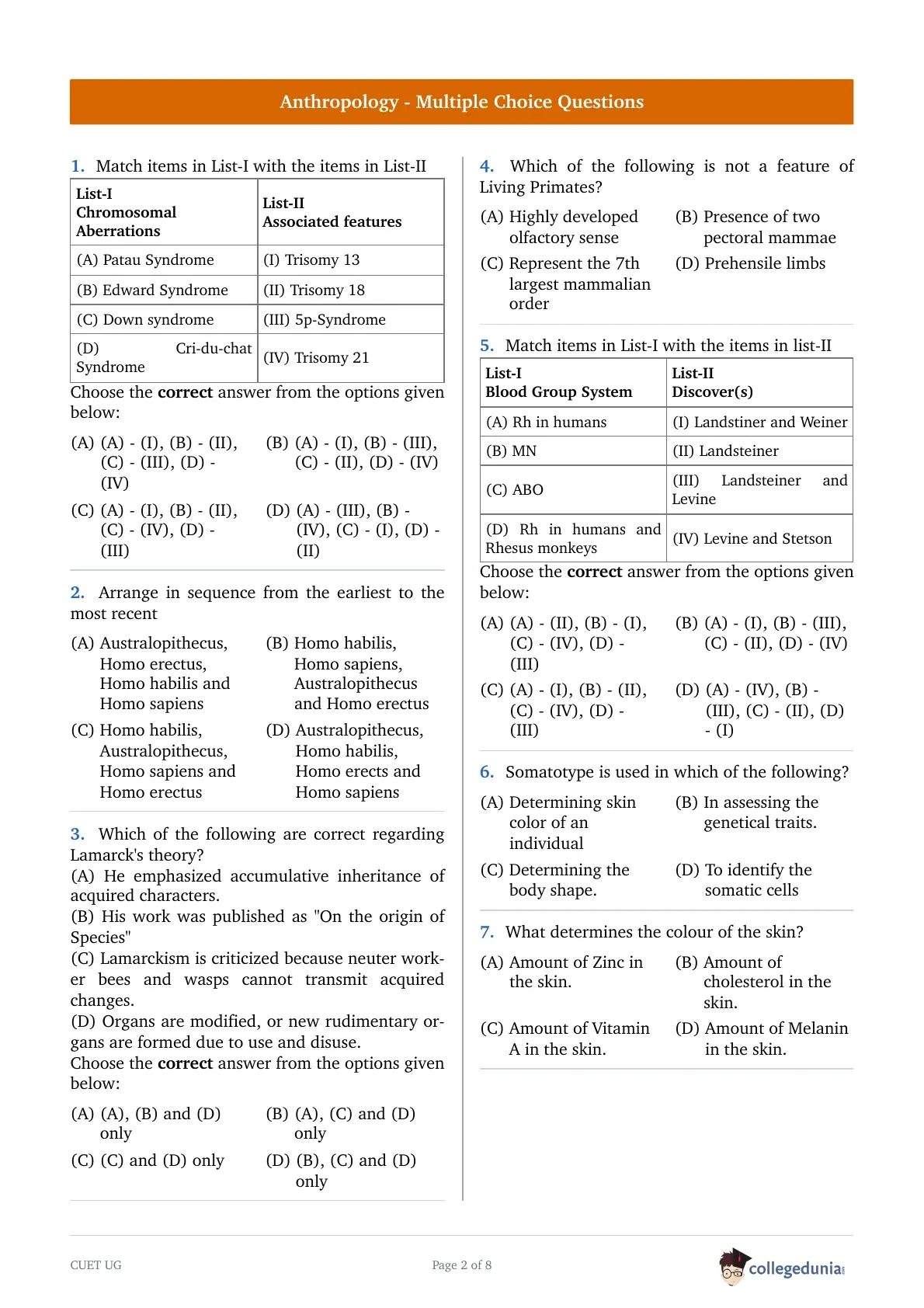
Question 1:
Match items in List-I with the items in List-II:
Choose the correct answer from the options given below:
  • (A) (A) - (I), (B) - (II), (C) - (III), (D) - (IV)
  • (B) (A) - (I), (B) - (III), (C) - (II), (D) - (IV)
  • (C) (A) - (I), (B) - (II), (C) - (IV), (D) - (III)
  • (D) (A) - (III), (B) - (IV), (C) - (I), (D) - (II)

Question 2:
Arrange in sequence from the earliest to the most recent
  • (A) Australopithecus, Homo erectus, Homo habilis and Homo sapiens
  • (B) Homo habilis, Homo sapiens, Australopithecus and Homo erectus
  • (C) Homo habilis, Australopithecus, Homo sapiens and Homo erectus
  • (D) Australopithecus, Homo habilis, Homo erects and Homo sapiens

Question 3:
Which of the following are correct regarding Lamarck's theory?
(A) He emphasized accumulative inheritance of acquired characters.
(B) His work was published as "On the origin of Species"
(C) Lamarckism is criticized because neuter worker bees and wasps cannot transmit acquired changes.
(D) Organs are modified, or new rudimentary organs are formed due to use and disuse.
Choose the correct answer from the options given below:
  • (A) (A), (B) and (D) only
  • (B) (A), (C) and (D) only
  • (C) (C) and (D) only
  • (D) (B), (C) and (D) only

Question 4:
Which of the following is not a feature of Living Primates?
  • (A) Highly developed olfactory sense
  • (B) Presence of two pectoral mammae
  • (C) Represent the 7th largest mammalian order
  • (D) Prehensile limbs

Question 5:
Match items in List-I with the items in List-II:
Choose the correct answer from the options given below:
  • (A) (A) - (II), (B) - (I), (C) - (IV), (D) - (III)
  • (B) (A) - (I), (B) - (III), (C) - (II), (D) - (IV)
  • (C) (A) - (I), (B) - (II), (C) - (IV), (D) - (III)
  • (D) (A) - (IV), (B) - (III), (C) - (II), (D) - (I)

Question 6:
Somatotype is used in which of the following?
  • (A) Determining skin color of an individual
  • (B) In assessing the genetical traits
  • (C) Determining the body shape
  • (D) To identify the somatic cells

Question 7:
What determines the colour of the skin?
  • (A) Amount of Zinc in the skin
  • (B) Amount of cholesterol in the skin
  • (C) Amount of Vitamin A in the skin
  • (D) Amount of Melanin in the skin

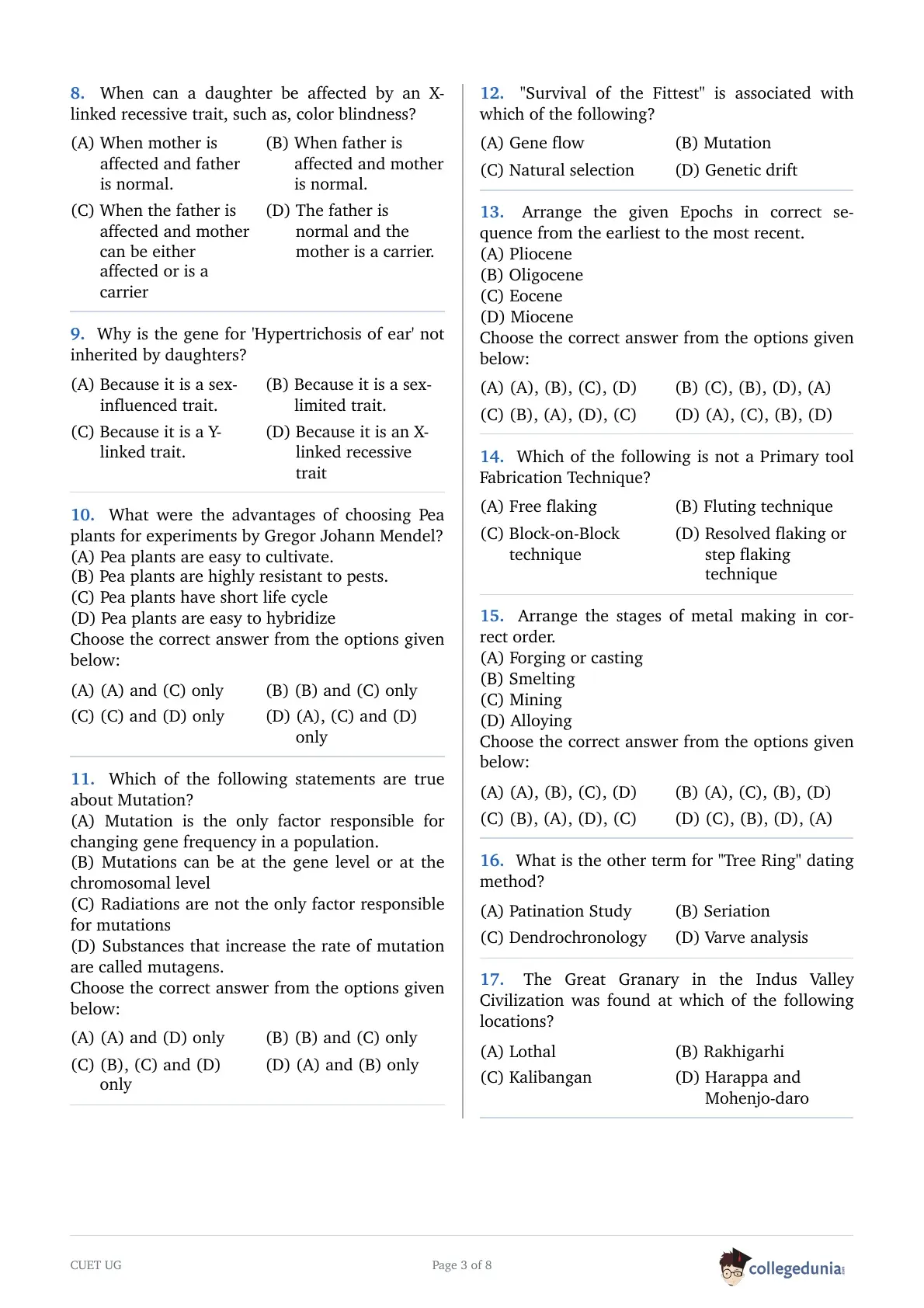
Question 8:
When can a daughter be affected by an X-linked recessive trait, such as color blindness?
  • (A) When mother is affected and father is normal
  • (B) When father is affected and mother is normal
  • (C) When the father is affected and mother can be either affected or is a carrier
  • (D) The father is normal and the mother is a carrier

Question 9:
Why is the gene for 'Hypertrichosis of ear' not inherited by daughters?
  • (A) Because it is a sex-influenced trait
  • (B) Because it is a sex-limited trait
  • (C) Because it is a Y-linked trait
  • (D) Because it is an X-linked recessive trait

Question 10:
What were the advantages of choosing Pea plants for experiments by Gregor Johann Mendel?
(A) Pea plants are easy to cultivate.
(B) Pea plants are highly resistent to pests.
(C) Pea plants have short life cycle.
(D) Pea plants are easy to hybridize.
Choose the correct answer from the options given below:
  • (A) (A) and (C) only
  • (B) (B) and (C) only
  • (C) (C) and (D) only
  • (D) (A), (C) and (D) only

Question 11:
Which of the following statements are true about Mutation?
(A) Mutation is the only factor responsible for changing gene frequency in a population.
(B) Mutations can be at the gene level or at the chromosomal level.
(C) Radiations are not the only factor responsible for mutations.
(D) Substances that increase the rate of mutation are called mutagens.
Choose the correct answer from the options given below:
  • (A) (A) and (D) only
  • (B) (B) and (C) only
  • (C) (B), (C) and (D) only
  • (D) (A) and (B) only

Question 12:
"Survival of the Fittest" is associated with which of the following?
  • (A) Gene flow
  • (B) Mutation
  • (C) Natural selection
  • (D) Genetic drift

Question 13:
Arrange the given Epochs in correct sequence from the earliest to the most recent:
(A) Pliocene
(B) Oligocene
(C) Eocene
(D) Miocene
Choose the correct answer from the options given below:
  • (A) (A), (B), (C), (D)
  • (B) (C), (B), (D), (A)
  • (C) (B), (A), (D), (C)
  • (D) (A), (C), (B), (D)

Question 14:
Which of the following is not a Primary tool Fabrication Technique?
  • (A) Free flaking
  • (B) Fluting technique
  • (C) Block-on-Block technique
  • (D) Resolved flaking or step flaking technique

Question 15:
Arrange the stages of metal making in correct order:
(A) Forging or casting
(B) Smelting
(C) Mining
(D) Alloying
Choose the correct answer from the options given below:
  • (A) (A), (B), (C), (D)
  • (B) (A), (C), (B), (D)
  • (C) (B), (A), (D), (C)
  • (D) (C), (B), (D), (A)

Question 16:
What is the other term for "Tree Ring" dating method?
  • (A) Patination Study
  • (B) Seriation
  • (C) Dendrochronology
  • (D) Varve analysis

Question 17:
The Great Granary in the Indus Valley Civilization was found at which of the following locations?
  • (A) Lothal
  • (B) Rakhigarhi
  • (C) Kalibangan
  • (D) Harappa and Mohenjo-daro

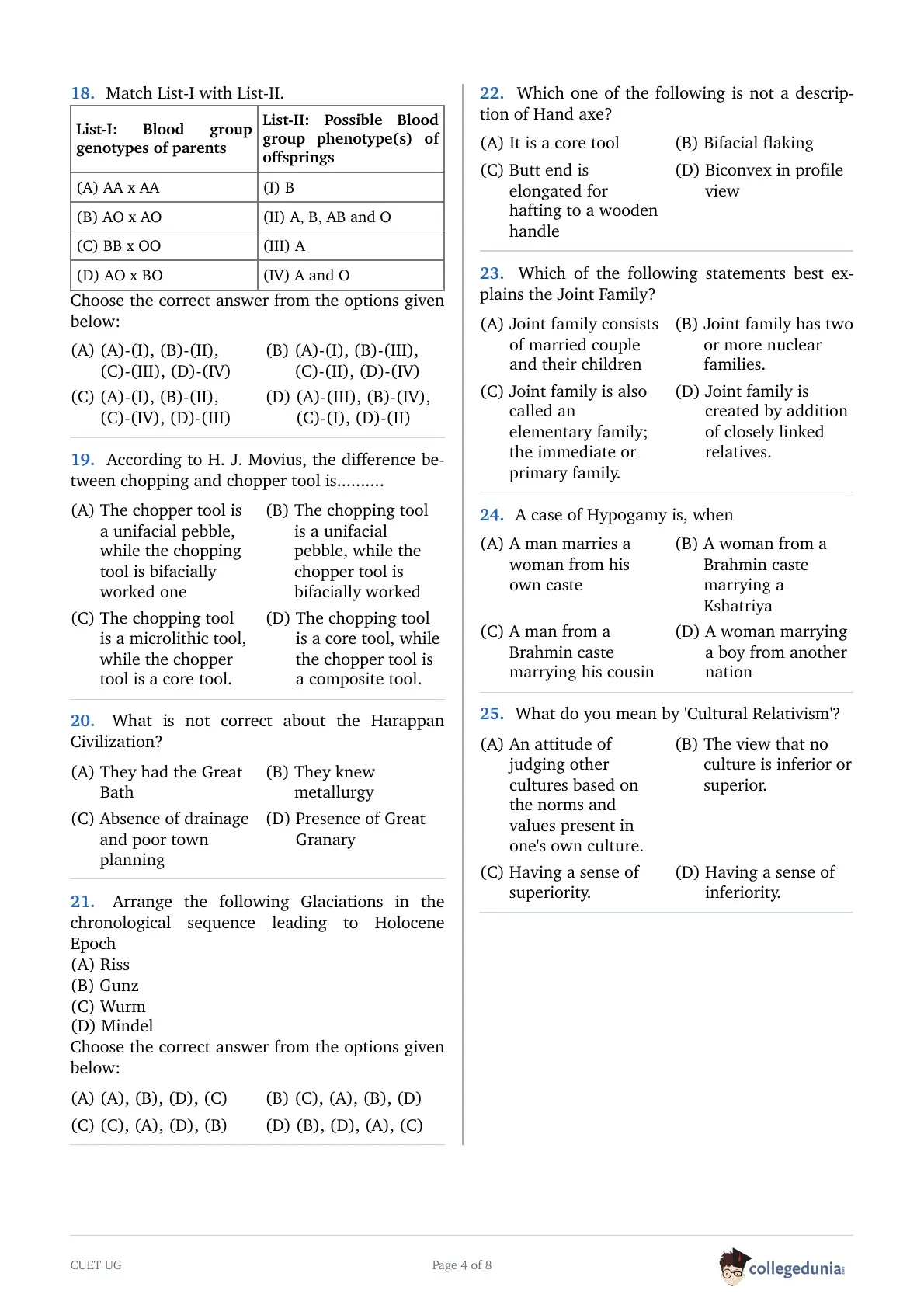
Question 18:
Match List-I with List-II:
Choose the correct answer from the options given below:
  • (A) (A) - (I), (B) - (II), (C) - (III), (D) - (IV)
  • (B) (A) - (I), (B) - (III), (C) - (II), (D) - (IV)
  • (C) (A) - (I), (B) - (II), (C) - (IV), (D) - (III)
  • (D) (A) - (III), (B) - (IV), (C) - (I), (D) - (II)

Question 19:
According to H. J. Movius, the difference between chopping and chopper tool is ...........
  • (A) The chopper tool is a unifacial pebble, while the chopping tool is bifacially worked one
  • (B) The chopping tool is a unifacial pebble, while the chopper tool is bifacially worked
  • (C) The chopping tool is a microlithic tool, while the chopper tool is a core tool
  • (D) The chopping tool is a core tool, while the chopper tool is a composite tool

Question 20:
What is not correct about the Harappan Civilization?
  • (A) They had the Great Bath
  • (B) They knew metallurgy
  • (C) Absence of drainage and poor town planning
  • (D) Presence of Great Granary

Question 21:
Arrange the following Glaciations in the chronological sequence leading to Holocene Epoch:
(A) Riss
(B) Gunz
(C) Wurm
(D) Mindel
Choose the correct answer from the options given below:
  • (A) (A), (B), (D), (C)
  • (B) (C), (A), (B), (D)
  • (C) (C), (A), (D), (B)
  • (D) (B), (D), (A), (C)

Question 22:
Which one of the following is not a description of Hand axe?
  • (A) It is a core tool
  • (B) Bifacial flaking
  • (C) Butt end is elongated for hafting to a wooden handle
  • (D) Biconvex in profile view

Question 23:
Which of the following statements best explains the Joint Family?
  • (A) Joint family consists of married couple and their children
  • (B) Joint family has two or more nuclear families
  • (C) Joint family is also called an elementary family; the immediate or primary family
  • (D) Joint family is created by addition of closely linked relatives

Question 24:
A case of Hypogamy is, when
  • (A) A man marries a woman from his own caste
  • (B) A woman from a Brahmin caste marrying a Kshatriya
  • (C) A man from a Brahmin caste marrying his cousin
  • (D) A woman marrying a boy from another nation

Question 25:
What do you mean by 'Cultural Relativism'?
  • (A) An attitude of judging other cultures based on the norms and values present in one's own culture
  • (B) The view that no culture is inferior or superior
  • (C) Having a sense of superiority
  • (D) Having a sense of inferiority

Question 26:
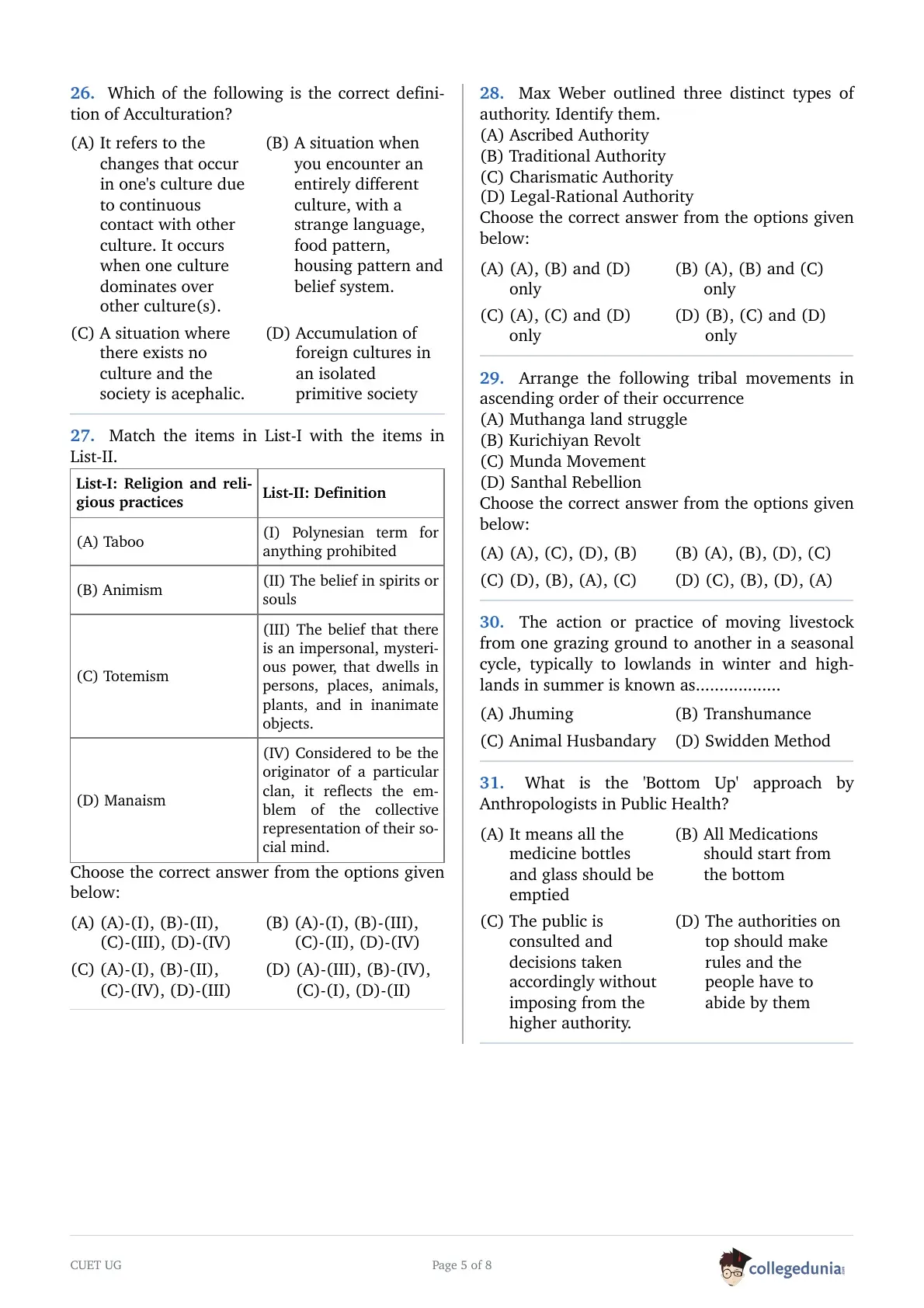
Which of the following is the correct definition of Acculturation?
  • (A) It refers to the changes that occur in one's culture due to continuous contact with other culture. It occurs when one culture dominates over other culture(s).
  • (B) A situation when you encounter an entirely different culture, with a strange language, food pattern, housing pattern and belief system.
  • (C) A situation where there exists no culture and the society is acephalic.
  • (D) Accumulation of foreign cultures in an isolated primitive society

Question 27:
Match the items in List-I with the items in List-II:
Choose the correct answer from the options given below:
  • (A) (A) - (I), (B) - (II), (C) - (III), (D) - (IV)
  • (B) (A) - (I), (B) - (III), (C) - (II), (D) - (IV)
  • (C) (A) - (I), (B) - (II), (C) - (IV), (D) - (III)
  • (D) (A) - (III), (B) - (IV), (C) - (I), (D) - (II)

Question 28:
Max Weber outlined three distinct types of authority. Identify them.
(A) Ascribed Authority
(B) Traditional Authority
(C) Charismatic Authority
(D) Legal-Rational Authority
Choose the correct answer from the options given below:
  • (A) (A), (B) and (D) only
  • (B) (A), (B) and (C) only
  • (C) (A), (C) and (D) only
  • (D) (B), (C) and (D) only

Question 29:
Arrange the following tribal movements in ascending order of their occurrence:
(A) Muthanga land struggle
(B) Kurichiyan Revolt
(C) Munda Movement
(D) Santhal Rebellion
Choose the correct answer from the options given below:
  • (A) (A), (C), (D), (B)
  • (B) (A), (B), (D), (C)
  • (C) (D), (B), (A), (C)
  • (D) (C), (B), (D), (A)

Question 30:
The action or practice of moving livestock from one grazing ground to another in a seasonal cycle, typically to lowlands in winter and highlands in summer is known as...................
  • (A) Jhuming
  • (B) Transhumance
  • (C) Animal Husbandary
  • (D) Swidden Method

Question 31:
What is the 'Bottom Up' approach by Anthropologists in Public Health?
  • (A) It means all the medicine bottles and glass should be emptied
  • (B) All Medications should start from the bottom
  • (C) The public is consulted and decisions taken accordingly without imposing from the higher authority
  • (D) The authorities on top should make rules and the people have to abide by them

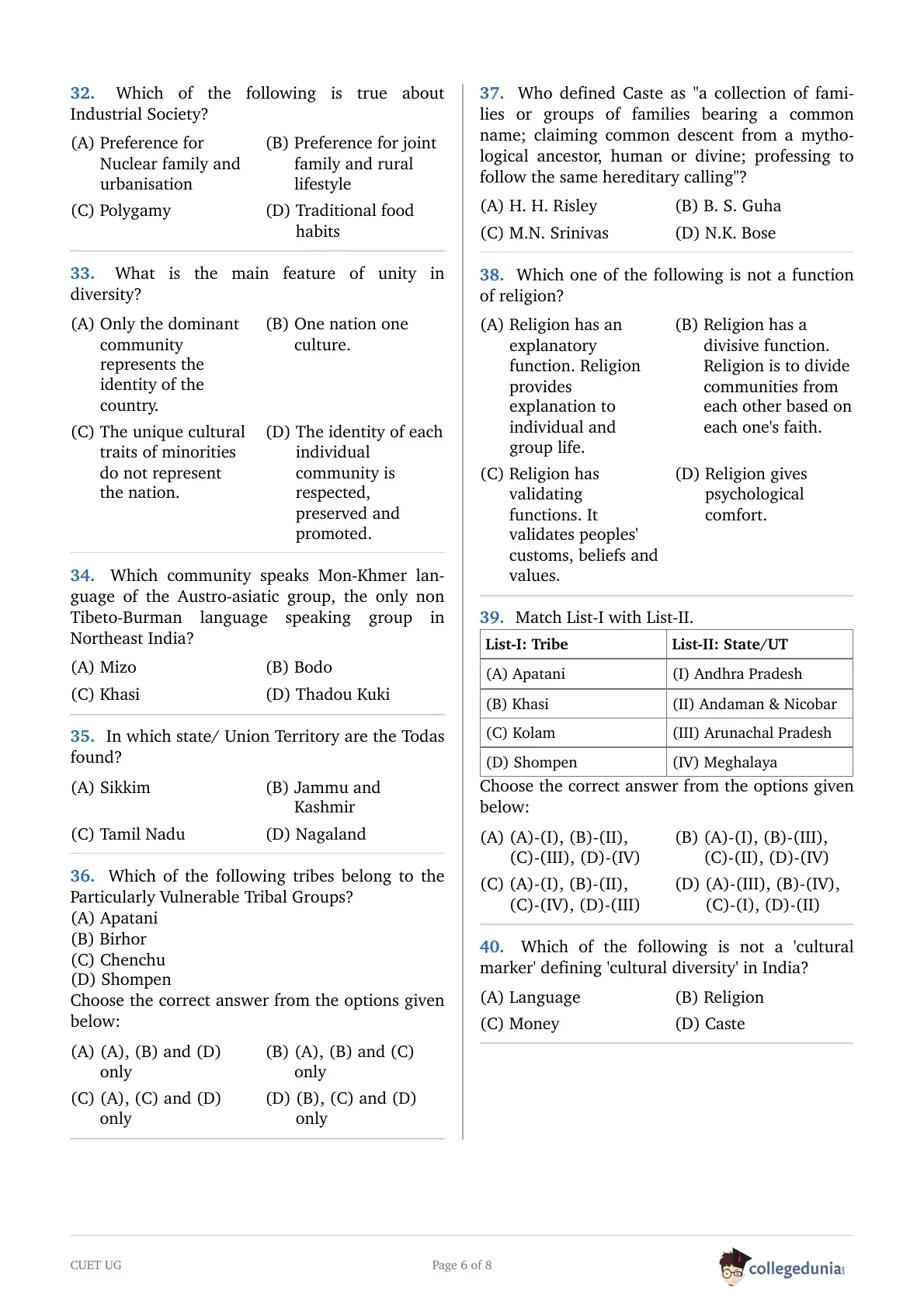
Question 32:
Which of the following is true about Industrial Society?
  • (A) Preference for Nuclear family and urbanisation
  • (B) Preference for joint family and rural lifestyle
  • (C) Polygamy
  • (D) Traditional food habits

Question 33:
What is the main feature of unity in diversity?
  • (A) Only the dominant community represents the identity of the country.
  • (B) One nation one culture.
  • (C) The unique cultural traits of minorities do not represent the nation.
  • (D) The identity of each individual community is respected, preserved and promoted.

Question 34:
Which community speaks Mon-Khmer language of the Austro-asiatic group, the only non Tibeto-Burman language speaking group in Northeast India?
  • (A) Mizo
  • (B) Bodo
  • (C) Khasi
  • (D) Thadou Kuki

Question 35:
In which state/ Union Teritory are the Todas found?
  • (A) Sikkim
  • (B) Jammu and Kashmir
  • (C) Tamil Nadu
  • (D) Nagaland

Question 36:
Which of the following tribes belong to the Particularly Vulnerable Tribal Groups?
(A) Apatani
(B) Birhor
(C) Chenchu
(D) Shompen
Choose the correct answer from the options given below:
  • (A) (A), (B) and (D) only
  • (B) (A), (B) and (C) only
  • (C) (A), (C) and (D) only
  • (D) (B), (C) and (D) only

Question 37:
Who defined Caste as "a collection of families or groups of families bearing a common name; claiming common descent from a mythological ancestor, human or divine; professing to follow the same hereditary calling"?

  • (A) H. H. Risley
  • (B) B. S. Guha
  • (C) M.N. Srinivas
  • (D) N.K. Bose

Question 38:
Which of the following is not a function of religion?
  • (A) Religion has an explanatory function. Religion provides explanation to individual and group life.
  • (B) Religion has a divisive function. Religion is to divide communities from each other based on each one's faith.
  • (C) Religion has validating functions. It validates peoples' customs, beliefs and values.
  • (D) Religion gives psychological comfort.

Question 39:
Match List-I with List-II:
Choose the correct answer from the options given below:
  • (A) (A) - (I), (B) - (II), (C) - (III), (D) - (IV)
  • (B) (A) - (I), (B) - (III), (C) - (II), (D) - (IV)
  • (C) (A) - (I), (B) - (II), (C) - (IV), (D) - (III)
  • (D) (A) - (III), (B) - (IV), (C) - (I), (D) - (II)

Question 40:
Which of the following is not a 'cultural marker' defining 'cultural diversity' in India?
  • (A) Language
  • (B) Religion
  • (C) Money
  • (D) Caste

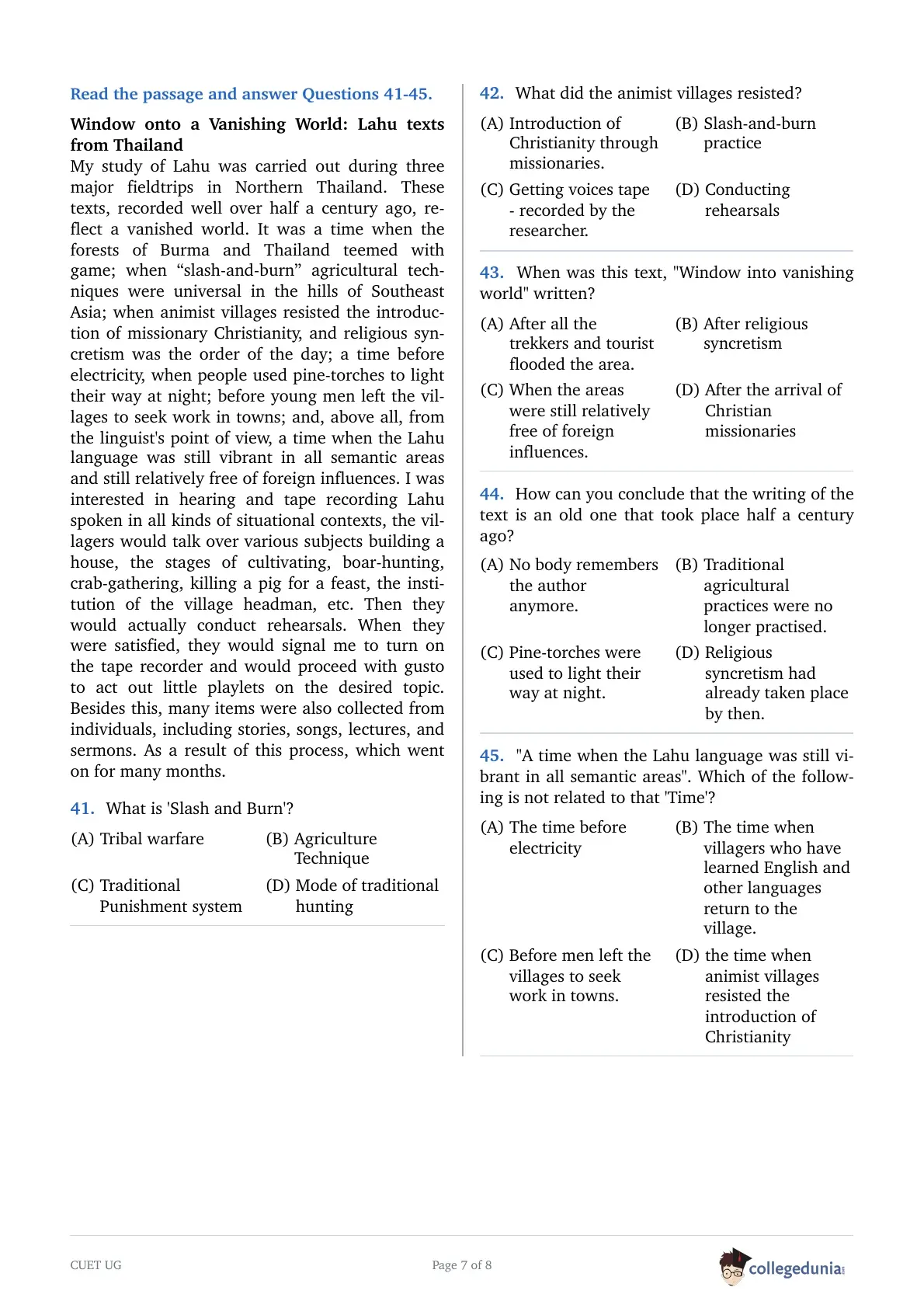
Case-based Questions - Set 1 (Q41 - Q45)

Question 41:

What is 'Slash and Burn'?
  • (A) Tribal warfare
  • (B) Agriculture Technique
  • (C) Traditional Punishment system
  • (D) Mode of traditional hunting

Question 42:

What did the animist villages resisted?
  • (A) Introduction of Christianity through missionaries.
  • (B) Slash-and-burn practice
  • (C) Getting voices tape - recorded by the researcher.
  • (D) Conducting rehearsals

Question 43:

When was this text, "Window into vanishing world" written?
  • (A) After all the trekkers and tourist flooded the area.
  • (B) After religious syncretism
  • (C) When the areas were still relatively free of foreign influences.
  • (D) After the arrival of Christian missionaries

Question 44:

How can you conclude that the writing of the text is an old one that took place half a century ago?
  • (A) No body remembers the author anymore.
  • (B) Traditional agricultural practices were no longer practised.
  • (C) Pine-torches were used to light their way at night.
  • (D) Religious syncretism had already taken place by then.

Question 45:

"A time when the Lahu language was still vibrant in all semantic areas".
Which of the following is not related to that 'Time'?
  • (A) The time before electricity
  • (B) The time when villagers who have learned English and other languages return to the village.
  • (C) Before men left the villages to seek work in towns.
  • (D) the time when animist villages resisted the introduction of Christianity

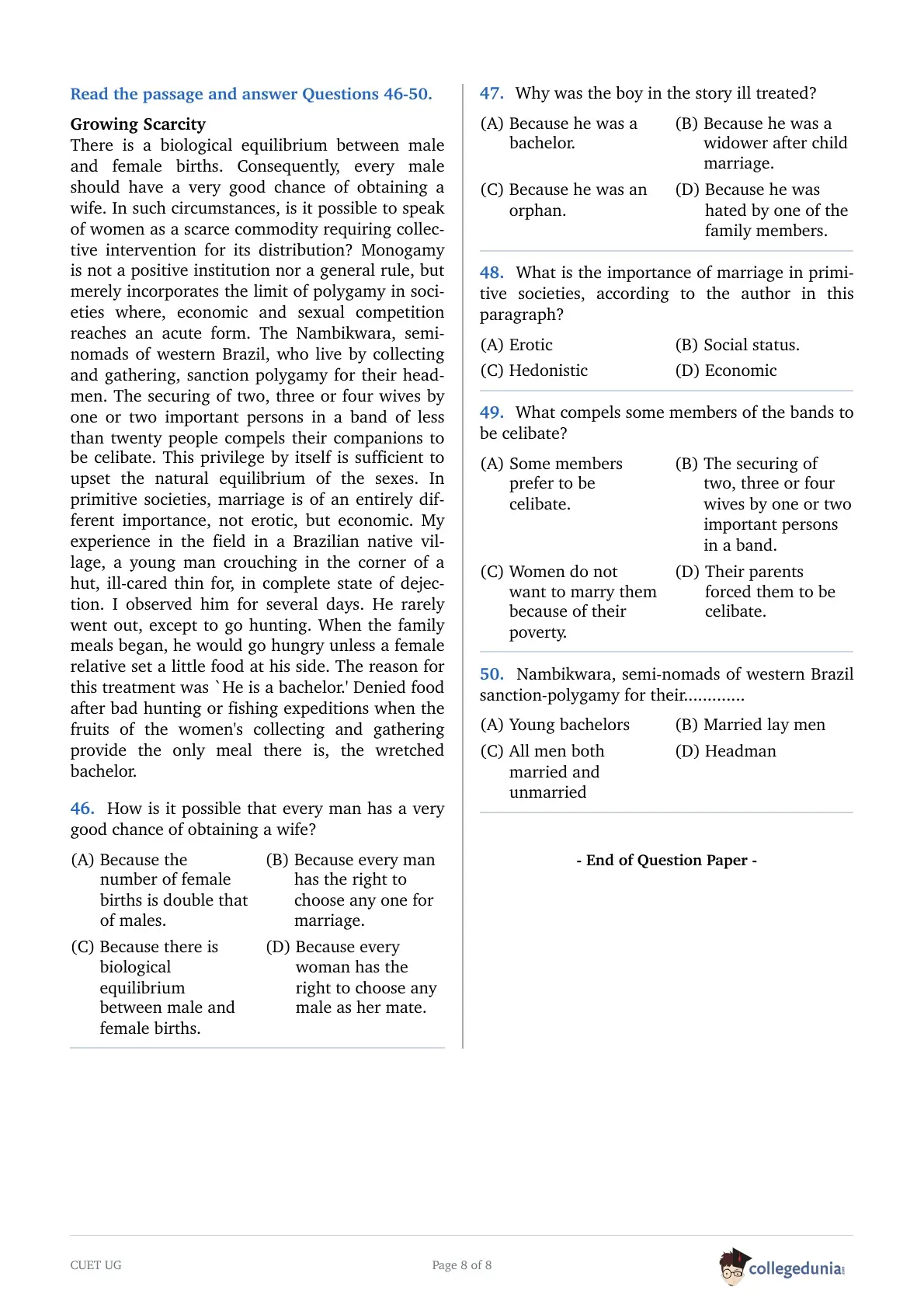
Case-based Questions - Set 2 (Q46 - Q50)

Question 46:

How is it possible that every man has a very good chance of obtaining a wife?
  • (A) Because the number of female births is double that of males.
  • (B) Because every man has the right to choose any one for marriage.
  • (C) Because there is biological equilibrium between male and female births.
  • (D) Because every woman has the right to choose any male as her mate.

Question 47:

Why was the boy in the story ill treated?
  • (A) Because he was a bachelor.
  • (B) Because he was a widower after child marriage.
  • (C) Because he was an orphan.
  • (D) Because he was hated by one of the family members.

Question 48:

What is the importance of marriage in primitive societies, according to the author in this paragraph?
  • (A) Erotic
  • (B) Social status.
  • (C) Hedonistic
  • (D) Economic

Question 49:

What compels some members of the bands to be celibate?
  • (A) Some members prefer to be celibate.
  • (B) The securing of two, three or four wives by one or two important persons in a band.
  • (C) Women do not want to marry them because of their poverty.
  • (D) Their parents forced them to be celibate.

Question 50:

Nambikwara, semi-nomads of western Brazil sanction-polygamy for their ..............
  • (A) Young bachelors
  • (B) Married lay men
  • (C) All men both married and unmarried
  • (D) Headman

CUET UG 2026 Exam Pattern and Marking Scheme

Parameter Details
Exam Name Common University Entrance Test (CUET UG) 2026
Conducting Body National Testing Agency (NTA)
Exam Mode Computer-Based Test (CBT)
Exam Duration 60 minutes per test
Total Sections 3 (Languages, Domain Subjects, General Test)
Question Type Multiple Choice Questions (MCQs)
Questions per Test 50 questions (all compulsory)
Marking Scheme +5 for correct, -1 for incorrect
Maximum Marks 250 marks per test
Maximum Subject Choices 5 subjects in total
Syllabus Base Class 12 NCERT (mainly for Domain Subjects)

CUET 2026 Anthropology May 19 Shift 1 Paper Analysis