




CUET 2026 June 6 Shift 2 English Question Paper is available for download here. NTA is conducting the CUET 2026 exam from 11th May to 31st May and June 6 to June 7.
- CUET 2026 English exam consists of 50 questions for 250 marks to be attempted in 60 minutes.
- As per the marking scheme, 5 marks are awarded for each correct answer, and 1 mark is deducted for incorrect answer.
Candidates can download CUET 2026 June 6 Shift 2 English Question Paper with Answer Key and Solution PDF from links provided below.
Related Links:
CUET 2026 English June 6 Shift 2 Question Paper with Solution PDF
| CUET 6 June Shift 2 English Question Paper 2026 | Download PDF | Check Solutions |
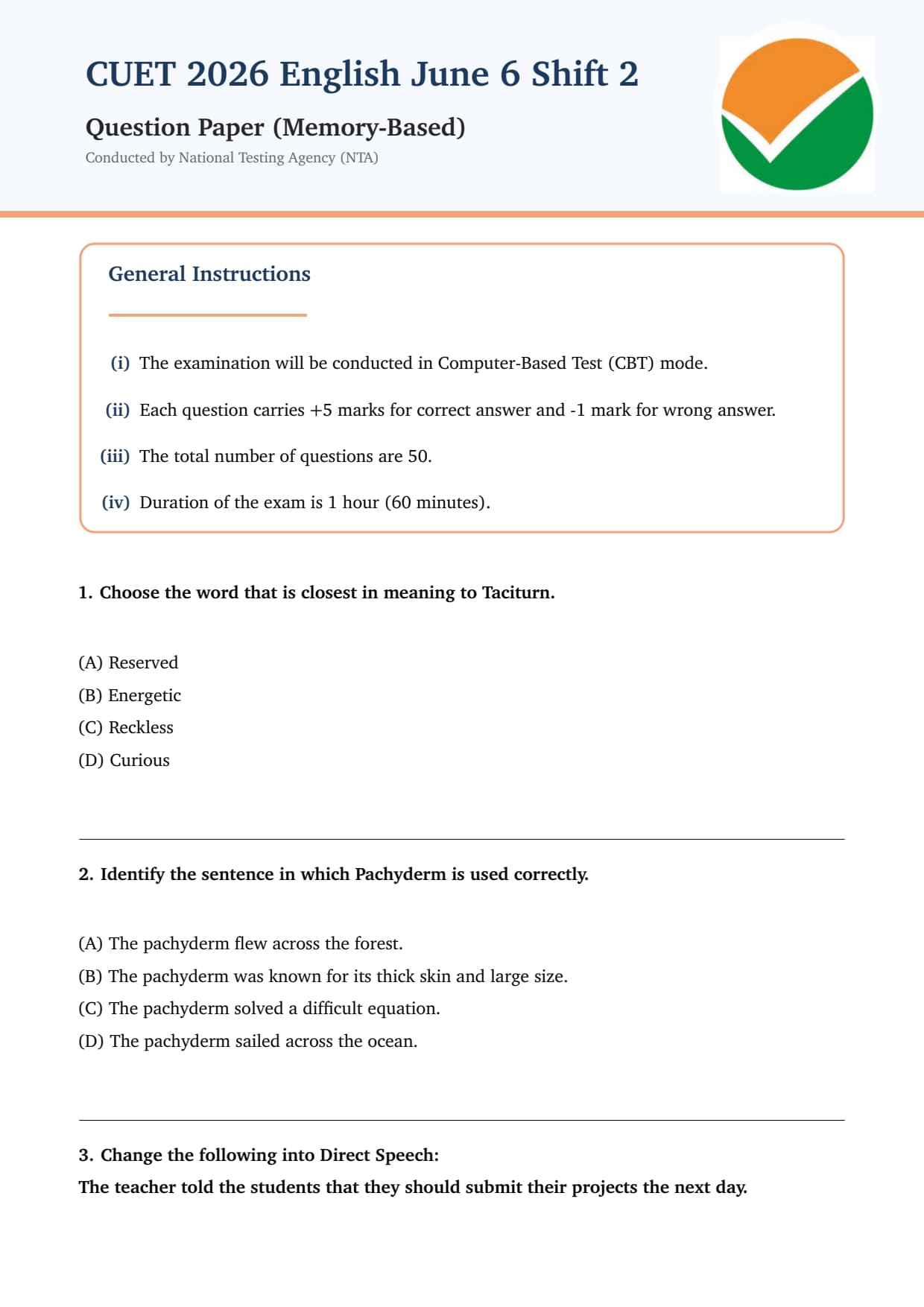

Choose the word that is closest in meaning to Taciturn.
View Solution
Step 1: Understanding the Question:
The purpose of this question is to test the vocabulary knowledge of the student, specifically focusing on synonyms.
The student is required to identify a word from the options that is closest in meaning to the word 'Taciturn'.
Step 2: Detailed Explanation:
Definition of 'Taciturn': The word 'taciturn' is an adjective that describes a person who speaks very little, is habitually quiet, and is reserved in conversation.
Analyzing Option (A) - Reserved: 'Reserved' is used to describe individuals who are reticent and do not easily share their thoughts or feelings. This is a direct match to 'taciturn'.
Analyzing Option (B) - Energetic: 'Energetic' describes someone full of energy, vitality, and activity. It is completely unrelated to a person's level of talkativeness.
Analyzing Option (C) - Reckless: 'Reckless' refers to someone who acts without thinking about the dangers or consequences of their behavior. It has no relevance to silence or speech.
Analyzing Option (D) - Curious: 'Curious' describes someone who has a strong desire to know or learn something. This is also unrelated to being silent.
Conclusion: Based on the detailed definitions above, only 'Reserved' shares the same meaning of quietness, making it the correct synonym.
Step 3: Final Answer:
Hence, the correct answer is option (A).
Quick Tip: To remember 'taciturn', associate it with the root 'tacit', which means silent or implied without being spoken aloud.
Recognizing common Latin and Greek roots can help decode unfamiliar words during the exam.
Identify the sentence in which Pachyderm is used correctly.
View Solution
Step 1: Understanding the Question:
The purpose of this question is to assess the correct usage of the noun 'Pachyderm' in a given sentence.
It tests whether the candidate knows the definition of the word and can apply it to realistic contexts.
Step 2: Detailed Explanation:
Definition of 'Pachyderm': The term 'pachyderm' refers to any of various large, thick-skinned, hoofed mammals, such as elephants, rhinoceroses, and hippopotamuses.
Analyzing Option (A): 'The pachyderm flew across the forest.' This is incorrect because pachyderms are heavy, flightless mammals and cannot fly.
Analyzing Option (B): 'The pachyderm was known for its thick skin and large size.' This is correct because 'thick skin' and 'large size' are the literal defining physical characteristics of a pachyderm.
Analyzing Option (C): 'The pachyderm solved a difficult equation.' This is incorrect because animals do not possess the cognitive ability to solve advanced mathematical equations.
Analyzing Option (D): 'The pachyderm sailed across the ocean.' This is incorrect because sailing is a human action that involves navigating a vessel, which a wild mammal cannot do.
Conclusion: Therefore, Option (B) is the only sentence where the word is used in a logically and factively correct context.
Step 3: Final Answer:
Hence, the correct answer is option (B).
Quick Tip: Break down difficult words using etymology: 'pachy-' means thick, and '-derm' means skin (just like in dermatologist).
This etymological trick will make it simple to remember the definition of the word.
Change the following into Direct Speech:
The teacher told the students that they should submit their projects the next day.
View Solution
Step 1: Understanding the Question:
The question requires converting a sentence from indirect speech into direct speech.
This requires a thorough understanding of tense transformations, pronoun changes, and time adverbial shifts.
Step 2: Detailed Explanation:
Identifying the Reporting Verb: The indirect sentence uses 'The teacher told the students that...', which indicates past tense and shows direct address to the students.
Analyzing Pronoun Changes: The pronoun 'they' in the reported clause refers to 'the students'. When converting to direct speech, because the teacher is addressing them directly, 'they' becomes the second-person plural pronoun 'You'.
Analyzing Possessive Pronoun Changes: Similarly, the possessive pronoun 'their' changes to 'your' when speaking directly to the listeners.
Analyzing Adverb of Time Changes: The time phrase 'the next day' in indirect speech is converted back to 'tomorrow' in direct speech.
Evaluating Option (A): 'The teacher said, "You should submit your projects tomorrow."' This option correctly transforms the pronouns ('they' to 'You', 'their' to 'your') and the time phrase ('the next day' to 'tomorrow').
Evaluating Option (B): This option incorrectly retains the third-person pronouns 'They' and 'their', which violates direct address rules.
Evaluating Option (C): This option uses 'We' and 'our', which would incorrectly imply that the teacher is also submitting a project.
Evaluating Option (D): This option incorrectly uses 'yesterday', which corresponds to 'the previous day' in indirect speech.
Step 3: Final Answer:
Therefore, Option (A) is the only grammatically accurate direct speech representation.
Quick Tip: Always look at the time adverbial first during conversions.
'The next day' in indirect speech almost always converts back to 'tomorrow' in direct speech, which instantly helps eliminate incorrect options like (D).
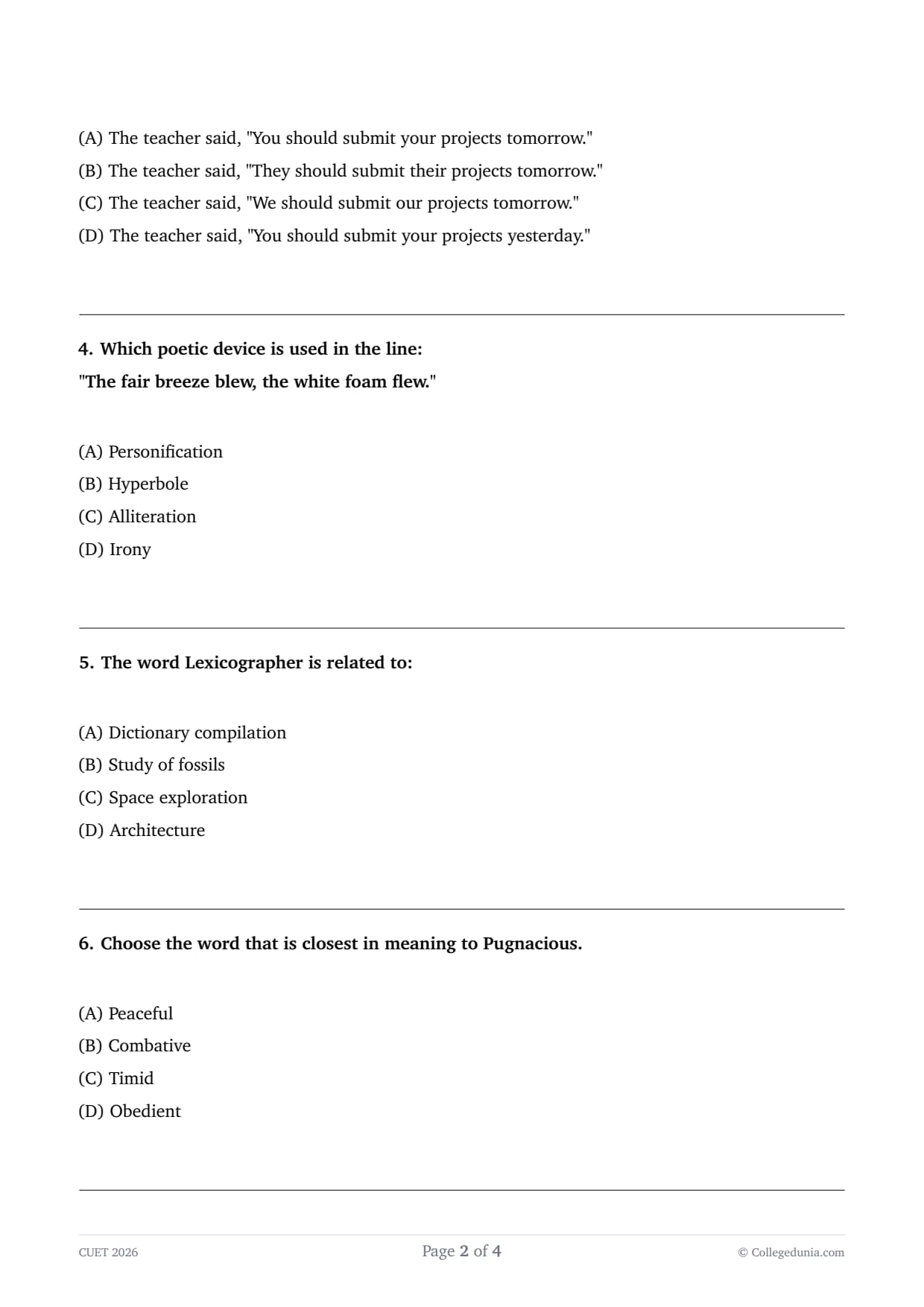
Which poetic device is used in the line:
"The fair breeze blew, the white foam flew."
View Solution
Step 1: Understanding the Question:
The question asks to identify the poetic device used in the line: 'The fair breeze blew, the white foam flew.'
Recognizing literary devices is a core component of reading comprehension and poetry analysis in competitive English exams.
Step 2: Detailed Explanation:
Understanding Alliteration: Alliteration is a literary device where two or more words in close proximity share the same consonant sound at the beginning of the words.
Analyzing the Given Line: In the phrase 'The fair breeze blew, the white foam flew', we can observe two prominent examples of alliteration: the sound /b/ is repeated at the start of 'breeze' and 'blew', and the sound /f/ is repeated at the start of 'fair', 'foam', and 'flew'. This strong repetition of consonant sounds defines alliteration.
Evaluating Option (A) - Personification: Personification involves giving human qualities to inanimate objects. While the breeze blowing and foam flying are actions, they are natural movements rather than distinctly human traits, so this is not the primary device.
Evaluating Option (B) - Hyperbole: Hyperbole is an extreme exaggeration used for emphasis or rhetorical effect. There is no exaggeration here; it is a standard descriptive depiction of a ship sailing.
Evaluating Option (D) - Irony: Irony is a contrast between expectation and reality. This line contains no such contrast and is a straightforward description, making irony incorrect.
Conclusion: Because of the clear repetition of the starting consonant sounds /b/ and /f/, alliteration is the dominant and correct poetic device.
Step 3: Final Answer:
Thus, the correct poetic device is Alliteration, which corresponds to option (C).
Quick Tip: When checking for alliteration, focus on the sounds of the letters, not just the spelling.
Consonant sounds repeating at the start of words in quick succession is a definitive sign of alliteration.
The word Lexicographer is related to:
View Solution
Step 1: Understanding the Question:
The objective is to identify the professional field or activity associated with the noun 'Lexicographer'.
One-word substitutions test the depth of a candidate's English vocabulary and etymological knowledge.
Step 2: Detailed Explanation:
Etymology of Lexicographer: The word is derived from the Greek word 'lexikon' meaning 'dictionary' and 'graphos' meaning 'writer' or 'compiler'. Thus, a lexicographer is a person who writes, compiles, and edits dictionaries.
Analyzing Option (A) - Dictionary compilation: This matches the etymological definition of a lexicographer, whose job is to study words and assemble dictionaries.
Analyzing Option (B) - Study of fossils: This field of science is known as Paleontology, and a scientist in this field is a paleontologist.
Analyzing Option (C) - Space exploration: Professional fields related to space include Astronautics, Astronomy, or Aerospace Engineering.
Analyzing Option (D) - Architecture: This refers to the art and science of designing buildings, which is done by an Architect.
Conclusion: Comparing all the alternatives, dictionary compilation is the only accurate association for the term lexicographer.
Step 3: Final Answer:
Hence, a lexicographer is uniquely associated with dictionary compilation, matching option (A).
Quick Tip: Remember that '-grapher' refers to a person who writes or records (e.g., photographer, cartographer).
Combining this with 'lexico-' (related to words) makes it easier to identify the correct meaning.
Choose the word that is closest in meaning to Pugnacious.
View Solution
Step 1: Understanding the Question:
The question asks for the closest synonym of the adjective 'Pugnacious'.
To identify the correct answer, we must evaluate the definitions of all options and find the word that represents the same semantic meaning.
Step 2: Detailed Explanation:
Definition of 'Pugnacious': The word 'pugnacious' is derived from the Latin root 'pugnare', which means 'to fight'. It is used to describe someone who is eager or quick to argue, quarrel, or fight.
Analyzing Option (A) - Peaceful: This means tranquil, calm, and free from disturbance. This is an antonym, not a synonym.
Analyzing Option (B) - Combative: This word describes someone who is ready or eager to fight or argue. This aligns precisely with the definition of 'pugnacious'.
Analyzing Option (C) - Timid: Timid means showing a lack of courage or confidence, easily frightened. This is opposite in nature to a pugnacious disposition.
Analyzing Option (D) - Obedient: Obedient describes someone who is willing to comply with orders and respect authority. This is unrelated to the aggressive nature of being pugnacious.
Conclusion: Since 'combative' directly conveys the meaning of being argumentative and ready to fight, it is the most suitable synonym.
Step 3: Final Answer:
Therefore, the closest synonym is 'Combative', which is option (B).
Quick Tip: Associate 'pugnacious' with the word 'pug' (the dog breed known for looking stubborn and feisty) or the word 'pugilist' (which means a professional boxer).
This visual association can help lock the definition in memory.
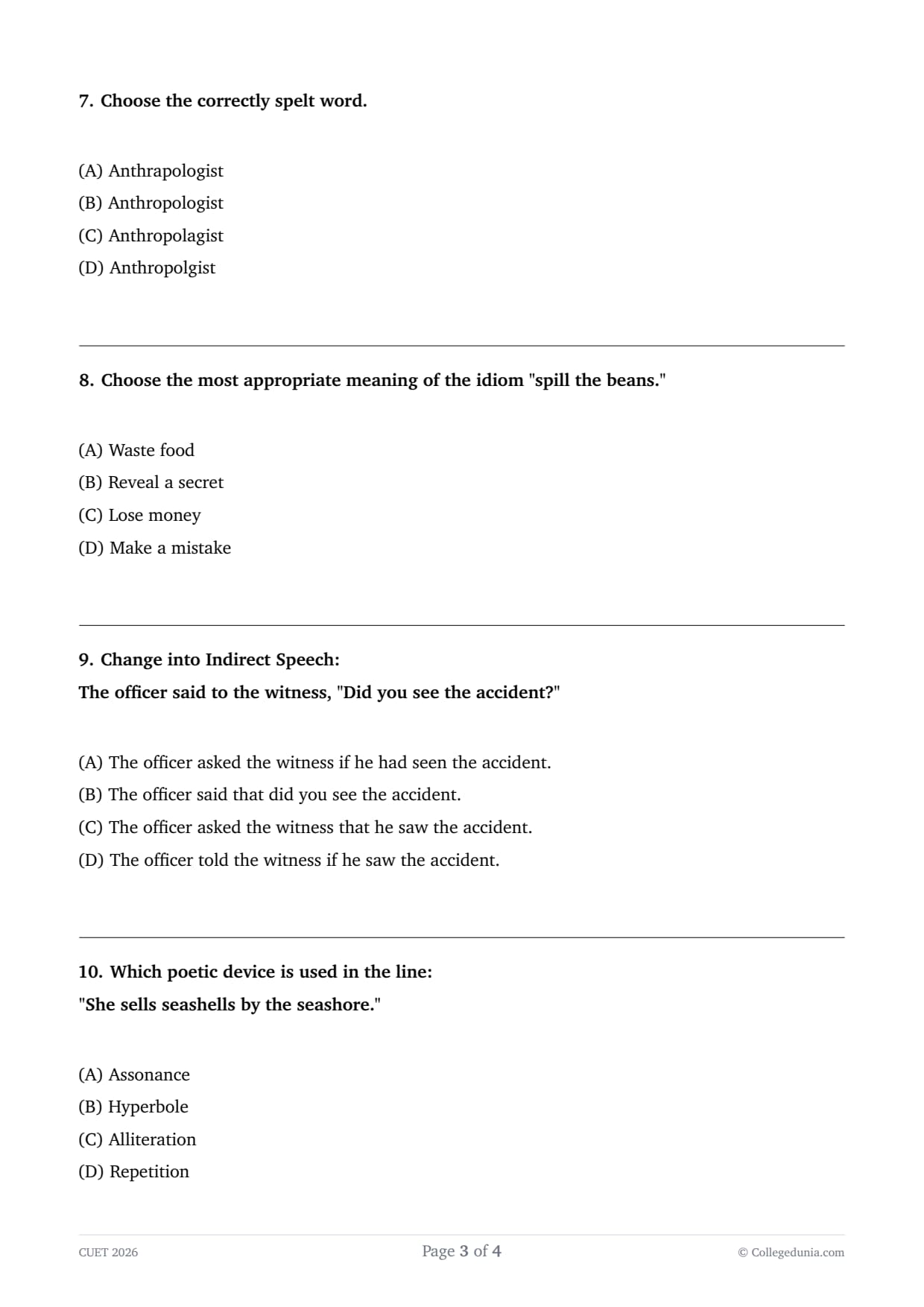
Choose the correctly spelt word.
View Solution
Step 1: Understanding the Question:
This question tests spelling accuracy, which is a frequent topic in competitive English examinations.
The student must recognize the correct orthographic representation of the word referring to a student of human societies and cultures.
Step 2: Detailed Explanation:
Etymology of the Word: The word is composed of the Greek root 'anthropos' (meaning human), the combining form 'logy' (meaning the study of), and the suffix 'ist' (denoting a person who practices). Combined, it forms 'anthropologist'.
Analyzing the Correct Spelling: The correct letter-by-letter spelling of the word is A-N-T-H-R-O-P-O-L-O-G-I-S-T. Note that the vowels following the consonants 'r', 'p', and 'l' are all 'o'.
Evaluating Option (A) - 'Anthrapologist': This version is incorrect because it uses the vowel 'a' instead of 'o' after the consonant 'r'.
Evaluating Option (C) - 'Anthropolagist': This version is incorrect because it uses the vowel 'a' instead of 'o' after the consonant 'l'.
Evaluating Option (D) - 'Anthropolgist': This version is incorrect because it completely omits the letter 'o' between 'l' and 'g'.
Conclusion: Only Option (B) contains the correct sequence of vowels and consonants that conforms to standard English spelling rules.
Step 3: Final Answer:
Thus, the correctly spelled word is 'Anthropologist', which is option (B).
Quick Tip: Break down words with the suffix '-logist'.
Most fields of study end in '-ology' (e.g., biology, sociology), so the person practicing it will end in '-ologist' (e.g., biologist, sociologist, anthropologist).
Choose the most appropriate meaning of the idiom "spill the beans."
View Solution
Step 1: Understanding the Question:
This question aims to determine the correct figurative meaning of the common English idiom 'spill the beans'.
Idiomatic expressions cannot be interpreted literally; rather, they have established figurative meanings that must be memorized.
Step 2: Detailed Explanation:
Understanding the Idiom: 'Spill the beans' is an informal idiom that means to disclose secret, confidential, or private information, often prematurely or unintentionally.
Analyzing Option (A) - Waste food: This is a literal interpretation of dropping or discarding beans, which is incorrect since idioms function figuratively.
Analyzing Option (B) - Reveal a secret: This represents the true idiomatic meaning, as it describes the act of making a secret known to others.
Analyzing Option (C) - Lose money: There is no connection between spilling beans and financial loss, making this option incorrect.
Analyzing Option (D) - Make a mistake: While dropping something can be described as a physical mistake, the specific idiomatic meaning refers strictly to information disclosure, not general errors.
Conclusion: Based on the established usage of this idiom, 'Reveal a secret' is the correct meaning.
Step 3: Final Answer:
Therefore, the correct choice is option (B).
Quick Tip: Be careful to avoid literal translations of idioms.
Options that describe physical activities involving the words in the idiom (such as 'waste food' for 'spill the beans') are almost always traps.
Change into Indirect Speech:
The officer said to the witness, "Did you see the accident?"
View Solution
Step 1: Understanding the Question:
The question requires converting an interrogative sentence from direct speech into indirect speech.
This involves applying specific grammar rules for reporting questions, changing tenses, and adjusting pronouns.
Step 2: Detailed Explanation:
Identifying the Reporting Verb: The phrase 'said to' is used in a question format, which must be changed to 'asked' or 'enquired of' in indirect speech.
Selecting the Conjunction: Because the direct speech contains a polar (yes/no) question starting with the auxiliary verb 'Did', we must use the conjunction 'if' or 'whether' to join the clauses. The conjunction 'that' must not be used.
Applying Tense Conversion Rules: The verb tense in direct speech is Simple Past ('Did you see'). In indirect speech, when the reporting verb is in the past tense, Simple Past must be converted to Past Perfect ('had seen').
Applying Pronoun Conversion Rules: The second-person pronoun 'you' refers to the listener 'the witness', so it changes to the third-person singular pronoun 'he' (or 'she').
Evaluating the Options: Option (A) correctly changes 'said to' to 'asked', uses 'if', changes 'you' to 'he', and shifts 'Did see' to 'had seen'. Options (B), (C), and (D) fail on these counts by using incorrect conjunctions or incorrect verb tenses.
Step 3: Final Answer:
Thus, the correct indirect speech form is represented in option (A).
Quick Tip: Remember: Never use 'that' and 'if/whether' together in indirect speech.
Additionally, always shift a simple past tense ('did see') to past perfect ('had seen') when converting to indirect speech.
Which poetic device is used in the line:
"She sells seashells by the seashore."
View Solution
Step 1: Understanding the Question:
This question asks to identify the poetic device used in the line: 'She sells seashells by the seashore.'
Recognizing literary techniques is a vital skill for literary appreciation and comprehension exams.
Step 2: Detailed Explanation:
Definition of Alliteration: Alliteration is a literary device characterized by the repetition of the same consonant sounds at the beginning of adjacent or closely placed words in a sentence.
Analyzing the Line: The line 'She sells seashells by the seashore' contains a rapid repetition of the sibilant sounds /s/ and /ʃ/ at the beginning of almost every word ('She', 'sells', 'seashells', 'seashore'). This is a classic tongue-twister designed around this phonetic repetition.
Evaluating Option (A) - Assonance: Assonance involves the repetition of vowel sounds within words (such as the /e/ sound in 'sells' and 'shells'). While present, it is not the primary defining poetic device of this line.
Evaluating Option (B) - Hyperbole: Hyperbole is an intentional exaggeration for emphasis. This sentence does not contain any exaggeration, so this option is incorrect.
Evaluating Option (D) - Repetition: Repetition involves repeating the exact same word multiple times. Although the word parts 'sea' and 'shell' appear, the exact words are not repeated, making alliteration the more precise poetic device.
Conclusion: The dominant literary device here is the repetition of the consonant sounds, which is the definition of Alliteration.
Step 3: Final Answer:
Therefore, the primary poetic device used is Alliteration, which is option (C).
Quick Tip: Alliteration is based on sound, not spelling.
The 'sh' sound in 'she' and 's' sound in 'sells' are closely related sibilant sounds, making this a classic textbook example of alliterative play.
CUET UG 2026 Exam Pattern
| Parameter | Details |
|---|---|
| Exam Name | Common University Entrance Test (CUET UG) 2026 |
| Conducting Body | National Testing Agency (NTA) |
| Exam Mode | Computer-Based Test (CBT) |
| Exam Duration | 60 minutes per test |
| Total Sections | 3 (Languages, Domain Subjects, General Test) |
| Question Type | Multiple Choice Questions (MCQs) |
| Questions per Test | 50 questions (all compulsory) |
| Marking Scheme | +5 for correct, -1 for incorrect |
| Maximum Marks | 250 marks per test |
| Maximum Subject Choices | 5 subjects in total |
| Syllabus Base | Class 12 NCERT (mainly for Domain Subjects) |



Comments