




CUET 2026 Mathematics Question Paper is available for download here. NTA conducted the CUET 2026 exam from 11th May to 31st May in two shifts.
The CUET 2026 Mathematics question paper includes the following:
- 85 questions in the paper, of which 50 are to be attempted in 60 minutes
- Section A (common), Q1 - Q15: 15 compulsory questions, 75 marks
- Section B (attempt one of the two), 175 marks: B1 Mathematics (Q16 - Q50) or B2 Applied Mathematics (Q51 - Q85), 35 questions each
- Marking: +5 for a correct answer, -1 for an incorrect answer, 0 for an unattempted question
- Maximum marks: 250
CUET 2026 Mathematics May 24 Shift 2 Question Paper with Solution PDF
| NTA Official PDF | CD PDF | CD PDF with Solutions |
|---|---|---|
| Download official PDF 10.84 MB | Download Collegedunia PDF 0.62 MB | Download solutions PDF 0.74 MB |
Also Check:
- CUET 2027 Latest Updates
- Download CUET UG Previous Year Papers for free
- CUET 2026 May 24 Shift 2 Mathematics Question Paper with Solutions
CUET 2026 Mathematics May 24 Shift 2 Questions with Solutions
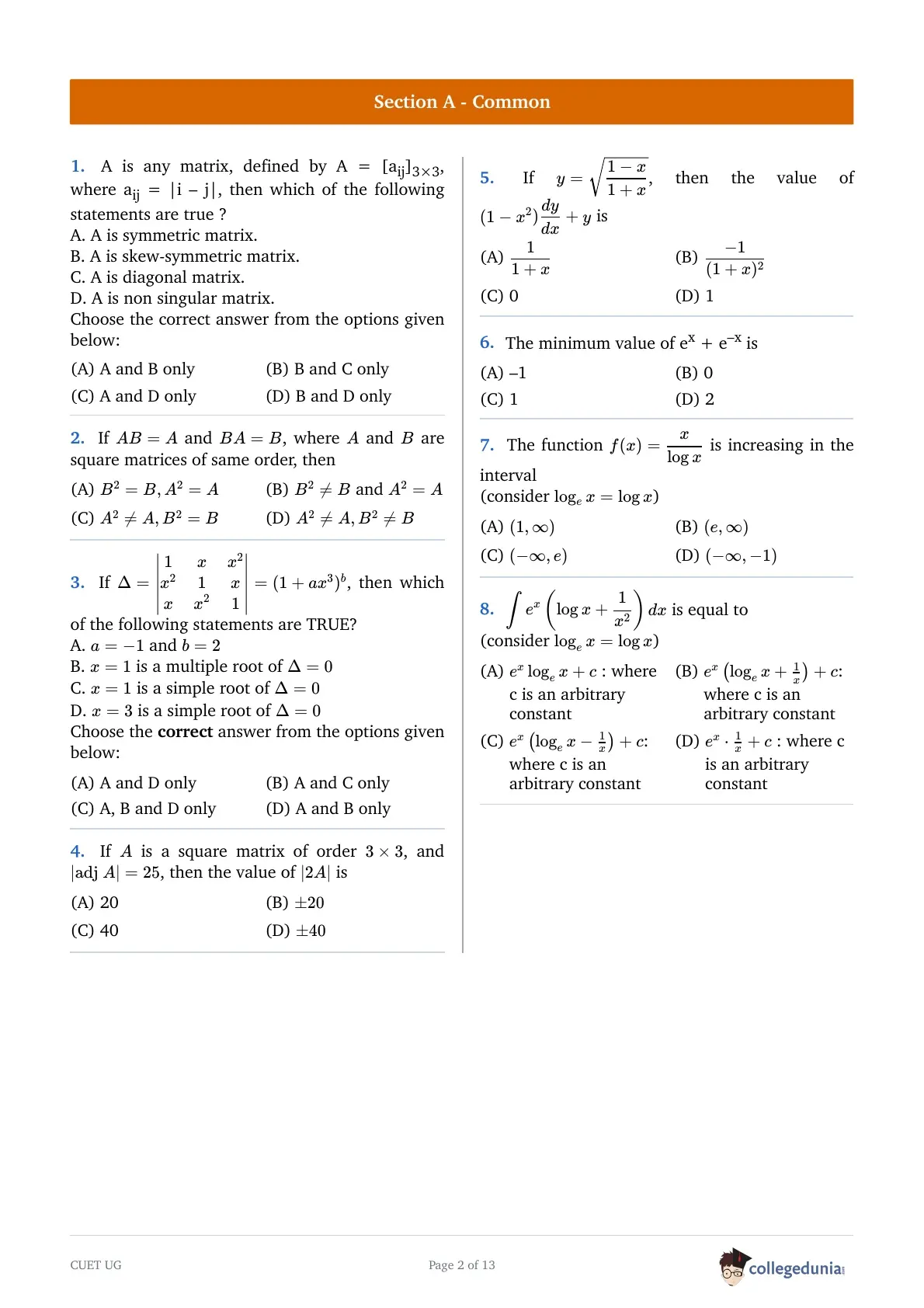
Section A - Common Section (Q1 - Q15)
\(A\) is any matrix, defined by \(A = [a_{ij}]_{3\times 3}\), where \(a_{ij} = |i - j|\), then which of the following statements are true ?
A. \(A\) is symmetric matrix.
B. \(A\) is skew-symmetric matrix.
C. \(A\) is diagonal matrix.
D. \(A\) is non singular matrix.
Choose the correct answer from the options given below:
If \(AB = A\) and \(BA = B\), where \(A\) and \(B\) are square matrices of same order, then
If \(\Delta = \begin{vmatrix} 1 & x & x^2 \\ x^2 & 1 & x \\ x & x^2 & 1 \end{vmatrix} = (1 + ax^3)^b\), then which of the following statements are TRUE?
A. \(a = -1\) and \(b = 2\)
B. \(x = 1\) is a multiple root of \(\Delta = 0\)
C. \(x = 1\) is a simple root of \(\Delta = 0\)
D. \(x = 3\) is a simple root of \(\Delta = 0\)
Choose the correct answer from the options given below:
If \(A\) is a square matrix of order \(3 \times 3\), and \(|\text{adj } A| = 25\), then the value of \(|2A|\) is
If \(y = \sqrt{\dfrac{1-x}{1+x}}\), then the value of \((1 - x^2)\dfrac{dy}{dx} + y\) is
The minimum value of \(e^x + e^{-x}\) is
The function \(f(x) = \dfrac{x}{\log x}\) is increasing in the interval
(consider \(\log_e x = \log x\))
\(\displaystyle\int e^{x}\left(\log x+\frac{1}{x^{2}}\right)dx\) is equal to
(consider \(\log_e x = \log x\))
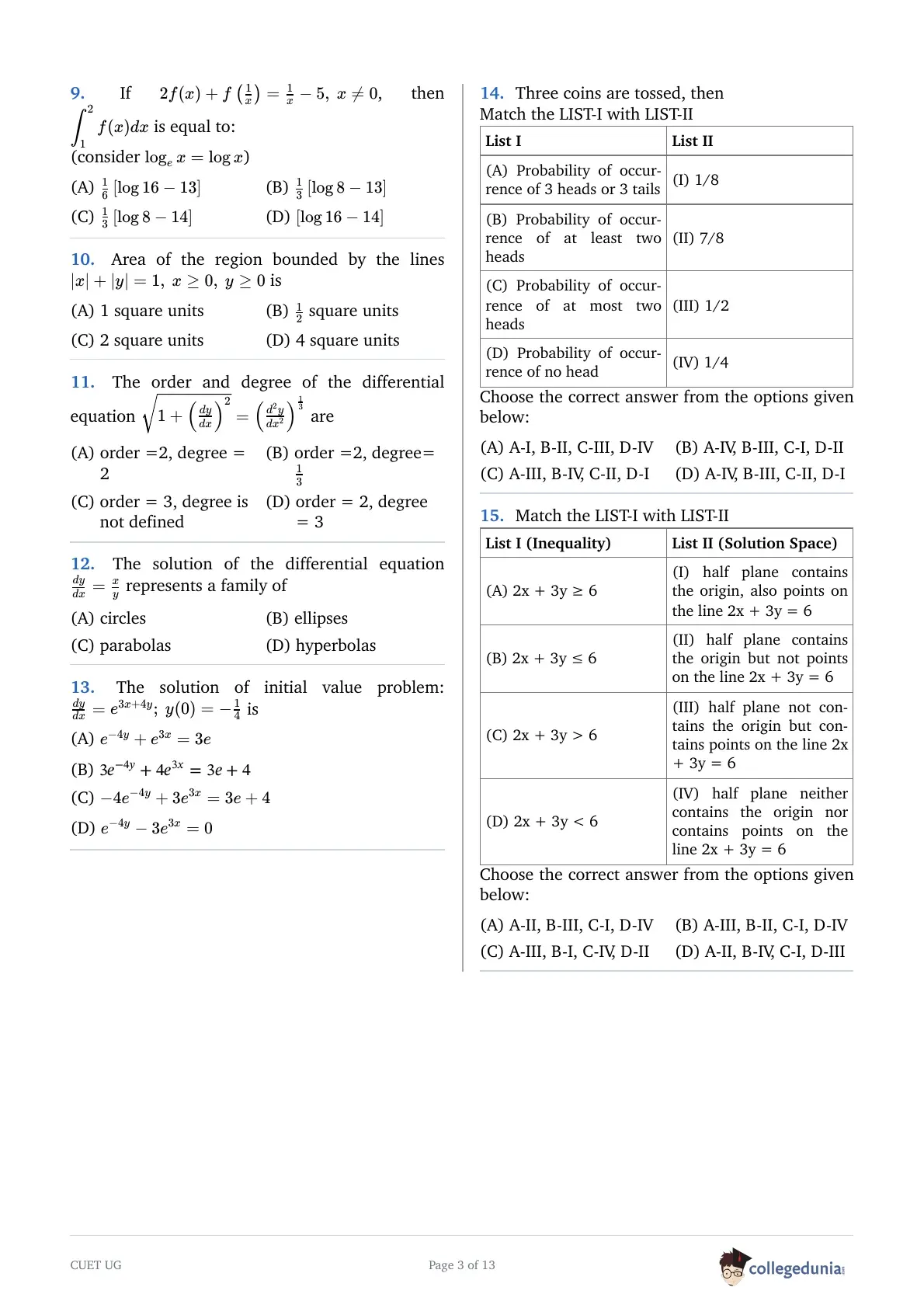
If \(2f(x)+f\left(\frac{1}{x}\right)=\frac{1}{x}-5,\ x\neq 0\), then \(\displaystyle\int_{1}^{2}f(x)dx\) is equal to:
(consider \(\log_e x = \log x\))
Area of the region bounded by the lines \(|x|+|y|=1,\ x\geq 0,\ y\geq 0\) is
The order and degree of the differential equation \(\sqrt{1+\left(\frac{dy}{dx}\right)^{2}}=\left(\frac{d^{2}y}{dx^{2}}\right)^{\frac{1}{3}}\) are
The solution of the differential equation \(\frac{dy}{dx}=\frac{x}{y}\) represents a family of
The solution of initial value problem: \(\frac{dy}{dx}=e^{3x+4y};\ y(0)=-\frac{1}{4}\) is
Three coins are tossed, then
Match the LIST-I with LIST-II
| LIST-I | LIST-II | ||
|---|---|---|---|
| A. | Probability of occurrence of 3 heads or 3 tails | I. | \(\frac{1}{8}\) |
| B. | Probability of occurrence of at least two heads | II. | \(\frac{7}{8}\) |
| C. | Probability of occurrence of at most two heads | III. | \(\frac{1}{2}\) |
| D. | Probability of occurrence of no head | IV. | \(\frac{1}{4}\) |
Match the LIST-I with LIST-II
| LIST-I Inequality | LIST-II Solution Space | ||
|---|---|---|---|
| A. | \(2x+3y \geq 6\) | I. | half plane contains the origin, also points on the line \(2x+3y=6\) |
| B. | \(2x+3y \leq 6\) | II. | half plane contains the origin but not points on the line \(2x+3y=6\) |
| C. | \(2x+3y > 6\) | III. | half plane not contains the origin but contains points on the line \(2x+3y=6\) |
| D. | \(2x+3y < 6\) | IV. | half plane neither contains the origin nor contains points on the line \(2x+3y=6\) |
Choose the correct answer from the options given below:
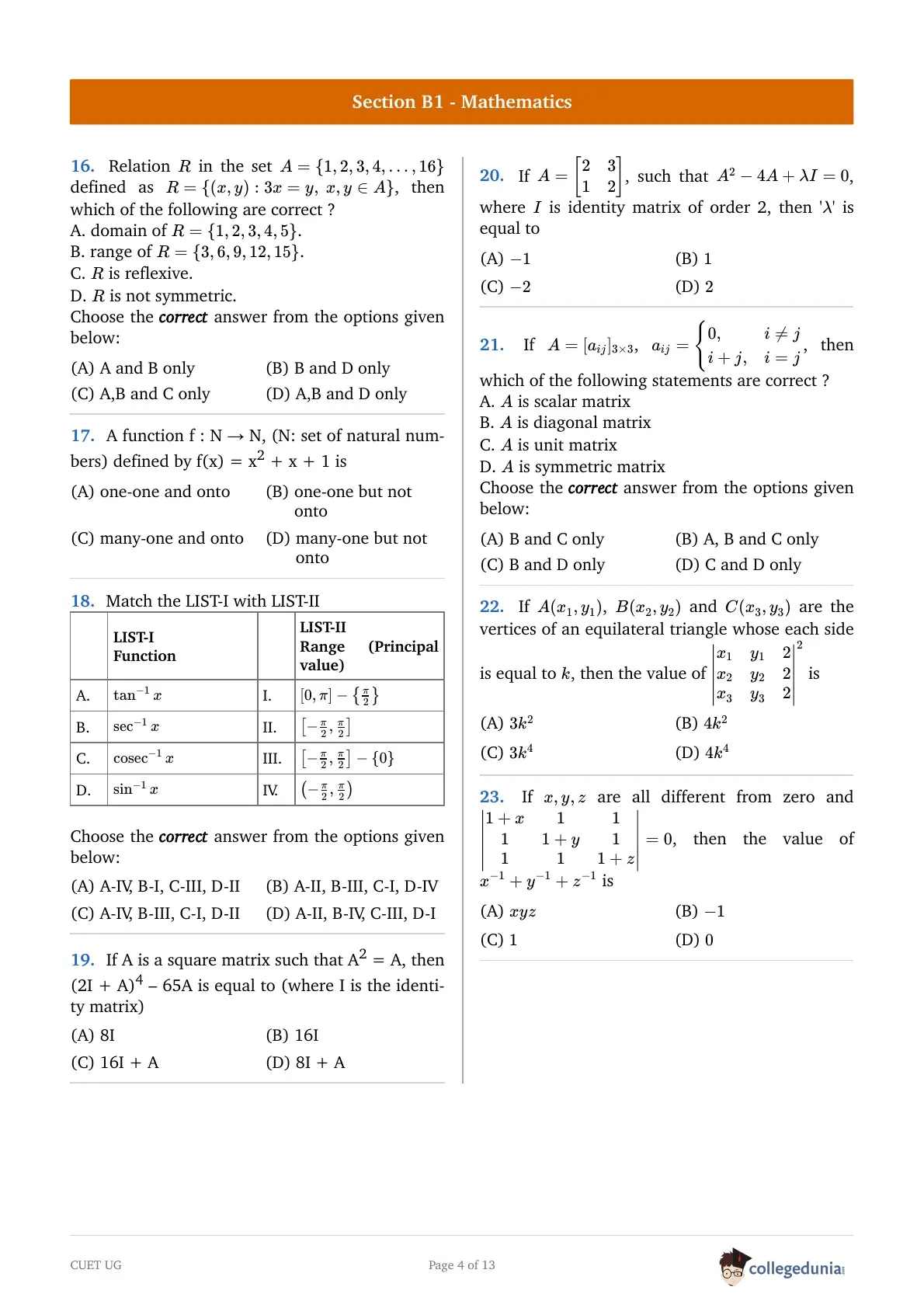
Section B1 - Mathematics (Q16 - Q50)
Relation \(R\) in the set \(A = \{1,2,3,4,\ldots,16\}\) defined as \(R = \{(x,y): 3x = y,\ x,y \in A\}\), then which of the following are correct ?
A. domain of \(R = \{1, 2, 3, 4, 5\}\).
B. range of \(R = \{3, 6, 9, 12, 15\}\).
C. \(R\) is reflexive.
D. \(R\) is not symmetric.
Choose the correct answer from the options given below:
A function \(f: N \to N\), (\(N\): set of natural numbers) defined by \(f(x) = x^2 + x + 1\) is
Match the LIST-I with LIST-II
| LIST-I Function | LIST-II Range (Principal value) | ||
|---|---|---|---|
| A. | \(\tan^{-1}x\) | I. | \([0,\pi]-\left\{\frac{\pi}{2}\right\}\) |
| B. | \(\sec^{-1}x\) | II. | \(\left[-\frac{\pi}{2},\frac{\pi}{2}\right]\) |
| C. | \(\operatorname{cosec}^{-1}x\) | III. | \(\left[-\frac{\pi}{2},\frac{\pi}{2}\right]-\{0\}\) |
| D. | \(\sin^{-1}x\) | IV. | \(\left(-\frac{\pi}{2},\frac{\pi}{2}\right)\) |
Choose the correct answer from the options given below:
If \(A\) is square matrix such that \(A^2 = A\), then \((2I + A)^4 - 65A\) is equal to (Where \(I\) is identity matrix)
If \(A = \begin{bmatrix} 2 & 3 \\ 1 & 2 \end{bmatrix}\), such that \(A^2 - 4A + \lambda I = 0\), where \(I\) is identity matrix of order 2, then '\(\lambda\)' is equal to
If \(A = [a_{ij}]_{3\times 3}\), \(a_{ij} = \begin{cases} 0, & i \neq j \\ i+j, & i = j \end{cases}\), then which of the following statements are correct ?
A. \(A\) is scalar matrix
B. \(A\) is diagonal matrix
C. \(A\) is unit matrix
D. \(A\) is symmetric matrix
Choose the correct answer from the options given below:
If \(A(x_1,y_1)\), \(B(x_2,y_2)\) and \(C(x_3,y_3)\) are the vertices of an equilateral triangle whose each side is equal to \(k\), then the value of \(\begin{vmatrix} x_1 & y_1 & 2 \\ x_2 & y_2 & 2 \\ x_3 & y_3 & 2 \end{vmatrix}^2\) is
If \(x, y, z\) are all different from zero and \(\begin{vmatrix} 1+x & 1 & 1 \\ 1 & 1+y & 1 \\ 1 & 1 & 1+z \end{vmatrix} = 0\), then the value of \(x^{-1} + y^{-1} + z^{-1}\) is
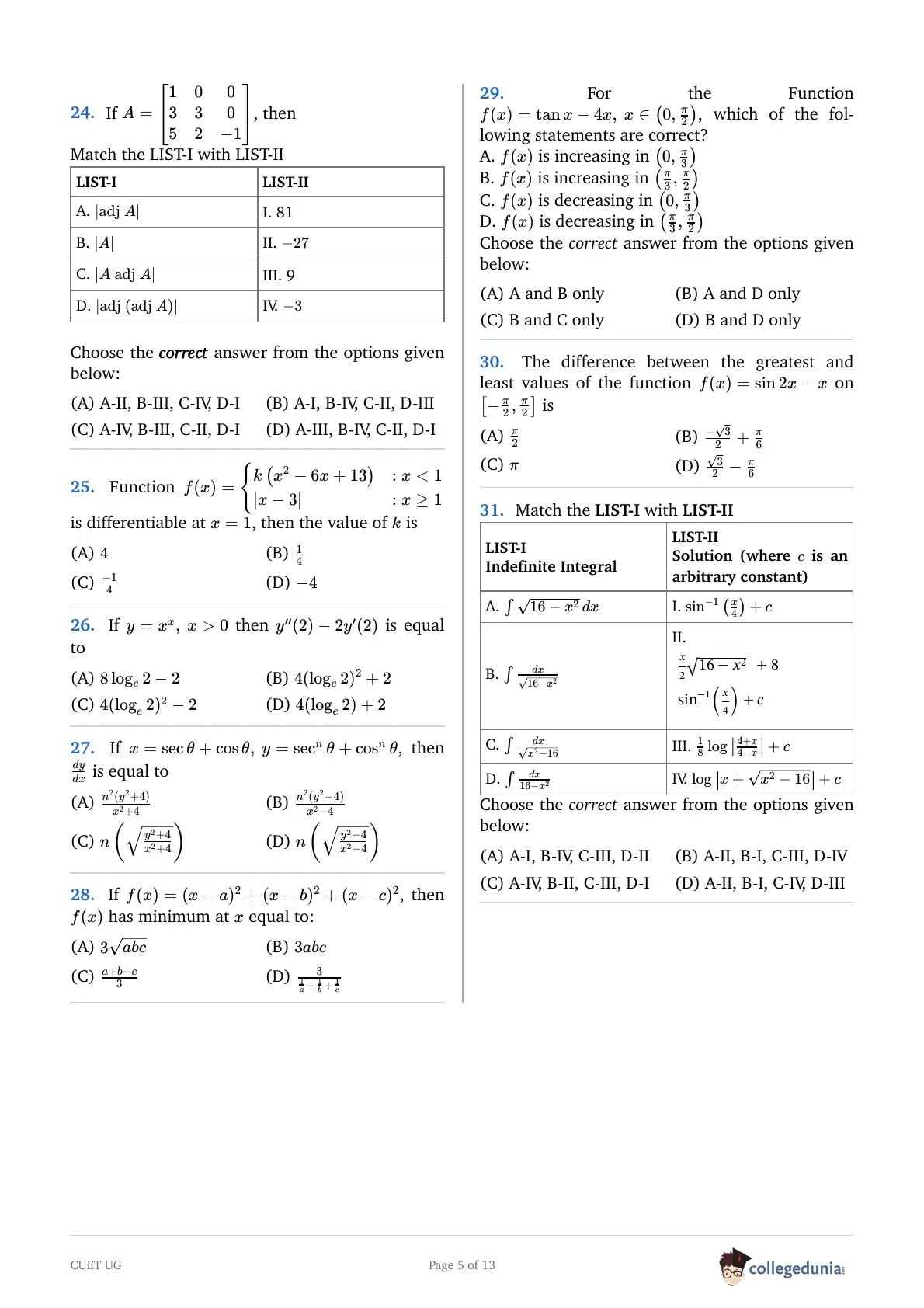
If \(A=\begin{bmatrix} 1 & 0 & 0 \\ 3 & 3 & 0 \\ 5 & 2 & -1 \end{bmatrix}\), then
Match the LIST-I with LIST-II
| LIST-I | LIST-II |
|---|---|
| A. \(|\text{adj }A|\) | I. 81 |
| B. \(|A|\) | II. \(-27\) |
| C. \(|A\ \text{adj }A|\) | III. 9 |
| D. \(|\text{adj (adj }A)|\) | IV. \(-3\) |
Choose the correct answer from the options given below:
Function \(f(x)=\begin{cases} k\left(x^2-6x+13\right) & : x<1 \\ |x-3| & : x\ge 1 \end{cases}\) is differentiable at \(x=1\), then the value of \(k\) is
If \(y=x^x,\ x>0\) then \(y^{\prime\prime}(2)-2y^{\prime}(2)\) is equal to
If \(x=\sec\theta+\cos\theta,\ y=\sec^n\theta+\cos^n\theta\), then \(\frac{dy}{dx}\) is equal to
If \(f(x)=(x-a)^2+(x-b)^2+(x-c)^2\), then \(f(x)\) has minimum at \(x\) equal to:
For the Function \(f(x)=\tan x-4x,\ x\in\left(0,\frac{\pi}{2}\right)\), which of the following statements are correct?
A. \(f(x)\) is increasing in \(\left(0,\frac{\pi}{3}\right)\)
B. \(f(x)\) is increasing in \(\left(\frac{\pi}{3},\frac{\pi}{2}\right)\)
C. \(f(x)\) is decreasing in \(\left(0,\frac{\pi}{3}\right)\)
D. \(f(x)\) is decreasing in \(\left(\frac{\pi}{3},\frac{\pi}{2}\right)\)
Choose the correct answer from the options given below:
The difference between the greatest and least values of the function \(f(x)=\sin 2x-x\) on \(\left[-\frac{\pi}{2},\frac{\pi}{2}\right]\) is
Match the LIST-I with LIST-II
| LIST-I Indefinite Integral | LIST-II Solution (where \(c\) is an arbitrary constant) |
|---|---|
| A. \(\int\sqrt{16-x^2}\,dx\) | I. \(\sin^{-1}\left(\frac{x}{4}\right)+c\) |
| B. \(\int\frac{dx}{\sqrt{16-x^2}}\) | II. \(\frac{x}{2}\sqrt{16-x^2}+8\sin^{-1}\left(\frac{x}{4}\right)+c\) |
| C. \(\int\frac{dx}{\sqrt{x^2-16}}\) | III. \(\frac{1}{8}\log\left|\frac{4+x}{4-x}\right|+c\) |
| D. \(\int\frac{dx}{16-x^2}\) | IV. \(\log\left|x+\sqrt{x^2-16}\right|+c\) |
\(\int_{-\pi/2}^{\pi/2}\frac{\cos x}{1+e^{x}}\,dx=\)
\(\int\frac{dx}{(x+1)\sqrt{x^2-1}}\) is equal to:
[\(c\) is an arbitrary constant]

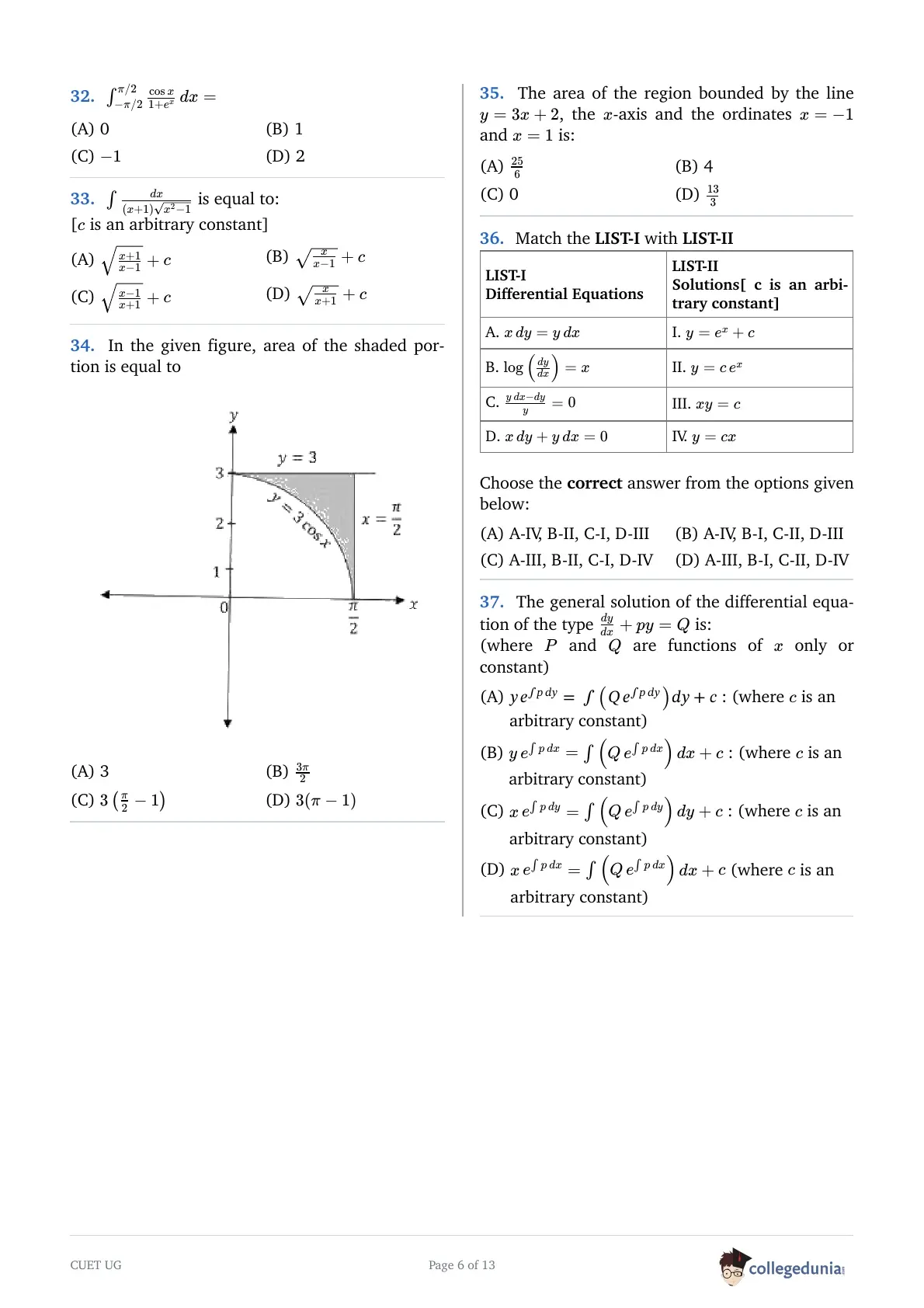
The area of the region bounded by the line \(y = 3x + 2\), the \(x\)-axis and the ordinates \(x = -1\) and \(x = 1\) is:
Match the LIST-I with LIST-II
| LIST-I Differential Equations | LIST-II Solutions[ c is an arbitrary constant] |
|---|---|
| A. \(x\,dy = y\,dx\) | I. \(y = e^{x} + c\) |
| B. \(\log\left(\frac{dy}{dx}\right) = x\) | II. \(y = c\,e^{x}\) |
| C. \(\frac{y\,dx - dy}{y} = 0\) | III. \(xy = c\) |
| D. \(x\,dy + y\,dx = 0\) | IV. \(y = cx\) |
Choose the correct answer from the options given below:
The general solution of the differential equation of the type \(\frac{dy}{dx} + py = Q\) is:
(where \(P\) and \(Q\) are functions of \(x\) only or constant)
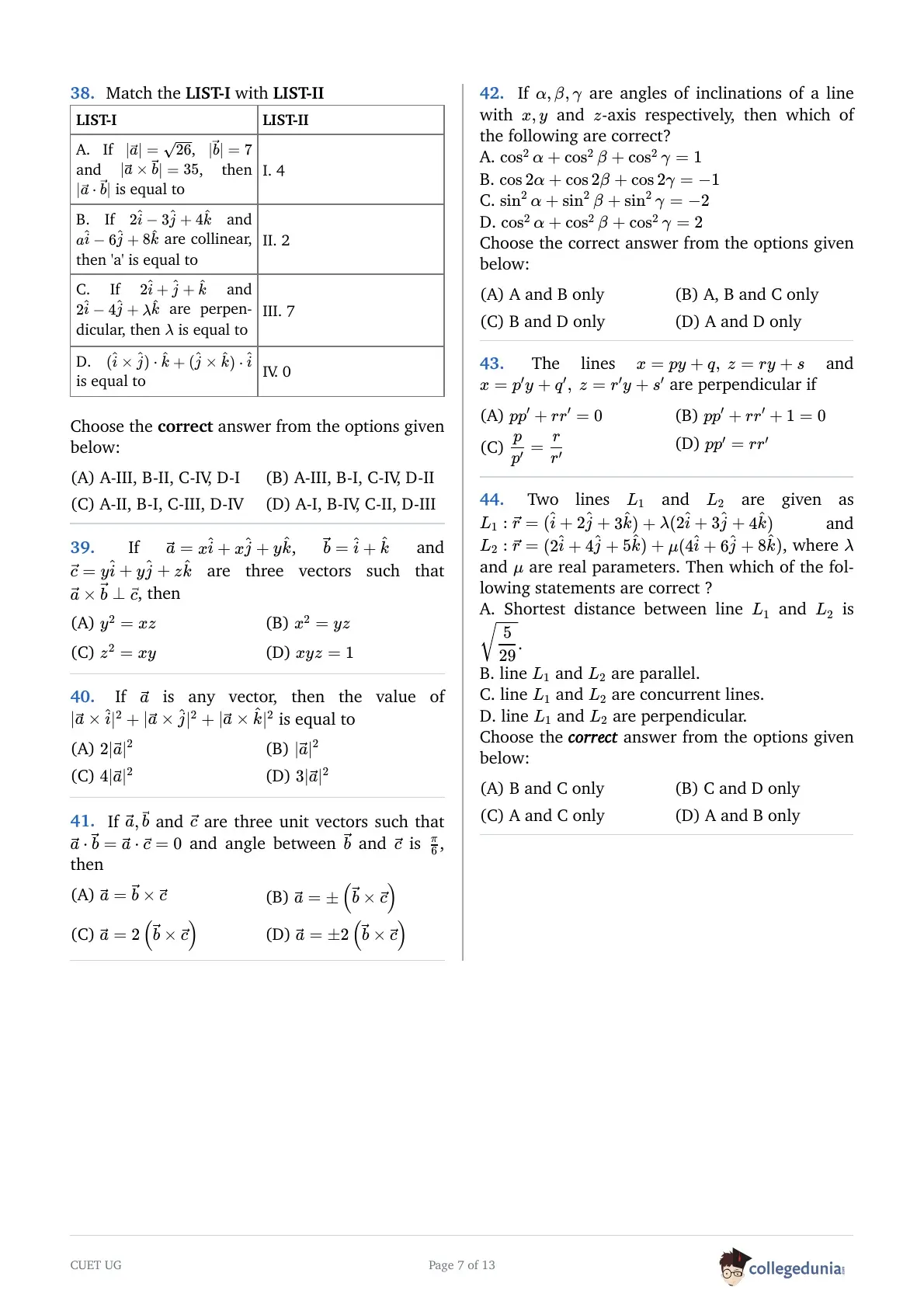
Match the LIST-I with LIST-II
| LIST-I | LIST-II |
|---|---|
| A. If \(|\vec{a}| = \sqrt{26}\), \(|\vec{b}| = 7\) and \(|\vec{a} \times \vec{b}| = 35\), then \(|\vec{a} \cdot \vec{b}|\) is equal to | I. 4 |
| B. If \(2\hat{i} - 3\hat{j} + 4\hat{k}\) and \(a\hat{i} - 6\hat{j} + 8\hat{k}\) are collinear, then 'a' is equal to | II. 2 |
| C. If \(2\hat{i} + \hat{j} + \hat{k}\) and \(2\hat{i} - 4\hat{j} + \lambda\hat{k}\) are perpendicular, then \(\lambda\) is equal to | III. 7 |
| D. \((\hat{i} \times \hat{j}) \cdot \hat{k} + (\hat{j} \times \hat{k}) \cdot \hat{i}\) is equal to | IV. 0 |
Choose the correct answer from the options given below:
If \(\vec{a} = x\hat{i} + x\hat{j} + y\hat{k}\), \(\vec{b} = \hat{i} + \hat{k}\) and \(\vec{c} = y\hat{i} + y\hat{j} + z\hat{k}\) are three vectors such that \(\vec{a} \times \vec{b} \perp \vec{c}\), then
If \(\vec{a}\) is any vector, then the value of \(|\vec{a} \times \hat{i}|^2 + |\vec{a} \times \hat{j}|^2 + |\vec{a} \times \hat{k}|^2\) is equal to
If \(\vec{a}, \vec{b}\) and \(\vec{c}\) are three unit vectors such that \(\vec{a} \cdot \vec{b} = \vec{a} \cdot \vec{c} = 0\) and angle between \(\vec{b}\) and \(\vec{c}\) is \(\frac{\pi}{6}\), then
If \(\alpha, \beta, \gamma\) are angles of inclinations of a line with \(x, y\) and \(z\)-axis respectively, then which of the following are correct?
A. \(\cos^2\alpha + \cos^2\beta + \cos^2\gamma = 1\)
B. \(\cos 2\alpha + \cos 2\beta + \cos 2\gamma = -1\)
C. \(\sin^2\alpha + \sin^2\beta + \sin^2\gamma = -2\)
D. \(\cos^2\alpha + \cos^2\beta + \cos^2\gamma = 2\)
Choose the correct answer from the options given below:
The lines \(x = py + q,\ z = ry + s\) and \(x = p'y + q',\ z = r'y + s'\) are perpendicular if
Two lines \(L_1\) and \(L_2\) are given as \(L_1: \vec{r} = (\hat{i}+2\hat{j}+3\hat{k}) + \lambda(2\hat{i}+3\hat{j}+4\hat{k})\) and \(L_2: \vec{r} = (2\hat{i}+4\hat{j}+5\hat{k}) + \mu(4\hat{i}+6\hat{j}+8\hat{k})\), where \(\lambda\) and \(\mu\) are real parameters. Then which of the following statements are correct ?
A. Shortest distance between line \(L_1\) and \(L_2\) is \(\sqrt{\dfrac{5}{29}}\).
B. line \(L_1\) and \(L_2\) are parallel.
C. line \(L_1\) and \(L_2\) are concurrent lines.
D. line \(L_1\) and \(L_2\) are perpendicular.
Choose the correct answer from the options given below:
The objective function of a LPP is given by \(z = ax + by\), where \(a\) and \(b\) are constants. If minimum of \(z\) occurs at two points \((50, 30)\) and \((20, 40)\), then
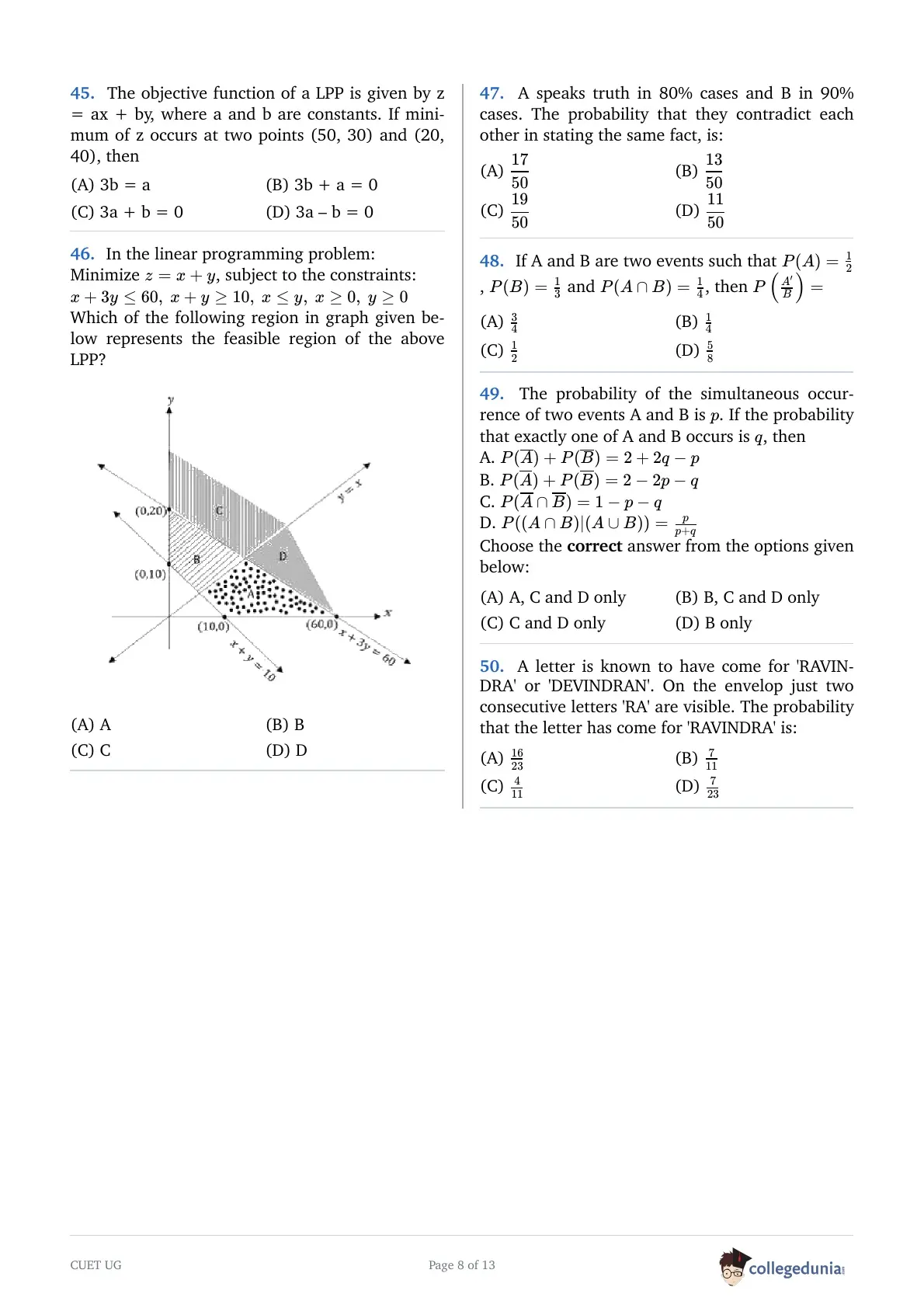
In the linear programming problem:
Minimize \(z = x + y\), subject to the constraints:
\(x + 3y \leq 60,\ x + y \geq 10,\ x \leq y,\ x \geq 0,\ y \geq 0\)
Which of the following region in graph given below represents the feasible region of the above LPP?

A speaks truth in 80% cases and B in 90% cases. The probability that they contradict each other in stating the same fact, is:
If A and B are two events such that \(P(A)=\frac{1}{2}\), \(P(B)=\frac{1}{3}\) and \(P(A \cap B)=\frac{1}{4}\), then \(P\left(\frac{A'}{B}\right)=\)
The probability of the simultaneous occurrence of two events A and B is \(p\). If the probability that exactly one of A and B occurs is \(q\), then
A. \(P(\overline{A})+P(\overline{B})=2+2q-p\)
B. \(P(\overline{A})+P(\overline{B})=2-2p-q\)
C. \(P(\overline{A}\cap\overline{B})=1-p-q\)
D. \(P((A\cap B)|(A\cup B))=\frac{p}{p+q}\)
Choose the correct answer from the options given below:
A letter is known to have come for 'RAVINDRA' or 'DEVINDRAN'. On the envelop just two consecutive letters 'RA' are visible. The probability that the letter has come for 'RAVINDRA' is:
Section B2 - Applied Mathematics (Q51 - Q85)
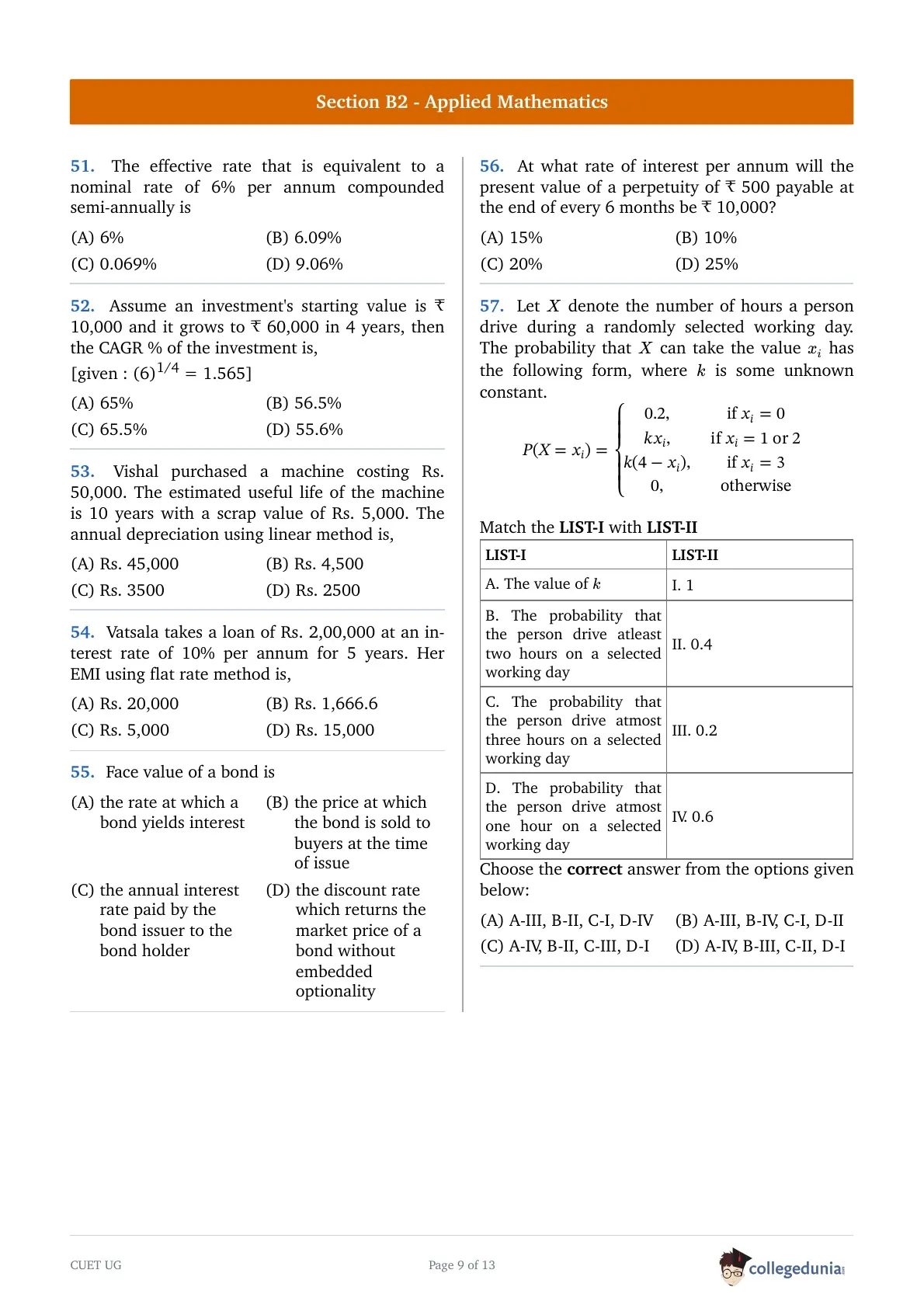
The effective rate that is equivalent to a nominal rate of 6% per annum compounded semi-annually is
Assume an investment's starting value is Rs. 10,000 and it grows to Rs. 60,000 in 4 years, then the CAGR % of the investment is,
[given : \((6)^{1/4}=1.565\)]
Vishal purchased a machine costing Rs. 50,000. The estimated useful life of the machine is 10 years with a scrap value of Rs. 5,000. The annual depreciation using linear method is,
Vatsala takes a loan of Rs. 2,00,000 at an interest rate of 10% per annum for 5 years. Her EMI using flat rate method is,
Face value of a bond is
At what rate of interest per annum will the present value of a perpetuity of Rs. 500 payable at the end of every 6 months be Rs. 10,000?
Let \(X\) denote the number of hours a person drive during a randomly selected working day. The probability that \(X\) can take the value \(x_i\) has the following form, where \(k\) is some unknown constant.
\[ P(X = x_i) = \begin{cases} 0.2, & \text{if } x_i = 0 \\ kx_i, & \text{if } x_i = 1 \text{ or } 2 \\ k(4 - x_i), & \text{if } x_i = 3 \\ 0, & \text{otherwise} \end{cases} \]
Match the LIST-I with LIST-II
| LIST-I | LIST-II |
|---|---|
| A. The value of \(k\) | I. 1 |
| B. The probability that the person drive atleast two hours on a selected working day | II. 0.4 |
| C. The probability that the person drive atmost three hours on a selected working day | III. 0.2 |
| D. The probability that the person drive atmost one hour on a selected working day | IV. 0.6 |
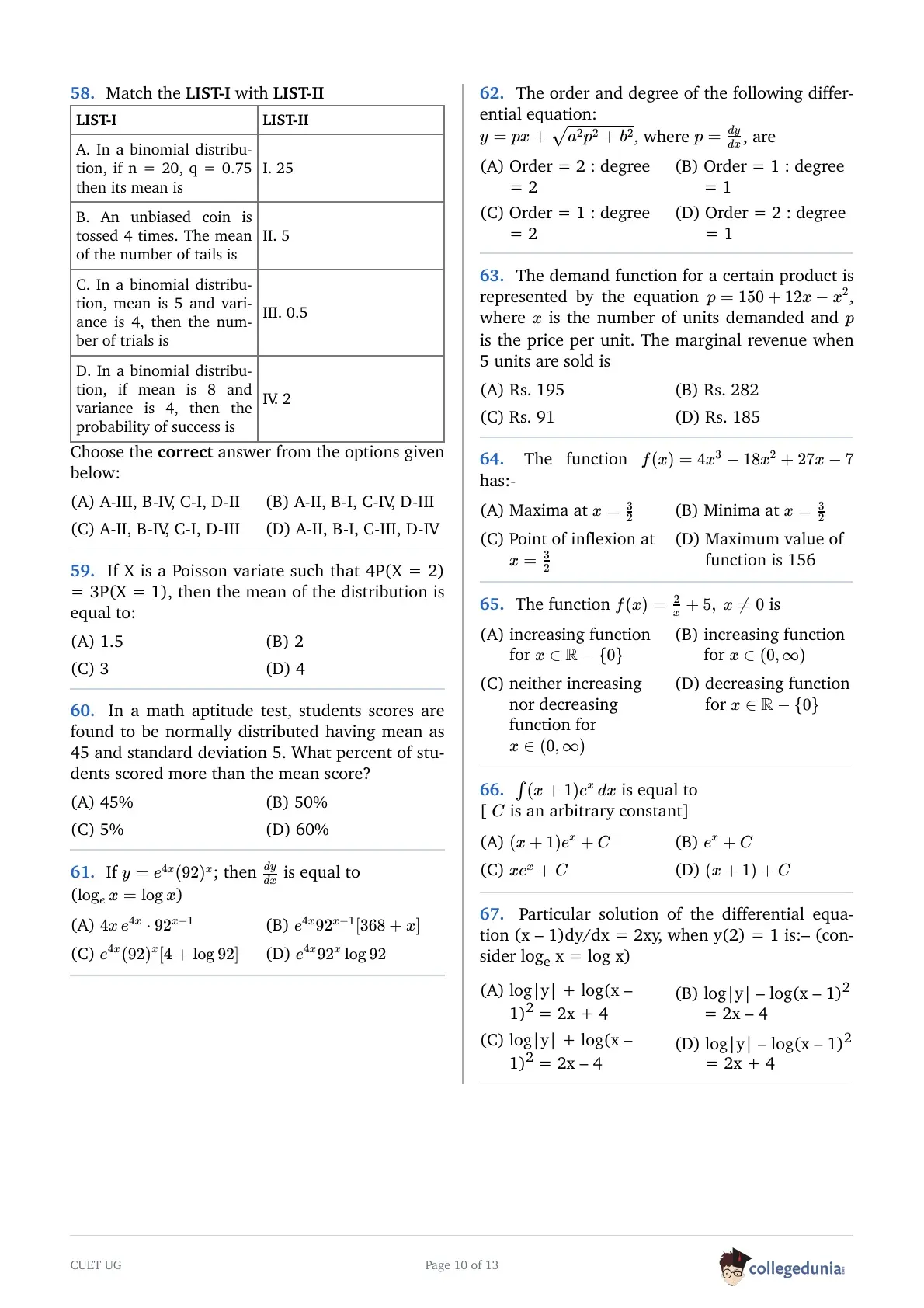
Match the LIST-I with LIST-II
| LIST-I | LIST-II |
|---|---|
| A. In a binomial distribution, if n = 20, q = 0.75 then its mean is | I. 25 |
| B. An unbiased coin is tossed 4 times. The mean of the number of tails is | II. 5 |
| C. In a binomial distribution, mean is 5 and variance is 4, then the number of trials is | III. 0.5 |
| D. In a binomial distribution, if mean is 8 and variance is 4, then the probability of success is | IV. 2 |
If \(X\) is a Poisson variate such that \(4P(X = 2) = 3P(X = 1)\), then the mean of the distribution is equal to:
In a math aptitude test, students scores are found to be normally distributed having mean as 45 and standard deviation 5. What percent of students scored more than the mean score?
If \(y=e^{4x}(92)^x\); then \(\frac{dy}{dx}\) is equal to
(\(\log_e x=\log x\))
The order and degree of the following differential equation:
\(y=px+\sqrt{a^2p^2+b^2}\), where \(p=\frac{dy}{dx}\), are
The demand function for a certain product is represented by the equation \(p=150+12x-x^2\), where \(x\) is the number of units demanded and \(p\) is the price per unit. The marginal revenue when 5 units are sold is
The function \(f(x)=4x^3-18x^2+27x-7\) has:-
The function \(f(x)=\frac{2}{x}+5,\ x\ne 0\) is
\(\int (x+1)e^x\,dx\) is equal to
[ \(C\) is an arbitrary constant]
Particular solution of the differential equation \((x-1)\frac{dy}{dx}=2xy\), when \(y(2)=1\) is:- (consider \(\log_e x=\log x\))
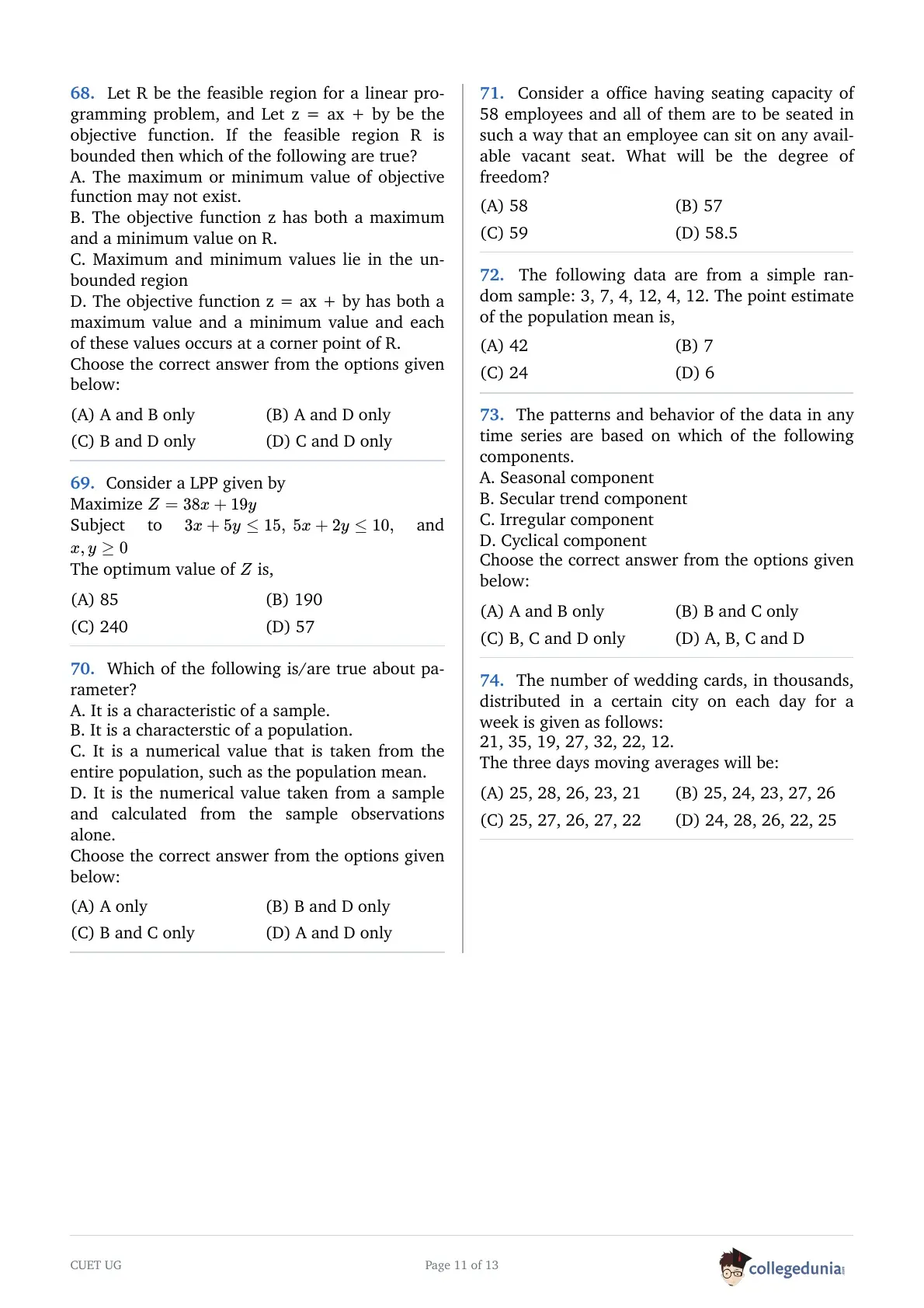
Let R be the feasible region for a linear programming problem, and Let \(z=ax+by\) be the objective function. If the feasible region R is bounded then which of the following are true ?
A. The maximum or minimum value of objective function may not exist.
B. The objective function \(z\) has both a maximum and a minimum value on R.
C. Maximum and minimum values lie in the unbounded region
D. The objective function \(z=ax+by\) has both a maximum value and a minimum value and each of these values occurs at a corner point of R.
Choose the correct answer from the options given below:
Consider a LPP given by
Maximize \(Z=38x+19y\)
Subject to \(3x+5y\le 15,\ 5x+2y\le 10,\) and \(x,y\ge 0\)
The optimum value of \(Z\) is,
Which of the following is/are true about parameter ?
A. It is a characteristic of a sample.
B. It is a characterstic of a population.
C. It is a numerical value that is taken from the entire population, such as the population mean.
D. It is the numerical value taken from a sample and calculated from the sample observations alone.
Choose the correct answer from the options given below:
Consider a office having seating capacity of 58 employees and all of them are to be seated in such a way that an employee can sit on any available vacant seat . What will be the degree of freedom?
The following data are from a simple random sample: 3 , 7 , 4 , 12 , 4 , 12. The point estimate of the population mean is,
The patterns and behavior of the data in any time series are based on which of the following components.
A. Seasonal component
B. Secular trend component
C. Irregular component
D. Cyclical component
Choose the correct answer from the options given below:
The number of wedding cards, in thousands, distributed in a certain city on each day for a week is given as follows:-
21, 35, 19, 27, 32, 22, 12.
The three days moving averages will be:
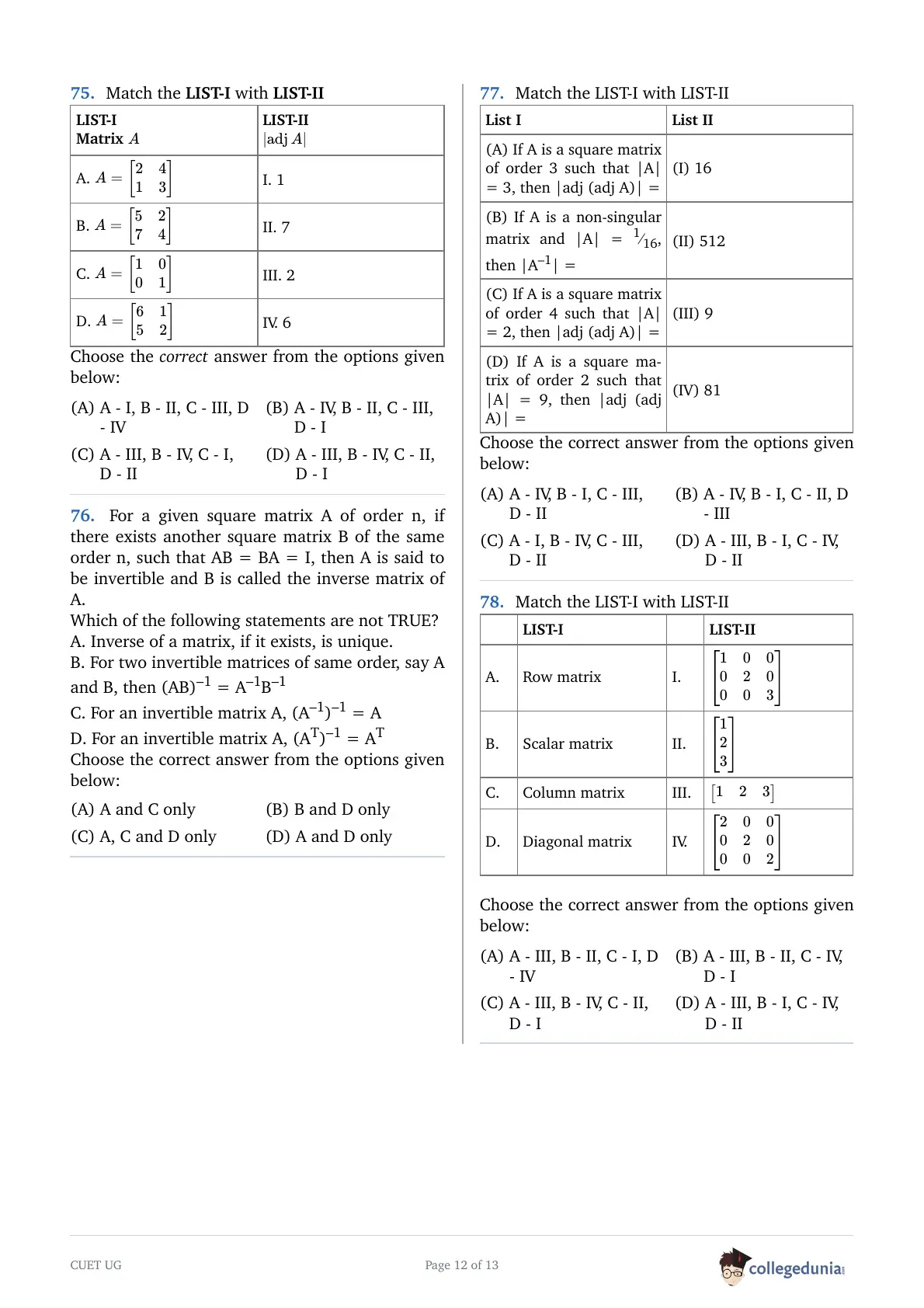
Match the LIST-I with LIST-II
| LIST-I Matrix \(A\) | LIST-II \(|\text{adj}\,A|\) |
|---|---|
| A. \(A=\begin{bmatrix}2&4\\1&3\end{bmatrix}\) | I. 1 |
| B. \(A=\begin{bmatrix}5&2\\7&4\end{bmatrix}\) | II. 7 |
| C. \(A=\begin{bmatrix}1&0\\0&1\end{bmatrix}\) | III. 2 |
| D. \(A=\begin{bmatrix}6&1\\5&2\end{bmatrix}\) | IV. 6 |
For a given square matrix \(A\) of order n, if there exists another square matrix \(B\) of the same order n, such that \(AB = BA = I\), then \(A\) is said to be invertible and \(B\) is called the inverse matrix of \(A\).
Which of the following statements are not TRUE ?
A. Inverse of a matrix, if it exists, is unique.
B. For two invertible matrices of same order, say \(A\) and \(B\) , then \((AB)^{-1} = A^{-1}B^{-1}\)
C. For an invertible matrix \(A\), \((A^{-1})^{-1} = A\)
D. For an invertible matrix \(A\), \((A^{T})^{-1} = A^{T}\)
Choose the correct answer from the options given below:
Match the LIST-I with LIST-II
| LIST-I | LIST-II | ||
|---|---|---|---|
| A. | If A is a square matrix of order 3 such that \(|A| = 3\), then \(|adj (adj A)| =\) | I. | 16 |
| B. | If A is a non-singular matrix and \(|A| = \frac{1}{16}\), then \(|A^{-1}| =\) | II. | 512 |
| C. | If A is a square matrix of order 4 such that \(|A| = 2\), then \(|adj (adj A)| =\) | III. | 9 |
| D. | If A is a square matrix of order 2 such that \(|A| = 9\), then \(|adj (adj A)| =\) | IV. | 81 |
Choose the correct answer from the options given below:
Match the LIST-I with LIST-II
| LIST-I | LIST-II | ||
|---|---|---|---|
| A. | Row matrix | I. | \(\begin{bmatrix}1 & 0 & 0\\0 & 2 & 0\\0 & 0 & 3\end{bmatrix}\) |
| B. | Scalar matrix | II. | \(\begin{bmatrix}1\\2\\3\end{bmatrix}\) |
| C. | Column matrix | III. | \(\begin{bmatrix}1 & 2 & 3\end{bmatrix}\) |
| D. | Diagonal matrix | IV. | \(\begin{bmatrix}2 & 0 & 0\\0 & 2 & 0\\0 & 0 & 2\end{bmatrix}\) |
Choose the correct answer from the options given below:
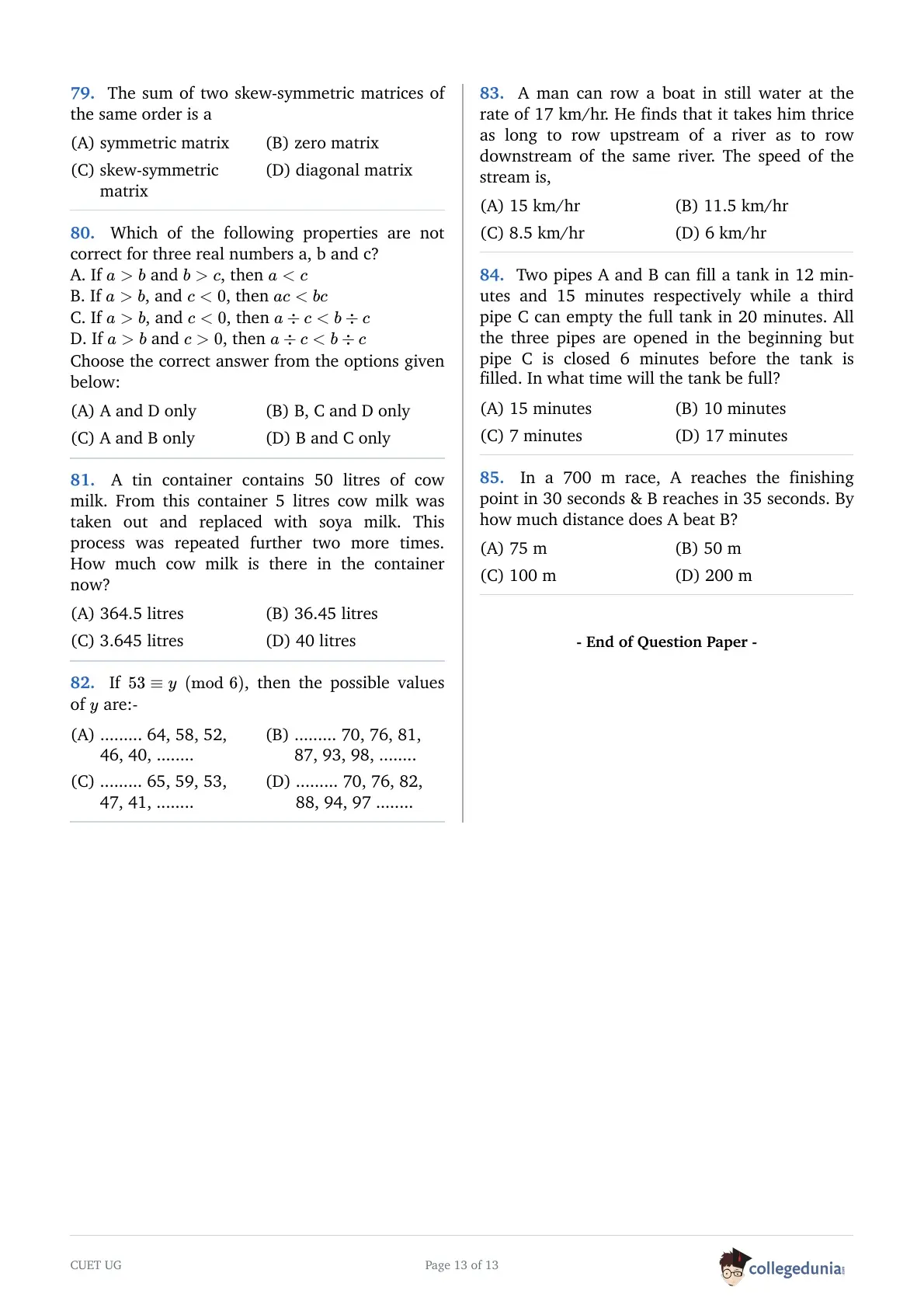
The sum of two skew-symmetric matrices of the same order is a
Which of the following properties are not correct for three real numbers a, b and c?
A. If \(a > b\) and \(b > c\), then \(a < c\)
B. If \(a > b\), and \(c < 0\), then \(ac < bc\)
C. If \(a > b\), and \(c < 0\), then \(a \div c < b \div c\)
D. If \(a > b\) and \(c > 0\), then \(a \div c < b \div c\)
Choose the correct answer from the options given below:
A tin container contains 50 litres of cow milk. From this container 5 litres cow milk was taken out and replaced with soya milk. This process was repeated further two more times. How much cow milk is there in the container now?
If \(53 \equiv y \pmod 6\), then the possible values of \(y\) are:-
A man can row a boat in still water at the rate of 17 km/hr. He finds that it takes him thrice as long to row upstream of a river as to row downstream of the same river. The speed of of the stream is,
Two pipes A and B can fill a tank in 12 minutes and 15 minutes respectively while a third pipe C can empty the full tank in 20 minutes. All the three pipes are opened in the beginning but pipe C is closed 6 minutes before the tank is filled. In what time will the tank is full?
In a 700 m race, A reaches the finishing point in 30 seconds & B reaches in 35 seconds. By how much distance A beats B?
CUET UG 2026 Exam Pattern and Marking Scheme
| Parameter | Details |
|---|---|
| Exam Name | Common University Entrance Test (CUET UG) 2026 |
| Conducting Body | National Testing Agency (NTA) |
| Exam Mode | Computer-Based Test (CBT) |
| Exam Duration | 60 minutes per test |
| Total Sections | 3 (Languages, Domain Subjects, General Test) |
| Question Type | Multiple Choice Questions (MCQs) |
| Questions per Test | 50 questions (all compulsory) |
| Marking Scheme | +5 for correct, -1 for incorrect |
| Maximum Marks | 250 marks per test |
| Maximum Subject Choices | 5 subjects in total |
| Syllabus Base | Class 12 NCERT (mainly for Domain Subjects) |
Other CUET 2026 Mathematics Shift-wise Question Papers
| CUET 2026 Day and Shift | Question Paper PDF | Solutions PDF |
|---|---|---|
| CUET 2026 Mathematics Question Paper May 15 Shift 1 | Download PDF | Check Solutions |
| CUET 2026 Mathematics Question Paper May 14 Shift 2 | Download PDF | Check Solutions |



Comments