




CUET 2026 May 25 Shift 1 Physics Question Paper is available for download here. NTA is conducting the CUET 2026 exam from 11th May to 31st May.
- CUET 2026 Physics exam consists of 50 questions for 250 marks to be attempted in 60 minutes.
- As per the marking scheme, 5 marks are awarded for each correct answer, and 1 mark is deducted for incorrect answer.
Candidates can download CUET 2026 May 25 Shift 1 Physics Question Paper with Answer Key and Solution PDF from links provided below.
Related Links:
CUET 2026 Physics May 25 Shift 1 Question Paper with Solution PDF
| CUET May 25 Shift 1 Physics Question Paper 2026 | Download PDF | Check Solutions |
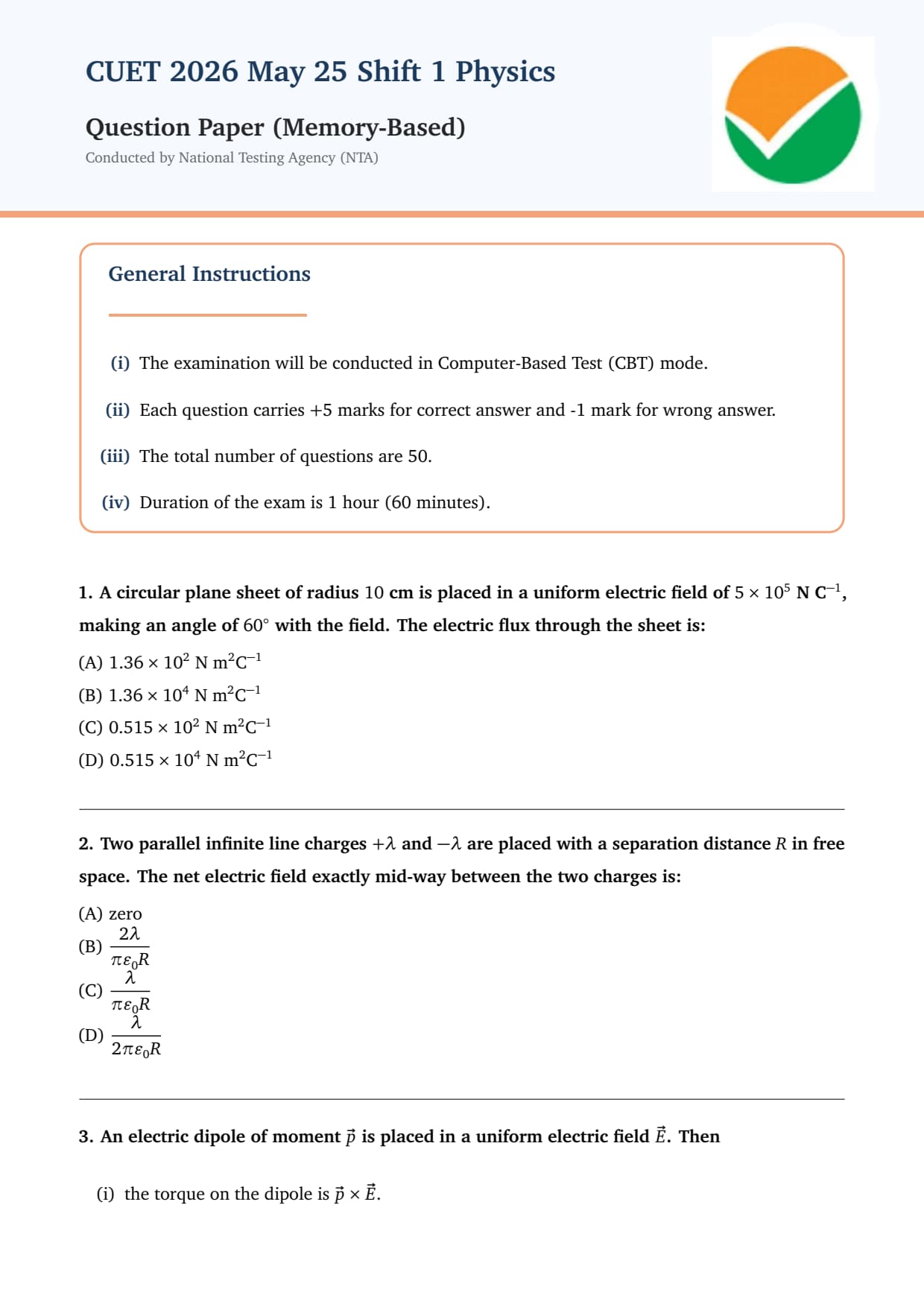


A circular plane sheet of radius \(10\ cm\) is placed in a uniform electric field of \(5 \times 10^5\ N C^{-1}\), making an angle of \(60^\circ\) with the field. The electric flux through the sheet is:
Two parallel infinite line charges \(+\lambda\) and \(-\lambda\) are placed with a separation distance \(R\) in free space. The net electric field exactly mid-way between the two charges is:
An electric dipole of moment \(\vec{p}\) is placed in a uniform electric field \(\vec{E}\). Then
[(i)] the torque on the dipole is \(\vec{p}\times\vec{E}\).
[(ii)] the potential energy of the system is \(\vec{p}\cdot\vec{E}\).
[(iii)] the resultant force on the dipole is zero.
Choose the correct option.
A parallel plate capacitor having area \(A\) and separated by distance \(d\) is filled by a copper plate of thickness \(b\). The new capacity is:
A parallel plate capacitor of capacitance \(5\ \mu F\) and plate separation \(6\ cm\) is connected to a \(1\ V\) battery and charged. A dielectric of dielectric constant \(4\) and thickness \(4\ cm\) is introduced between the plates of the capacitor. The additional charge that flows into the capacitor from the battery is:
A slab of material of dielectric constant \(K\) has the same area \(A\) as the plates of a parallel plate capacitor, and has thickness \(\left(\frac{3}{4}d\right)\), where \(d\) is the separation of the plates. The capacitance when the slab is inserted between the plates is:
A wire has a resistance of \(2.5\ \Omega\) at \(28^\circ C\) and a resistance of \(2.9\ \Omega\) at \(100^\circ C\). The temperature coefficient of resistivity of the material of the wire is:
Choose the correct combination of three resistances \(1\ \Omega\), \(2\ \Omega\) and \(3\ \Omega\) to get equivalent resistance \(\dfrac{11}{5}\ \Omega\).
A battery of emf \(15\ V\) and internal resistance of \(4\ \Omega\) is connected to a resistor. If the current in the circuit is \(2\ A\), the resistance of the resistor and terminal voltage of the battery will be:
Two cells \(\varepsilon_1\) and \(\varepsilon_2\) are connected in opposition to each other as shown in the figure. The cell \(\varepsilon_1\) is of emf \(9\ V\) and internal resistance \(3\ \Omega\). The cell \(\varepsilon_2\) is of emf \(7\ V\) and internal resistance \(7\ \Omega\). The potential difference between the points \(A\) and \(B\) is:
CUET UG 2026 Exam Pattern
| Parameter | Details |
|---|---|
| Exam Name | Common University Entrance Test (CUET UG) 2026 |
| Conducting Body | National Testing Agency (NTA) |
| Exam Mode | Computer-Based Test (CBT) |
| Exam Duration | 60 minutes per test |
| Total Sections | 3 (Languages, Domain Subjects, General Test) |
| Question Type | Multiple Choice Questions (MCQs) |
| Questions per Test | 50 questions (all compulsory) |
| Marking Scheme | +5 for correct, -1 for incorrect |
| Maximum Marks | 250 marks per test |
| Maximum Subject Choices | 5 subjects in total |
| Syllabus Base | Class 12 NCERT (mainly for Domain Subjects) |



Comments