




CUET 2026 May 30 Shift 1 Mass Media Question Paper is available for download here. NTA conducted the CUET 2026 exam from 11th May to 31st May.
- CUET 2026 Mass Media exam consists of 50 questions for 250 marks to be attempted in 60 minutes.
- As per the marking scheme, 5 marks are awarded for each correct answer, and 1 mark is deducted for incorrect answer.
Candidates can download CUET 2026 May 30 Shift 1 Mass Media Question Paper with Answer Key and Solution PDF from links provided below.
CUET 2026 Mass Media May 30 Shift 1 Question Paper with Solution PDF
| CUET May 30 Shift 1 Mass Media Question Paper 2026 | Download PDF | Check Solutions |



In 1973, the Supreme Court held that the "Fundamental Rights can be amended but the basic structure of the Constitution cannot be destroyed".
Identify the case.
View Solution
Step 1: Understanding the Question:The question quotes a famous Supreme Court ruling of 1973. The court said Parliament can amend Fundamental Rights, but it cannot destroy the basic structure of the Constitution. We must name the case in which this was decided.
Step 2: Recall the doctrine:
This idea is called the Basic Structure Doctrine. It was laid down by a thirteen judge bench in 1973. The bench ruled on the limits of Parliament's power to amend the Constitution under Article 368.
Step 3: Check option 1:
Golaknath vs. State of Punjab was decided in 1967. There the court held that Parliament could not amend Fundamental Rights at all. This is a stricter view than the quoted statement and it was later overruled. So option 1 is wrong.
Step 4: Check option 2:
Keshavananda Bharati vs. State of Kerala was decided in April 1973. It gave the basic structure doctrine and allowed amendment of Fundamental Rights without damaging the basic structure. This matches the quote exactly. So option 2 is right.
Step 5: Check option 3:
Romesh Thappar vs. State of Madras was decided in 1950. It is a press freedom case about a ban on a magazine, and it held that freedom of speech includes freedom of circulation. It has nothing to do with the amending power. So option 3 is wrong.
Step 6: Check option 4:
Umed Ram Sharma vs. State of Himachal Pradesh is not the case linked with the basic structure doctrine. So option 4 is wrong.
Final Answer:
The case is Keshavananda Bharati vs. State of Kerala, which is option 2. \[ \boxed{2} \]
The Hindustan Times Business daily Mint was published in partnership with------?
View Solution
Step 1: Understanding the Question:The question asks which foreign media house partnered with the Hindustan Times group when it launched its business daily Mint. Mint was launched in 2007.
Step 2: Recall the fact:
Mint was started by HT Media. At launch it was set up in a content partnership with the Wall Street Journal, a leading American business newspaper. The Wall Street Journal supplied part of the global business content.
Step 3: Check option 1:
The Washington Post is an American daily known for political news. It was not the partner of Mint. So option 1 is wrong.
Step 4: Check option 2:
The New York Times is a general news daily from New York. It has no tie-up with Mint. So option 2 is wrong.
Step 5: Check option 3:
The Courier is a regional paper title and has no link with Mint. So option 3 is wrong.
Step 6: Check option 4:
The Wall Street Journal is a business daily, which fits a business newspaper like Mint. It was the partner at launch. So option 4 is right.
Final Answer:
Mint was published in partnership with the Wall Street Journal, which is option 4. \[ \boxed{4} \]
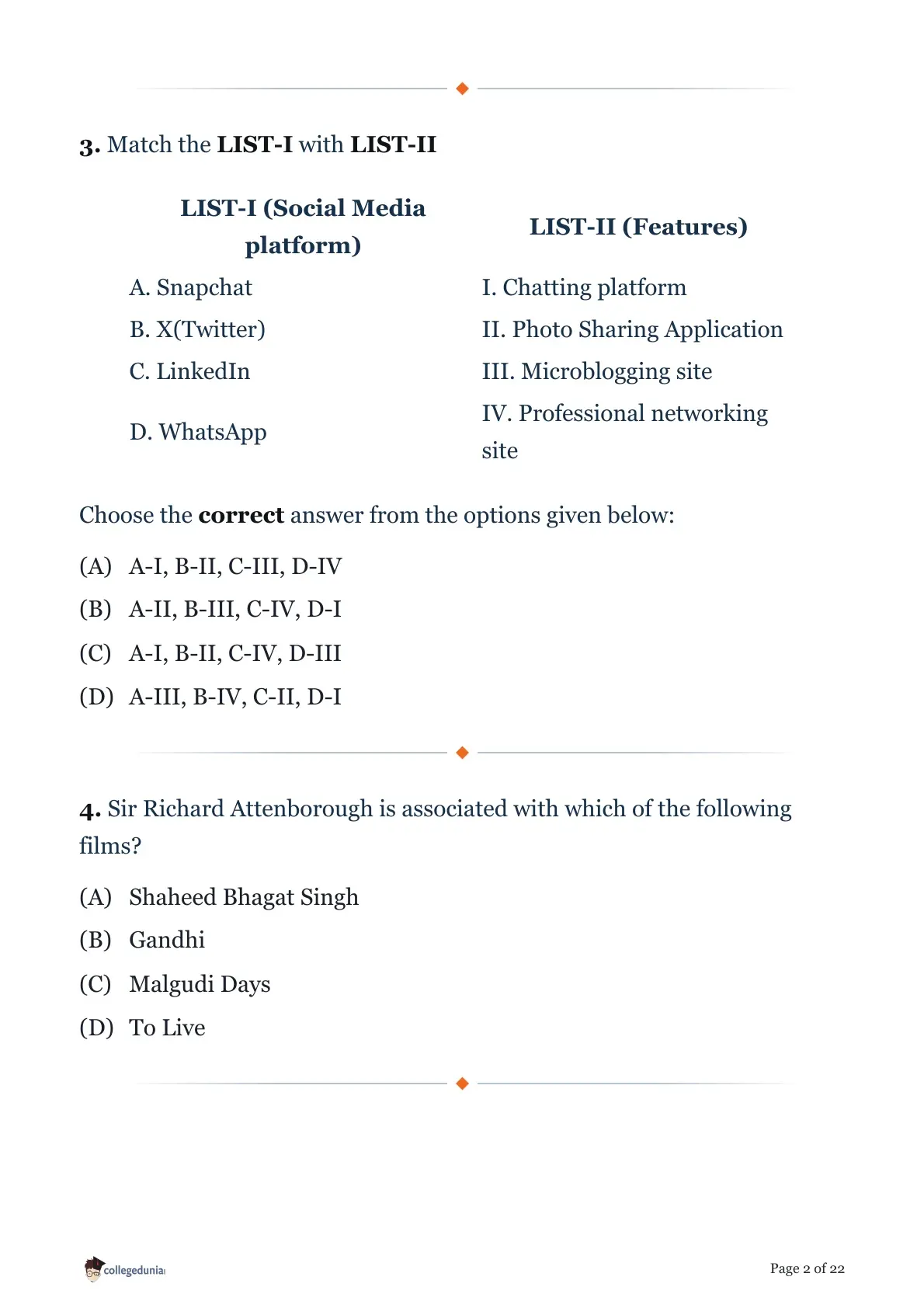
Match the LIST-I with LIST-II
| LIST-I (Social Media platform) | LIST-II (Features) |
|---|---|
| A. Snapchat | I. Chatting platform |
| B. X(Twitter) | II. Photo Sharing Application |
| C. LinkedIn | III. Microblogging site |
| D. WhatsApp | IV. Professional networking site |
View Solution
Step 1: Understanding the Question:We must match each social media platform in List-I with its main feature in List-II. The correct pairs are Snapchat with photo sharing, X with microblogging, LinkedIn with professional networking and WhatsApp with chatting.
Step 2: Work out the pairs:
Snapchat is mainly used to send photos and short videos, so A matches II. X (Twitter) allows very short posts, so it is a microblogging site and B matches III. LinkedIn connects working people and employers, so C matches IV. WhatsApp is a messaging app, so D matches I. The right code is A-II, B-III, C-IV, D-I.
Step 3: Check option 1:
This option pairs Snapchat with chatting and X with photo sharing. Both are mismatched. So option 1 is wrong.
Step 4: Check option 2:
This option gives A-II, B-III, C-IV, D-I. It matches all four pairs found above. So option 2 is right.
Step 5: Check option 3:
This option pairs Snapchat with chatting, X with photo sharing and WhatsApp with microblogging. All three are wrong. So option 3 is wrong.
Step 6: Check option 4:
This option pairs Snapchat with microblogging and X with professional networking. These are wrong. So option 4 is wrong.
Final Answer:
The correct matching is A-II, B-III, C-IV, D-I, which is option 2. \[ \boxed{2} \]
Sir Richard Attenborough is associated with which of the following films?
View Solution
Step 1: Understanding the Question:We are asked to name the film linked with Sir Richard Attenborough. He was a British actor and film maker.
Step 2: Recall the fact:
Richard Attenborough directed and produced the 1982 biographical film Gandhi, starring Ben Kingsley. The film won several Academy Awards, including Best Picture and Best Director.
Step 3: Check option 1:
Shaheed Bhagat Singh is an Indian film about the freedom fighter. It was made by Indian film makers, not by Attenborough. So option 1 is wrong.
Step 4: Check option 2:
Gandhi is the film Attenborough made. So option 2 is right.
Step 5: Check option 3:
Malgudi Days is an Indian television series based on R. K. Narayan's stories. It was directed by Shankar Nag. So option 3 is wrong.
Step 6: Check option 4:
To Live is a Chinese film directed by Zhang Yimou. It has no link with Attenborough. So option 4 is wrong.
Final Answer:
Sir Richard Attenborough is associated with the film Gandhi, which is option 2. \[ \boxed{2} \]
Arrange the following in correct sequence beginning from the first:
A. Constitution of the First Press Council of India
B. First Press Commission set up in India
C. The Advertising Standards Council of India
D. Adams Act
Choose the correct answer from the options given below:
View Solution
Step 1: Understanding the Question:We must put four events of Indian press history in time order, starting from the earliest. The four items are the Adams Act, the First Press Commission, the First Press Council and the Advertising Standards Council of India.
Step 2: Find the year of each event:
The Adams Act (press licensing regulation under John Adams) came in 1823. The First Press Commission was set up in 1952. The First Press Council of India was formed in 1966, after the commission had suggested it. The Advertising Standards Council of India was set up in 1985.
Step 3: Arrange the events:
In time order the list is Adams Act (D), First Press Commission (B), First Press Council (A), ASCI (C). The sequence is D, B, A, C.
Step 4: Check option 1:
A, B, C, D puts the Press Council before the Commission and puts the Adams Act last. This is wrong. So option 1 is wrong.
Step 5: Check option 2:
D, B, A, C matches the order found above. So option 2 is right.
Step 6: Check option 3:
B, A, D, C places the Adams Act after the Press Council, but the Act was from the early nineteenth century. So option 3 is wrong.
Step 7: Check option 4:
D, A, C, B puts the Press Council before the Press Commission and puts the Commission last. This is wrong. So option 4 is wrong.
Final Answer:
The correct sequence is D, B, A, C, which is option 2. \[ \boxed{2} \]
Which of the following statements are correct about the First Media Age?
A. It influences individual experience of space and time.
B. Pre-disposed to state control.
C. It is centered where few speak to many.
D. An instrument of regimes of stratification and inequality.
Choose the correct answer from the options given below:
View Solution
Step 1: Understanding the concept:The First Media Age is a term from media theory (Mark Poster). It describes the age of broadcasting: press, radio and television. In this age a central source sends the same message to a large mass audience. The Second Media Age is the age of interactive digital media, where many people can speak to many.
Step 2: Key approach:
We test each statement against the main features of broadcast media: one-way flow, central control and unequal access to the right to speak. Then we match the true statements with the four options.
Step 3: Check statement (A):
The change in how people feel space and time is the headline effect of the Second Media Age. Internet and mobile media let users act in a virtual space and in real time across places. Broadcasting did not change the individual's sense of space and time in this way. So (A) does not fit the First Media Age and is treated as FALSE.
Step 4: Check statement (B):
Broadcast channels need licences, costly equipment and a few large organisations. This makes them easy for a state to control, own or censor. So (B) is TRUE.
Step 5: Check statement (C):
The model is a few producers speaking to many receivers, with little chance to reply. This is the core idea of the First Media Age. So (C) is TRUE.
Step 6: Check statement (D):
Because only a few groups hold the power to speak, the system keeps older divisions of class, power and voice in place. Media in this age are seen as an instrument of stratification and inequality. So (D) is TRUE.
Step 7: Match with the options:
Statement C is true, so options 1 and 2 (which leave out C) are wrong. Option 3 uses A, which is false. Option 4 uses B, C and D, which are all true.
Final Answer:
The true statements for the First Media Age are B, C and D, which is option 4. \[ \boxed{\text{Option 4: B, C and D only}} \]
Who said, "One of the objectives of a newspaper is to identify the popular feeling and give expression to it; another is to arouse among people certain desirable sentiments; third is to fearlessly expose popular defects."?
View Solution
Step 1: Understanding the question:We must name the person who listed three aims of a newspaper: reflect popular feeling, create good sentiments in readers, and expose public faults without fear.
Step 2: Recall the source:
This is Mahatma Gandhi's well-known view of journalism, written in his autobiography, My Experiments with Truth. He ran Indian Opinion, Young India and Harijan and treated journalism as public service, not business.
Step 3: Check option 1, Mahatma Gandhi:
The three aims match his writing exactly. So option 1 is CORRECT.
Step 4: Check option 2, Jawaharlal Nehru:
Nehru founded the National Herald and wrote on press freedom. But this three-part statement of newspaper aims is not his. Option 2 is wrong.
Step 5: Check option 3, Sardar Vallabhbhai Patel:
Patel is known for integrating the princely states. He is not linked to this statement. Option 3 is wrong.
Step 6: Check option 4, Raja Ram Mohan Roy:
Roy was an early pioneer of the Indian press (Mirat-ul-Akhbar, Sambad Kaumudi) and protested press restrictions. Still, the quote is Gandhi's. Option 4 is wrong.
Final Answer:
The quote is by Mahatma Gandhi, option 1. \[ \boxed{\text{Option 1: Mahatma Gandhi}} \]
Areopagitica which defended freedom of the press and inviolability of books was written and distributed by---------?
View Solution
Step 1: Understanding the question:We must name the author of Areopagitica, an early defence of a free press.
Step 2: Recall the facts:
Areopagitica was a pamphlet published in 1644 by the English poet John Milton. It argued against the Licensing Order of 1643, under which books needed approval before printing. It is seen as a landmark in the history of free expression.
Step 3: Check option 1, John Milton:
Milton wrote and published it without a licence. So option 1 is CORRECT.
Step 4: Check option 2, Aristotle:
Aristotle was an ancient Greek philosopher who lived long before printing. Option 2 is wrong.
Step 5: Check option 3, Plato:
Plato was also an ancient Greek thinker and he was in fact wary of free poetry in his ideal state. Option 3 is wrong.
Step 6: Check option 4, Immanuel Kant:
Kant wrote in the 1700s on enlightenment and public reason, but not Areopagitica. Option 4 is wrong.
Final Answer:
Areopagitica was written by John Milton, option 1. \[ \boxed{\text{Option 1: John Milton}} \]
Match the LIST-I with LIST-II
| LIST-I Brand | LIST-II Tagline | ||
|---|---|---|---|
| A. | LIC | I. | Daag acche hai |
| B. | Mountain Dew | II. | I'm lovin it |
| C. | Surf Excel | III. | Darr ke aage jeet hai |
| D. | McDonalds' | IV. | Zindagi ke sath bhi, zindagi ke badh bhi |
Choose the correct answer from the options given below:
View Solution
Step 1: Understanding the question:We must pair each brand with its advertising tagline (slogan). A tagline is a short catchy line used in many ads of one brand.
Step 2: Match A, LIC:
LIC is a life insurance company. Its line promises cover during life and after it: Zindagi ke saath bhi, zindagi ke baad bhi. So A matches IV.
Step 3: Match B, Mountain Dew:
The cold drink uses the line Darr ke aage jeet hai, about winning by beating fear. So B matches III.
Step 4: Match C, Surf Excel:
The detergent brand is known for Daag acche hain, which means stains are good. So C matches I.
Step 5: Match D, McDonald's:
The fast food chain uses I'm lovin it worldwide. So D matches II.
Step 6: Check the options:
The pairs are A-IV, B-III, C-I, D-II. Option 1 has A-I, which is wrong. Option 2 and option 3 also start with A-I, so both are wrong. Only option 4 gives all four right.
Final Answer:
The correct matching is A-IV, B-III, C-I, D-II, option 4. \[ \boxed{\text{Option 4}} \]
This is the responsibility of a PRO. Identify from the following:
A. AD campaign design
B. Crisis management
C. Building brand image
D. Expanding business with partners
Choose the correct answer from the options given below:
View Solution
Step 1: Understanding the concept:A Public Relations Officer (PRO) manages how the public and media see an organisation. The job is about reputation, trust and communication, not about selling or running paid ads.
Step 2: Check A, AD campaign design:
Designing ad campaigns is the work of advertising or creative teams, who buy space and time. A PRO may support them, but it is not the core duty. So A is not a PRO duty.
Step 3: Check B, Crisis management:
When bad news hits, the PRO speaks to media, issues statements and protects the name of the organisation. So B is a PRO duty.
Step 4: Check C, Building brand image:
Creating a good public image through press notes, events and relations with media is the heart of PR. So C is a PRO duty.
Step 5: Check D, Expanding business with partners:
Finding partners and growing business is a business development or marketing task. So D is not a PRO duty.
Step 6: Choose the option:
Only B and C are PRO duties, which is option 3.
Final Answer:
B and C only, option 3. \[ \boxed{\text{Option 3: B and C only}} \]
Identify the famous US sitcom which dealt with the issue of child abuse, pedophilia and drugs.
View Solution
Step 1: Understanding the question:A sitcom is a situation comedy. We must find the US sitcom known for serious issues like child abuse, pedophilia and drugs.
Step 2: Check option 1, Diff'rent Strokes:
This 1978 to 1986 show about two Black boys adopted by a rich white man became famous for 'very special episodes'. These dealt with a child predator and with drug abuse. This fits the question, so option 1 is CORRECT.
Step 3: Check option 2, Taxi:
Taxi was a workplace comedy about cab drivers. It touched on personal struggles, but was not known for these issues. Option 2 is wrong.
Step 4: Check option 3, South Park:
South Park is an adult animated comedy known for satire and shock. It is a cartoon series, not the sitcom famous for earnest special episodes on these topics. Option 3 is wrong.
Step 5: Check option 4, Cheers:
Cheers is set in a Boston bar and is about relationships. Option 4 is wrong.
Final Answer:
The sitcom is Diff'rent Strokes, option 1. This answer is chosen by elimination and recall, since the question gives no key. \[ \boxed{\text{Option 1}} \]
In which form of advertising the product is disguised in entertainment?
View Solution
Step 1: Understanding the question:We need the type of advertising where the ad is hidden inside entertainment, so the viewer does not notice it as an ad.
Step 2: Check option 1, Merchandise:
Merchandise means goods like T-shirts or toys that carry a brand or a show logo. It is not hidden inside a story. Option 1 is wrong.
Step 3: Check option 2, Covert advertising:
Covert advertising places a brand inside a film, serial or song so that it looks like part of the story. Product placement is the common example. So option 2 is CORRECT.
Step 4: Check option 3, Informational advertising:
This type gives facts about a product, such as features and price, openly. Option 3 is wrong.
Step 5: Check option 4, Cross Promotion:
Two brands or media promote each other, and both are openly shown. Option 4 is wrong.
Final Answer:
The form is covert advertising, option 2. \[ \boxed{\text{Option 2: Covert advertising}} \]
This form of advertising is used when a product is being first time introduced in the market.
View Solution
Step 1: Understand the question.The question describes advertising used when a product is launched for the first time. The aim of such advertising is to tell people that the product exists, what it does and where to get it.
Step 2: Recall the key idea.
Advertising is often grouped by purpose. Informational (pioneering) advertising builds awareness and explains a new product. Persuasive advertising comes later, when rivals are present, and reminder advertising keeps a known brand in mind.
Step 3: Check option 1, Institutional ads.
Institutional ads promote the image and reputation of an organisation, not a specific new product. So option 1 is wrong.
Step 4: Check option 2, Cooperative ads.
Cooperative ads are paid for jointly, for example by a manufacturer and a local retailer. This describes who pays, not a launch purpose. So option 2 is wrong.
Step 5: Check option 3, Informational ads.
Informational ads give facts about a new product, such as features, uses and price, so that the market learns about it. This matches a first-time introduction. So option 3 is right.
Step 6: Check option 4, Cross promotion.
Cross promotion means two brands promote each other's products. It is not tied to introducing a product. So option 4 is wrong.
Final Answer:
A product that is new to the market needs informational advertising to create awareness. This is option 3. \[ \boxed{\text{Informational ads (Option 3)}} \]
Match the LIST-I with LIST-II
| LIST-I (Headline) | LIST-II (Characteristic) |
|---|---|
| A. Banner | I. secondary head that carries the story in inside pages. |
| B. Boxed | II. stretches across many columns |
| C. Jumphead | III. centred on the column |
| D. Cross | IV. in a small rectangle shape |
View Solution
Step 1: Understand the question.We must match four newspaper headline types with their features. The matching must be right for all four pairs together.
Step 2: Match A, Banner.
A banner headline is the big headline that runs across the top of the page, over many columns. So A matches II.
Step 3: Match B, Boxed.
A boxed headline sits inside a ruled box, usually a small rectangle, to make a story stand out. So B matches IV.
Step 4: Match C, Jumphead.
A jumphead is the headline used where a story continues on an inside page. It is a secondary head carrying the story forward. So C matches I.
Step 5: Match D, Cross.
A crosshead is a small heading placed in the middle of a column of text to break it up, and it is centred on the column. So D matches III.
Step 6: Check option 1.
It pairs A with I and B with II, which is wrong for both. Option 1 is wrong.
Step 7: Check option 3.
It pairs A with I and C with IV, which is wrong. Option 3 is wrong.
Step 8: Check option 4.
It pairs A with III and D with II, which is wrong. Option 4 is wrong.
Step 9: Check option 2.
It gives A-II, B-IV, C-I, D-III, which matches every pair we found. Option 2 is right.
Final Answer:
The correct matching is A-II, B-IV, C-I, D-III. This is option 2. \[ \boxed{\text{A-II, B-IV, C-I, D-III (Option 2)}} \]
Which of the following statements are correct?
A. The Voice of America was launched in 1942
B. The headquarters of Al Jazeera is located in Riyadh
C. Doordarshan starts color transmission in 1983
D. The BBC started its first Television service of the world in 1936
Choose the correct answer from the options given below:
View Solution
Step 1: Understand the question.We must find which of the four statements about broadcasting history are true. Each statement is checked on its own.
Step 2: Check statement A.
The Voice of America began broadcasting in February 1942, during the Second World War. So A is TRUE.
Step 3: Check statement B.
Al Jazeera has its headquarters in Doha, the capital of Qatar, not Riyadh. So B is FALSE.
Step 4: Check statement C.
Doordarshan began colour transmission in 1982, around the Delhi Asian Games, and not in 1983. So C is FALSE.
Step 5: Check statement D.
The BBC started the world's first regular high-definition television service in November 1936. So D is TRUE.
Step 6: Match with the options.
Only A and D are true. Option 1 says A and D only. Option 2 wrongly adds B. Option 3 adds the false B and C. Option 4 includes false C.
Final Answer:
Statements A and D are correct. This is option 1. \[ \boxed{\text{A and D only (Option 1)}} \]
Arrange the following in order of their appearance in a typical daily newspaper.
A. Sports page
B. City page
C. National/Regional page
D. Editorial page
Choose the correct answer from the options given below:
View Solution
Step 1: Understand the question.We must put four sections of a daily newspaper in the order a reader meets them. The order follows the usual layout of Indian dailies.
Step 2: Recall the layout.
After the front page, a daily usually runs city or local news and national or regional news, then the editorial and opinion pages, and the sports pages come near the back.
Step 3: Place the news pages first.
City page (B) and National/Regional page (C) come in the early pages, so they lead the list. In the options that keep B before C, the list starts with B, C.
Step 4: Place the editorial page.
The editorial page (D) comes after the news pages, because opinion follows reporting. So D follows C.
Step 5: Place the sports page.
The sports page (A) is generally placed at the end. So A is last.
Step 6: Check the options.
Option 1 puts the editorial first, which is not usual. Option 2 puts sports first. Option 3 puts sports before the editorial. Option 4 gives B, C, D, A, which fits the layout.
Final Answer:
The order is City, National/Regional, Editorial, Sports. This is option 4, the best fit. \[ \boxed{\text{B, C, D, A (Option 4)}} \]
Which department is regarded as the creative organ of a Newspaper organization?
View Solution
Step 1: Understand the question.The question asks which department of a newspaper does the creative work, such as ideas, writing and presentation.
Step 2: Recall the structure.
A newspaper organisation has editorial, marketing or advertising, circulation or distribution, production or technical and administration departments.
Step 3: Check option 1, Marketing.
The marketing department sells advertising space and promotes the paper. It is the business side, so it is not the creative organ.
Step 4: Check option 2, Distribution.
The distribution department moves printed copies to agents and readers. It is about logistics, so it is wrong.
Step 5: Check option 3, Editorial.
The editorial department generates ideas, gathers and writes news, edits it and decides the content. This is the creative work, so option 3 is right.
Step 6: Check option 4, Technical.
The technical department handles printing machines and production. It carries out the work but does not create content. So it is wrong.
Final Answer:
The editorial department is the creative organ. This is option 3. \[ \boxed{\text{Editorial (Option 3)}} \]
Who arbitrates complaints in a Newspaper?
View Solution
Step 1: Understand the question.The question asks for the person who hears and settles complaints from readers about a newspaper.
Step 2: Recall the idea.
Some newspapers appoint an independent person to look into reader complaints about accuracy and fairness. This post is called an ombudsman, or readers' editor.
Step 3: Check option 1, Wire Editor.
A wire editor selects and edits stories that come from news agencies. This is not a complaints role, so it is wrong.
Step 4: Check option 2, Sub-Editor.
A sub-editor corrects copy, writes headlines and fits stories to pages. Not a complaints role, so it is wrong.
Step 5: Check option 3, Reporter.
A reporter collects and writes news. A reporter is often the subject of a complaint, so cannot judge it. This is wrong.
Step 6: Check option 4, Ombudsman.
An ombudsman receives complaints, examines them independently and recommends or publishes corrections. So option 4 is right.
Final Answer:
The ombudsman arbitrates complaints. This is option 4. \[ \boxed{\text{Ombudsman (Option 4)}} \]
The Film "The Damned Rain" was made by ________?
View Solution
Step 1: Understand the question.The question asks who directed the film titled The Damned Rain. It tests knowledge of Indian cinema.
Step 2: Recall the film.
The Damned Rain is the English title of the Marathi film Gabhricha Paus (2009). It is about farmer suicides and the pain of rain-fed farming in Vidarbha.
Step 3: Check option 1, Mani Ratnam.
Mani Ratnam is a Tamil film maker known for films like Roja and Bombay. He did not make this film.
Step 4: Check option 2, Satyajit Ray.
Satyajit Ray is a Bengali director known for the Apu trilogy. He died in 1992, long before this film. So this is wrong.
Step 5: Check option 3, Satish Kaushik.
Satish Kaushik was a Hindi actor and director known for comedy films. He did not make this film.
Step 6: Check option 4, Satish Manwar.
Satish Manwar directed Gabhricha Paus, released in English as The Damned Rain. So option 4 is right.
Final Answer:
The film was directed by Satish Manwar. This is option 4. \[ \boxed{\text{Satish Manwar (Option 4)}} \]
Which of these is an unethical practice in Journalism?
View Solution
Step 1: Understanding the Question:The question asks which habit goes against the ethics of journalism. Ethics here means the code of conduct that a reporter should follow while collecting and publishing news.
Step 2: Key Approach:
Good journalism rests on accuracy, fairness, objectivity and accountability. Any practice that helps these values is ethical. Any practice that bends the story towards one side is unethical.
Step 3: Check option (1) Giving source credit.
When a reporter names the source of a fact or quote, readers can judge how reliable it is. It also respects the work of others and avoids plagiarism. So (1) is an ethical practice and is not the answer.
Step 4: Check option (2) Doing background checks.
Before printing a story, a careful reporter checks the history and claims of people and organisations involved. This protects the public from false or misleading news. So (2) is ethical.
Step 5: Check option (3) Partisan reporting.
Partisan means taking the side of one party or group. A partisan reporter shows only one side and hides or twists the other. This kills balance and objectivity, which are the base of journalism. So (3) is UNETHICAL.
Step 6: Check option (4) Facts verification.
Checking facts before publishing is the first duty of a journalist. It keeps errors and rumours out of the news. So (4) is ethical.
Final Answer:
Only partisan reporting, option (3), breaks the ethics of journalism. \[ \boxed{\text{Option (3): Partisan reporting}} \]
Arrange in the correct order.
A. Reciever
B. Feedback
C. Encoding
D. Channel
Choose the correct answer from the options given below:
View Solution
Step 1: Understanding the Question:We have to put four parts of the communication process in the right sequence. The four parts are receiver, feedback, encoding and channel.
Step 2: Key Approach:
In the basic model, a sender forms a message and encodes it. The message goes through a channel. The receiver gets and decodes it. The receiver then sends a reply, which is feedback.
Step 3: Place each element.
Encoding (C) comes first, because the idea must be turned into words, symbols or signs before it can travel. Channel (D) comes next, because the encoded message needs a path such as speech, print or a screen. Receiver (A) comes after that, because the person at the other end takes in the message. Feedback (B) is last, because it is the receiver's reply to the sender. The order is C, D, A, B.
Step 4: Check option (1).
A, B, C, D starts with the receiver. A message cannot reach a receiver before it is encoded. So (1) is wrong.
Step 5: Check option (2).
D, A, B, C starts with the channel and ends with encoding. Encoding cannot be last, so (2) is wrong.
Step 6: Check option (3).
B, A, D, C starts with feedback. Feedback is a response and cannot come before the message exists. So (3) is wrong.
Step 7: Check option (4).
C, D, A, B matches the order we found, so (4) is correct.
Final Answer:
The correct sequence is Encoding, Channel, Receiver, Feedback, which is option (4). \[ \boxed{\text{C, D, A, B (Option 4)}} \]
Match the LIST-I with LIST-II
| LIST-I (Book/Theory proposed/Characteristic, etc.) | LIST-II (Author/Thinker/Name of Theory, etc.) |
|---|---|
| A. Self communication | I. Inter-personal communication |
| B. Communication with instant feedback | II. Communicology |
| C. The totality of time, space, personality and circumstance | III. Mass communication |
| D. From a few senders to unlimited receivers | IV. Intra-personal communication |
View Solution
Step 1: Understanding the Question:We must match four descriptions in List-I with four terms in List-II. All of them are about the types and the study of communication.
Step 2: Match A.
Self communication means a person talks to himself or herself, like thinking or planning silently. The word for this is intra-personal communication. So A matches IV.
Step 3: Match B.
Communication with instant feedback happens when two people talk face to face or on a call. Each can reply at once. This is inter-personal communication. So B matches I.
Step 4: Match C.
The totality of time, space, personality and circumstance is the full setting in which communication occurs. The study of communication as a whole system is called communicology. So C matches II.
Step 5: Match D.
When a few senders reach a very large and spread-out audience through media, it is mass communication. So D matches III.
Step 6: Compare with the options.
Our matching is A-IV, B-I, C-II, D-III. Option (1) gives A-I, which is wrong. Option (2) gives A-II, which is wrong. Option (3) gives C-IV, which is wrong. Option (4) is exactly our matching.
Final Answer:
The correct match is A-IV, B-I, C-II, D-III, which is option (4). \[ \boxed{\text{A-IV, B-I, C-II, D-III (Option 4)}} \]
According to which theory the audience is passive and the media messages can be injected into them?
View Solution
Step 1: Understanding the Question:The question describes a theory in which the audience does nothing on its own and simply takes in whatever the media sends. The message is said to be injected into people.
Step 2: Key Approach:
Early mass communication thinkers believed that media had a direct and powerful effect. We have to find which option carries this idea.
Step 3: Check option (1) Uses and gratification theory.
This theory says the audience is active. People choose media to meet their own needs, like information or fun. This is the opposite of a passive audience. So (1) is wrong.
Step 4: Check option (2) Two-step flow model.
This model says media messages first reach opinion leaders and then spread to others through them. The effect is not direct, and people discuss and filter the message. So (2) is wrong.
Step 5: Check option (3) Hypodermic needle theory.
A hypodermic needle puts medicine straight into the body. This theory says the media inject a message straight into a passive audience, and everybody reacts in the same way. This matches the question. So (3) is correct.
Step 6: Check option (4) Propaganda.
Propaganda is a method of spreading one-sided ideas to shape opinion. It is a practice, not a theory of audience behaviour. So (4) is wrong.
Final Answer:
The theory of a passive audience that gets messages injected is the Hypodermic needle theory, option (3). \[ \boxed{\text{Hypodermic needle theory}} \]
Identify the type of Barrier to Communication - "No network in mobile phone".
View Solution
Step 1: Understanding the Question:A phone has no network, so a call or message cannot go through. We have to name the type of barrier this is.
Step 2: Key Approach:
Barriers are grouped by their cause. Some come from the mind, some from the surroundings, and some from the machines or tools used to send the message.
Step 3: Check option (1) Psychological barrier.
These come from the state of mind, such as stress, bias or lack of interest. A missing network signal has nothing to do with anyone's mind. So (1) is wrong.
Step 4: Check option (2) Physical barrier.
These come from the surroundings, such as noise, distance or a closed door. The question points to a fault of the phone service, not the place. So (2) is wrong.
Step 5: Check option (3) Mechanical barrier.
These come from failure of a device or channel, like a dead microphone, a broken line or no network. The phone is the tool for the message, and it cannot carry it. So (3) is correct.
Step 6: Check option (4) Defensiveness and fear.
These are feelings of the sender or the receiver, so they are emotional barriers. No network is not a feeling. So (4) is wrong.
Final Answer:
No network in a mobile phone is a Mechanical barrier, option (3). \[ \boxed{\text{Mechanical barrier}} \]
Which was the first Hindi newspaper published in India?
View Solution
Step 1: Understanding the Question:We are asked to name the very first newspaper in the Hindi language to be printed in India. This is a fact from the history of Indian journalism.
Step 2: Key Fact:
Udant Martand was a weekly newspaper started in Calcutta on 30 May 1826 by Pandit Jugal Kishore Shukla. Its name means the rising sun. It is counted as the first Hindi newspaper. Hindi Journalism Day is marked on 30 May because of it.
Step 3: Check option (1) Saraswati.
Saraswati was a well known Hindi literary magazine, edited for many years by Mahavir Prasad Dwivedi. It began in 1900, which is much later. So (1) is wrong.
Step 4: Check option (2) Hindustan.
Hindustan is a Hindi daily of the twentieth century, and it began in 1936. It is not the first. So (2) is wrong.
Step 5: Check option (3) Navbharat Times.
Navbharat Times is a Hindi daily whose Delhi edition began in 1947, and it is a modern paper. So (3) is wrong.
Step 6: Check option (4) Udant Martand.
This matches the first Hindi newspaper of 1826. So (4) is correct.
Final Answer:
The first Hindi newspaper in India was Udant Martand, option (4). \[ \boxed{\text{Udant Martand}} \]
Rupert Murdoch is associated with--------?
View Solution
Step 1: Understanding the Question:We have to link Rupert Murdoch, a media owner, to the right company from the four options.
Step 2: Key Fact:
Rupert Murdoch built a large media empire. News Corporation is the parent group. News International was its British newspaper arm, which published The Sun and The Times. So his name is tied to News International.
Step 3: Check option (1) General Electric.
General Electric is a big industrial company that made machines and electrical goods. It was linked to Jack Welch and not to Murdoch. So (1) is wrong.
Step 4: Check option (2) Universal Studio.
Universal is a film studio, and its owners over time were other firms and not Murdoch. So (2) is wrong.
Step 5: Check option (3) News International.
This is the group of newspapers run by Murdoch's News Corporation. So (3) is correct.
Step 6: Check option (4) Viacom.
Viacom was a media company led by Sumner Redstone, and it is not tied to Murdoch. So (4) is wrong.
Final Answer:
Rupert Murdoch is associated with News International, option (3). \[ \boxed{\text{News International}} \]
Match the LIST-I with LIST-II
| LIST-I (Laws) | LIST-II (Cases) |
|---|---|
| A. Right to Information | I. Radia Tapes |
| B. Violation of Article 19(1)(a) | II. Praveen Togadia |
| C. Right to Privacy - A Fundamental Right | III. Aruna Roy |
| D. Sedition | IV. Bennett Coleman vs Union of India |
Choose the correct answer from the options given below:
View Solution
Step 1: Understanding the questionThis is a matching question on media law. We must link each law or legal issue in LIST-I with the case or person in LIST-II that is best known for it. If even one pair is wrong, the whole option is wrong.
So the best method is to fix the pairs we are sure about, and then use them to remove options.
Step 2: Match A, Right to Information
The Right to Information movement in India grew out of the work of the grassroots group MKSS and its leader Aruna Roy. Her campaign for transparency in village records led to the RTI Act, 2005. So A matches III.
Step 3: Match B, Violation of Article 19(1)(a)
Article 19(1)(a) protects freedom of speech and expression, which includes freedom of the press. In Bennett Coleman and Co. vs Union of India (1972-73), the Supreme Court struck down newsprint controls because they restricted the press. So B matches IV.
Step 4: Match C, Right to Privacy as a Fundamental Right
The leak of the Radia Tapes (recorded phone talks) led to a privacy petition in the Supreme Court. This petition was one of the reasons the privacy debate reached the courts, and it is linked with the privacy right later declared fundamental. So C matches I.
Step 5: Match D, Sedition
Sedition is a criminal charge for speech or acts against the State. Praveen Togadia, a public figure, was linked with a sedition case in this list. So D matches II.
Step 6: Check option (1)
Option 1 gives A-I, which is wrong, because A belongs to III. So option 1 is FALSE.
Step 7: Check option (2)
Option 2 gives A-IV. But IV (Bennett Coleman) is about press freedom, not the Right to Information. So option 2 is FALSE.
Step 8: Check option (3)
Option 3 again gives A-I, which is wrong. It also gives C-IV, which is wrong. So option 3 is FALSE.
Step 9: Check option (4)
Option 4 gives A-III, B-IV, C-I, D-II. All four pairs agree with our matches. So option 4 is TRUE.
Final Answer:
All four pairs are A-III, B-IV, C-I and D-II, which is option (4). \[ \boxed{\text{Option (4): A-III, B-IV, C-I, D-II}} \]
A good Radio Jockey must ideally adapt to these rules. Identify them.
A. Use of jargon
B. Conversational style
C. Complex sentences
D. Use of imaginary words
Choose the correct answer from the options given below:
View Solution
Step 1: Understanding the questionA radio jockey (RJ) talks to listeners who only hear the voice. There are no pictures. So the speech must be easy to follow at once. We need to find which of the four habits suit a good RJ.
Step 2: Check A, Use of jargon
Jargon means special words that only experts know. A listener cannot pause or look up a word on radio. So jargon pushes listeners away. A is NOT a good rule.
Step 3: Check B, Conversational style
A good RJ talks like a friend, in a warm and natural way, as if speaking to one person. This builds closeness with the listener. B is a good rule.
Step 4: Check C, Complex sentences
Long and tangled sentences are hard to follow when you only hear them once. Radio needs short and simple sentences. C is NOT a good rule.
Step 5: Check D, Use of imaginary words
Radio is a blind medium, so the RJ paints pictures with colourful and imaginative words. This helps the listener see the scene in the mind. D is a good rule.
Step 6: Check the options
Option 1 includes A, which is wrong. Option 2 includes all four, so it includes A and C, which are wrong. Option 3 includes A and C, and leaves out B, so it is wrong. Option 4 has B and D only, which is what we found.
Final Answer:
A good RJ uses a conversational style and imaginative words, so the answer is B and D only, which is option (4). \[ \boxed{\text{Option (4): B and D only}} \]
Who is regarded as the father of Documentary films?
View Solution
Step 1: Understanding the questionThe question asks who is called the father of documentary films. A documentary is a non-fiction film that records real people and real events with a purpose.
Step 2: Check option (1) Lumiere Brothers
The Lumiere Brothers made the first public film shows in Paris in 1895 and shot short real-life scenes. They are called pioneers of cinema, not the father of the documentary as a form. So option 1 is FALSE.
Step 3: Check option (2) Dada Saheb Phalke
Dada Saheb Phalke is known as the father of Indian cinema for his film Raja Harishchandra (1913). He is not linked with the documentary. So option 2 is FALSE.
Step 4: Check option (3) John Grierson
John Grierson, a Scottish film maker, first used the word documentary in 1926 for a film review. He also led the British documentary movement of the 1930s. So option 3 is TRUE.
Step 5: Check option (4) Walter Lipmann
Walter Lippmann was an American writer known for his book Public Opinion and his work on stereotypes in communication. He was not a film maker. So option 4 is FALSE.
Final Answer:
The father of documentary films is John Grierson, which is option (3). \[ \boxed{\text{John Grierson (3)}} \]
Which lens is used for capturing establishing shots?
View Solution
Step 1: Understanding the questionAn establishing shot is a wide view at the start of a scene. It shows the place, so the viewer knows where the action happens. To capture a large area in one frame, we need a lens with a broad field of view.
Step 2: Check option (1) Tele photo lens
A telephoto lens has a long focal length and a narrow field of view. It brings far objects close and flattens depth. It is not suited to show a broad scene. So option 1 is FALSE.
Step 3: Check option (2) Fish eye lens
A fish eye lens is an extreme wide lens that bends straight lines into curves. It is used for special effects, not for a normal establishing shot. So option 2 is FALSE.
Step 4: Check option (3) Simple lens
A simple lens is a single piece of glass lens, as used in basic optics. It is not the film lens type used for this kind of framing. So option 3 is FALSE.
Step 5: Check option (4) Wide angle lens
A wide angle lens has a short focal length and takes in a large part of the scene, with good depth. This is the usual choice for establishing shots. So option 4 is TRUE.
Final Answer:
Establishing shots are taken with a wide angle lens, which is option (4). \[ \boxed{\text{Wide angle lens (4)}} \]
Which Indian film director was famous for shooting with 1:3-1:4 shooting ratio?
View Solution
Step 1: Understanding the questionA shooting ratio compares the amount of footage shot with the amount used in the final film. A ratio of 1:3 to 1:4 is very low. It means the director planned each shot so well that very little footage was wasted.
Step 2: Check option (1) Yash Chopra
Yash Chopra made grand, colourful films with large sets and many takes. He is not known for a very tight shooting ratio. So option 1 is FALSE.
Step 3: Check option (2) Hrishikesh Mukherjee
Hrishikesh Mukherjee came from an editing background and made light, simple films. He was an economical film maker too, but he is not the name most linked with the extremely tight planning of this ratio. So option 2 is less likely.
Step 4: Check option (3) Ramesh Sippy
Ramesh Sippy made large scale films like Sholay, which took long schedules and a lot of footage. So option 3 is FALSE.
Step 5: Check option (4) Satyajit Ray
Satyajit Ray planned every shot on paper in his notebooks before shooting. Because he drew and edited in his head, he shot very little extra footage. He is famous for this low shooting ratio. So option 4 is TRUE (this answer is based on the common textbook view).
Final Answer:
The director known for such a tight shooting ratio is Satyajit Ray, which is option (4). \[ \boxed{\text{Satyajit Ray (4)}} \]
Arrange the following television serials which were telecast for the first time on Doordarshan, in correct order, beginning from the first.
A. Udaan
B. Nukkad
C. Fauji
D. Karamchand
Choose the correct answer from the options given below:
View Solution
Step 1: Understanding the questionWe must put four Doordarshan serials in the order of their first telecast. So we need the year each serial started. Then we sort the years from the oldest to the newest.
Step 2: Find the year of D, Karamchand
Karamchand, the detective serial, started in 1985. This is the earliest of the four.
Step 3: Find the year of B, Nukkad
Nukkad, a serial about the lives of ordinary street people, started in 1986.
Step 4: Find the year of C, Fauji
Fauji, the army serial that gave Shah Rukh Khan his start, began in 1988.
Step 5: Find the year of A, Udaan
Udaan, a serial about a woman police officer, started in 1989. This is the latest.
Step 6: Sort the years
1985 (D), 1986 (B), 1988 (C), 1989 (A). The order is D, B, C, A.
Step 7: Check the options
Option 1 (A, B, C, D) is the reverse of the real order, so it is wrong. Option 3 (B, A, D, C) puts Udaan too early, so it is wrong. Option 4 (C, B, D, A) puts Fauji first, so it is wrong. Option 2 (D, B, C, A) matches.
Final Answer:
The correct order of first telecast is D, B, C, A, which is option (2). \[ \boxed{\text{Option (2): D, B, C, A}} \]
Which of the following films have been made by Mrinal Sen?
A. Bhuvan Shome
B. Garam Hawa
C. 27 Down
D. Calcutta 71
Choose the correct answer from the options given below:
View Solution
Step 1: Understanding the questionWe must pick which of the four films were directed by Mrinal Sen. So we match each film with its director and keep only those by Sen.
Step 2: Check A, Bhuvan Shome
Bhuvan Shome (1969) was directed by Mrinal Sen. It is often called the start of the New Wave in Hindi cinema. So A is TRUE.
Step 3: Check B, Garam Hawa
Garam Hawa (1973) is a film on the partition, directed by M. S. Sathyu, not by Sen. So B is FALSE.
Step 4: Check C, 27 Down
27 Down (1974) was directed by Avtar Kaul. So C is FALSE.
Step 5: Check D, Calcutta 71
Calcutta 71 (1972) is part of Sen's Calcutta trilogy and was directed by him. So D is TRUE.
Step 6: Match with the options
The true set is A and D. Option 1 adds B, which is wrong. Option 3 has B but misses D, so it is wrong. Option 4 has B and C, which are wrong. Option 2 has A and D only.
Final Answer:
Mrinal Sen made Bhuvan Shome and Calcutta 71, so the answer is option (2). \[ \boxed{\text{Option (2): A and D only}} \]
Ohio's Columbus Dispatch is credited with being______?
View Solution
Step 1: Understanding the QuestionThe question asks what distinction the Columbus Dispatch of Ohio holds in newspaper history. It is a fact based question on the history of online journalism.
Step 2: Recall the fact.
In 1980 the Columbus Dispatch became the first newspaper in the world to put its content online. It did this through the CompuServe service, long before websites became common.
Step 3: Check option 1.
This matches the fact above. So option 1 is TRUE.
Step 4: Check option 2.
No newspaper is known as the first to be modeled on television. Television styled layouts came much later and are not linked to this paper. So option 2 is FALSE.
Step 5: Check option 3.
Breaking a story on a website instead of the front page is a later web era practice and is not the claim to fame of this paper. So option 3 is FALSE.
Step 6: Check option 4.
An underground newspaper is a small, often illegal or alternative paper. The Dispatch is a mainstream daily, so option 4 is FALSE.
Final Answer:
The Columbus Dispatch was the first newspaper to go online. This is option 1.
Which of the following theories was postulated by George Gerbner ?
View Solution
Step 1: Understanding the QuestionThe question asks us to link George Gerbner with one of the media theories. Each option is a well known theory with a different scholar behind it.
Step 2: Check option 1: Gate Keeping Theory.
This theory was introduced by Kurt Lewin and applied to news by David Manning White. It explains how editors decide which items pass through to the audience. It is not Gerbner's. So option 1 is wrong.
Step 3: Check option 2: Agenda Setting Theory.
This theory was proposed by Maxwell McCombs and Donald Shaw in 1972. It says media decide which issues the public thinks about. So option 2 is wrong.
Step 4: Check option 3: Cultivation Theory.
George Gerbner developed it in the 1960s and 1970s. It says that heavy television viewers start to see the real world in the way TV shows it, and this is called the mean world syndrome. So option 3 is right.
Step 5: Check option 4: Uses and Gratifications Theory.
This theory was developed by Elihu Katz, Jay Blumler and others. It asks what people do with media, not what media do to people. So option 4 is wrong.
Final Answer:
Gerbner postulated the Cultivation Theory. This is option 3.
Distance in front of a camera within which actors and an entire scene can be shown in focus is called ______________.
View Solution
Step 1: Understanding the QuestionThe question describes a range of distance in front of the lens inside which everything looks sharp. We must name that term from camera language.
Step 2: Check option 1: Depth of field.
Depth of field is the range of distance between the nearest and farthest objects that look acceptably sharp in a shot. It matches the description exactly. So option 1 is right.
Step 3: Check option 2: Focal length.
Focal length is the distance between the lens and the sensor when the subject is in focus. It is measured in millimetres and decides the angle of view. It is not a range of sharp distance. So option 2 is wrong.
Step 4: Check option 3: Focus.
Focus is the act of making one subject look sharp by adjusting the lens. It refers to a point, not to a range. So option 3 is wrong.
Step 5: Check option 4: Area of focus.
This is not a standard camera term. It only sounds close to the right idea. So option 4 is wrong.
Final Answer:
The term is depth of field. This is option 1.
Arrange the following events in chronological order beginning from the first:
A. Persian Gulf war
B. Vietnam War
C. 26/11 attack
D. 9/11 attack
Choose the correct answer from the options given below:
View Solution
Step 1: Understanding the QuestionWe have to place four events in time order, from the earliest to the latest. So we first find the year of each event.
Step 2: Find the date of A: Persian Gulf war.
This war took place in 1990 to 1991, after Iraq invaded Kuwait. It is known as Gulf War I.
Step 3: Find the date of B: Vietnam War.
The Vietnam War lasted from about 1955 to 1975. It is the earliest of the four.
Step 4: Find the date of C: 26/11 attack.
The Mumbai terror attacks took place on 26 November 2008.
Step 5: Find the date of D: 9/11 attack.
The attacks on the World Trade Center in New York took place on 11 September 2001.
Step 6: Put them in order.
From the earliest to the latest we get Vietnam War (1975), Persian Gulf war (1991), 9/11 (2001) and 26/11 (2008). So the order is B, A, D, C.
Step 7: Compare with the options.
Option 1 puts A before B, which is wrong. Option 3 puts C before D, which is wrong. Option 4 starts with A and also puts B late, which is wrong. Option 2 gives B, A, D, C, which matches.
Final Answer:
The correct order is B, A, D, C. This is option 2.
Which of the following wars was a psychological warfare?
View Solution
Step 1: Understanding the QuestionPsychological warfare means using propaganda, fear, news and information to affect the minds of people instead of fighting with direct battle. We must find the war that was mostly of this type.
Step 2: Check option 1: Cold war.
The Cold War between the USA and the USSR had no direct full scale fight between them. It was run by propaganda, spying, media campaigns and threats. So option 1 is right.
Step 3: Check option 2: Kargil war.
Kargil in 1999 was a limited armed conflict between India and Pakistan in high mountains. It was fought with real troops and weapons. So option 2 is wrong.
Step 4: Check option 3: Guerilla war.
This is a style of fighting with small mobile groups using ambush and surprise. It is a military method, not a psychological war. So option 3 is wrong.
Step 5: Check option 4: Gulf war I.
Gulf War I in 1991 was an armed conflict with air and ground attacks, and it was also called the first televised war. It was still a real fight. So option 4 is wrong.
Final Answer:
The Cold War is the example of psychological warfare. This is option 1.
The term 'yellow journalism' was coined to describe----------?
View Solution
Step 1: Understanding the QuestionThe question asks what situation gave rise to the term yellow journalism.
Step 2: Recall the history.
The term came up in the 1890s in New York. Joseph Pulitzer's New York World and William Randolph Hearst's New York Journal fought each other for readers. Both used sensational stories and bold headlines to raise sales. A popular comic strip character, the Yellow Kid, was printed in both, and this gave the style its name.
Step 3: Check option 1.
Television channels were not around in the 1890s. So option 1 is wrong.
Step 4: Check option 2.
The fight between two newspapers for circulation is exactly the event behind the term. So option 2 is right.
Step 5: Check option 3.
Anchors belong to broadcast media and are not part of this story. So option 3 is wrong.
Step 6: Check option 4.
Media conglomerates are large groups that own many outlets. The term was not coined for them. So option 4 is wrong.
Final Answer:
Yellow journalism describes the rivalry between two newspapers for circulation. This is option 2.
A person who divulges information to the media about a secret event, a scandal or an issue that is of interest to the public is known as a -----------?
View Solution
Step 1: Understanding the QuestionThe question describes someone who passes secret or hidden information to the media for the public good. We need the right name for this person.
Step 2: Check option 1: Police inspector.
A police inspector is an officer who investigates crimes. The role is not about leaking information to the press. So option 1 is wrong.
Step 3: Check option 2: Arbitrator.
An arbitrator is a neutral person who settles a dispute outside a court. So option 2 is wrong.
Step 4: Check option 3: Whistleblower.
A whistleblower is a person, often an insider, who reveals wrongdoing, a scandal or a secret matter to the media or the authorities. This matches the description. So option 3 is right.
Step 5: Check option 4: Social worker.
A social worker helps individuals and communities with welfare. This is not the role described. So option 4 is wrong.
Final Answer:
The person is called a whistleblower. This is option 3.

According to Stuart Hall most texts are
View Solution
Step 1: Understand the question.The blank asks how Stuart Hall described most media texts. The answer comes from the first sentence of the passage.
Step 2: Recall what the passage says.
The passage says Hall rejected the linear model and held that most texts are polysemic, meaning they can carry many meanings. It adds that producers still hope for one preferred reading.
Step 3: Check option 1, Polysemic.
Polysemic is exactly the word the passage uses for most texts. A polysemic text can be read in more than one way. So option 1 is right.
Step 4: Check option 2, Status quo.
Status quo is what the preferred reading tends to support, and it is the name of a position, not a type of text. It does not describe most texts. So option 2 is wrong.
Step 5: Check option 3, Dominant.
Dominant is the name of the preferred reading that producers intend. It is a kind of reading, not the nature of most texts. So option 3 is wrong.
Step 6: Check option 4, Negotiated.
Negotiated is one of the three decoding categories that Morley used for group responses. It does not describe the texts themselves. So option 4 is wrong.
Final Answer:
Hall called most texts polysemic, so the blank is filled by option 1. \[ \boxed{\text{Option 1}} \]
According to the passage David Morley's publication was based on .
View Solution
Step 1: Understand the question.The question asks which theory Morley's study was based on.
Step 2: Recall what the passage says.
The passage says Morley applied Hall's insights and that his work became a model for later reception studies. So his study belongs to the area of reception studies.
Step 3: Check option 1, Dominant Theory.
Dominant is a type of reading in Hall's scheme, not a theory behind Morley's publication. So option 1 is wrong.
Step 4: Check option 2, Reception Theory.
The passage names reception studies as the field Morley's work served as a model for. His study looked at how audiences interpreted a programme, which is reception theory. So option 2 is right.
Step 5: Check option 3, Development Theory.
Development theory is about media in national development. The passage never mentions it. So option 3 is wrong.
Step 6: Check option 4, Entertainment Theory.
Entertainment theory is not mentioned anywhere in the passage and is not linked to Morley. So option 4 is wrong.
Final Answer:
Morley's study of how groups read a programme is reception theory, so option 2 is correct. \[ \boxed{\text{Option 2}} \]
What was the theme of program 'Nationwide', which David Morley studied?
View Solution
Step 1: Understand the question.The question asks what the programme Nationwide was about.
Step 2: Recall what the passage says.
The passage says the groups watched an episode of Nationwide, a British news magazine show, which looked at the economic effects of the government's yearly budget on three families.
Step 3: Check option 1, Planning annual budget for families.
The programme did not teach families how to plan a budget. It reported on the government budget, so this is wrong. So option 1 is wrong.
Step 4: Check option 2, Life challenges of three families.
The three families appear in the episode, but their life challenges are not the theme. The theme is the budget effect on them. So option 2 is wrong.
Step 5: Check option 3, Government development policies on families.
Development policies are not mentioned. The topic was the annual budget, so this is wrong. So option 3 is wrong.
Step 6: Check option 4, Economic consequences of government's annual budget on three families.
This repeats the passage closely: the economic consequences of the annual government budget on three families. This is right. So option 4 is right.
Final Answer:
The episode assessed the economic consequences of the annual budget on three families, which is option 4. \[ \boxed{\text{Option 4}} \]
Why did David Morley choose 'Nationwide' for the study?
View Solution
Step 1: Understand the question.The question asks for the reason Morley picked this programme.
Step 2: Recall what the passage says.
The passage gives the reason directly: an earlier analysis had found that the show regularly explained social issues in a status quo way. It was also made to appeal to lower and middle class viewers.
Step 3: Check option 1, The program was chosen because it was a British TV program.
Being British describes the show but is not given as the reason for choosing it. So option 1 is wrong.
Step 4: Check option 2, The program was chosen because it was a news magazine.
Being a news magazine is also only a description of the format, not the stated reason. So option 2 is wrong.
Step 5: Check option 3, The program was chosen because earlier analysis identified it as a program that offered status quo explanation.
This matches the passage. Earlier analysis had identified the show as one that gave status quo explanations of social issues, so it suited the study. This is right. So option 3 is right.
Step 6: Check option 4, The program was chosen because it had discussions.
The discussions were held by the groups after viewing, not by the programme. So this is not the reason. So option 4 is wrong.
Final Answer:
The stated reason is the earlier analysis of status quo explanations, so option 3 is correct. \[ \boxed{\text{Option 3}} \]
According to the passage, which of the following is not a category of decoding under which group discussion was analyzed?
View Solution
Step 1: Understand the question.The question asks which option is not one of the decoding categories used by Morley.
Step 2: Recall what the passage says.
The passage lists three categories for the group discussions: dominant, negotiated and oppositional. Any option outside this list is the answer.
Step 3: Check option 1, Resistance.
Resistance is not in the list of three categories. The passage uses the word oppositional instead. So this is the one that is not a category, and it is right. So option 1 is right.
Step 4: Check option 2, Dominant.
Dominant is the first of the three listed categories, so it is a category and cannot be the answer. So option 2 is wrong.
Step 5: Check option 3, Negotiated.
Negotiated is the second listed category, so it is a category and cannot be the answer. So option 3 is wrong.
Step 6: Check option 4, Oppositional.
Oppositional is the third listed category, so it is a category and cannot be the answer. So option 4 is wrong.
Final Answer:
Resistance is the only term that is absent from the passage list, so the answer is option 1. \[ \boxed{\text{Option 1}} \]

Which source provides instant online information?
View Solution
Step 1: Understand the question.The question asks which source gives instant online information.
Step 2: Recall what the passage says.
The first sentence of the passage says the Internet provides instant online access to information about other cultures and people.
Step 3: Check option 1, People.
People are the subject of that information, not the source that gives it online. So option 1 is wrong.
Step 4: Check option 2, Neighbours.
Neighbours are mentioned as those we should understand better, not as an online source. So option 2 is wrong.
Step 5: Check option 3, Internet.
The passage says directly that the Internet provides instant online access to information. This is right. So option 3 is right.
Step 6: Check option 4, Society.
Society is a general word used for societal wars and is not a source of online information. So option 4 is wrong.
Final Answer:
The Internet is the source named in the first sentence, so option 3 is correct. \[ \boxed{\text{Option 3}} \]
According to the "Centre for Peace", what has increased over the years?
View Solution
Step 1: Understand the question.The question asks what has risen, according to the Centre named in the passage.
Step 2: Recall what the passage says.
The passage says that according to the Centre for Systemic Peace, conflict between national powers has decreased while societal wars have increased.
Step 3: Check option 1, National Power.
National power conflict is said to have decreased, not national power rising. So this is wrong. So option 1 is wrong.
Step 4: Check option 2, Close Communication ties.
The passage says knowledge of others does not necessarily lead to better communication, so close ties are not said to increase. So option 2 is wrong.
Step 5: Check option 3, Societal wars.
Societal wars are named as having increased. This is right. So option 3 is right.
Step 6: Check option 4, Freedom.
Freedom is not said to have increased. The passage talks of limits on access to information. So option 4 is wrong.
Final Answer:
Societal wars have increased, so option 3 is the answer. \[ \boxed{\text{Option 3}} \]
According to the passage, what is the source of information for the people in Pakistan for seeking news about military actions in their countries?
View Solution
Step 1: Understand the question.The question asks where people in Pakistan get news about military actions.
Step 2: Recall what the passage says.
The second paragraph says people in Pakistan and Afghanistan learn more about military actions by accessing CNN.com than through their local newspapers.
Step 3: Check option 1, Local newspapers.
Local newspapers are named, but as the weaker source compared with the website. So this is wrong. So option 1 is wrong.
Step 4: Check option 2, Radio.
Radio is never mentioned in the passage. So option 2 is wrong.
Step 5: Check option 3, CNN.com.
CNN.com is the named source that gives them more information. This is right. So option 3 is right.
Step 6: Check option 4, Internet.
The Internet is the general medium, but the passage names a particular source, CNN.com. The specific answer is the better one. So option 4 is wrong.
Final Answer:
The passage names CNN.com as the source, so option 3 is correct. \[ \boxed{\text{Option 3}} \]
Which country was the worst abuser of Internet freedom in 2015?
View Solution
Step 1: Understand the question.The question asks which country was named as the worst abuser of Internet freedom in 2015.
Step 2: Recall what the passage says.
The last sentence of the passage says that, according to some net watchers, China was the worst abuser of Internet freedom in 2015.
Step 3: Check option 1, Pakistan.
Pakistan is named only as a place where people use CNN.com. It is not called an abuser. So option 1 is wrong.
Step 4: Check option 2, China.
The final sentence names China as the worst abuser in 2015. This is right. So option 2 is right.
Step 5: Check option 3, Afghanistan.
Afghanistan is named only along with Pakistan for the example of military news, not as an abuser. So option 3 is wrong.
Step 6: Check option 4, North Korea.
North Korea is not mentioned in the passage. So option 4 is wrong.
Final Answer:
China is named in the last sentence, so option 2 is correct. \[ \boxed{\text{Option 2}} \]
What kind of information do we usually access ?
View Solution
Step 1: Understand the question.The question asks what kind of information people usually look for.
Step 2: Recall what the passage says.
At the end of the first paragraph the passage says some evidence shows that we mostly access information that supports our existing views of the world.
Step 3: Check option 1, That supports our existing views..
The passage says we mostly access information that supports our existing views. This is right. So option 1 is right.
Step 4: Check option 2, That supports military actions.
Military actions come up in the second paragraph as a topic people read about, not as the kind of information they prefer. So option 2 is wrong.
Step 5: Check option 3, That supports the government.
Support for the government is not stated. Governments are discussed as limiting access. So option 3 is wrong.
Step 6: Check option 4, That supports the media.
Support for the media is not stated anywhere. So option 4 is wrong.
Final Answer:
People mostly access information that supports what they already believe, so option 1 is correct. \[ \boxed{\text{Option 1}} \]
CUET UG 2026 Exam Pattern
| Parameter | Details |
|---|---|
| Exam Name | Common University Entrance Test (CUET UG) 2026 |
| Conducting Body | National Testing Agency (NTA) |
| Exam Mode | Computer-Based Test (CBT) |
| Exam Duration | 60 minutes per test |
| Total Sections | 3 (Languages, Domain Subjects, General Test) |
| Question Type | Multiple Choice Questions (MCQs) |
| Questions per Test | 50 questions (all compulsory) |
| Marking Scheme | +5 for correct, -1 for incorrect |
| Maximum Marks | 250 marks per test |
| Maximum Subject Choices | 5 subjects in total |
| Syllabus Base | Class 12 NCERT (mainly for Domain Subjects) |



Comments