




The CUET Chemistry Question Paper 2025 with Answer Key and Solution PDF is available here for download. The CUET 2025 exam was conducted from 13th May to 3rd June. The CUET Chemistry paper was moderate to difficult in the difficulty level.
As per the exam pattern, the CUET Chemistry exam consists of 50 questions for 250 marks to be attempted in 60 minutes. 5 marks are awarded for each correct answer, and 1 mark is deducted for incorrect answer.
Also Check:
CUET Chemistry Question Paper 2025 with Answer Key
| CUET Chemistry Question Paper 2025 June 3 | Download PDF | Check Solution |
| CUET Chemistry Question Paper 2025 June 2 | Download PDF | Check Solution |
| CUET Chemistry Question Paper 2025 | Download PDF | Check Solution |
CUET 2025 Chemistry Questions June 3
Question 1:
The wavelength of the first line in the Balmer series of hydrogen spectrum is 656 nm. What is the wavelength of the second line?
Which of the following molecules has the highest bond angle?
Which of the following gases will deviate most from ideal behavior at high pressure?
For a spontaneous process at constant temperature and pressure, which of the following is true?
For a first-order reaction, the time required to reduce the concentration of the reactant to one-fourth of its initial value is 20 minutes. What is the half-life of the reaction?
In an electrochemical cell, the standard electrode potential of Zn\(^{2+}\)/Zn is \(-0.76\, V\) and that of Cu\(^{2+}\)/Cu is \(+0.34\, V\). What is the standard EMF of the cell?
Which of the following is used as a catalyst in the Haber process?
Which of the following compounds contains a carbonyl group?
The coordination number of the central metal ion in \([ Fe(CN)_6 ]^{4-}\) is:
Which of the following is a polysaccharide?
CUET 2025 Chemistry Questions June 2
Question 1:
How many molecules are present in 11.2 L of CO2 at STP?
Which metal is extracted by electrolytic reduction?
Which of the following is an example of an \textbf{addition reaction}?
A compound contains 40% carbon, 6.7% hydrogen, and 53.3% oxygen by mass. What is its empirical formula?
(Atomic masses: C = 12, H = 1, O = 16)
A gas occupies 500 mL at 1 atm pressure. What will be its volume at 2 atm, temperature constant?
For the reaction \( N_2 + 3H_2 \rightleftharpoons 2NH_3 \), if equilibrium concentrations are:
\([ N_2 ] = 0.5\, M, \, [ H_2 ] = 1.5\, M, \, [ NH_3 ] = 1.0\, M \)
What is the value of \( K_c \)?
What is the \( n \)-factor of KMnO4 in acidic medium?
The enthalpy of combustion of methane is \(-890 \, kJ/mol\). What is the enthalpy change when 8 g of methane is burned?
(Molar mass = 16 g/mol)
What is the percentage of carbon in ethanol (C\textsubscript{2}H\textsubscript{5}OH)?
(Atomic masses: C = 12, H = 1, O = 16)
Given:
\( E^\circ_{Zn^{2+}/Zn} = -0.76 \, V \)
\( E^\circ_{Cu^{2+}/Cu} = +0.34 \, V \)
What is the EMF of the galvanic cell:
\(Zn \mid Zn^{2+} \parallel Cu^{2+} \mid Cu\)?
How much water should be added to 100 mL of 1 M HCl to make it 0.25 M?
CUET Chemistry Questions 2025
Question 1:
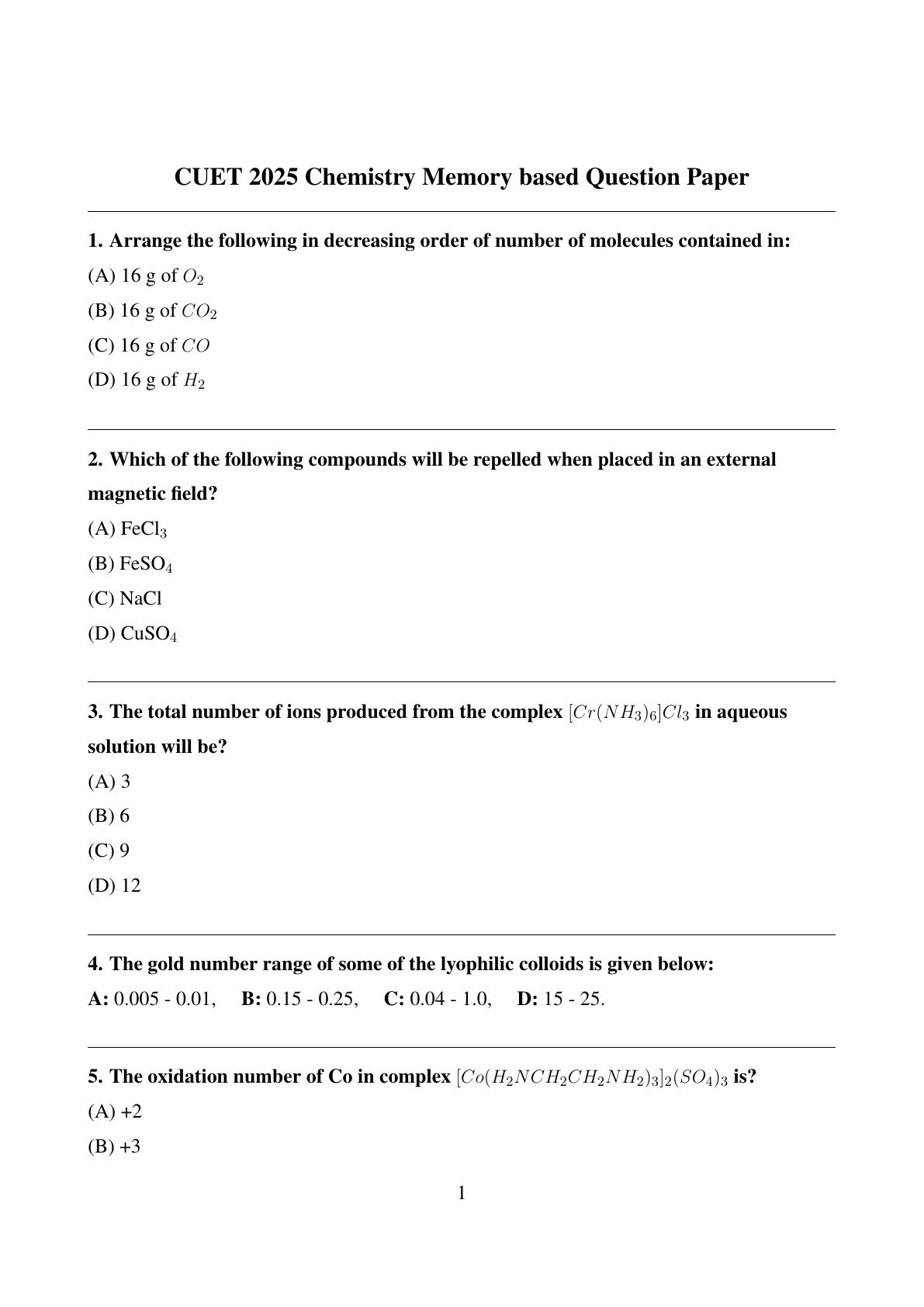
Arrange the following in decreasing order of number of molecules contained in:
Which of the following compounds will be repelled when placed in an external magnetic field?
The total number of ions produced from the complex \( [Cr(NH_3)_6]Cl_3 \) in aqueous solution will be?
The gold number range of some of the lyophilic colloids is given below:
A: 0.005 - 0.01
B: 0.15 - 0.25
C: 0.04 - 1.0
D: 15 - 25
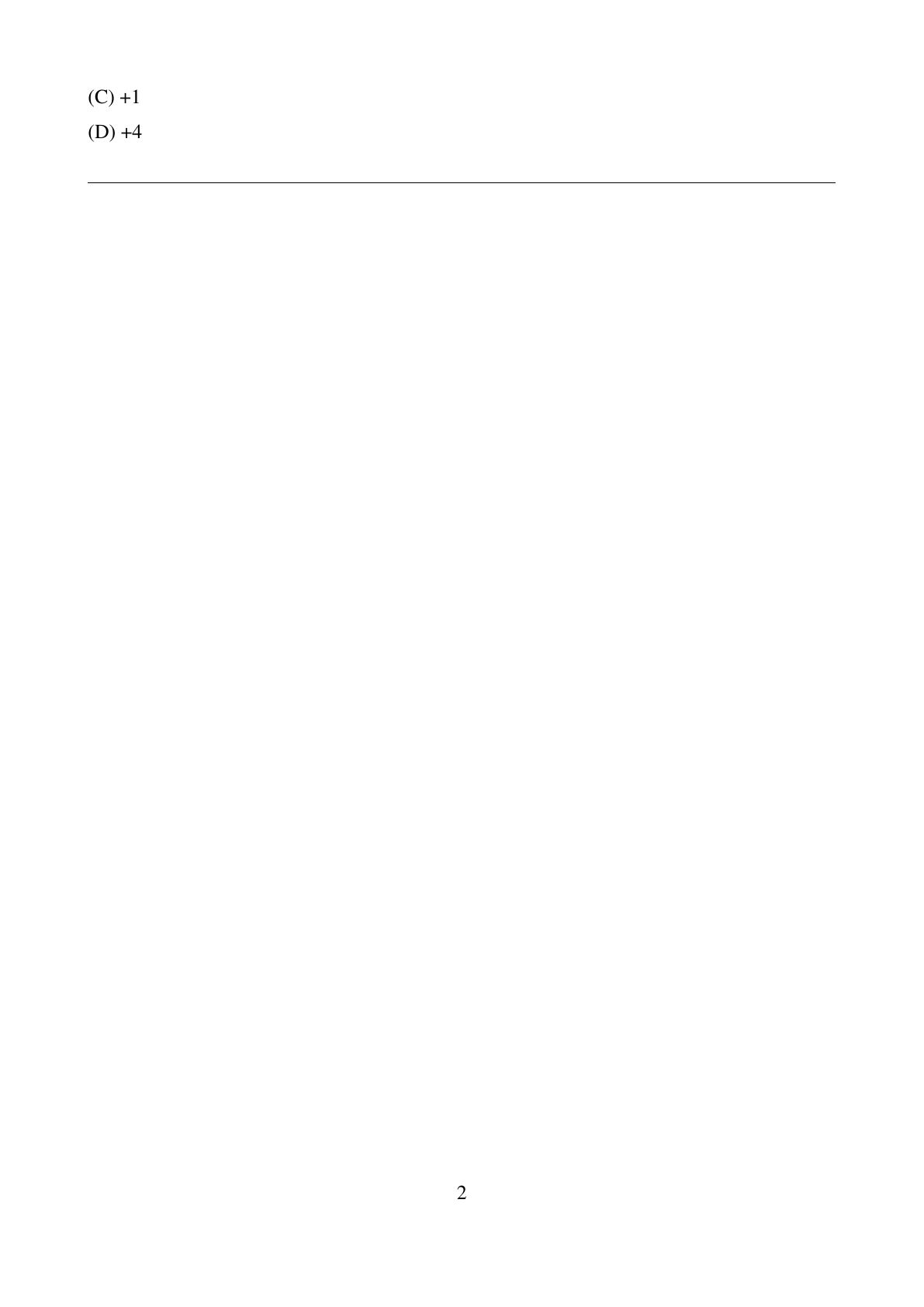
The oxidation number of Co in complex \( [Co(H_2NCH_2CH_2NH_2)_3]_2(SO_4)_3 \) is?
CUET Chemistry Exam Analysis (Expected)
The CUET Chemistry paper is expected to have 15-18 moderately difficult questions each from Physical and Organic Chemistry. Inorganic chemistry is expected to have 12-13 questions of easy to moderate difficulty, while 2-3 easy questions are expected from General Chemistry. The overall difficulty level for CUET Chemistry is expected to be Moderate to Difficult. You can check the paper analysis here after the exam.
| Section | Expected Difficulty | Expected No of Questions | Key Points |
| Physical Chemistry | Moderate to Difficult | 17-18 | - 50% numerical-based (e.g., Electrochemistry, Solutions)- 30% conceptual (e.g., Chemical Kinetics)- 20% application-based |
| Organic Chemistry | Moderate to Difficult | 17-18 | - 40% reaction mechanisms (e.g., Aldehydes, Ketones)- 30% name reactions (e.g., Clemmensen, Sandmeyer)- 20% stereochemistry- 10% practical-based |
| Inorganic Chemistry | Easy to Moderate | 12-13 | - 50% direct theory (e.g., d- and f-block elements)- 30% coordination compounds- 20% practical-based (e.g., salt analysis) |
| General Chemistry | Easy | 2-3 | - Covers Surface Chemistry, Polymers, Biomolecules- Mostly conceptual or application-based |
| Overall Difficulty Split | - Easy: 20% - Moderate: 50% - Difficult: 30% | 50 | - Mix of direct, tricky, and time-intensive questions- Numerical and mechanism-based questions are toughest |



Comments