




The CUET 2025 exam was conducted from 13th May to 3rd June. The CUET Physics Question Paper 2025 with Answer Key and Solution PDF is available after the exam. The CUET Physics was moderate to difficult in the difficulty level.
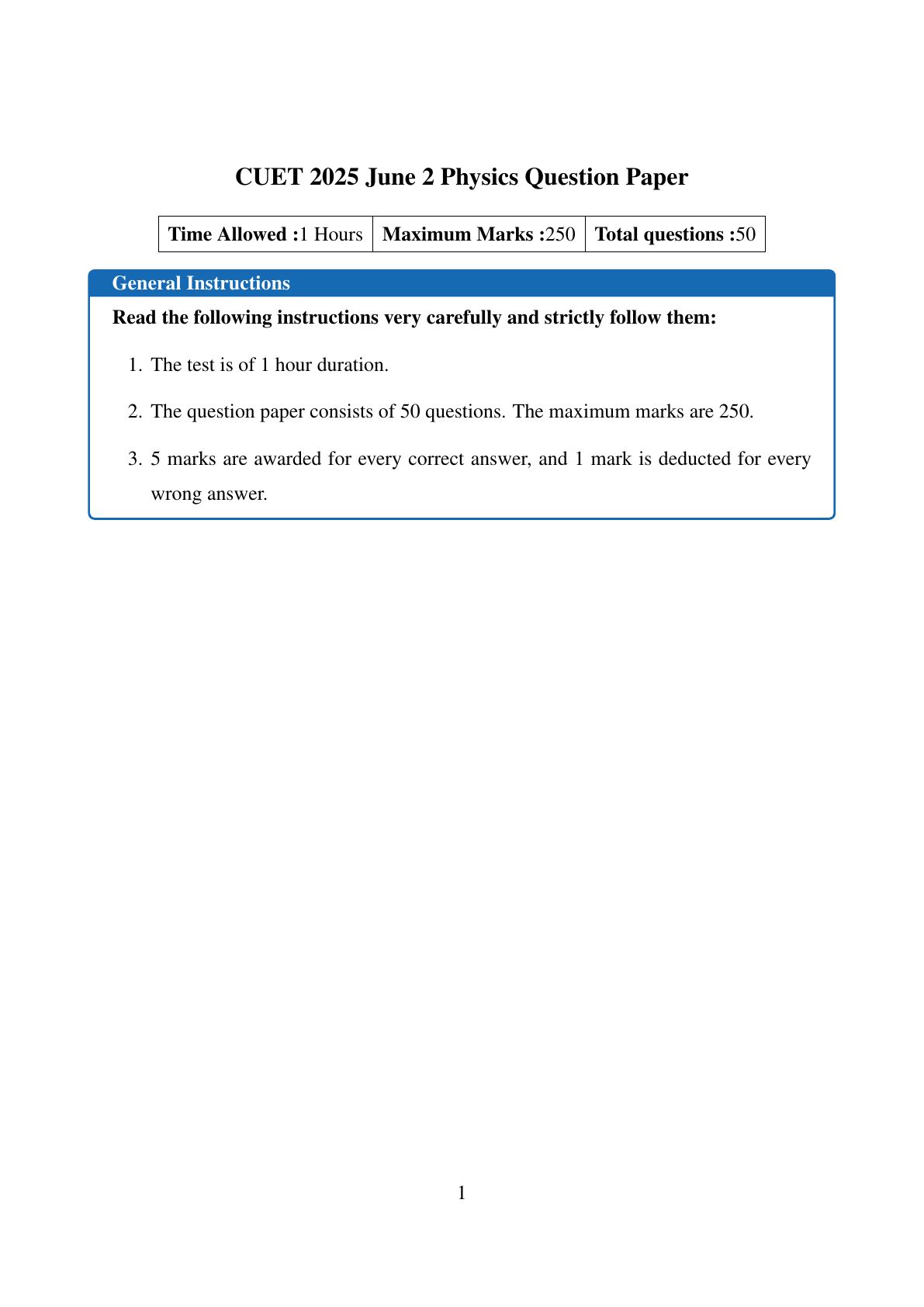
As per the exam pattern, the CUET Physics exam consists of 50 questions for 250 marks to be attempted in 60 minutes. 5 marks are awarded for each correct answer, and 1 mark is deducted for each incorrect answer.
Also Check:
CUET 2025 Question Paper with Solution PDF
CUET Physics Question Paper 2025 with Answer Key
| CUET Physics Question Paper 2025 |  Download Download |
Check Solution |
Question 1:
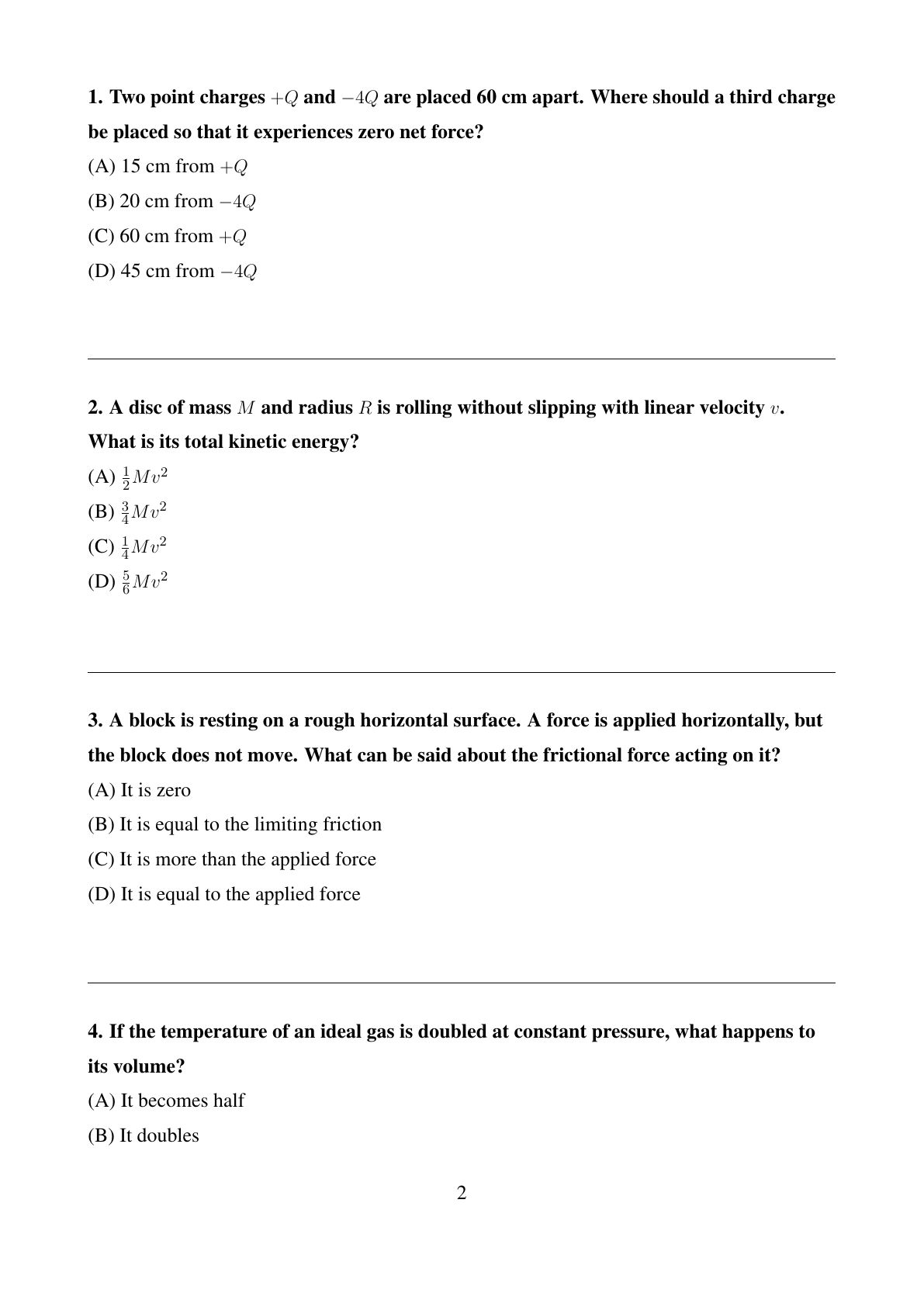
Two point charges \( +Q \) and \( -4Q \) are placed 60 cm apart. Where should a third charge be placed so that it experiences zero net force?
A disc of mass \( M \) and radius \( R \) is rolling without slipping with linear velocity \( v \). What is its total kinetic energy?
A block is resting on a rough horizontal surface. A force is applied horizontally, but the block does not move. What can be said about the frictional force acting on it?
If the temperature of an ideal gas is doubled at constant pressure, what happens to its volume?
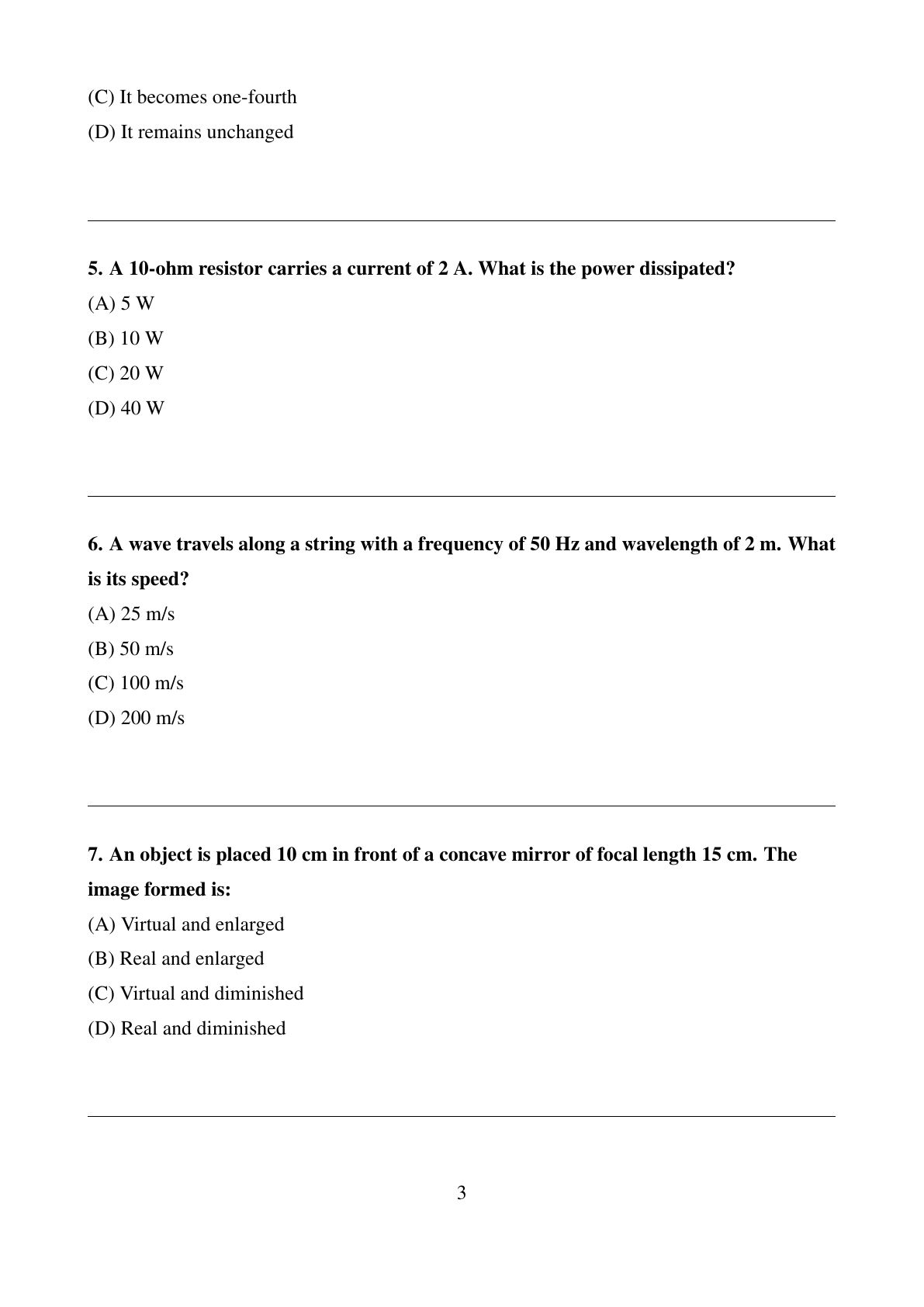
A 10-ohm resistor carries a current of 2 A. What is the power dissipated?
A wave travels along a string with a frequency of 50 Hz and wavelength of 2 m. What is its speed?
An object is placed 10 cm in front of a concave mirror of focal length 15 cm. The image formed is:
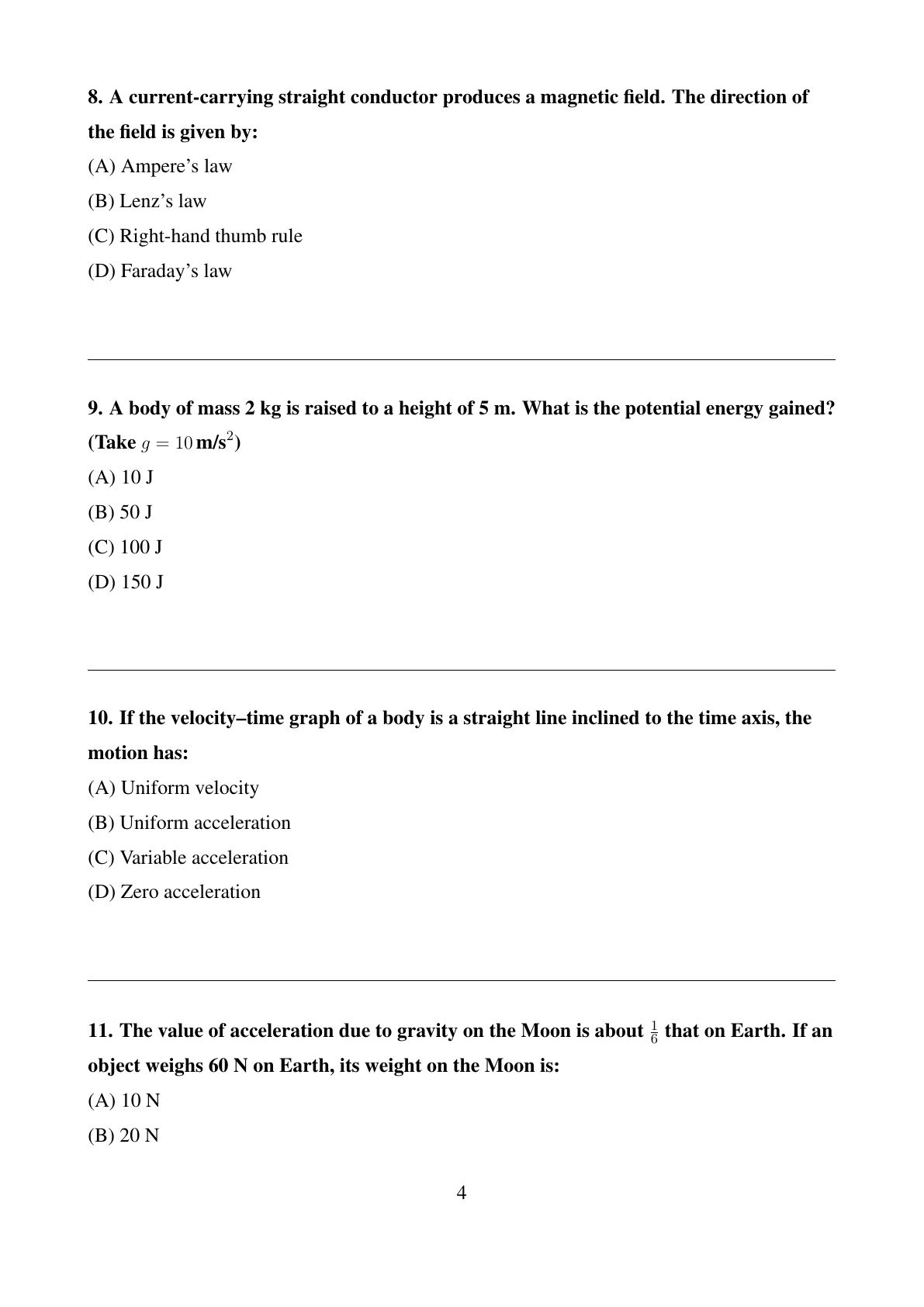
A current-carrying straight conductor produces a magnetic field. The direction of the field is given by:
A body of mass 2 kg is raised to a height of 5 m. What is the potential energy gained? (Take \( g = 10 \, m/s^2 \))
If the velocity–time graph of a body is a straight line inclined to the time axis, the motion has:
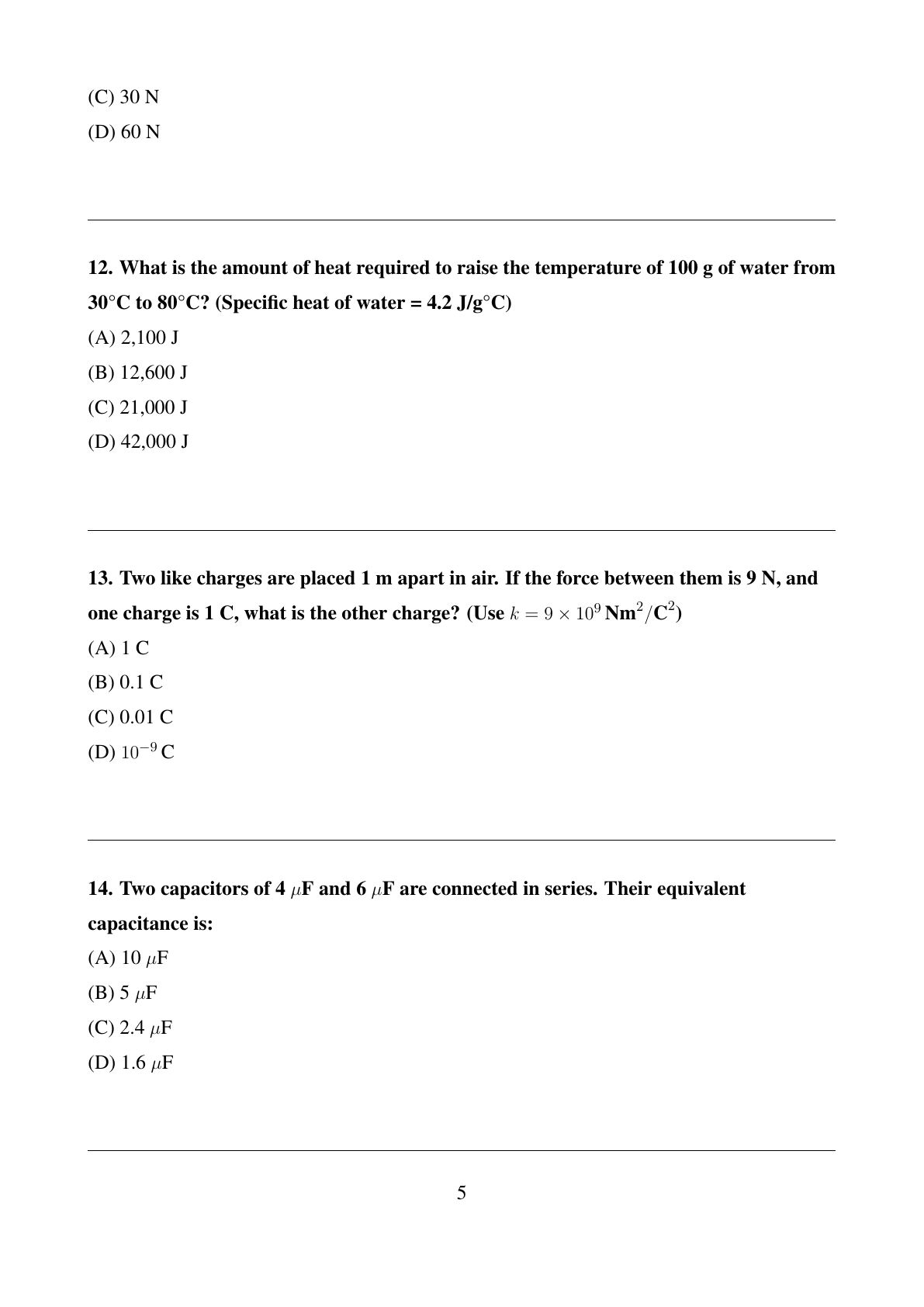
The value of acceleration due to gravity on the Moon is about \( \frac{1}{6} \) that on Earth. If an object weighs 60 N on Earth, its weight on the Moon is:
What is the amount of heat required to raise the temperature of 100 g of water from 30°C to 80°C? (Specific heat of water = 4.2 J/g°C)
Two like charges are placed 1 m apart in air. If the force between them is 9 N, and one charge is 1 C, what is the other charge? (Use \( k = 9 \times 10^9 \, Nm^2/C^2 \))
Two capacitors of 4 \(\mu\)F and 6 \(\mu\)F are connected in series. Their equivalent capacitance is:
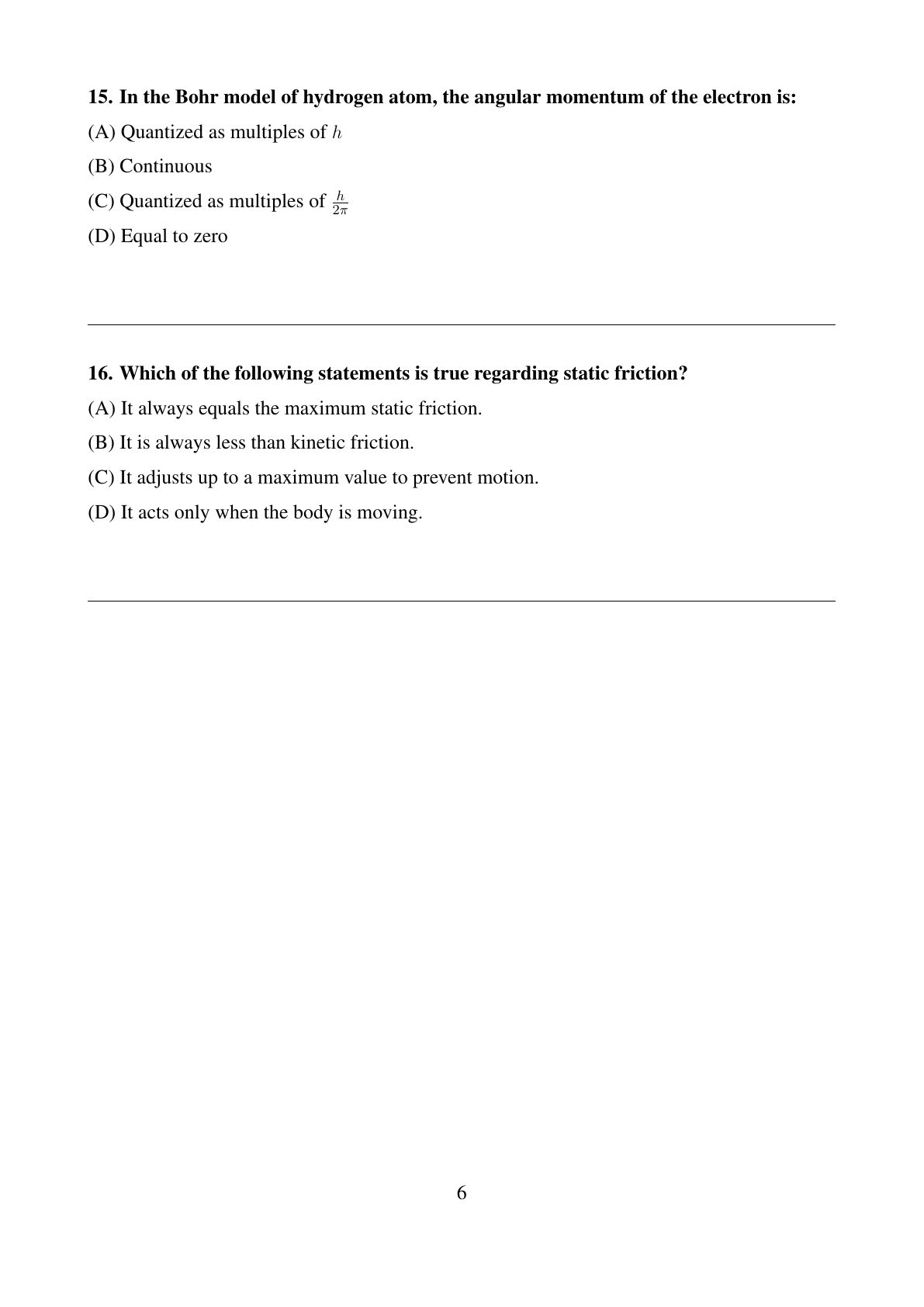
In the Bohr model of hydrogen atom, the angular momentum of the electron is:
Which of the following statements is \textbf{true} regarding static friction?



Comments